Barton turns community clinic into health center

By Kathryn Reed

Walking in the front door it’s like entering brand new doctors’ offices. Gone is the cramped, dingy reception area. Beyond the waiting area are exam rooms that while sterile in a good way, are welcoming.

And gone is the name. Barton Community Clinic is now Barton Community Health Center.

“It’s a better fit for what we provide,” Barton spokeswoman Monica Sciuto said of the new name.

Barton Health Care Center

Barton Health Care Center on South Avenue in South Lake Tahoe near Barton Memorial Hospital. Photos/Kathryn Reed

It was in 1989 that doctors Paul Rork, Greg Bergner and Martin started the clinic. Barton took over in 1995. Martin is the only one still directly involved with the clinic.

For the past year the clinic-health center has been going through more than just a remodel. It is now a 7,379-square-foot facility. An additional 3,000-square-feet was added to the existing structure. It went from 11 exam rooms to 18, which includes two procedure rooms.

The front door is on the opposite side of the building. The old front door is now the employee entrance. And what was the waiting room is a doctor’s office.

The doors on the $1.4 million renovation were opened last month, with the official dedication planned for July 27.

Debbie McCarthy, outpatient clinical director, came on board three months ago to head the facility. She also runs Barton Family Medicine.

She didn’t get to see what the old facility looked like, but she has heard plenty of stories.

Three hallways divide the care areas. The ob-gyn area is set off in its own area, with an entrance next to the main one. This is so if someone from the general population has chicken pox or something else contagious, the expectant mother will not come in contact with that person.

The reception is more professional then the old clinic.

The reception is more professional then the old clinic.

The plan is to provide services from day one of pregnancy through post partum. Other services are being talked about – like nutrition, adding a social worker, teaching how to breast feed and how to use a car seat.

With the state projecting a 40 percent increase in Medi-Cal patients when the Health Care Reform Act takes effect Jan. 1, Barton Community Health Center knows its numbers will go up as well.

Barton is already doing outreach to let people know about the changes that are coming because of the federal medical reforms, but also plans to do more to reach the community that today is uninsured.

The facility primarily serves the uninsured on the South Shore, along with those on Medi-Cal, Medicare or who have limited insurance.

The center is averaging about 1,200 patients a month, with 1,113 coming in May, the last month numbers are available. Demand for services has been increasing since January 2009. The clinic has treated 1,600 patients in a month.

To help with demand the center is open on Saturdays. But for now, no staff has been added. There are five nurse practitioners, two physician assistants, four registered nurses, two medical assistants, four technician-receptionists, and six receptionists. That would change if the patient numbers spike 40 percent.

(Some jobs are being reclassified as the health center approach is implemented. More training is taking place as needed.)

Exam rooms are new or completely remodeled.

Exam rooms are new or completely remodeled.

General practitioners come in, as well as specialists, plus there is a growing telemedicine component.

Going from clinic to health center, it’s less about giving a patient a pill and sending them home and more about education, prevention and follow-up consultations to cut down on repeat visits.

“It’s wellness focused, not illness focused,” McCarthy said. “As we get more people who will quality for insurance, we hope they will seek health care and focus more on prevention and a better quality of life.”

The medical home model is being looked at. It’s about whole care coordination. It’s about educating people about their disease, following up with them via telephone, and having an RN on call 24 hours to answer questions.

“Especially with chronic diseases you want quality of life,” McCarthy said.

While the center is operating as usual, a few things are still being ironed out. And it is clear the decorating is one of the last items to be addressed.

—-

Notes:

• Open house on July 27 from 9-11:30am, 2201 South Ave., South Lake Tahoe. There will be tours and free health screenings.

• Funding: Barton Foundation $137,441; Barton Memorial Hospital Auxiliary more than $1 million.

• Barton Health has information online about the Health Care Reform Act. People will be able enroll in the health care exchanges in California and Nevada in October.

Air quality station at LTCC to aid students, TRPA

By Kathryn Reed

An air quality station that is going to be installed at Lake Tahoe Community College by the Tahoe Regional Planning Agency is also going to have an educational component to it.

The college board at its meeting last week heard a presentation by a member of the bi-state regulatory agency about the station that will monitor visibility, ozone and meteorological data. The board is expected to vote on the MOU at the Aug. 13 meeting.

The two entities are entering an agreement to place the device behind the physical education building near the South Tahoe Public Utility District pump house.

Hazy skies in Lake Tahoe on July 14 are from fires outside the basin. A station at LTCC will soon be able to monitor the air quality. Photo/LTN

Hazy skies like these on July 14 in Lake Tahoe might be something the station at LTCC would soon be able to monitor. Photo/LTN

“To provide mutual benefit with LTCC, we will provide the Science Department with a web–based display of the meteorological and particulate sampling from the equipment,” Jeff Cowen, TRPA spokesman, told Lake Tahoe News. “The primary intent of the LTCC monitoring station is to gauge how the basin is doing in terms of regional and sub-regional visibility, which is a measure of particulate matter in the air from wood smoke and suspended soil.”

According to the July 9 LTCC staff report, “Graphic display of the monitoring data will include hourly, daily and historical air quality trends on a 32-inch LCD screen.”

TRPA used to have a monitoring station near Timber Cove in South Lake Tahoe. The agency has had a station at D.L. Bliss State Park since 1991, and also has facilities in Kings Beach, Tahoe City, Incline Village, Echo Summit and at its Stateline office.

Air quality is one of the thresholds in TRPA’s Compact.

The Tahoe Basin Regional Air Quality Monitory Program is a jointly managed by TRPA, California Air Resources Board, UC Davis, Desert Research Institute and the Environmental Protection Agency.

TRPA is responsible for paying for the installation of the station at the college as well as all operational and maintenance expenses. This includes installing power, telephone service and fencing.


Agencies linked to Nutting want funds restored

By Peter Hecht, Sacramento Bee

In the 375-page El Dorado County grand jury transcript of The People v. Raymond James Nutting, a prosecutor took aim at two checks that an official from an obscure local resource district co-signed on behalf of another agency.

Deputy District Attorney James Clinchard asserted the state fire prevention grant checks paid to Nutting in 2009 were evidence the four-term county supervisor was guilty of a felony conflict of interest.

Ray Nutting

Ray Nutting

Yet now, following the release of the grand jury transcripts, two El Dorado County resource districts – and a former official who co-signed the checks to Nutting – wonder about the prosecution’s assertions.

They question authorities’ theory of political corruption that connects Nutting’s grant income to his votes to fund two other local districts that handle conservation projects.

They contend the local resource districts have been unfairly tainted by the Nutting controversy and – as a consequence – have temporarily lost their county funding until the matter is sorted out.

“I want to assure you there is no collusion going on and no special favors,” said Al Hubbard, who served until 2012 on the Georgetown Resource Conservation District, a local board that pays state and county money to contractors for fire safety, water and habitat projects. “I can promise you that.”

Read the whole story


Odds favor previous Tahoe celeb golf winners

By Kathryn Reed

If the sportsbooks are right, there is going to be a repeat winner at this week’s American Century Championship golf tournament.

Dan Quinn, who has the won the tournament five times – including last year, is favored this year with the odds at 7:2. Seven-time winner Rick Rhoden is behind him with 4:1 odds. Three-time winner Billy Jo Tolliver has odds of 9:2 and two-time winner Jack Wagoner has 6:1 odds to win.

Sneaking in at fourth favored, though, is John Smoltz. He has yet to take home the trophy or $600,000 purse.

While there isn’t big action on the annual celebrity golf tournament, it can add another element of excitement to the event.

Odds makers say Dan Quinn. right, is favored to win the ACC tournament at Edgewood Tahoe. Photo/LTN file

Odds makers say Dan Quinn. right, is favored to win the ACC tournament at Edgewood Tahoe. Photo/LTN file

“A lot of celebrities will go in and bet,” John Packer, spokesman for Harveys-Harrah’s told Lake Tahoe News. And many are betting on themselves. Some joke about thinking the odds are not what they would have set for themselves.

“There are probably seven to 10 who could walk away with it any given year,” Packer said, which means special attention has to be paid to how the algorithms are used to configure the odds.

Those who follow the Lake Tahoe tournament that is now in its 24th year won’t be surprised to learn Charles Barkley is the least likely man to win. But at 500:1 odds, he is not alone. Trent Green, Jay Demarcus and Kevin Nealon have the same odds.

Packer says some people have joked that Barkley should be closer to 1 million to 1 odds to win.

But sometimes a rather long shot wins. Mario Lemieux was at 40:1 to win. He paid off big for some people in 1998 when he took home the title.

Phil Weidinger, who handles the public relations and a lot more for this tournament, put down $100 on Lemieux that year. He was watching from the pressroom as Lemieux was coming down the 18th green. That putt he sank put $4,000 in Weidinger’s pocket.

Weidinger isn’t revealing who he has money on this year.

Besides the straightforward bets, there is also one prop bet.

Quinn caddies for pro Ernie Els on occasion. While Quinn is in Tahoe, Els will be at the British Open. The odds they will both win July 21 are 85-1, while the odds that they will not are 1:105. The latter bet means for every $105 spent, the bettor could win $1.

The two won the respective tournaments in the same year in 2012 and 2002.

Like all betting odds, the numbers are subject to change before play begins.

—-

Notes:

• NBC will televise the 54-hole tournament live July 19-21. The sportsbook at Harveys will be airing it on multiple televisions.

• Wednesday is a practice round.

• Thursday is a celeb-am tournament.

• Tournament tickets (Fri-Sun) are $25; the other days are $15. Discount tickets available at Raley’s.

• More than 40,000 attended last year – which was a record.

• The tournament is played at Edgewood Tahoe in Stateline.

• For more info, go online.


More homes being built in fire-prone areas

By Felicity Barringer, New York Times

The death of 19 firefighters in Arizona recently highlights what has become a fact of life in the West: Every summer, smoke fills the big skies yet people continue to build in the places that burn most. More people live in these areas, and many balk at controls on how and where to build.

Just as many Easterners resist stepping back from their increasingly flooded coast, Westerners build where they want to build.

In a report last September, CoreLogic, a business analytics company, estimated that 740,000 homes in 13 Western states, with a total value of $136 billion, were at high or very high risk of burning up. Nationwide, Oregon and Wisconsin researchers found, 98.5 million people lived in 43.7 million homes in what is known as the wildland-urban interface or WUI (pronounced woo-ee) in 2010.

The sentiment that people should build where and how they choose is embedded in the Bitterroot Valley of western Montana, where a series of infamous 2000 blazes helped usher in the era of ever-more-dangerous Western wildfires.

In 2007, 254 houses burned and bout 3,100 acres -- mostly USFS land -- on the South Shore of Lake Tahoe. Photo/Lake Valley Fire

In 2007, 254 houses burned and nearly 3,100 acres — mostly USFS land — near South Lake Tahoe. Photo/Lake Valley Fire

Seventy houses were destroyed, and one flare-up left Becky Koon, a landscape designer and local school volunteer, briefly frantic over the fate of her 13-year-old daughter, who, oblivious to the sudden danger, was sunbathing at a friend’s house. The girls were rescued, and Koon has since tried to help people there lower their risk by reaching out with information about brush- and tree-clearing and other ways to make their homes safer.

But she remains frustrated. “It’s a mixed bag,” was the best she could say of the reception her neighbors in Ravalli County, Mont., had given her efforts. This is a county whose voters decisively rejected a proposal to initiate local zoning and that prides itself on its log cabins and a belief that government should stay out of people’s lives.

Almost 15,700 of Ravalli County’s 19,000 homes are built where fires are likely, according to 2010 data compiled by researchers at the University of Wisconsin and Oregon State University. That is nearly double the 8,062 houses in the same area in 1990. Currently, more than 32,000 of the 40,212 people in the county live in the WUI.

But Ravalli county commissioners refused to adopt new maps of this interface, in the face of objections from homeowners and real estate agents that it would depress property values, increase insurance rates and lead to regulation.

As Greg Chilcott, a county commissioner, said: “Regulatory intrusion is a concern. We have somewhat adopted the philosophy, in my mind, that informing citizens of the risk of their choices as to where they build their homes is what our job is — rather than regulating them out of their homes or away from their lands.”

Ravalli County’s resistance to controls either by governments or insurers is hardly unique among the Western states. In fire-prone areas of California, Colorado, Texas, New Mexico and Arizona, the increase in wildfires has been exacerbated by droughts driven by climate change, and beetle infestations that turn evergreen forests into red tree graveyards. But construction has continued apace.

“Up until 2006 to 2008, the trend accelerated,” said Roger Hammer, a sociology professor at Oregon State University who has studied the issue for years. He called the recession “a speed bump” that “isn’t going to change the trend at all.”

But some of the more heavily inhabited places have started to change. The fierceness of recent fires in places like politically liberal Boulder, Colo., and politically conservative Colorado Springs changed minds. This year, Boulder required fire-resistant construction materials in such areas. Colorado Springs used WUI maps as the basis for new controls on hillside construction.

And Colorado’s governor, John Hickenlooper, this year appointed two public-private task forces to look at the issue of how to deal with fire risks.

“One of the things we’re looking at is, should there be fee assessments if you’re living in that area, to support wildfire-fighting efforts?” said Kelly Campbell, a member of one of the commissions and a vice president of the Property Casualty Insurers Association of America.

Another, she said, is “if we are providing insurance at a rate that is less than the risk, are we encouraging development in an area we might not want to?” But she indicated that until recently the question of wildfire risks was low on the insurance industry’s agenda because fire losses make up perhaps 2 percent of total losses, and wildfires even less.

Some communities, like Ruidoso, N.M., have aggressively used state and federal grant money to inform residents — many there only in summer — about mitigating fire risks. The village has stringent requirements for construction and management of trees and brush.

“Some local communities are getting the word,” said Stephen Pyne, a historian and expert on Western fires. “But we’ve got 30-plus years of backlog, of communities that need to be retrofitted, where we have to go back in and put in building codes and zoning and create a fire-resilient landscape. We are not going to banish fire.”

Even in the wake of a tragedy like the Yarnell Hill Fire in Arizona, northwest of Phoenix, lessons about lessening risk “are not being learned,” said Ray Rasker, executive director of Headwaters Economics, a research group in Bozeman, Mont.

About 16 percent of wildland-urban interface has been developed, he said. “But we’re not even having a national conversation about the other 84 percent.” He added that “the reason that local governments are not responding and not restricting development is that they don’t bear much of the cost” of fighting the fires and cleaning up afterward. “The bulk is borne by the federal taxpayer.”

Indeed, in Ravalli County, Koon pushed to have residents thin out combustible trees and brush on their property. “I was amazed at how many people believe it’s the government’s job to do this,” she said. “… For some of the landowners, it’s summer property. They don’t do anything.”


July 4 South Tahoe fireworks debris washing ashore

By Maria Medina, CBS-13

Residents say they’re being forced to clean up the mess more than a week after a fireworks show at Lake Tahoe.

For more than a week, Joan Truxler’s filled bag after bag with fireworks debris left over from south Lake Tahoe’s Fourth of July show.

The first people to alert her about the trash washing up onshore were her grandsons.

“We were clearing out the area around us, and we were shocked and appalled,” she said. “So I continued to walk down the beach and found huge pieces of debris with wires attached to it, and the company’s name.”

The company that puts on the show, Pyro Spectacular, tells CBS13 they cleaned as much of the debris from the water soon after the show and the next morning, just like they do every year.

Truxler says she’s found debris from those South Shore fireworks along a quarter-mile stretch of this beach. But the company says this is the first time they’ve gotten this complaint after more than 30 years putting on the show.

“We spend about $3,000 to $5,000 on cleanup,” said Mike Frye with the Lake Tahoe Visitors Authority.

The group oversees the fireworks show, and Frye says they also hire the cleanup crew, including divers.

“It’s just something that’s never happened before.”

He says they’re working with Pyro and other agencies to figure out what happened this year, especially since the next fireworks show is less than two months away on Labor Day.

“We love the lake and want to take care of it.”

He says half of the debris they found was from Pyro, the other half from illegal fireworks.

But Joan says most of what’s washed up on shore is from the show.

“I was actually able to find their name on some of the debris,” she said. “I would challenge Mike Frye to come look at my debris. None of the agencies here have offered to come and extend a hand.”

The Lake Tahoe Visitors Authority wonders if strong winds that day are to blame, or if a net broke free.

They’re looking into fishing nets for the Labor Day fireworks show.

Meanwhile, the Tahoe Regional Planning Agency is investigating what went wrong.


Garden tour grows into colorful celebration

By Kathryn Reed

A 95-year-old house with a garden that had been certified by the National Wildlife Federation as a wildlife habitat and is on the national registry, a garden that flows into a golf course, one full of veggies, another with antiques that have become yard art to house flowers, some in full shade, others in full sun. A kaleidoscope of colors. A sea of green.

“Eye candy” is how one garden is described. “What is her secret?” someone asks about all those peonies.

One homeowner admits the slope of her yard means it’s 20 degrees cooler at the bottom – just one of her dilemmas. Two owners each have to contend with maintaining an acre of land – and not in a wild, Tahoe pinecone kind of way.

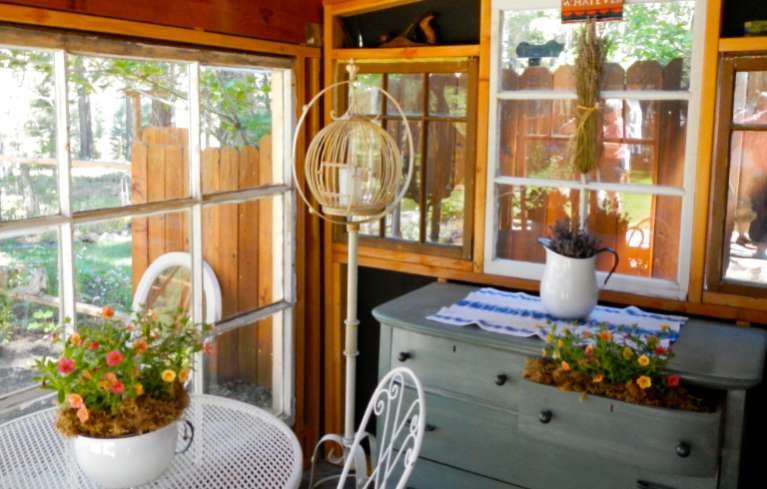
Known as the Tallac Shack because of the view of the mountain, this morning coffee or afternoon wine spot even has flowers in a dresser drawer. Photos/Kathryn Reed

Known as the Tallac Shack because of the view of the mountain, this morning coffee or afternoon wine spot even has flowers in a dresser drawer. Photos/Kathryn Reed

These nine gardens that will be featured July 27 on the Lake Tahoe Historical Society’s garden tour are some of the best ones from the past 10 years. All have been showcased once before. This is the 10-year anniversary edition of the tour.

Homeowners got to see the other gardens on Saturday, while organizers checked things out to make sure everything is ready for the annual event. This tour is the historical society’s No. 1 fundraiser. The 300 $25 tickets sell out each year.

It’s a mix of locals and out-of-towners who come each year. Locals like to see what is able to grow in Tahoe, and visitors make this the reason they come to town this time of year.

What grows is so much more than the native plants and wildflowers agencies talk about. Weeping cherry trees, Japanese maples, meadow rue and grapes are some of the less common items found along the tour.

“For our anniversary tour we tried to pick ones that were all a little different,” Catherine Whelan with the historical society told Lake Tahoe News. Her home, which was first on the tour in 2006, is one of the first houses to visit this year.

She grew up coming to Tahoe to visit her grandparents, and eventually the house became hers. Whelan said her grandmother would keep trying different things to see what would work. Now it’s like walking through a gate into a lush, shade-filled oasis.

Ann Rasmussen said when her home was on the tour in 2003 it was just after she and her husband, Gene, had remodeled. The yard had basically been a construction site. Today, it’s all about maintenance.

She points to the rock work on the house that is covered by the green in the garden. Now she wonders why they thought the rock was a good idea.

Each garden is unique, but many on this tour have views of Mount Tallac. And the owners – they all seem fit – which might prove gardening is a form of exercise. Even so, most gardens have multiple places to sit and enjoy the surroundings – proving it’s not all about working.

Notes:

• Tickets are $25; available at the museum (3058 Lake Tahoe Blvd., South Lake Tahoe) and at Aspen Hollow, Nels, Sunbasin and Tahoe Outdoor Living.

• Event is July 27, 10am-4pm.

• Barton Memorial Hospital’s gardens are the final stop.

ngg_shortcode_0_placeholder (Click on photos to enlarge.)


Study slams USFS for lack of trail maintenace

By Jeff Barnard, AP

GRANTS PASS, Ore. — Shane Krogen has no trouble finding retirees willing to spend a week in the wilderness grubbing out rocks and swinging a pick or shovel to bring a hiking trail back up to national standards.

The hard part is getting the U.S. Forest Service to come up with a few thousand dollars to buy the volunteers a T-shirt and feed them well, which is all it takes to keep them coming back for more.

“The Forest Service will fund us when they can, if they’ve got the dollars,” said Krogen, executive director of the High Sierra Volunteer Trail Crew in Clovis. “It’s just a matter of their budgets being cut drastically.”

Eagle Falls in Desolation Wilderness. Photo/LTN file

Eagle Falls in Desolation Wilderness. Photo/LTN file

A government watchdog agency has found that hiking trails on national forests suffer from a $314 million backlog in maintenance, with only a quarter of the 158,000 miles of trails meeting national quality standards.

“The Forest Service has more miles of trail than it has been able to maintain, resulting in a persistent maintenance backlog with a range of negative effects,” said the report from the Government Accountability Office.

Annual funding has lagged far behind the need. In 2012, for example, trails needed $523.7 million for maintenance, operations and capital improvements, according to the report, yet received only $81.9 million. The gap in 2006 was similar, with $509.1 million of need, but only $74.2 million in funding.

The report adds that the Forest Service relies heavily on volunteers to maintain trails, but does not take full advantage of them. While the Forest Service manual sets a goal of using volunteers, the agency has not established that as an expectation of trails managers, and training on working with volunteers is limited.

In 2012, the equivalent of 667 volunteers working full time did $26 million worth of work, the report said. The volunteer effort was equivalent to the 667 full-time Forest Service employees working on trails.

The national system of recreational fees does little to fill the funding gap. The Forest Service told Congress last month it collects $66 million a year, mostly from campgrounds, cabins and picnic areas. The law authorizing the fee expires in December 2014.

Jim Furnish is a retired Forest Service deputy chief for the forest system. He says the problem goes back decades, and results from the Forest Service and Congress making recreation a low priority, with a low level of risk when the work doesn’t get done.

“Part of the issue is the consequences of neglect are not seen as severe,” he added. “People can usually get where they’re going, just with difficulty.”

Forest Service Chief Thomas L. Tidwell said in his formal response to the report that the agency agrees with the GAO’s conclusions, and pledged to look for ways to close the funding gap and improve training. He said the growing need to fight wildfires and budget cuts both contribute to the problem.

Krogan said spending $600 for T-shirts and $2,000 for food will keep a crew of 50 volunteers working in the wilderness for five days. A paid crew would cost 20 times that.

Why would someone work so hard for so little?

“Most of us sit at a desk all week and at the end of the week have no tangible outcome for our effort,” said Krogen. “Whether they are cutting out a tree or building rock steps, they have a sense of pride and ownership. ‘Look what I was able to do, and I’ve never done this before. Now I’ll be able to come through here and remember this day for the rest of my life.'”


Bike ride is mostly about the Truckee River

By Kathryn Reed

TAHOE CITY – It was a bit like being on sensory overload.

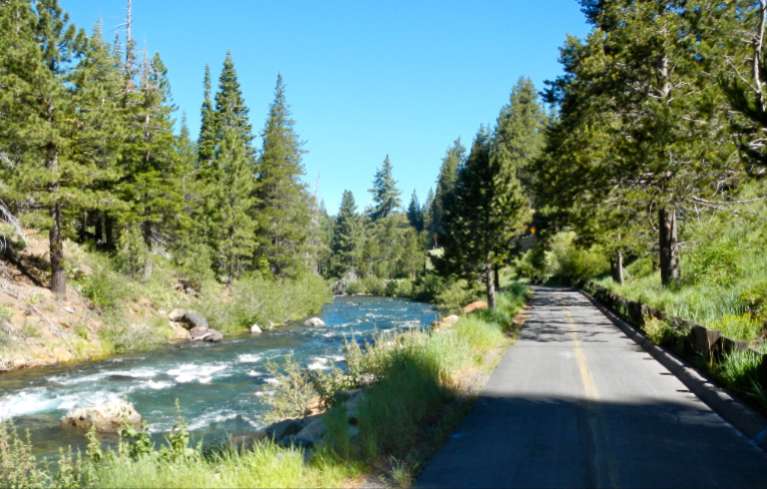
Endorphins are going with each rotation of the pedal. Sounds of the river rippling and people playing on it are inviting. The aroma of pines and other foliage make breathing deep desirable. The scenery – well, it’s breathtaking and challenges one to take pictures and ride at the same time.

Cycling the 8.03 miles from Tahoe City to Squaw Valley’s village is pretty easy – even for people who don’t often pedal. The most challenging part is avoiding all of the other people.

The four of us set out early to bypass the brunt of the heat on the last Saturday in June as well as the people. But this is a popular trail, so it’s impossible in the summer to have to the trail all to ourselves.

Besides the cyclists, some of whom were pulling children in trailers, people are jogging, walking (some with dogs), and others are on inline skates.

Much of the trail between Tahoe City and Squaw Valley is along the Truckee River. Photos/Kathryn Reed

Much of the trail between Tahoe City and Squaw Valley is along the Truckee River. Photos/Kathryn Reed

There are definite spots on the trail that are jarring, especially on a road bike with those skinny tires. And it’s obvious this is an old trail not built to current ASHTO standards that call for the trail to be 10-feet-wide with 2-foot shoulders. This one doesn’t seem much wider than 6-feet, if that. This plays into the congestion problem at times.

But most people are courteous and recognize this is a shared use trail.

Off to the side are interpretative signs that had we not been on bikes we probably would have stopped to read. There are also permanent maps that point out the various recreation amenities on this side of Lake Tahoe.

A few rafters are floating down the river on our way to Squaw. Coming back they seem to be everywhere. Some are part of a company that guides people and provides larger rafts, some brought their own for a group, while others are in individual blow-up devices. And some have floating coolers. One guy is on a stand up paddleboard going upstream.

Considering we are doing this ride on a weekend that has the temps well above normal, it’s great having so much shade.

We get to the junction of Highway 89 and Squaw Valley Road where a light has us crossing to go to the village. There’s something about staring at those Olympic rings, that flame – I never get tired of it.

The road up is wide, but the shade is gone. Beyond the Resort at Squaw Creek the bike trail is on the left.

That meadow with Squaw Creek and the Resort at Squaw Creek’s golf course just beyond are so lush. And Squaw – the mountain – in some ways I feel like I am back riding in Switzerland. While the Alps and Sierra are so different, Squaw is the one place in the Tahoe area that even comes close.

Stay on the “wrong” side of the road for a short jaunt and then follow the parallel blue lines that lead cyclists into the village. At that hour of day we all opted to get smoothies as a refresher, lounging in chairs in the village. Bike racks seem to be outside most of the businesses.

Then it was time to get back on the saddle to head out. We retrace our steps out of Squaw and along the river.

We cross our starting bridge and ride through the two roundabouts that are just for bikes or pedestrians, and wind up at the Bridgetender restaurant in Tahoe City. It’s a perfect spot next to the Truckee River to refuel for the rest of day’s activities.

—-

Getting there:

From South Lake Tahoe, go north on Highway 89. Just before the Fanny Bridge in Tahoe City is the transit center parking area on the left. Pull in and park.

The bike trail is on the north side. Cross the bridge, go left and keep pedaling.

The trail comes out at a light to cross Highway 89 to be able to ride up to the village at Squaw.

The transit center is also an area from which the Tahoe Rim Trail may be accessed as well as the Truckee River. Plus, it’s a place to park – for free – that provides walking access to Tahoe City.

ngg_shortcode_1_placeholder (Click on photos to enlarge.)


Study: Americans living longer, but are less healthy

By Ron Winslow, Wall Street Journal

Americans are living longer than they did two decades ago, but they are losing ground on key measures of health to people in other developed nations, a study shows.

The findings, from the most comprehensive analysis of the health of the U.S. population in more than 15 years, show progress in reducing death rates, adjusted for age, across a variety of diseases. But death rates from illnesses associated with obesity, such as diabetes and kidney disease, as well as neurological conditions like Alzheimer’s disease, are on the rise.

Meanwhile, the number of years of living with chronic disability, an indicator of quality of life, rose for the average American in the past 20 years, partly reflecting increased longevity.

Despite gains in longevity, Americans are living the extra years “not necessarily in good health,” said the researchers, led by Christopher Murray, director of the Institute for Health Metrics and Evaluation at the University of Washington in Seattle.

The study was published Wednesday by JAMA, the Journal of the American Medical Association. Murray also presented the results, along with separate reports on physical activity and obesity in counties across the U.S., at a White House event hosted by first lady Michelle Obama as part of her campaign against childhood obesity.

Murray said the U.S. has also made important headway against such problems as strokes; certain cancers, including colon and breast cancers; and HIV, the virus that causes AIDS. “It’s important to recognize that there are some areas where we do well,” he said.

With annual health-care outlays in the U.S. totaling nearly 18 percent of gross domestic product, according to federal data, outside experts cast the study’s findings in economic terms.

“Despite a level of health expenditures that would have seemed unthinkable a generation ago, the health of the U.S. population has improved only gradually and has fallen behind the pace of progress in many other wealthy nations,” said Harvey V. Fineberg, president of the Institute of Medicine, in an editorial accompanying the report. The IOM advises the government on health matters.

In every measure examined, including life expectancy and quality of life, Fineberg said, the U.S. ranking fell among the 34 members of the Organization for Economic Co-operation and Development, a think tank for developed countries.

Michael Roizen, chief wellness officer at the Cleveland Clinic in Ohio, said the findings put the U.S. at a disadvantage in the global job market. But he said much of the problem could be addressed by better diet, smaller food portions, increased physical activity, quitting smoking and better management of stress. “They are things we totally have control over,” he said.”It’s a matter of us getting serious about this.”

The analysis was based on data for 291 diseases and 67 risk factors for disease, as well as a variety of government-sponsored health surveys. It included data from 187 countries, making it one of the most ambitious efforts undertaken to assess the disease burden not only in the U.S. but around the world.

In the U.S., life expectancy rose three years to 78.2 years in 2010 from 75.2 in 1990, researchers found. But the nation’s ranking among OECD countries fell to 27th from 20th 20 years earlier.

A doctor examines a patient in Miami earlier this year. Life expectancy in the U.S. rose three years to 78.2 years in 2010 from 75.2 in 1990.

Moreover, people were in good health, or without short- or long-term disabilities, for just 68.1 of those years on average, the report found. The gap of 10.1 years between total life span and a healthy life span rose from 9.4 years in 1990, and the U.S. ranking for a healthy life span fell to 26th from 14th two decades ago.

Despite progress on cardiovascular disease and some cancers, the lead causes of premature death in the U.S. remained heart disease, lung cancer and strokes. Leading contributors to disability were lower-back pain and other disorders of muscles, nerves and joints, as well as depression and anxiety.

While many chronic disabling conditions play only a limited role in premature death, they are major drivers of health-care costs, Dr. Murray said. “We are not very good at preventing them or curing them and only mildly good at treating them.”

Researchers also found that poor dietary habits have overtaken smoking as the most important risk factor associated with years of life lost to disability and to premature death.

Findings from the county studies presented at the White House show a substantial increase in physical activity, including in Kentucky, a state that traditionally has trailed in healthy living habits. But over 20 years, he said, not one county in the U.S. reduced the burden of obesity among its residents.

For Sister Donna Hawk, who left a job as a hospital chaplain at the beginning of this year, the link between longer life and potential disability came into focus when she recently turned 70. Her father died just before turning 70, having had two open heart surgeries, and other family members had similar problems. She herself has seven stents in her heart, and had been overweight.

“So I’m thinking in their older age, they weren’t as healthy as they wanted to be,” she said. “I feel like I have a few good years ahead of me and I wanted to take care of myself in such a way that I could enjoy myself.”

She has lost 25 pounds in the past year, partly through a program at the Cleveland Clinic. She has improved her cholesterol, has started a plant-based diet and has begun exercising regularly.

“I’m not ready to go yet,” she said.