Study: Gene mutation linked to obesity

By Elizabeth Lopatto, Bloomberg

A genetic mutation linked to obesity in mice can cause weight gain without overeating, a discovery researchers at Boston Children’s Hospital say suggests the gene may govern how the body uses energy.

Mice altered to silence the gene, called Mrap2, had to be underfed by 10 percent to 15 percent to keep their weight gain as low as normal mice, according to the study released yesterday in the journal Science. An analysis of 500 people found the equivalent human gene mutation in four people with severe, early onset obesity.

The mutant mice grew to twice the normal size and the weight gain was exaggerated further when they ate a high-fat diet. The finding suggests the body’s mechanisms for energy use and weight gain among some obese people may be different than among skinnier peers.

“These mice aren’t burning the fat, they’re somehow holding onto it,” Joseph Majzoub, the chief of endocrinology at Boston Children’s Hospital and a study author, said in a statement.

Of the 500 obese humans whose genes were sequenced, the four people with the mutation had become obese at an early age. Only one had a mutation that totally disabled the gene. That suggests the mutation induced in the mice is responsible for less than 1 percent of the obese population.

Obese people have too much body fat, which increases the risk of diabetes, heart disease, stroke, arthritis, and certain cancers, according to the National Institutes of Health. Obesity is calculated using body mass index, which is measured by height and weight. A person with a BMI higher than 30 is considered obese. That means a person who stands 5 foot 9 inches is obese if he or she weighs 203 pounds or more.


Nutting wants all charges to be dropped

By Kathryn Reed

Ray Nutting, his attorney and supporters believe the felony and misdemeanor charges brought against the El Dorado County supervisor should be dropped.

Nutting didn’t say a word during his arraignment Monday in El Dorado County Superior Court in South Lake Tahoe. Before the hearing he sat with his wife and cadre of supporters, getting up at times to confer with his attorney, and mostly looking sullen.

Instead of entering a plea, defense attorney David Weiner told Judge Tim Buckley that he intended to file a 995 and a demurrer.

The legal proceedings challenge whether there is enough evidence to try Nutting and essentially ask for the case to be dismissed.

Ray Nutting, back left on phone, with wife, Jennifer, wait with supporters July 22, while his attorney, David Weiner, left foreground, goes over paperwork. Photo/Kathryn Reed

Ray Nutting, back left on phone, with wife, Jennifer, wait with supporters July 22, while his attorney, David Weiner, left foreground, goes over paperwork. Photo/Kathryn Reed

Weiner has until Aug. 15 to file the paperwork. The prosecution has until Sept. 9 to respond to it. Buckley will hear both issues on Sept. 20 in South Lake Tahoe.

“We are aware of the negative impact on the county and related government entities with this case hanging around,” District Attorney Vern Pierson told Lake Tahoe News. “We are doing everything we can to move it along as expeditiously as possible.”

Nutting, 53, faces four felony counts regarding money he received from the state to clear brush from his 350-acre ranch on the West Slope. (His brother owns an adjacent 350 acres.) He is accused of not reporting the money and voting on contracts that affected him monetarily.

After those charges were leveled in May, the district attorney and state Attorney General’ Office filed seven misdemeanor charges against Nutting regarding how he got his $55,000 in bail money. He is accused of taking loans from county employees.

The bail was the subject of most of Monday’s hearing because Weiner wanted his client to be released on his own recognizance. The state said the $55,000 bail should remain in place.

Buckley said the money for the bail should be returned to the people it came from and that Nutting would have until Friday to post a reduced bail of $20,000.


Pilot dies in S. Tahoe plane crash; 1 person survives

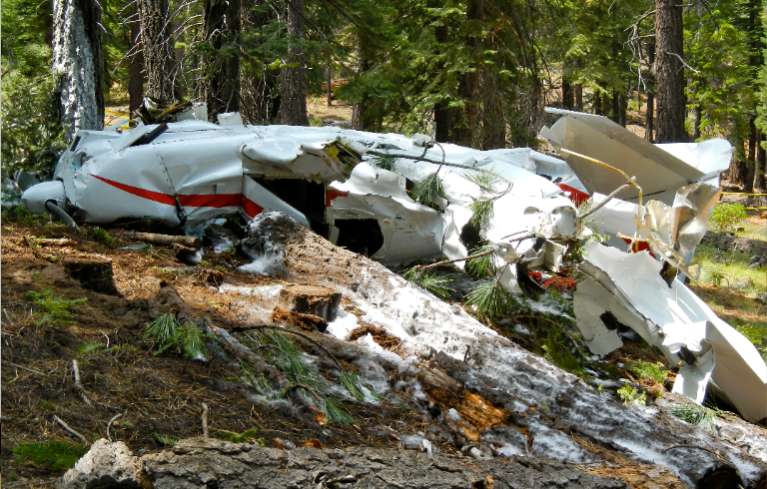
One person died, one survived after this plane crashed July 22 near South Lake Tahoe. Photo/Kathryn Reed

One person died, one survived after this plane crashed July 22 near South Lake Tahoe. Photo/Kathryn Reed

Updated 4:25pm:

By Kathryn Reed

The 67-year-old pilot of a single-engine plane crashed moments after taking off Monday from Lake Tahoe Airport.

Steven Lefton’s  wife, Karen Lefton, was the lone passenger of the 1963 Mooney. She was conscious when Calstar airlifted her from the meadow near Golden Bear to Renown Medical Center in Reno. She is expected to recover from her injuries.

The Palo Alto couple arrived at the South Lake Tahoe airport on July 18. They were taking off about 11:15am July 22 when the plane banked to the right, lost altitude and crashed in a wooded area about three-quarters of a mile to the east of the airport.

“It’s a fairly powerful plane, but on a hot day like this it’s fairly easy to lose density altitude and have problems,” El Dorado County sheriff’s Lt. Pete Van Arnum told Lake Tahoe News.

Another plane in the area saw the four-seater flying low and heard the crash. Then the jet picked up the emergency beacon signal of the downed plane. From there Calstar was able to locate the crash site from the air.

The plane crashed into trees and flipped. It was resting upside down in a crumpled heap.

Beth Frisby, a flight nurse with Calstar, was the first person on the scene because she was on a walk in the area. She called her husband, EDSO Deputy Damian Frisby, who was able to track her location via GPS on the phones.

The plane was still running when Frisby came upon the crash site.

She was assessing the occupants of the plane as crews arrived.

“A lot of fuel was leaking, so we were concerned when we got here,” Van Arnum said.

He said it was lucky the plane did not explode or cause much of a fire.

Investigators from the Federal Aviation Administration arrived within hours from Reno and National Transportation Safety board are expected Tuesday from Seattle. Guards will be onsite until investigators are done and the plane can be hauled away.


Parents expect to spend less on school supplies

By Megan Kowalski, USA Today

Despite higher prices for back-to-school needs, students and parents will spend nearly 8 percent less this season than in 2012, according to a survey out Thursday from the National Retail Federation.

Parents will save by shopping earlier for sales, shopping online and by having children re-use items bought in last year’s booming back-to-school season, the NRF says.

Average back-to-school spending will be $635, down from last year’s average of $689, the NRF says. Back-to-college spending also will shrink this year, the NRF says, to an average of $837 for supplies — including apparel, electronics and dorm furnishings — down from $907 last year. It estimates total U.S. spending will be $26.7 billion.

The back-to-school drop comes despite a 7.3 percent increase in the cost of school supplies, fees and activities estimated by Columbus, Ohio-based Huntington Bank’s annual “Backpack Index,” also out Thursday.

The cost of back-to-school shopping could increase 36 percent from last year if students add a midprice $300 tablet to purchases, according to the Backpack Index.

A new study from educational services company CourseSmart found 35 percent of college students now own a tablet, up from 7 percent in its 2011 survey.


Thunderbird Lodge — a glimpse into old Tahoe

By Kathryn Reed

INCLINE VILLAGE – Along the East Shore of Lake Tahoe is one of Nevada’s most famous houses that belonged to a man few have heard of.

The Thunderbird Lodge was George Whittell’s escape from the world and especially people.

And while Howard Hughes and William Randolph Hearst Jr. were his peers – especially in terms of wealth – Whittell did not leave a legacy like those men did. He was a bit eccentric and liked to keep to himself.

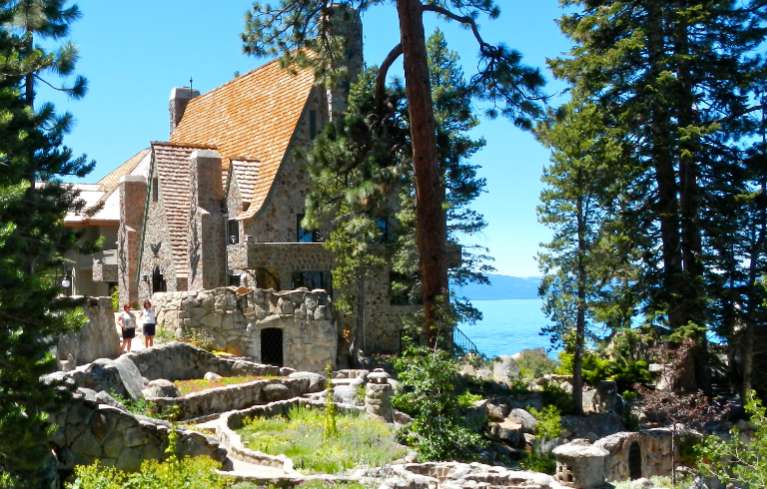
What he left is a swath of undeveloped land along with a house made of native wood and rock that sits on a pristine piece of Lake Tahoe shoreline.

The Thunderbird Lodge in Incline Village is open for tours throughout the summer. Photos/Kathryn Reed

The Thunderbird Lodge in Incline Village is open for tours throughout the summer. Photos/Kathryn Reed

Whittell was born into San Francisco money and never had to work. He did serve in World War I.

Against his parents’ wishes he joined the Barnum and Bailey Circus. His love of big animals continued long after that stint. He had a barn built at Thunderbird for his elephants that had Dutch doors so they would have a lake view. There was even a fireplace to keep them warm.

But the climate in and elevation of Tahoe didn’t suit these animals; so back to his Woodside estate they went.

Bill the Lion, though, was known to roam the grounds in Tahoe. And stories are that overnight guests might wake to a big kiss from the wild cat.

At one point Whittell owned 40,000 acres on the Nevada side of Tahoe that included 24 miles of shoreline. After the 1929 stock market crash the Carson & Tahoe Lumber and Fluming Company and other landholders needed cash. Whittell was able to buy much of it for 6 cents an acre.

His property went from the state line on the North Shore to Zephyr Cove. That is how Whittell High School got its name.

Construction on the estate began in 1936. In the 1980s Jack Dreyfus bought the property and added on. However, at the time the Tahoe Regional Planning Agency said the construction could not be historical in nature. That policy has been reversed, and if the addition were built now, it would have to match the original architecture.

Having the building be of two distinct time periods allows the visitor to know what is old and what is new. Part of the new is built on top of what was a deck for Whittell.

The old is not so spectacular inside – especially the living area. What is interesting is the long tunnel that is rock lined that has a couple escape routes. One is to the game room. Docents said Whittell would disappear from poker games if he were losing.

A small, dark room in the tunnel is not on the plans for the house. Samples of the soot from the ceiling revealed this was where opium was smoked.

The tunnel also leads to the boathouse where the Thunderbird yacht is moored.

In 1939, John Hacker, a Naval architect, designed the vessel to resemble Whittell’s personal DC-2 aircraft and his many Duesenbergs automobiles. It has two vintage V-12 Allison Aircraft engines. Jet fuel is available at the Tahoe City Marina.

When first built the Thunderbird cost $87,000. That is about $3.3 million in today’s dollars. It is 55-feet long and made of Honduran mahogany.

To charter the boat it costs $5,000 an hour. It gets one-quarter mile per gallon.

Today the Thunderbird Preservation Society owns the estate, which includes about 6 acres, the house and five cottages, and the yacht.

Susan Grove, lodge manager, said the society is trying to change its image from being elitist to being more inclusive. One way to do that is to create a $20 million endowment ($6 million is in the bank) so from that pot the annual expenses could be paid. She said it costs $1 million to maintain the site, the boat, pay off the loan on the boat and pay the few employees. (Most of the work is done by volunteers – even the executive director works for free.)

The Dreyfus side of the estate is where the bulk of the fundraising events take place – from cocktail parties for society members to weddings to winemaker dinners. This room is what was their great room. Walls of windows look onto the shimmering lake.

Docents said the Dreyfuses never spent the night at the house because they believed it was haunted.

The Dreyfus kitchen has been changed a bit so it is a working commercial kitchen. The Whittell kitchen looks much like it would have decades ago with the old appliances. But it was functional, with an island that has a marble top.

Earlier this month the original fountain was finally restored at a cost of $300,000. But what remains is an odd looking addition from the Dreyfus-period.

“It’s expensive to keep things up. We want to do things historically accurate,” Grove told Lake Tahoe News.

Whittell had three wives, but no children. When he died in 1969 he left the bulk of his estate, which was valued at more than $300 million, to animal rights organizations.

It was in 1999 that the preservation society got the Thunderbird Lodge. Tours began in 2002.

—–

Notes:

• Tours are $39 if starting by land. There are also tours via the old Tahoe out of the Tahoe Keys Marina and kayak tours starting in Tahoe City.

• Tours are May-October.

• More info is online.

• The Thunderbird Yacht will be at South Tahoe Wooden Boat Classic at Tahoe Keys Marina July 26-27. More info is online.

ngg_shortcode_0_placeholder (Click on photos to enlarge.)


Tolliver wins ACC in 3-hole playoff

Billy Joe Tolliver on July 21 won his fourth ACC tournament. Photo/LTN

Billy Joe Tolliver on July 21 won his fourth ACC tournament. Photo/LTN

It took a three-hole playoff Sunday to determine the winner of the American Century Championship golf tournament.

Two former NFL quarterbacks Mark Rypien and Billy Joe Tolliver vied for the title, with Tolliver coming out on top on the third hole. Each has won the celebrity golf event before – Rypien in 1990 and Tolliver in 1996, 2005 and 2010.

“He is pretty good around the greens. He is pretty good with the wedges. He is just streaky with the putter. But when he is good with the putter, he contends, and he did that this week,” Roger Maltbie with the Golf Channel said of Tolliver.

This is first time since the tournament went to the Stableford scoring in 2003 that a playoff was necessary and the first time in the 24-year history that a playoff needed more than one hole.

Rypien finished second last year, too.

 — Lake Tahoe News staff report


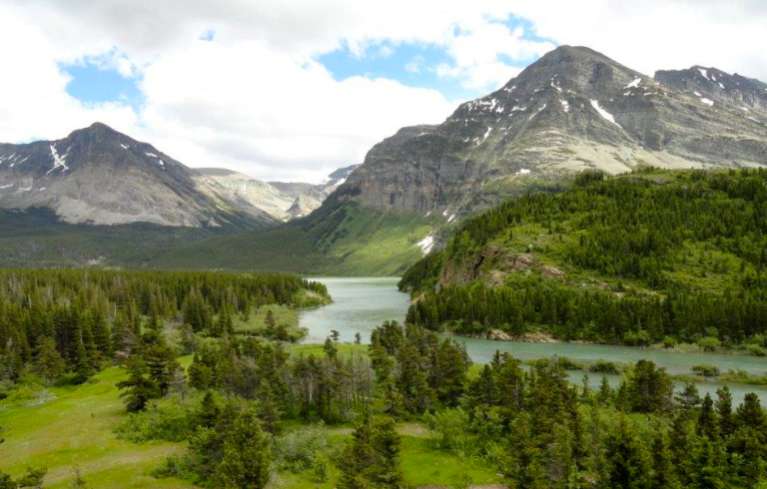
Glacier Park’s majesty slowly melting away

Many Glacier Valley  Photos/Robert S. Wood

Many Glacier Valley
Photos/Robert S. Wood

By Robert S. Wood

GLACIER NATIONAL PARK – It was shocking to learn that the last of famous Glacier Park’s hundreds of glaciers will be dead and gone in as little as seven years. With an extra month of summer on our hands, it seemed a good time to go up and have a look at the mere 25 moving ice fields that remain in the park. My wife Deanne and I were also curious to see how the northern Rockies stack up against our home mountain turf of Tahoe, Desolation and Yosemite.

Cruising the Web, then following up by phone, we discovered that would-be visitors customarily make Glacier reservations a year in advance at the few big old lodges inside the park. All we could unearth on short (two week) notice were three nights at Lake McDonald on the southwestern side of the pass and five nights at Many Glaciers — now more aptly nicknamed “Few Glaciers”– on the northeastern side.

But we were warned that snowplows were still working on Logan Pass and it wasn’t scheduled to open until the day we arrived.

It was a gamble, but nothing else was available this year. Basically, the short summer season up in northern Montana’s high Rocky Mountains is just July and August, as snow returns in September. At least we’d see the peaks at their prettiest, under a full mantle of snow. So we booked the rooms starting June 21 and consulted our maps, wondering how best to sample and hike a million-acre park, called the “Crown of the Continent,” in just nine days — some of it still under snow.

Snowmelt on towering Triple Divide Peak, we learned, can drain to the Pacific, the Arctic and the Gulf of Mexico.

Further research revealed that four of Glacier’s lakes offered inexpensive boat trips in ancient launches that ended at multiple wilderness trailheads on the lake’s far shore — and all of them were just beginning operation — reminding us of boat access to Desolation Wilderness via the Echo Lakes water taxi.

So we pre-booked trips on three of these launches to form the core of our park explorations, hoping we could get over the snowy pass to reach them. Otherwise, we’d have to circle around outside the park. We also allotted half a day to visiting Glacier’s adjoining sister park just across the Canadian border. Jointly the two comprise the Waterton-Glacier International Peace Park, the first of its kind.

Our next consideration was how to get to Glacier from Tahoe. Highway maps revealed that it looked like three days driving — each way. That would double the length of the trip, with all the substantial attendant costs of gas, motels and food. But air connections on Delta turned out to be excellent, so we decided to spare the old Subaru and fly and rent a car, arriving fast and fresh. Using past accumulated air miles — even with a $350 Dollar rental car bill — for us it was also cheaper.

After spending the night in Reno, we took a 6:30am flight to Salt Lake City, then transferred to a flying cigar that took us to Kalispell, Mont. There we got upgraded to a new Subaru and were driving into the park before noon, with the afternoon still before us. At the visitor center we learned that Logan pass had just opened and people were happily skiing and snowboarding on the high trails of the famous “Going to the Sun” pass road. Though the pass was a mere 6,600 feet in elevation, it commonly was buried under 50 feet of snowpack — quite a change from the central Sierra.

The detailed one-page park trail map, with good directions, revealed a nearby network of forest trails that looked inviting, part of it ascending the booming McDonald River above the misty lake, so we dropped our bags at our cabin and hit the trail, hoping to get in a walk before threatening clouds unloaded. The thick forest was primarily Englemann spruce and so mossy (and muddy from recent rain) that it reminded us more of Muir Woods in the coastal redwoods than the Sierra, with Spanish moss festooning conifers. The other Glacier forest trees are Arctic fir, quaking aspen and the familiar lodgepole pine. Spectacular wildflowers, featuring the white plume of native Bear Grass, emerged just days after the snow melted.

The thundering river, dwarfing most Sierra streams, was bank-to-bank white water. At every trailhead was a sign solemnly warning “You are entering Grizzly Bear country” mentioning danger, no guarantee of safety, and that hikers had been killed by bears, etc. Many of our fellow walkers wore little bells in hopes of warning wandering bears of their presence. Startling or surprising Grizzlies was severely warned against. Other hikers made a practice of frequently yelling variations of “Hear bear, bear, bear” and loudly clapping their hands.

Returning to our cabin by the lakeshore just before it started raining, we found ourselves in one of six tiny cubicles with paper-thin walls and two single beds jammed against the walls. No radio, TV, WiFi, phone, frig or microwave, just a basin, toilet and steel stall shower. Primitive, but functional. Apparently we were lucky to have it on short notice. We spent the rainy evenings visiting in the lodge by the blazing fire.

The next day we took the No. 1 rated wilderness hike in our area — along with probably 100 other visitors. From a vast jammed parking lot we mounted a boardwalk leading through mossy groves and up a splashing creek past beautiful waterfalls to Avalanche Lake in a snowy cirque, where we ate our lunch on the beach, passing several tame deer on the way. Hikers on the beach with a spotting scope claimed to see a grizzly and bighorn sheep high on the distant snowfields, but we couldn’t see them.

After completing the 5-mile roundtrip walk with 500-foot elevation gain, we decided it might be smart to drive up to Logan Pass on Going to the Sun road, since it was a fine afternoon with big cumulus clouds in baby blue sky. But there was a 90 percent chance of rain forecast for the day we were scheduled to drive it.

The drive was absolutely gorgeous on the narrow two-lane road with no shoulders, but numerous turnouts. We stopped often to take pictures and savor the dramatic alpine vistas before reaching the pass and its 8-foot deep drifts. The peaks of Glacier are not high, only six of them top 10,000 feet, but timberline is only 6,000 to 7000 feet, so the country looks like 12,000 to 14,000 feet in the Sierra.

Unlike the Sierra’s long rounded ridgelines, the Glacier peaks jut straight up in individual cliff-faced blocks of dark rock that soar steeply. Big cirques open between them, often containing as many as three glaciers. A distinctive cross-hatched pattern of snow etches the flat faces of these dark steep pyramids, anvils and glacially-carved aretes.

When the park opened a hundred years ago, there were more than 150 certified glaciers, often three or five on a single mountain. By 1967 the number had dropped to 50; and now only 25 remain active and alive. Living glaciers are moving bodies of ice that creep downhill due to their weight on steep rock and the forces of gravity. When more ice melts in the summer than is replaced by winter snow, the glacier loses needed weight and grinds to a halt, becoming a dead glacier, a mere motionless ice field.

Once we had moved to the many Glaciers Motor Lodge on the drier northeast side of the pass, we were ready for our three boat-assist hikes. We found our way to the docks at the end of the roads and climbed aboard ancient classic motor launches, not unlike the graceful historic varnished wooden yachts that plied Tahoe waters a century ago. On the northeast side of the park the country was much drier, as in the eastern Sierra. The boat trips, except on stormy days, were on serene narrow lakes that often yielded reflections of the surrounding peaks, unlike rarely reflective larger Tahoe.

Enclosed launches held 20 to 40 trippers, a majority of whom were prepared to hit the trail at the far end of the lake. Each trip offers several trail hikes, one of which is usually led by a boat captain or a park ranger. Mostly the trails lead to backcountry lakes, waterfalls, glaciers or glacier viewpoints. Walkers like us allergic to group hikes had other trails to choose from. Even on the dry side of the mountain, the country was wetter and more lush than on the west side of the Sierra crest, with little bare ground. We were well satisfied by our decision to take narrated boat trips to trailheads for hikes into more remote parkland, where the country was wilder and the chances of seeing animals was greater.

While in Glacier we saw grizzly and black bear, bighorn sheep, mule deer, moose, mountain goats and marmots, but none of the elusive wolves, mountain lions and wolverines. Park Service scopes in the parking lot helped visitors spot wildlife high on the cliffs above. We joined others by driving slowly at dusk along the park roads, when big animal viewing was at its best. Campers were always ready with tall tales of the giant grizzly that just crashed through their camp. Though black bears were vastly far more common, the sightings reported were somehow always of massive threatening grizzlies.

One day we took an open-roofed, vintage 1936 Red Bus touring north through the prairie across the Canadian border into Waterton Peace Park to the stately Prince of Wales Hotel, on a half day amusingly narrated trip. I had to go to Canada to get Mexican beer, which went well with Canadian style featuring a fried egg on top. The dramatic view across the lake from the hotel was similar to the famous one at Lake Louise in the Canadian Rockies, less than two hours away to the north.

Accommodations in the park are nothing likes those in the Sierra. Gigantic stately old hotels, not unlike the Ahwahnee in Yosemite Valley, built 80 to 100 years ago by the railroad, supply most of the park beds, with small spare basic rooms. Hotels are built around a huge cavernous lobby featuring a giant fireplace, with rustic, handsome old-fashioned dining rooms, where waiting in line was common. The menus seemed as old as the hotels, poor, dated and expensive, limited and identical. We soon grew sick of the park food and lack of choice, and were happy to drive east out of the park to eat our dinner at the cafes and roadhouses on the edges of the rolling green prairie. Park Café, Two Sisters and Luna’s are recommended.

The dividing line between steep and forested mountains and treeless rolling green prairie was sharp, distinct and delightful. On our return three-hour trip to the Kalispell airport, we were happy to circle east around the park through the Blackfoot reservation’s empty prairie, where Indians once lived off the teeming buffalo, and down the booming Flathead River, instead of driving back over busy Logan Pass.

Overall, our Glacier visit was a huge success, despite rain on five consecutive days and some clouds and wind. We loved the sheer soaring snow-etched cliffs, deep slender lakes, the abundant wildlife, big rivers, historic hotels, launches and buses, the country quiet and lack of glitz, though it’s clear that America is “loving its parks to death.” And it was fun to compare beautiful Glacier to our familiar Sierra home and take a last look at the park’s handsome, but dying glaciers before the last of them are gone.

Robert S. Wood and his wife spend half the year in Lake Tahoe and the other half in Sedona. He is the author of a dozen books, including the original trail guide to Desolation Wilderness.

ngg_shortcode_1_placeholder (Click on photos to enlarge.)



PUC: NV Energy should refund customers’ money

By Andrew Doughman, Las Vegas Sun

In an unprecedented move, two state agencies are arguing that NV Energy should refund its customers a total of about $14.6 million.

The state’s Bureau of Consumer Protection and staff at the Public Utilities Commission of Nevada say the utility basically earned too much money last year, so it should give some of it back to you, the ratepayer.

Both agencies filed testimony Wednesday arguing the company should refund the money.

The regulated monopoly has what’s called an authorized rate of return, but it’s possible it could earn a profit beyond what’s allowed by the PUC.

Last year, when the company reported $322 million in record profits, it also collected $14.6 million in energy efficiency charges.

Read the whole story


Lack of water threatens energy production

By Sandra Postel, National Geographic

When we flip on a light, we rarely think about water. But electricity generation is the biggest user of water in the United States.

Thermoelectric power plants alone use more than 200 billion gallons of water a day – about 49 percent of the nation’s total water withdrawals.

Large quantities of water are needed as well for the production, refining and transport of the fuels that light and heat our homes and buildings, and run our buses and cars. Every gallon of gasoline at the pump takes about 13 gallons of water to make.

And of course hydroelectric energy requires water to drive the turbines that generate the power. For every one-foot drop in the level of Lake Mead on the Colorado River, Hoover Dam loses 5 to 6 megawatts of generating capacity – enough to supply electricity to about 5,000 homes.

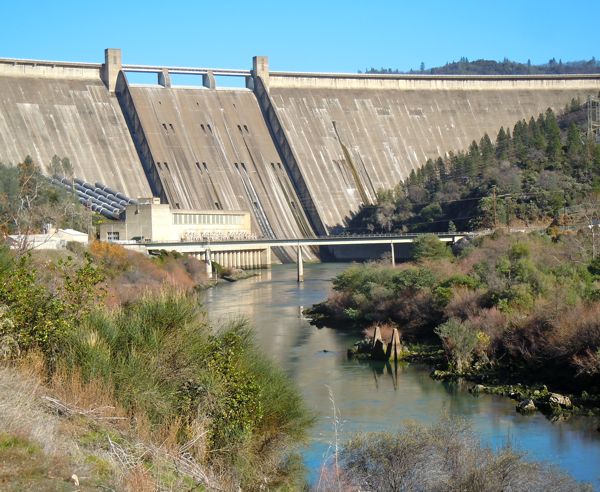
Shasta Dam allows for water storage via Shasta Lake. Photo/LTN

Shasta Dam allows for water storage via Shasta Lake. Photo/LTN

In short, energy production is deeply dependent on the availability of water. And, as a report released last week by the U.S. Department of Energy makes clear, as climate change brings hotter temperatures, more widespread and severe droughts, and lower river and lake levels, the nation’s energy supply is becoming more vulnerable.

Consider these examples from the DOE report:

In September 2010, Lake Mead dropped to levels not seen since the drought of 1956; as a result, the Bureau of Reclamation cut Hoover Dam’s generating capacity by 23 percent.

In 2009, NV Energy abandoned plans for a 1,500 megawatt coal-fired power plant that would have used more than 7.1 million gallons of water per hour.

Extreme drought in the fall of 2011 led the city of Grand Prairie, Texas, to ban the use of municipal water for hydraulic fracturing in order to save the city’s dwindling drinking water supply.

In 2007, 2010 and 2011, the Tennessee Valley Authority had to reduce power output from its Browns Ferry Nuclear Plant in Alabama because the temperature of the river into which the plant discharges was high enough to raise ecological risks.

In summer 2012, low snowpack in the Sierra Nevada curtailed California’s hydroelectric generating capacity by 8 percent.

At the Martin Lake Steam Electric Station in Texas, drought so reduced the level of its cooling pond that cooling water had to be piped in from another water source eight miles away.

One particularly interesting figure in the report compares the water requirements of seven different types of electric power facilities – nuclear, coal, biopower, natural gas combined-cycle, concentrated solar, photovoltaic solar and wind. The last two come out as by far the most water-conserving electricity sources. In contrast to the 20,000-60,000 gallons per megawatt-hour needed for nuclear and coal plants with “once-through” cooling systems, PV solar and wind require only negligible quantities.

Of the one hundred coal-fired power plants deemed to be most vulnerable to water shortages, most are located in the southeastern states of Alabama, Florida, Georgia, North Carolina and South Carolina. In these states, water for cooling may be constrained by low river flows, high water temperatures or both – forcing utilities to cut back on power generation.

On balance the study’s findings make a strong case for a more rapid shift to renewable energy sources to shore up the nation’s energy security in the face of climate change.

If there’s a call to action in the DOE assessment, it’s this: If, by 2050, the United States could get 80 percent of its electricity from renewable sources – with nearly half coming from water-thrifty wind and solar photovoltaic generation – then total water consumption in the U.S. power sector would decline by about half.

Given the projections for climate-related disruptions to the water cycle, there is little time to waste in making this transition.

Sandra Postel is director of the Global Water Policy Project, Freshwater Fellow of the National Geographic Society, and author of several books and numerous articles on global water issues.


Kings Beach trying to evolve and stay funky

By Kathryn Reed

KINGS BEACH – Lake Tahoe communities have the same vision – look pretty; be functional in terms of accessibility and the diversity of offerings; if there is a sense of community, don’t lose it and if there isn’t one, try to establish one; focus on recreation; have adequate tourist accommodations; and improvement the environment and economic vitality.

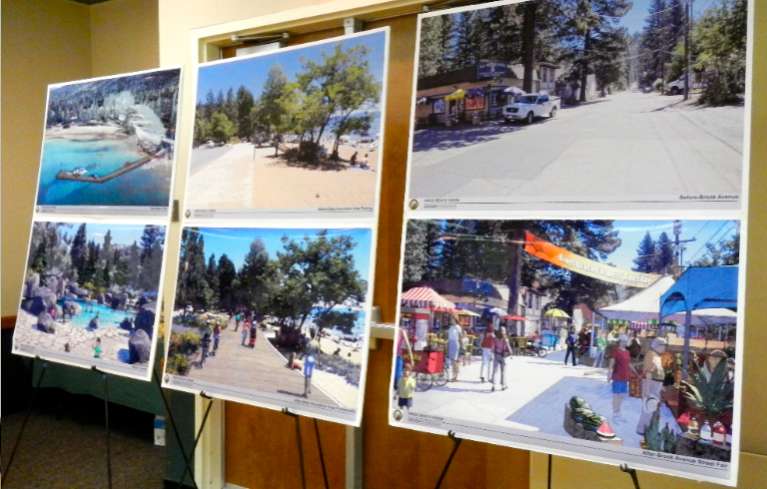
Kings Beach is the latest area to go through the visioning process. A three-day charette concluded Thursday with about 40 people perusing the various images created by Design Workshop.

While this area is already in the process of improving its streets, this larger vision encompasses the beach, the buildings, neighborhoods, transit, recreation and more. It will also be incorporated into Placer County’s Tahoe Basin Community Plan update.

Top photos reflect Kings Beach today and below are renderings by Design Workshop of what it could become. Photo/LTN

Top photos reflect Kings Beach today and below are renderings by Design Workshop of what it could become. Photo/LTN

Although work on the Kings Beach plan has been under way for a year, July 18 was the first time people’s visions were captured visually.

“The term funky was used quite a bit,” Stephanie Grigsby with Design Workshop said. And people want to keep that feel.

Her team’s goal was not to create a regulatory plan, but instead transform aspirational ideas into what could be Kings Beach’s future reality.

Making the beach into even more of a central location, with promenades and potential winter recreation amenities were ideas that came forward. Restoring the sand dunes that were leveled in the 1940s and addressing sand retention were brought up.

Extending the public pier to accommodate water transit was broached.

Height of buildings is a contentious issue. Proposed is to have lakeside buildings be no more than 36-feet tall and mountain side be a maximum of 48 feet.

Density is an issue that was not addressed in the charette process, but will be as the community plan goes forward.

An idea that has been talked about in some circles for more than a decade was brought to life on canvas – that is to close Brooks Street and create a series of uses for that area.

Kings Beach has a problem with sediment reaching Lake Tahoe. This is a large contributor to declining lake clarity. Redevelopment and roadwork could address some of those issues.

Through the charette much discussion was centered on what other uses the events center could have, but Design Workshop officials said the final outcome will be found in future meetings the community will need to lead.

Members of the community team that worked with the county and Design Workshop had mostly positive things to say about the process – saying they were listened to and didn’t feel like something was crammed down their throats.

—-

Notes:

• Placer County supervisors will be given an update on the plan July 23.

• Aug. 28 there is a workshop on the Tahoe City vision plan from 5-6:30pm at Granlibakken.

• Sept. 11 at 6pm is a town hall meeting on the Tahoe City and Kings Beach plans at the North Tahoe Event Center in Kings Beach

• In mid- to late September plans go to the county Planning Commission.

• More info will soon be on Placer County’s website.