Recreation dollars being spent on fields, bike trails

By Kathryn Reed

Improvements to South Lake Tahoe ball fields and bike trails will be in the ground by the time the building season is over in the fall.

The upgrades all have to do with the transformation of Measure S into Measure R. South Shore voters on the California side decided the recreation measure was too limiting and that by changing the language more money could be spent on some critical items.

An update on what the fields and bicycle advisory committees are doing was given at Friday’s South Lake Tahoe Recreation Facilities Joint Powers Authority board meeting.

Crews work July 26 on Sierra House Elementary School's field. Photo/LTN

Crews work July 26 on Sierra House Elementary School’s field. Photo/LTN

John Dalton, chair of the fields committee, explained how the revamping of Sierra House Elementary School’s field is the big project this summer. It looks a bit like a construction site now with all of the heavy equipment moving dirt.

Before work began the field was full of holes and seemed dangerous when running on it.

It was also a field, like Bijou Community School, that when designed had its first priority be about Tahoe Regional Planning Agency erosion control mandates and not the functionality of a play field. This meant there was a slope to the field to catch runoff from the hard surfaces. That much water on turf is not a good thing.

This project is coming in under bid, with the expectation there could be a savings of $5,000. The field committee recommended the JPA board dedicates any leftover money to help fix the Babe Ruth field.

“It was vandalized in the spring and needs repairs on the field,” Dalton told the board July 26.

He said kids broke into the shack and trashed the place by using baseball bats on equipment. Babe Ruth officials have taken care of the snack shack vandalism, but need help with the field.

The board voted 3-0 to give any “extra” Sierra House money to Babe Ruth.

The JPA board is chaired by Norma Santiago representing El Dorado County, JoAnn Conner from South Lake Tahoe, and Judy Clot from Tahoe Paradise Resort Improvement District.

The fields committee is also in the process of planning improvement for the Al Tahoe fields. The goal is to add a field that youth baseball and softball could play on.

Shay Navarro, who heads the bike committee, told the board how next week the city is expected to go out to bid on the trail improvements. The goal is that they would be in the ground before the grading season is over.

The sections of trails will be pulverized, with that material becoming the base. Then new asphalt will be laid over that. This should prevent the monstrous cracks that have developed.

Portions to be upgraded are the trail behind McDonald’s at the Y, part of the area behind Motel 6, behind Meek’s in the city, and from Tulare Avenue to Los Angeles Avenue.

Also to be replaced are the bridges over Trout Creek and Upper Truckee River where the bike route parallels Highway 50.

The bike committee has $17,000 left to spend and asked the JPA board to keep that in case there are cost overruns with the projects the city will be in charge of. The board agreed to this.

The bike committee is also working with the Lake Tahoe Bicycle Coalition to provide informational signs so cyclists know where they are and where they could go.

In other news:

• The JPA board in January will make two appointments to the field committee, and probably three to the bike. Applications will be available in December.

• The state is now considering the JPA a special district, which requires more audits be done. The county auditor-controller will be tasked with that job.



Sex offender trying to interact with kids in S. Tahoe

Police are warning people about sex offender Wesley Goetz. Photos/Provided

Police are warning people about sex offender Wesley Goetz. Photos/Provided

Updated July 27 6:45am:

South Lake Tahoe police are recanting some of the information released about registered sex offender Wesley Goetz.

Goetz is on lifetime supervision, but he is not on active parole in Nevada. He is permitted to travel into California.

Police say Goetz’s desire to obtain a business license in South Lake Tahoe do not amount a parole violation or any other criminal violation.

Goetz must still adhere to several special conditions including staying away from areas or businesses which children frequent, and not accessing the Internet without permission.

Goetz is not wanted by law enforcement officials. Goetz is currently in compliance the terms of his supervision.

A registered sex offender from Nevada has been trying to start a business in South Lake Tahoe that involves children.

Wesley Goetz, 55, lives in Incline Village is a Tier II sex offender out of Nevada. He was convicted in 1998 for felony lewdness with a child under 14, and is on lifetime supervision for his crimes.

Coming into the city limits is a violation of his parole.

South Lake Tahoe officials said Goetz applied – and was denied – a license for an Internet-based business. He also tried to obtain a business license to be a photographer at children’s birthday parties, a handyman and a traveling salesman. He was also denied licenses for those businesses.

Part of Goetz’s parole conditions is that he must stay away from areas and businesses which children frequent, and not access the Internet without permission.

South Lake Tahoe police detectives say Goetz has falsely claimed that he has permission to be near children, and that he has permission to leave Nevada. Authorities say he has also lied to El Dorado and Placer counties deputies.

Goetz has a valid Nevada driver’s license and two vehicles registered in his name; a 1991 Ford Aerostar van bearing NV/805WXK and a 1995 Honda motorcycle bearing NV/177782.

Anyone seeing Goetz near children or in California should call authorities. He is a white male, brown hair, blue eyes, 5-feet-4-inches, and 140 pounds.

Officers have provided the following information:

• Registered sex offenders in California are listed online.

• Registered sex offenders in Nevada are online.

• The offender registry includes only people who have been required by law to register and who are in compliance with the offender registration laws.

• The information contained in the registry is provided as a public service and may not be current or accurate.

• Persons should not rely solely on the offender registry as a safeguard against offenses in their communities.

• The crime for which a person is convicted may not accurately reflect the level of risk.

• Anyone who uses information contained in the registry to harass registrants or commit any crime may be subject to criminal prosecution.

— Lake Tahoe News staff report


Loop road proponents looking at community impacts

By Kathryn Reed

Federal law dictates what happens to people who might be displaced if the Tahoe Transportation District ever reroutes Highway 50 on the South Shore. But fair market value today is another story.

One man at Thursday’s TTD meeting brought up the fact that he would have to fully disclose to a potential buyer that the loop road could one day take out his property. He said he would not be able to get fair market value today because of this fact.

Alfred Knotts with Tahoe Transportation District looks over one of the loop road maps with Angie Watson who owns apartments in the project area. Photo/Kathryn Reed

Alfred Knotts with Tahoe Transportation District looks over one of the loop road maps with Angie Watson who owns apartments in the project area. Photo/Kathryn Reed

A real estate broker in the audience confirmed that everyone with property that could be affected by the project now has to tell a buyer about the loop road. This scenario is the same thing that for years left those in the path of the convention center project not wanting to improve their properties for fear of not getting a return on investment and unable to sell based on the threat of the parcel being consumed for what became a hole.

Officials are trying to bring transparency to the loop road by talking relocation and acquisition, but some in the audience said notices that have gone out seem more like scare tactics.

This project, though, would not become a hole because it cannot start until all the funding is in place.

There are four alternatives being studied, along with a do-nothing option. The one the TTD prefers would start on the west side in South Lake Tahoe at the vacant lots the city owns before the junction with Pioneer Trail and then go behind  Harrah’s and MontBleu, coming out at Lake Parkway where a roundabout would be put in. Another starts at the Pioneer Trail intersection. One calls for Highway 50 to be one way and the loop on the mountain side to go in the opposite direction. Then there is the skyway option to move pedestrians around, but would not address the traffic concerns proponents want to improve.

Goals of a loop road include making what is now Highway 50 in the tourist core a city-county street that would be more pedestrian-bike-transit centric, have wide-inviting sidewalks, and feel more like a downtown.

About 30 people turned out for the July 25 meeting – about half of what officials had hoped for.

Mike Lahodny with Bender Rosenthal, a commercial valuation and right-of-way services company, went over the laws that dictate what can happen to property owners, business owners and tenants.

No appraisals or acquisitions can occur until the TTD board certifies the environmental document. But part of the environmental document is the Community Impact Study (CIS), with the Relocation Impact Study (RIS) being a component of that.

The RIS is expected to be completed by the end of August and the CIS in the fall.

Lahodny said even though the information being collected today will be outdated three to four years from now when appraisals may actually occur, the data is designed to let planners project out what could happen.

The draft environmental documents could be released in spring 2015, with the final document out in fall 2015. It is on the draft enviro docs that the public will be able to make the most comments, though officials are always taking comments.

South Lake Tahoe and Douglas County electeds will have to sign-off on the environmental documents, along with the TTD board. The one place the city and county could derail the project would be to not approve the permits to do the work within their jurisdictions.

The information Lahodny discussed is expected to be on the TTD website today, along with more detailed maps of the parcels that could be affected.


Walt Currier — 1934-2013

Longtime South Lake Tahoe resident Walter Currier died July 6. He was 78.

He born on Sept. 4, 1934.

Walter, known to all as Walt, began teaching at the age of 21 in Martinez in 1955. He taught at Martinez Elementary School until 1961. He then moved his family to South Lake Tahoe where he was first hired to teach seventh grade at Al Tahoe Middle School which was combined with the high school.

In 1962 he moved to Tahoe Valley Elementary to teach sixth grade. He then became a teaching vice principal, and then principal from 1965 until 1970.

In 1970 he became principal of Bijou Elementary School; serving that community until 1978.

In 1978 he became principal of the Meyers Elementary School; serving that community until 1983.

In 1983 he became principal of Sierra House Elementary School; serving that community until 1987.

In 1987 he became principal of South Tahoe Middle School.

In spring and summer of 1988 he served as interim superintendent of Lake Tahoe Unified School District.

He then began working for El Dorado County as the director of Court Schools, which included El Dorado Juvenile Hall in Placerville.

At the same time he was a liaison to the project Right of Passage which enabled students to graduate high school who struggled in the public system.

He retired from the county in 1994 to spend time with his wife, Nancy, and children Janiece, Walter Jr. and Mark and dog Frankie.

Walt was an avid runner for decades and then enjoyed his walks in the woods with Frankie.

He spent his last days at Cascade of the Sierras in Spanish Springs, Nev., with his daughter, Janiece, son-in-law, John, and grandson, Jess Walsh.

He was well loved and will be missed by all.


Record Kokanee reeled in from Lake Tahoe

Capt. Scott Carey and fisherman Bill Brush with the record-breaking Kokanee. Photo/Tahoe Sport Fishing

Capt. Scott Carey and fisherman Bill Brush with the record-breaking Kokanee. Photo/Tahoe Sport Fishing

By Kathryn Reed

A Nevada City man broke a 40-year-old state record when he went fishing last weekend. Bill Brush reeled in a 5-pound, 2-ounce Kokanee salmon from Lake Tahoe.

Dave Bournique of South Lake set the previous California record of 4 pounds, 13 ounces on Aug. 1, 1973.

The day started slow. They were trolling in the Camp Richardson, Baldwin Beach area when the record breaker clamped on.

“The next thing that freak fish hit the line and we could tell he was on to something the way the fish was banging on that rod,” Capt. Scott Carey told Lake Tahoe News. “When it hit the deck I knew we had (the record).”

Kokanee lose weight when pulled from the water so it was imperative to get to an official scale as soon as possible. It’s also been recorded with California Department of Fish and Wildlife.

The 45-year-old Carey has been fishing Lake Tahoe half his life and July 20 was the first record where he was the skipper. He said he didn’t think it was going to happen.

“I tell everyone if you can catch half the fish that hit the line, you had a good day,” Carey, who works for Tahoe Sport Fishing based in South Lake Tahoe, said.

When the fish surfaced, the deck hand went for the Kokanee scooper. Then Carey told him to get the big scoop. In one swift motion the fish was on the boat.

“He played the fish perfectly,” Carey said of Brush.

A long line of 150 was cast which went to a depth of about 67 feet. They used a flasher set-up called a double whammy that looks like a wedding ring. The little lure is on a 6-pound line.

Corn is placed on the tip of the lure because it resembles daphnia, a form of plankton that no longer exists in Lake Tahoe.

“That’s why we don’t have big Kokanee here like we did in the ’70s,” John Shearer, who owns Tahoe Sport Fishing, said of the daphnia.

Now through September is the best time to fish for Kokanee at Lake Tahoe – before they begin to spawn.

Shearer said the record-breaker is a “beautiful fish.”

It’s sitting in a cooler at Carey’s house and will eventually be mounted. Brush told Carey he wanted the captain to be the keeper of record-breaking Kokanee.


Ellis Peak — like being on top of the world

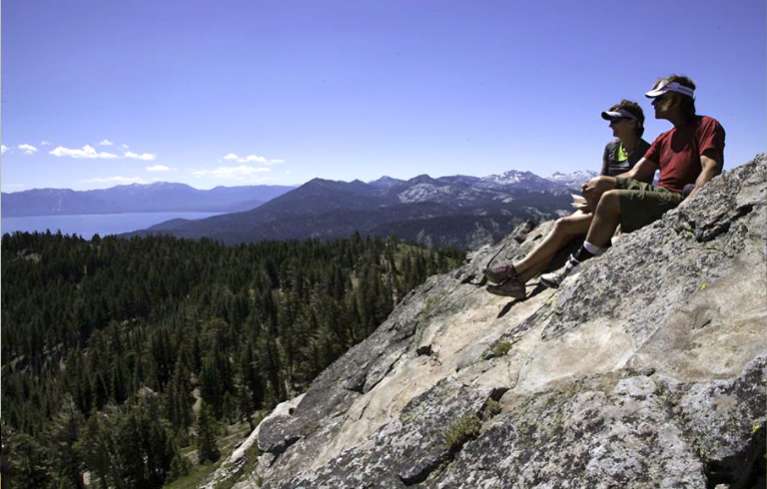
Suzy and Mark take in Lake Tahoe and all the scenery from the false summit of Ellis Peak. Photo/Carolyn E. Wright/Copyright

Suzy and Mark take in Lake Tahoe and all the scenery from the false summit of Ellis Peak. Photo Copyright 2013 Carolyn E. Wright

By Kathryn Reed

HOMEWOOD – If you survive the first half hour, the rest of the hike will feel like an average walk in the woods. But there was nothing average about the views.

This is what the six of us discovered earlier this month as we set out to climb the 8,740-foot Ellis Peak on the West Shore. It was the first time any of us had been there.

The total elevation gain is 1,465 feet. A significant amount of it comes right at the start. But the reward is so worth it.

It’s like walking into a watercolor painting. A sea of colorful wildflowers covers the expansive meadow – mule’s ear, Western blue flax, Indian paintbrush, thistle and other flora no one knew the name of fill the plateau.

To our right is Loon Lake with its island and other points in the Crystal Basin. Granite Chief and Desolation wilderness areas surround us.

We marvel at the ruggedness and rather daunting drop offs. Even from this spot it’s a bit like being on top of the world.

But it only gets better.

The trail is well maintained. Much of it is soft dirt. Shade keeps us cool.

In one section trees are covered in moss on all sides so if we were lost, there would be no knowing which direction was north.

Crossing the road that is open to four-wheelers was no big deal. We never saw nor heard any motorized vehicles.

At times Lake Tahoe comes into view. Along the trail it seems so far away.

We scamper up a rock formation we think is the top of Ellis Peak. We eat lunch, take pictures and congratulate ourselves. Then we look to our left and see people on another peak. Oops. Down we go to the real Ellis Peak.

It wasn’t that much farther, but pride insisted if we had gotten that far, we were going to make it to our true destination.

In one direction is Lake Tahoe. We are so high that we see behind the basin; the Pine Nut range is in the far distance.

At the base of Ellis is the lake by the same name. From this perch it looks dark and dank like some backwoods Mississippi swamp.

A structure in the foreground looking out to Lake Tahoe is the top of one of Homewood Mountain Resort’s chairlifts. If it were operating, it looks like it would take off substantial time in terms of hiking Ellis Peak.

To avoid the false summit, stay to the right as you near what looks like the peak. We missed the cairns on the way up, but they were clearly there on the way back. The true summit cannot be seen at this point.

The route is about 6.5 miles roundtrip. Just the first part might have some people thinking something less ambitious would be smarter. But the six of us –  Sue, Rosemary, Carolyn, Suzy, Mark and I – never thought twice about reaching our destination.

—-

Getting there:

From South Lake Tahoe take Highway 89 north. Beyond Homewood and before Sunnyside in Tahoe City will be a sign for Kaspian Campground. Turn left there. The road goes for about 7 miles. (Veer to the left and don’t go straight on the dirt road like some people.) At the end of the hill the pavement turns to dirt. The trail is to your left. Park on the side of the road.

Bug juice and sunscreen are recommended.

ngg_shortcode_0_placeholder (Click on photos to enlarge.)


Fast food talking to chefs about increasing nutrition

By Stephanie Strom, New York Times

ST. HELENA — The chicken thighs, smoked for two hours, then soaked in buttermilk spiked with Crystal hot sauce and dredged in flour, turned a perfect golden brown, full of the promise of succulence and crunch, under the stern watch of Chef H. Alexander Talbot.

But not one, alas, went into a salivating mouth as soon as it left the bubbling rice bran oil. Rather, it was rushed under a glass “udder” bristling with slender filaments and tended by technicians, who would soon analyze it at a PepsiCo lab in Illinois for the magic that gave it such flavor and crispiness.

Other creations, destined for the same lab, went into Styrofoam containers bedded on dry ice, part of a continuing effort to find new ways to improve the nutritional quality of the giant food company’s products without losing recognizable flavors.

“The challenge facing us and other big food companies today is not easy: to have a great-tasting product without as much salt, fat and sugar,” said Greg Yep, senior vice president for long-term research and development at PepsiCo. “Chefs have ways of tricking the taste buds that we can use in our products.”

Prodded by consumers, regulators and politicians, major food companies like PepsiCo are under extraordinary pressure to make healthier foods. Kellogg has cut as much as 30 percent of the sugar in children’s cereals like Apple Jacks and Froot Loops, removed salt from others and increased fiber. Taco Bell last month announced a new Power Protein menu that will include items with less fat and calories, and other companies are rushing to get their products in shape.

“We’re not only thinking about making great-tasting foods but about the nutrition guidelines we need to deliver on,” said Greg Creed, chief executive of Taco Bell, referring to the company’s pledge to bring one-third of the meal options in its restaurants into compliance with the federal dietary guidelines by 2020. “This is a huge change in mind-set.”

Read the whole story


Calif. Dems want Obama to back off pot enforcement

By Robin Wilkey, Huffington Post

SAN FRANCISCO — Marijuana may not be fully legal in California, but the state’s Democratic Party has made its position clear.

In a resolution released on Sunday, the California Democratic Party requested that President Obama end the federal crackdown against states with marijuana laws on the books:

“The California Democratic Party requests: President Obama to allow the newly enacted marijuana legalization laws in Colorado and Washington to go into effect with no federal interference, and […] end the Department of Justice interference and raids by federal agencies in states with medical marijuana laws.”

The authors cited voter support for marijuana, the cost of enforcing prohibition laws and racially biased punishment as motivations for the resolution:

“18 states and the District of Columbia have passed laws legalizing the use of cannabis […] and Colorado and Washington in 2012 passed laws legalizing the recreational use. […]”

“The United States spends over $20 billion a year enforcing marijuana prohibition laws, and thousands of people are murdered every year involving the smuggling of illegal drugs into the United States and marijuana accounts for over half of these illegal drugs […]

“Marijuana prohibition laws are racially enforced with a far larger percentage of African-Americans and Hispanics convicted and imprisoned for marijuana prohibition offenses than their white counterparts even though marijuana use in their communities is no more than in white communities.”

The party also encouraged state legislators to establish parameters to guide cities and counties in the distribution of medical marijuana, and announced plans to begin a comprehensive study “to produce recommendations for reform of our nation’s marijuana prohibition laws.”

News of the resolution was applauded by marijuana reform advocates, including Marijuana Majority founder and chairman Tom Angell.

“In just the past few weeks, we’ve seen the U.S. Conference of Mayors, the New York Times editorial board and now the Democratic Party of our nation’s most populous state call on President Obama to finally follow through on his campaign promises to respect state marijuana laws,” Angell told the Huffington Post.

A recent survey released by the Partnership at Drugfree.org, one of the nation’s harshest critics of drug use, indicated that a strong majority of Americans support medical marijuana legalization, and nearly half support recreational use.

“Polls show that the American people support what candidate Obama pledged to do over what President Obama has actually done,” said Angell. “Now would be a good time for the president to start delivering on the changes he promised in 2008.”


LTUSD tackling safety issues at school sites

By Kathryn Reed

Changing how a desk faces, putting a defensive item on a teacher’s desk, playing over worst-case scenarios in one’s head to know what to do just in case – those are some of the basic security measures being taken in Lake Tahoe Unified School District.

More substantive things are being done as well, and many are being implemented in coordination with local law enforcement.

LTUSD’s school board was given an update on security within the district at the July 23 meeting.

Landscape modifications, window treatments, cameras, front entrance control, barriers to stop a vehicle from ramming a structure, signage – those are some of the easier items to tackle.

Another component to this is the technology needs of the district. The phone system is the same one Lake Tahoe Community College had that failed earlier this year and temporarily stopped voice communication. But the district’s data delivery is even more antiquated, so that is a higher priority.

Al Frangione, who is leading the development of the security plan for the district, said the technology piece would cost $1.5 million to do what he wants. There is about half of that dollar amount left from the Measure G facilities bond that could go toward IT.

Tuesday was about getting information, not for the board to make a decision on how to go forward.

What is happening

After the December 2012 fatal school shooting in Connecticut, a federal unfunded mandate came out saying the FBI needed to do some extensive training with local law enforcement to deal with school shootings or another crisis that would threaten students and staff.

Last week the El Dorado County Sheriff’s Department used a West Slope school for a rigorous training.

LTUSD has been looking at how prepared it is in case there is a threat at a school.

“We looked at what are the threats and vulnerabilities and how do you rectify it,” Frangione told the board.

What isn’t public record is what all the weaknesses are so they cannot easily be exploited.

“The key thing is to get people to think about what they would do, especially by staff, so they can make a difference,” FBI Agent Chris Campion said.

Staff will be receiving training before school starts next month and more intensive training will follow.

“It’s probable staff is the first responders whether we like it or not,” Frangione said.

A collaborative approach is being used, with multiple agencies involved in what is called REACT – Regional Emergency Action Crisis Team. But it was also noted that many of the groups don’t regularly train together so each one might have a different set of protocols when it comes to dealing with an emergency.

With the South Shore being so small and staffing minimal, one department could not handle something like a Sandy Hook mass shooting.

Looking at prevention

Collaboration is also needed when it comes to various entities talking about what they perceive as a potential threat. It’s not about profiling a student, or even an employee or parent, but instead putting pieces together.

The goal would be to try to get an individual help or defuse a situation before it became deadly.

Superintendent Jim Tarwater pointed out that in the last eight years he has found that parents are more difficult to reach.

El Dorado County sheriff’s Lt. Pete Van Arnum spoke of how when he was with South Lake Tahoe Police Department in the 1990s he was the school resource officer at South Tahoe Middle School. It was at a time when gangs were infiltrating the school, and students and staff felt intimidated.

He said he’s talked to teachers and that same feeling is coming back to STMS.

“Some kids are taking control again at the middle school,” Van Arnum said. “It needs to be two pronged. You need to be tough, but you need to care.”

He said building trust and relationships with students could help change how they behave. Programs like Police Activities League, after school boxing, weekend backpacking trips and a day on the slopes helped the kids bond with law enforcement and change the direction of their lives.

Today there is no officer at the middle school. And those programs are a thing of the past.


Study: Skipping breakfast not a healthy idea

By Mary MacVean, Los Angeles Times

Even Elmo knows that breakfast is the most important meal of the day in his world, but there hasn’t been enough scientific evidence for the federal government to recommend it for grownups.

Still, it sounds like it might be a wise move to stock up on oatmeal and the like. In an article released Monday in the journal Circulation, researchers found that men who skipped breakfast had a 27 percent higher risk of coronary heart disease than men who ate their morning meal – though we imagine that big daily plates of bacon and pancakes with syrup are not the ideal.

The researchers also found, using a large ongoing study of mostly white men, that those who ate late at night had a 55 percent higher risk of coronary heart disease. They didn’t find an association with the number of times a day a person ate.

Those associations were true — if somewhat less so — when other habits and conditions that would cause coronary heart disease were factored in, said the researchers, from Harvard University and Brigham and Women’s Hospital.

Snacking and skipping breakfast are common among Americans, the researchers noted. And such habits have been associated with weight gain, high blood pressure and diabetes, they wrote.

So they looked at the Health Professionals Follow-up Study, an ongoing look at 51,529 men who are questioned every two years about their health and habits.

The men who did not eat breakfast were younger, more often single and more likely to smoke and less active than the other men. The late-night snackers were also more likely to smoke and to have hypertension and sleep less than seven hours a night, the researchers wrote.

But the quality of the men’s diets was on average very high.

“The timing of the meal may be directly responsible for the metabolic effects that may lead to CHD, or alternatively, eating habits may be a proxy for specific foods more likely to be consumed at breakfast or late at night such as breakfast cereals high in dietary fiber and fortified micronutrients like folate or late-night snack foods high in calories,” the researchers wrote.

They said they would like to see additional studies looking at women and ethnic groups.