N. America’s oldest petroglyphs found in Nev.

By Scott Sonner, AP

PYRAMID LAKE — Ancient rock etchings along a dried-up lake bed in Nevada have been confirmed to be the oldest recorded petroglyphs in North America, dating back at least 10,000 years.

The petroglyphs found on limestone boulders near Pyramid Lake in northern Nevada’s high desert are similar in design to etchings found at a lake in Oregon that are believed to be at least 7,600 years old. Unlike later drawings that sometimes depict a spear or antelope, the carvings are abstract with tightly clustered geometric designs — some are diamond patterns, others have short parallel lines on top of a longer line.

 USGS, Larry Benson / AP Photo This May 2012 photo provided by the U.S. Geological Survey shows ancient carvings on limestone boulders in northern Nevada's high desert near Pyramid Lake. The carvings have been confirmed to be the oldest recorded petroglyphs in North America - at least 10,500 years old. The findings were published August 2013 in the Journal of Archaeological Science. This site was once the shoreline of the now dried up Winnemucca Lake. Read more here: http://www.sacbee.com/2013/08/14/5650997/nevada-petroglyphs-the-oldest.html?utm_source=dlvr.it&utm_medium=twitter#mi_rss=Latest%20News#storylink=cpy

Ancient carvings on limestone boulders near Pyramid Lake. Photo/Larry Benson/USGS/AP

Scientists can’t tell for sure who carved them, but they were found on the Pyramid Lake Paiute Tribe’s reservation land.

“We initially thought people 12,000 or 10,000 years ago were primitive, but their artistic expressions and technological expertise associated with these paints a much different picture,” said Eugene Hattori, the curator of anthropology at the Nevada State Museum in Carson City who co-wrote a paper on the findings earlier this month in the Journal of Archaeological Science.

The petroglyphs could be as much as 14,800 years old, said Larry Benson, a geochemist who used radiocarbon testing to date the etchings and was the lead author of the research paper.

Radiocarbon testing dated the carbonate layer underlying the petroglyphs to roughly 14,800 years ago. Geochemical data and sediment and rock samples from adjacent Pyramid Lake show they were exposed to air from 13,200 to 14,800 years ago, and again from 10,500 to 11,300 years ago.

“Whether they turn out to be as old as 14,800 years ago or as recent as 10,500 years ago, they are still the oldest petroglyphs that have been dated in North America,” said Benson, a former research scientist for the U.S. Geological Survey and current curator of anthropology at the University of Colorado Natural History Museum in Boulder.

Dennis Jenkins, an archaeologist with the University of Oregon’s Museum of Natural and Cultural History, called it a significant discovery. He led recent excavations of obsidian spear points near Paisley, Ore., that he dated back 13,200 years, and noted that the bigger challenge is identifying who created the petroglyphs.

“When you get back into this time period, if you speak with Native Americans they will tell you they were made (created) there and that is obviously their people and their artwork,” Jenkins said. “But approaching it from a scientific point of view — what we can prove — at this point, it is impossible to connect these to any tribal group.”

William Cannon, a longtime archaeologist for the U.S. Bureau of Land Management who discovered the petroglyphs at Long Lake in Oregon, brought the Nevada site to Hattori’s attention years ago. He said they bore similarities to petroglyphs at nearby Winnemucca Lake, and Hattori began connecting the dots after Benson spotted the carbonate coating on the rocks.

The etchings in Nevada and Oregon have relatively deep, carved lines dominated by linear, curved and circular geometrical designs. Some feature “tree-form designs” with a series of evenly spaced, vertically oriented ‘V’ shapes bisected by a vertical line.

Researchers have suggested the etchings represent various meteorological symbols, such as clouds and lightning, perhaps the Milky Way.

“But we really have nothing to go on for these particular petroglyphs that go back 10,000 or more years,” Hattori said Wednesday.

Benson has no idea what they mean.

“When I looked at it, I said, ‘These things are incredibly beautiful.’ We have so much beautiful, old Native American stuff in the United States, but this shows it didn’t necessarily get more interesting or more pretty with time,” he said.

Ben Aleck, a co-author of the study who is the collection manager at the Pyramid Lake Paiute Tribe’s Museum and Visitor Center in Nixon, said Wednesday he could not comment without permission from tribal leaders.



Mama bear, cub caught-released on same day

The black bear and cub that were caught in the Foothill Road area of Carson Valley were released tonight in the foothills of Douglas County near Kingsbury Grade by the Nevada Department of Wildlife.

The two bears were caught early Aug. 15. A trap had been set in the area 10 days ago because there were complaints of bears doing damage to beehives.

The mama bear wondered into the trap at about 2am Thursday. But her cub wanted nothing to do with that “den” and decided to stay in a tree with her eye on mom.

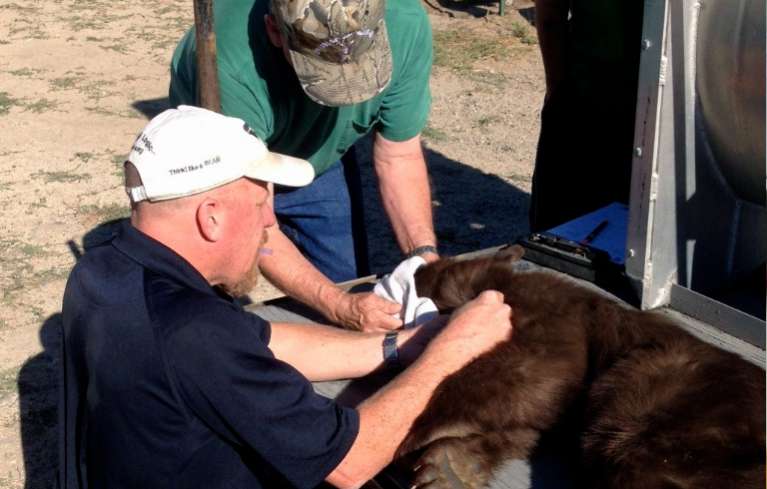
This black bear and her cub were returned to the wild tonight. Photo/Provided

This black bear and her cub were returned to the wild tonight. Photo/Provided

NDOW officials tranquilized the female, dragged her out of the trap and placed her under the tree. The cub came down to check on mom. That’s when the little one was tranquilized.

“We’ve used that technique successfully before,” Carl Lackey, biologist with NDOW, said in a statement. “By luring the cub from the tree, we can dart it without the bear falling out of the tree and possible getting hurt or killed.”

Lackey said the female bear was caught years ago in about the same area. She is estimated to be 14 years old.

“We performed aversive conditioning before and she stayed away seven years. We’ll do it again to her and the cub when we release them and they should get the message to stay away from human activity,” Lackey said.

In addition to capturing the two bears, Lackey also is working with the owner of the beehives to strengthen the electric fence that was already in place when the bears first started coming into the area.

 — Lake Tahoe News staff report


Report: Severe weather threatens power grid

By Neela Banerjee, Los Angeles Times

WASHINGTON — A decade after a vast power outage shut down the Northeast, the electricity grid remains “highly vulnerable” to blackouts because of extreme weather fueled by climate change, a report by the White House and the Energy Department concludes.

Sagging and downed power lines in Tahoe. Photo/LTN file

Sagging and downed power lines in Tahoe. Photo/LTN file

The Aug. 14, 2003, blackout occurred when an alarm failed in an Ohio utility control room, leading to a cascade of blackouts that affected 50 million people from Michigan to Massachusetts. More recent power outages have been caused by severe weather, such as storms in the East and wildfires in the West.

Between 2003 and 2012, 679 blackouts occurred because of weather events, each affecting at least 50,000 customers. Over the same period, weather-related outages cost the economy between $18 billion and $33 billion annually, depending on the number and severity of events.

Read the whole story


Aces deliver quality baseball in intimate setting

The Aces are in their fifth year playing in Reno. Photos/Kathryn Reed

The Aces are in their fifth year playing in Reno. Photos/Kathryn Reed

By Kathryn Reed

RENO – It felt a bit like being back at spring training – a warm night that never required long sleeves, grass beyond the outfield fence to sit in, beer prices that don’t break the bank and an intimate ballpark.

Now in their fifth season, the Reno Aces are developing players for the Arizona Diamondbacks.

But this year more parallels can be drawn between the Aces and San Francisco Giants than the Aces and Diamondbacks.

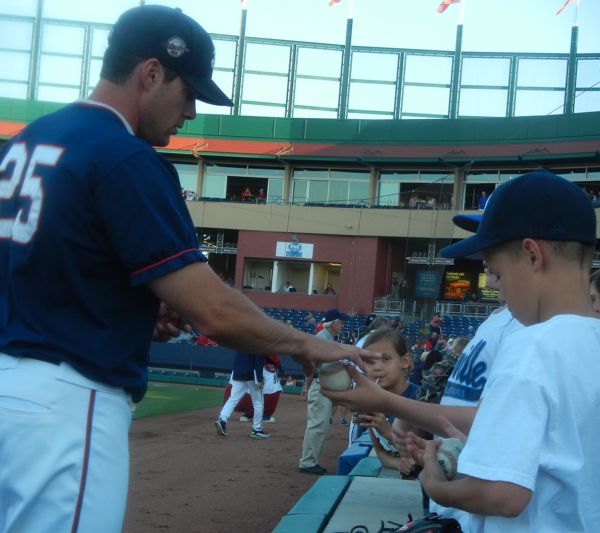
Aces rightfielder Brad Snyder signs autographs before the game.

Aces  outfielder Brad Snyder signs autographs.

The Aces and Giants both have impressive ballparks. (Walk around each one to take it all in.) Both have interesting food. (The veggie burger in Reno is homemade and yummy, while the mac ’n cheese bites need some work.) Both won their respective championships in 2012. Both are in last place in their divisions this year. (And that probably won’t change.)

Oh, and both can be a ton of fun to watch. The fact that the Aces won 14-3 on Tuesday helped with the fun factor.

But there are major differences as well. Prices are much less expensive at this triple-A ballpark. There is grass seating in Reno. Reno seats 9,100 and San Francisco more than 40,000. The announcer in SF is superb; the one in Reno needs to be replaced. The parks define jumbotron much differently.

While the team from Nashville was winning through the first three innings, the Aces took a commanding 8-3 lead after the sixth. But based on the fans, it would have been hard to know the Aces were winning. Or maybe they were Nashville fans.

(The announcer said there were more than 4,000 in attendance, but that was more likely the number of tickets sold because there were a ton of empty seats.)

It’s the announcer’s job to play fun music and get the crowd into the game if the players aren’t doing it. It didn’t work.

Still, if baseball is the main reason to be at the ballpark, then an Aces game is the place to be. There are future Major League players on the field and some who want a return trip to the Bigs. Eugenio Velez who used to race around the bases as a Giant was playing the other night — and still running fast — but for the Nashville Sound now.

Grass seating beyond the outfield.

Grass seating beyond the outfield.

The Aces’ season ends Sept. 2. There are six home games left, including tonight. And as the days tick away, more transactions are likely to occur. On Wednesday, pitcher Blayne Weller was transferred to Hillsboro, outfielder Tony Campana was recalled by Arizona, outfielder Ryan Stovall was transferred from Visalia and pitcher Tyler Skaggs was optioned to Reno.


Study: Climate change may help redwoods

By Paul Rogers, San Jose Mercury News

Climate change is melting glaciers, worsening droughts and raising sea levels around the world.

But when it comes to redwood trees — the ancient, iconic sentinels that scientists have worried may be at risk as the planet heats up — global warming may actually be helping, at least for now, according to research released Wednesday.

“We’re not seeing any evidence of declining growth rates,” said Steve Sillett, a forestry professor at Humboldt State and nationally known redwoods expert. “In fact, a lot of the sites are exhibiting increasing rates of growth over the last 100 years.”

It may be that the trees prefer warmer temperatures, or that they are benefiting from more sunlight, a longer growing season or even decades of fire suppression. Or they might even be responding well to higher levels of carbon dioxide in the atmosphere.

Nobody knows yet.

Read the whole story

But Sillett and other researchers working on an ambitious, four-year study found that growth rates of coastal redwoods and giant sequoia trees in California’s old-growth forests increased during the 20th century, even as other parts of the Earth’s environment — from polar bears to coral reefs — suffered from climate change.


Calif. lawmaker lobbies for scaled down water bond

By Barry Eberling, Fairfield Daily Republic

State Sen. Lois Wolk has proposed a $5.6 billion state water bond, one that includes no money for the controversial proposal to build twin tunnels to take water exports under the Sacramento-San Joaquin Delta.

Instead, Wolk, D-Vacaville, proposes to spend $1.5 billion on safe drinking water projects, $1.8 billion on water quality and watershed projects, $1.3 billion on flood control and $1 billion for water system operations improvements such as groundwater storage and recycled water storage.

Senate Bill 42 prohibits using bond money to build or do mitigation for a new water conveyance project.

Wolk wants this $5.6 billion bond to replace the $11 billion state water bond scheduled to go before voters in 2014. The state Legislature agreed to that $11 billion bond measure in 2009.

But Wolk has long criticized the 2009 bond measure, saying items got added by the Legislature in the middle of the night to win passage. It has such items as $3 million for a Lake Tahoe water taxi. Wolk last year said her bond proposal wouldn’t be a Christmas tree or bloated.

Read the whole story


Incorporating town could thwart plans to add lodging, retail to Squaw Valley’s base

By Ed Fletcher, Sacramento Bee

Concerned by a major development proposal, a group of Squaw Valley activists say they have more than enough signatures needed to start the process of turning the tiny ski resort community into the new city of Olympic Valley.

The process is expected to cost in excess of $100,000 and take at least two years.

Owners of Squaw Valley want to further develop the base area. Photo/LTN file

Owners of Squaw Valley want to further develop the base area. Photo/LTN file

“I don’t see big obstacles once we become a town,” said Fred Ilfeld, one of the lead proponents of cityhood.

Olympic Valley might be a small town, but it’s a community filled with people who have accomplished much in their lives, said Ilfeld. He did not foresee problems electing a capable council.

Incorporation is a response to the December 2011 announcement by Squaw Valley’s owners of a proposed phased development of 101.5 acres, adding more than 1,000 lodging units and 47,000 square feet of commercial space.

Squaw CEO Andy Wirth said while his organization doesn’t have an official position on incorporation, he has concerns.

Read the whole story


Sensors report water content throughout Calif.

By Olga Kharif, Bloomberg

In February, six students on snowshoes battled as much as 12 feet of snow to penetrate into the heart of the American River basin.

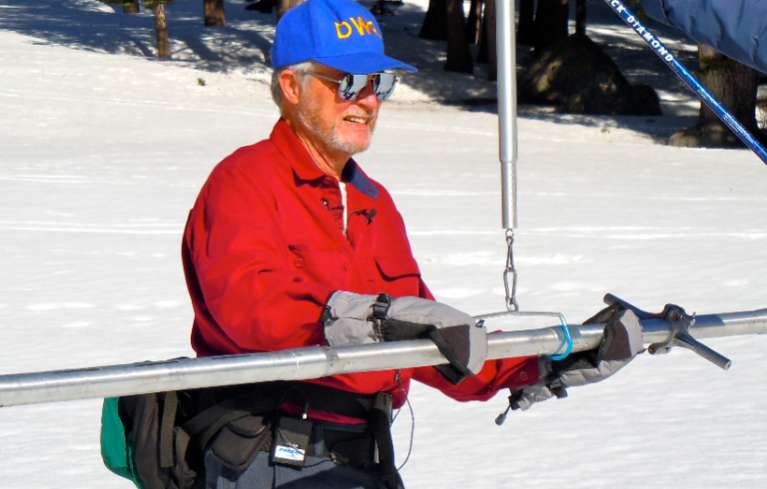
Moving through dense forests and meadows, they mounted 90 iPhone-sized machines, designed to measure everything from soil moisture to temperature and relative humidity, onto 16-foot poles that beam data to researchers like Steven Glaser, a professor at UC Berkeley.

With additional trips this summer, Glaser hopes to create the world’s largest sensor network, comprising 7,500 devices that will inform researchers and government agencies for the first time in detail how much water California has in its coffers — critical data for farmers and state planners.

Department of Water Resources customarily tests water content throughout the winter in the Sierra; no sensors can give real-time water info to officials. Photo/LTN file

Department of Water Resources customarily tests water content throughout the winter in the Sierra; now sensors can give real-time water info to officials. Photo/LTN file

The network will be among the largest tests of a new kind of sensor: one that feels as well as thinks, while using very little power — a D-cell battery can last years.

Glaser’s gadgets come equipped with silicon from Linear Technology Corp. and Cypress Semiconductor Corp. that turns them into mini-computers. They’re part of a generation of intelligent sensors whose sales may rise about 10 percent a year to reach $6.9 billion in 2018, according to Transparency Market Research.

Unlike dumb predecessors that gathered data and passed it to a central server to analyze, these devices monitor the information’s quality and perform advanced calculations.

“It’s smart cities, smart buildings, smart water,” said Susan Eustis, president of WinterGreen Research Inc. “It’s enabling a world of things. It’s going to grow unbelievably fast.”

Read the whole story


Woman didn’t know roommate was murderer

By CBS-13

A woman and her two children shared a home with a murderer and didn’t realize it until later. Now that killer is accused of striking again.

She describes him as odd, but charming and charismatic. The worst she thought was he could have been a good con man.

Joseph Michael Nissensohn

Joseph Nissensohn

When cops knocked on Theresa Robertson’s door years later, she thought it was because he passed a few bad checks.

She had no idea, all those years ago, that she spent six weeks with a killer.

“I was short on rent and I needed a roommate.”

She had no way of knowing that just days before Joseph Nissensohn became her roommate in South Lake Tahoe that he murdered a 46-year-old woman in Washington.

Nissensohn is being tried on murder charges in El Dorado County Superior Court in South Lake Tahoe.

Read the whole story


Contractor ready to resume Chateau project

By Kathryn Reed

Before construction resumes at the hole in South Lake Tahoe, some deconstruction is going to occur.

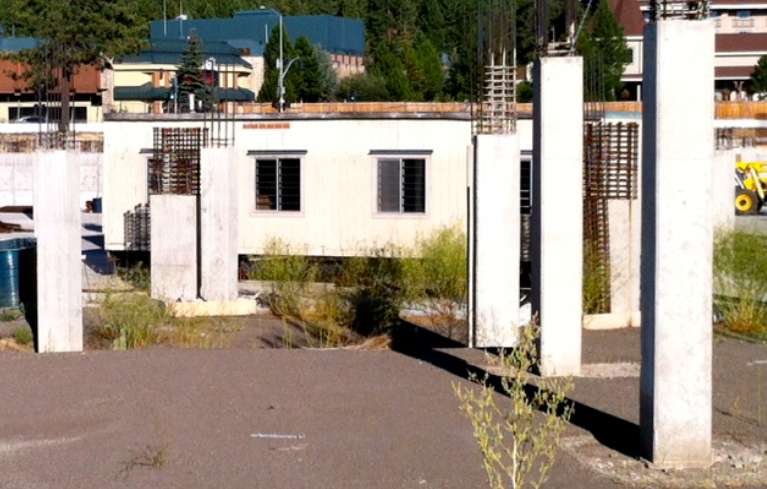
Eight columns out of the nearly 100 that are in the ground need to be taken out because they don’t meet current standards to withstand an earthquake. Two changes to California’s building codes have occurred since the foundation for the Chateau project was poured a handful of years ago. The columns need to be bigger.

The demolition permit is expected to be issued today by the city to Tahoe Stateline Ventures.

A construction trailer is at the Chateau site and a bevy of activity likely to begin next week. Photo/Susan Wood

A construction trailer is at the Chateau site, with a bevy of activity likely to begin next week. Photo/Susan Wood

Tahoe Stateline Ventures is the company created by Owens Financial to develop a section of what was to be a $410 million hotel-retail-convention center in the city near the state line and across Highway 50 from Heavenly Village.

On Thursday, TSV will be before the South Tahoe Public Utility District board seeking approval of the contract to construct the water main.

All of the site work for construction of the 14-inch water main is slated to be done this building season.

Once the agreement is signed by STPUD, TSV officials will take that to the city in hopes a building permit is issued on Friday.

No contract is needed between the city and developer because this is now a completely private endeavor. Before the bankruptcy, when the entire 11-plus-acre site was to be developed, the agreement was the city would issue millions of dollars worth of bonds to pay for the convention center that it would ultimately own. The city was also going to own the open spaces.

Now the city doesn’t have ownership to anything regarding this project.

“We’ve been working with the developers since fall 2012 to determine the best course of action to restart the project and are very pleased that Mr. (Bill) Owens is willing to invest millions to restart the project,” City Manager Nancy Kerry told Lake Tahoe News.

Construction trailers are on site and preconstruction work – like cleaning up the area – has been occurring. Real construction could begin Monday.

SMC Contracting is the general contractor for what is now an $11 million project on only part of the acreage. SMC was the lead the first time as well.

A temporary sidewalk along Highway 50 will be installed and the foundation for the retail will go in this building season. Work will continue through the winter, with completion – including landscaping – coming about this time next year.

“The expectation is retailers will be able to initiate their tenant improvements in late spring. Then in late summer, early fall they could be open for business,” Lew Feldman, attorney for TSV, told Lake Tahoe News.

About a half dozen business are expected to move in.

No lease contracts have been signed and Feldman would not disclose any potential retailers. There is 19,000-square-feet of retail, which does not include the restaurant-night club. (By comparison, Heavenly Village has about 120,000-square-feet of retail.)

The corner of Highway 50 and Stateline Avenue was always intended to be a restaurant. McP’s is going to move there; which was also the original plan. The bi-level building will have one story below ground, one above ground. Outdoor seating, fire pits and a kitchen that would be capable of producing real meals are part of the plans.