Calif., Nev. recommit to focus on Tahoe fire issues

By Kathryn Reed

“With all of the major fires burning across California, and the corresponding inundation of smoke in the Tahoe basin, complacency is at an all time low again.”

And that has Gareth Harris, chief of Lake Valley Fire Protection District, worried. His colleagues throughout the Lake Tahoe Basin are worried as well.

Most people in the firefighting world would like to see more resources devoted to prevention because that is more effective in terms of manpower, resources and forest health compared to suppressing a fire once it has ignited.

Even though the South Shore lost 254 houses in June 2007 to the Angora Fire, it has left people questioning why the U.S. Forest Service has embarked on a multi-year project to thin 10,000 acres here.

While the Forest Service’s forest, fuels and fire management policies have changed through the years with much debate and criticism, fire officials in other agencies are on board with the belief that prevention is key. Political figures agree.

Govs. Jerry Brown, left, and Brian Sandoval at the Aug. 19 Lake Tahoe Environmental Summit. Photo/Kathryn Reed

Govs. Jerry Brown, left, and Brian Sandoval at the Aug. 19 Lake Tahoe Environmental Summit. Photo/Kathryn Reed

Govs. Jerry Brown and Brian Sandoval re-upped that commitment a week ago before the Lake Tahoe Environmental Summit at Sand Harbor. A bi-state fire commission was convened in 2008 after the Angora Fire to look into what could be done to prevent another such devastating fire in the basin. Many of the findings are in place.

With the California and Nevada governors signing the proclamation, it reaffirmed the states’ commitment to recognizing the importance of fire prevention, and the effects a fire could have on the environment and economy of Tahoe.

Most of the basin’s fire chiefs were in the front row at the summit. And while people like Sen. Dianne Feinstein, D-Calif., each year point to the need for a healthy forest, those that appropriate money to make that happen aren’t always in agreement, nor are individuals in the basin doing what they can via defensible space techniques.

Keeping fire issues in the front of people’s minds is what fire officials hope is one of the outcomes of the proclamation.

“It’s important because it refocuses and keeps awareness of the Tahoe basin and the needs we have to protect our resources and our jewel here,” Eric Guevin with Tahoe Douglas Fire Protection District said of the agreement. “Some of that is political and some of that is economic. It drives the economic engine that keeps these prevention programs in place so we can do much more.”

Money is an ongoing concern. Southern Nevada Public Lands Management Act money is drying up. And it’s not cheap to do these projects.

In fiscal year 2012-13, the USFS spent almost $800,000 on hazardous fuel reduction projects on nonfederal lands, about $500,000 went to residents and landowners through the California Fire Safe Council, and approximately $1.67 million was given to South Tahoe Public Utility District to improve water systems for fire protection.

“One of the biggest issues which a number of the points in the proclamation address is funding for fuel reduction projects. We have the crews ready to work, we have the plan in place, we have regulatory approval, we just need sustainable funding sources in order to get the fuels reduction work done. Reauthorization of the Lake Tahoe Restoration Act would represent a substantial move in the right direction,” Harris told Lake Tahoe News.


Declassification of Area 51 may spur tourists

By Adam Nagourney, New York Times

RACHEL, Nev. — The Little A’Le’Inn has been an unlikely tourist destination in the Mojave Desert for nearly 25 years, selling souvenirs — from green alien coffee cups to E.T. Highway T-shirts — dedicated to the notion that we are not alone. Understandably.

Nine miles up a nearby dirt road is the top-secret military installation known as Area 51, whose murky provenance fueled decades of speculation about extraterrestrial aliens and kept the U.F.O.-hunting tourists coming.

Or rather, the top-secret military installation not known as Area 51 — at least until last week, when the CIA released a classified report on the history of the U-2 spy plane, which officially acknowledged what everyone here has long known: There is a secret military testing base at Groom Lake called Area 51. It is 150 miles north by car from Las Vegas, in a vast expanse of utterly empty scabland, desert and mountain, and signs reading “No gas station next 150 miles.”

The report, released after eight years of prodding by a George Washington University archivist researching the history of the U-2, made no mention of colonies of alien life, suggesting that the secret base was dedicated to the relatively more mundane task of testing spy planes.

But no matter. Even this little bit of validation was welcome in Rachel, which claimed a population of 57 as of last Tuesday afternoon, and where the tourists have not been coming at quite the pace they once did. The movies and television shows that once fed an international fixation with aliens secreted at Area 51 — from “The X Files” to movies like “Independence Day” and “Paul” — are, with the passage of time and the inevitable rise of new subjects of national interest, not quite as gripping as they once were.

Read the whole story


Language, ecological diversity in Calif. linked

By Melissa Pandika, Los Angeles Times

Anthropologists have puzzled for decades over why a complex patchwork of languages emerged in California thousands of years ago, but not in other parts of North America. New research now traces California’s linguistic diversity to its ecological diversity.

A study published Monday in the Proceedings of the National Academy of Sciences found that the migrating tribes first settled along the state’s lush Pacific coast, then moved into progressively drier habitats farther inland, resulting in an array of language groups living alongside one another. Prehistoric California was home to speakers of about 64 distinct languages, according to the California Department of Parks and Recreation.

Earlier studies have shown an association between ecological and linguistic diversity, but anthropologists Brian Codding from the University of Utah and Terry Jones from Cal Poly San Luis Obispo wanted to understand how this diversity developed over time.

To that end, they tested a model of how people colonize landscapes, which behavioral ecologists first proposed around the 1970s. The model predicts that the greenest habitats will be settled first and have the densest populations, because of their ability to support more people. Later waves of migrants will settle in less suitable areas.

Read the whole story


Trek to Raymond Lake a contrast in landscape

Raymond Lake in Alpine County is about 1,000 below the jagged Raymond Peak. Photos/Kathryn Reed

Raymond Lake in Alpine County is about 1,000 feet below jagged Raymond Peak. Photos/Kathryn Reed

By Kathryn Reed

HOPE VALLEY – With each step, it seems like the landscape is changing.

Smooth granite turns into coarse volcanic rock. Sandy footing becomes hardpack. Towering mountains and pines give way to 360-degree views.

If this is anything what the entire 2,650-mile Pacific Crest Trail is like, it might be something I would contemplate doing. But then again, considering how good the beer at the Jeep tasted and the hot tub at home felt, I’m pretty sure my adventures on the PCT will be limited to day trips.

Brenda and I start our trek on a recent Friday morning and never encounter another soul on the trail.

We begin at an elevation of 6,461 feet. Our destination of Raymond Lake is at 8,972 feet. Brenda’s GPS had the trip at 5.5 miles going out and 5.3 coming back. We’re not sure how we lost those two-tenths of mile on the return.

Distinct signs of autumn line the trail early on as leaves are already a yellow-orange.

We get to an overlook with a marker that says we are at 8,000 feet. While the view is a bit like being on top the world, clearly there are peaks around us that are much higher, like Reynolds Peak at 9,690 feet.

Looking down is a vast meadow – the one that is by Grover Hot Springs in the Markleeville area. Across the way a strand of water flows from the mountains. This is one of two waterfalls we see on our hike.

Part of the trail crosses Pleasant Valley Creek. In August it is not a big deal to cross, but reports are that it can be difficult in the spring.

A few wildflowers still sway, but most of the color is gone. Brenda has been on this hike once before and said the flora can be exceptional.

At times the trail is narrow, with a steep descent to one side. It can be a bit breathtaking for those, like me, with a little fear of heights. But Brenda got me through it. I would have turned around had I been on my own.

Going along we see what appears to be large granite rocks that have a hue of light red and purple, as though Mother Nature has splashed them with pastel paint. An orange, rough moss-like substance covers other rocks.

The only turn to pay attention to is clearly marked. One way is to stay on the PCT, the other for Raymond Lake. We follow the arrow for the latter. Another three-quarters of a mile and we are at our destination.

At the shore of the lake there are enough disintegrated rocks to make sitting comfortable – though this isn’t anything like soft sand. A breeze comes up and it’s like flecks of light are dancing across the water.

We see a couple people at the far end of the lake who must have been camping. Permits are required for overnight stays, but not for day hikes.

Supposedly golden trout are in Raymond Lake, but we didn’t see any.

Brenda walks around the lake while I sit and take in the scenery. The jagged spires that form Raymond Peak are 10,011-feet tall. It appears there are caves in the mountain, but they are too high up to explore. Some of the flat surfaces of the rock wall look like they could be a paradise for climbers.

It’s a definite paradise for hikers.

—–

Getting there:

From South Lake Tahoe, take Highway 50 west. Turn left onto Highway 89 to go over Luther Pass. Turn right on to Highway 88 at Pickett’s Junction. Turn left on Blue Lakes Road. Turn left toward Tamarack Lake. At the fork, go left. Then there will be place to veer slightly to the right. There will be a big wide area to park before you get to Lower Sunset Lake. If you are down by that lake, turn around.

Part of this is a dirt road. While 4-wheel drive is not necessary, the road is not ideal for a typical passenger car.

The trail is to the right of the road we drove in on. Not far up is a single-track trail to the left – take it. There is not a trail marker at the start or for this first left.

ngg_shortcode_0_placeholder (Click on photos to enlarge.)


Report: High school students not ready for college

By Anita Hofschneider, Wall Street Journal

First, the bad news: Nearly 75 percent of 2013 high school graduates who took the ACT college readiness exam aren’t fully prepared for college, according to a report by the organization that administers the test.

Now, the (moderately) good: Student performance has improved slightly since 2009, when just 23 percent of high school graduates tested met all four of the exam’s benchmarks for college readiness, compared with 26 percent this year.

The report, out Wednesday from the ACT, shows that American high school students are making slow progress toward college readiness and raises concerns about whether they’ll have the skills necessary to fill jobs in the future, said Jon Erickson, president of educational division of the ACT.

More than half of all 2013 high school graduates in the U.S. took the exam, which assesses proficiency in English, reading, math and science.

Read the whole story


Environmentalists upset with Calif. fracking bill

By Marc Lifsher, Los Angeles Times

SACRAMENTO — Environmental and liberal activist groups are split over a pending pioneering bill that would regulate the controversial oil-extraction technique known as fracking.

Legislation by Sen. Fran Pavley, D-Agoura Hills, would, for the first time in the nation, require oil companies to disclose details of the chemicals, locations and procedures involved with hydraulic fracturing and related “well-stimulation” activities. The bill also would require that well sites be permitted and that the state conduct a scientific study of hydraulic fracturing, among other things.

In fracking, large quantities of water and sand as well as various chemicals are injected to free up oil and natural gas locked deep underground in shale formations. Another extraction method uses acid-solution injections to release the hydrocarbons.

Most environmental groups in testimony Wednesday before the Assembly Appropriations Committee backed Pavley. But the Sierra Club said it opposed the bill, arguing that it doesn’t give the public enough information to protect water and air from potential contamination.

Read the whole story


Hints of fall popping up on foliage in Tahoe

Shades of fall on Aug. 16 hiking to Raymond Lake in Alpine County. Photo/Kathryn Reed

Shades of fall on Aug. 16 hiking to Raymond Lake in Alpine County. Photo/Kathryn Reed

By Kathryn Reed

While the calendar says fall is still about a month away, the foliage throughout California is saying it’s on its way. Signs of autumn started appearing in earnest last week.

Trees in the Lake Tahoe Basin are starting to turn yellow, with the change even more prominent at higher elevations.

But it’s not just Tahoe – trees in San Francisco are turning, leaves on Napa grapevines are not all green and the corn husks in Lake County along Highway 20 have already dried out and turned golden.

Early September is the normal time to be seeing signs of fall color.

“Temperatures and lack of water play into it,” Michelle Breckner, senior climatologist with the Western Regional Climate Center in Reno, told Lake Tahoe News. “The quick burst of hot temperatures this year just dried everything out and it was drier this year.”

She said the ongoing drought in California and Nevada is making things drier each year.

“It is climate change and the Earth is hotter,” Breckner said. “The water is directed to other areas of the world.”

June and July were unusually warm in the Tahoe-Reno area, with August starting off cooler than normal.

“What you want for good fall color is warm daytime temperatures and chilly overnight,” explained Scott McGuire, meteorologist with the National Weather Service in Reno.

For the first half of August the daytime temps have been slightly below normal and the night temps just above normal. Still, the color is here.

“It seems like it’s been 15 years or so since we have had a cool August. August has generally been above average for the last decade and a half around Lake Tahoe. This one is starting out on the cool side,” Kelly Redmond, deputy director and regional climatologist with the Western Regional Climate Center in Reno, said.

It’s possible the colors may not be as vibrant as some years because of the lack of moisture. It’s been relatively dry since January.

“The best fall colors occur following a growing season with plenty of moisture or at least a good snowpack the previous spring and then a dry clear fall with cool nights but not freezing temperatures. Frost will cause the leaves to brown and drop quickly,” Blake Engelhardt, botanist with the Lake Tahoe Basin Management Unit, told Lake Tahoe News. “Local temperature and moisture characteristics as well as small genetic differences between individual (plants) will affect when and how the color change progresses. Even with the dry conditions, we could still see some really nice fall colors.”

This is how Engelhardt explained the leaf color transformation process: “During the summer growing season, the leaves are constantly producing chlorophyll which gives them their green color. In the fall, longer nights trigger the formation of the abscission layer. This is essentially a thickened layer of cells at the base of the leaf where it attaches to the stem that blocks the transport of water and sugar into the leaf. Thin deciduous leaves won’t survive the freezing temperatures of winter, so there’s no reason to keep feeding them. Once chlorophyll synthesis stops, the green quickly disappears and other more persistent pigments become visible yellows, reds, purples. If the growing season is particularly dry, the abscission layer can form sooner and the leaves may turn color earlier or drop before a very brilliant display.”

But just because the leaves are turning sooner does not mean winter will arrive sooner.

However, pay attention to what the squirrels do because their behavior can be an indicator of the winter ahead.

“We find if they drop a whole lot of pine cones, we will have a heavy winter,” Cheryl Millham, executive director of Lake Tahoe Wildlife Care, told Lake Tahoe News. Heavy winter means lots of snow or super cold.

Millham said she has started to notice some cones falling, but she isn’t ready to make any predictions just yet based on squirrel activity.


Dangerous smoke cancels South Lake Tahoe air show; health officials say stay inside

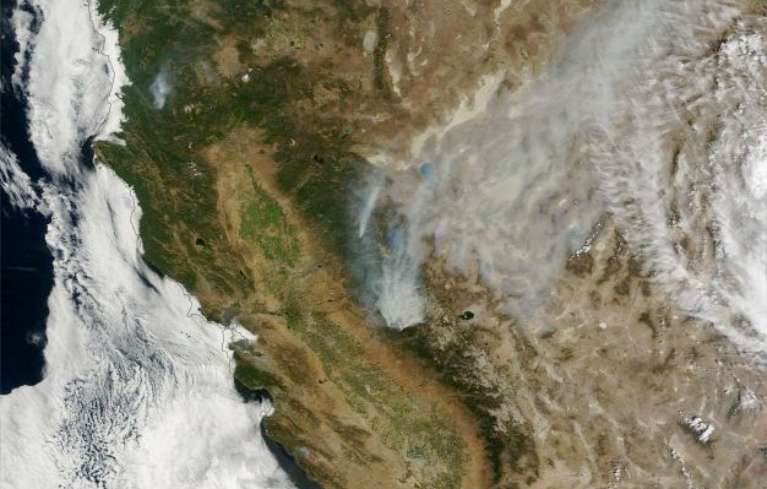
NASA image showing smoke plumes blowing north/northeast from Rim Fire outside Yosemite National Park

This NASA image shows smoke from the Rim Fire blowing toward Lake Tahoe.

By Kathryn Reed

A fire hundreds of miles from Lake Tahoe has forced the cancellation of the 24th annual Lake in the Sky Air Show.

South Lake Tahoe City Manager Nancy Kerry said the FAA requires 1.5 to 3 miles of visibility and that as of Friday afternoon it is only at one mile.

And with the National Weather Service in Reno saying the smoky skies are expected to stay through the weekend, city officials did not want to take a chance and wait to call off of the show on Saturday morning – the day of the show.

The Rim Fire burning out of control near Yosemite National Park is bringing the eerie color skies to the basin. As of 3pm Aug. 23 that fire was at 105,620 acres and 2 percent containment. Fire crews say the growth potential is “extreme”.

Kerry said there was talk of having a static air show – as in planes just on the ground. However, she said with El Dorado County public health issuing a warning for people to stay indoors, the city could not justify having people stand around inhaling the smoke – including employees and the public.

“By Labor Day it will blow out. I wish we could just switch the air show to then,” Kerry told Lake Tahoe News.

El Dorado County has said the air quality is “unhealthy”. The smoke is prevalent in El Dorado Hills and only gets stronger coming through the American River Canyon into the Lake Tahoe Basin.

Douglas County officials are also recommending people stay indoors. Air samples taken Friday in Gardnerville put the air quality in the upper end of the “moderate” level in the Carson Valley.

The National Weather Service in Reno has issued a dense smoke advisory for Alpine County and the southern part of the Lake Tahoe Basin through 7pm Aug. 24. Visibility in Markleeville and along parts of Highway 50 is expected to drop to one-quarter mile.

Ash has fallen in the Carson Valley and Alpine County.

Air quality is also an issue for the North Shore and Truckee and Carson areas. The American Fire that is burning near Foresthill is also hitting those regions.

“Afternoon-evening winds are forecast to increase somewhat each day this weekend, with winds gusts 20-30 mph Saturday and up to 35 mph Sunday. Any holdover fires from the lightning earlier this week could flare up with these gusts,” Jon Mittelstadt with the Weather Service said.

The good news about the wind is that should blow the smoke out of the basin.

In addition to the air show’s being canceled, the South Lake Tahoe city pool and Bijou Golf Course are closed. The decision to open them will be on a day-to-day basis, but Kerry said to expect them to be closed through the weekend.

Other cancellations:

• Aug. 23 Minden Concert in the Park.

• The Aug. 24-25 Lake Tahoe Outrigger Challenge Race at Lakeview Commons.

• The Strawberry Music Festival at Camp Mather on Labor Day weekend.


Calif. taxpayer-funded drug rehab under scrutiny

By Christina Jewett and Will Evans, Center for Investigative Journalism

SACRAMENTO -– California lawmakers ordered an audit this week to examine the extent of fraud in the state’s taxpayer-funded drug rehabilitation program and to assess why measures weren’t taken to stop it sooner.

The review was spurred by Rehab Racket, a yearlong investigation by the Center for Investigative Reporting and CNN that found widespread forgery and fabrication at alcohol and drug counseling clinics, as well as wide gaps in state and county oversight.

Sen. Ted Lieu, a Los Angeles County Democrat, and Assemblyman Adam Gray, chairman of the Joint Legislative Audit Committee and a Merced Democrat, jointly called for the review of the Medi-Cal-funded program for the poor.

“Ineffective oversight and fraud in the system siphons funds away from legitimate clinics, wastes taxpayer dollars and undercuts the public support for the program,” Lieu told the Joint Legislative Audit Committee.

The audit is launching days after the Los Angeles County Board of Supervisors unanimously approved its own independent review of the troubled program. That review is expected to probe what powers the county has to sanction and shut down errant clinics, since counties control the clinics’ funding.

The state Department of Health Care Services and Department of Justice also are pursuing investigations into dozens of rehab clinics that have been suspended temporarily.

The statewide crackdown spurred by journalists’ inquiries has resulted in 43 suspension letters mailed to 116 drug rehabilitation centers, which include headquarters offices and satellite offices, said Norman Williams, spokesman for the Department of Health Care Services.

The closures have hit a growing number of clinics featured in the CIR/CNN reports.

A week before the investigation’s publication and airing, authorities quickly suspended operations at Able Family Support, a San Fernando Valley clinic operated by a man with an organized crime conviction that should have disqualified him from running a Medi-Cal clinic.

Another Los Angeles County clinic, Basen Inc., ceased operations this month, according to a former staff member as well as a man who answered Executive Director Bassey Enun-Abara’s phone. Former client Vredette Hawkins described the center as a chaotic place where clients were paid $5 to show up. Enun-Abara denied the claim in a June interview.

Earlier this month, Los Angeles authorities also terminated their contract with Pride Health Services, a clinic that former employees said billed for “ghost clients” who didn’t show up for treatment.

The contract was cut based on the findings of a June Los Angeles County investigation described in the original CIR/CNN report. An anonymous complaint alleged, in part, that the firm billed for sham clients and services offered on Wednesdays, even though no services were offered that day.

Reporters confirmed in April that Pride did not see clients on Wednesdays during an interview with a receptionist captured on a hidden camera. When the clinic sent its billing to the county several weeks later, it billed for dozens of in-person therapy sessions that day.

County authorities did not find evidence to support the anonymous complaint, after talking to facility staff in May and June. However, days after the Rehab Racket series aired, the county moved on Aug. 2 to cut the contract based on other “serious deficiencies” identified in the June review. The termination notice cited the auditors’ discovery of blank medical forms signed by the clinic doctor.

Stephanie Jackson Parnell, a former employee who had filed another complaint about ghost billing at the clinic in 2009, said she was glad to see Medi-Cal funding cut off for Pride’s executive director, Godfrey Nwogene. “That’s what he gets,” she said.

Nwogene could not be reached at his clinic this week and has not responded to repeated requests for comment.

Following today’s committee approval, the Bureau of State Audits will review conduct at Pride and clinics like it at an estimated cost of $316,720.

State Auditor Elaine Howle said auditors will scrutinize clinics in Los Angeles and two other counties to determine the extent of fraudulent activity in the last five years.

“And if the corrective action has not been taken, why is that, what are the reasons that … the state and or the county has for not taking action,” Howle said.

Top audits and investigations staff from the state’s Medi-Cal agency, the Department of Health Care Services, have been briefed on fraud in the rehab program for at least five years, the CIR/CNN investigation found.

Still, the state department did not begin a review of Drug Medi-Cal until mid-2012, when it gained full authority over the program, said Karen Johnson, the department’s chief deputy director. That also was when CIR began filing Public Records Act requests related to the program.

Johnson said authorities welcome the review and plan to cooperate.

“We consider this audit to be an opportunity for us to gain more information about the program’s administration and to hear recommendations for improving it,” she told lawmakers.

The call for the seven-month state review follows the Los Angeles County Board of Supervisors’ unanimous request for a 30-day review of the rehabilitation program.

Supervisor Zev Yaroslavsky asked for a county auditor-controller review of Drug Medi-Cal oversight, noting that responsibilities have been “unclear, overly complex, and have continually shifted.”

He also called on the county Department of Public Health to develop a way to rate the severity of problems found during routine clinic reviews and to report significant findings to top management and supervisors.

“How can we do better?” Yaroslavsky said in an interview. “Because it has implications for not only this program, but the other programs we fund.”

Soon after the Los Angeles County review is expected to be completed, state lawmakers are scheduled to take up the matter again during a Sept. 26 Assembly Health Committee hearing.


Tahoe officials not worried about West Slope housing boom

By Kathryn Reed

No one knows what the economic impact to all of El Dorado County would be if 7,000 houses are built on the West Slope.

But more people would definitely further clog Highway 50, the main artery to the South Shore. Traffic is regularly choked getting out of South Lake Tahoe through Meyers on Sundays and bottlenecks again in Placerville with the traffic lights. The reverse happens on Fridays.

Tahoe tourism advocates for the past few years have tried to urge people to travel at non-peak times to help avoid the congestion and lessen the time it takes them to get to and from Tahoe. At the same they have urged hotels and restaurants and others to entice people to come earlier and stay later.

“Perhaps this presents a viable opportunity to contemplate public transit from outside the basin,” Carol Chaplin, executive director of Lake Tahoe Visitors Authority, told Lake Tahoe News.

The county could have helped the highway situation, but opted earlier to allocate Highway 50 funds to other areas.

Mike Applegarth with the County Administrator’s Office said the county has no tool to study the economic impacts of the housing because there are so many variables.

He told Lake Tahoe News that it is doubtful property taxes would cover all of the services impacted by the new development.

“But with homes comes commercial development. There is not a lot of development left on the West Slope. I think we have 1,500 acres of remaining commercial left,” Applegarth said. “Whether retail establishments generate a lot of sales taxes, it’s hard to say.”

Property tax revenue would definitely increase, especially with the new housing to be assessed at a higher rate than most of the older properties on the market.

But there is also the toll that can be taken on roads, schools, fire districts, sheriff’s office, and other infrastructure and county departments.

The county’s 2014 General Plan allows for 21,000 more houses. The General Plan for the most part covers areas outside of the Lake Tahoe Basin. The basin is covered by the Tahoe Regional Planning Agency Regional Plan and community or area plans for specific sections.

“These projects sound like they will create quite a bit of a fight between growth, smart-growth and rural advocates, putting pressure on the El Dorado County supervisors to balance these competing interests. The arguments for and against are the same arguments that have been waged in most locations throughout the west for many years,” Nancy Kerry, South Lake Tahoe city manager, told Lake Tahoe News.

She doesn’t see the housing alone negatively impacting the South Shore, but added that if jobs that pay well are part of the equation, then an impact would likely be inevitable.

El Dorado County Supervisor Norma Santiago, who represents Tahoe, was not available for comment.

“From a tourism standpoint, it won’t drive much in the way of room nights as the West Slope would be a day trip market for the most part,” Chaplin said. “With that said, it could benefit our recreation providers and generate sales tax through purchase of activities, retail and restaurant food-beverage.”

While the Lake Tahoe South Shore Chamber of Commerce is supposed to represent a different constituency than LTVA, chamber CEO B Gorman said, “I think (Chaplin) covered all that I would have said.”

Then there is also the matter of 10,000 houses that are slated to go in next door in Folsom – which is in Sacramento County.