Economy shrinking Nev. brothel business

By Alison Vekshin, Bloomberg

In a dim parlor furnished with red velvet couches and a stripper pole, Brooke Taylor is having a sale on herself.

“I offer a lot more specials and discounts and incentives for people to come in to see me,” said Taylor, 32, a brunette prostitute in a short, green dress at the Moonlite Bunny Ranch outside Carson City. “People are looking for deals.”

Nevada’s legal brothels, which took root in the mid-1800s silver-mining boom, are dwindling, down to about 19 from roughly 36 in 1985, according to George Flint, an industry lobbyist. Many have been the highest-profile businesses in their sparsely populated regions, and their decline hurts already-stretched county budgets and marks the end to local institutions — though not the universally beloved sort.

The state’s flagging economy, decreased patronage by truckers squeezed by fuel costs and growing use of the Internet to arrange liaisons are to blame, managers say.

“A lot of our clients don’t have the discretionary income they had six years ago, five years ago,” said Susan Austin, 63, the madam of the Mustang Ranch in Sparks. “The ones that can come in, they aren’t spending quite what they were spending before.”

Read the whole story


Yellowjackets coming out in large numbers

By Kathryn Reed

Depending on where you are in the Lake Tahoe Basin, more yellowjackets may be buzzing around compared to years past.

“The vector techs are seeing more yellowjackets this season because the winter was more mild, which allows more queens to survive through the winter. Each queen trapped in the spring represents one less nest of up to 5,000 worker yellowjackets in the summer and fall,” Karen Bender with El Dorado County Department of Environmental Health told Lake Tahoe News.

She said it’s not just Tahoe that is affected, but all parts of the county are seeing an influx of the bees.

A honeybee nest found in May by El Dorado County vector control. Photo/Provided

A honeybee nest found in May by El Dorado County vector control. Photo/Provided

On Monday her department had 16 service calls related to yellowjackets and have been averaging about 10 a day for the past week. Specialists apply a pesticide that comes in a white powder. It’s a product that is not available to the public.

“One reason we want vector control to go out is because we don’t want to kill honeybees,” Bender explained.

Honeybees are the “good” bees that are needed to keep everything pollinated; after all they are responsible for 80 percent of the insect pollination.

Yellowjackets are part of the wasp family.

County residents pay $6 a year via property taxes for vector control, so a home visit is part of taxes already paid. What workers won’t do is go inside a residence; they only deal with outside bee and wasp issues.

Yellowjackets can make nests in the ground, under decks, in walls, under eaves and other places. Because they can be on the ground it’s important to pay attention to each step to avoid being swarmed by the yellowjackets.

In the forest the bees don’t seem to be as much of a problem as in more populated areas.

Holly Holwager, a harvest inspector with Lake Tahoe Basin Management Unit, said, “We are seeing the same amount of bees in the field, however they seem less aggressive than last field season.”

Bees and wasps are attracted to water, go after food and like to sting people, too. Last weekend a woman was stung while playing tennis at Zephyr Cove park.

Bee and wasp stings can be lethal for people who are allergic to them.

Warren Withers, director of Barton Memorial Hospital’s emergency department, said he has noticed more people coming in with stings this year compared to last year.

“When we do see the stings they can cause a variety of reactions – from minor irritation to more serious allergic reactions,” Withers told Lake Tahoe News. “They do tend to be more numerous and more aggressive in September-October, especially as the weather cools, until the first hard freeze.”

Barton Urgent Care and Family Practice has also had an uptick in sting cases recently, but so far their numbers have not surpassed 2012 figures.

The medical advice is that minor stings should be treated with Benadryl and a cold compress. If the sting is infected, get medical help because antibiotics may be needed. Call 911 if after a sting there is tightness of the throat, nausea and vomiting, difficulty breathing, cramping or abdominal pain, or fainting.

Having an epi pen is also advisable for those with known allergies.

El Dorado County vector control is at (530) 573.3197.


Study: Growing number of kids ‘too hungry to learn’

By Rebecca Klein, Huffington Post

The vast majority of teachers and principals routinely see students that are “too hungry to learn,” according to a report released Tuesday by the No Kid Hungry organization.

The organization, which works to end child hunger, surveyed more than 1,000 teachers and principals around the country for the report, according to a press release. The results show that 73 percent of teachers said they regularly instruct hungry students who don’t have enough to eat at home, and 87 percent of principals said they consistently see hungry students in school. As a result of such pervasive hunger, teachers spend nearly $40 a month buying food for kids out of pocket, the survey found.

The results represent an increase since last August, when the organization found that 3 out of 5 teachers had students who regularly came to school hungry. Christy Felling, No Kid Hungry public relations director, told the Huffington Post that there are several potential reasons for the uptick in hunger.

“I think what has happened is the so-called economic recovery hasn’t really reached low-income people. People are still really having a tough time, and that’s what we’re seeing,” Felling said in a phone interview. “We’ve seen it anecdotally with some of our campaigns around the country. People still haven’t gone back to work, or they’ve blown through savings.”

Read the whole story


Summer is a hot season for colds

By Angela Chen, Wall Street Journal

Something summery may be lingering even as the season fades — the summer cold.

Colds in summertime can last for weeks, at times seemingly going away and then suddenly storming back with a vengeance, infectious-disease experts say. A winter cold, by contrast, is typically gone in a few days.

The reason for the difference: Summer colds are caused by different viruses from the ones that bring on sniffling and sneezing in the colder months. And some of the things people commonly do in the summer can prolong the illness, like being physically active and going in and out of air-conditioned buildings.

“A winter cold is nasty, brutish and short,” says Bruce Hirsch, infectious-disease specialist at North Shore University Hospital in Manhasset, N.Y. “But summer colds tend to linger. They can go on for weeks and reoccur.”

Summer colds, which can hit between June and October, occur only about 25 percent as often as the winter variety. But summer colds can have more severe, flu-like symptoms, in addition to sneezing and coughing. Many people also mistake a summer cold for allergies, because it just doesn’t seem to leave.

Read the whole story


S. Tahoe restaurant owner strives for originality

Gunbarrel's Lamb Lollipops, Tower 16 and Brie sandwich. Photo/LTN

Gunbarrel restaurant’s Lamb Lollipops, from left, Tower 16 Tuna and Brie sandwich. Photo/LTN

By Kathryn Reed

Unconventional. That’s exactly what the owner of Gunbarrel Tavern & Eatery wants to be.

“We are here to give the finger to standard ideas about what a menu is supposed to be. We try to do things different … to not abide by anything you have to do,” Alex Cox said.

Cox this month opened Gunbarrel restaurant in Heavenly Village where Wolfgang Puck’s used to be. He is also the owner of 22 Bistro at the Village at Squaw Valley.

He has incorporated his love for skiing into the names of his restaurants. Gunbarrel is the same name as Heavenly Mountain Resort’s face and the 22 comes from Squaw’s renowned KT-22.

Cox thought he was moving to Lake Tahoe to be a ski bum after he graduated from the University of Indiana. He was right. But what wasn’t in the original plan was to make Tahoe his home. That he has done for more than a decade.

What he brings to the restaurant business is a desire to showcase foods he and his staff like, with dishes that are unique, some that are prepared in original ways and other items that appeal to the masses.

Billy McCullough is the executive chef at both restaurants. McCullough is also executive chef of Dragonfly, the Truckee restaurant he owns. He is also the co-founder of Slow Food Lake Tahoe.

Gunbarrel’s head chef is Ricky Sausser. Sausser grew up on the North Shore. He worked for McCullough before being hired at 22 Bistro in 2009.

The goal, according to Cox, will be to use as much local food as possible. Local, though, could be the Central Valley since not much grows in Tahoe. But what he would like to do is use the biodome in Truckee or the one proposed for Squaw Valley to grow something like chard or kale to have on the menu as a truly locally sourced item.

Talks are also under way with farmers in Nevada to potentially provide produce to Gunbarrel.

The range of menu choices is varied. Those in the media who were invited to a special tasting last week raved about the Mac N’ Cheese. It comes as an appetizer with bacon, but as a side (without bacon) with the PBR Beer Can Chicken. This chicken is Cox’s favorite on the menu. An LTN reporter said she would easily order the chicken again.

For the Lamb Lollipops it takes some time over the grill before they come to the table. This is because the lack of a binding agent requires the chef to apply pressure as they cook so the meat stays on the stick. Then this appetizer is served with a harissa yogurt sauce and a mini cucumber mint salad.

The Tower 16 Tuna was another app that people raved about. The Fire-Roasted Cauliflower with achiote chili oil and toasted lemon zest just gets better as the flavors meld together.

The caramelized onions and balsamic glaze on the Brie Grilled Cheese added sweetness to the sandwich and balanced the richness of the Brie. The chips served with it are cooked and seasoned at the restaurant. What’s in the seasoning is a secret. But each bite is a bit different, at times sweet, at times spicy – all good.

To complement the variety of food items is an interesting drink menu. The beer and wine choices are limited.

Even the décor is a bit eclectic. The exposed concrete is a bit new age-industrial, while the tables are mountain wood.

Cox is working on creating an outside bar and eating area that would include fire pits and live music.

“At this time, due to the prohibitive cost, Gunbarrel Tavern does not validate parking. We are currently looking into other potential solutions but have yet to come to an effective resolution. We are hopeful, however, that we will be able to validate customer parking in the future,” Cox told Lake Tahoe News.

Gunbarrel is open for lunch and dinner seven days a week.


Quest is on for safer drinking water in U.S.

By Peter Andrey Smith, New York Times

UNIONTOWN, Pa. — On a muggy Friday afternoon in a strip mall parking lot, as thunder echoed in the Alleghenies and cottonwood seeds floated on the breeze, Lee Stanish, 32, a postdoctoral researcher at the University of Colorado Boulder, and Natalie Hull, 24, a lab manager, stepped out of a white van, its hood plastered with dead insects.

After a brief conversation with a chain store manager, the two women retrieved a large black container from their van and wheeled it into the bathroom. Ms. Hull opened the faucet and let the cold water run. The two snapped on disposable gloves, unpacked their equipment, and began collecting tap water.

Hull checked the water temperature and filled water in a vial of formaldehyde for cell counts. Stanish placed another vial of water in a portable chlorine meter for analysis. “We’re in and out in about 10 minutes,” she said. Hull flipped the faucet off. On to the next tap.

By nightfall, the van would be loaded with close to 30 gallons of water sampled from dozens of locations across the Ohio River Valley. Stanish and Hull planned to set up a mobile laboratory in a hotel room in Morgantown, W.Va., all in an effort to understand a hidden underground ecology where organisms eke out a living in dark, cool pipes loaded with chlorine.

“What we know so far is that it’s usually very clean,” Stanish said. “But it’s a disturbed environment.”

The 53,000 water utilities in the United States deliver some of the safest drinking water in the world — a public health victory of unrivaled success that began in 1908 with chlorination campaigns in Jersey City and Chicago. Still, millions of individual cases of waterborne diseases occur annually and related hospitalization costs approach $1 billion each year. In 2007 and 2008, the most recent years for which figures are available, the Centers for Disease Control and Prevention recorded 164 waterborne disease outbreaks, almost entirely from protozoan cysts of the parasite Cryptosporidium.

Read the whole story


Rim Fire’s intensity takes toll on ecosystem

By Bettina Boxall, Los Angeles Times

Standing on ridges miles away from the Rim Fire, John Buckley has traced the path of the huge Sierra Nevada blaze by watching fire clouds billowing above the Stanislaus National Forest.

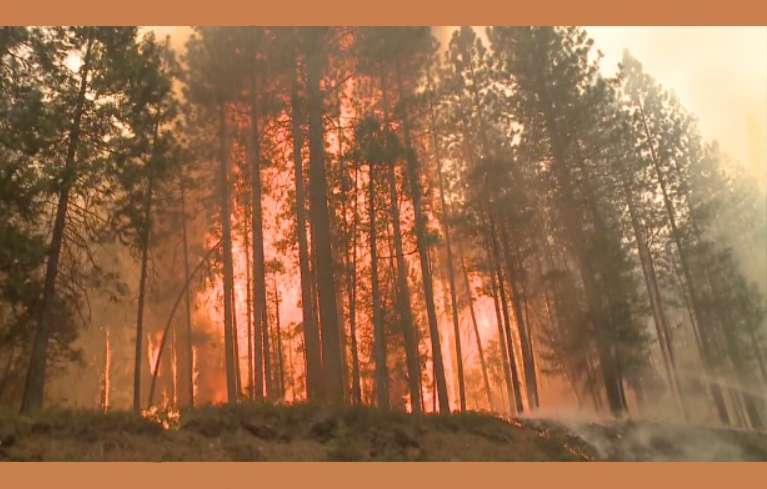
The view has been sobering. As the Rim blaze burns its way into the record books, Buckley thinks it is roasting some of the last remaining old-growth stands in the Stanislaus forest, incinerating thousands of acres of young trees planted at a cost of millions of dollars after massive 1987 fires and destroying important nesting areas for California spotted owls and goshawks.

The Rim Fire near Yosemite is one of the largest in California's history. Photo/CBS Sacramento

The Rim Fire near Yosemite is one of the largest in California’s history. Photo/CBS Sacramento

The extent of ecological damage from the Rim fire won’t be known until after it dies out and crews survey the burn area. But given the intensity of the blaze and 200-foot-tall walls of flame shooting up canyons, Buckley and others expect nothing to be left on big patches of mountain chaparral areas and timberland.

“It’s making these incredible hot runs where it’s literally wiping out the forest,” said Buckley, an ex-firefighter for the U.S. Forest Service and head of the Central Sierra Environmental Resource Center, which has worked for more than two decades to protect the region’s ecosystem.

For a variety of reasons, the region is one of the most burned in the Sierra.

Read the whole story


El Dorado County, union close to agreement

By Kathryn Reed

What was going to be a protest during today’s El Dorado County Board of Supervisors is now expected to be more of an employee rally.

This is because labor negotiations suddenly took a turn for the better on Monday.

“We are cautiously optimistic we are going to be able to reach a settlement that is fair and equitable to everyone,” Richard Boyd, senior business agent for Local 1, told Lake Tahoe News.

The nearly 800-strong Local 1 has been negotiating with the county since February to come up with a contract. The bargaining unit has been working without a contract since June 30 when the previous three-year contract expired. An unfair labor practice charge was filed with the Public Employees Relations Board.

Boyd said the county has been negotiating in bad faith up until Aug. 26 and that it had violated various bargaining rules, which is why the charge was filed with PERB.

“Regarding the unfair labor practice grievance filed by Local 1, the county is aware of the claim. The claim is baseless and we find it surprising given the progress that the parties are making at the bargaining table,” Terri Daly, the county’s chief administrative officer, told Lake Tahoe News on Aug. 26.

Boyd believes filing the charge spurred the county to come to the table Monday with a more reasonable offer. That offer has not been made public. The union and county are slated to sit down again Sept. 9.

The union represents almost all county employees except for sworn officers and management.

In the contract that expired nearly two months ago no raises were given and the big item was that employees had to pay 3 percent into their retirement via the Public Employee Retirement System.

Now Local 1 is asking for a four-year contract with wage increases each year starting with 5 percent this fiscal year and 3 percent each of the subsequent years.

It’s not that county isn’t giving raises, but they are for higher ups. Kelly Webb, interim information technology director, went from step 3 on the pay scale to step 4 on July 23, and then to step 5 on Aug. 6. The electeds approved these raises on 5-0 votes.

On July 31 the rate of pay for the human resources director was $124,821. CAO Daly asked for it to be bumped to $157,810 and the supervisors said OK on Aug. 1. Then Daly hired a friend of hers for that position.

On today’s agenda is an item talking about hiring a communications specialist at $100,000, even though it’s not in the budget.

This chart details who the top salary earners are in El Dorado County.

A class and compensation study is also something the union wants.

“The county has agreed they are not competitive and because they are not competitive they have monumental recruitment and retention problems,” Boyd said.

What the union is upset about is what it calls cherry picking individuals for raises – like the IT and HR directors.

“For us, it gets down to a justice and fairness argument,” Boyd said.


Agreement reached to repair Mono Lake damage

By Louis Sahagun, Los Angeles Times

Ending decades of bitter disputes over fragile Mono Lake, Los Angeles and conservationists on Friday announced an agreement to heal the environmental damage caused by diverting the lake’s eastern Sierra tributary streams into the city’s World War II-era aqueduct.

The controversy over alkaline Mono Lake, which is famous for its bizarre, craggy tufa formations and breeding grounds for sea gulls and migratory birds, is one of California’s longest-running environmental disputes.

The settlement resolves all of the issues among weary combatants, including the city of Los Angeles, the Los Angeles Department of Water and Power, the California Department of Fish and Wildlife, California Trout and the Mono Lake Committee.

It calls for construction of a $15-million adjustable gate in Grant Dam, an earthen structure 87 feet high and 700 feet long designed to impound tributary water. The goal is to release pulses of water along a seven-mile stretch of Rush Creek to mimic annual flood cycles, distributing willow seeds and promoting healthy trout populations. The settlement will not affect water levels at Mono Lake.

Read the whole story


Baby boomers may lack caregivers in old age

By Walter Hamilton, Los Angeles Times

Baby boomers may have no one to care for them in their old age.

Shifting demographics mean that aging boomers will have fewer friends and family members to take care of them as they get into their 80s, according to a new study by AARP.

In other words, even though you may be supporting your own elderly parents, the chances of someone being there for you are numerically diminished.

Read the whole story