2017 was costliest year ever in U.S. for weather

By Kurtis Alexander, San Francisco Chronicle
 
 Last year’s devastating floods and fires in California combined with hurricanes and other natural disasters to wreak unprecedented financial damage on the United States, the federal government reported Monday.

The nation endured 16 weather and climate events that inflicted $1 billion or more apiece in damage in 2017, tying 2011 for the most 10-digit calamities in a year and setting an annual total-cost record of $306 billion, according to the National Oceanic and Atmospheric Administration. The natural disasters resulted in 362 deaths.

Read the whole story


18 states may introduce sports betting bills in 2018

By Wayne Parry, AP

ATLANTIC CITY, N.J. — A new report predicts 18 states will introduce bills to regulate sports betting this year, with 11 having a good chance of passing legislation.

Eilers & Krejcik Gaming, which tracks gambling legislation nationwide, says that’s just the minimum; the firm predicts more than 30 states could introduce sports betting bills.

The U.S. Supreme Court this year will decide a case brought by New Jersey that seeks to overturn a ban on sports betting in all but four states: Delaware, Montana, Nevada and Oregon. A favorable ruling in that case could open the floodgates in terms of states adopting a new form of gambling.

Read the whole story


Sierra, Squaw turn Olympic dreams into reality

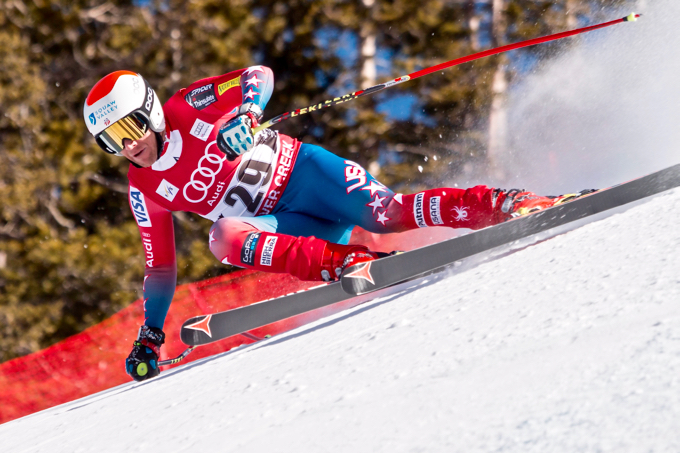
Squaw Valley racer Marco Sullivan competed in four Olympics. Photo/Eric Schramm Photography

By Susan Wood

When the Winter Games in PyeongChang, South Korea, surge into our consciousness next month, retired alpine ski racer Marco Sullivan’s snow-filled mind is sure to drift to another mountain.

Sullivan, like many before and expectedly after him, grew up gracing the slopes of Squaw Valley.

Squaw, like its southern Lake Tahoe counterpart – Sierra-at-Tahoe, has an uncanny knack for cultivating Olympians. Combine Travis Ganong, Julia Mancuso, and Jonny Moseley on one shore with Jamie Anderson, Maddie Bowman, Hannah Teter and Travis Cabral on the other – and you’ve got a powerhouse assortment of Olympic medalists and contenders.  

“I’m really proud to say I’m from Squaw. Maybe it’s a similar vibe at Sierra,” Sullivan, a 37-year-old Truckee resident, told Lake Tahoe News. “There’s a long tradition of people in the valley, ex-ski team, who have established a vibe.”

To those associated with these athletes, there are various reasons why these no-holds-barred, homegrown resorts crank these top-of-their-field competitors out of the gate. Unique qualities ranging from the magnitude of the training program and the terrain to the abilities of the coaches and desires of the parents and resort management were cited from a host of people on the periphery. Plus, health care support like that found in Barton orthopedics is also commendable, U.S. Ski and Snowboard Chief of Sport Luke Bodensteiner outlined for LTN.

This year is no exception.

“I think we have the best team going,” Bodensteiner said boldly. There’s a whole crop of kids looking to carry on the tradition of excellence from the American team.
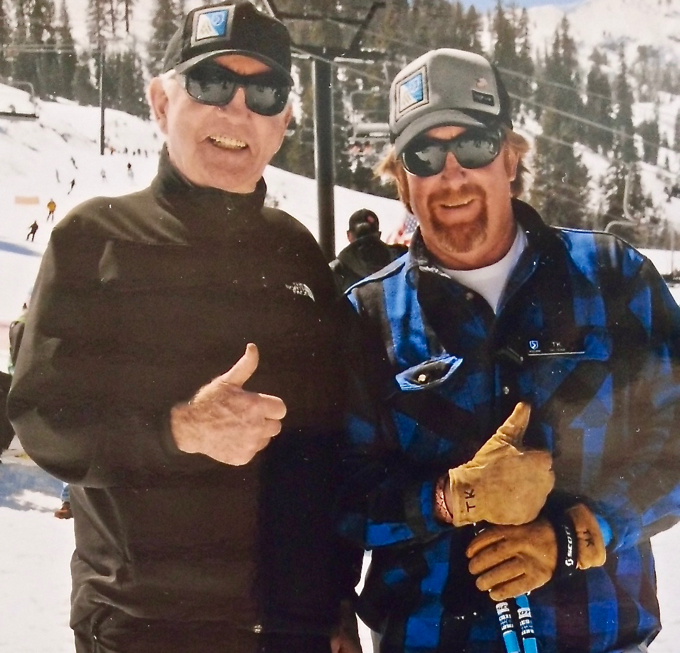
Tom and Todd Kelly are part of Squaw’s skiing heritage. Photo/Provided

And for Tahoe, it’s part of a history dating back as far as 1960.

For his part, Sullivan dreamed of competing in a World Cup race as early as age 5. The ski team member traded good grades and his traditional physical education class at North Tahoe High School for hours on the mountain in the afternoon. As the ski team head coach, his late uncle Mark “Sully” Sullivan saw something in Marco that groomed him for competition.

“The guy paved the way for me,” Sullivan said. “I never questioned going to the U.S. Ski Team. It was a given.”

The rest is history – a storied one filled with trials and tribulations. He competed for 15 seasons and made 105 World Cup starts – the most of any American racer. Podiums were hard to come by – four total. But the memories carved an indelible mark on his life, proving the journey is as important as the destination.

When he retired from racing, it was emotional.

“I ended a big part of my life. It’s not something that came easily,” he said. “I guess looking back I wished I would’ve won (a World Cup race). When you’re getting in 15th place, sometimes you forget you’re representing your country. I appreciate it all now.”

He now sees that fire in the eye of teenagers while running the American Downhill Ski Camp. The last large outing brought out 30 bright-eyed hopefuls between the ages of 12 and 19, along with a superstar staff including the most decorated downhill racer-turned-skiercross competitor Daron Rahlves, also from Truckee and retired. Sullivan also works as a NASTAR pacesetter on tour. Essentially, the job coaxes the competitors to meet and exceed the race-time threshold of a veteran.

As the Olympics go, he competed in four – Salt Lake City, Turin, Vancouver and Sochi.

He likes the chances of the women as well as his Squaw comrade Bryce Bennett this year.

When the teams are announced Jan. 20, it will mark almost six decades since Squaw Valley hosted the Games. That date comes only a month after the U.S. Ski and Snowboard Association announced a five-year agreement with the legendary North Lake Tahoe resort as an official training site of the U.S. Ski and Snowboard Team. While hosting the FIS World Cup Championships last year, Squaw joins the ranks with Mammoth Mountain, Deer Valley, Copper Mountain and Timberline.
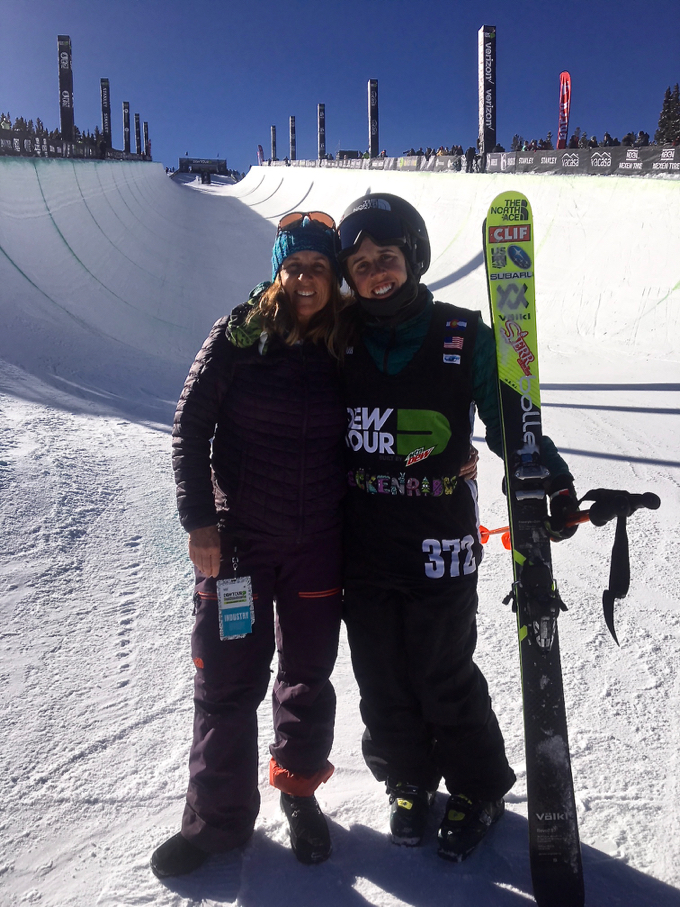
Sue and Maddie Bowman prove the power of family is strong at Sierra in so many ways. Photo/Provided

It takes a village — a familial one

An extraordinary ski team program is as crucial as the culture that created it, Squaw-Alpine Ski and Snowboard Team Director Todd Kelly insists.

Let’s face it, when you have kids who see the exhilaration and temptation for greatness as young as age 4, it’s tough to deny their shot. And Squaw sees many.  They learn early on who is Tamara McKinney, a four-time World Cup champion, and they see stars.

The program trains those who “bleed blue” (their uniform colors) in three disciplines — GS “giant slalom,” slalom and downhill. The development segment runs from ages 4 to 9.

“You can spot these kids here and there at age 5 to 7 – the ones that can ski great,” Kelly said.

Racing starts as early as age 7, and they grow into three age categories. From there, it takes a mature mental toughness.

“You definitely have to believe in yourself that you can win on that day,” Kelly told LTN.

He should know. Kelly, 48, went through the ranks and made the same declarations more than three decades ago – at this same mountain. He competed from 1986 to 1994 and was rated as the top U.S. super-G skier.

The village is indeed a family.

Marco’s uncle “Sully” was Kelly’s mentor before he died three years ago. So the connections run as deep as a healthy Sierra dumping in February.

The simplest argument is the culture breeds ski royalty from Truckee to Squaw Village.

“When you make a right or a left turn into the valley, there’s a culture for skiing and a passion that you learn at (age) 3 or 4,” Kelly said.

Of course, it helps when your father paves the way.

“Basically, it’s the mountain,” said Tom Kelly, a giant in his own right.

The two men provided a father-son perspective about Squaw with Lake Tahoe News. Their views were intertwined.

The elder Kelly, the resort’s 69-year-old building services manager, was a former Olympic and U.S. Ski Team coach.

He points out that even if the conditions vary, (take the unseasonably warm slush World Cup competitors navigated through last March at Squaw), the systematic support makes all the difference to a ski area bringing an athlete up to par.

“They need tremendous support from the people who run it,” he said with a nod to Squaw chief Andy Wirth.

Kelly and his son not only cite Wirth, the person at the helm of their resort, but Tom Kelly is quite familiar with the unbreakable reputation of John Rice at Sierra-at-Tahoe.

Jamie Anderson, Maddie Bowman and Hannah Teter celebrating in 2014 at Sierra. Photo/LTN file

The power of place of Sierra

After the last Winter Games, Sierra-at-Tahoe hosted a huge community party to honor three women who have all won gold medals for Lake Tahoe.

Snowboarder Teter, who earned hers in an earlier Olympics, with snowboarder Anderson and free skier Bowman having achieved theirs from 2014 — all say the same thing when asked where they honed their exceptional skills on snow. Sierra-at-Tahoe, a smaller resort than other properties owned by a conglomerate, is their home resort.

They let that be known in various ways.

Teter, who hailed from Vermont, released her version of maple syrup in an event at the Sierra Pub.

Anderson speaks often of freeing her in-demand mind by cutting loose in the stashes of Sierra.

Bowman, well, she’s rather engrained in the culture – as her mom knows so well.

How many teenagers do you know would take the time to deliver homemade fudge to the employees spread out all over a ski resort during the holidays?

Maddie’s mother, Sue, a volunteer coach who is celebrating her 52nd year skiing, makes 16 pounds of it. The mother-daughter duo thinks nothing of stuffing the secret recipe into their packs and making the rounds. It’s gotten to the point in which the staff counts on it, waiting for the days when the younger celebrity takes time out of her busy schedule to come home.

The tricks Bowman performs on skis are only matched by her humility.  That’s because she knows where she comes from and lives by those died-in-the-wool, mountain-community ethics that make Sierra-at-Tahoe something other resorts may not get.

For one thing, the resort groomers and terrain park builders are known to move heaven and earth to create a masterpiece challenging enough for Olympians to be interested.

For another, General Manager Rice implemented a program at Sierra-at-Tahoe years ago that provides free ski passes for students at Lake Tahoe Unified School District making a 4.0 grade point average. Hundreds of passes have been doled out, students have excelled, and Rice set a benchmark for teens like Bowman to become the role model she is today. Bowman attributes part of her success to that program.

Then there’s the attitude that starts from the top down. Sue Perpall told LTN she’ll never forget when her daughter was about to make her debut on a Dew Tour in her “tore-up” ski pants. Rice took her to one of the resort’s retail shops and bought her a “presentable” pair.

“When someone helps you out like that, it boosts your confidence,” Perpall said.

Perpall has tried to put things into perspective because it’s common for parents “to think their kids are superstars.” Maddie was proving it on the Buddy Werner team among others, and Rice saw it.

“It never occurred to me (she would be a contender). But John skied up to me one day and said: ‘I want to back her,’” she said. “How many general managers can ski up to somebody, first find their mom, then know when someone has promise?”

Bowman just thought she wanted to hang with the boys as sometimes the only girl in a daredevil group destined for greatness. They’d challenge her, and she delivered.

“She was always a tomboy from Day 1. When she’s on top of the halfpipe, she brings it,” Perpall said.  “And Sierra bends over backward to build its halfpipe when it can. It’s been amazing what they’ve been able to do.”

Perpall emphasized the lack of dedication from other resorts.

That commitment is also noticed by the industry.

“Sierra is different. With Sierra, it may well be the culture for Hannah, Maddie and Jamie. I think the stuff they do when it comes to the Olympics fits with Sierra – that laid-back style,” California Ski Industry Association President Mike Reitzell said.

Then, there’s the obvious.

“I think Squaw is a no brainer. When you host the Olympics, you’re forever entrenched as the place that’s going to attract the Olympians. And Squaw totally embraces its Olympic heritage,” Reitzell told Lake Tahoe News. “It’s evident when you first see those Olympic rings off Highway 89.”

The Winter Games start Feb. 9.



Nevada has two races in national spotlight

By Colton Lochhead, Las Vegas Review-Journal

 Nevada is sure to see plenty of national attention as this year’s election cycle ramps up.

Politico recently rated the Silver State’s 2018 battles for U.S. Senate and governor as races to watch.

Sen. Dean Heller’s re-election bid, which features a primary challenge from businessman Danny Tarkanian and a strong Democratic candidate in freshman Rep. Jacky Rosen, ranked as Politico’s top Senate race to watch.

Politico also ranked Nevada’s race to replace term-limited Gov. Brian Sandoval fifth in its Top 10 governor’s races to watch in 2018.

Read the whole story


Nev.’s first female senator shares her progress, priorities

By Yvonne Gonzalez, Las Vegas Sun

Twenty-six palm-sized portraits of Nevada’s U.S. senators hang on a wall here. The most recent portrait is not another man in a no-nonsense tie, but a pearl-wearing Latina whose election in 2016 made state history.

As the state’s first female senator and the chamber’s first Hispanic woman, Catherine Cortez Masto replaced former Sen. Harry Reid, a Democrat who in more than 30 years in office became one of the most powerful politicians in state history. He led the Senate majority and endorsed Cortez Masto immediately after she announced her candidacy.

Whether she could fill Reid’s shoes, she says, is a question she has had to answer often.

Read the whole story


Fires prompt bill to improve emergency alert system

By Joaquin Palomino, San Francisco Chronicle

North Bay lawmakers have introduced a bill to bolster the ability of emergency officials to contact residents who may be in harm’s way — a topic that has been scrutinized since last year’s devastating wildfires.

The legislation, introduced by multiple lawmakers, including state Sen. Mike McGuire, D-Healdsburg, would create uniform statewide emergency notification protocols. It also would require all counties to develop and adopt guidelines for using Wireless Emergency Alerts, a federally administered system that can send Amber Alert-style messages to cell phones in a disaster area.

As the Chronicle and others have reported, many North Bay residents said they received no official warning and were blindsided by the rapidly spreading flames that sparked in multiple counties in October.

Some experts said that statewide systems can be useful for regional or large-scale disasters, but in smaller incidents notification decisions are often better left to local leaders.

Read the whole story


South Lake Tahoe pot shop willingly closes doors after being denied for-profit status by state

People wanting Tahoe Wellness Cooperative to remain open picket outside the center on Jan. 7. Photo/LTN

By Kathryn Reed

Tahoe Wellness Cooperative shut its doors on Jan. 7, but the medicinal marijuana shop hopes to reopen tonight or Tuesday morning.

There is a discrepancy as to why exactly the doors were closed because neither the state nor the city of South Lake Tahoe directed the business to do so.

“He decided to close on his own free will,” City Manager Nancy Kerry told Lake Tahoe News of TWC owner Cody Bass.

As California started its foray into recreational marijuana on Jan. 1, it also meant changes for existing medicinal marijuana establishments. New businesses and those changing their status must have a permit from the state Bureau of Cannabis Control. Those permits are temporary until June at which time the state will be assessing what is working and what isn’t.

The South Lake Tahoe shop said it had its license in hand before 2018 arrived.

However, a letter dated Jan. 5 from the state agency to Bass says, “After review of your application and supporting documentation your application is denied because you do not qualify for a temporary license at this time. You have not been authorized by the local jurisdiction to conduct the commercial cannabis activity for which you have applied.”

The “commercial” aspect is what is the stumbling block. This puts TWC under a different classification from how it has operated for the last seven years as a nonprofit. It would still only be a medicinal dispensary because the city has a temporary moratorium on recreational sales.

“Commercial designation means for-profit and that they could only do business with other licensed entities,” Alex Traverso with the state Bureau of Cannabis Control told Lake Tahoe News.

Bass would not speak directly to LTN.

Had Bass not sought the commercial designation, he could have been operating as he always has. He did not need a temporary state license to continue what he had been doing.

The city had to tell the state if TWC had a permit to do business. It doesn’t, but the city explained by court order the dispensary is allowed to operate.

(The city and Bass are in a legal dispute about the permit. While a court hearing is slated for next month, that could be a moot point because Bass is in escrow to buy the building near the Bijou Center – which means he’d be his own landlord and would permit the business to continue operating.)

“In order for a state license to be issued, the local government must also agree to permit the business, and the local government was not willing to permit the activity. So we couldn’t license Tahoe Wellness,” Traverso said.

On Sunday less than a dozen people were outside TWC protesting. They were placing blame for TWC’s closure on everyone but TWC when in fact TWC chose to lock its doors.

The TWC employee who said the dispensary may soon reopen didn’t explain why this could happen nor did the person elaborate if TWC would stick with being a nonprofit.

This means for now NuLeaf in Incline Village is the only place to get marijuana legally in the Lake Tahoe Basin.


Why there’s a rush to buy untreated water

By Nellie Bowles, New York Times
 
SAN FRANCISCO — At Rainbow Grocery, a cooperative in this city’s Mission District, one brand of water is so popular that it’s often out of stock. But one recent evening, there was a glittering rack of it: glass orbs containing 2.5 gallons of what is billed as “raw water” – unfiltered, untreated, unsterilized spring water, $36.99 each and $14.99 per refill, bottled and marketed by a small company called Live Water.

“It has a vaguely mild sweetness, a nice smooth mouth feel, nothing that overwhelms the flavor profile,” said Kevin Freeman, a shift manager at the store. “Bottled water’s controversial. We’ve curtailed our water selection. But this is totally outside that whole realm.”

Here on the West Coast and in other pockets around the country, many people are looking to get off the water grid.


Read the whole story


Lake Tahoe Airport on path to being self-sufficient

By Kathryn Reed

Like most things in the basin, even Lake Tahoe Airport is seasonal. Sixty-eight percent of the landings are between May and October.

This was just one of the many statistics that was part of a workshop last month conducted by airport manager Mark Gibbs for the South Lake Tahoe City Council.

On the conservative side, the airport is bringing about 50,000 people to the area annually. The annual impact on the economy is more than $1.27 million.

In 2015, there were 23,595 aircraft operations.

Gibbs’ goal is to decrease the airport’s impact on the city’s General Fund, which today is a little more than a quarter million dollars each year. He told the council his focus in on economic vitality.

“We need to recognize and promote that fact,” Gibbs said.

One way to do that is through events and leasing of airport facilities.

In 2017, the Marines were in town for 10 days. Beyond using the airport – refueling being a biggie – it meant 35 hotel rooms, dining and rental cars for the flyboys.

This year there will be a weeklong gay pilots fly-in event that is expected to attract more than 100 people.

Solar generation may be brought to the airport. This would save the city thousands of dollars each year in electric bills.

The airport has 11 tenants who pay rent. Hertz is going to resume a limited car rental business at the airport.

Individuals who rent hangars account for 36 percent of the airport’s revenues. Building more is possible.

Gibbs would also like to develop an aviation repair and maintenance facility.

A potential income source is developing the land the city owns around the airport. This would be a long-term revenue stream. While a music venue was talked about going there, the limited acreage silenced that idea.

“The whole South Shore has a storage shortage,” Gibbs said. It’s not that he wants the city to get into the storage business, but it would be possible to lease the land to someone who wants it for that purpose. This could be for boats/RVs or household items.

Gibbs shared that the Minden airport’s largest revenue source is storage rental.

While the airport is able to rely on the Federal Aviation Administration to pay for the bulk of runway paving, the feds don’t pay a dime when it comes to vegetation management even when safety is the overriding reason to do anything. And this is going to be a big issue for the airport in the coming years.

Trees are a safety issue for planes landing and taking off. Gibbs would like to create an annual airport timber harvest plan. The annual tree harvest ended in the 1990s because of the Tahoe Regional Planning Agency and League to Save Lake Tahoe’s lawsuit against the airport.

While the airport has seen many changes through the years, it isn’t going to close. As Gibbs pointed out, the feds have listed it as one of the 100 most important airports in the country. It’s a resource for military training, firefighting and is a life line to the outside world if roads into the basin were to be inaccessible.

“This airport is very important to the economy and to the nation,” Gibbs said.


Stryder Franklin — 1973-2018

David Stryder Franklin

David Stryder Franklin, age 44, passed away in a tragic accident on Jan. 1, 2018, in Costa Mesa, Calif. Funeral services will be at Pacific View Memorial Park and Mortuary located at 3500 Pacific View Drive in Corona del Mar, on Jan. 12, 2018 at 2pm.

Stryder was born in Hollywood on March 25, 1973, and grew up in Orange County. He moved to South Lake Tahoe with his family at age 9.

Stryder attended Whittell High School in Zephyr Cove and graduated in 1992. Stryder served in the Navy from 1993 to 1996 as a third class petty officer of the Helicopter Combat Support Squadron Five. Stryder graduated from Platt College with a degree in information technology networking in 2001.

Stryder was married to Tracy Sheldon Franklin from July 5, 2002 until November 2017.

Stryder worked as the maintenance supervisor at Tahoe Beach & Ski Club for many years and at Tahoe Seasons Resort.

Stryder had a gift of being able to fix anything – whether it was construction, vehicles or mechanical; there wasn’t anything he couldn’t repair. Stryder loved Lake Tahoe whether he was four-wheeling on the Rubicon Trail, water skiing, mountain biking, skiing at Heavenly or hiking with his dogs Baron, Benny and Bronson on local trails. Stryder was loved by many and would do a favor for anyone and will be truly missed forever.

Styrder’s best friend was always his younger brother Trevor Green. They had an extra special closeness of being brothers and enjoyed body surfing, working on cars, building a project, going to concerts and enjoying each other’s company. You could rarely be around these two without laughing and having an amazing time with them.

Stryder is survived by his former wife, Tracy Sheldon Franklin; daughter Halie Franklin; mom and step-dad Lee and Perry Fetterman; dad Ron Bowman; siblings Trevor Green, Lucas Green, Jennifer Bowman, Barret Bowman, Evan Bowman; grandmother Barbara Franklin; uncles and aunts Steve and Cindi Franklin, Kevin and Christine Franklin, and Jim and Penny Popov.