T.J. Maxx building changing water purveyors

By Kathryn Reed

Sometime in October the T.J. Maxx building in South Lake Tahoe will be a water customer of South Tahoe Public Utility District’s instead of Lukins Brothers Water Company.

The STPUD board will get an update this afternoon at 2 about the property owner’s application for water service and the main line extension.

The Garfinkles own the building at the Y.

The water supply became an issue last fall just before the department store was about to open. It was discovered there was not adequate water pressure for the sprinkler system that had been installed. An emergency agreement was drawn up between the two water companies that would provide fire suppression by South Tahoe PUD if needed.

The T.J. Maxx building is switching this fall from Lukins to STPUD water. Photo/LTN

The T.J. Maxx building will switch this fall from Lukins to STPUD water. Photo/LTN

Original sprinkler plans had been signed off by the South Lake Tahoe fire marshal. But when it came time for inspection it was discovered that the system was of a higher grade that is more than the building needs and would require more pressure than Lukins could supply.

(The Garfinkles and the contractor are in a lawsuit regarding that issue.)

For months a resolution has been sought for a permanent supply of water in the event of a fire. The Garfinkles, who live off the hill, triggered a clause in their agreement that allows them to switch from Lukins to STPUD.

“I never thought it would come to that. It’s such an unfortunate situation,” Jennifer Lukins told Lake Tahoe News.

Switching water companies requires special circumstances like this. It’s not just something any customer may ask for and receive.

The Garfinkles have told STPUD they will have the necessary work done by Oct. 1.

Part of the reason for the switch is the money involved. STPUD was going to charge Lukins $147,500 for the fire only connection fee. This represents 36 percent of a full domestic 8-inch connection. Lukins in turn was going to pass the cost onto Garfinkles and not spread the expense to all of its customers.

South Tahoe PUD offered Garfinkles domestic and fire water for $97,469.

Richard Solbrig, STPUD general manager, said the total comes in part from the connection fee and then the following:

• The estimated 1-inch diameter domestic line for $11,389;

• Six-inch diameter for the sprinklers in T.J. Maxx for $953;

• A 4-inch diameter for the sprinklers in the other half of the building currently unoccupied for $477;

• A $2,500 water main extension agreement charge;

• A $2,000 time and materials deposit;

• A $150 administration fee.

“Note that both options provide the capability of extending the main further along James Avenue to accommodate redevelopment of the old AAA building on the adjacent parcel. This is currently being studied by the property owner,” Solbrig told Lake Tahoe News.

Lukins, though, said the neighboring building would remain one of her company’s customers.


Caesars officials downplay bankruptcy rumors

By Richard N. Velotta, Las Vegas Sun

The publisher of a newsletter about Las Vegas is encouraging readers not to put money down on hotel reservations or make deposits in casinos operated by Caesars Entertainment, citing the prospect of a bankruptcy filing.

Caesars owns Harrah’s and Harveys at Stateline.

“In an abundance of caution, this newsletter advises you not to deposit any funds (deposits for hotel reservations, deposits in the cashier’s cage or not redeeming casino chips, etc.), in … Caesars hotels, until the situation at Caesars becomes clearer,” Publisher Bill Mandel said in his Openings and Closings in Las Vegas newsletter distributed Monday.

While analysts have speculated on a Caesars bankruptcy filing, company insiders said executives aren’t considering it.

A UNLV gaming expert said that even if Caesars were to file for bankruptcy protection, it’s highly unlikely that it would affect hotel reservations and casino deposits.

Read the whole story


U.S. university enrollment on the decline

By Janet Lorin, Bloomberg

The number of U.S. university students declined by almost half a million last year, following years of growth, according to the U.S. Census Bureau.

The decrease was driven by students 25 and older, with 419,000 fewer enrolled in the fall of 2012 from a year earlier, according to data the Census Bureau released today. The number of college students younger than 25 also declined.

The cost of college continues to rise as the population of college-age students drops. After two decades of growth, the number of high-school graduates probably peaked at 3.4 million in the 2010-2011 school year, the Western Interstate Commission on Higher Education said in January. College enrollment at the undergraduate and graduate levels had grown to 3.2 million between 2006 and 2011 before the decline.

One group that didn’t follow the trend was Hispanics, whose numbers grew by about 447,000 between 2011 and 2012.

Read the whole story


South Lake Tahoe cracking down on arts-crafts festivals, outdoor displays by businesses

By Kathryn Reed

Who gets to sell what and where dominated Tuesday’s South Lake Tahoe City Council meeting. At the root of the discussion is what the five electeds want the city to look like.

Less junky was the overwhelming, though not unanimous, decision.

No longer will arts and crafts festivals be allowed in South Lake Tahoe every weekend during the summer. Starting in 2014 four will be allowed instead of the current 12.

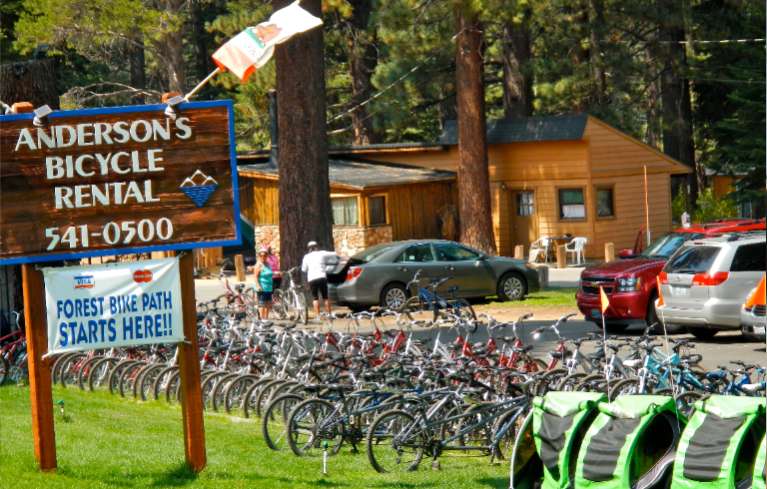
Anderson's has a special use permit that allows it to display its bikes in South Lake Tahoe. Photo/LTn

Anderson’s has a special use permit that allows it to display its bikes in South Lake Tahoe. Photo/LTN

This topic is usually a heated discussion and Sept. 3 did not disappoint. Voting against the change in numbers were councilmembers Tom Davis and JoAnn Conner.

“They add to the ambiance of the community,” Davis said of the fairs. “They are selling what the customer wants.”

Conner said she sees locals as vendors and customers at the fairs.

The topic was brought forward because in the past the promoter had to give $5,000 from each event to a local nonprofit. A recent U.S. Supreme Court ruling has made this mandate by governments illegal.

“I have consistently felt that arts and crafts shows have been detrimental to the city,” Councilman Hal Cole said. He has voted for them in the past because of the nonprofit component.

He believes tourists have a limited amount of discretionary income and that offering these fairs takes away from established businesses.

Loretta Bookhammer with the Tahoe Art League told the council that promoter Bob Williams, who secures all 12 festivals, allows their members free booth space. Artists then give a percentage of their proceeds to TAL. She lobbied for as many fairs as possible.

The council was open to a larger juried art festival that might fall under a special event and not a crafts fair that would allow TAL to make money.

On a related matter the council was in unanimous agreement to actually enforce the ordinance on the books that deals with outdoor displays.

“I think the policy helps improve our built environment,” Councilmember Brooke Laine said. “You can’t just put all of your goods on the sidewalk.”

But Davis cited specific businesses that rent bikes, standup paddleboards and sell wood carved bears that ought to be allowed to display their wares. He worries businesses will go out of business if the ordinance is enforced.

City Attorney Tom Watson admonished him by saying that would be favoritism and the council can’t do that. The policy must apply to everyone and be enforced equitably.

“By enforcing (the ordinance) we are going to say take down the display by Oct. 15,” City Manager Nancy Kerry said. The plan is to send a letter to the offenders explaining the rules and telling them they don’t get to break them again in the spring when the weather is nice.

A business like Anderson’s Bike Rentals has a special use permit so it can display its bikes.

The goal of the ordinance is to not allow businesses to take things out of their store and clutter the entrance and walkway with goods.

The ordinance allows businesses to seek a special permit to have outdoor sales or the like four times a year.

Councilwoman Angela Swanson said the predominant complaint she hears from constituents is how “crummy” the town looks. And the outdoor displays are one example of that crumminess.

The amended ordinance, which had a 5-0 vote, calls for no longer allowing food trucks or any mobile vending business to receive a temporary use permit that would allow it to be parked at a business for up to six months.

The amendment now allows temporary activities for four days with four days between the activities. Security deposits for these activities will be required to discourage violations of the ordinance.

This was the first reading of the ordinance, with the second expected at the Sept. 17 council meeting.

The council agreed at a future meeting to come up with a policy regarding mobile vendors, whether certain businesses may have outdoor displays on a more permanent basis, and whether there is flexibility with the four special events a year at any one location. The latter is a Tahoe Regional Planning Agency mandate.


Donner museum opening delayed one year

By Barbara Barte Osborn, Sacramento Bee

TRUCKEE – Mired in the bureaucracy of a contract dispute and lacking the funds to hire a coordinator, California state parks officials have delayed the opening of a new museum at Donner Memorial State Park.

Instead of opening this fall, the High Sierra Crossing Museum – a 9,400-square-foot structure that’s nearly complete – will sit empty until fall 2014.

When it finally does open, the museum will feature exhibits on the Donner Party, regional American Indian history, the history of railroad development through Donner Pass and early highway construction.

Donner Memorial State Park is probably best known as the site where most members of the Donner Party, an 81-member wagon train from the Midwest, camped in 1846 and became trapped by heavy snows.

Read the whole story


Controversy surrounds Sierra stream poisoning

By Louis Sahagun, Los Angeles Times

WALKER — State fisheries biologist Dave Lentz poured poison into a remote High Sierra stream and watched quietly as every rainbow and golden trout in the water turned belly up.

After the rotenone spread along 11 miles of Silver King Creek last Wednesday, other biologists poured in a neutralizing agent, making the river again habitable — and a suitable home for the rarest trout in the world.

Kneeling beside a small brass spigot that dripped the milky white toxin into a pool edged with alders, Lentz, a conservation coordinator for native trout with the California Department of Fish and Wildlife, smiled and said, “Looks like everything is working as intended. The Paiute cutthroat trout belongs in this stream, not the nonnatives in here now.”

The Paiute trout is native to the Alpine County stream in the Eastern Sierra’s Carson-Iceberg Wilderness of the Humboldt-Toiyabe National Forest. But it had been squeezed out by rainbow and golden trout, which are not native to this portion of Silver King Creek.

The plan to restore the Paiute trout had been held up in federal court for more than a decade by opponents who believe that poisoning a stream is about the worst thing that could happen in a designated wilderness. They also question the safety of rotenone and worry about its possible long-term effects on wildlife and regional water supplies.

Read the whole story


Union challenges LTUSD over Mt. Tallac principal

By Kathryn Reed

Last year Mount Tallac High School was run by a teacher on site, with the principal of South Tahoe High School the actual administrator. This year there is an administrator on campus.

This has led the South Tahoe Educators Association to file an unfair labor practice charge with the Public Employees Relations Board. Lake Tahoe Unified School District officials have this week to respond.

But a resolution could take months. Some form of mediation is likely to occur and could be the route to solving the dispute.

At issue is taking away a teacher’s position without the union agreeing to it. It is not about the people, but the jobs they are doing.

When Susan Baker was at the helm of the continuation school in South Lake Tahoe she was a teacher who was paid a stipend to run the facility. When she retired at the end of last year Karen Tinlin was brought from Bijou Community School to be principal of Mount Tallac.

Ivone Larson, principal of South Tahoe High School, had been the principal of Mount Tallac. Larson also oversaw the Independent Learning Academy and the Transitional Learning Center. Now those tasks fall to Tinlin.

“It was the recommendation of Susan Baker and Ivone Larson to have an administrator at that position,” Superintendent Jim Tarwater told Lake Tahoe News. “As the world turns, the roles change.”

It is costing the district about $10,000 more a year to have an administrator at Mount Tallac.

Jodi Dayberry, president of the local teachers’ union, said she could not comment on the issue because it is a personnel matter.

This is not the first time Mount Tallac has had an administrator at the helm. Jim Stevens was once the principal. When he left the principal at STHS oversaw both schools.


A new perspective on passing

By Robert S. Wood

I just lost a dear friend of 50 years. She was more than a friend, more like a soul mate. Her passing reminded me of how little the public knows about death, and how fearful our traditional beliefs about it have become.

We know it’s the end of our physical life, and that’s about all. The rest is hope, fear, myth, superstition and wild conjecture. No wonder death is the biggest, longest-running source of anxiety in our lives.

Dissatisfied with what self-appointed authorities on death tell us, I set about researching alternative views, going back to ancient history, consulting the wisdom of the ages, new evidence, other cultures, modern science, metaphysics — everything I could find.

What I discovered excited and intrigued me. Instead of the negative, morbid, depressing beliefs we know so well, I found a highly optimistic outlook that contradict our grim, fearful views.

My discoveries so excited me, they inspired me to write a couple of books on what I learned — good news about death with the potential to create a new paradigm and save untold suffering worldwide.

My friend’s death reminded me that local readers in these difficult times might benefit from hearing what I learned — especially older readers who increasingly wonder and worry about death as it draws closer.

Instead of being something to dread, I learned, death can be something to look forward to when the time is right, a wonderful end to suffering, a blessed relief. Experts say it’s generally far less traumatic than birth.

Little known modern science reveals that our traditional fearful beliefs about death are all wrong. We can pass away whenever we want, they say, by simply letting go of the life force that keeps us alive.

Mind-boggling quantum physics, building on the discoveries of Albert Einstein in the 1920s, says we actually cannot die until we make the decision to depart this lifetime. Think of the implications.

Instead of having no control over the time and manner of our passing, just the opposite turns out to be true. So our lifetime fears of death from any cause are groundless.

Ultra modern science assures us we can depart this old world whenever we want, because we create all the events of our life with our thoughts not our actions. It therefore follows that we determine when we’re ready to leave this lifetime. Instead of fearfully waiting for our bodies to fail, we can simply let go of them.

Why make an unconscious decision to let the body fail, when you can consciously decide when to depart? When you’re mentally completely ready, you can just go to sleep one night firmly intending to wake up on the other side. And you will.

As I wrote in “Peaceful Passing, Die When You Choose with Dignity & Ease,” ”It’s the path of passing chosen by wise men and women down the ages, and it’s increasingly employed today by enlightened, spiritually aware, advanced thoughtful people everywhere.…”

Applied science tells us: (1) We can die whenever we want, easily, painlessly and peacefully. So there’s no longer a need to wait helplessly for death to overtake us.

We can avoid all the pain and suffering of lying hopelessly in some hospital bed while our relatives wring their hands and our savings disappear. Sadly, that’s how most Americans die nowadays.

(2) It means we’re safe from death from any source — from accident to illness to natural calamity to murder, terror or war — safe from every kind of threat — as long as we believe ourselves safe and wish to continue living. So our lifetime fear of death no longer has any basis.

(3) Knowing that everyone who dies made the decision to do so frees us from needing to grieve for them, because they went willingly. We can mourn for our loss of them, but not for their loss of life, because they made the decision to pass.

(4) Quantum physics also tells us that there can be no real death. Only the body dies. Our mind, soul and spirit live on. Death of the body is therefore not the end, a happy belief now shared by a majority of Americans.

Our personal beliefs about death and dying profoundly affect the quality of our lives. Changing our beliefs about death to conform to those supported by modern science can create a new and happier paradigm of death in America, with the potential to prevent untold needless suffering

Making the final decision to depart requires a combination of belief, desire and willpower, but anyone can do it. So why wait until you’re dying to change your beliefs? Why go through life with the brakes on, when you can take back control of your life — and assure yourself an easy death.

Changing your beliefs now, well in advance of need, can dissolve your fear of death and provide you a new lease on a happier life — paving the way for a happier passing, irrespective of your religious or spiritual beliefs.

This discovery lifted a great weight off my shoulders and brought me a new freedom, because now I know I can cross over whenever I want, and until them I’m perfectly safe. I didn’t need to grieve for my friend because I know that she was ready to go. Instead I rejoice in the end of her suffering and her blessed relief.

Clinical scientific studies of near death experiences confirm that all deaths require an individual decision to let go of life. So do the people who once walked the earth who have died and now speak to us from first hand experience from the other side. What they tell us is entirely consistent with the findings of modern science.

So, there really is an easy way to kick the bucket, cross over, buy the farm, turn out the lights and say goodbye. It’s an option that’s truly good news for all of us.

Robert S. Wood and his wife spend half the year in Lake Tahoe and the other half in Sedona. He is the author of a dozen books, including the original trail guide to Desolation Wilderness.


Feds change stance on marijuana policy

By Joe Mozingo, Ari Bloomekatz and David G. Savage, Los Angeles Times

In a significant policy shift by the Obama administration, Attorney General Eric Holder Jr. signaled Thursday that the federal government would no longer interfere in states that allowed commercial marijuana sales as long as they were strictly regulated.

The move comes two years after the Justice Department said federal drug agents would not tolerate large-scale or commercial pot businesses and began a campaign to shut down dispensaries and growers. The crackdown was particularly aggressive in California, where hundreds have been shut down.

The new policy suggests the federal government is trying to find a workable balance between federal law, which prohibits all marijuana use, and laws in a growing number of states such as California that permit it.

Read the whole story


A summer of hard labor 30 years ago led to Tahoe’s revered Flume mountain bike trail

After 30 years of being associated with the Flume Trail, Max Jones doesn't get tired of it. Photos/Jessie Marchesseau

After 30 years of being associated with the Flume Trail, Max Jones still has fun on it and likes getting first-timers to ride it. Photos/Jessie Marchesseau

By Jessie Marchesseau

INCLINE VILLAGE – Every time Max Jones rides the Flume Trail, he can’t help but take notice of a certain overhanging boulder that once caught the bar of a chain saw he was carrying on his back that sent him, his bicycle and the chain saw tumbling down the steep granite hillside “headed for Sand Harbor.”

“It could have been bad, but ended up just being really dusty,” he said.

That was 1983, just days before Jones finished clearing the Flume Trail. This year marks the 30th anniversary of the summer Jones spent making the trail passable on a mountain bike. Today the 13.2-mile Flume ride with its sweeping views of Lake Tahoe is one of the most well known bike rides in Tahoe and is consistently ranked as one of the top mountain biking trails in the country. It goes from Spooner Lake to Incline Village.

Jones did not create the Flume Trail; it has been in existence since the 1870s when water flumes, or elevated wooden channels, transported water from Marlette Lake to nearby lumber operations and into an underground pipeline that took it all the way to Virginia City. The entire system was a true engineering feat in its day. Eventually replaced by a more modern pipeline in the mid-1900s, the wooden flumes were abandoned and mostly removed, but the flume route remained on many maps. This was how Jones learned of it soon after moving to Incline Village with his wife, Patti McMullen, in 1982.

A mountain biker heads out on the Flume Trail.

A mountain biker heads out on the Flume Trail.

At the time, Jones was just breaking into the world of professional mountain biking, and was riding every local trail he could find. In the summer of 1983, he decided to check out the blue line labeled “Flume Trail” on his maps. Having recently picked up his very first mountain bike sponsor, Ritchey bicycles, Jones took out his brand new Ritchey to test out the trail. What he found was an overgrown mess.

Though the entire ride is more than 13 miles, technically, the Flume Trail is only the 4.5-mile stretch of trail that connects Marlette Dam to Tunnel Creek Road. The first time Jones rode it, that 4.5-mile section took him nearly five hours. In some parts willow bushes were so thick he had to throw his brand new bike as far as he could into the bush then crawl through, grab and throw it again. Other sections had been completely wiped out by landslides.

After such an experience, most riders would have just written the trail off as unrideable and moved on, but for some reason Jones kept going back. He took tools with him, either on his back or strapped to his bicycle and worked on clearing the trail, little by little.

“Some days I’d work all day and get maybe a hundred feet,” Jones told Lake Tahoe News.

He worked all summer that year, clearing brush and boulders and hacking through abandoned aluminum pipes entirely by himself with nothing more than hand tools. Only during the final few days did he convince the local forest ranger to let him bring help and a chain saw to finish it.

“I wanted a place to ride. It’s as simple as that,” Jones said of the efforts he put into clearing the trail.

Jones spent 13 years – from 1983-96 – as a professional mountain biker. He has ridden all over the world, from Switzerland to Japan. He is a two-time national mountain bike champion, has had four top five finishes at the World Championships and has been inducted into the Mountain Bike Hall of Fame. He still thinks the Flume is one of the best rides out there.

“It’s not technically the most difficult trail around, but I have yet to come across a trail that’s more scenic,” he said.

Now 55, Jones estimates he’s ridden the Flume Trail 300 or 400 times. As owner and operator of Flume Trail Bikes, which rents mountain bikes and shuttles riders between the start and finish points of the trail, he still has the opportunity to ride the Flume on a regular basis.

One of his favorite things is taking first-timers on the trail, especially ones who have never seen Lake Tahoe. The views from the narrow trail winding along the steep granite hillside are so spectacular riders have to be careful not to ride right off the edge.

“They are the best views of Tahoe at Tahoe,” Jones said, “and you have to work to get them. You can’t just step out of your car, which I think makes them better, actually.”

Tahoe Area Mountain Biking Association President Kevin Joell also cites riding with first-time Flumers as one of his favorite things about the trail. He calls the views “absolutely spectacular” and said the consistent reaction he gets from other riders is just “wow.”

“It’s one of the top 10 most iconic trails in the world,” Joell said, pointing out that the Flume Trail graces the cover of the International Mountain Bicycling Association’s book on how to build great trails.

Joell has not ridden the trail as many times as Jones, but said it is still way more times than he can count. And he keeps going back, noticing something new every time.

Jones estimates somewhere between 20,000 and 50,000 people ride the Flume Trail every year, with 4,000 to 5,000 of those using his shuttle service.

Though he has only been running Flume Trail Bikes since about 2000, Jones has been involved with the trail in one way or another since he first cleared it. He and his wife ran a pro bike race on the trail for many years, and he helps with trail maintenance annually. The couple also spent 27 years running the cross country ski center at Spooner Lake as concessionaire for the Nevada Division of State Parks. They ran the ski center from the park in the winter and the bike business in the summer. In 2012, the couple stopped running the ski center and this summer moved Flume Trail Bikes to Tunnel Creek Station just south of Incline Village. This is their first year in the new location, and business is better than ever.

Though Jones may not have invented the Flume Trail, he did re-invent it. His vision and persistence paid off in the form of a world-class mountain bike trail which has since been enjoyed by hundreds of thousands of locals and visitors to Lake Tahoe.

Flume Trail tips from the experts:

• On the initial climb, be patient and allow your breathing to acclimate to the altitude change.

• Bring plenty of water and food. It’s going to take longer than you expect because you’re going to want to stop and take pictures and admire the views.

• Be cautious around blind corners, ring a bell or call out when approaching.

• Avoid riding through sand. Look ahead to spot how other riders have been navigating the area.

• If you’re afraid of heights, don’t look down. Focus on the trail ahead.

• Take your time and enjoy it.