LTCC board contemplates 2014 bond measure

By Kathryn Reed

The bulk of the buildings on the 164-acre campus of Lake Tahoe Community College have been funded by the state of California. But that might change next year.

For more than a year college board members have been discussing the possibility of asking local voters to pass a general obligation bond that would help create new facilities. John Palmer with Orrick, Herrington & Sutcliffe law firm discussed the legal implications, process and options with the board on Sept. 24.

At the Oct. 8 meeting the board will likely vote on a reimbursement resolution. This would not obligate the college to go forward with the bond, but it’s the next step in the process.
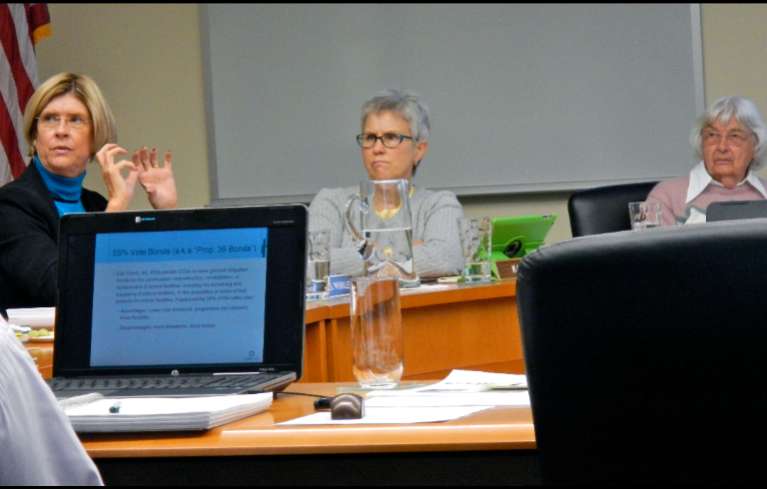
LTCC President Kindred Murillo, from left, talks as board members Karen Borges and Roberta Mason listen. Photo/Kathryn Reed

LTCC President Kindred Murillo, from left, talks about a possible bond as board members Karen Borges and Roberta Mason listen. Photo/Kathryn Reed

LTCC is one of eight college districts in the state to have never gone to voters with a general obligation bond.

The college is looking at possibly asking voters in November 2014 to approve a bond of probably no more than $38 million that would be paid back in 25 years.

The college has a list of $43 million worth of improvements, but doesn’t believe the higher amount is something the voters would stomach.

Another concern is the other tax measures that could be on that ballot. South Lake Tahoe is contemplating a snow removal tax hike and the local library is expected to ask voters to renew that tax.

When local voters went to the ballot in spring 1974 they agreed to tax themselves 72 cents on every $100,000 of assessed property value. (This was pre-Proposition 13.) Voters were asked to create the college district, approve the tax that would buy the land, and select the board members. (Roberta Mason and Fritz Wenck were on the original board and are still board members.)

Hazel Hoak, who was El Dorado County’s assistant superintendent of schools, became the interim president until the board that September hired Jim Duke to be the college’s first full-time president. (Hoak will be at the college’s 40th anniversary celebration in June.)

Classes started in fall 1975 at a motel on Highway 50. In 1988, the first building opened on the campus people know today. It is state dollars that have funded most every building on campus. There was a local capital campaign for the Haldan Art Gallery and library. The debt on that is paid for from money the college receives through redevelopment money and rent from the U.S. Forest Service.

And it is state money that would help LTCC achieve what it wants for the next decade. Kindred Murillo, college president, said the goal is to double what taxpayers approve through matching dollars from the state.

Today when the state gives money for facilities it expects the college to come up with half of the funds for the project.

LTCC is going forward with plans to make improvements. It has made the short list with the state for a remodel for efficiency grant. The bond money would provide the needed matching funds. The plan is to modernize the science lab, upgrade technology on campus and make energy upgrades.

LEED certified buildings were brought up at last week’s visioning session, which points to the community already wanting the college to be a leader in energy efficiency.

The college has also asked the state for money to build a public safety training facility. This would go close to where the U.S. Forest Service offices are. The college is also talking to city officials about this project because it could include a fire station. (The city has long wanted to update the outdated station across from South Tahoe Middle School.) It’s also possible the college site could be a command center in the event of a major emergency like the Angora Fire.

Murillo would like part of the safety piece to also include another exit point in case of an emergency. This might be via South Tahoe Public Utility District. Putting in automatic door locks and being able to communicate with every classroom in the event of an emergency are other foreseeable improvements. So are cameras in the parking lot.

Other facilities the college would like to construct include residential housing for students. A public-private partnership is possible.

An environmental science building could have multiple uses – including being a university center for a four-year program.

Another upgrade would be the possibility of creating an early childhood development center that could incorporate the Child Development Center on campus with Tahoe Parents Nursery School.

While a decision has not been made, the bond counsel on Tuesday touted the option of going the route where only 55 percent of the voters need to say yes. More requirements come with that type of bond compared to the usual two-thirds needed for a tax measure, but it can also be easier to pass.

Snowmaking may not save ski resorts

By Jakob Schiller, Powder

The first time I went to my local ski area last year — Sipapu Ski and Summer Resort in northern New Mexico — there was one run open and almost all the snow was man-made. To any bird flying over it must have been quite a scene: a mostly brown hill with a thin, continuous patch of white running from top to bottom.

But there I was, season pass in hand, anxious to put skis to snow. I’d waited all summer to strap on my boards and it seemed more important to finally be making turns than to worry about what it all meant. I was hungry. Still, the question lingered in the back of my head: What was the cost of this absurdity?

Porter Fox, whose book “Deep” was excerpted in the September issue of Powder, says the snowpack in the Cascades is down 20-40 percent because of climate change. Here in the Rockies, the spring snowpack is down 20 percent. Climatologists estimate that two-thirds of ski resorts in Europe might have to close by 2100 and only four of the 14 major resorts on the East Coast might be afloat at that same time.

According to a report cited in a study released by Protect Our Winters and the Natural Resources Defense Council, “Park City, Utah will lose all mountain snow pack by the end the century while Aspen Mountain, Colorado snowpack will be confined to the top quarter of the mountain under a higher emissions scenario.”

To compensate for a lack of snowfall that has already dramatically declined, 88 percent of North American ski areas make snow, although according to an article in High Country News, some resorts are trying to mitigate the impacts as best they can. Heavenly Mountain Resort uses computers to run its snowmaking operation, which helps make it more efficient. And Loveland Ski Area in Colorado has found a way to capture the runoff from its manmade snow and store the water so it can be reused. Both strategies are creative, but no amount of computerization or runoff capture will offset the amount of snow these large areas will need to make and the battles that will be fought over the water to make it.

Snowmaking is already a contentious issue in the West and several recent cases point to the kinds of problems that will undoubtedly crop up as other resorts turn to snow cannons to make sure they have enough snow on the slopes for opening day.

Read the whole story


Obama lenient with Indian gaming

By Julie Bykowicz, Bloomberg

As President Obama began his first term in January 2009, an Arizona Indian tribe saw a long-awaited opportunity to jumpstart a plan to build a 225,000-square-foot casino not far from the Cardinals’ football stadium.

Five years earlier, through a special company, the Tohono O’odham Nation purchased land outside Phoenix, 160 miles north of the tribe’s Sells city headquarters on its Tucson-area reservation. Now, having waited out a freeze on casino construction on property distant from a tribe’s reservation by President George W. Bush’s administration, it submitted the project to Obama’s U.S. Department of the Interior — eight days after Inauguration Day.

Tohono found this White House friendlier. The tribe won initial federal approval and then overcame lawsuits filed by state and local officials and competing tribes. There’s one last obstacle: Congressional legislation that would scuttle the project.

The U.S. House last week approved the legislation, and it now moves to the Senate.

“The Bush administration would not have gone in this direction,” said Representative Trent Franks, an Arizona Republican who sponsored the bill. “Obama is trying to gain favor with tribal entities. They seem to believe that all of the negatives associated with gambling are subordinate to the political advantage that they believe it brings them by approving these projects.”

Read the whole story


Tahoe docs offer solutions for low back pain

By Kathryn Reed

Two doctors with different approaches to low pain spelled out options for people last week during a lecture at Lake Tahoe Community College.

Michael Fry and Peter Costa are part of Barton Health’s team. Fry is an orthopedic surgeon focusing on the spine and sports medicine. Costa is a physiatrist, specializing in physical medicine and rehabilitation.

About 75 percent of adults will have low back pain at some point. It doesn’t mean it will be serious or require surgery. But according to stats presented at the Sept. 19 lecture, low back pain is the No. 2 reason people visit their primary care physician. In the United States, 25 million people miss at least one day of work each year because of low back pain. The direct health care cost of low back pain is $25 billion a year.

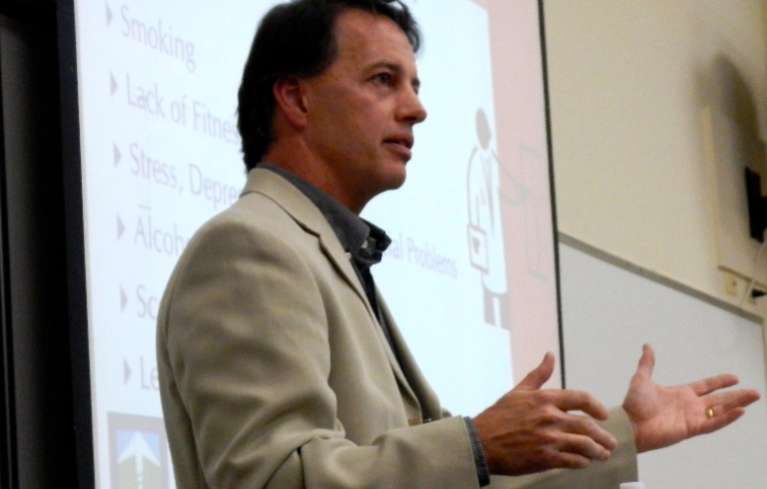
Peter Costa, a doctor with Barton Health, talks about his approach to low back pain. Photo/Kathryn Reed

Peter Costa, a doctor with Barton Health, talks about his approach to low back pain. Photo/Kathryn Reed

Some of the causes are hereditary. Smoking is a contributor because the nicotine reduces the flow of blood and discs in the back naturally lack a good supply of blood.

Sitting hunched over – like many people do at a computer – is a huge stressor on the low back. Or sitting like many of the nearly 70 people did at the talk in the college desks is another example of how posture is key.

“While we sit here all of our discs are degenerating,” Costa said. “As a disc degenerates, it gets sloppy in there. That’s when you get instability.”

Yet at the same time bending forward often decreases the pain because the canals open up and the symptoms go away.

But the problem is not always where the pain is. Kidneys, stomach and liver issues can cause low back pain, as does constipation, urinary tract infections, and uterus and ovary problems.

“You want to make sure you don’t miss a hip problem when you have back pain,” Fry said.

A series of exams and tests are regular protocols with Fry. Pain meds, epidurals and surgery are all possible treatments.

“An operation treats the symptoms of spinal stenosis. Degeneration is ongoing,” Fry said.

He said with surgery one can expect about 85 percent decrease in butt and leg pain and 65 percent decrease in back pain.

For Costa, as a physiatrist, he is treating the whole person and not just where the pain is. It’s a nonsurgical approach to medical care.

“I definitely take an educational approach. I believe the more you know about the problem, the more control you have,” Costa said.

Costa talks to patients about the medications they are on to determine if that could be the source of the pain. He asks about life issues to analyze how stress may be physically affecting a person.

“Epidurals control the pain. They don’t fix the problem,” Costa said.

When the pain comes on the doctors say don’t stay in bed all day. Do some gentle stretches and take anti-inflammatory meds. If pain lasts for a few weeks, see a doctor. And see a doctor immediately, they said, if there is a fever, numbness in the legs or uncontrolled bladder.


Gaming Expo lacking on innovation

By Ed Komenda, Las Vegas Sun

Call it the year of movie-themed moneymakers.

Gambling insiders expect this year’s Global Gaming Expo to be light on breakthroughs but heavy on pop culture. The convention’s most-anticipated games this year center around popular movies and pop stars of the last century.

And while the subjects are wildly popular, analysts say manufacturers’ growing reliance on such a tried-and-true formula dampens investors’ interest in the industry.

“The show is becoming a little less mandatory,” said Chad Beynon, an analyst with Macquarie Research in Manhattan. “Now, so many of the companies are coming up with products similar to their peers.”

G2E opened today at the Las Vegas Sands Convention Center.

Read the whole story


Crews go to great lengths to save Rim Fire big trees

By Diana Marcum, Los Angeles Times

YOSEMITE NATIONAL PARK — Each afternoon the fire’s thunderous plume rose.

At night, helicopter crews at the Crane Flat lookout watched a line of orange burning across the horizon. The line kept drawing closer.

By the last week of August, every effort to halt the Rim fire before it moved deeper into the national park had failed. The blaze now had a clear path to the Tuolumne and Merced groves of giant sequoia, and the Rockefeller grove, one of the last stands of giant sugar pine untouched by logging.

On Aug. 30, a Friday, a group of firefighters gathered at the lookout to launch a risky plan to protect some of Earth’s oldest and largest living organisms.

Even Ben Jacobs, the division commander, was nervous.

Jacobs, 55, had fought wildfires and managed prescribed burns at Sequoia Kings Canyon National Park. But he had seen crews take chances earlier in the week trying to save family camps and businesses. If they’d gambled for buildings, what would they do for living giants?

He also worried that if crews lost control of the backfires they were about to ignite, flames could spread for miles, even as far as the Merced River, west of the park’s famous valley.

“Listen,” he said. “Nobody wants to be the guy who burned down Yosemite.”

Read the whole story


Community food garden proposed for Bijou park

By Kathryn Reed

Anyone who has tried to grow produce in the Lake Tahoe Basin has at least one story of failure to tell. But if gardening advocates have their way, more positive stories are about to be told.

“The whole purpose is to teach how to grow in an alpine environment,” Gerri Grego told the South Lake Tahoe City Council last week.

Grego and other members of the Lake Tahoe Sustainability Collaborative want to turn a 30-foot-by-80-foot plot of land in Bijou Community Park into a community food garden.

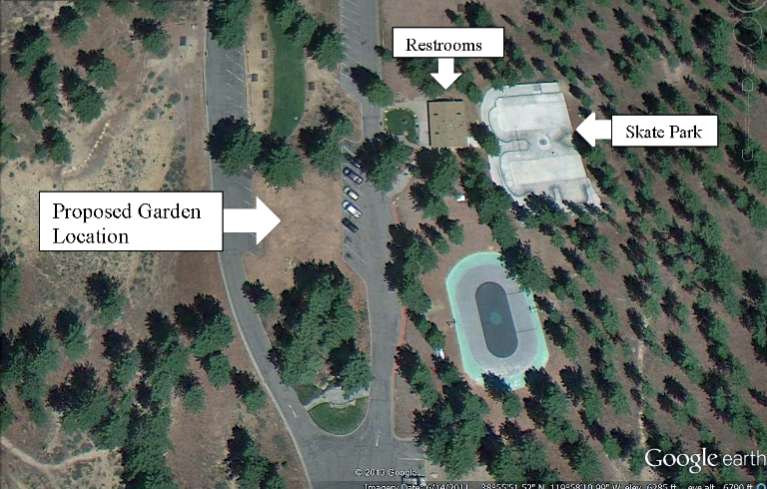
Proposed location for a community garden in Bijou Community Park. Photo illustration/Provided

Proposed location for a community garden in Bijou Community Park. Photo illustration/Provided

While the council embraced the idea, it did not want to give the go-ahead when there is no policy on the books for how non-government groups can use the city’s land.

Peter Fink, who is on the city’s Parks and Recreation Commission, said that group is in the process of devising such a policy that would then be approved by staff. It’s expected to be completed at the commission’s October meeting.

The commission did approve a trial run for the food garden at its September meeting, but that is on hold for now.

The council directed the sustainability collaborative to go back to the parks commission once the public use policy is completed. Then the parks commissioners will rehear the proposal.

Grego said she didn’t want the agreement entered into until April 1 to give her group the time needed to get insurance and other details settled. The goal is all the paperwork will be done by the spring so planting would begin next season along with 2014 being the first harvest.

The garden is proposed to go between the circle of roads before the snack shack.

Brian Hirdman, a certified permaculture design consultant, is working with the group.

“A garden is needed in Tahoe to demonstrate how you can grow food here,” Hirdman told the council Sept. 17. “The location is perfect because it is a central location.”

The plants will be in containers, so no digging is involved. And no permanent structures will be built. Water for the drip irrigation system will be paid for by the collaborative. Minimal temporary signs will be installed.

It will be an organic garden – meaning no pesticides or herbicides.

To begin with, the food would be given to low-income people in town through various charities. As the harvest grows, the distribution will grow to include alternative food sources, Barton Memorial Hospital, schools and restaurants.

Rebecca Bryson, who is part of the collaborative, said the group is working with the schools when it comes to nutrition standards. She pointed out how studies show kids who are involved with knowing where their food comes from tend to eat more healthy foods.

Throughout the growing season the goal is to teach people how they could have a garden in their yard or develop a garden for particular neighborhoods.

Hirdman also teaches at Lake Tahoe Community College. He plans to incorporate the garden into his curriculum.


More logging in national forests approved by House

By Richard Simon, Los Angeles Times

WASHINGTON — In response to fires that have ravaged the West this year, the House on Friday approved a bill that would expand logging in national forests despite a White House veto threat.

The measure, which would impose limits on environmental reviews to speed timber-cutting projects, was approved by the Republican-controlled House, 244-173, on a largely party-line vote.

The bill would more than double timber harvest levels nationwide to roughly 6 billion board feet of timber for sale each year, up from the average of 2.5 billion board feet sold annually in recent years.

It would significantly affect California with its 18 national forests that take in more than 20 million acres. About 5 million acres of California forest are suitable for harvest. Currently, about 22,000 acres are logged in the state, a number that would likely increase if the measure became law.

Read the whole story


College grads working where a degree not required

By Alana Semuels, New York Times

In a packed pub in midtown Manhattan, Ryan Flagherty is surrounded on three sides by people clamoring for his attention.

He spins one way and pours a shot of vodka into a glass, then turns around and wedges a lime into a bottle of Corona, pushing it across the counter. Ignoring the annoyed gaze of a bulky man on his right, he turns again to a touch-screen register to ring up the sales.

It’s just a minute out of the grueling, physically demanding eight-hour shift that will last long into the night. But Flagherty, 28, isn’t complaining.

With the generous tips of New Yorkers and his pick of shifts, he pulls in around $80,000 a year as a bartender. It’s more than he was offered for various office jobs he considered when he arrived in the city, even though he’s highly educated.

“I have a master’s in economics and I’m bartending in New York,” he said with a shrug. “It’s a good way to make money.”

A college degree once all but guaranteed a well-paying job and higher earnings than high school graduates. But fewer of these good jobs are now available because of both long-term economic changes and the lingering effects of the Great Recession.

Read the whole story


Network of Lake Tahoe bike trails increasing

By Kathryn Reed

TAHOE CITY – Piece-by-piece agencies in the basin are putting together a comprehensive bike trail system with the goal of eventually being able to ride a bike around Lake Tahoe on something other than a state highway.

At this month’s California Tahoe Conservancy meeting the board awarded $500,000 to the Tahoe City Public Utility District to build a one-mile section in Homewood that will link Tahoe City with Sugar Pine Point State Park.

TCPUD has 22 miles of trails that are well used. It’s estimated 400,000 people are on the paths each year. And there are only 7,000 permanent residents in the area.

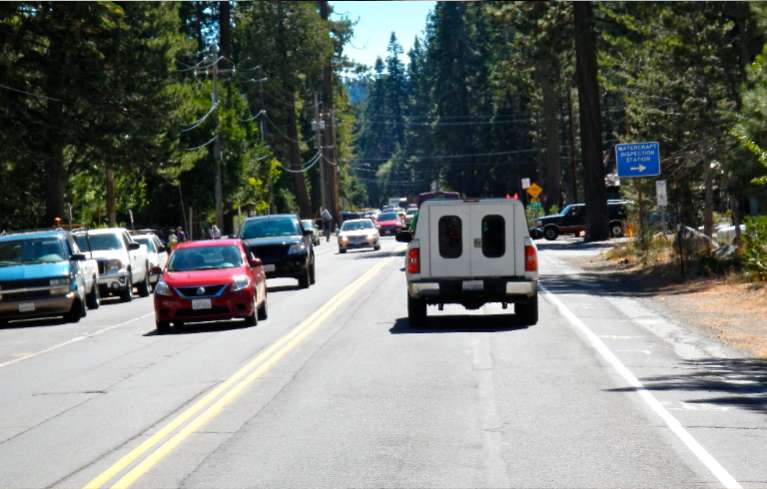
Today cyclists must ride next to traffic in Homewood. That will change next summer. Photo/LTN

Today cyclists must ride next to traffic in Homewood. That will change next summer. Photo/LTN

Most of the new trail will be Class 1, meaning it will be separated from traffic. It will be 8-feet-wide, with 2-foot shoulders. Part of the trail will be Class 3, meaning next to a vehicle lane. This is when it veers off Highway 89 and goes onto San Souci Terrace.

A new bridge will also be built to cross Madden Creek.

The plan is for the trail to be constructed on the west side of the highway in 2014. This will be concurrent with a Caltrans water quality project.

The total cost of this one mile is $1,557,970. The North Lake Tahoe Resort Association has contributed $600,000, the Tahoe Fund $34,375 and Placer County $25,000. The remaining nearly $400,000 is expected to come from a grant, additional county park fees or TCPUD capital funds.

The trail will be striped in front of Homewood Mountain Resort. If JMA Ventures, the property owner, redevelops the resort, then it would be mandated to put in a more formal bike path to complement what will be constructed next summer.

Also on Sept. 19, the CTC board agreed to award Placer County $500,000 for it to buy a 19.5-acre parcel from NV Energy that will be used for the Dollar Creek Shared-Use Trail project.

The 2.2-mile section of trail will tie into the TCPUD’s 22 miles of trails on one end and to Kings Beach on the other.

Connections beyond the parcel that was just bought will involve the U.S. Forest Service because that is where its ownership begins.

Larry Sevison, board chairman, said Northstar is interested in creating a loop that would link up with the newly acquired property.

There is also a cross country ski resort that abuts the parcel.

“We are talking to the ski center. There is a bridge crossing Dollar Creek that could be upsized for their groomer,” Jon Mitchell with Placer County told the board.

This means the trail could become accessible year-round.

The first priority is to get the trail built and then land ownership will be discussed. CTC, Placer County, California State Parks and North Tahoe Public Utility District all own a slice of where the trail will go.

The entire network of trails helped the North Lake Tahoe area in May to receive the League of American Bicyclists’ bronze level Bicycle Friendly Community.