USFS Fish Festival a victim of government shutdown; other Tahoe entities faring OK

By Kathryn Reed

Crime will still be fought on the South Shore, but this weekend’s Fall Fish Festival has been canceled because of the federal government shutdown that took effect today.

A big unknown is how the social service programs that so many in the area rely on will be affected by the government essentially turning off the financial spigot. While there is money in the pipeline, it won’t last forever. And there is no known date for when Congress might figure out how to resolve its differences.

govt shutdownGina Swankie with the Sacramento FBI office said the government shutdown is not affecting agents – including the ones stationed in South Lake Tahoe. However, the U.S. Attorneys Office is shuttered.

The U.S. Forest Service offices throughout the country are closed. Law enforcement and firefighters are still working.

For Lake Tahoe it means the Oct. 5-6 annual Fall Fish Festival, formerly known as the Kokanee Festival, has been canceled. Taylor Creek Visitors Center is closed, as well as Forest Service operated campgrounds.

However, campgrounds that are operated by a concessionaire and other concession-operated facilities are open as of now. The Forest Service is leaving gates and roads open, too.

The trail building day on Oct. 5 in the Angora burn area has been canceled because USFS personnel were going to oversee the work.

Tahoe National Forest offices, including the headquarters in Nevada City and ranger district offices in Camptonville, Foresthill, Sierraville, and Truckee are closed.

TNF is leaving its woodcutting hotlines open, and anyone with a fuel wood permit may continue to gather firewood as conditions allow.

The shutdown could delay the sale of any Forest Service cabins. Escrows will be unable to close unless the buyer has already interviewed with the Forest Service and documents were provided to title and escrow.

The other main federal agency in the basin – Tahoe Regional Planning Agency – is staying open.

“TRPA may not be impacted by a federal shutdown for some time. We are not directly funded by any federal agency, but partners with various agencies, such as the [U.S. Fish and Wildlife Service] through the Aquatic Invasive Species Program. We may not need to submit any invoices to the federal government for several months,” Jeff Cowen, with the Tahoe Regional Planning Agency, told Lake Tahoe News.

Barton Health officials do not anticipate any direct impact from this shutdown. Medicare reimbursements will still be forthcoming.

While the Centers for Disease Control and Prevention says the shutdown will affect its flu vaccination program as the country goes into flu season, Tahoe-ites should be OK.

“Barton has worked closely with El Dorado County Health and Human Services on the flu shot program for our community this year. El Dorado County will provide flu shots to community members at a low rate,” Monica Sciuto, Barton spokeswoman, told Lake Tahoe News. “Pharmacies in town are already offering flu shots as well. Barton will be providing flu shots through the physician offices and to patients at the hospital. Barton already has flu vaccines – we order a year in advance – and is ready to go with our flu program for this winter season.”

Educators believe they will weather a short shutdown just fine.

“The district has received this year’s federally funded program appropriations. However, payments may be delayed from the U.S. Department of Agriculture funded school lunch and breakfast programs. The district will continue to serve meals to all students until this possible federal shutdown is addressed,” Jim Tarwater, superintendent of Lake Tahoe Unified School District, told Lake Tahoe News.

Douglas County School District also receives funding for the free and reduced lunch program, as well as federal dollars for its three Title 1 schools.

Rich Alexander, assistant superintendent for DCSD, said the district is operating as normal and anticipates doing so for the foreseeable future while the feds work out the problem.

“If the shutdown does not last too long, we are not anticipating any issues. It is very hard to get a reading on the long-term impact, as there is a lot of speculation,” Lake Tahoe Community College President Kindred Murillo said.

Other government entities also are keeping an eye on Washington.

Steve Mokrohisky, Douglas County manager, told Lake Tahoe News, “While it appears that critical emergency support services may not be immediately affected, our continued efforts to resolve FEMA flood map issues, seek approval of our comprehensive lands bill, work with the Forest Service on improvements at Round Hill Pines, pursue federal funding for transportation and water quality improvements at Lake Tahoe, as well as several other areas will likely be delayed. New grant opportunities will also likely be on hold, which will impact our efforts to meet the infrastructure needs of local residents.”

South Lake Tahoe City Manager Nancy Kerry said there are no direct impacts right now, but that staff will be looking at how federally funded grant projects could be affected.


California driving up traffic fines

By Caroline Chen, Center for Investigative Reporting

Motorist Derick Neal doesn’t remember the April night when he rolled through a right turn at a red light in San Leandro.

The video from the red-light camera clearly shows the violation, he admits. Nevertheless, the 40-year-old software engineer is outraged about the price of the ticket: $490, plus an additional $59 for traffic school.

“It’s one thing if I was barreling through, but you can see my brake lights all the way through,” he said after viewing the video. “I expected it to be $100, $150 at most for the infraction.”

Like Neal, many of the more than 6 million California drivers who get tickets each year experience sticker shock. State records show that traffic citation fines have skyrocketed over the last decade, with some common infractions now costing close to $500.

Derick Neal’s ticket
Base fine
$100
State penalty assessment
$100
County penalty assessment
$70
DNA identification fund
$50
Court construction
$50
State surcharge
$20
Emergency medical services
$20
Emergency medical air transportation
$4
Court operations
$40
Conviction assessment
$35
Night court
$1
Total ticket
$490
Traffic school
$59
Total cost
$549

Running a red light, currently $490, cost $340 in 2003 and $103 in 1993, according to the Judicial Council of California, which sets the base fines for traffic offenses. A ticket for rolling through a stop sign costs $238; a decade ago, it was $130. Speeding up to 15 mph over the limit also comes with a $238 price tag ‒ more than eight times what it cost in 1993. And traffic school can add $60.

Oddly, the base fine for most violations has remained the same for the last 20 years. The growth in fines is due to add-ons known as penalty assessments, which are set by the Legislature. These fees are tacked on to citations, with the money earmarked for projects ranging from court construction to DNA research for solving crimes.

Viewed separately, each assessment might not seem particularly onerous, but the penalties add up. About a decade ago, there was one penalty assessment. Now, there are 10 – and total fines average four or five times the amount of the base fine.

The soaring fines don’t seem to have encouraged Californians to become better drivers. Each year, between 26 and 30 percent of drivers get a traffic citation, records show. But the high price of a ticket has led many traffic offenders to plead not guilty and contest their tickets in court, hoping to have them dismissed or reduced.

In 2003, about 196,000 traffic citations were disputed in California courts, according to Judicial Council statistics. That was 4.5 percent of the total issued. By 2011, that number had nearly doubled to 383,000, 7.1 percent of all the citations issued.

Advocates say the increased fines are especially hard on the working class.

“If you’re a single parent barely making it, one of those (red-light) tickets could really set you back,” said Shane Gusman, legislative representative for the California Teamsters union. “I think folks are doing the math and hoping that it will get dismissed if the officer doesn’t show up. I know our drivers are doing that calculation.”

Some traffic court judges offer community service, rather than fines, to those who plead guilty. Gusman says this isn’t much help for many people. At the community service rate of $10 an hour, it would take 49 hours to pay off a red-light violation ticket.

The courts don’t track whether they are losing revenue because more motorists are fighting their tickets. But some courts around the state are struggling to handle the influx of people contesting tickets.

Trial dates are backed up in San Diego County, where the number of motorists contesting tickets has doubled in a decade, said court spokeswoman Karen Dalton. The current wait is six months.

Those accused of traffic violations in Los Angeles County have been facing waits of nine months or more for a hearing, said court spokeswoman Mary Hearn. But it’s about to get worse. Recently, courts underwent their third round of layoffs in four years.

“With the changes our court was forced to make in the past few months, I expect those numbers will again increase dramatically,” Hearn said.

Derick Neal pleaded not guilty on his red-light violation and went to court in Oakland this month. He was found guilty and must pay the full fine.

Some courts offer discounts to motorists who plead guilty rather than fight their tickets. At the San Francisco Hall of Justice on a recent day, a court officer offered deals to about 80 people who had shown up to dispute their tickets. Motorists could pay $285 to settle any ticket of $400 or more, the officer said, and tickets of less than $400 could be settled for $178. If motorists went to trial and lost, they would pay the full fine, the officer warned.

But there was no such clemency across the bay in Oakland at the Wiley W. Manuel Courthouse, where Commissioner Taylor Culver reigns over his courtroom with sarcastic humor. During a red-light camera trial on a recent afternoon, when one defendant asked for a reduction in his fine, Culver boomed, “Nobody here is special or better than anybody. There’s nobody here special but me.”

In another case, Culver cut off a defendant’s comments by saying, “Just tell me about the money. How are you going to pay?”

Experts say there is little chance that the penalty assessments will stop increasing because it’s an attractive source of revenue for state and county governments. A 2006 report by the California Research Bureau, which studies issues for the governor and Legislature, estimated that traffic violations bring in more than $500 million per year.

“I don’t know we’ll ever have a rollback unless the state had enough money in the general fund,” said Gregory Pagan, chief counsel for the Assembly Public Safety Committee. “It’s an easy way to find a revenue stream to fund (a program). They’ll never stop.”


Angora burn trail system under construction

Updated Oct. 1 3:40pm: The Oct. 5 trail building day is canceled because of the federal shutdown.

By Kathryn Reed

One of the final pieces of the Angora burn restoration should be completed this fall – the trail system.

When the more than dozen miles worth of trails are finished, it will be possible to hike, ride a bike or a horse from the gun mount near the base of Echo Summit to Camp Richardson. The Long Term Angora Restoration Project encompasses only the trail network in the area that burned in 2007.

“We have laid it out for different experiences,” Garrett Villanueva, who heads the U.S. Forest Service’s trails team, told Lake Tahoe News. This means some areas will be more challenging than others. “The challenging trails off Tahoe Mountain will be rockier, they have more trail texture. We are trying to lay out the trails so they are not in a straight line, but so they follow the landscape and are interesting.”

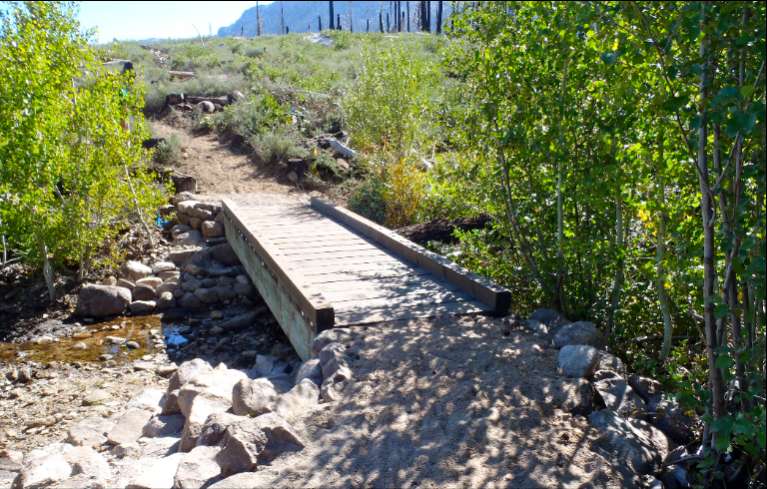
South Tahoe Association of Realtors paid for the bridge that crosses Angora Creek. Photo/Jordan Burge

South Tahoe Association of Realtors paid for the bridge that crosses Angora Creek. Photo/Jordan Burge

The grading work must end by Oct. 15 per Tahoe Regional Planning Agency rules. If need be, what doesn’t get done this year, will be wrapped up in the spring.

The delay in doing the work is because it took so long to get the necessary permits from agencies in the basin.

Trails that had been next to stream zones have been relocated to benefit the ecosystem and help with water quality issues.

The South Tahoe Association of Realtors paid for the bridge going over Angora Creek. Some of their members, along with TAMBA volunteers and anyone else will be helping the Forest Service with a trail day on Oct. 5.

STAR created the Angora Fire Disaster Relief fund immediately after the fire. Initial donations went to members who lost their homes in the fire. The remaining funds are being used for the bridge, which will be dedicated to the residents in the area.

The trails are single track. Drainage systems have been built into the system so little maintenance it required. Undulations will naturally shed water.

A road system still remains in the area, but that is for future management needs and will only be accessed by Forest Service personnel.

Signs will be installed so people know where they are and where they can go.

A kiosk with a map of the trail system will be installed at Sawmill Road and Lake Tahoe Boulevard. This is a good access point for people needing to drive to get to the trails. Another entry point via vehicle is from the Camp Richardson side on Highway 89 where the four lanes end and there is a green gate.

Other projects to be done in the Angora burn area:

• Finish the pile burning in two units near South Tahoe High School.

• Seneca Pond restoration could begin in 2015. Phase one is to drain it and phase two is to restore the area to its natural setting – which means no pond. It is not funded yet.

• Angora Creek restoration does have funding. Next year crews will likely do some wood placement by hand. In 2015 there would be stream construction work and then work should be completed in 2017 with connection of the channel.

• There will be thinning work in the area, but it’s part of the South Shore Fuels Reduction Project and not Angora restoration work.

Notes:

• There is a trail workday on Oct. 5 from 9am-4pm. Meet at the end of Forest Mountain Road off Tahoe Mountain Road. Hard hats and tools will be provided.

• Here is a copy of the Angora trail map.


Landlords economically better off than savers

By Kathleen Madigan, Wall Street Journal

In this recovery, it’s better to be a landlord or investor than a saver.

That is the message from Friday’s report on personal income. Since the recession ended in the second quarter of 2009 to the average so far in the third quarter, the gains in income have been paced by rents collected by landlords and dividends paid to shareholders.

Since mid-2009, nominal personal income has increased 17%. Rental income has soared 85 percent, and dividends are up 44 percent. Retail income and dividends compromise less than 10 percent of all income, but have accounted for 25 percent of the increase in all earnings so far in the recovery. Following close behind is proprietors’ income, up about 42 percent.

Wages and salaries, about half of all household earnings, have grown about 14 percent, accounting for 40 percent of the entire income increase.

Some of the divergent growth rates reflect changes in the economy coming out of the Great Recession–trends that won’t last over time.

Read the whole story


SAT scores reveal students not ready for college

By Justin Doubleday, Chronicle of Higher Education

Less than half of the students who took the SAT in 2013 are ready to succeed in postsecondary education, according to a report released on Thursday by the College Board, which owns the SAT.

Only 43 percent of the test takers this year met or exceeded the benchmark score of 1,550 out of a possible 2,400, the same proportion as last year.

Those who reach that number, according to the College Board, have a greater chance of attaining a B-minus average or higher during their first year of college and persisting to graduation. The mean score for 2013 was 1,498.

In a conference call with reporters on Tuesday, College Board officials said the number of students reaching the benchmark score had remained virtually unchanged over the last five years. “We are just not moving the needle as aggressively as it needs to be moved,” said Cyndie Schmeiser, chief of assessments.

For more test takers to reach a score of 1,550, rigorous coursework will have to become more widely accessible, said David Coleman, president of the College Board.

Coleman plans to better align the SAT with the Common Core State Standards, which he helped write. They prescribe what students should learn, in English and mathematics, from kindergarten through high school. His proposal to make the essay portion of the SAT more analytical has been met by a mix of applause and apprehension.

The SAT results show that more must be done in elementary and secondary schools to prepare students for college and careers, Coleman said on Tuesday: “We at the College Board consider this a call for action.”

Read the whole story


Court commissioner seeks El Dorado judgeship

By Kathryn Reed

El Dorado County’s lone court commissioner is running for Superior Court judge.

Dylan Sullivan, 47, started with the El Dorado County court system in September 2011 after having spent a number of years with the state Parole Board.

Judge Daniel Proud is retiring, thus creating the vacancy. The primary will be in June 2014, with a runoff in November if necessary.

Dylan Sullivan is running for El Dorado County Superior Court judge. Photo/Provided

Dylan Sullivan is running for El Dorado County Superior Court judge. Photo/Provided

“I encourage voters to spend some time looking at who has the capacity to make difficult decisions for the community because the decisions that come through the judicial branch go to the heart of what happens in everyday life,” Sullivan told Lake Tahoe News. “It’s important to have somebody in the judicial role who can look at facts, be unbiased and understand the dispute and give a fair proceeding.”

As a court commissioner Sullivan does the work of a judge, but is officially a rung below that level. Plus, it is not an elected position.

Sullivan works in the South Lake Tahoe courthouse where she hears family law, Child Protective Services, unlawful detainers, traffic, and restraining order cases.

“It’s basically the tough cases – CPS, people getting kicked out of their homes, some domestic violence and some drug addiction,” Sullivan said.

She said her experience with the Parole Board has helped her with her current position, adding that this is a different side of what is often the same problem.

“Nothing in the courtroom is shocking,” Sullivan said. “It makes me want to work with community service providers to see how we can better deliver services. If we do a better job collectively upfront to work with families to get through a crisis better, we are better off as a community because less people will be depending on government and more will be able to contribute and be able to live without abuses and dysfunctions.”

Outside of work Sullivan also gives back. She is a member of the El Dorado County Child Abuse Prevention Council, an advisory member to the board of the El Dorado County Big Brothers Big Sisters, on the committee for the Department of Justice’s local Safe Haven grant, a Kiwanis member, and volunteers as the Teen Court judge in South Lake Tahoe.

She also teaches judges in the state for the Committee on Judicial Education and Research.

It was that sense of wanting to give back that led Sullivan to go to law school.

Before getting into law Sullivan was in the medical field. She earned a bachelor’s in physiology from UC Davis in 1988. She worked in a trauma center and then in medical sales when she was in her 20s. Corporate America is not where she wanted to be.

In 1997, she graduated from McGeorge School of Law with honors. She started in private practice doing civil litigation and criminal defense. From there she went to the Parole Board where she was a deputy commissioner.

Half the time at the parole board she conducted hearings to decide if someone should be granted parole. Mostly it was murderers she was dealing with. Sullivan also managed people who did the hearings, and worked at headquarters on policy and litigation.

When the commissioner position opened in El Dorado County she knew it would be the logical next step in her career – and a way to give back. Plus, she liked the idea of “the everyday give and take in the courtroom.”

Of the eight Superior Court judges in El Dorado County there is one woman. If Sullivan were elected, she would bring the percentage to 25, still below the state average where 33 percent of the bench is female.

She’s worked in a male dominated field her whole career. Plus, she’s already an integral part of the court dynamics. She doesn’t see how things like gender have any bearing on one’s ability to do a job.

“As judges we are people and we bring who we are,” Sullivan said. “We learn how to put our personal ideas about life at the door so we can objectively evaluate the facts and apply it to the law.”

The only downside Sullivan sees in being elected is the position is on the West Slope, so it would make sense to move from Tahoe to the other side of the county. She enjoys calling Tahoe home – taking advantage of the hiking and playing in the snow. But she knows she can always make the short drive to Tahoe to play on her day off.


Algae bloom killing fish in Stampede Reservoir

By Barbara Barte Osborn, Sacramento Bee

A massive fish die-off at Stampede Reservoir, 19 miles northeast of Truckee, is thought to be due to an algae bloom.

“The bloom appears to be causing oxygen to lower in the deeper water, and there are hundreds and hundreds of dead kokanee and lake trout,” said fisheries biologist Amber Rossi.

The lake, which is in the Sierra County portion of the Tahoe National Forest, is a popular fishing spot.

Concerned anglers have called the state Department of Fish and Wildlife and the Forest Service’s Truckee Ranger District office for several weeks, said Rossi, who is Fish and Wildlife’s fisheries biologist for Sierra and Plumas counties.

“We’re still getting reports,” she said Friday, “so apparently it’s still going on.”

Read the whole story


Mixed emotions as insurance exchanges set to open

By Eric Whitney, NPR

Tuesday is a big day for the White House. That’s when new open in every state, where people can buy the insurance the Affordable Care Act requires next year. They will also see if they qualify for new subsidies to help them afford it.

The day will be met by both intense scrutiny and complete cluelessness. Policy wonks will be watching like scientists running lab rats through a maze.

Camped on the virtual sidewalk outside the new exchanges, just waiting for the online doors to open, are people like Caroline Pearson, a vice president at Avalere Health, a Washington, D.C., consulting firm. She says she knows a lot of people who are just dying to take the federal government’s new health insurance shopping system for a spin when it opens Tuesday morning.

“I think that every health care researcher in the country is going to immediately log in to the website — and hopefully not overwhelm the system and crash the website,” she laughs.

Researchers like Pearson want to see if the technology really works. They want to compare prices across the country, know who’s buying and how much people are willing to spend. They want demographics, consumer behavior, prices — data, data, data.

At the other end of the spectrum are the estimated 80 million Americans who say they don’t know anything about the law and may not notice at all.

Read the whole story


Famous South Tahoe chocolate cake lives on

By Kathryn Reed

Some of the best cookbooks are ones that practically read like a novel because they tell stories that weave food into our everyday lives. Others offer so many tips that they eliminate the need for some other “how to” books. Some are compilations and not just the recipes of one chef.

“Favorite Recipes from the South Tahoe Garden Club” is a little bit of all of those types of cookbooks.

And while it doesn’t have the stories per se, the ads, ingredients and advice are insights into Lake Tahoe in 1969 – the year the book was published. The cookbooks were a moneymaker for the club.

Lake Tahoe News Publisher Kathryn Reed celebrates her birthday with an Ethel Clarke chocolate cake made by Susan Wood. Photo/Susan Wood

Lake Tahoe News Publisher Kathryn Reed celebrates her birthday with an Ethel Clarke chocolate cake made by Susan Wood. Photo/Susan Wood

Some of the businesses that advertised are still here. Some are just memories.

One of the funniest ads is for Tahoe Valley Pharmacy. It says, “If your experimental recipe does not work, come see us.”

The book has tips for high altitude cooking and gardening. All sorts of different conversions are in it – like how 2 pounds of fresh peaches will become 1 quart when canned.

What to do with leftovers, ideas for kids’ lunches, what to grill, suggestions for losing weight and the nutritional value of foods are all part of the cookbook.

While the cookbook is comprehensive, it’s not very big – 128 pages. But the type in places is super small.

Tucked into this cookbook is a recipe made famous by Ethel Clarke. She was notorious for delivering her famous chocolate cakes to houses when there was a birthday.

“I have never tasted so much chocolate in my life,” Del Laine said. With six kids in the Laine family, they were well stocked with cakes every year.

Clarke never sold a cake for profit, but plenty of money was made off of her baking skills. That’s how people became familiar with her chocolate cake. She would bring them to different bazaars. Sometimes they were sold by the slice, other times the whole cake was purchased.

“The chocolate cake was a treasure. It was made with real butter. It was so moist,” recalls Brenda Stewart.

With all of her civic involvement, there were plenty of opportunities for cake making. Clarke was secretary of the Lake Valley Community Club, organizer-president of the American Legion Auxiliary, charter president of Soroptimist International of South Lake Tahoe, first secretary of South Tahoe Public Utility District, board member of Lake Tahoe Community Concerts, charter member of Lake Tahoe Historical Society, and member (chair for five years) of the South Tahoe City-School Recreation Commission. (Plus she owned the first insurance agency and built the first local office building in South Lake Tahoe.)

Clarke died in 1987, but her recipe lives on. It was part of a birthday celebration last weekend.

 Chocolate Cake by Ethel Clarke

Cream 1 cube of butter. Add 1½ cups of sugar; beat. Add 4 egg yolks; beat. Add 2 squares of Baker’s unsweetened chocolate melted over hot water – beat. Have ready 2¼ cups of flour (sifted 3 times). Into 1½ cups of buttermilk stir 1¼ teaspoons of soda.

When buttermilk is well mixed with soda, add ½ to batter. Next, add one half of the flour, then the balance of buttermilk and balance of flour. Add 2 teaspoons of vanilla and fold in 4 stiffly beaten egg whites. Bake at 325 degrees for 35 minutes.

Batter should be very stiff, makes 3 round or 2 large square layers.

Ice with:

1 cube butter

milk to moisten

2 tsp vanilla

1 package powdered sugar

2 squares Baker’s unsweetened chocolate melted over hot water

Do not use a butter substitutes – will not work.


Gaming execs: Market is oversaturated

By Richard N. Velotta, Las Vegas Sun

Saturation has arrived in the gaming industry and except for a few outposts — namely the state of Texas — there aren’t many places in the United States where a player can’t drive three hours or less to get to a casino, a panel of gaming industry executives concluded in a wide-ranging panel on industry issues.

“New England is saturated,” said Penn National Gaming President Tim Wilmott. “The market is crowded in Ohio. It’s a little underserved in Florida.”

So what does that mean for companies in the business? Panelists said it means growth will occur by acquisition and mergers and possibly diversification into the online world.

Even international markets are getting crowded, with Southeast Asia still the best option for new venues. Wilmott said Japan and South Korea have casinos in their future.

Read the whole story