Lake Tahoe area athletes in the hunt for gold

By Kathryn Reed

Lake Tahoe is often well represented in the Winter Olympics. Expect nothing less in 2014.

Today, 25 athletes are vying to be part of the Games that are in Russia Feb. 7-23. Some are household names – especially for those who live in the basin and follow skiing and snowboarding, while other athletes are newcomers to this level of competition.

Sierra-at-Tahoe, Heavenly Mountain Resort, Squaw Valley, Northstar, Sugar Bowl and Mammoth Mountain all expect to send competitors to the Olympics. In the coming months they will be competing throughout the world with the goal of making the U.S. Team.

Though, for Joanna “PNut” Dzierzawski, she is hoping to make the Poland team as a slopestyle snowboarder. She trains at Heavenly. And Kaya Turski, who trains at Mammoth, is hoping to be competing in skier slopestyle for Canada.

Here are the athletes from the greater Lake Tahoe who are in contention for the U.S. Olympic team:

• Maddie Bowman: Freeskier, from South Lake Tahoe, trains at Sierra-at-Tahoe. Gold at the 2013 X Games in halfpipe. This would be her first Olympics.

• Jamie Anderson: Snowboard slopestyle, from South Lake Tahoe, trains at Sierra-at-Tahoe. Decorated X Games competitor. This is the first year for slopestyle as an Olympic sport.

• Hannah Teter: Won gold at the 2006 Winter Olympic Games and a silver at the 2010 Winter Olympics in snowboarding, lives in Meyers, trains at Sierra-at-Tahoe.

• Kyle Smaine: Halfpipe skier, from South Lake Tahoe, trains at Sierra-at-Tahoe.

• Mark Hoyt: Snowboard slopestyle, trains at Sierra-at-Tahoe.

• Elena Hight: Snowboard halfpipe, from South Lake Tahoe, trains at Northstar. Competed in 2006 and 2010 Olympics. Well decorated at the X Games.

• Sho Kashima: Moguls, lives in Stateline, trains at Heavenly. Missed the 2010 Olympics because of a knee injury.

• David Wise: Freeskiing halfpipe, from Reno, trains at Northstar. Multiple X Games awards.

• Chas Guldemond: Snowboarding halfpipe and slopestyle, lives in Reno, trains at Northstar.

• Shaun White: Snowboarding halfpipe and slopestyle, from Southern California, trains at Northstar. Won gold in snowboard halfpipe at 2006 and 2010 Winter Games.

• Julia Mancuso: Ski racer, from Squaw Valley, trains at Squaw Valley. Won gold in giant slalom at 2006 Olympics and at the 2010 Games won silver in the downhill and silver in the combined.

• Marco Sullivan: Ski racer, from Truckee, trains at Squaw Valley. Competed in the 2002 and 2010 Games.

• Travis Ganong: Ski racer, lives in Squaw Valley, trains at Squaw Valley.

• Ross Andrews: Boardercrosss, from Michigan, trains at Sugar Bowl.

• Jayson Hale: Boardercross, from Sierraville, trains at Sugar Bowl. Competed in 2010 Olympics.

Charlotte Mia Skinner: Skiercross, lives on North Shore, trains at Sugar Bowl.

• Greg Bretz: Halfpipe snowboarding, lives in Mammoth, trains at Mammoth. Competed in the 2010 Olympics.

• Trevor Jacob: Boardercross, lives in Mammoth, trains at Mammoth.

• Luke Mitrani: Snowboard halfpipe, lives and trains in Mammoth.

• Kelly Clark: Snowboard halfpipe, lives and trains in Mammoth. Won gold in 2002 Olympics and bronze in 2010.

• Sammy Carlson: Freeskier, from Oregon, trains at Mammoth.

• Aaron Blunck: Halfpipe skier, from Colorado, trains at Mammoth.

• John Teller: Skiercross, lives and trains at Mammoth.


Retailers not expecting happy holiday season

By Tiffany Hsu, Los Angeles Times

Count on coal this Christmas.

That’s what researchers at Morgan Stanley are saying in the first major forecast of a decidedly dour holiday season. Retailers hoping for a respite from a year of so-so shopping can instead expect the worst Thanksgiving-to-Christmas sales since 2008, the financial services firm said Thursday.

Five years ago, the industry was free-falling into recession. This year, a new collection of worrisome economic conditions looms as stores gear up for a period that can sometimes account for 40 percent of annual revenue.

Shopper confidence is low. The recent federal government stalemate and shutdown was a damper. The window for holiday shopping is six days shorter than it was last year.

Read the whole story


Beaver restoration would reduce wildfires

By Ralph Maughan

After almost every large wildfire or fires that do significant damage to structures, people ask for proactive measures. The desire for this is rational. It needs no explanation.

Officeholders usually respond, verbally at least. Politicians’ solutions, however, are often useless. One reason is lack of knowledge, but probably as often they have other agendas that can be fanned by fear of wildfire. These politicians’ proposed solutions often sound plausible because they use common public ignorance to achieve credibility for what the politician is pushing. The most common plausible sounding solution used in the Western United States is large scale fuel reduction — little fuel; little fire.

A big problem with fuels reduction is that you have to pay to have it done. Potential fuel covers hundreds of millions of acres. We say “potential” fuel because what will burn varies greatly. Some years are too wet. Every year hundreds of fires burn out, but a wind, not drought could make them quickly into great conflagrations. Politicians often use the words “logging” and “fuel reduction” in the same breath, but commercial logging, where the land owner gets paid, only works for good timber. That’s mostly not what is burning. Dry brush, droughty green trees, dying or dead trees, cheatgrass, and annual weeds — that’s what is usually burning. It is difficult and far too expensive to eliminate these.

One idea that is rarely mentioned is to keep the stream bottoms green and raise the humidity. How could this be done? Let’s restore beaver to the creeks of the Western United States. This is much less expensive than cutting out or clearing potential fuels. It also has significant fish and wildlife benefits. We can often add flood control too, plus the recharge of aquifers.

A string of beaver ponds up a drainage is like a permanent fire break. The ponds not only enlarge the area covered with water, more importantly, they increase the portion of the creek or streamside area (the riparian zone) that stays green all summer. They raise the ground water level. Beaver ponds also increase the humidity of air in the drainage. The result is fewer hours in a day when wildfires can burn hot and hard.

Beaver reestablishment is not a sudden new idea. In fact, during the Cold War days there was fear the Soviets would burn off the West by launching thousands of incendiary devices to start range and forest fires. One plan to foil this was to have a massive effort to restore beaver ponds on as many creeks as possible. The Soviets are gone now, but the likelihood of fire has grown as the climate has mostly changed towards drier, with rising temperatures, especially as we look northward.

Additional fire related benefits of beaver are that their ponds offer remote, dispersed water storage reservoirs that could be used by firefighters during fires. Areas with beaver may serve as refuges for all animals during a fire. Finally, beaver ponds trap sediment and the debris that washes down from burns. As a result a fire’s effect on water quality is reduced.

There are those who complain mightily about beaver due to changes in a creek channel, the animal’s tendency to plug culverts and small bridges, and flooding from some of their ponds. Beaver sometimes cut shade and ornamental trees, trees that are unique for some reason. However, a large scale program could utilize and efficiently deploy the many methods that have devised to stop or prevent this kind of damage.

Those who trap beaver for fun and profit could have their trapping diverted to live trapping to remove beaver in problem places and redistribute them about the landscape. A wise program could outbid the often small price they get from pelts.

Some observers might point out that many creeks, ponds, and meanders in the West have not had beaver in the memory of anyone living or even any written report of the location. However, British, French and American fur trappers began trapping the beaver 300 or more years ago. Entire areas were not just heavily trapped long ago, but deliberately trapped out — trapped until none were left as part of early day conflict between European powers and the incipient American nation-state. So beaver restoration in places might be a restoration far more profound than that of wolves after an 80-100 year absence.

Beaver could be a powerful tool to tame the effects of climate change.

Ralph Maughan is professor emeritus of political science at Idaho State University with specialties in natural resource politics, public opinion, interest groups, political parties, voting and elections.


Lake Tahoe search and rescue volunteers regularly risk their lives to save others

By Kathryn Reed

STATELINE – While it’s mostly tourists whom search and rescue teams help, it isn’t always live bodies that are carried out of the wilderness.

Domino is brought in to assist with avalanche and cadaver calls. Through their dog is how Scott and Heather Longoria got involved with the El Dorado County Search and Rescue team.

Because teeth hold a scent for years that is often a tool used to train dogs. Domino showed how well he is trained at Harrah’s Lake Tahoe last week during the weekly Soroptimist International South Lake Tahoe lunch. He sniffed out a tooth under a table after being given the command “seek”.

“We probably bring closure to 10 or 15 families a year in the greater Lake Tahoe Basin,” Scott Gabler said of rescues that turn into recoveries.

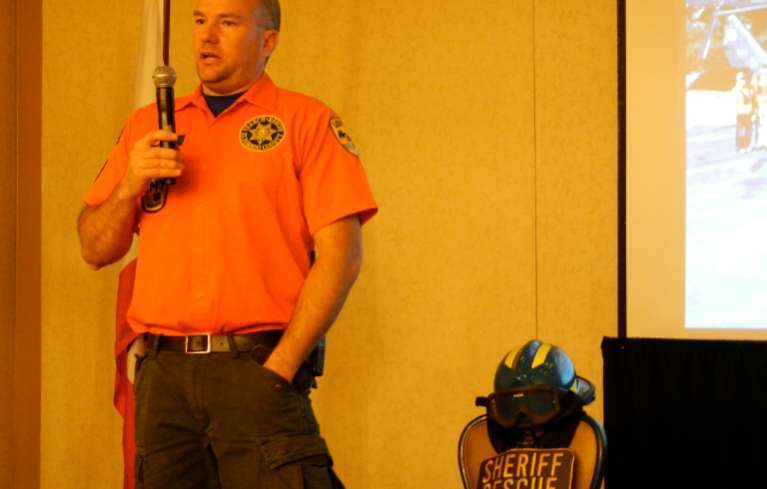
Scott Gabler talks Oct. 30 about the roll of Search and Rescue in the Lake Tahoe Basin. Photo/Kathryn reed

Scott Gabler talks Oct. 30 about the roll of search and rescue volunteers in the Lake Tahoe Basin. Photo/Kathryn Reed

In the three years he has been with SAR he has responded to 150 searches that equated to 2,300 hours. His work earned him state recognition earlier this year.

The Tahoe unit of the El Dorado County SAR is a group of 25 volunteers who drop what they are doing to help strangers – and often at the same time putting themselves in precarious situations. They respond to upward of 100 calls a year.

“The vast majority are urgent in nature,” Gabler said. “Search and rescue operates in the background until it’s needed.”

He said about three-quarters of the people in need are tourists. And because they don’t know the terrain, or understand the winds and temperature of Lake Tahoe, or aren’t prepared SAR often comes to the rescue.

But not all incidents can be prevented. Accidents happen.

Search rescue team members may train for one of the specialized teams. Some are adept at rope rescue. Most often rock climbers find themselves in trouble at Lovers Leap, though the cliffs at Angora can also be treacherous.

Most water rescues are on Lake Tahoe, with very few involving the Upper Truckee River. It’s people on human powered craft and motorboats who call for help.

Ice axes and crampons are standard equipment for the mountaineering team.

Trips to ski resorts are fairly routine for SAR. And many times SAR is out there without backup from ski patrol.

“We get calls typically when someone goes out of bounds. And typically it’s at the end of the day,” Scott Longoria said.

It’s not always easy to find people. The person might not know where they are or the ping from a cell phone could be misleading.

The latter was true last winter when four Stanford students called to say they were lost. Their snowshoe excursion nearly ended with a recovery because one of the women was already taking her clothes off – a sign hypothermia had set in.

They had set out at noon dressed more in workout clothes than winterwear. They had no provisions to stay out in single-digit temperatures.

The cell phone died, but the initial ping showed they were near Angora. The reality is they were near Stanford Sierra Camp. When crews figured this out they chipped ice out of the marina at Fallen Leaf Lake to be able to use the boat that happened to still be in the water. The foursome was rescued about midnight.

SAR is often assisted on rescues by a California Highway Patrol helicopter out of Auburn as well as CalStar stationed at Lake Tahoe Airport.

An annual fundraiser and community donations keep SAR afloat. The fundraiser is the third Wednesday in June at Riva Grill in South Lake Tahoe. For more info about volunteering or donating, go online.


Few problems with pot in California

By Adam Nagourney and Rick Lyman, New York Times

LOS ANGELES — In the heart of Northern California’s marijuana growing region, the sheriff’s office is inundated each fall with complaints about the stench of marijuana plots or the latest expropriation of public land by growers. Its tranquil communities have been altered by the emergence of a wealthy class of marijuana entrepreneurs, while nearly 500 miles away in Los Angeles, officials have struggled to regulate an explosion of medical marijuana shops.

But at a time when polls show widening public support for legalization — recreational marijuana is about to become legal in Colorado and Washington, and voter initiatives are in the pipeline in at least three other states — California’s 17-year experience as the first state to legalize medical marijuana offers surprising lessons, experts say.

Warnings voiced against partial legalization — of civic disorder, increased lawlessness and a drastic rise in other drug use — have proved unfounded.

Instead, research suggests both that marijuana has become an alcohol substitute for younger people here and in other states that have legalized medical marijuana, and that while driving under the influence of any intoxicant is dangerous, driving after smoking marijuana is less dangerous than after drinking alcohol.

Although marijuana is legal here only for medical use, it is widely available. There is no evidence that its use by teenagers has risen since the 1996 legalization, though it is an open question whether outright legalization would make the drug that much easier for young people to get, and thus contribute to increased use.

Read the whole story


Salmonella outbreak highlights flaws in food safety system

By Katharine Mieszkowski, Center for Investigative Reporting

Each month, the U.S. Department of Agriculture publishes a list calling out chicken processing plants across the country that have failed salmonella testing. Notably absent from its October report: the three Foster Farms plants in Central California that have been linked to a virulent outbreak.

Those facilities in Fresno and Livingston easily passed, receiving high marks from federal inspectors for controlling the human pathogen on their young chicken carcasses, according to Daniel Engeljohn, assistant administrator with the USDA’s Food Safety and Inspection Service.

But inspectors don’t routinely test the chicken for salmonella once it’s chopped up into parts, like drumsticks, breasts and thighs, to be packaged and sold. And it’s in that secondary processing that food safety regulators speculate the contamination may have spread.

The outbreak has exposed weaknesses in the country’s food safety system, which is designed to spot salmonella at one stop in the journey from the typical bird’s birth to its perch in the supermarket refrigerator case. And, even as the plants continue operating, neither federal regulators nor Foster Farms officials have publicly pinpointed the cause of the outbreak.

There are no federal rules for how much salmonella is acceptable in chicken parts. Federal regulators say they’re developing them. But even if those rules had existed already, it is unlikely they would have caught the problem at the Foster Farms plants.

And if inspectors had raised the alarm before the outbreak of foodborne illness, the best they could have done is pressure the plants to improve their processes. A famous court case involving beef and salmonella found the USDA did not have the authority to close a plant that consistently failed its testing for the human pathogen.

Meanwhile, the rate of salmonella infection in the United States is holding steady with no sign of going down, while Europe has managed to cut its rate dramatically in a five-year period, according to the European Food Safety Authority. That’s in part because some European countries test for salmonella at the beginning of the process – when the chickens are being raised for slaughter.

In the current outbreak traced to the California Foster Farms plants, 338 people had been reported infected with seven strains of salmonella Heidelberg as of Oct. 17. Those strains are antibiotic-resistant, which might be contributing to the high rate of hospitalization associated with the outbreak. It has sickened people in 20 states and Puerto Rico, though most of the cases have occurred in California. For every reported illness from salmonella, the Centers for Disease Control and Prevention estimates 29 more cases might remain unreported, putting the likely toll closer to 10,000 infections.

Since January, federal inspectors have documented food safety violations at the three Foster Farms plants, including fecal material on carcasses. But federal food safety officials say those violations are no worse than what you’d see in a typical chicken processing plant.

And those same plants had such a strong record on salmonella that their young chicken carcasses were tested for it by federal inspectors only about once every two years, Engeljohn said.

In the most recent tests, which took place within the year, fewer than 2 percent of the carcasses tested were tainted with the human pathogen. Under federal rules, no more than 7.5 percent of broilers tested should show evidence of the bacteria, which underscores that some salmonella is tolerated in chicken meat in the United States.

At these three Foster Farms facilities, something appears to have gone wrong later in the process. Exactly what happened is still unclear. If the company knows what happened, it has not disclosed it.

The federal government does not typically inspect chicken for salmonella once it’s been chopped into parts from whole. It did so at these three plants once the outbreak happened, though the rates it discovered were only slightly higher than those found at other plants across the country.

The government estimates 24 percent of all chicken parts have salmonella at plants nationwide. The Foster Farms plants had between 25 and 27 percent.

In response to the outbreak in early October, the USDA’s Food Safety and Inspection Service threatened to shut down the plants by withdrawing its inspectors, who have to be on-site for the plants to operate. Under pressure, the company said it would implement new processes. The plants stayed open.

One change at the plants: Chicken parts now will be washed with an antimicrobial treatment, according to the USDA. This is done already at another Foster Farms plant in Washington state, where federal inspectors found a much lower rate of salmonella on chicken parts.

“They’re treating their parts with an additional antimicrobial treatment, which all of the rest of the industry does not use, which we’re encouraging the industry to do,” Engeljohn said. Regulators do not have the authority to mandate that all plants adopt that treatment.

Yet, even if the federal government develops performance standards for salmonella on chicken parts, the USDA is unlikely to shut down facilities that do not meet those standards before people get sick. A pivotal 2001 court case, Supreme Beef Processors v. USDA, found that the agency cannot close a meat processing plant that consistently fails salmonella testing because, in this country, the bacteria is not considered an “adulterant” in meat.

That means it’s treated as an unfortunate food safety hazard and a natural constituent of poultry that consumers should cook properly to destroy. Once something is considered an adulterant, like E. coli O157:H7 in ground beef, it cannot legally be sold as food for humans unless it has been inactivated by cooking or some other process.

When a poultry plant fails its salmonella testing, federal inspectors put pressure on the company to improve its processes. Plants that have failed also are tested more often to ensure they’re cleaning up. If a facility repeatedly fails these tests, the agency can threaten to withdraw its inspectors to shut it down. But it is unlikely that the USDA will actually do so, or else risk being sued as it was in the Supreme Beef case.


Barton Health buying multiple properties, building cogeneration plant at hospital

By Kathryn Reed

Barton Health has been on a bit of a property buying spree as well as deep into plans to be more energy efficient.

The South Lake Tahoe health care system just closed escrow on four buildings on Emerald Bay Road, two of which the organization was renting. One is used for Barton University and the other physician billing.

“To reduce costs in the long term, Barton Health purchased the buildings as the cost of purchase was less than the rental of the buildings,” Rich Belli, director of Facilities Administration, told Lake Tahoe News.

Barton now owns these buildings on Emerald Bay Road. Photo/LTN

Barton now owns these buildings on Emerald Bay Road. Photo/LTN

Barton has also purchased the Ponderosa Glass building that is next door on the west side. The address for that is 1119 Emerald Bay Road, while the other properties are 1111, 1113, and 1115 Emerald Bay Road.

“It is unclear what Barton will do with the Ponderosa building once the lease is up. Barton still rents some buildings and could move other offices to those buildings or expand a new service to the community in that building,” Belli said. The lease expires in three years.

Renters in the other buildings will be able to continue to operate their businesses for the foreseeable future.

Dave Cooper had owned the 1111, 1113, 1115 properties. He is the same property owner who recently sold land and a building to South Lake Tahoe in the industrial area. The city intends to relocate its fleet of snow removal equipment there.

As part of the purchase agreement with Barton, Cooper agreed to pave the back lot so there is now adequate parking. The back of what is known as Barton University had long been just dirt. Tahoe Regional Planning Agency required erosion control measures be put in at the same time.

TRPA has also signed off on all the permits for Barton Memorial Hospital to build a utility plant that will replace the 40-year-old facility. The Governing Board approved the proposal at its October meeting.

“As part of the project, Barton will be adding a cogeneration plant that will produce roughly 75 percent of our own electricity and will enable the hospital to reuse the excess heat to provide heat to the hospital. This will save the hospital on utility costs moving forward,” Belli said.

It’s estimated the hospital will save $200,000 on utility bills with the cogeneration plant.

Construction is expected to start next year. The Office of Statewide Health Planning and Development still needs to give its OK.

The new building will be south of the emergency room entrance. The floor area will be 6,555-square-feet, and the building will be 41-feet-tall. Even though existing buildings range from 25 to 37 feet in height, the TRPA staff report said the taller building “is consistent and compatible with these other structures and uses.”

The staff report also said, “The new (central utility plant) building will incorporate several new and sustainable technologies including equipment for heating and cooling, domestic hot water, medical air and medical vacuum systems, process and humidifying steam, gas powered cogeneration equipment, and two new diesel engine-driven generators that will provide emergency power for the hospital in case of loss or interruption of utility supply.”

The current plant, also located outside the hospital, will become storage.


Russia struggling to be ready for Olympics

By David Wharton and Sergei L. Loiko, Los Angeles Times

MOSCOW — Clouds of dust. Piles of rubble. Muddy roads and construction sites.

Oleg Rubezhansky looks around Sochi and says: “We live like in a besieged town during the war.”

His Russian city is not under attack, it is scrambling to finish preparations for the 2014 Winter Olympics with less than 100 days remaining until the opening ceremony.

And Rubezhansky, who owns a local newspaper and television company, is not alone in his concern.

Work delays, massive cost overruns and allegations of corruption have marked the run-up to these Games. Some weather forecasters are predicting a warm winter with not enough snow to cover ski runs and snowboard halfpipes.

Just as worrisome, Russia’s new anti-gay legislation has triggered a sustained international outcry among political leaders and athletes.

Read the whole story


Concussions and the classroom being studied

By Jan Hoffman, New York Times

Because of heightened awareness about the hazards of sports-related concussions, many states have implemented standards determining when an injured student may resume playing contact sports. But only a few states have begun to address how and when a student should resume classwork.

On Sunday the American Academy of Pediatrics issued recommendations for “return to learn” checklists to alert doctors, school administrators and parents to potential cognitive and academic challenges to students who have suffered concussions.

“They’re student athletes, and we have to worry about the student part first,” said Dr. Mark E. Halstead, the lead author of “Returning to Learning Following a Concussion,” a clinical report in this week’s Pediatrics.

For adolescents prone to risk-taking behaviors, concussions are not just the nasty by-products of sports. Halstead, an assistant professor in pediatric sports medicine at Washington University, recently treated a 15-year-old girl whose concussion came not from a soccer match, but because “she was running backwards in a school hallway and cracked heads with someone.”

The academy emphasized that research about recovery protocols and cognitive function is scant: There is no established rest-until-recovered timeline. The new recommendations are based on expert opinions and guidelines developed by the Rocky Mountain Youth Sports Medicine Institute in Denver.

Doctors generally recommend that a student with a concussion rest initially, to give the brain time to heal. That may mean no texting, video games, computer use, reading or television. But there’s a big question mark about the timing and duration of “cognitive rest.” Experts have not identified at what point mental exertion impedes healing, when it actually helps, and when too much rest prolongs recovery. Although many doctors are concerned that a hasty return to a full school day could be harmful, this theory has not yet been confirmed by research.

Read the whole story


Hockey team creating a buzz in South Tahoe

This is the inaugural season for Lake Tahoe Blue in South Lake Tahoe. Photos/Jessie Marchesseau

This is the inaugural season for Lake Tahoe Blue in South Lake Tahoe. Photos/Jessie Marchesseau

By Jessie Marchesseau

I know very little about hockey other than players wear ice skates and try to hit a little black puck into the net with sticks that resemble oversized golf clubs. However, after attending the Lake Tahoe Blue game against the Long Beach Bombers last weekend, I realized something else about hockey: you don’t have to know anything about it to enjoy watching it.

The fast-paced game had players and pucks flying from one end of the rink to the other at speeds far greater than one would see at a football or basketball game. Blue players were racing back and forth and showed no reservations about ending up on the ice, slammed into the wall, at the bottom of a dog pile, or in an old-fashioned fistfight. The game was anything but boring.

Based on the South Shore, this is the Blue’s first season in Lake Tahoe. Part of the Western States Hockey League, the Blue is a Junior A team. But don’t let the term “junior” fool you. The players are all between the ages of 18 and 20. Most are hoping to earn college hockey scholarships or be scouted into higher level leagues, maybe even the NHL.

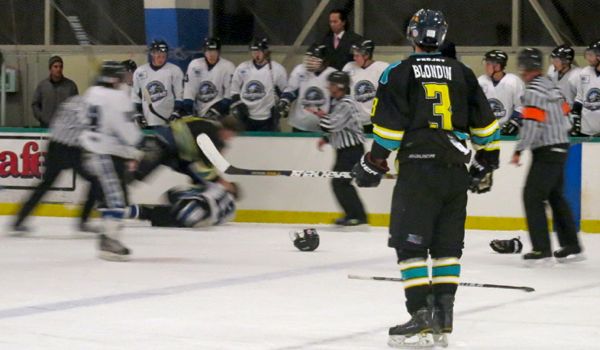
Team captain Kyle Blondin looks on as a fight breaks out during the Lake Tahoe Blue vs. Long Beach Bombers game last weekend.

Lake Tahoe Blue captain Kyle Blondin looks on as a fight breaks out with the Long Beach Bombers last weekend.

This is not just a local or California league either. The WSHL is made up of 24 teams spread across the Western United States, and players come from all over the world to play. In fact, nearly half of the Blue, including the coach, are from outside the U.S. Several reign from Canada, others from Sweden, Hong Kong, Latvia, Slovakia and the Czech Republic.

All have moved to South Lake to live, for now anyway, and play hockey.

Head coach Zoran Bendicak is originally from the former Czechoslovakia. He moved to the U.S. in 2000 to play in the International Hockey League and has been coaching players of all ages for more than a decade. He fell in love with Tahoe many years ago on a vacation to Squaw Valley and calls the opportunity to live and coach hockey here “a dream come true.”

“I was waiting 10 years for this,” he told Lake Tahoe News.

Bendicak’s dream finally came to fruition when Van Oleson, one of the founders of Tahoe Sports Entertainment which runs the South Lake Tahoe Ice Arena, contacted Chris Collins, general manager of the Bay Area Seals Junior A hockey team, and Greg Jamison, former president and CEO of the San Jose Sharks. Together, the three worked out a plan to move the Seals to Lake Tahoe. In August the plan was finalized, and the Bay Area Seals became Lake Tahoe Blue.

Collins explained that the Seals’ rink closed in the Bay Area. The Seals had only been there for one season, and after watching the success of other small-town teams, Collins wanted to take his team somewhere smaller where they could really become an integral part of the community. When he was contacted by Oleson, everything fell into place.

“We want to represent South Lake Tahoe to the best of our ability, and it would be great to become part of the fabric of the community,” Jamison said.

Jamison and Bendicak are hoping the Blue will inspire more kids from the area to get involved in hockey, and they see it happening already. All of the Blue players spend time working with the children’s teams, and Bendicak has 10-year-olds asking him if he thinks they can make the team someday.

“Little kids really look up to them; it’s really nice,” he said.

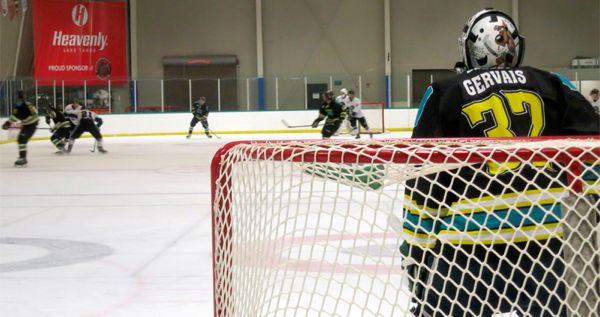
Lake Tahoe Blue goalie Olivier Gervais has played this position since he was 10.

Lake Tahoe Blue goalie Olivier Gervais has played this position since he was 10.

One of those players helping to inspire the younger generation and hoping to “create a community” for hockey in Lake Tahoe is starting goalie Olivier Gervais. Out with a fractured thumb for the first part of the season, Saturday’s bout against the Bombers was his first game back.

It is not hard to see why younger players look up to Gervais. Originally from Montreal, Gervais admits he likes to be different. On the ice, he sports a helmet he painted himself with images of Chewbacca, the Road Runner and Scooby Doo. The pink ribbon painted on the back is in honor of his grandmother who had breast cancer. He is also currently sporting a blond mohawk in support of breast cancer awareness month. He said he was going to shave his head, but thought it might be more interesting if he shaved both sides of it.

Gervais has been a goalie since he was 10 years old and jokingly says it’s because he doesn’t know how to skate.

“It’s a tough job, but it’s the best,” he said in a French-Canadian accent.

Lake Tahoe Blue does have one local player, Evan Brown who is a South Tahoe High grad, and a few from elsewhere in California, including Mark De Vaughn from Sacramento.

De Vaughn played in New York last season, but says he is glad to be closer to home this year. Even though he has only been playing with his Blue teammates for a couple of months, De Vaughn said they’re like family to him.

“I’m really glad that I’m on this team with this group of guys because I wouldn’t want any other family to play with,” he said.

At 20, this is De Vaughn’s last year in the league, and he is focusing on getting a spot on a college team next year. Gervais, on the other hand, said he would like to go to college, but is hoping to earn a spot on a professional team, perhaps in Europe.

Regardless of where they end up next year, from the coaches to the owners to the players, they all have one goal in common: to take Lake Tahoe Blue to this year’s national championships.

“The only way to achieve excellence is by reaching for greatness,” Collins said.

While the championship game is still months away, Saturday’s 7-5 win over Long Beach was a step in the right direction.

The Blue will play three more home games this weekend against the Southern Oregon Spartans. They have 12 home games left during this season which goes through March. Tickets are $5 for children, $10 for adults, and season passes are also available.