Mediterranean diet boosts mind and body

By Allison Aubrey, NPR

For all of us nearing middle age, or slogging through it, yes, there is a benefit in eating a Mediterranean-style diet rich in fish, nuts, vegetables and fruit.

A new study published in the Annals of Internal Medicine finds that women who followed this pattern of eating in their 50s were about 40 percent more likely to reach the later decades without developing chronic diseases and memory or physical problems, compared to women who didn’t eat as well.

Researchers tracked the dietary habits and lifestyles of more than 10,000 women, beginning in late middle age. Every two years, the women filled out detailed surveys describing their diets.

Over the next 15 years, researchers kept tabs on who among the women developed a whole host of chronic diseases including Parkinson’s, cancer, lung and pulmonary disease. The women were also given a battery of memory tests, and researchers also evaluated physical function, meaning the women’s abilities to move around and stay active.

“This really suggests that a healthy diet can help improve multiple aspects of your health and your ability to function when you’re older,” says Fran Grodstein researcher of Harvard School of Public Health.

Meir Stampfer, co-author of the new paper, says he was “surprised by the magnitude of the effects” in the study, given what we already know about the heart benefits of a Mediterranean style diet.

Read the whole story


Swanson enters El Dorado County supes race

By Kathryn Reed

Experience, knowledge and the ability to get things done are what Angela Swanson believes she would bring to the job of El Dorado County supervisor.

The 53-year-old officially threw her hat in the ring this week when at the Nov. 5 South Lake Tahoe City Council meeting she told her peers she would not be seeking re-election to that body but instead would be going for the county position in 2014.

When she isn’t at the twice-monthly council meetings she is either at the Board of Supervisors meeting in Placerville or watching it online. She believes in relationship building, and has been doing so on the West Slope to grasp a better understanding of countywide issues.

Angela Swanson

Angela Swanson

“District 5 is very different than in the past with the inclusion of the district going to Pollock Pines. We are no longer the lake district. We are the eastern end of El Dorado County,” Swanson told Lake Tahoe News. “We have to know how to play in the big sandbox.”

Swanson is entering her fourth year on the City Council. In the past three years she said, “I had to expand my base knowledge of Tahoe and El Dorado County to understand environmental politics, transportation, growth, development, management of public safety and fire, and more.”

She says her city appointments have helped her gain a breadth of knowledge. For two years she was on the California Tahoe Conservancy board, is in her third year on the Tahoe Transportation District, three years on the Cal-Tahoe Joint Powers Authority, and has been on the Waste Disposal board.

Swanson is also active in the League of California Cities. She is on the Transportation, Communication, and Public Works Policy Committee as well as the Women’s Caucus dealing with pensions.

Outside of the city responsibilities Swanson is part of Lake Tahoe Collaborative, advisory board member of the Boys & Girls Club of Lake Tahoe and on the Lake Tahoe Educational Foundation board.

It is the latter role and that of being a council member that put her name in headlines in August 2012. The ed foundation accepted money from a man who had business before the council and who subsequently went to prison on drug charges. The District Attorney’s Office has never filed charges nor exonerated her in that case, with DA Vern Pierson telling Lake Tahoe News there is still an active investigation involving Swanson.

Swanson said she has only spoken with Pierson twice in the last 15 months.

“My focus needs to be not on worrying about forces outside my control, but continuing to do what I have done since last August – come prepared, come with a plan, do hard work, and execute projects on behalf of the city at the policy level,” Swanson said.

Prior to being elected to the council, Swanson was on the Lake Tahoe Unified School District board from 2005-09. She left before the term expired “to focus on my family after a job loss.”

She is still working in school facility planning arena, though most of her emphasis is on grant writing projects.

The other declared candidates for the fifth district seat are Gerri Grego and Sue Novasel.


Paid parking may be decided by S. Tahoe voters

By Kathryn Reed

Do the voters of South Lake Tahoe want paid parking?

That is a question a group of residents wants on the June 3 ballot. The goal if voters say remove the parking kiosks, is they would be uprooted 30 days later.

The legwork to get the initiative on the ballot started Wednesday. This is one day after the City Council heard a report from staff about how the program is working.

The names on the document given to the city Nov. 6 are Peggy Bourland, John Cefalu and John Grace.

A grassroots group called Tahoe4Tahoe is behind the initiative. Bourland, who is part of the group, would not say how many people are involved, nor would she say who they are. The group formed out of frustrations with the city in regards to paid parking.

Bourland told Lake Tahoe News the point of the ballot initiative is to give the people a voice in the parking decision, adding that the group believes the City Council acted against the will of most residents with the parking program that started this past summer.

However, the language on the “text of the initiative” is much broader than that and could limit the power of the city government.

The text says, “The people of the city of South Lake Tahoe do ordain that the city of South Lake Tahoe be prohibited from enacting any ordinance that would result in a tax, an assessment, a fee, or charge of any kind for the use of public streets for vehicle parking purposes.” It ends with, “Any other ordinances or parts of ordinances of the city of South Lake Tahoe in conflict herewith are hereby repealed.”

The next step is for the city attorney to answer the “text of the initiative”. Tom Watson has 15 days to write a legal summary that does not exceed 500 words and he must write a ballot title.

It is possible if a legal summary could not be written, that the petitioners would have to start over.

Assuming Watson writes the summary, the Tahoe4Tahoe group must publish the intent in an adjudicated publication, and then take that document to the city clerk. Then the group must get 926 valid signatures on the petition. If certified by the county elections department, it goes on the ballot.

“The way I look at the time frame, it is going to be really, really tight to get on the June ballot,” City Clerk Suzie Alessi told Lake Tahoe News.

Bourland was of the belief it would not cost the city any money to put the initiative on the ballot. The truth is will cost between $10,000 and $20,000, according to Alessi.

The city was not expecting to have any election costs in June, just in November 2014. Because El Dorado County has issues on the June ballot the city would not have the burden of that entire election.

The fee to the city is based on a formula of the county tallying all of its election expenses, take the number of registered voters and coming up with a fee per voter that is then paid by the city.


Marijuana one of the fastest growing markets

By Carly Schwartz, Huffington Post

Legal marijuana is the fastest growing market in the United States, and it’s growing at a rate poised to outpace the expansion of the global smartphone market, according to a new report obtained exclusively by the Huffington Post.

Researchers surveyed hundreds of medical cannabis retailers, processors, dispensary owners and industry leaders over the course of six months this year, and estimated that more than $1.43 billion worth of legal marijuana will be sold in 2013. The report also predicts that figure to grow by 64 percent to $2.34 billion next year. Recent figures show the smartphone market expanded by 46 percent from 2012 to 2013.

“Cannabis is one of the fastest growing industries,” said Steve Berg, a former managing director of Wells Fargo Bank and editor of the report, the second edition of the State of Legal Marijuana Markets. “Domestically, we weren’t able to find any market that is growing as quickly.”

While it’s important to note that smartphones surged in popularity long before medical marijuana became a viable industry, and global sales numbers for 2012-2013 don’t offer a direct comparison to 2013-2014 domestic estimates, Berg said his goal was to illustrate just how rapidly the cannabis market is expanding by offering familiar data points. The U.S. smartphone market, by comparison, is growing at a rate of 7.3 percent.

Read the whole story


South Tahoe’s paid parking turns a profit

By Kathryn Reed

Paid parking in South Lake Tahoe is working – based on when it comes to revenues being greater than expenses.

Paid parking in South Lake Tahoe is not working – based on the nine people who spoke Nov. 5.

Paid parking in South Lake Tahoe is evolving and will continue to – based on the direction the council gave staff.

Paid parking has been contentious for the 15-plus years the issue has been discussed here. More than $80,000 has been paid to consultants in that time period to study how best to manage parking. The studies finally stopped and action was taken. Most of the kiosks for paid parking went online in the city after the busy July 4 weekend.

For about two hours the City Council on Tuesday heard about what is working and what isn’t, as well as what the public thinks.

paid parkingMany people just don’t like paid parking no matter how much money is generated. It would be difficult to find anyone in any town – local or visitor – who wants to pay a dime to park their vehicle on a slab of asphalt. So it could be a fact when the people who are against the parking fee say everyone is against paid parking for some reason.

The people who aren’t weighing-in are those who pay for it whether they like it or not. After all, 42,342 people paid to park in South Lake Tahoe in the three-plus months the kiosks have been working. Most were at Lakeview Commons – 20,876; then Lakeside Beach – 16,796; Venice Drive – 3,347; and Paradise – 1,223.

Bellamy Court kiosks have been in for a couple years, with 9,161 transactions during the same time period.

Of the 3,551 tickets issued in fiscal year 2012-13, 1,507 were in the paid parking areas. Other tickets include being in front of a fire hydrant, in a handicapped spot, snow removal or other reasons.

The ticket at the parking kiosk costs offenders $55. If there is no challenge to the ticket, the city pays the Southern California collection agency $3. That dollar amount goes up through the appeals process, so then the city is generating less income.

According to the staff report, the compliance rate at kiosks is 97.5 percent.

The city collected $190,976 off the kiosks in the 12- to 15-week period it was operational and another $211,183 from tickets. After expenses, some being one time, the net revenue for 2012-13 was $180,783.

The city is projecting net revenue of more than $1.37 million in five years beginning with the fiscal year that started Oct. 1.

Still, Lakeside Beach area people have been fired up and angry about the parking and remain so.

Andy Engelhardt of Lakeside told the council, “You have created disgruntled, not delighted customers.”

He keeps saying Lakeside lost money ever since the kiosks went in. But what he doesn’t publicly say is that the fee to access his beach went up and Lake Tahoe Resort Hotel no longer buys beach tickets for its guests. The former Embassy Suites was Lakeside’s best customer in years past. There has also been a change to who is operating the restaurant on the beach and that contract is now being negotiated.

Most of the other beach areas on the South Shore that the city has nothing to do with have paid parking during the summer season – such as U.S. Forest Service beaches, Ski Run and Camp Richardson.

Kings Beach is following South Lake Tahoe’s lead with year-round parking. The North Tahoe Public Utility District voted this fall to charge at Kings Beach State Recreation Area and North Tahoe Regional Park. The park alone has more than $1 million in deferred maintenance.

Councilman Hal Cole in his support of the program said the city needs to create cash to pay for the operation and maintenance of places like Lakeview Commons, as well improvements to other areas like Lakeside.

The council agreed to have the parking program come back after the first of the year to further look at the entire program, whether kiosks would be removed from Paradise Avenue, how to improve Venice Drive – including possibly adding a trail for pedestrians and cyclists and bringing trailer parking back, hours of operation, lighting on kiosks, signage and a season pass.

Already the paid parking on Venice Drive has been suspended until May 1.



S. Tahoe getting booze, shoes, auto parts stores

By Kathryn Reed

Three businesses that have never operated in South Lake Tahoe are expected to open their doors in 2014.

Auto Zone is going in next to Izzy’s Burgers on Highway 50. The martial arts building will be torn down. That used to be the garage where Buzz Springmeyer worked. His widow, Marjorie Springmeyer, still owns the land.

Construction on the new building will start in the spring.

The closest Auto Zone stores to South Lake Tahoe are in Gardnerville and the two in Carson City.

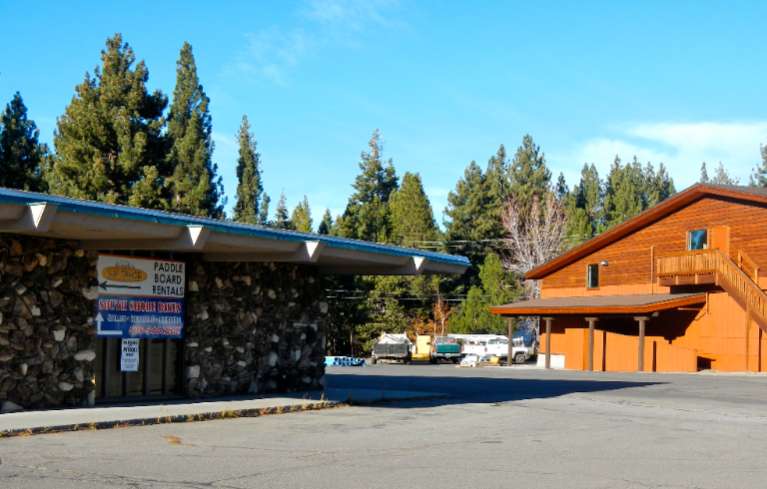
The building on the left will come down and a BevMo will be built; while on the right a shoe store is slated to go in adjacent to T.J. Maxx. Photo/LTN

The building on the left will come down and a BevMo will be built; while on the right a shoe store is slated to go in adjacent to T.J. Maxx. Photo/LTN

Another building in South Lake Tahoe is also going to be razed next year. That is at the Y next to T.J. Maxx where a bike shop, standup paddle and Laundromat are located. In its place will be a 10,000-square-foot building for BevMo.

“We have not received an application for BevMo, however, we did have a pre-application meeting with them to tell them what would be required should they apply,” Judy Finn, associate planner with the city, told Lake Tahoe News.

However, two other officials with the city have told Lake Tahoe News that the Bay Area company is going to expand its operations here next year. BevMo – which is short for Beverages and More – has 146 stores based near San Francisco, Sacramento, Los Angeles, San Diego, Phoenix and Seattle.

No one from the corporate offices in Concord returned phone calls. However, city officials said the goal is for BevMo to open in November 2014.

There is a property dispute concerning the building that exists today. The owners of the T.J. Maxx building allege about 3 feet of the building are on their property. But because it will be demolished and a new one built it could be moved down Emerald Bay Road and still work.

Both buildings are owned by out of town landlords.

The space next to T.J. Maxx is going to be occupied by a shoe store, according to Mayor Tom Davis. He announced this at the Nov. 5 City Council meeting.

The exact store has not been made public, but unofficially it will be DSW, a designer shoe warehouse.

“I just spoke with the Garfinkle rep last week and they are still trying to resolve the water pressure issue with STPUD and Lukins before they can rent the tenant space,” Finn said. The shoe store has not submitted any paperwork to city planners.

While an agreement has been worked out between South Tahoe Public Utility District and Lukins Brothers Water, a contract has not been signed for the Garfinkle (aka T.J. Maxx building) to become a STPUD customer. It was supposed to be finalized in October.


Prop. 30 working for California

By Jessica Calefati and Josh Richman, San Jose Mercury News

SACRAMENTO — A year ago this week, Californians were still locked in a fierce battle over Proposition 30, Gov. Jerry Brown’s ballot initiative that raised income taxes on the wealthy and the sales tax on everyone.

One side argued that the state needed a temporary infusion of cash to keep schools and vital state programs afloat until the economy fully recovered. The other side countered that new tax money would simply line the pockets of school bureaucrats and unionized teachers — and that thousands of overtaxed “job creators” would flee California and throw the state’s still-recovering economy into reverse.

But today, few Californians are arguing that Proposition 30, which to the surprise of many political observers sailed to an easy victory in last year’s Nov. 6 election, hasn’t been a good thing for the state.

It stabilized school funding in California for the first time since the Great Recession began, allowing school districts to avert thousands of teacher layoffs. It helped the Legislature balance its budget for the first time in years without slashing social programs. And it helped a state whose fiscal mismanagement used to be fodder for late-night comedians suddenly become a poster child of sound budgeting that some say Washington, D.C., politicians should model.

“I don’t know that taxpayers much appreciated it, but it helped the state cover its costs,” said Joseph Henchman, a vice president at the Tax Foundation, a nonpartisan tax research group based in Washington.

Read the whole story


Young Tahoe actors to star in holiday play

By Kathryn Reed

Children not listening, talking when it’s not their line and parents almost looking more bewildered. It’s impossible at this juncture to know who the angels, shepherds or wise men are. Joseph is one of the tall boys. Mary is twirling a doll – aka Jesus.

“The whole play is supposed to be chaotic and I expect it will be,” Ginger Nicolay Davis said of “The Best Christmas Pageant Ever” days after this particular rehearsal. She laughs a little when she says this. But this veteran South Lake Tahoe actor knows that rehearsals look nothing like the end product.

But Davis admits there are a couple boys she wonders about. They have a few lines and know them well. It’s just that they say them at random times and never at the right time.

Director Dave Hamilton talks to the actors about how the scene is supposed to unfold. Photo/LTN

Director Dave Hamilton talks to the actors about how the scene is supposed to unfold. Photo/LTN

Davis is producing the play for Barton Foundation’s fifth annual Festival of Trees & Lights. Dave Hamilton is directing the production and Diana Evans is co-producing. Davis, Hamilton and Evans all have ties to the Tahoe Tallac Association. This play is a partnership with Barton Foundation.

Forty children are part of the show, ranging in age from 5 to 12. The 10 adults in it will be performing alongside at least one of their children.

“It’s the right little show to get anyone in the mood for the holidays,” Davis told Lake Tahoe News. “There is a religious component, but it’s a funny look at it.” Even the non-religious will enjoy it, she said.

“The Best Christmas Pageant Ever” is about a woman putting on a church Christmas pageant. The problem is the worst kids in town are part of the cast. It’s about how those kids and the Christmas story meet head-on.

The Tallac Association has long wanted to do a winter play, but the boathouse where summer events are staged isn’t heated. Talks began a couple years ago about partnering with Barton Foundation. The goal is this particular play could run for multiple years during the Festival of Trees and Lights, with the cast changing.

Davis chose this play because of the age group of actors involved. There aren’t many opportunities for elementary and middle school students to act on the South Shore.

Of course there are challenges with this group, but nothing the adults aren’t ready to overcome. Hamilton is patient and tolerant of his young charges. Practicing at the Grand Hall at Valhalla, he tells them where to go, answers questions and keeps an eye on the moving young people. When one boy wants to sit instead of stand, Hamilton says fine but has him move so the audience would see him.

The cast will have three days to rehearse on the actual stage of MontBleu so the kids can get a feel for what show time will be like. Of course, all of this is after the weeklong Thanksgiving break when no rehearsals are scheduled.

Davis said it’s all part of the chaos – some choreographed, some not.

—-

Notes:

• “The Best Christmas Pageant Ever” is Dec. 5-6 at 6pm and Dec. 8 at 2pm. All shows are in the MontBleu showroom. Tickets are $20 for ages 9 and older, $10 for ages 2-8. For tickets, go online.

• The Festival of Trees and Lights is Dec. 4-8 at MontBleu.

• For more details about the entire festival, go online.


Scientists oppose logging bills in Congress

By Scott Sonner, AP

More than 200 biologists, ecologists and other scientists are urging Congress to defeat legislation they say would destroy critical wildlife habitat by setting aside U.S. environmental laws to speed logging of burned trees at Yosemite National Park and other national forests and wilderness areas across the West.

The experts say two measures pushed by pro-logging interests ignore a growing scientific consensus that the burned landscape plays a critical role in forest regeneration and is home to many birds, bats and other species found nowhere else.

“We urge you to consider what the science is telling us: that post-fire habitat created by fire, including patches of severe fire, are ecological treasures rather than ecological catastrophes, and that post-fire logging does far more harm than good to the nation’s public lands,” they wrote in a letter mailed to members of Congress Friday.

One bill, authored by Rep. Doc Hastings, R-Wash., would make logging a requirement on some public forestland, speed timber sales and discourage legal challenges.

The House approved the legislation 244-173 in September and sent it to the Senate, where it awaits consideration by the Committee on Energy and Natural Resources. The White House has threatened a veto, saying it would jeopardize endangered species, increase lawsuits and block creation of national monuments.

Hastings, chairman of the House Natural Resources Committee, said wildfires burned 9.3 million acres in the U.S. last year, while the Forest Service only harvested timber from about 200,000 acres.

Hastings’ bill includes an amendment by Rep. Tom McClintock, R-Granite Bay, which he also introduced as separate legislation specific to lands burned by this year’s Rim Fire at Yosemite National Park, neighboring wilderness and national forests in the Sierra Nevada.

“We have no time to waste in the aftermath of the Yosemite Rim Fire,” McClintock said at a subcommittee hearing in October. “By the time the formal environmental review of salvage operations has been completed in a year, what was once forestland will have already begun converting to brushland, and by the following year, reforestation will become infinitely more difficult and expensive.”

The Rim Fire started in August and grew to become one of the largest wildfires in California history. It burned 400 square miles and destroyed 11 residences, three commercial properties and 98 outbuildings. It cost $127 million to fight.

Members of the House Natural Resources Committee remain optimistic the Senate will take up Hastings’ bill before the end of the year, said Mallory Micetich, the committee’s deputy press secretary.

“We have a lot of hazardous fuel buildup, and it will help alleviate some of the threat of catastrophic wildfires,” she said.

The scientists see it differently.

“Just about the worst thing you can do to these forests after a fire is salvage-log them,” said Dominick DellaSala, the lead author of the letter. “It’s worse than the fire itself because it sets back the recovery that begins the minute the fire is out.”

DellaSala, chief scientist at the conservation group Geos Institute in Ashland, Ore., was on a team of scientists that produced the U.S. Fish and Wildlife Service’s final recovery plan for the spotted owl in 2008.

Many who signed the opposition letter have done research in the field and several played roles with the U.S. Forest Service and Fish and Wildlife Service in developing logging policies for the threatened northern spotted owl in the Pacific Northwest.

“Though it may seem at first glance that a post-fire landscape is a catastrophe ecologically,” they wrote, “numerous scientific studies tell us that even in patches where forest fires burned most intensely, the resulting post-fire community is one of the most ecologically important and biodiverse habitat types in western conifer forests.

“Moreover, it is the least protected of all forest types and is often as rare, or rarer, than old-growth forest due to damaging forest practices encouraged by post-fire logging policies.”


Ex-Tahoe exec to run Calif.’s largest Indian casino

By Peter Hecht, Sacramento Bee

ROHNERT PARK — Anita Silva, 82, never felt deprived by her humble upbringing in a drafty shack with no indoor plumbing on a reservation in Sonoma County. Despite economic hardships, she said simply, “I didn’t remember that there were any.”

Silva, a tribal elder for the Federated Indians of the Graton Rancheria, instead reflects on her years working in Indian health care, on her grandchildren and great-grandchildren – and on how much she loves playing the slots at Northern California tribal casinos. She still talks excitedly about the 94 bucks she won at the Dry Creek rancheria in one glorious payout two years ago.

Now, in the culmination of an improbable journey, Silva and fellow tribal members are about to get their own casino – and the proceeds from perhaps the grandest and most lucrative tribal gambling establishment in California.

On Tuesday, the 1,300-member tribe will open its Graton Resort & Casino, an $800 million development in the Sonoma County wine country. Situated next to Highway 101 in Rohnert Park, it will be the closest tribal casino to San Francisco and is expected to instantly rival Thunder Valley Casino Resort in Lincoln for supremacy in the California gambling market.

Industry analysts say the new development – with 3,000 slot machines and 144 gambling tables beneath chandeliers that glitter with 24,000 pink glass flower petals – may transform gambling in California, intensifying competition among high-end resorts and the pressure to build casinos near major highways and urban centers.

“This is the bear – no, make that the $800 million gorilla,” said Ken Adams, a Reno-based casino industry analyst. “It certainly is going to grow the total amount of gaming revenue in California. It’s going to force Cache Creek and Thunder Valley to respond competitively. … We’re off to the races.”

Cheryl Schmit, an anti-gambling advocate who is fighting a major casino development another tribe plans near Highway 99 in Madera County, said the Graton resort and its prime location may signal a gambling future far different than voters envisioned when they approved tribal casinos in California.

“Here we have this massive Las Vegas-style casino very close to an urban area at the gateway to San Francisco,” Schmit said. “Everyone is pushing forward. We’re going to wake up in a few years and California will be a full-service gaming state.”

A 2012 Standard and Poor’s market assessment said the Graton resort, to be managed by Las Vegas-based Station Casinos Inc., could generate annual gambling revenue of more than $530 million by 2016. General manager Joe Hasson, who formerly ran the Harrah’s and Harveys resorts in Stateline, said the opening is being promoted in the Bay Area market with radio and TV spots airing with “such frequency that we could elect someone governor.”

Read the whole story