Casinos prepare for Supreme Court ruling on sports betting

By Nicole Raz, Las Vegas Review-Journal 

At least 18 states are poised to introduce bills this year to regulate sports betting, according to a new report.

Of those, the report by Eilers & Krejcik Gaming suggests 12 have a good chance of enacting legislation.

“I believe if the U.S. Supreme Court makes a decision that allows states to move freely on this issue, I think they’ll take them up on that offer,” said Chris Grove, managing director of Eilers & Krejcik Gaming in Las Vegas.

The U.S. Supreme Court is expected to decide by June on a case brought by New Jersey that seeks to overturn a ban on sports betting in all but four states: Delaware, Montana, Nevada and Oregon.

Read the whole story


Millions of dead Sierra trees may have helped save water during the drought

By Ryan Sabalow, Sacramento Bee

The millions of trees that died in the Sierra Nevada during California’s five-year drought may have actually helped the state’s water supply once the historic dry spell finally ended, according to a study.

Scientists led by UC Merced’s Sierra Nevada Research Institute examined how much water was being absorbed by plant life in 1 million acres of Sierra forest along the watershed that feeds into the Kings River east of Fresno. The study, published Friday in the journal Scientific Reports, spanned the years before, during and after the drought, which officially ended last year.

Federal forestry officials estimate that during that time, more than 100 million trees in the central and southern Sierra died before the drought ended.

Read the whole story


Largest Nev. casinos earn $1.6B during fiscal year 2017

By Regina Garcia Cano, AP

Nevada’s largest casinos turned a profit for the second fiscal year in a row and finally broke the revenue record set in 2007 before the recession affected the operators’ books, according to a state report released Friday.

The largest casinos in the state reported income of $1.6 billion from total revenue of $26.2 billion during the fiscal year that ended June 30, data from the Nevada Gaming Control Board show. The reported income from 272 casinos was 59 percent higher compared with the previous fiscal year, while revenue was up 3.7 percent.

Read the whole story


What would a pot shutdown look like in Nev?

By Chris Kudialis, Las Vegas Sun

U.S. Attorney General Jeff Sessions wasn’t joking when he said he believed marijuana use in the U.S. “should be minimized.”

On Jan. 4, the Department of Justice head rescinded Obama-era guidelines — most notably the Cole and Wilkinson memorandums — that provided marijuana-legal states an opportunity to operate their respective industries without federal interference as long as the state’s industries abided by certain rules, like keeping cannabis out of the hands of children, gangs and motor vehicle drivers.

Without those memos — which were not legal documents, but rather internal guidance policies for Justice officials in enforcing federal laws — marijuana-legal states are vulnerable to being shut down by the feds, experts and industry members said.

But what would a federal crackdown on cannabis look like? In Nevada, it would mean the loss of as many as 7,000 jobs and more than $5 million in monthly state tax revenue, said Riana Durrett of the Nevada Dispensary Association.

Read the whole story


Genoa trail provides plenty of recreation sans snow

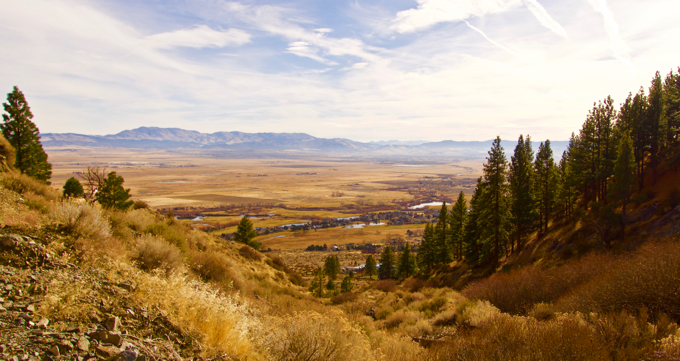
Views into the farm lands of the Carson Valley dominate the trail. Photo/Kathryn Reed

By Kathryn Reed

GENOA – Layers were coming off relatively quickly – it was that warm. The ground was barren, even the higher elevations didn’t have much white stuff. It’s not supposed to still be hiking season.

Five us and that dog named AJ ushered out 2017 with a hike instead of a snowshoe. And today, the same trek would be possible. Things might be different later this week, but because the hike was outside the basin, odds are it will still be do-able this weekend and beyond.

With Mother Nature being spastic this winter, one has to climb a bit for snow, or drop in elevation to hike. We chose the latter on New Year’s Eve.

The Eagle Ridge Loop (6.5 miles) is part of the larger Genoa Trail System. A number of options are available, including connecting to the Tahoe Rim Trail.

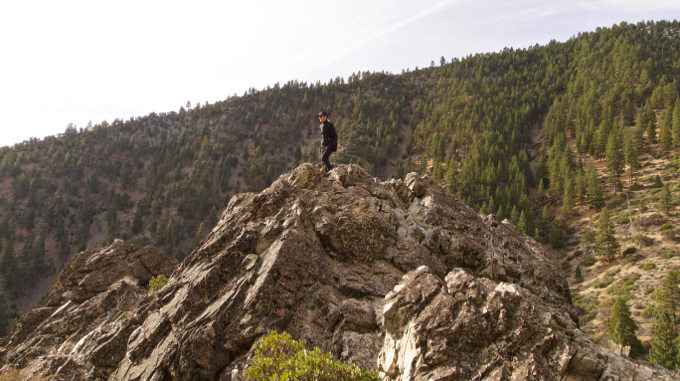
Barb gets a better view from the one rock outcropping along the way. Photo/Kathryn Reed

It’s like a different world from Tahoe. Pine trees still dot the landscape, but they are more dispersed and intermingled with other flora. The brown grasses provide their own beauty. With the expansive views, it’s easy to see across the valley to the Pine Nuts.

Trail markers at key locations were welcome, especially since none of us had been there before. We also had printed out a map, which was good for deciding where to park, start and have our bearings on the trail.

Much of the route is single track, hardpack dirt. It’s in great condition.

Mountain bikers are allowed here; a few were making their way up as we were descending. The climb (elevation gain is 1,775 feet) would have had me pushing the bike, and the narrowness of the trail at times would have made me uncomfortable. But mountain biking isn’t my sport, either.

The one creek crossing quenched AJ’s thirst, though bring water for your canine companions because they’ll need it. A substantive wood bridge ensured us two-leggeds didn’t have to get wet.

The only real downside to the hike is that it requires walking on pavement to get back to the car, including a stretch along Jacks Valley Road. Still, the shoulder is wide enough to feel safe.

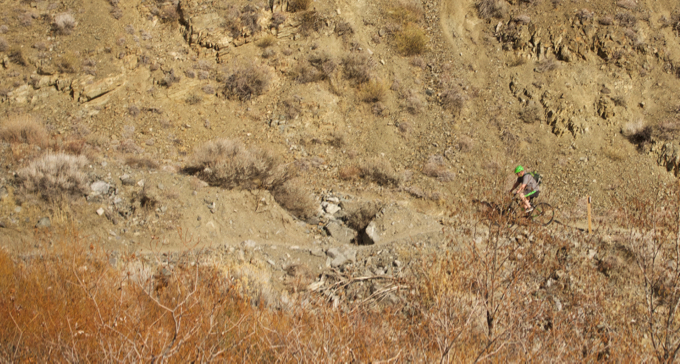
A mountain biker makes his way up the Eagle Ridge Loop. Photo/Kathryn Reed

—–

Getting there:

From South Lake Tahoe, take Highway 50 east to Stateline. Take Kingsbury Grade to the Carson Valley. Turn left on Foothill Road. Go through Genoa, then turn left on Centennial Drive. Park at the corner of Snowshoe Lane. The trailhead is at the end of the lane.


Roof collapse triggers interest in Mt. Rose’s funky old lodge

Rosemount Lodge in winter 1957. Photo/Vonderheide Collection

By Alison Bender, Tahoe Quarterly

Reindeer Lodge, located on a horseshoe curve along Mount Rose Highway between the ski resorts and Reno, has seen much in its 60 years of existence.

It’s seen the old Reno Ski Bowl morph into Mt. Rose Ski Tahoe. It’s seen generations of UNR students as they drank hot-buttered rums and danced to popular music. It’s seen huge snowstorms, like in the spring of 1958, when residents and guests were trapped, the highway buried under several feet of snow.

Change came to the lodge, as well.

What was once the Rosemount Lodge, an upscale establishment catering to local skiers, changed names and operators multiple times on its path to becoming the funky property known as Reindeer Lodge. In the record-breaking winter of 2016–17, after years of disrepair, the roof collapsed, feet of snow caving in around the fireplace that had for decades warmed skiers coming off the slopes.

Read the whole story


Calif. climate fight gets harder soon

By Julie Cart, CalMatters

By most measures, California has earned the right to brag about how much it has cleaned up its environmental act. The air in much of smog-shrouded Southern California has been scrubbed. A passenger car for sale here today is 99 percent cleaner than one on offer in the early 1970s. The fossil fuels required to power the state’s economic engine have decreased by a third since their peak in 2001, while economic activity has expanded in that time by an equal measure.

In addition, California’s response to climate change is a one-of-a-kind hybrid, knitting together market-based programs such as the cap-and-trade system for reducing carbon dioxide and other harmful emissions; strict regulations to promote energy efficiency in buildings; and generous financial incentives for “green” projects, drawn from more than $6 billion in carbon-trading proceeds.

It’s working. California is poised to meet its goal to reduce greenhouse gases 33 percent, to 1990 levels, by the year 2020. Its targets for use of more renewable energy by that date are, in some cases, already exceeded.

So take a bow, California; you’ve done the easy stuff. But hold on tight for what comes next. The state’s overarching plan was intended to ease industry and consumers into a carbon-free future bit by bit; ten years in, the training wheels are off.

Emissions-reduction must hit 40 percent by 2030 and twice that by 2050. In 12 years, half the state’s energy must come from renewable sources such as wind and sun. California’s 14 million buildings must operate twice as efficiently, and the number of electric cars on the road will have to multiply more than 10 times. Failure would likely mean more extreme measures in later years and, many experts say, could affect public health.

The scope of the state’s approach is all-encompassing. By law or executive order, every state agency must consider climate change when making any planning decision. Developers must take into account how far motorists travel to reach a destination, forests will be managed so that trees store more carbon dioxide and highway builders have to calculate the possibility that rising seas might inundate the roads.

The near term looks good. But for the 2030 goals and beyond, normally upbeat officials are guarded.

“Getting a 40 percent reduction [by] 2030 is no small thing. There will be lots of challenges,” said Ken Alex, director of the state Office of Planning and Research, who sees the entire field when it comes to emissions reductions. “Sometimes I’m optimistic, sometimes I’m pessimistic. I’m pessimistic about the political will it takes to get there.”

The most difficult work begins with California’s single most polluting sector: transportation, which accounts for nearly half the state’s greenhouse-gas emissions.

Mary Nichols, who chairs the California Air Resources Board, acknowledged that squeezing emissions from transportation will be the most difficult lift of all the 2030 standards, saying the gains require no less than a “deep transformation.”

That will include cutting gasoline use in half, reducing the miles that car-centric Californians drive, dramatically ramping up the adoption of electric vehicles and building a network of readily available charging stations.

“There’s no question that transportation is a critical piece, maybe the critical piece, in solving our energy problems,” said Sean Hecht, co-executive director of UCLA’s Emmett Institute on Climate Change and the Environment.

One reason it’s difficult is that transportation emissions are produced largely outside the clutches of state regulation: think airplanes, trains, and ships. Another is sluggish technological change for heavy-duty and medium-duty trucks, buses and shuttles, although adoption of all-electric municipal buses is growing as costs come down.

Although California has decreed that auto manufacturers sell a percentage of zero-emission vehicles, there is no mandate that drivers purchase the pricey cars. Regulators and legislators have been reluctant to force consumers to buy them, as they have with TVs, heavy appliances and other products.

That would change with legislation proposed by Assemblyman Phil Ting, a Democrat from San Francisco. Ting’s bill would ban the sale of gasoline-powered cars in California by 2040, mirroring bans proposed by some European countries. The idea went nowhere when Ting proposed it last year, and its prospects now are unclear.

While gas-sipping hybrids such as the Prius are nearly ubiquitous and certainly helpful, only true zero-emission vehicles can bring about the scale of change the state’s goals require, experts say.

“There’s no way to get there without significant reduction in passenger-vehicle emissions,” said Ting, who drives an electric car. He said that more access to charging stations would be transformational.

“People talk about the lack of infrastructure, yet there’s electricity everywhere they park their car, unless they are in the forest,” he said. “People park their car much nearer to electricity than they do to gasoline. In transportation they talk about ‘the last mile.’ Here we have the ‘last foot’ issue. We just need the extension cord for the last foot.”

Much of that work falls to the California Energy Commission, which has tied together charging stations that trace a north-south, mainly coastal path. The easier task of attracting electric car buyers in Southern California and the Bay Area has been accomplished. The challenge now is engaging inland drivers, in places such as Bakersfield, Fresno and Redding.

John Kato, deputy director of the commission’s Fuels and Transportation Division, agreed that the new benchmarks are “challenging, but we believe the private sector will take up the baton,” with automakers producing a wider variety of vehicles, across a broad price range, appealing to more buyers.

An unexpected private-sector benefit comes from Volkswagen, which settled an emissions-cheating case by agreeing to spend more than $800 million building charging stations (from which the company will also profit) throughout the state.

National trends are cause for optimism, said Paul Cort, an attorney with the environmental group Earthjustice. “There is an acceleration in acceptance and uptake among car buyers,” he said. “It took us 10 years to get to the first million electric vehicles; the second million was achieved in two years; the third million will be on the road in one year.”

One success story has been the state utilities’ swift integration of renewable energy into the state electric grid, partly because of a dramatic decline in the cost of solar energy. Emissions from power generated in the state fell by more than 19 percent last year, partly due to the ramping up of hydroelectric power with last year’s heavy rains. The Public Utilities Commission that regulates energy companies reports that they have met or will soon meet the 2020 targets.

State Sen. Kevin de León, a Democrat from Los Angeles who is currently running to unseat Democratic Sen. Dianne Feinstein, recently set an even higher bar, proposing 100 percent renewable energy throughout the state by 2045.

It will be more difficult to find further savings from existing energy-efficiency programs, long a bulwark of California’s carbon-reduction efforts. The state is phasing out incandescent light bulbs and the building codes for new construction continue to mandate efficiency. But still to be tackled is the thorny problem of retrofitting millions of old and outdated homes and businesses.

At least one analysis calculates that natural gas used in hot water heaters and to warm residential and commercial buildings is causing nearly the same emissions as the state’s power plants. Converting gas-fired buildings to fully electric is daunting, and hugely expensive.

With so many reductions required, the Air Resource Board’s post-2020 strategy is one element—a critical one—of the state’s multiagency approach to climate change. That strategy elevates the cap-and-trade system, in which companies can pay to pollute by buying credits, to a much more significant role. Cap and trade limits emissions on 80 percent of California’s polluters.

The agency has never precisely quantified cap and trade’s contribution to greenhouse-gas reduction. Officials projected it at 17-20 percent in a planning document in 2008—a year before the program launched—but are unable to say if those assumptions have been borne out. The board has not conducted the complicated analysis required to determine the program’s actual role in cutting emissions.

Nonetheless, last month it adopted a plan to reach post-2020 objectives that ups the ante: It forecasts that cap and trade, which lawmakers recently extended to 2030, will be responsible for nearly 40 percent of California’s emissions reductions by that time, a figure disputed by some as unrealistic.

Some critics of the program say another factor could cause the state to miss its 2030 emissions targets: the banking system that allows individual companies to hold tens of millions of carbon credits in reserve.

According to separate analyses by the nonpartisan Legislative Analyst’s Office and independent economists, refineries, cement plants and other major polluters could produce emissions in the next decade that are well above the state’s ever-tightening limits and use their banked credits, purchased cheaply, to offset their excess.

Chris Busch, an economist and research director at the think tank Energy Innovation, said his analysis showed that because of the oversupply of allowances the “effectiveness of the program could be compromised.”

Ross Brown, who analyzes cap and trade for the LAO, said in an interview that there’s a “decent to good chance” that banked credits could vault emissions to more than 30 percent over legal limits in 2030.

The issue has the attention of the state Legislature, which has directed the air board to investigate. So far, the agency has shrugged off the concerns.

Rajinder Sahota, who oversees the cap-and-trade program for the air board, said that although the analyses may be correct in that emissions may exceed the cap in any given year, the agency is confident that the cumulative emissions between 2021 and 2030 will fall and California will meet its goals.

“We expect to see fluctuations over time,” she said. “There are a number of factors that account for emissions in any given year—the economy, business decisions. In a perfect world, you’d like to see a decline over time. But it doesn’t always work that way.”

Sahota said the analyses of banked credits are a “paper exercise.”

“Most of the allowances in the program are still in the ARB’s account,” she said. The LAO’s calculations would require a company to spend hundreds of millions of dollars for credits now on a bet that the price will rise as emissions limits get stricter, she said.

“The data show that is not happening,” Sahota said.

Nevertheless, she and air board chairwoman Nichols said the plan is open to revisions.

Gov. Jerry Brown’s personal investment in California’s climate-change policies has been a force multiplier, spurring the myriad state agencies to adopt, and state industries to adapt to, the prospect of a carbon-less future. But Brown is in his final year in office, and the Legislature’s to-do list is crowded with other enormous issues, such as poverty and housing.

Whether lawmakers will continue to invest in programs that, to some, don’t seem to immediately improve the lives of Californians, is an open question.

One critic is state Sen. John Moorlach, a Republican from Costa Mesa who is also an accountant.

“I come from a world where you measure things so you can manage it,” the senator said. “It’s a matter of priorities. Sacramento is pumping itself on the chest, thinking it is going save the world. I’m not convinced this is the right use of our resources.”

Such doubts could present hurdles as the global-warming clock winds down.

“We are running out of time. That’s clear,” said Ken Alex. “To me, it’s about political will and scale. We feel confident that it’s doable.  But do we have the political will to get there?”


Amateur Tahoe curlers being led by Olympian

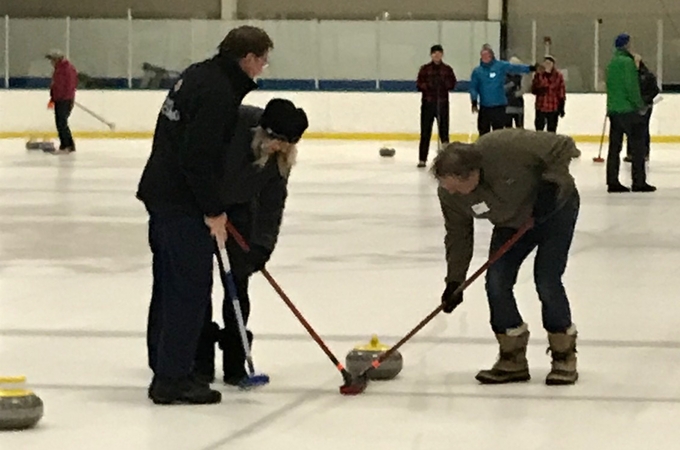
Curling is becoming a popular year-round sport in South Lake Tahoe. Photo/Edith Loudon

By Terra Breeden

Even though there isn’t any snow on the ground, winter sports are still thriving in South Lake Tahoe. Curling, a team sport played on ice, is sliding into popularity with the club Lake Tahoe Epic Curling leading the movement.

“It’s like shuffleboard or chess on ice. There’s a lot of strategy involved,” Lake Tahoe Epic Curling Club President Edith Loudon told Lake Tahoe News.

Curling originated in Scotland during the 16th century and the winter sport hasn’t gone out of style in the centuries since. Curling tournaments called “bonspiels” are played all over the globe and the sport is even an event in the Winter Olympics.

The game consists of two teams of four players competing against one another. Players push 42 pound curling stones across the ice to a target of rings that are 140 feet away. The object of the game is to knock your opponent’s stones away and get closest to the center ring to score points.

“The purpose is to outwit your opponent and beat them at their own game,” Loudon says. “You can be competitive on the ice, but the club is really a big family and we have a lot of fun off the ice too.”

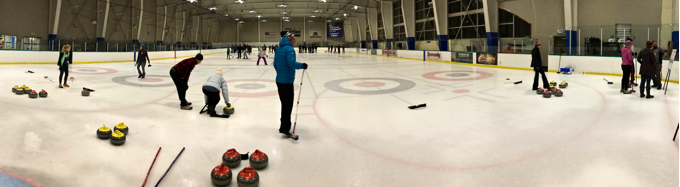
South Lake Tahoe Ice Arena is home the area’s only curling club. Photo/Edith Loudon

Lake Tahoe Epic Curling holds “Learn to Curl” classes and bonspiels on Sunday evenings from 5:30-8 at the South Lake Tahoe Ice Arena. Classes are led by Loudon, a longtime curling competitor and former Olympic athlete.

Loudon, a native of Scotland, was a member of Great Britain’s Olympic curling team and competed in the 1998 Winter Games in Japan. It was an important year for curling; the first year the game was considered a full medal sport. Previous Olympics had only featured curling in demonstrations.

Great Britain’s team went on to finish fourth in the 1998 Olympics (just outside of the medal zone after losing in the semi-finals to Canada, the country that took home the gold that year). However, Loudon says that competing in the Olympics was incredible.

“I felt very privileged to be in that position,” Loudon says. “It was one of the most awesome experiences of my life.”

A polished ice rink can be intimidating to newbie curlers, but Loudon feels comfortable on the ice. She grew up curling in Scotland where the game is popular. Her whole family curls competitively. Both her younger sister and brother have represented Great Britain in the Winter Olympics.

After the 1998 Games, Loudon competed on Scotland’s curling team and went to the World Curling Championships in North Dakota in 2002 where her team won gold. Loudon later worked as a volunteer in the 2006 Winter Olympics in Italy where she met Eric Hazard, a fellow curler, who trained her to use curling software and would later become her husband.

Beginning curling classes are offered regularly. Photo/Edith Loudon

“Within about five minutes of meeting he realized what I knew about curling and we got married seven years later,” Loudon says.

Three years ago, Loudon moved to South Lake Tahoe to live with her husband, who owns a house near Heavenly, and quickly became involved with Lake Tahoe Epic Curling.

“South Lake Tahoe is one of the most amazing places to live,” Loudon says. “I love the changing seasons, the scenery, and I learned to ski here, which I love too.”

Lake Tahoe Epic Curling was founded in 2013 by Loudon’s husband, Hazard, and Ray Sidney, a South Shore local involved in the tech industry. Sidney is an avid fan of curling and purchased all of the equipment and curling stones for the club. At $5,000 a set, curling stones aren’t cheap, but Sidney wanted to bring the sport to his hometown. Thanks to Sidney’s generosity, Lake Tahoe Epic Curling has state of the art curling equipment and over 30 members.

Curling has a long season that runs from September through May. There are three leagues in a season: a fall, winter and spring league.

Loudon says that although curling is a new sport in California, it is gaining momentum every year.

“In California there’s fresh and new energy,” Loudon says. “People are really enthusiastic about the game and just want to have fun on the ice.”

The next “Learn to Curl” class will be Jan. 28 from 5:30-8pm at South Lake Tahoe Ice Arena. Those who want to try curling can sign up online and attend the class for $20. All you need to bring is shoes with good tread, warm clothes and enthusiasm. Loudon suggests attendees don’t wear tight jeans because they make it hard to bend on the ice.

The last “Learn to Curl” class was in December and more than 40 people attended. Since then, the club has gotten 12 new members, all of whom attended the “Learn to Curl” class.

“It was a lot of fun,” says Nancy Kehro who attended the December class and is now a club member. “I love the camaraderie of curling and everyone is so nice. Just come and give it a try.”


King’s words still inspire long after his death

By Associated Press

Though his voice was silenced nearly 50 years ago, Martin Luther King Jr.’s message of nonviolence still resonates and inspires.

Decades ago, the famed civil rights leader – also regarded as one of America’s greatest orators – recalled driving one night from Atlanta to Chattanooga, Tennessee, with his brother A.D. at the wheel. Most cars in the opposite lane failed to dim their lights, and his brother angrily vowed to keep his bright lights on in retaliation.

“And I looked at him right quick and said: ‘Oh no, don’t do that. There’d be too much light on this highway, and it will end up in mutual destruction for all. Somebody got to have some sense on this highway,'” King told the congregation at the Dexter Avenue Baptist Church in Montgomery, Ala., during a 1957 sermon.

Read the whole story


La Nina peaks, snowpack on the line

By Don Jenkins, Capital Press

 A weak to moderate La Nina in the tropical Pacific has probably peaked, though it may have enough punch left to swell snowpacks, climatologists reported last week.

The National Oceanic and Atmospheric Administration said that the cooler-than-normal ocean likely will begin warming, but won’t reach average temperatures until the spring. Climatologists estimated the chances of La Nina sticking through the winter at 90 percent.

La Nina stacks the deck in favor of cool and wet weather for the next few weeks, Washington State Climatologist Nick Bond said.

Read the whole story