A Tahoe history lesson from locals who lived it
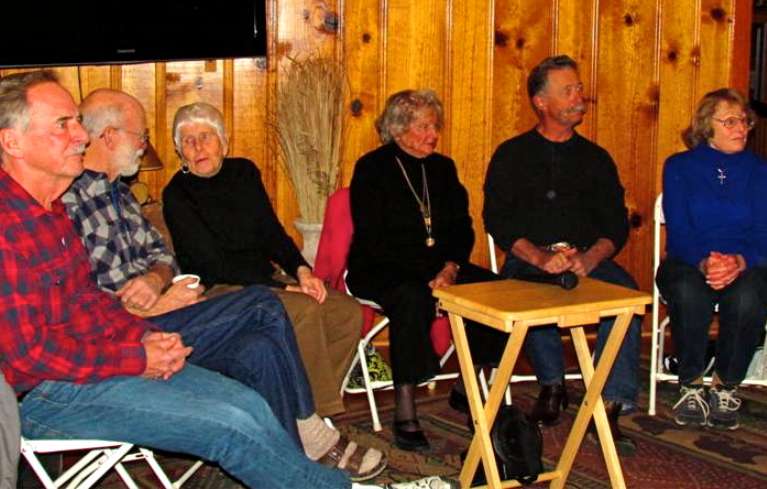
Bill Kingman, from left, Dave Wakeman, Betty Mitchell, Patty Olson, Tom Celio and Margie Daum Photo/Denise Haerr

Bill Kingman, from left, Dave Wakeman, Betty Mitchell, Patty Olson, Tom Celio and Margie Daum                                  Photo/Denise Haerr

By Kathryn Reed

CAMP RICHARDSON – For an area that judges its residents based on the number of years they’ve lived here, the six panelists who retold stories Tuesday night of days gone by more than passed the test of being a local.

Bill Kingman, Dave Wakeman, Betty Mitchell, Patty Olson, Tom Celio and Margie Daum regaled more than 70 people who crammed together at the Camp Richardson Lodge. The six spoke of the infamous winter of 1951-52, how the Lake Valley schoolhouse was where T.J. Maxx is now, two-lane dirt roads, cattle drives through the middle of town and more.

South Lake Tahoe in some ways was about 100 years behind some parts of the country when it came to infrastructure in the 1950s. The city wasn’t incorporated until 1965. Before then people said they were from one of five areas like Bijou or Lake Valley or Al Tahoe. Dirt roads were not unusual. And few people lived year-round in the Lake Tahoe Basin.

Many in the audience had their own stories to tell. After all, from a show of hands about two dozen of them have lived here for more than 40 years.

Kingman started his journey to Tahoe in the 1940s with his parents, and then moved to the South Shore permanently in 1961. He has been a disc jockey and chief engineer at every Lake Tahoe radio station. Today he writes the “Then and Now” feature for Lake Tahoe News each Sunday and broadcasts the fireworks show for KRLT.

He brought old black and white photos to share with the crowd – including cows on Highway 50 in front of the old Harrahs Club.

Kingman spoke of Highway 50 not becoming four lanes until 1957. The Y really was a Y until 1961-62 when Lake Tahoe Boulevard was extended.

Wakeman, a 1959 graduate of South Tahoe High School, grew up in what is now Alpina Café on Emerald Bay Road.

He said the Camp Rich area used to be a busy community. There was a fish hatchery near Taylor Creek. From there people would walk to the lodge to play cards and drink.

A house used to sit down the road from the lodge. It’s now a vacant lot used for parking. But Wakeman remembers it being where the telephone operator lived and worked. There were 20 party lines. If someone wasn’t home, the operator took a message.

No building department existed at the time – well, one did in Placerville, but no one bothered to come to the lake to see what was being built.

Wakeman remembers buildings collapsing after the snow melted from the record-setting winter of 1951-52. The snow held them up during the winter, but with the thaw they came down. He said the 149¾ inches that fell in 72 hours on Donner Summit still holds the record for snowfall in the United States. And that was just one of many storms that winter.

The one snowplow broke that winter. Tahoe was cut off from the rest of the world when it came to traveling by vehicle.

Daum was about 13 in that monster winter. She remembers people going to the Olsons’ store to get red Kool-Aid and Jell-O that they used to make an X in the meadow so the plow part could be air dropped.

“Just like the Angora Fire, the community pulled together. Everyone helped everyone,” Daum said.

Olson said with the winter being not long after the end of World War II, people knew how to deal with rationing and hard times.

The house she lives in today is 165 years old. It used to be Young’s Market.

She and her husband were instrumental in getting Barton Memorial Hospital built. To do so, the community had to raise $400,000. The Barton’s gave the land, Harrah’s gave $24,000 and others donated what they could.

While Mitchell didn’t move here until 1958, she remembers plenty of trying times – like the summer of 1960. A fire on the North Shore cut power to this end of the lake. It meant no showers. And the weather was cold, so dipping into Lake Tahoe was not happening.

She was a substitute teacher at the Lake Valley school, which went up to grade four. There was only one teacher, which Mitchell said was awkward at times.

Mitchell is credited with starting the Lake Tahoe Historical Society.

While Celio’s family’s roots run the deepest of the six (150 years ago they created what is now Meyers), he is the newest permanent resident of the basin. He took over the old family ranch three years ago. But he spent the better part of each summer at the ranch, spending much of his time on cattle drives.

The Lake Tahoe Historical Society, which coordinated the event, hopes to have a similar gathering in the spring with different speakers. The Nov. 12 event was videotaped, with copies of the DVDs available for purchase at the Lake Tahoe Museum starting Dec. 5.



College grads lack soft skills to get, keep a job

By Martha C. White, Time

It’s because college kids today can’t do math, one line of reasoning goes. Or they don’t know science. Or they’re clueless about technology, aside from their myriad social-media profiles.

These are all good theories, but the problem with the unemployability of these young adults goes way beyond a lack of STEM skills. As it turns out, they can’t even show up on time in a button-down shirt and organize a team project.

The technical term for navigating a workplace effectively might be soft skills, but employers are facing some hard facts: the entry-level candidates who are on tap to join the ranks of full-time work are clueless about the fundamentals of office life.

A survey by the Workforce Solutions Group at St. Louis Community College finds that more than 60 percent of employers say applicants lack “communication and interpersonal skills” — a jump of about 10 percentage points in just two years. A wide margin of managers also say today’s applicants can’t think critically and creatively, solve problems or write well.

Another employer survey, this one by staffing company Adecco, turns up similar results. The company says in a statement, “44 percent of respondents cited soft skills, such as communication, critical thinking, creativity and collaboration, as the area with the biggest gap.” Only half as many say a lack of technical skills is the pain point.

Read the whole story


‘Natural’ disappearing from food labels

By Mike Esterl, Wall Street Journal

Now you see them. Now you don’t. Food products labeled as “natural” are starting to disappear.

A growing number of food and drink companies are quietly removing “all natural” claims from packages amid lawsuits challenging the “naturalness” of everything. Mike Esterl reports on the News Hub. Photo: Naked Juice.

“Natural” Goldfish crackers will soon be just Goldfish. “All Natural” Naked juice is going stark Naked. “All Natural” Puffins cereal is turning into plain old Puffins.

A growing number of food and drink companies including PepsiCo Inc. are quietly removing these claims from packages amid lawsuits challenging the “naturalness” of everything from potato chips to ice cream to granola bars.

Food labeled “natural” raked in more than $40 billion in U.S. retail sales over the past 12 months. That is second only to food claiming to be low in fat, according to Nielsen. A survey last year by Mintel, another market research company, found 51% of Americans seek out “all natural” when food shopping.

The problem is, “natural” has no clear meaning.

Read the whole story


Official: Resorts need to offer more than skiing

By Kathryn Reed

TRUCKEE – If ski resorts don’t become year-round playgrounds, they are going to be out of business. In large part, this is because climate change is bringing less snow to the slopes.

This was the message delivered Nov. 12 by Bob Roberts, president of the California Ski Industry Association. The Truckee-Donner Chamber of Commerce breakfast meeting was filled with industry representatives.

Winters are warming and that means less snow falling in the Sierra. While snowmaking will help save the industry, it won’t be enough. And this is especially true when the drive-up market heads to the slopes when Mother Nature dumps, not when the man-made stuff is blown.

Roberts points to how dramatically things have changed in his lifetime. Five significant glaciers were on Mount Shasta when he worked at that resort. Now, he said, they are slivers.

“We need to stop thinking of them as ski resorts and see them as mountain resorts,” Roberts said. “We’re seeing it here in Tahoe.”

Resorts in Tahoe have been trying to stay ahead of the game as they invest in the on-mountain product. Rope courses, ziplines and other play structures are for the most part year-round activities and not limited to just when there is no snow.

Bob Roberts, president of the California Ski Industry Association, talks Nov. 12 in Truckee. Photo/Kathryn Reed

Bob Roberts, president of the California Ski Industry Association, talks Nov. 12 in Truckee. Photo/Kathryn Reed

Roberts pointed out how this summer $100 million was invested in Tahoe area resorts. He noted even a small resort like Sierra-at-Tahoe spent $4.5 million. Then there are the bigger players like KSL (owner of Alpine and Squaw Valley) and Vail Resorts (parent company of Heavenly, Kirkwood and Northstar) that are spending even more. In the last three years KSL will have spent $46 million on its two resorts.

A four-season resort is what ski resorts need to evolve into, Roberts said.

The Tahoe area is responsible for 53 percent of the California skier visits, though 57 percent of the spending occurs here. This equates to $58 million a year in local taxes, Roberts said. Resorts account for 1,700 full-time employees and 7,200 seasonal.

Another concern for ski resorts is fewer people are skiing and snowboarding. Roberts said K2 snowboard sales are down 50 percent. The average number of newbies to skiing-snowboarding across the country has been 1 million. That figure dropped to 850,000 last season.

“We have to get this thing jacked back up. We need to make sure they are hooked and want to continue on,” Roberts said of new skiers and riders.

Between 8.5 million and 10.5 million people from the U.S. ski or snowboard each year. Weather is usually the factor that makes the number fluctuate. The British market is still strong, while the Chinese sector is increasing.

The Asian and family markets are growing in California, while seniors has leveled off.

The demographic that is changing is singles and those younger than 18. They aren’t hitting the slopes. That, Roberts said, is something the industry needs to keep its eye on.


Social media a growing concern when applying to college

By Natasha Singer, New York Times

At Bowdoin College in Brunswick, Maine, admissions officers are still talking about the high school senior who attended a campus information session last year for prospective students. Throughout the presentation, she apparently posted disparaging comments on Twitter about her fellow attendees, repeatedly using a common expletive.

Perhaps she hadn’t realized that colleges keep track of their social media mentions.

“It was incredibly unusual and foolish of her to do that,” Scott A. Meiklejohn, Bowdoin’s dean of admissions and financial aid, told me last week. The college ultimately denied the student admission, he said, because her academic record wasn’t competitive. But had her credentials been better, those indiscreet posts could have scuttled her chances.

“We would have wondered about the judgment of someone who spends their time on their mobile phone and makes such awful remarks,” Meiklejohn said.

As certain high school seniors work meticulously this month to finish their early applications to colleges, some may not realize that comments they casually make online could negatively affect their prospects. In fact, new research from Kaplan Test Prep, the service owned by the Washington Post Company, suggests that online scrutiny of college hopefuls is growing.

Of 381 college admissions officers who answered a Kaplan telephone questionnaire this year, 31 percent said they had visited an applicant’s Facebook or other personal social media page to learn more about them — a five-percentage-point increase from last year. More crucially for those trying to get into college, 30 percent of the admissions officers said they had discovered information online that had negatively affected an applicant’s prospects.

Read the whole story


Food stamps not enough for healthy diet

By Eli Saslow, Washington Post

McALLEN, Texas — They were already running late for a doctor’s appointment, but first the Salas family hurried into their kitchen for another breakfast paid for by the federal government. The 4-year-old grabbed a bag of cheddar-flavored potato chips and a granola bar. The 9-year-old filled a bowl with sugary cereal and then gulped down chocolate milk. Their mother, Blanca, arrived at the refrigerator and reached into the drawer where she stored the insulin needed to treat her diabetes. She filled a needle with fluid and injected it into her stomach with a practiced jab.

“Let’s go,” she told the children, rushing them out of the kitchen and into the car. “We can stop for snacks on our way home.”

The family checkup had been scheduled at the insistence of a school nurse, who wanted the Salas family to address two concerns: They were suffering from both a shortage of nutritious food and a diet of excess — paradoxical problems that have become increasingly interconnected in the United States, and especially in South Texas.

For almost a decade, Blanca had supported her five children by stretching $430 in monthly food stamp benefits, adding lard to thicken her refried beans and buying instant soup by the case at a nearby dollar store. She shopped for “quantity over quality,” she said, aiming to fill a grocery cart for $100 or less.

But the cheap foods she could afford on the standard government allotment of about $1.50 per meal also tended to be among the least nutritious — heavy in preservatives, fats, salt and refined sugar. Now Clarissa, her 13-year-old daughter, had a darkening ring around her neck that suggested early-onset diabetes from too much sugar. Now Antonio, 9, was sharing dosages of his mother’s cholesterol medication. Now Blanca herself was too sick to work, receiving disability payments at age 40 and testing her blood-sugar level twice each day to guard against the stroke doctors warned was forthcoming as a result of her diet.

Read the whole story


Survey: Lake Tahoe homeowners remain frustrated and dissatisfied with TRPA

Tahoe Regional Planning Agency continues to be a sore subject with locals in the basin. Photo/LTN file

Tahoe Regional Planning Agency continues to be a sore subject with locals in the basin. Photo/LTN file

By Steven Miller, Nevada Journal

The Tahoe Regional Planning Agency is winning national awards from government-planning professionals, but among homeowners in the five counties surrounding Lake Tahoe, it’s the least popular local government agency of all.

Seventy percent of homeowners in the Lake Tahoe Basin said TRPA would not take their concerns very seriously and 47 percent expressed much frustration with TRPA.

When poll respondents reporting minimal experience with the agency were excluded from the calculations, the negatives went up — to 72 percent and 55 percent, respectively.

In every case, TRPA’s negative numbers are significantly higher than those of other local government agencies in the basin and higher still when compared to the attitudes of homeowners just outside the basin.

Those are among many findings produced by two surveys of attitudes toward local governments of homeowners living in the counties surrounding Lake Tahoe.

The two automated telephone surveys — one inside the Tahoe basin and one in the same five counties but outside the basin — were conducted Sept. 17-19, contacting homeowners with land-line telephones.

The surveys, conducted for Nevada Journal by PMI International, have a margin of error, plus or minus, of 5 percent.

Homeowners were first asked to characterize the quantity of their experience with various governmental entities. Then they were asked to evaluate each entity in three different contexts.

While none of the governments scored especially well, the Tahoe Regional Planning Agency regularly scored lowest.

The first evaluative question attempted to discover how seriously homeowners believe authorities within those agencies take citizen concerns.

“Hypothetically,” respondents were asked, “let’s say that you and a neighbor are concerned, because you believe a local government is going down the wrong path on an important issue. If you and your neighbor attend a public meeting of that government to ask it to reconsider, how seriously do you believe each of the following government entities would take your concerns?”

Of 172 responses from homeowners inside the basin, 70 percent said TRPA would not take such citizens’ concerns very seriously. That was worse than county government, at 61 percent, and city government, at 57 percent.

Alternatively, 9 percent believed TRPA would take the citizen concerns “very seriously,” while 7 percent said their county government would and 10 percent said their city government would.

Outside-the-basin homeowners were asked a parallel question, in which the term, “your local planning agency,” replaced “the Tahoe Regional Planning Agency.”

In that case, 57 percent said that the local planning agency would not take citizens’ concerns very seriously, 53 percent said the same of their county government, and 51 percent judged their city government similarly.

The second evaluative question probed homeowner frustration with government. It asked: “To what degree have you found your experience with your local governments frustrating?”

Of homeowners with experience of the government agencies responding from inside the basin, 52 percent said that they experienced “much frustration” in dealing with TRPA. That was worse than their reported experience with county government, at 35 percent, and city government, at 46 percent.

Comparable outside-the-basin homeowners regularly reported less frustration. Regarding their local planning agency, 33 percent reported “much frustration,” while 29 percent characterized their county government that way, as did 28 percent for their city government.

The survey’s third evaluative question sought to identify the extent to which homeowners find dealing with any of these government entities simply futile.

Respondents were asked to rate “the degree of futility you’ve felt in dealing with each” of the governments by selecting among “not futile,” “somewhat futile” and “very futile.”

Here again, TRPA’s ratings were the most frequently negative — given a “very futile” classification by 57 percent of basin respondents with experience of the agency. In comparison, the percentage who saw county government in such terms was 32 percent, while city government came in at 37 percent.

Outside the basin — but within the same counties — only 37 percent of agency-experienced homeowners gave their local planning agencies the “very futile” ranking. County and city governments received that rating from 28 percent and 24 percent, respectively.

Given the tenor of basin homeowners’ answers to the survey, it may not be surprising that most of them perceive that they have less freedom than Americans who live elsewhere.

That question was introduced in each survey with the statement, “Many different government entities make and enforce rules in the Lake Tahoe Basin. It has been argued that a result of this is that homeowners within the basin end up with less real liberty, practically speaking, than Americans who live outside the basin.”

Basin homeowners, by a 59 to 41 percent majority, answered that “Basin residents end up with less liberty than Americans outside Tahoe basin.”

However, homeowners living in the same counties, but outside the basin, don’t see the problem. They see basin homeowners as having just as much freedom as everyone else.

Within the basin, the rate of participation by homeowners was significantly higher than the rate statistically normal for automated surveys. Of 2,745 individuals contacted live, 5.97 percent, or 164, completed all 16 questions.

Outside the basin, the rate of participation by homeowners was statistically normal, according to experts consulted by Nevada Journal. Of 7,492 individuals contacted live, a total of 256, or 3.42 percent, completed all 16 questions.

Findings did not appear to vary significantly, depending upon the amount of time that respondents had lived in their homes.

Nevada Journal is a publication of the Nevada Policy Research Institute.


South Lake Tahoe salutes veterans

A gentle breeze has Old Glory swaying Nov. 11 in South Lake Tahoe. Photo/Kathryn Reed

A gentle breeze has Old Glory swaying during the South Lake Tahoe Veterans Day ceremony. Photo/Kathryn Reed

Under partly sunny skies, the mood was somber as nearly 100 people gathered in South Lake Tahoe to honor veterans from near and afar.

Before the ceremony Monday morning, members of the local Moose Lodge placed 445 flags at Happy Homestead Cemetery to honor those who have served and since passed on.

Traditional words of sacrifice, honor and respect rang through the speeches given by those who have served, as well as local politicians who spoke.

Many in attendance at the American Legion carried small U.S. flags as symbols of their loyalty and gratitude for those who have served in the military.

Soroptimist International of Tahoe Sierra will be honoring female veterans at the Nov. 14 7:30am meeting at the South Lake Tahoe Senior Center.

 — Lake Tahoe News staff report


Calif. to help Ma Nature with cloud seeding

By Matt Weiser, Sacramento Bee

As California concludes a second drought year and water managers hope eagerly to avoid a third, utilities across the state are poised for that first mass of pillowy gray clouds to drift ashore from the Pacific Ocean.

When it arrives, if conditions are right, they’ll be ready with cloud-seeding tools to squeeze out every extra snowflake, with the goal of boosting the snowpack that ultimately feeds the state’s water-storage reservoirs.

Cloud seeding in the Sierra Nevada. Photo/DRI

Cloud seeding in the Sierra Nevada. Photo/DRI

Once viewed by some as a fringe science, cloud seeding has entered the mainstream as a tool to pad the state’s crucial mountain snowpack. New technology to manage the practice, and research that points to reliable results, have cemented cloud seeding as a dependable and affordable water-supply practice.

“The message is starting to sink in that this is a cost-effective tool,” said Jeff Tilley, director of weather modification at the Desert Research Institute in Reno, which practices cloud seeding in the Lake Tahoe Basin and Eastern Sierra Nevada. “The technology is better; we understand how to do cloud seeding much better. And because we know how to do it more effectively, it’s definitely taken more seriously.”

Cloud seeding is often misunderstood as a kind of magic that conjures rain from thin air. In reality, it is simple chemistry combined with careful weather monitoring.

As practiced in California and elsewhere in the West, cloud seeding involves spraying fine particles of silver iodide into a cloud system to increase snowfall that is already underway or about to begin. Silver iodide causes water droplets within the clouds to form ice crystals. As the crystals grow larger, they become snowflakes, which fall out to create more snow than the storm would have generated on its own.

Read the whole story


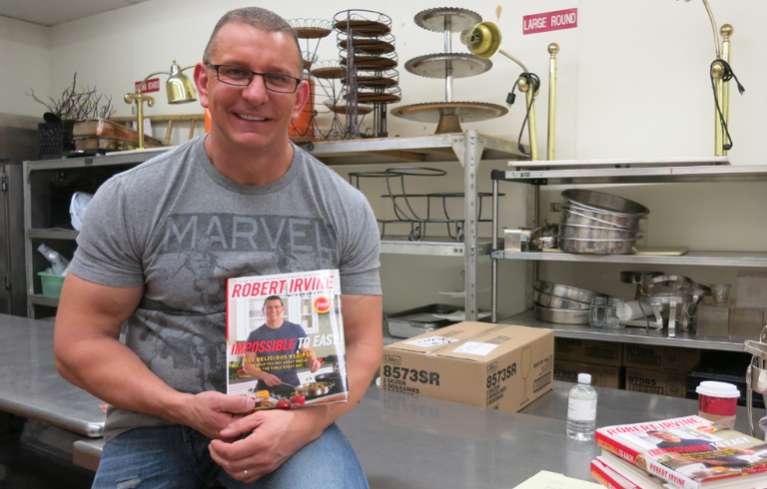
Impossible not to be wowed by Chef Irvine

Chef Robert Irvine proves he has a soft side at 4th annual South Lake Tahoe Food and Wine Festival. Photos/Jessie Marchesseau

Chef Robert Irvine proves he has a soft side at the South Lake Tahoe Food and Wine Festival. Photos/Jessie Marchesseau

By Jessie Marchesseau

STATELINE – Chef Robert Irvine’s down-to-business attitude on “Restaurant: Impossible” can make him seem intimidating and unapproachable. In person, he is just the opposite.

An intimate dinner of less than 150 people gave guests an opportunity to interact personally with the chef. Irvine called the experience “bonding time” as he made it a point to stop at every table to chat, answer questions, take photos and sign copies of his cookbook.

At the various events, dressed in his signature jeans and T-shirt, Irvine took time to sign hundreds of autographs and have his photo taken with just as many fans.

Eating and drinking were the main activities at the 4th annual South Lake Tahoe Food and Wine Festival Nov. 9-10 at Harrah’s and Harveys casinos. The sold-out two-day festival offered guests a variety of experiences to choose from. Seven events allowed attendees a chance to learn something, taste something, drink something and/or rub elbows with a celebrity chef.

This year’s star was Irvine, host of the Food Network television show “Restaurant: Impossible”. Each year the festival highlights a different celebrity chef. Past years have brought names such as Martin Yan and Anthony Bourdain.

A chocolate sculpture by pastry chef Cathy Haynes featured at the Grand Market.

A chocolate sculpture by pastry chef Cathy Haynes featured at the Grand Market.

Saturday evening’s Chef in the Kitchen event was a chance for diners to enjoy a three-course meal created by Irvine. He said he wanted the menu to be simple and classic.

“Doing the simplest thing and doing it well always wows people,” Irvine said.

Harrah’s pastry chef Cathy Haynes said Irvine came into the kitchens to introduce himself and shake hands with the rest of the staff, something that does not always happen when the celebrity chefs come to town.

“Robert Irvine was incredible. He went way above and beyond what we asked him to,” said John Packer, director of entertainment and public relations for Harrah’s and Harveys, told Lake Tahoe News. “He’s just really a great performer.”

At Saturday night’s Chef on Stage, Irvine on multiple occasions wandered through the audience of more than 700. He answered cooking questions, personal inquiries, business questions and spent time joking with audience members. One heckler was asked to join him on stage and stand there holding a fire extinguisher for several minutes. Another he brought up and asked to do an ape impression, but not before Irvine did one himself.

When he wasn’t mingling with the guests, Irvine was on stage cooking. Chef on Stage was an hourlong cooking demonstration. The night’s lesson was seared halibut with haricot verts potato salad. Steam rose from his saucepans as the smell of sautéing garlic and onions wafted through the South Shore Room. The fish, on the other hand, did not smell. Irvine even walked around asking people to smell the raw halibut fillet in his hand to emphasize his point: fresh fish does not smell fishy.

The finished product was what Irvine called “sexy food.” Just the smell in the room could make you salivate.

“Food is supposed to be fun and fictional, or factual, or just good,” he told the audience.

Irvine said he chose halibut for the Chef on Stage demonstration because he gets more questions on how to cook good fish than any other cooking inquiry.

“I tried to show everyone something simple and how to do it well,” he said.

Braised Veal Breast with Balsamic fig conserve and candied bacon by chef Eric Vaughn.

Braised veal breast with balsamic fig conserve and candied bacon by chef Eric Vaughn.

Irvine calls himself a simple cook, with comfort foods being his favorite things to cook, and eat.

But Irvine was not the only chef serving up delectable delights during the festival. While he may have been the headliner, Saturday’s Grand Market is the anchor event for the entire weekend. More than a thousand people filed into the Harrah’s special events center for a chance to sample the selection of gourmet food, wines and liquors.

The market is a chance for Caesars Entertainment, the company that owns Harrah’s and Harveys, to showcase chefs from various properties. Small booths lined the walls of the event center, each one offering a different tapas-sized treat or tasting-sized beverage.

Chefs from Caesars properties in Las Vegas, Reno and Tahoe demonstrated their creative talents with dishes specially invented for the event. More than one person, including my companion, declared the braised veal breast with balsamic fig conserve and candied bacon the best food there. Prepared by Eric Vaughn, executive chef for Paris, Bally’s and Planet Hollywood casino-hotels in Las Vegas, the dish is something he described as incredibly labor-intensive. Even though it had rave reviews from tasters, will never make it onto the menu at any of his restaurants.

By far the most popular food station of the market, and my personal favorite, was Haynes’. It was the only one offering sweets, and unlike most tasting stations which only offered one dish, she and her staff prepared more than half a dozen bite-sized options for guests to try. In this case, Haynes said some of the more popular ones might actually make their way onto menus.

Also on her table were two chocolate showpieces created by Haynes and her pastry staff: a crate of “South Lake Tahoe Wine” bottles surrounded by fall leaves and a tall steam punk-esque sculpture with various gears and parts, both made entirely of chocolate.

“This is such a fun event,” she said of the festival. “It’s the one time of year we get to be creative.”

In between tastings, visitors were entertained by cooking demonstrations with Andy LoRusso, “The Singing Chef,” and an appearance and photo opportunities with Irvine. The aroma of LoRusso’s Bellini’s Pasta Norma filled the air, as did the sounds of him singing Italian songs while he cooked.

We spent nearly two hours tasting gourmet delights and mouth-watering wines, and though the Grand Market is just the kickoff event for an entire weekend of culinary affairs, we left feeling satisfied and humming the old-world Italian tunes of The Singing Chef.