Bears, trash, people a growing problem in Incline

By Jim Carlton, Wall Street Journal

INCLINE VILLAGE — When Brent and Benét Terry moved into their new home in this upscale Lake Tahoe community recently, they were surprised to meet one of the neighbors: a black bear that had taken up residence in a culvert across the street.

“He’s a pretty good-sized boy,” said Brent Terry, a 61-year-old retired airline pilot. “I’m surprised he can even get in there.”

Incline Village is crawling with bears. As of early this month, there were 66 reported sightings this year in the town of some 9,000 people — up 38 percent from all of last year—and the animals are wreaking havoc. Homes and cars have been broken into and innumerable garbage bins and dumpsters pawed through.

The bears’ attraction to garbage appears to be the crux of the problem, most residents agree. But they are divided over both the proposed long-term solution — a mandate to use more-expensive bear-proof garbage containers — and whether to handle their burly neighbors with tough love or lethal force.

Nevada wildlife officials and private bear-removal services advocate trapping and relocating the animals, frightening them with aversion techniques and, as a last resort, killing them. Bear-friendly activists endorse scaring off bears by yelling and rattling cans of rocks, but not killing them.

“The bears are dying for the transgressions of people,” said Ann Bryant, executive director of BEAR League, a bear-friendly group whose mission is “helping bears and people live peacefully in this world together.”

Read the whole story


Forest Plan attempts to bring balance to basin

By Kathryn Reed

People have plenty of ideas how the 150,000 acres in the Lake Tahoe Basin Management Unit of the U.S. Forest Service should be managed. The agency received about 18,500 comments on the environmental document for the Forest Plan.

While wilderness areas and snowmobiling were some of the more contentious issues during public hearings, they did not dominate the comments. No new wilderness areas have been added. The Forest Service wants to find a way for snowmobilers and non-motorized recreationists to play outdoors without annoying each other.

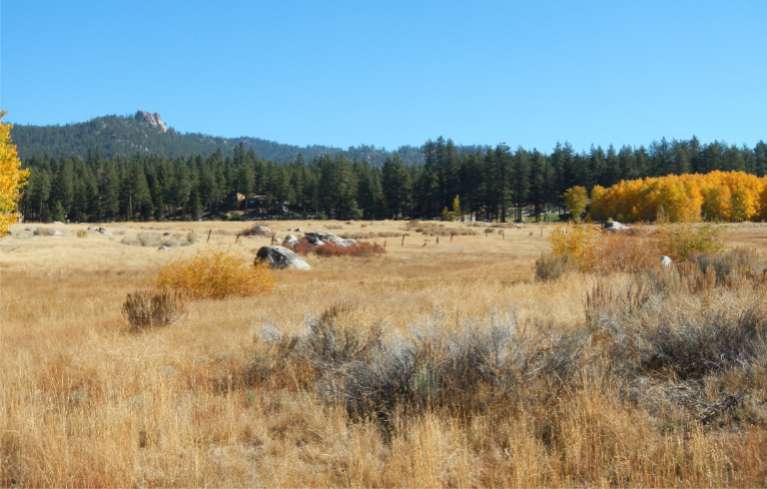
Rabe Meadow in Stateline is a small part of what the Lake Tahoe Basin Management Unit oversees. Photo/LTN

Rabe Meadow in Stateline is a small part of what the Lake Tahoe Basin Management Unit oversees. Photo/LTN

Jeff Marsolais, deputy forest supervisor, said the key with the plan is to bring balance to the various needs of the people using the forest, as well as the animals and plants that call it home.

“One thing holds true, there are folks on both sides of pretty much all of the issues. It gets back to balance,” Marsolais said. Some want more aggressive management for wildfire protection, others want less intrusive approaches; some want less recreation, others want more.

Some of the comments pointed out science the Forest Service was not using. Marsolais said his team listened and more science is part of the document.

The Forest Plan is the guiding document for the local Forest Service office for the next 15 years. Comments are being accepted on the final environmental impact statement until Jan. 21.

The previous Forest Plan had 21 management areas; this one has four. This will make things more efficient with less needless redundancy.

The Stanford Rock Backcountry Area, which is approximately 3,800 acres between Blackwood and Ward canyons, has been added.

“People who go to those special places want a little bit more solitude and not necessarily have it be wilderness,” Marsolais told Lake Tahoe News.

One thing the public will notice is an increase of 5 percent of the land being designated for recreation. This could mean various things – a few more parking spaces or developed campsites.

“Just because the plan authorizes it doesn’t mean we will do it,” Marsolais said.

This plan is not about projects. It’s more of a big-picture planning document that outlines allowable uses.

This Forest Plan is long overdue. Work on in started in the early 2000s. Twice the Forest Service was sued – in 2005 and 2008. This meant starting over to come up with a planning tool that would not be litigated. That happened in 2012.

New to this document compared to others is how climate change could affect the forest lands.

“This Forest Plan considers the effect of changing climate and establishes standards and guides for species management and vegetation management,” Marsolais said. “This plan creates a space for us to be more adaptable to use new science or assessments for how to do projects on the ground.”

—-

Notes:

• The Forest Service will have two webinars to explain the final plan, highlight changes from the draft and outline the remainder of the plan revision process. The first will be Dec. 9 from 5-6pm. The second will be Jan. 14 from 2-3pm. The webinars will feature a brief presentation, followed by a question and answer period, and they will be archived on the LTBMU website for later viewing.

• The plan, final EIS, draft record of decision and webinar info is online.

• CDs or print copies are available at 35 College Drive, South Lake Tahoe or by calling (530) 543.2694.

• A record of decision could be signed in the spring, at which time the document takes effect.


SLT city attorney says no to paid parking foes

By Kathryn Reed

The group of South Lake Tahoe residents who want paid parking to go before the voters was handed a setback when the city attorney said he could not write a ballot title and summary.

“At this time the Tahoe4Tahoe committee is exploring their options for a legal challenge to the city’s rejection of our petition request and continue to believe that the voters of South Lake Tahoe deserve the opportunity to decide if they want paid parking on their city streets and public parks,” Peggy Bourland, spokeswoman for the group, told Lake Tahoe News.

Paid parking has been a contentious issue since the city started talking about putting up kiosks a few years ago. The bulk of the meters was installed this past summer. While the city shows a financial profit, the naysayers are not going away.

Earlier this month Tahoe4Tahoe filed a notice of intent to circulate a petition that would ultimately result in the voters deciding June 3 whether the city’s paid parking program stays or goes.

One of the hurdles to get it on the ballot is for the city attorney to write the summary and title.

City Attorney Tom Watson wrote Bourland saying, “The text as drafted impairs essential government functions, including, but not limited to: the power of taxation, the police power to control public streets and highways, fiscal management abilities, franchising authority and the legislative power to provide for the health and safety of the community. Additionally, because the initiative is multipart, it potentially violates the single subject rule.”

Bourland requested a meeting with the city attorney. He said no, saying he could not be an advocate for their group and instead recommended hiring private legal counsel.

Time is ticking for the group to meet the deadlines for the June ballot, however there will also be an election in November. But by November the parking program the group doesn’t like will in all likelihood have had another summer to be in place.

The City Council after the first of the year is expected to revisit the parking program to potentially make changes and/or solidify what is in place.


Black Friday not always the cheapest shopping day

By Tiffany Hsu, Los Angeles Times

As the hardiest of shoppers prepare for the annual Black Friday consumption frenzy, many are convinced it’s their one shot at a great deal.

But “that’s not even close to the truth,” said Matthew Ong, senior retail analyst at online personal finance company NerdWallet Inc.

Bargain hunters can — and, in some cases, should — avoid the Black Friday weekend crush, several experts said.

Many characterize the shopping bonanza as an expertly marketed ploy to capitalize on shoppers’ fear of missing out. By dangling a small batch of irresistible savings, stores land hordes of hopeful shoppers all scheming to score the retail version of Willy Wonka’s golden ticket.

Yet only a tiny percentage of customers end up with the most desirable deals. The rest, unwilling to leave empty-handed, walk away with lesser bargains arranged appealingly nearby.

Read the whole story


STR clamps down on types of garbage cans

By Kathryn Reed

Garbage removal on the South Shore isn’t like a lot of other places. Depending on the customer this is a good or bad thing.

This fall South Tahoe Refuse sent postcards to people saying, “Do not purchase totes.” These are the receptacles that have handles that attach to a garbage truck and are then mechanically lifted and emptied.

STR doesn’t have these types of trucks. Instead, human power is used to lift the can into the truck.

A South Tahoe Refuse customer is miffed about the company's policy on tote cans and even more perturbed his can is knocked over after being emptied. Photo/Provided

A South Tahoe Refuse customer is miffed about the company’s policy on tote cans and even more perturbed his can is knocked over after being emptied. Photo/Provided

“They are high strength molded plastic designed specifically to be used with hydraulic systems,” John Marchini with South Tahoe Refuse told Lake Tahoe News of the totes. “Our biggest concern is that we do not want to subject our coworkers to lift these totes.”

The totes are usually larger because jurisdictions that allow them don’t have workers lifting them, plus customers are often limited to one can, though usually there are separate recycling and yard waste cans.

“Lifting sometimes heavy trash containers is a job description, not a basis for a campaign to downgrade the town’s trash containers,” one customer told Lake Tahoe News.

“What sticks in my craw is that this thing is a monopoly, that trash pick up is mandatory and that I’d like to see the town cleaned up and standardized trash containers with attached lids would go a long way. So it is especially annoying when I do more than my part and buy a nice wheeled container, like every other civilized town, and they actually try to forbid me from doing something so simple,” a 24-year resident told Lake Tahoe News. He is feeling put upon by STR, his tote trash can knocked over after it’s emptied and denied blue recycling bags, so he doesn’t want his name used for fear of serious retribution.

STR says it has come up with a compromise for people who want to use the tote cans. If garbage is in bags that can be lifted out and thrown into the truck, the garbagemen will service that container.

Totes, though, are not the typical 32- or 45-gallon can. Like other cans, some are designed to be animal resistant.

In general, cans should not be more than 50 pounds, and bags no more than 30 pounds.

The South Lake Tahoe-base company has no intention of changing its vehicles to accommodate the totes that are so widely used every place else. One reason is more jurisdictions are requiring bear boxes. Totes don’t fit in bear boxes.

El Dorado County requires anyone building a new home or doing a remodel to put in a bear box.

If STR were to go to hydraulic trucks that could lift totes, the bear box issue would require some sort of hybrid system. And company officials say one day that is possible.

The thinking behind sending the postcard was also to let commercial customers know totes are not acceptable.


Study: Boredom can be dangerous

By Karen Kaplan, Los Angeles Times

Boredom is a lot more interesting than scientists had thought.

A study of students in Germany reveals that there are five distinct types of boredom. That’s one more than researchers had expected.

What’s more, the newly discovered category — which they labeled “apathetic boredom” — was quite common among high school students, according to the study, published this week in the journal Motivation and Emotion.

Boredom isn’t just boring. It can be dangerous, either for the person who is bored or for the people around him. For instance, people who are bored are more likely to smoke, drink or use drugs. Kids who are bored are more likely to drop out of school and become juvenile delinquents. Studies have also linked boredom with stress and other health problems.

Read the whole story


Small businesses grapple with health care law

By Andrew Doughman, Las Vegas Sun

Americans now know that President Obama erred when he told the nation that people can keep their health plans if they like them.

In Nevada, about 25,000 people in the individual health insurance market received cancellation notices, leading to an apology from the president and a proposed fix.

But this isn’t over.

The same principle that led to people receiving cancellation notices also applies to businesses. Workers will face a lot of changes to the health care market in late 2014 as business owners seek to comply with business-related provisions of the health care law that start Jan. 1, 2015.

The timing means workers and business owners will face disruptions in the health insurance market right as Republicans and Democrats are competing to win votes in the Nov. 4, 2014, election.

“It’ll be what you’re hearing now about the individual (health insurance) plans times 10,” said one health insurance broker with large-business clients in Las Vegas.

That’s because the individual insurance market is small. Many more people get insurance through small-group or large employer health plans.

Many of these plans already provide better coverage than individual health plans, but they’ll still have to comply with the law come 2015.

Read the whole story


S. Tahoe hotel cutting it close to open on time

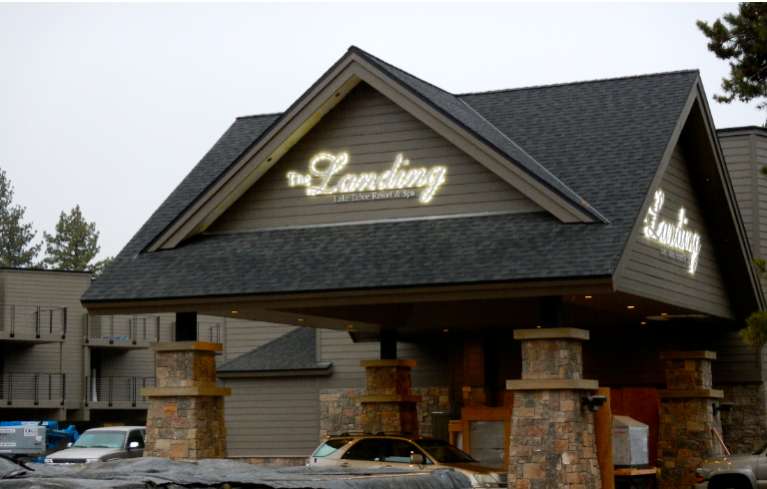
The Landing Resort in South Lake Tahoe is expected to open Dec. 12. Photos/LTN

The Landing Resort in South Lake Tahoe is expected to open Dec. 12. Photos/LTN

By Kathryn Reed

The sound of construction equipment continues to hum from Landing Resort & Spa despite its anticipated opening in two weeks.

Billed as Lake Tahoe’s first five-star resort, the property was once a throwback to “old Tahoe” and now has the makings of a modern, upscale hotel.

It’s expected to open Dec. 12, with introductory room rates of $149 per night for one of the 88 rooms. Rooms come with fireplaces and decks.

While the hotel claims to have private beach access, in reality anyone can pay to go to Lakeside Beach.

Bikes will be free to use. In the winter ski valet and boot warmers are available.

The 3,600-square-foot rooftop deck is designed for parties, weddings and other events.

A pool, hot tub and five outdoor fire pits are on the grounds.

Included on the property, which used to be the Royal Valhalla in South Lake Tahoe near Stateline, is a restaurant called Jimmy’s. It’s based on owner Jim Demetriades’ Mammoth restaurant. Jimmy’s will serve Greek-seafood. Based on the menu out front it will not be a place vegetarians will visit.

British chef Maria Elia will be running the kitchen. She is well versed in Greek cuisine. In September her third cookbook was published. It’s a collection of recipes inspired by her Greek heritage. The restaurant includes private dining alcoves with fireplaces and outdoor fire pits with views of the lake from the patio. The wine list includes 250 labels from around the world.

A mix of about 70 full-time and part-time employees is expected to work at the resort during peak times.

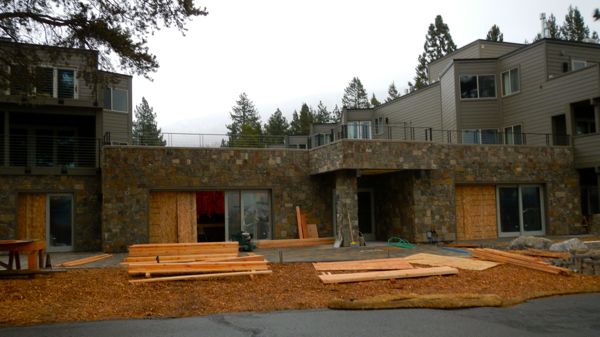
Contractors are still working on the Landing Resort.

Contractors are still working on the Landing Resort.

However, getting to this point has not been completely smooth.

There is a question as to whether trees were poisoned or more taken out than needed, they’ve angered neighbors, the hotel is already on its second marketing and sales director, and it has dropped a local spa operator in preference of running it in-house.

Controversy has arisen with a neighbor and the fence that now divides the two properties. Plus, the fence was initially put in without a permit.

“Once we were aware that the fence was being constructed, our staff contacted the project manager to notify them of the fence permit requirement. They then submitted an application and a permit was issued. This is not the ideal sequence when it comes to permitting construction work, but we often are notified of, or see work being done without proper permits and once we contact the property owner they follow up with the required permit application,” Hillary Roverud, chief planner with South Lake Tahoe, told Lake Tahoe News.

Jim Promo, general manager of the resort, told Lake Tahoe News the fence issue has been resolved with neighbor Jake Parnell. It’s short in front and at least 6-feet-high in Parnell’s back yard. Parnell used to be able to see to the lake from his back yard. Now he can’t. Parnell, who lives part time in South Tahoe and part time off the hill, had yet to see the fence as of last week so he didn’t have a comment.

Some of the trees that were removed conveniently opened up better views of the lake, especially from where weddings will take place. Promo said weddings are going to be a large component of their business.

“We had an arboriculturist come out. They made recommendations. The trees we took were basically diseased,” Promo said.

The Tahoe Regional Planning Agency forester tagged four lodgepole and one Jeffery to be felled.

According to TRPA spokesman Jeff Cowen, one of the trees that came down was because trenching work for a utility line was done on the wrong side of the tree and when it was done on the correct side the tree was then severely compromised.

He said one of the trees was in the city’s right-of-way. It was taken out because it would eventually have to go when the city put in a curb.

More info about the Landing Resort & Spa may be found online.


Age doesn’t have to be the reason not to ski

By AP

STEAMBOAT SPRINGS, Colo. — If you’ve walked into a ski lodge the past few years, likely as not you’ve seen tables filled with gray-haired skiers wearing sweaters so old they’re back in style.

That’s because the number of skiers on the far side of 50 — some on the very far side — has been creeping up each year, according to the National Ski Areas Association.

Credit advances in artificial hips and knees that make it possible for skiers to continue enjoying the sport; shaped skis, along with better snowmaking and grooming that make skiing easier; and high-speed lifts and luxury touches like ski valets that make it more pleasant.

“There are no excuses,” said 93-year-old Klaus Obermeyer, the Aspen-based skiwear designer. Despite breaking his leg in a wipeout two years ago, Obermeyer still skis each day.

Sure, younger people still make up the majority on the slopes — the average skier is 38.5 years old — but, “The person who skis the most in a given year is 65 and older,” said Michael Berry, president of the NSAA, based in suburban Denver.

Bragging rights go to those age 68 and older, who averaged 9.5 days skiing last season. Boomers — those age 49 to 67 this year — also skied more than the national average of five times per year, according to an NSAA survey released in August.

“You don’t want to sit in your rocking chair and look at the view,” said 70-year-old Billy Kidd, who won a silver in the slalom at the 1964 Olympics. “You want to remember your days of youth and you love that feeling of adrenaline and dealing with the variables of skiing.”

Clearly, others old enough to remember Kidd in his heyday feel the same way. Those ages 45-54 made up 20 percent of skiers last winter, up from 14 percent in the 1997-98 season; the 55-64 age group made up 12 percent, up from nearly 5 percent, and those 65 and older rose to 5.5 percent from 2.5 percent, according to the NSAA study.

Kidd, who skis nearly daily in his role as an ambassador for the Steamboat Ski Resort, said one thing that has changed as he’s gotten older is his gear.

Indeed, Kidd is a walking billboard for the latest innovations. His skis and poles are lightweight carbon fiber. His Osbe helmet does away with goggles and replaces them with a built-in visor that provides better peripheral vision. He traded in traditional ski boots for soft Apex boots, which provide support through an external frame. (For putting on traditional ski boots, many older skiers swear by the Ski and Snowboard Boot Horn.)

“At 20 years old I didn’t care about comfort,” Kidd said. “I still have to have control, but the top priority for me is comfort.”

Certainly, there are challenges as skiers age, not the least of which is finding friends who are also still skiing.

Clubs like the 70+ Ski Club, based in North Kingstown, R.I., with more than 4,000 members, and the Over the Hill Gang International based in Colorado Springs with 3,000 members, offer camaraderie, discounted tickets and ski trips near and far.

Even those who retire to Florida still pursue their passion. The Florida Ski Council has 17 clubs in the state and at least one trip going every week of the ski season. The largest club, the Tampa Bay Snow Skiers and Boarders, takes about 1,000 people a year skiing, said Clair Quenzler, the council president.

These dedicated watchers of the discounts for skiers agree that the perks seniors used to get from ski resorts have been reduced as their numbers increase.

Several resorts have raised the eligibility age for discounted lift tickets, or they’ve limited deals to weekdays.

“To be fair to the ski areas, it’s a business for them as well,” said Doug Lofland, 56, one of the owners of the Over The Hill Gang International.

So what suggestions do experts have to help the rest of us ski into our Golden Years?:

  • Stay in shape.
  • Try to choose slopes with less traffic so you can safely ski a little slower.
  • Think about afternoon sun and shadows. A west-facing slope will have better definition.
  • Be cognizant of higher altitude and hydration.
  • Walking in ski boots can be more challenging than skiing, so companies have developed lightweight shoes, like Pakems, that you can carry with during the day for a quick change.
  • Consider taking a gondola or chairlift down the mountain if weather sets in or you’re tired.
  • Consciously chose your danger level. “The repercussions of making a mistake are too great,” Kidd said.

And finally, enjoy, like the 89-year-old who sent the 70+ Ski Club a photo of herself skiing with her great grandchildren.

“There are not many sports four generations can do together like that,” said club president 42-year-old Richard Lambert.

Calif. projects years of budget surpluses

By David Siders and Jim Miller, Sacramento Bee

In its most optimistic budget forecast in more than a decade, the Legislature’s fiscal analyst said Wednesday that California is poised for years of multibillion-dollar surpluses.

However, even a moderate economic downturn could throw the state back into deficit, the nonpartisan Legislative Analyst’s Office said. The analyst projected a $5.6 billion surplus by June 2015 and urged lawmakers to hold much of it in reserve.

The fiscal outlook is a prelude to annual budget negotiations at the Capitol, where the expectation of a surplus will foist pressure on Democratic lawmakers to increase spending in budget talks next year. Many social service advocates limped out of the recession desperate to restore or expand programs for California’s poorest and neediest residents, and despite modest spending increases many of their funding requests remain unfulfilled.

“There were many things cut that need to be restored,” said Anthony Wright, director of the nonprofit advocacy group Health Access California. “We had cut the safety net beyond the pale. … We started to restore this past year, but only at the margins, and more needs to be done.”

Read the whole story