Tech giants want government to back off

By Edward Wyatt and Claire Cain Miller, New York Times

Eight prominent technology companies, bruised by revelations of government spying on their customers’ data and scrambling to repair the damage to their reputations, are mounting a public campaign to urge President Obama and Congress to set new limits on government surveillance.

On Monday the companies, led by Google and Microsoft, presented a plan to regulate online spying and urged the United States to lead a worldwide effort to restrict it. They accompanied it with an open letter, in the form of full-page ads in national newspapers and a website detailing their concerns.

It is the broadest and strongest effort by the companies, often archrivals, to speak with one voice to pressure the government. The tech industry, whose billionaire founders and executives are highly sought as political donors, forms a powerful interest group that is increasingly flexing its muscle in Washington.

Read the whole story


Nissensohn sentenced to death for 3 killings

By Kathryn Reed

Joseph Michael Nissensohn will never have the opportunity to hurt another woman. On Tuesday, a jury of 12 in South Lake Tahoe said he should die for his crimes.

In October, the 62-year-old was found guilty of three counts of first-degree murder.

The remains of Kathy Graves, 15, of South Lake were found near the Mount Tallac trailhead in 1990, about one year after she was last seen alive. Nissensohn also killed Monterey County teenagers Tanya Jones and Tammy Lynn Jarschke in 1981.

Joseph Michael Nissensohn

Joseph Michael Nissensohn

He has already been in prison 15 years for the second-degree murder of a woman in Tillicum, Wash. When he was supposed to get out in 2008 El Dorado and Monterey county prosecutors agreed to wrap their cases into one and filed charges before Nissensohn was freed.

It took jurors only 90 minutes to complete this phase of the more than six-month trial.

As soon as the clerk in the El Dorado County Superior Court read the verdict Nissensohn was handcuffed. The entire time he sat staring straight ahead in the direction of Judge Suzanne Kingsbury.

“I wouldn’t say it was disturbing, but you definitely feel a lot of responsibility is on your shoulders,” Bob Grant, one of the jurors, told Lake Tahoe News after the Dec. 10 sentencing verdict. “You are very careful to pay attention in court to make sure you get the right verdict.”

El Dorado County sheriff’s Lt. Pete Van Arnum was in the courtroom. Afterward he called Nissensohn a dangerous man. Van Arnum was with a different department when Grave’s skull was found near Fallen Leaf Lake.

He said it’s good Nissensohn was sentenced to death; pausing to wonder if these are the only crimes the criminal committed.

Nissensohn is scheduled to be formally sentenced March 18.

Since El Dorado County District Attorney Vern Pierson was elected in 2007 his office has pursued the death penalty three times and has won them each time. Prior to today, David Zanon was the last person sent to Death Row from El Dorado County. This was three years ago for the murder of California Highway Patrol Officer Scott Russell.

California has more than 700 inmates on Death Row. Clarence Ray Allen on Jan. 17, 2007, was the last person executed. The controversy of using lethal injection is creating the logjam.


Nevadans may be asked to vote on 2% business tax

By Andrew Doughman, Las Vegas Sun

Here’s one for the holiday shoppers in Nevada whisking in and out of retail stores.

No state business tax means you should be getting better prices here than in other states, right?

After all, if businesses pay fewer taxes in Nevada than in other states, the savings ought to trickle down to Nevada consumers. It’s simple logic: Hey, the state’s giving you a break, so how about cutting us a break?

But just the opposite is happening, says Guy Hobbs, founder of Hobbs, Ong & Associates, Inc., a Las Vegas-based financial advisory firm. Nevadans are effectively subsidizing other states’ consumers because people living in high-tax states are paying about the same price as people do in Nevada when they shop at national retailers, Hobbs said.

And the complaint doesn’t stop there. Nevadans also are paying with a diminished quality of life that is rubbed in our noses with every new ranking that compares Nevada dismally with the other states.

Some political activists say it’s time for large companies to pay more to do business in Nevada and are advocating a tax measure to wring money out of companies for Nevada’s education system.

That effort comes in the form of a proposed 2 percent business margins tax, which teachers and others want voters to approve in the Nov. 4 election.

Read the whole story


In-house suspensions at STHS a possibility

By Kathryn Reed

Students at South Tahoe High School who are caught with or under the influence of drugs, including alcohol, get what amounts to a three-day vacation from school. That could change.

In the past the school had a diversion program where students would get counseling as part of the process. With cutbacks in recent years, the school has lost two counselors, a community outreach person who was bilingual, a clerk who made calls to see why kids weren’t at school and a full-time person for the high school who handled the School Attendance Review Board.

To date for this school year, there have been 27 alcohol or drug offenses at the school. Nine of those were committed by the same three people. Five were alcohol related and committed at the same time.
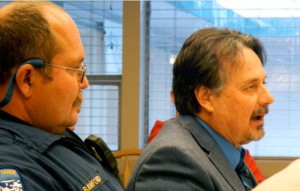
South Tahoe police Officer Aaron Crawford, left, and South Tahoe High Principal Dennis Sarosik talk Dec. 9 about student drug use. Photo/Kathryn Reed

South Tahoe police Officer Aaron Crawford, left, and South Tahoe High Vice Principal Dennis Sarosik talk Dec. 9 about student drug use. Photo/Kathryn Reed

Freshmen or sophomores usually commit the infractions. After a while the kids figure out it’s not a good idea to be bringing drugs to school.

“Alcohol is not the drug of choice, it’s marijuana,” Dennis Sarosik, STHS vice principal, said.

South Tahoe police Officer Aaron Crawford is the school resource officer. He patrols the grounds along with a probation officer.

“It’s easy access here at the lake. It’s easier to get than alcohol,” Crawford said of marijuana.

It’s so pervasive that South Lake Tahoe is known as a “green community” and that has nothing to do with the environment.

Sarosik and Crawford were at the Dec. 9 South Tahoe Drug Free Coalition meeting to talk about what happens to students who are caught with drugs and listen to ideas from coalition members.

The first infraction a student is suspended for three days; the second comes with a five-day suspension. Alternative education is the next course of action. Referrals to Tahoe Youth & Family Services are also given, but are not mandatory.

Athletes face other consequences per NIAA regulations.

The coalition is working on devising a program where students will serve suspensions at the school.

STHS used to have a diversion program. It is part counseling – which could be individual, group and/or family; criminal justice (this piece is all that exists today); and school support.

The latter is important because so many of the multiple offenders are also failing more than one subject.

“There is a need for academic support. We need someone there to manage it,” Sarosik said.

Sarosik said the school would be open to resurrecting the diversion program, but it does not have the manpower to make it happen.

Hector Reyes, supervising health education coordinator with El Dorado County, said his department and others in the community could provide the counseling piece. Tahoe Turning Point and TY&FS also have drug and alcohol counselors on staff.

Lake Tahoe Unified School District does not have a drug-testing program, unlike its neighbor Douglas County School District. DCSD started the program in 2009-10 for students who participate in athletics and other extra curricular activities.

Sarosik said cost is a prohibiting factor to drug testing, as well as that it is hard to test for synthetics. However, it was pointed out that Tahoe Turning Point tests for drugs onsite at a cost of $15.

STHS does use a breathalyzer at dances on everyone coming and going.

“It’s changed the character of dances. There’s no more projectile vomit or people passing out,” Sarosik said.

But it’s not just high school students using. Crawford said the number of marijuana infractions this year is increasing at South Tahoe Middle School. Every year there are a couple elementary students who are high or are possessing drugs.

Here are some stats from 2011-12 regarding drug use at STMS, STHS and Mt. Tallac high.

The goal is for coalition members to research other diversion programs, for drug counselors to devise a way to provide STHS help, and for the school to figure out what it would need to make it all work.



Special interests to take their cause to voters in ’14

By Anthony York, Los Angeles Times

SACRAMENTO — While much of the country is gearing up for the holidays, political forces in Sacramento are girding for battle.

Already, special interests are lined up with plans that could shape next year’s general election ballot. They are considering propositions to increase medical malpractice awards, hike tobacco taxes and give local governments the right to scale back public employee pensions, among other ideas.

Each of the proposals could spawn campaigns costing tens of millions of dollars. Decisions about whether to proceed will be made in the next couple of weeks as de facto deadlines loom.

Some propositions have already qualified for the November ballot. One would allow the state insurance commissioner to veto proposed increases in healthcare premiums, as he now can with auto policies. Another is a referendum on a new Central Valley casino project approved by Gov. Jerry Brown this year.

Votes are also scheduled on a multibillion-dollar water bond and a limit on state spending. But those measures were placed on the ballot by the Legislature and could change, because lawmakers are not bound by the same rules or deadlines as initiative sponsors.

Read the whole story


Online poker generating income for gaming firms

By Richard N. Velotta, Las Vegas Sun

Gaming companies blazing the trail for online poker are starting to generate revenue from their Internet investments.

It’s still too early to determine exactly how much they have made and how sustained the results will be, but frontrunners Caesars Entertainment and Station Casinos both have realized proceeds from online gaming.

Caesars, parent company of Harrah’s Lake Tahoe and Harveys, began generating online poker revenue during the third quarter of the year in Nevada and the fourth quarter in New Jersey. The company’s third-quarter earnings included only 11 days of online poker revenue. Caesars unveiled its World Series of Poker site Sept. 19. The company didn’t specify online poker revenue in its earnings report.

Station got an even earlier start, having already managed more than 1 million hands here, and is ready to roll out its product in New Jersey. Both companies take a percentage of gamblers’ money for every hand played.

Overall, Caesars reported revenue of $2 billion, down 0.7 percent from the third quarter last year. The company reported $112 million in casino revenue, a 7 percent decline offset by lower promotional expenses and increases in nongaming revenue.

Read the whole story


STR branching out with what it recycles

By Kathryn Reed

No one is getting rich off recycling plastic. And come Jan. 1 with South Lake Tahoe banning grocery stores from handing out plastic bags, there is bound to be much less for South Tahoe Refuse to collect.

“Film plastic from grocery bags to trash bags for lawn maintenance to plastic film that goes around your bread is all recyclable. But it is very volatile. It is like the lowest grade of plastic besides Styrofoam,” explained John Marchini, owner of STR.

By volatile he means there isn’t much return for it per pound.

“Our brokers won’t accept it from us at times because there is no demand for it,” Marchini told Lake Tahoe News.

Even those blue bags are recyclable.

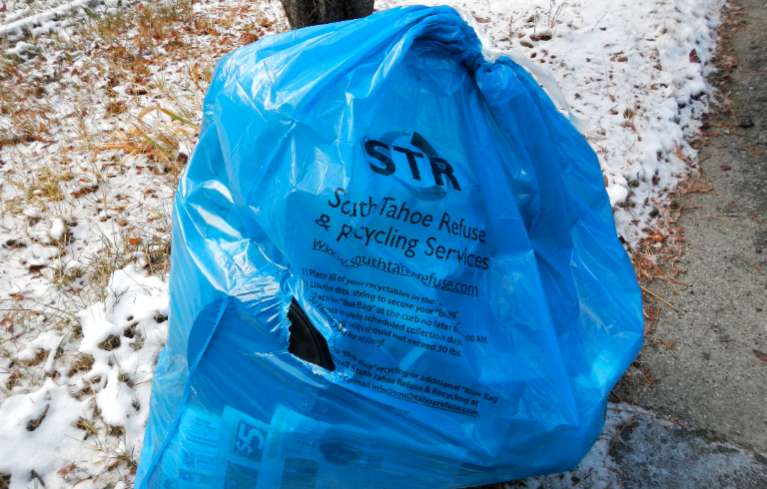
South Tahoe Refuse collects a substantial amount of its recyclables via blue bags. Photo/LTN

South Tahoe Refuse collects a substantial amount of its recyclables via blue bags. Photo/LTN

Still, STR, like all garbage companies in California, is required to meet certain recycling minimums. State rules are 50 percent of trash must be recycled. That percentage is slated to go to 75 percent in 2020. However, several years ago South Lake Tahoe said the rate must be 55 percent.

For the first nine months of 2013, STR is at a 63 percent compliance rate.

If people don’t put their recycling in blue bags, workers on the assembly line pick out the recyclables piece by piece. The problem is they can’t get everything. The blue bags come across the line separate from the garbage and are then sorted in appropriate recycling categories.

“Our employees target different material. Mixed paper is a stronger commodity and there is more of it than film plastic,” Jeanne Lear with STR explained. “There is a bigger bang for the buck if we pull off cereal boxes and mixed mail.”

Recycling goes well beyond what people on the South Shore put in their blue bags each week.

To get to 75 percent is going to require STR finding markets for nearly everything that comes through its doors. To increase the recycling by one percentage point it takes about 1,000 pounds of recycling.

“We are going to shoot for everything we can. Our focus over the last nine months to a year is really ramping up green, organic waste,” Lear said.

Contractors are given a drop box. Bigger projects separate the debris on site, while smaller operators bring in a mixed box. STR employees then sort through the bins, putting metal, wood, asphalt and concrete into separate piles.

“Construction has good weight and we have outlets for wood and metal. We will focus on that in the winter because there is not as much yard waste in winter,” Lear told LTN.

Insulation usually ends up at the landfill.

Drywall, though, is something the company recently started targeting. It’s a material that Full Circle Compost in Minden will take.

Wood often goes to Bentley Agrowdynamics in the Carson Valley.

Dirt is another commodity STR has started recycling.

Food waste also goes to Full Circle.

STR has been working with a handful of restaurants for several years to collect food waste. Last school year Sierra House Elementary came on board. After the first of the year Bijou Community School will be part of the program.

“We just need to make sure it is done well and that kids understand the whole process and we keep contamination levels down,” Lear said.

STR and Lake Tahoe Unified School District officials have talked about having a districtwide composting program. One holdback is the tipping fee at Full Circle. But if enough were recycled, then it would mean the district’s garbage fee would go down so it could pencil out.


Museum to feature state parks artifacts

By Matt Weiser, Sacramento Bee

Most Californians know their state parks as a place to camp, walk on the beach or stare with jaws gaping into a canopy of giant redwoods. Fewer know the state parks system also guards one of the largest troves of historical artifacts in the nation.

Soon, Californians will be able to walk through that remarkable assembly of artifacts for the first time. They can survey one of the largest collections anywhere of American Indian basketry, behold racks of ornate furniture once owned by big names straight from the history books, and eye curiosities – such as Kit Carson’s name carved into a tree stump.

All these and a lot more are held by the California Department of Parks and Recreation at its Museum Collections Center, a vast storage and research facility unveiled Wednesday after more than four years of preparation.

The center is housed at a cavernous concrete warehouse at Sacramento’s McClellan Park, a former U.S. Air Force installation. The state parks system spent four years and $15 million refurbishing the building. In total, more than a million artifacts are stored here – and millions more documents and photographs – most of which have never been displayed in a state park or museum. Parks officials said they have as much responsibility to protect these remnants of California’s past as they do the parks themselves.

Starting Jan. 7, the Museum Collections Center will be open to the public.

Read the whole story


Study: People are becoming more carnivorous

By Hannah Hoag, Nature

The fast-growing economies of China and India are driving a global increase in meat consumption, canceling out decreases elsewhere, according to a comprehensive study of global food consumption.

The work, published this month in Proceedings of the National Academy of Sciences, takes a detailed look at what people eat, as well as trends from one country to the next. It is also the first time that researchers have calculated humanity’s trophic level, a metric used in ecology to position species in the food chain.

The metric puts plants and algae, which make their own food, at trophic level 1. Rabbits, which eat plants, occupy level 2. Foxes, which eat herbivores, sit at trophic level 3. Cod, a fish that eats other fish, claims level 4. Polar bears and orcas, which have few or no predators and eat other mammals with gusto, hold the top positions — levels up to 5.5.

The study, led by Sylvain Bonhommeau, a fisheries scientist at the French Research Institute for Exploitation of the Sea in Sète, estimates that humanity’s global median trophic level was 2.21 in 2009, which puts us on a par with other omnivores, such as pigs and anchovies, in the global food web. “We are closer to herbivore than carnivore,” says Bonhommeau. “It changes the preconception of being top predator.”

Read the whole story


Cooking Channel wants to make over Tahoe bar

By Kathryn Reed

Which Lake Tahoe bar needs a makeover? The Cooking Channel wants to know.

The casting crew is in search of a bar that needs better ambiance, food people want, and improved customer service.

“We really want local recommendations … what you feel really needs help, and who is save-worthy,” explained Danya Berman, casting director for “Belly Up”. “Who does the community want to see helped?”

The bar can be anywhere in the Lake Tahoe Basin.

The pilot of “Belly Up” aired in late summer. The network then gave the go-ahead for six episodes to be produced. The plan is to make a U-shape of the country when it comes to picking locations. Other areas include Phoenix-Scottsdale, Charleston, S.C., and Albuquerque.

Eddie Russell is the host. He is a chef and consultant who usually charges big bucks for the advice he will be dispensing in what will amount to 30-minutes of television. But it will be worth thousands of dollars in information and improvements.

The actual time the crew will be in town will be a few days, filming for hours, which will include a grand reopening party the community will be invited to.

“We want to help people erase bad reviews, make more money and help owners with their vision. Even dive bars have a vision,” Berman told Lake Tahoe News.

It won’t be as aggressive as a show like “Bar Rescue” in part because the Cooking Channel’s emphasis is on food. Berman said food and service would be key elements of the show.

Filming is expected to begin in March or April. When the show airs will be up to network executives.

“America loves the underdog story. We like to see people and businesses made over. People want a happy ending,” Berman said. “It is feel good show. Will there be some drama? I suppose there will be.”

—-

Notes:

• To nominate a bar, email gastromakeover@gmail.com by Dec. 25.

• Bars must be less than 4,000-square-feet, have a working kitchen, have at least four employees, of which one must be a cook.

• Interviews with bar owners will be done via Skype. Those will be submitted to network officials for them choose the bars that will be part of the show.