Reno firm wants to be first to create supersonic business jet

By Molly McMillin, Wichita Eagle

The need for speed remains the catalyst behind a continuing effort by the Aerion Corp. to develop a business jet that can fly faster than the speed of sound.

“We don’t think there’s any doubt this is clearly the next frontier,” said Brian Barents, Aerion vice chairman and a former executive at Bombardier Learjet and Cessna Aircraft in Wichita.

The industry is building business jets that fly farther, but it’s stuck at subsonic flight, Barents said.

“There’s clearly a demand for speed, and we feel that we’re in a good position to take advantage of that demand,” he said.

Supersonic business jet flight will happen in our lifetime, Barents said.

Reno-based Aerion wants to be first to the market.

Read the whole story


Barton provides transition care for patients

By Cristina Janney, Telegraph

Over a period of 12 months in 2012 and 2013, Brooke Laine’s father, Ed, was hospitalized twice with pneumonia.

Each time he came home from Barton Memorial Hospital, Laine tried her best to help take care of her father, but both struggled. Brooke Laine worried about doing the right things and managing her father’s mediations. Ed Laine, who is 82, also was worried about getting his medications right.

After the second hospitalization, the Laines found help through a new program provided by the hospital called Transitions in Care. The program provides nurses to help with care and recovery in the home after a hospitalization. The goal is to reduce costly re-admissions to the hospital.

One of the primary goals of the nation’s new Affordable Care Act is to improve health care quality and use money more wisely. Hospital re-admissions are expensive and in many cases experts believe they are preventable with better primary care. Under the new payment system put in place by the new health law, re-admissions are one of the measures that will be tracked and tied to payments. Hospitals will face financial penalties for excessive re-admissions of Medicare patients with certain illnesses, including pneumonia, heart attack and heart failure.

Read the whole story


Anderson ensures students ride this winter

By Kathryn Reed

Growing up in a family of eight kids, Jamie Anderson knows outfitting youngsters to ride or ski is expensive. She also knows what it means to be on the slopes when you are young.

Although Anderson is only 23, the Meyers resident is a veteran snowboarder. She’s been taking home gold since she was a teenager. On Friday she won the snowboard slopestyle at the Dew Tour in Breckenridge, Colo. She is aiming to be on the Olympic team for the Games in Russia.

But before going after more hardware, Anderson spent time Dec. 16 Skyping with students in Lake Tahoe Unified School District. She is still in Colorado. The students are competing to win a season pass to her home resort, Sierra-at-Tahoe, as well as a full set of gear – mostly from businesses who sponsor her. Without Anderson and Sierra’s generosity, these students would not be snowboarding this winter.

To be in the running for this prize, students had to write an essay about why they believe they deserve to be recognized by Anderson.

South Tahoe High School Principal Ivone Larson said, “They wrote a letter describing how it would impact them.”

Most were serious in nature, while sophomore Paul Mutz took a more creative comical approach that caught the attention of reviewers.

Sixth-grader Allison Kennedy told Lake Tahoe News, “I wrote about how my dad was in prison for four years and that he just got home last year and we haven’t had that much money.”

Administrators narrowed the field to the 10 finalists. Essays from the finalists have been emailed to Anderson.

All but the one person who was out of town read part of their essays to Anderson on Monday.

As fifth-grader Monserrat Franco spoke she got choked up and barely could get out how she wants to ride with her cousins, have them teach her to snowboard so then she can teach her younger brothers.

Junior Jorge Luquin spoke of how money from his part-time job goes to pay household bills. There is no money for playing on the mountain.

“You are amazing; all of you,” Anderson told them. “I’m excited to meet you guys in person. All of your letters were heartwarming.”

In the control room of South Tahoe High School's screening room Jamie Anderson, left, can be seen Skyping with students on Dec. 16. Photo/Kathryn Reed

In the control room of South Tahoe High School’s screening room Jamie Anderson, left, can be seen Skyping with students on Dec. 16. Photo/Kathryn Reed

Anderson didn’t have the normal school life. Mostly, except for a spell at South Tahoe Middle School, she was homeschooled.

She told the kids she knows things can be hard, that people can be mean. She asked them to try to rise above all the negativity.

“It’s more than about boarding. It’s about the love. It’s more about passing along love,” Anderson told them.

On Dec. 28 the youngsters will go to Sierra and ride with Anderson. That is when they find out who receives what.

This is the third year Anderson has partnered with Sierra and LTUSD to give students an opportunity to ride. The first year it was two students, last year four and this year it will be eight.

“Jamie is a world champion in so many ways, but a real class individual,” John Rice, general manager of Sierra-at-Tahoe, told Lake Tahoe News. “It is a great program. She wanted to expand it this year. It’s really showing that she is maturing as a human being and using her celebrity status to share with the world.”


Economy has Americans staying put

By Annie Lowrey, New York Times

Economists admire Americans for many traits: our profound respect for property rights, our tendency to forgo vacation days, our ingenious methods of mass-producing “food.”

Another important attribute is our willingness to move, between houses, between states and across the country. Some economists believe our inborn rootlessness makes the country’s work force more dynamic and strengthens our economy’s growth. Imagine how much worse off the country might be if the 49ers had decided against making the trek to California or the sharecroppers chose to stay in the South.

Economic mobility and geographic mobility have been closely linked for much of American history, so economists find it troubling that migration rates have been in decline lately. The proportion of Americans moving has fallen to new postwar lows in the past few years.

According to Census Bureau data from 2013, about 4.8 million Americans moved across state lines in the previous year. That is down from 5.7 million in 2006 and 7.5 million in 1999. All in all, the percentage of Americans moving across state lines has fallen by about half since the 1990s.

Read the whole story


Tahoe fire agencies improve cardiac care

By Kathryn Reed

Saving lives is nothing knew for fire departments. How they to it, though, changes regularly as technology evolves.

Two agencies in the Lake Tahoe Basin this month were recognized by Nevada Gov. Brian Sandoval as a Heart Safe Community – Tahoe Douglas and North Lake Tahoe fire protection districts. The mission of Nevada Project Heartbeat is to save lives through promotion of early defibrillation, education in sudden cardiac arrest, and promotion of training in AED-CPR.

In the United States, more people age 40 and older die of sudden cardiac arrest than anything else. That is one of the main reasons there is a strong push to get AED units distributed to areas beyond the typical medical facility.

Automated external defibrillators – or AEDs – can save lives. They are portable devices that shock the heart back into action. The machines require little training to use.

It is because the fire districts have worked at getting them distributed into their respective communities that the governor singled them out.

“It’s pretty big,” Eric Guevin of Tahoe Douglas said of the recognition and program. “It means that the public has access to AEDs, there are people trained to use the AEDs and can perform CPR. It means we should have a higher survival rate then other areas that don’t.”

There are about 60 AEDs in the district. Ten automated defibrillators are at the various stations as well ones on the engines. They are also at county facilities, including schools and the Zephyr Cove tennis courts.

Private businesses have bought AEDs in case of an emergency. Guevin said his department has been working on this for a while to get more AEDs in the community, especially in locations where people gather, like the Stateline casinos.

Dispatchers know where they are in Tahoe Douglas so if someone calls 911 with a cardiac emergency, it might be possible to locate a nearby AED to help the patient before paramedics arrive.

Tahoe Douglas gets about 200 cardiac calls a year.

“For every minute that goes by without shocking the heart you lose a 10 percent chance of saving that life,” Guevin told Lake Tahoe News. “This program will save lives. Every year more than 200,000 people die of sudden cardiac arrest, according to the American Heart Association.”

A heart attack is when there is an injury to the muscle, whereas sudden cardiac arrest is when heart stops and immediate care is required.


Nev. mental health patients bused and crimes followed

By Cynthia Hubert and Phillip Reese, Sacramento Bee

Six months after he was discharged to a Greyhound bus and shipped out of Las Vegas, one former patient of Nevada’s primary hospital for mentally ill people stabbed a man to death in Iowa.

Another former patient, responding to voices in his head, set off explosions in a grocery store and a doughnut shop in Tennessee just a month after Rawson-Neal Psychiatric Hospital in Las Vegas gave him a one-way ticket to Knoxville in July 2012.

Nevada bused yet another Rawson-Neal patient, a convicted child molester, to San Diego in 2011, even as he faced criminal charges in Las Vegas for failing to register as a sex offender. He also failed to register in San Diego, where he disappeared into the streets and soon became the target of a citywide manhunt.

Yet another former Rawson-Neal patient was found dead, his body floating in the American River near a homeless camp, seven months after he received a Greyhound ticket to Sacramento courtesy of the state of Nevada.

Even as Nevada’s embattled state mental hospital works to revamp operations, the fallout from its aggressive busing policies continues to resonate from California to Florida.

Read the whole story


Alarms sounding over resistance to antibotics

By Indre Viskontas and Chris Mooney, Center for Investigative Reporting

It’s flu season. And we’re all about to crisscross the country to exchange hugs, kisses and germs. We’re going to get sick. And when we do, many of us will run to our doctors and, hoping to get better, demand antibiotics.

And that’s the problem: Antibiotics don’t cure the flu (which is viral, not bacterial), but the overprescription of antibiotics imperils us all by driving antibiotic resistance. This threat is growing, so much so that in a recent widely read Medium article, Wired science blogger and self-described “scary disease girl” Maryn McKenna painted a disturbingly plausible picture of a world in which antibiotics have become markedly less effective.

“For 85 years,” McKenna explains, antibiotics “have been solving the problem of infectious disease in a way that’s really unique in human history. And people assume those antibiotics are always going to be there. And unfortunately, they’re wrong.”

Here are some disturbing facts about the growing problem of antibiotic resistance:

1. In the United States, 2 million people each year contract serious antibiotic-resistant infections, and 23,000 die from them.

These figures come from a new Centers for Disease Control and Prevention report on antibiotic resistance that, for the first time, uses a blunt classification scheme to identify “urgent,” “serious” and “concerning” threats from drug-resistant bacteria. The CDC currently lists three urgent threats: drug-resistant gonorrhea; drug-resistant Enterobacteriaceae, such as E. coli; and Clostridium difficile, which causes life-threatening diarrhea and often is acquired in hospitals. C. difficile kills at least 14,000 people each year.

2. We’ve been warned about antibiotic resistance since at least 1945. We just haven’t been listening.

From the first discovery of antibiotics, scientists have known that resistance is a danger. Alexander Fleming himself, credited with the discovery of penicillin, warned us as early as 1945 that antibiotics could lose their effectiveness.

His eerily prescient Nobel Prize speech cautions that “there may be a danger, though, in underdosage (of penicillin). It is not difficult to make microbes resistant to penicillin in the laboratory by exposing them to concentrations not sufficient to kill them, and the same thing has occasionally happened in the body. The time may come when penicillin can be bought by anyone in the shops. Then there is the danger that the ignorant man may easily underdose himself and by exposing his microbes to nonlethal quantities of the drug make them resistant.”

3. Antibiotic-resistant strains of bacteria are on the rise.

Clearly, antibiotic resistance is not a new phenomenon. Nonetheless, the frequency of these “antibiotic resistance events” is increasing. For example, from 1980 to 1987, cases of penicillin-resistant Streptococcus pneumoniae (the bacteria that causes pneumonia) remained steady at about 5 percent of all strains. By 1997, 44 percent of strains were showing resistance. Similarly, Enterococci bacteria can cause urinary tract infections and meningitis (among other diseases), and in 1989, fewer than 0.5 percent of strains found in hospitals were resistant to antibiotics. Four years later, though, that number was at 7.9 percent; by 1998, some hospitals reported levels as high as 30 to 50 percent.

“The more antibiotics are used, the more quickly bacteria develop resistance,” the CDC says.

4. There has been a steady decline in Food and Drug Administration approvals for new antibiotics.

And even as more bacteria are becoming resistant and our treatments are becoming less effective, we’re also producing fewer new drugs to combat infections. There has been a clear downtrend in FDA approvals for antibiotics that began in the 1980s.

Why has this happened? “There’s a kind of curve to antibiotic development,” McKenna says, noting that there was a boom in the 1950s, when Eli Lilly collected samples of biological materials from all over the world to capture antibiotic properties in natural substances. By the 1980s, though, much of the low-hanging antibiotic fruit had been harvested. Now, the development of new treatments is becoming increasingly difficult and costly, even as pharmaceutical companies are cutting research and development budgets and outsourcing drug discovery more and more.

“The faucet from which (antibiotics) come has been turned down and down and down, and now it’s just a drip,” McKenna says.

5. As many as half of all antibiotic prescriptions either aren’t needed or are “not optimally effective.”

A huge part of our problem is that we’re misusing and abusing antibiotics.

“Resistance is a natural process,” McKenna says, but “we made resistance worse by the cavalier way that we used antibiotics, and still use them.”

Sick patients pressure their doctors for drugs, and doctors too often yield and dash off a script. Indeed, a recent study found that doctors prescribed antibiotics 73 percent of the time for acute bronchitis, even though, as Mother Jones’ Kiera Butler reports, “antibiotics are not recommended at all” for this condition.

Adding to the evidence of misuse: According to the CDC, almost 1 in 5 ER visits resulting from adverse drug events are caused by antibiotics. Children are the most likely victims. Despite the fact that antibiotics generally are safe, they can cause allergic reactions and interact with other drugs, harming patients who are vulnerable because they already suffer from other medical conditions. If we stopped overprescribing antibiotics, we’d not only head off resistance, but we’d also lessen adverse drug effects.

6. And it’s not just human medical misuse – a large volume of antibiotics is inappropriately used in livestock.

Antibiotics also often are used in the agricultural industry; in fact, there is reason to think that more antibiotics are used to treat animals than to treat people. And these livestock drugs are not just used to fight off infections, but are often fed to animals in smaller doses to encourage weight gain and growth – a practice, the CDC says, that is “not necessary” and “should be phased out.” A recent draft document from the FDA similarly states that “in light of the risk that antimicrobial resistance poses to public health, the use of medically important antimicrobial drugs in food-producing animals for production purposes does not represent a judicious use of these drugs.” For now, though, the FDA’s approach to curbing this threat has been limited to issuing voluntary guidelines.

7. Before antibiotics, death rates were much higher from common occurrences like skin infections, pneumonia and childbirth.

In her Medium article, McKenna gives some disturbing stats. Giving birth could be deadly: Five out of every 1,000 women who had a baby died. Pneumonia killed 30 percent of its victims. And “one out of nine people who got a skin infection died, even from something as simple as a scrape or an insect bite.” If we run out of antibiotics, our future looks rather bleak.

8. The next major global pandemic might involve an antibiotic-resistant superbug.

For millennia, infectious diseases have reshaped civilization, culled our species and spread fear, superstition and death. But over the last century, we haven’t seen anything as devastating as the 1918 flu pandemic, which killed some 50 million people around the world.

But with drug-resistant bacteria, the threat rises. “Plagues still really have power, and almost a hundred years later, we shouldn’t think that we’re immune to them, because we’re not,” McKenna warns. For instance, tuberculosis kills more than 1 million people a year, and it is becoming increasingly drug resistant, according to the World Health Organization.

Meanwhile, though the 1918 flu was caused by a virus rather than a bacterium, recent research suggests that most victims actually died from bacterial pneumonia. Viruses can weaken our immune systems just enough to allow bacteria to take hold, and often, death results from secondary bacterial infections that, at least until recently, largely were curbed by effective antibiotics.

So are we doomed to recede back into a time when infections were the most significant health threat our species faced?

According to McKenna, it is not clear that we can fully curb antibiotic overuse. So the better approach is to get drug industry research engine firing again. “There’s a really active discourse around what’s the best way to get pharmaceutical companies back into manufacturing antibiotics,” she says.

Our future, then, once again lies in the hands of scientists, whose quest to find new treatments for drug-resistant bacteria is now of the utmost importance.

This story from the Climate Desk, a journalistic collaboration among the Atlantic, CIR, Grist, the Guardian, Mother Jones, Slate, Wired and PBS.



Spectacular views spill forth after easy climb

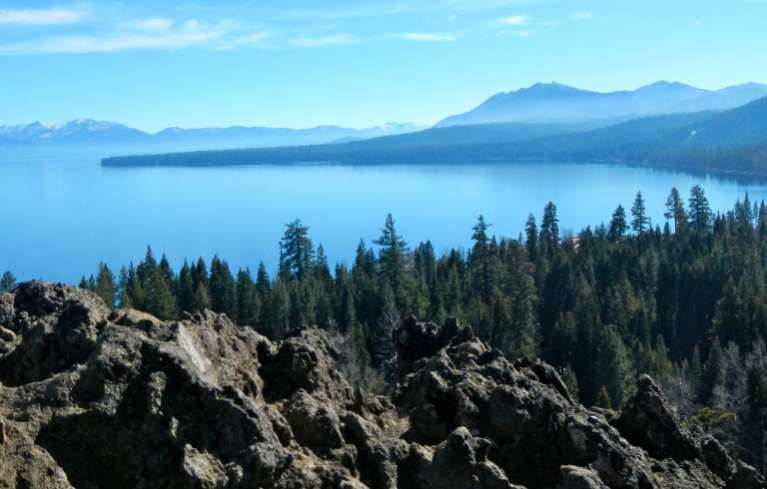
Views of Rubicon Point and Mount Tallac from Eagle Rock. Photos/Kathryn Reed

Views of Rubicon Point and Mount Tallac from Eagle Rock. Photos/Kathryn Reed

By Kathryn Reed

TAHOE CITY – Eagle Rock has to be the easiest hike in Lake Tahoe to get some of the most stunning views. It’s like having an eagle’s-eye view of the basin.

Eagle Rock has always been popular among those who knew about it. But now it is getting even more attention because a designated trail was created. It used to require scrambling up the rocky backside to get to the top.

When we scampered up there two weeks ago the dirt trail was narrow, with a gradual climb. It’s only 1,800-feet long.

Blackwood Creek flows into Lake Tahoe.

Blackwood Creek flows into Lake Tahoe.

Signs at the trailhead said it’s a moderate hike. I would say for those who are used to hiking in Tahoe it’s an easy hike. The only “difficult” part is a bit of rock scrambling at the top. This might be where poles would come in handy for anyone with balance or knee issues.

It’s 250-feet of volcanic rock at the top. This in itself makes it such a change from the usual granite that dominates the basin.

Like so many places in the basin, this used to be a special spot for Native Americans. However, white people knew about Eagle Rock in the 1880s. At one time there was a gazebo at the top. With how exposed the area is, it’s easy to see how it could be a hot vista in the summer.

There is a California State Lands Commission marker at the top that is dated 1979.

The California Tahoe Conservancy in 1987 acquired the 54.5-acre property that includes Eagle Rock for $450,000.

The Conservancy in 2012 completed a more than $4 million restoration project in the Blackwood Creek Watershed. This area contributed more sediment to Lake Tahoe than any other watershed in the basin – more than 1,900 tons a year.

The Eagle Rock trail is in the watershed. Part of it was built in 2011, with the second and final phase finished this year.

It’s easy to see where Blackwood Creek spills into Lake Tahoe.

Rubicon Peak

Rubicon Peak

The sweeping views make it a must-do hike. It takes about 15 minutes to get to the top. Rubicon Point and Mount Tallac dominate the southern view. Immediately to the south are Homewood’s ski runs. Heavenly’s upper trails are distinctly outlined in white. To the rear is Rubicon Peak. Private piers dot the landscape to the north.

—-

Getting there:

From South Lake Tahoe, take Highway 89 north. The trail is between Chamber’s Landing and Sunnyside, on the left. There is parking on the left side, but there is no visible trailhead sign that can be seen while driving. There is a large “Lower Blackwood Creek Restoration Project” sign. The trailhead sign is to the right of that.


Researchers getting to the root of vitamins

By Carl Zimmer, New York Times

In 1602, a Spanish fleet was sailing up the Pacific coast of Mexico when the crew became deathly ill. “The first symptom is pain in the whole body that makes it sensitive to touch,” wrote Antonio de la Ascensión, a priest on the expedition. “Purple spots begin to cover the body, especially from the waist down; then the gums become so swollen that the teeth cannot be brought together, and they can only drink, and finally they die all of a sudden, while talking.”

The crew was suffering from scurvy, a disease that was then both bitterly familiar and deeply mysterious. No one knew why it struck sailors or how to cure it. But on that 1602 voyage, Ascensión witnessed what he considered a miracle. While the crew was ashore burying the dead, one sick sailor picked up a cactus fruit to eat. He started to feel better, and his crewmates followed his example.

“They all began to eat them and bring them back on board so that, after another two weeks, they were all healed,” the priest wrote.

Over the next two centuries, it gradually became clear that scurvy was caused by a lack of fruits and vegetables on long-distance voyages. In the late 1700s, the British Navy started supplying its ships with millions of gallons of lemon juice, eradicating scurvy. But it wasn’t until 1928 that the Hungarian biochemist Albert Szent-Gyorgyi discovered the ingredient that cured scurvy: vitamin C.

Szent-Gyorgyi’s experiments were part of a wave of early-20th-century research that pulled back the curtain on vitamins. Scientists discovered that the human body required minuscule amounts of 13 organic molecules. A deficiency of any of the vitamins led to different diseases — a lack of vitamin A to blindness, vitamin B12 to severe anemia, vitamin D to rickets.

Today, a huge amount of research goes into understanding vitamins, but most of it is focused on how much of them people need to stay healthy. This work does not address a basic question, though: How did we end up so dependent on these peculiar little molecules?

Read the whole story


2013 fire season below average

By Bettina Boxall, Los Angeles Times

A wildfire season that began with dire warnings that dry conditions had set the stage for a year of flames across California and the West turned out to be one of the nation’s quietest in the past decade.

Although 2013 was marked by two high-profile blazes, one in California and the other in Arizona, nationally the total wildfire acreage of 4.15 million is far below the 10-year average of 6.8 million acres.

In California, the number of wildfires was high, but the amount of land that burned was slightly less than the 10-year average, according to state and federal figures. As always, weather was the deciding factor.

Read the whole story