Snowflakes might revolutionize weather forecasting

By Laura Dattaro, Weather Channel

When it snows in Utah, Tim Garrett likes to watch the storm. He looks outside, watching the blurry mess of white fill the window, the Wasatch Mountains in the background. But he also looks at his computer screen, where he sees a live feed of photographs of tiny, individual snowflakes, each shot from three different angles as it makes its way to the ground.

Garrett is a University of Utah physicist who founded the Alta Project, an effort to photograph falling snowflakes in real-time to help improve models used to forecast winter storms. Along with a student at the university, Garrett developed the Multi-Angle Snowflake Camera (MASC), which, so far, has taken millions of photos of snowflakes at the Alta Ski Resort, along with data on how fast the flakes fall.

“This is an instrument that I think is revealing an aspect of nature in a way that it has not been seen before,” Garrett told weather.com. “I mean for me, what we’re seeing is astounding. I really did not appreciate the variety of what is out there until we actually started measuring it.”

Read the whole story


Engineers: U.S. infrastructure close to failing

By Meagan Clark, International Business Times

U.S. infrastructure — roads, bridges, rail, drinking water, waste water, solid waste and more—is close to flunking according to a recent assessment from the American Society of Civil Engineers.

Once every four years, America’s civil engineers assess the nation’s infrastructure with an A to F report card. The engineers grade eight major categories: capacity, condition, funding, future need, operation, maintenance, public safety, resilience and innovation. This year’s grade average of all eight categories is a modest improvement, but hardly one to cheer about — it’s a D+ compared to a D in 2009. The nation’s infrastructure GPA has averaged in the D’s since 1998 for delayed maintenance and underinvestment across most categories.

“While the modest progress is encouraging, it is clear that we have a significant backlog of overdue maintenance across our infrastructure systems, a pressing need for modernization, and an immense opportunity to create reliable, long-term funding sources to avoid wiping out our recent gains,” the report states.

Solid waste earned the highest grade, a B-.

City and state efforts to repair and update some of the nation’s most vulnerable bridges improved the bridge category, and short-term federal funding improved several categories. However, improvements are not all due to government. Increased private investment for efficiency and connectivity helped rail’s grade improve.

Read the whole story


STPUD makes case for rate increases

By Kathryn Reed

It’s possible South Tahoe Public Utility District customers could be paying $78.60 more a year for water and sewer service starting July 1.

This breaks down to another $4.40 per month for water over 10 years and $2.15 a month for sewer in the same time period. It’s called the “optimum” plan to accomplish the district’s goals. Other scenarios include increases just for meter installation or spreading all costs over 20 years. Board members could develop other alternatives.

More than a dozen people on Dec. 19 attended a workshop designed to touch on the reasons the South Shore entity needs more money. The five board members were hearing some of the numbers for the first time.

South Tahoe PUD General Manager Richard Solbrig, left, explains the district's capital improvement needs Dec. 19. Photo/Kathryn Reed

South Tahoe PUD General Manager Richard Solbrig, left, explains the district’s capital improvement needs Dec. 19. Photo/Kathryn Reed

In the coming months the electeds will be tasked with deciding if rate increases should be sought. A preferred plan is expected to be decided in March, with public hearings on a rate increase and the 2014-15 budget in May.

While one slide of the presentation said salaries and benefits have been cut by 3 percent, this is a bit misleading. What the district pays out is down by that amount over the last two years. There has been no cost of living increase, however some people have had salary increases to keep them on par with their peers in other districts. Three and half positions have not been filled. And the district saved money by switching from being self-insured for health care to going with a group of state water districts to lower the costs by about $900,000 per year.

Another cost-savings came from cutting the operations and maintenance budget by 20 percent.

Risk vs. affordability is how district staff is putting forth the discussion. Can the district keep going forward without having adequate fire protection? Where does the money come from to put the remaining 8,300 water meters that need to be installed by 2025 in the ground? Is Lake Tahoe threatened without upgrades to the sewer system?

The board was fairly silent until an audience member asked what they thought of the staff presentation.

President Eric Schafer said for the nearly 13 years he has been on the board he has advocated for small increases. (Later that afternoon at the regular meeting Schafer was appointed to be chair for another year and Randy Vogelgesang vice chair.)

“We want to give the public a system they don’t have to worry about. There is a price for that. It won’t get cheaper,” Schafer said. “I’m advocating doing as much as we reasonably can.”

Board member Jim Jones said 1 percent of the value of the $1.6 billion infrastructure that is in the ground should be spent each year to replace what is wearing out. That would be $16 million a year. He pointed out the district has been spending closer to $6 million a year for the last 10 years.

Some of the parts in the district are 50 years old – the life expectancy of much of the equipment.

“Lines wear out from age, not use,” General Manager Richard Solbrig said. “The water system is protecting your house whether you are there or not.”

But not every house has large enough water lines out front to fight a fire. The district says it will take $67 million over 10 years to upgrade the water system. The bulk of that money is so there are 8-inch water lines for adequate water suppression pressure.

The district has to have all customers on meters by 2025 per state law. A previous board decided the district would put in the meters instead of mandating individual property owners do it.

The California Department of Public Health is offering a 20-year zero percent loan. The application is due in June. The $21.5 million loan would equate to ratepayers paying an additional $1.10 per month. A 5 percent interest rate on a loan would come out to $1.75 a month for customers.

District customer Bob Olsen questions why he would have to pay to install other people’s meters when he paid for his own.

Solbrig said expenses have to be spread out and that it isn’t possible for each customer to be charged for the exact cost of delivering water or taking away sewage. He gave the example of how some houses on hills require more electricity to pump the water, but are charged the same as everyone else.

With 30 percent of the sewer budget spent on exporting the wastewater to Alpine County, one person asked why not lobby to get rid of the Porter-Cologne Water Quality Control Act.

“It’s probably regarded as the single most successful thing that has been done to protect Lake Tahoe,” Solbrig said of the federal mandate.

He doesn’t believe the district has any chance of winning that battle in Sacramento or Washington.

The Luther Pass pump station needs substantive upgrades, including increasing the voltage to get the wastewater up and over the mountain pass. Parts are so old that Liberty Utilities does not have back up parts.


Pursuit of powder requires a strategy

By Cindy Hirschfeld, New York Times

It’s every skier’s dream: to arrive at a resort just after a good storm, take one of the first lifts up and ply delightfully fresh, powdery tracks. The reality, though, is that most of us can’t drop everything to chase storms. We have to plan a ski trip in advance. That means the odds of finding good snow, let alone a powder day (often defined as six or more inches of new snow), requires some strategizing.

The simplest trick (other than forking over a lot of money for a snowcat or heli-skiing trip, and even that’s no guarantee) is to pick a resort known for receiving prodigious amounts of snow.

But start talking to meteorologists and others who track snowfall, and it turns out it’s not so simple. The vagaries of mountain weather mean that snow conditions in a couple of months are nearly impossible to predict accurately.

“I really hate planning trips too far in the future, because you never know what’s going to happen,” said Joel Gratz, a Boulder, Colo.-based meteorologist and co-founder of the opensnow.com website, which specializes in ski-targeted forecasting. “Hope isn’t in my vocabulary.”

Short-term forecasting isn’t much easier. The craggy topography of mountainous terrain is partly to blame, as is the difficulty of measuring atmospheric moisture at mountain-top elevations and in the upper atmosphere. “A lot of the tricks of mountain forecasting come down to terrain and wind direction,” Gratz added. “To learn these local effects, you need to live there and have observed the weather for a few years.”

There is an elite club of American resorts that average 500 or more inches of snow annually. They include Mount Baker in Washington (655); Alyeska in Alaska (650); Kirkwood (600) and Sugar Bowl (500) in California; Alta (560), Snowbird, Brighton and Solitude (500 each) in Utah; and Grand Targhee in Wyoming (500).

Read the whole story


Study: Pot use among high school students increasing

By Anahad O’Connor, New York Times

A federal report shows that the percentage of American high school students who smoke marijuana is slowly rising, while the use of alcohol and almost every other drug is falling.

The report raises concerns that the relaxation of restrictions on marijuana, which can now be sold legally in 20 states and the District of Columbia, has been influencing use of the drug among teenagers. Health officials are concerned by the steady increase and point to what they say is a growing body of evidence that adolescent brains, which are still developing, are susceptible to subtle changes caused by marijuana.

“The acceptance of medical marijuana in multiple states leads to the sense that if it’s used for medicinal purposes, then it can’t be harmful,” said Dr. Nora D. Volkow, director of the National Institute on Drug Abuse, which issued the report. “This survey has shown very consistently that the greater the number of kids that perceive marijuana as risky, the less that smoke it.”

Volkow said that one way marijuana might affect cognitive function in adolescents was by disrupting the normal development of white matter through which cells in the brain communicate.

Read the whole story


Mountain bikers eager to test Heavenly’s trails

By Kathryn Reed

Mountain biking. That could be what Heavenly Mountain Resort is known for in the future.

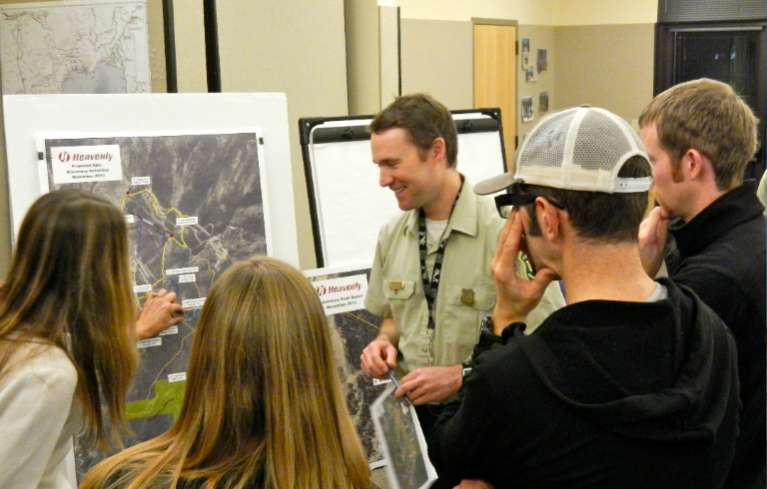
Maps with colorful squiggly lines filled the U.S. Forest Service conference room Wednesday night as people came and went during an informal information meeting about the South Shore resort’s plans to turn the mountain into more of a summer playground.

And while rope courses, hiking trails, ziplines and canopy tours are part of the overall design, it is the biking opportunities that are generating the most buzz.

U.S. Forest Service recreation specialist Jonathan Cook-Fisher, center, talks Dec. 18 to people about Heavenly's proposed mountain bike trails. Photo/Kathryn Reed

U.S. Forest Service recreation specialist Jonathan Cook-Fisher, center, talks Dec. 18 to people about Heavenly’s proposed mountain bike trails. Photo/Kathryn Reed

Jonathan Cook-Fisher, USFS recreation special uses program manager, said mountain biking is also bringing in the most comments on the scoping document.

(The deadline to comment on the scope of the environmental impact statement is Dec. 20. The Forest Service expects to release a draft environmental impact statement in August 2014 and a final EIS the following January. For more info, go online.)

“We have a TAMBA trail map and there is a black hole where Heavenly is,” Ben Fish told Lake Tahoe News.

That would change with what is mapped out.

The plan is people could ride from lake level up the mountain or take the gondola to access trails. Then the trails will connect with other established routes like the Tahoe Rim Trail. Heavenly’s trail system will be a connection that has long been missing.

Mountain bikers already use the public bus system to get to the Stagecoach area of Heavenly and then make their way down to Stateline or South Lake Tahoe. Some of those riders lament the fact BlueGo only allows two bikes per bus.

A group of cycling enthusiasts on Dec. 18 pointed out how Van Sickle Bi-state Park is likely to get more use, especially from people descending the mountain. They spoke of the need to put in signage so people understand the bike park boundaries and know when the trail becomes mixed use.

The Panorama Bike Trail could be what Ridge Run is to skiers – a route that offers sweeping views of Lake Tahoe, where photographs are a must. The difference between this bike trail and the Flume Trail is that it should be reasonable to stop to take a picture or two.

Right now a proposed trail goes under the mid-station of the gondola, but there is no connector to the deck area. With weddings and sightseeing being a draw to the mid-station, the thought is cyclists would negatively impact those users and could stir up a lot of dust. But some people want the Forest Service to rethink putting in a connector.

The actual bike park and concentration of trails are in Nevada and outside the Lake Tahoe Basin. This means they are outside Tahoe Regional Planning Agency and Lahontan Regional Water Quality Control Board’s jurisdictions.

“The mountain bike park will be smaller than Northstar’s park. But Northstar doesn’t connect to the national forest. It doesn’t have a ride-through capability,” Cook-Fisher told Lake Tahoe News.

There will be a mountain bike skill park outside the Tamarack Lodge.

Cycling advocate Kevin Joell sees the improvements as an economic driver for the area as well as another place for locals to play.

“What’s been missing is an inclusive trail network for beginners to advanced,” Joell told Lake Tahoe News.


Study: Livestock decisions should be made locally

By Eliza Barclay, NPR

To feed all 7 billion of us, address climate change and live longer, we all need to eat less meat. From Al Gore to the Meatless Monday movement to Harvard epidemiologists, that’s been the resounding advice offered to consumers lately.

But hold up a minute, says Mario Herrero, the chief research scientist at Australia’s national science agency, the CSIRO. Writing off food animals as greedy, inefficient polluters of land and water, artery cloggers and robbers of food from the mouths of hungry babes is perhaps a bit brash, he says.

Instead, it’s important to see the global livestock sector as a super diverse system of tiny backyards and massive feedlots that defies generalizations, Herrero tells the Salt. Shifting to this view is becoming more and more important as we plan for a future of 9 billion people on Earth by mid-century.

Read the whole story


Lake Tahoe part of study on Rim Fire’s smoke impacts

By Heather Segale

On Aug. 17, the largest recorded wildfire in the Sierra Nevada and the third largest in California history started in Stanislaus National Forest. This devastating fire burned more than 250,000 acres and took two months to contain.

The effects of the fire on the terrestrial ecosystem will certainly last for years. Here at TERC, the question is to what extent were Sierra lakes impacted?

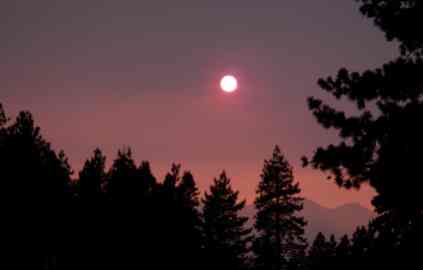
Smoke was a constant in Tahoe for much of August 2013. Photo/LTN file

Smoke was a constant in Tahoe for much of August 2013. Photo/LTN file

In October TERC researchers received a National Science Foundation – Rapid Response Grant to assess the effects of the Rim Fire on lakes in Northern California. It is a one-year study to look at water quality and ecological changes in lakes affected by the wildfire.

TERC is studying two lakes, Cherry Lake and Lake Eleanor, within the heart of the burn area and several lakes to the north that were impacted by smoke during the fire event, including Lake Tahoe, Emerald Bay, and Cascade Lake. Rock Creek Lake just south of Mammoth will serve as the control lake since it was not impacted by the fire or smoke.

UC Davis is collaborating in the study with Miami University, Ohio; Stony Brook University, New York; UNR; and UC Santa Barbara.

Initial assessment of the water quality and zooplankton community was completed in late October, prior to the first snow. The science team will return following a weather event that causes dramatic runoff, or during the spring snowmelt.

The research is focused on how the lakes respond to the organic compounds contained in the smoke from wildfires. The results will have importance to the entire west, with expectations for increases in wildfires due to climate change.

Heather Segale is the education and outreach director for the UC Davis Tahoe Environmental Research Center in Incline Village.


2012 SnowGlobe tragedy not forgotten during preparations for annual S. Tahoe music event

By Kathryn Reed

While it’s the music that draws people to SnowGlobe, it is Alyssa Byrne who is on so many people’s minds. The 19-year-old Petaluma woman died last year of hypothermia as she tried to walk from the concert venue to her Stateline hotel.

A lasting legacy of the tragedy is the Always Buddy Program that was created by her family and friends in Sonoma County. The mantra is, “I promise to never let myself or anyone I love leave in an unfamiliar place without a buddy system.”

SnowGlobe returns to South Lake Tahoe Dec. 29-31. Photo/LTN file

SnowGlobe returns to South Lake Tahoe Dec. 29-31. Photo/LTN file

Leandra and Paul Hale, who own the Butter Muffin in South Lake Tahoe, have become friends with the Byrne family. They are working on securing permits from the city to erect warming huts at Al Tahoe Boulevard and Highway 50, and Al Tahoe and Pioneer Trail.

“The most important thing is the heat up huts,” Leandra Hale told Lake Tahoe News. “Then people will realize if they hit Pioneer Trail, they are going in the wrong direction.”

The booths are likely to be 12-feet-by-12-feet, include warmers, cell phones for people to use and water. Vegan Café is donating hot beverages.

The Hales are also organizing a free ride program because if people make it to their tents, it means their intention is to walk and not take the bus. Rides will be provided all three nights.

Anyone wanting to donate water or a ride may call (530) 541.8547 or email the_buttermuffin@yahoo.com.

South Tahoe High School seniors Cassidy Jackson and Noah Palmeiri have a booth at SnowGlobe. They have been collecting hats, jackets, gloves, blankets, and hand warmers for attendees. They plan to provide coffee and water, along with charged cell phones people may use.

Another STHS student planned to create a video to air on V-TV, the school television station, that talks about the dangers of drugs, especially Molly. Molly, also known as ecstasy, causes dehydration.

“This is the reason at SnowGlobe that the water line is longer than the beer line,” South Tahoe police Officer Russell Liles told the South Lake Tahoe Drug Coalition this month.

And people who are not used to Tahoe’s elevation can easily become dehydrated without drugs, so the mix can be even more dangerous for flatlanders.

Methamphetamines and other drugs were found in Byrne’s system, according to the toxicology report.

Changes for this year

The SnowGlobe Music Festival is Dec. 29-31 on the ball field adjacent to Lake Tahoe Community College.

“The college is very much in support of a safe and responsible SnowGlobe and making sure people pay attention to the cold, make sure they ride buses, and follow the signage,” LTCC President Kindred Murillo told Lake Tahoe News.

This year’s lineup features Tiesto, Cut Copy, Kaskade, Snoop Dogg, Holy Ghost!, Zed’s Dead, Gramatik, and Beats Antique and others. More than 50 bands or DJs will fill the main stage and two tent stages.

“The artists are from a number of different genres. Snoop Dog will play a greatest hits set,” Chad Donnelly, SnowGlobe promoter, told Lake Tahoe News. Snoop Dog will be on stage Dec. 31.

Tickets are still on sale, but Donnelly expects them to sell out in the next 11 days.

Fireworks will be shot off all three nights instead of just on New Year’s Eve, as has been the case the previous two years.

SnowGlobe has expanded its affiliation with Heavenly Mountain Resort. Big Air snowboard and skiing demos will go on in between sets near the main stage.

To help with the cold, 10,000-square-feet of heated enclosed spaces will be set up. The main stage is totally exposed to the elements, while there are heaters in the two tent venues. However, those are only enclosed on three sides.

The number of buses being used has doubled, so this should eliminate the length of time people are standing around in the cold waiting to get back to their hotel room.

“We have made arrangement as a city to ensure pathways from the post office to the college are free of snow and accessible. That way we try to keep them off the road as much as possible,” Police Chief Brian Uhler said.

One of the noticeable changes will be what people are walking on. To help preserve the ball field the promoters will lay down a material called LD Panels on top of the synthetic field. It will be used along with plywood. The wood will be used to widen the spots and under anything that needs to stay in place for the entire event.

Law enforcement

Police agencies on the South Shore like that SnowGlobe has contributed to fewer people gathering in the casino core on New Year’s Eve.

New this year is the Horizon casino is having an outdoor concert Dec. 31-Jan. 2. No one at the casino returned calls so details are not available. El Dorado County sheriff’s Lt. Pete Van Arnum said that event is expected to attract 5,000 people each night. (Douglas County law enforcement had no information.)

SnowGlobe brings about 10,000 people per night.

“It will be nice if people go to that and SnowGlobe instead of hanging out in the middle of the street at Stateline,” Van Arnum told Lake Tahoe News.

Uhler said his department is not making any major changes this year in regards to SnowGlobe. Amnesty bins will be at the entrance where people can drop their drugs, no questions asked.

“Essentially it will be the same sort of presence. We have undercover officers. We are not making secret about it because we want to prevent any illegal drug use,” Uhler told Lake Tahoe News.

Officers in uniform will be out, as will a few dozen security guards provided by the event organizers.

The future

Even with precautions for the field, this is likely to be the last year SnowGlobe will be at this location.

“The reality is (city officials) just are not sure if that venue is the right venue over the long haul. We will continue to work with them to assess what makes sense,” Donnelly told Lake Tahoe News.

Murillo said the college is encouraging the city to find a venue that would be ideal for more of these types of events.

“As far as the status of SnowGlobe for future years there has been no definitive decision on whether they will return, but there has been discussion regarding the desire to relocate the event to some other venue not yet identified,” Lauren Thomaselli, South Lake Tahoe recreation manager, told Lake Tahoe News. “Each year the promoter has asked for a multi-year contract, however until another venue can be identified, it is not likely the city would commit to multiple years.”


2 dead in Renown Medical Center shooting

By Carma Hassan and Michael Martinez, CNN

A gunman and another person were killed during a shooting Tuesday at a medical building at Renown Medical Center, said Tom Robinson of the Reno Police Department.

Two other people were injured and were being treated at a hospital, Robinson said.

The shooter, who carried one weapon, died of a self-inflicted gunshot wound, authorities said.

On Tuesday afternoon, the shooter opened fire after going to the urology office of Nevada Advanced Medicine on the third floor, said Sharon Spangler, spokeswoman for Reno police.

Read the whole story