MV Transportation to receive nearly $1.5 mil.

By Kathryn Reed

When all the settlement payments are made MV Transportation will get $1,475,965.89.

The Fairfield-based transportation company sought $3 million when it filed a lawsuit against the now defunct South Tahoe Area Transit Authority. The company contended it was owed $2 million for services rendered and another $1 million in lost revenue.

MV ran the South Shore bus service BlueGo starting in summer 2009. (Tahoe Transportation District has since taken over the operation of the bus service.) STATA severed the three-year contract after the first year. MV sued. STATA filed for bankruptcy. Settlements were officially reached in November.

The largest check is being written by Feldman McLaughlin Thiel LLP — for $650,000. Mike McLaughlin, when the firm was Feldman Shaw, was the attorney for STATA before it filed for bankruptcy.

Neither McLaughlin nor Feldman would talk to Lake Tahoe News about the settlement because the details of the firm’s negligent legal advice are under a federal seal.

The directors’ insurance settlement is $450,000. The suit against the individual board members of STATA was dropped. But collectively, because of their decisions to keep running the bus system without the funds to do so, the group is being held responsible. The STATA board never reduced service, racked up bills and ended up bankrupt. MV at the time was calling for a reduction in service.

The following are the settlement payments, according to court documents, that have been made to MV:

• MontBleu — $48,500

• The Ridge — $40,000

• Douglas County — $100,000

• Tahoe Regional Planning Agency — $25,000

• Lakeside Inn — $16,652

• South Lake Tahoe — $57,500

• Harrah’s-Harveys — $100,000

• Horizon — $21,500

• Tahoe Transportation District — $36,771.75

• Board of directors — $50,000.

This totals $495,923.75.

Others creditors besides MV will be receiving some money, too.


Study: Christmas, New Year’s top the list for days to die

By Jen Christensen, CNN

There are many well-known risk factors for death — high cholesterol, smoking, obesity, and Christmas.

Yes, Christmas.

Several studies show you have a greater chance of dying on Christmas, the day after Christmas or New Year’s Day than any other single day of the year.

This is true for people who die of natural causes, which account for 93 percent of all deaths, according to the Centers for Disease Control.

It’s also true, researchers say, for people who die of the five most common diseases: circulatory problems, respiratory diseases, endocrine/nutritional/metabolic problems, digestive diseases and cancer.

There’s a spike in deaths for all age groups on those days with one exception — children.

Read the whole story


Unplugging can bring families together

By Dennis Canfield

Wouldn’t it be great if we could somehow bottle some of the Christmas magic that helps to bring our families together during the holidays, so we could enjoy that same feeling of togetherness year round? Of course, we can’t do that; that would be too easy.

But it doesn’t have to be difficult either. With that in mind, here are a few simple ideas to help the family togetherness of Christmas last throughout the year:

Unplug — Every now and again, maybe once a week, you and your spouse and your kids turn off your phones and TVs and log off the Internet and just be with your loved ones. Have an uninterrupted meal, play a board game, clean a room together, whatever. You may have to take several deep breaths after you put your phone down; that’s OK. But it’s a sign that you really do need to unplug.

Read to your children at bedtime — even as they get older. Let them pick out the books and make sure that nothing that happened earlier in the day intrudes on your time with your child. If you had an argument with your spouse, or a bad day at work, or if your child broke something or made a mess, let it go when you sit down to read. A few years from now you won’t remember it anyway.

Listen to audiobooks when you’re in the car together — Instead of everyone putting in their earbuds and listening to music or watching videos on their phones, listen to a good audio book together. You don’t have to finish it all in one car ride; it may take a few weeks of car trips to get through. No matter how anxious you are to find out how the story ends, you can’t listen to it unless you’re all listening together.

Family movie night –­ Let the kids pick out the movie (subject to parental approval), put away your cell phones, pop some popcorn, and have some fun.

Family video diary — Get the whole family on the sofa in front of a video camera and let the tape roll while everyone talks about anything and everything. It’s especially fun to do this after holidays and vacations and family gatherings. Nothing is off limits, but there is one rule that everyone has to agree to: it’s a private video that no one outside the family will ever see.

One reason we all like the holidays so much is that it’s the time of year when we make a conscious effort to spend time with our loved ones. It’s just as fun to spend time with love ones the rest of the year too; we just have to find time to interrupt the busyness.

Dennis Canfield is a graduate of the University of Illinois College of Commerce, and the Kellogg Graduate School of Management at Northwestern University.


Sierra transforms base area into event venue

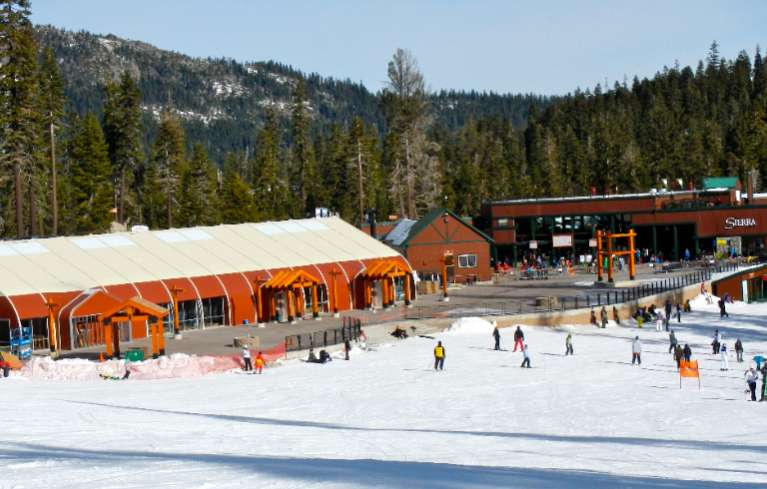
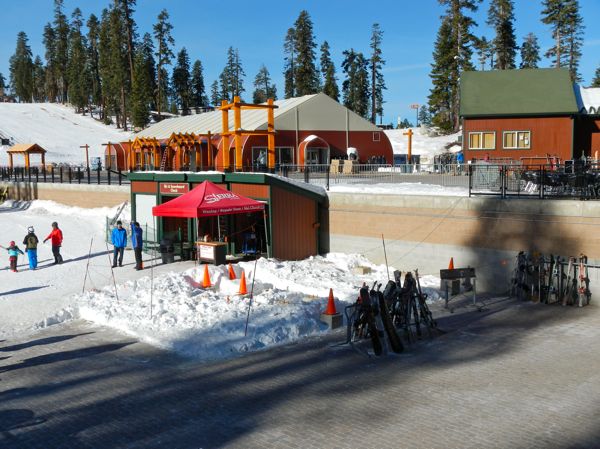
The new structure on the left, which has a restaurant and retail, will open in mid-January. Photos/Kathryn Reed

The new structure on the left, which has a restaurant and retail, will open in mid-January. Photos/Kathryn Reed

By Susan Wood

TWIN BRIDGES – Snowboarders aren’t the only ones sitting on their bottoms enjoying all that the slopes of Sierra-at-Tahoe have to offer.

The South Shore-area ski resort located 12 miles west of Meyers has kicked off the 2013-14 season with a new twist and turn – a major $5 million overhaul to its base lodge area that includes a plaza, new eatery and associated amenities designed to accommodate hanging out.

The resort started construction as soon as the last season ended.

“The mountain is incredible. We don’t want to change the mountain. We just wanted to do something that would enhance the overall ski and riding experience,” Sierra-at-Tahoe spokesman Steve Hemphill said, as he strolled through a massive expanse of paving stones now covering the area outside the main base lodge.
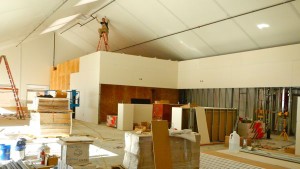
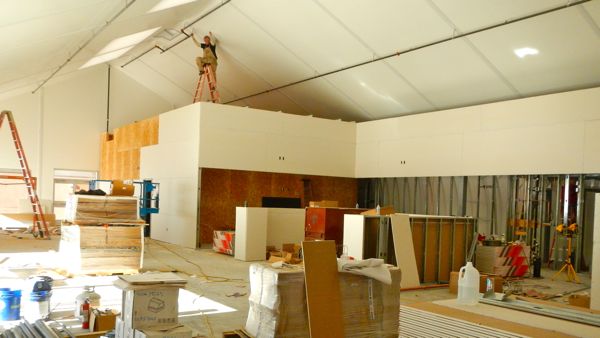
Richard Baker works on the Solstice restaurant at Sierra.

Richard Baker works on the Solstice restaurant at Sierra.

No longer should seating be an issue.

Two fire pits, a structure for an informational sign, lighting, fencing and a 9,000-square-foot building mark an area that used to be covered in dirt or snow. The improvements have greatly increased the number of seats available for those who don’t want to leave the ski area after playing on the slopes and for those who just want to people-watch or wait for others.

Sierra-at-Tahoe, still run under the management of Booth Creek Holdings, wants to expand into new markets – weddings, concerts and events. Three concerts that could simulate the Live at Lakeview series at South Lake Tahoe’s El Dorado Beach are planned in March in cooperation with Lake Tahoe Visitors Authority and OnCourse Events.

Also look for the plaza to be turned into a massive venue for a corn-hole tournament.

And when the Cal Band from Berkeley arrives for its annual pilgrimage to Sierra-at-Tahoe on Jan. 19 during the Martin Luther King Jr. holiday it will have a suitable place to stand and perform. This is the same weekend the new food-retail outlet on the plaza is set to open.

Events and parties represent part of the missing elements Sierra-at-Tahoe has wanted to capitalize on for years, but didn’t have the full monetary resources to pull it off. When it ran Northstar, Booth Creek tended to pile the money into improvements to the north before Vail Resorts took over the Truckee-area ski area.

Sierra wanted a little breathing room inside and out of its base area where 90 percent of its visitors pass through. Getting in on the act, the Aspen Café and Mama’s Kitchen in the base lodge were also opened up to accommodate more seating. Charging areas have been added for people who need to stay connected or do some work while at the resort.

“It’s a vast improvement. This will be the après ski experience we’ve never had,” Hemphill told Lake Tahoe News. “When you pay $84 (for a lift ticket), you expect certain things. That’s how the Vails of the world do a great job.”

However, Sierra isn’t anything like Vail – and doesn’t want to be. Within minutes of discussing how the improvements are a result of guest surveys, Hemphill confirmed the ski resort would not be the type of resort to put in hotel. That’s not its style. But Sierra wouldn’t mind if guests stayed after 4pm.
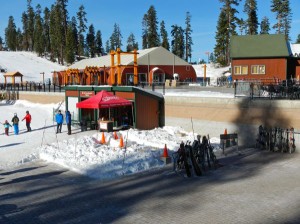
Paving stones are in the plaza, above, as well as for the entry to the ski rental area.

Paving stones are in the plaza, above the 14-foot wall, as well as in front of the ski rental area.

With chairlift technology constantly evolving, new lifts are in the master plan it shares with the landlord, the U.S. Forest Service. But lifts won’t be in new locations. A mountain bike park is not likely, but adventure races are.

So how does a small ski resort compete with the high-dollar, fancier ski areas of the world when they’re constantly adding new venues or improvements?

“We compete with the big guns by sticking to our guns. We’re not looking to compete. We’re just giving (people) the product they expect and enhanced it,” Hemphill said.

The new restaurant will be called Solstice. It’s designed to appeal to guests wanting healthier options and more local representation. These include the Hope Valley Café near Pickett’s Junction and Jack Russell Brewery near Placerville, along with other wine-tasting options in the El Dorado County region. There will be seating inside and out of Solstice, and a bar outside. The retail space of the structure, which took much negotiation with the county building department to nail down, will feature the ski area’s partners to provide them with more marketing offerings.

The new place is a Sprung design that’s similar to an airport hangar. It’s similar to the one at the West Bowl, only larger. This is where the last, large-scale improvement was made at Sierra for the 2003-04 season.

The plaza took out the shack for ski waxing and storage and moved the features to a tent on the lower level.

Long-term goals have the ski area eyeing improvements to its children’s ski school. After all, skiers and riders who grew up skiing this mountain have known greatness. Who can forget the two Travis’s skiing the slopes – Cabral and Ramos. Now all one has to do is look at the cast of young Olympians aiming for a shot at a gold medal. Some have already achieved it. Take snowboarding gold-medalist Hannah Teter who calls Sierra her host mountain near her Meyers home. Now there’s Jamie Anderson and Maddie Bowman likely on their way to Olympic stardom.

The resort hopes to erect a jumbo screen on the plaza during the Olympics in February so people can watch Sierra’s stars in action.
Highest paid Placer County employee retiring

By Ed Fletcher and Phillip Reese, Sacramento Bee

Placer County’s Dr. Richard Burton was the region’s highest paid public official in 2012, earning nearly $340,000. Throw in his benefits, and his total compensation reached nearly $460,000.

Burton wasn’t doing just one job, according to Nancy Nittler, the county’s personnel director. He had two key Placer County posts as public health officer and director of the Health and Human Services Department. After seven years in the health officer post, he added the HHS director title when the previous director left a decade ago.

The Placer County doctor is one of 22 city and county employees in the Sacramento region who earned more than $250,000 in total pay last year, according to a Sacramento Bee review of data from the State Controller’s Office.

Read the whole story


Time ticking to sign up for health care

By Tracy Seipel, San Jose Mercury News

Lynn Engelman still has no idea whether her doctors in Contra Costa County will be on her new health care plan — and neither, she says, do her doctors.

Capitola resident Kathryn Johnson has already paid the first month’s bill for her new policy through the state’s new health insurance exchange, but she just received a letter telling her she hasn’t signed up for a plan.

And in San Leandro, Linda Entrikin is one of 900,000 Californians suffering from whiplash after the Obama administration’s surprise announcement Thursday that people whose insurance plans have been canceled can replace them with cheap, bare-bones plans after all.

For tens of thousands of Californians still without health insurance, Monday’s deadline to enroll under the president’s new health law feels like an exercise of hurry up and wait. And across the country, government health exchanges are bracing for an avalanche of applications from people who must sign up by end of day Monday if they want coverage to begin Jan. 1.

Read the whole story


A secluded snowshoe through Van Sickle

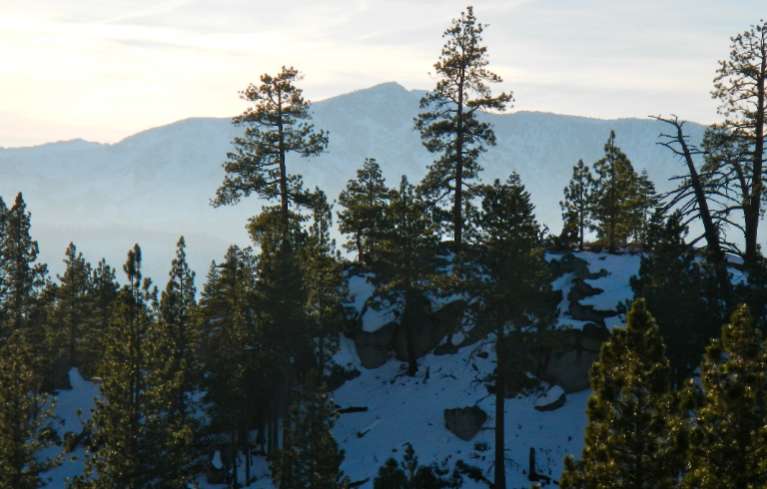
Mount Tallac from Van Sickle Bi-State Park. Photos/Kathryn Reed

Mount Tallac from Van Sickle Bi-State Park. Photos/Kathryn Reed

By Kathryn Reed

STATELINE – Everything changes with a little snow and some things even get better – like the views from Van Sickle Bi-state Park.

While we are familiar with the trail, we were thankful others had gone before us. This way we didn’t completely get lost – just a little sidetracked at the end.

This 725-acre park on the South Shore provides some stunning views of Lake Tahoe by snowshoeing just a short distance. The scenic outlook is 0.4 miles from the trailhead.

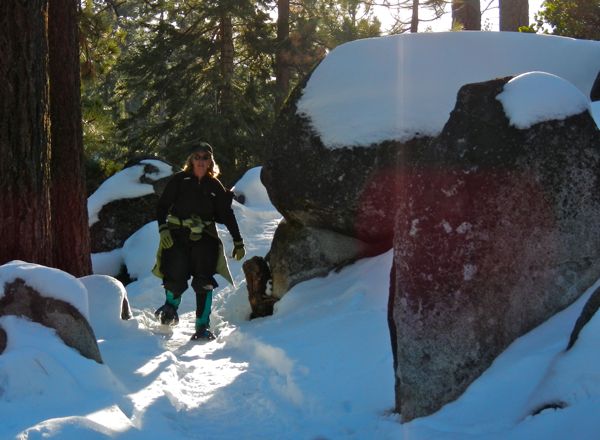
Sue Wood takes in the scenery along the trail.

Sue Wood takes in the scenery along the trail.

The only problem this time of year is that it requires walking to get to the trailhead. The California Tahoe Conservancy and Nevada Division of State Lands, which own and operate the park, shut the gate in winter.

Sue and I walked in via Harrah’s. There is a distinct trail almost directly across from the hotel-casino’s back parking lot. It was a bit precarious to cross the street without a crosswalk; I can’t even imagine what it would be like if that road ever becomes a four-lane federal highway.

We saunter up a little hill and then go left on South Tahoe Public Utility District’s road before we take a left onto the park’s road. A trail sign clearly indicates where the path really begins.

With part of the path last weekend a bit icy, it was great to have the claws of snowshoes to dig into the terrain. However, with the skimpy snow so far this season, patches of dirt had to be walked on, too.

Climbing to the vista is well worth the views of Tahoe and the mountain peaks. The casinos, Rabe Meadow and Round Hill stand out as well.

Tracks from other snowshoers, hikers and cross country skiers are evident. Even super wide bike tires have left their mark in the snow. Still, on a Sunday we saw one person on the main road and heard a few people ahead of us at one point. It mostly felt like we had the park to ourselves.

Lake Tahoe

Lake Tahoe

It’s a great place for dogs, too.

Since the last time I was at Van Sickle more signs are posted telling people about the terrain as well as where to go. The Gondola Fire of 2002 is talked about because many of the still charred trees are in the park. The story of sugar pine plantings is also told.

We opted for a loop we had not been on, nor was there signage for it on our last excursion. We took the upper turnoff for the Cal/Neva Loop. It heads toward California, with a spur going to Saddle Road.

It’s quiet, even secluded. The pines at one point give a sense of being enclosed in some far-off winter wonderland. The snow is softer, powder-like. Fewer people have been here.

Starting after noon allowed the temps to be warmer and for the afternoon light to provide colors and contrasts different than what Mother Nature casts in the morning.

The lake is glass-like – inviting – if only it weren’t so darn cold.

Skiers ride the Heavenly gondola at the end of the day.

Skiers ride the Heavenly gondola at the end of the day.

Soon we are reminded how close we are to civilization as the Heavenly gondola whirs above us.

We take the Barn Trail, knowing it will lead us to the main park road that will drop us off near the entrance where Park Avenue dead ends.

But we come to a fork and there is no sign, but tracks in two directions. Going forward is denser and intuitively the route to the old Van Sickle barn. We, though, go right where it is more open. Passing under the gondola again we know we are on the wrong path. We break trail a bit before hooking up with the STPUD road that will lead us back to where we started. It was fortunate someone had tied blue markers to trees.

—–

Notes:

• The Tahoe Rim Trail is offering a guided snowshoe in Van Sickle on Jan. 11 as part of National Winter Trails Day. More info is online.


Positive signs for ’14 housing market

By Michele Lerner, Realtor.com

The U.S. real estate market made a robust comeback in 2013, surpassing expectations of many economists, as the combination of low inventories and historically low interest rates caused home prices to rise and even helped fuel bidding wars in some markets, surpassing the expectations of many economists.

While positive trends, such as increasing home values, are expected to continue into 2014, mortgage rates are also expected to rise in the coming year and could put a damper on home buyers’ abilities to afford new homes.

Looking back at some 2013 data can give us a hint of the year ahead:

1. Inventory should gradually stabilize

The beginning of 2013 could be characterized as the “year of low inventory” as buyer demand ramped up and homeowners waited for further price increases and evidence of a solid economic recovery before putting their homes on the market. The year began with a significant shortage of inventory and then as early as February the level of shortages started to decline slowly. As 2013 comes to a close, inventory is approximately the same as a year ago. However, homes are selling faster than in 2012, with the median age of the inventory down by 11 percent.

2. A return to positive equity

Rising prices helped 2.5 million homeowners who were previously underwater regain positive equity status during the second quarter of 2013. However, approximately 7.1 million homes were still in negative equity at that time and an estimated 10 million homeowners, or about 21.1 percent of all homeowners with a mortgage, remained “under-equitied,” with less than 20 percent in home equity. The good news is that prices are expected to continue rising in 2014, which will lift more homeowners into positive territory. Median list prices for homes in October rose 7.57 percent above the same month of 2012.

3. Mortgage rates expected to rise

Mortgage rates increased approximately 100 basis points in 2013 and are likely to rise in 2014. The new chairman-designate of the Federal Reserve, Janet Yellen, is expected to continue the policies of Chairman Ben Bernanke, including keeping mortgage rates low by buying blocks of mortgage-backed securities. However, the Fed has considered tapering its bond-buying activity as the economy improves, which could lead to a slight increase in interest rates.

Read the whole story


Bill doubles USFS air tanker fleet

By Curtis Tate, Sacramento Bee

After a lengthy and destructive wildfire season in California, Sen. Dianne Feinstein, D-Calif., inserted language into a defense bill that will double the size of the U.S. Forest Service fleet of large air tankers.

Feinstein said that the amendment, which she cosponsored with Sen. John McCain, R-Ariz., would transfer seven surplus HC-130H Hercules aircraft from the Coast Guard to the Forest Service. The planes can carry a combined 21,000 gallons of water or fire retardant, she said.

Feinstein and McCain included the language into the National Defense Authorization Act. The Senate approved the bill late Thursday on a vote of 84-15.

Read the whole story


Liberty: Without new lines, blackouts possible

By Kathryn Reed

STATELINE – While the president of Liberty Utilities said he didn’t want to be an alarmist, he did say if power lines are not upgraded, brown outs or black outs in the Lake Tahoe-Truckee areas are possible.

“Even without any new growth I’m at the limit with 650,” Mike Smart, president of the utility company, on Dec. 18 told the Tahoe Regional Planning Agency Governing Board.

Line 650 runs from Truckee to Kings Beach. The line is 60 kilovolts and a new one would be 120 kilovolts.

CalPeco, the parent company of Liberty Utilities, is proposing a three-phase upgrade to its loop of power lines that incorporate Truckee, Kings Beach, Tahoe City, Squaw Valley and points in between.

Line 625 from Kings Beach to Tahoe City would also become 120KV. Line 650 was originally built in 1959 and 625 in 1971.

Smart said electric use peaked Dec. 30, 2012, at 7pm at 144 megawatts. The previous peak was 124 megawatts on Jan. 9, 2011, at 5pm.

“It was alarming to have that load scenario last winter. We were on the edge and we could be again in the next few weeks,” Smart said.

Working with NV Energy and using the diesel facilities at the Kings Beach substation allowed Liberty to avoid a system failure. Liberty buys its energy from NV, the former owner of the system. Liberty has about 49,000 customers on the California side of the basin, in Truckee and Alpine County.

An increase in electronic devices, bigger houses, growth outside the basin and resorts making more snow are contributing to the overload. The Christmas to New Year’s time period is Liberty’s highest demand for the entire year.

Some people who spoke Wednesday questioned why people in the Lake Tahoe Basin should be paying for the residential and commercial expansion in the Truckee area.

The estimated cost of the project is close to $50 million. It could start next summer, with the first phase taking two years, and completion of the project in 2019.

Liberty per the California Public Utilities Commission is allowed to ask that agency for a rate increase to cover its expenses once the project or a phase of it is completed. The last rate increase was January 2012. Rate increases can occur every three years.

Dave McClure with the North Lake Tahoe Citizens Action Alliance called the electrical lines “a resort loop” because it allows Northstar and Squaw Valley to keep growing.

Laurel Ames with the Tahoe Area Sierra Club believes the upgrades will spur more growth.

Jim Bengochea, lead project engineer, told Lake Tahoe News the 120KV lines would provide enough power for what Northstar, Squaw Valley and Homewood would like to do in the future. He said these upgrades could be sufficient for the next 20 or 30 years.

But he stressed that the problem is the electric company doesn’t have the capacity to carry the number of volts required to service customers today without a threat to the system at peak times, adding that the project has nothing to do with proposed future needs.

A concern brought up Wednesday is that the Tahoe City substation relocation is not part of the environmental documents. This issue dominated discussion at the TRPA’s Advisory Planning Commission this month, too.

Tahoe City is working on its area plan, which includes the relocation. Placer County documents also call for moving the substation from the 64-acre tract. It is feared that approval of the Liberty Utilities project could hamper efforts to move the substation in the future.

While this was not an action item for the board, members talked about possibly moving the lines farther into the forest for scenic reasons. However, 47,000 trees are already slated to be removed to put in the larger poles and bigger cables.

—-

Notes:

• Comments on the draft environmental documents are being taken until Jan. 7. The TRPA, CPUC and U.S. Forest Service are agencies putting out the documents. Wendy Jepson with TRPA is the point person – (775) 589.5269 or wjepson@trpa.org. More info is online.