Historic Rainbow Lodge to get new lease on life

By Hudson Sangree, Sacramento Bee

The historic, storybook Rainbow Lodge, made from native granite and heavy timber, fell on hard times in recent years after its prior owners defaulted on their loan and a court-appointed receiver took over. In late December, the venerable inn near Donner Summit was purchased out of receivership by a family from Rocklin, which plans to reopen it in February and restore some of its century-old grandeur.

The lodge, with its steeply pitched green-metal roof and stone walls, sits on the banks of the South Yuba River, not far from Interstate 80 in Soda Springs. For many years, cross country skiers warmed up there with a drink, a hot meal and a soft bed after long days on the trails. A pair of skis hang over its knotty-pine bar beneath thick wooden rafters. Historic photographs of the snow-covered lodge and trans-Sierra railroad adorn its walls. Threadbare carpet, tattered curtains and dated floral bedspreads detract from its rugged mountain charm. The worn items will be the first to be replaced, Mitchell said.

The 33-room lodge was originally built as a stagecoach stop in the 1800s. It was converted to a tavern in the 1920s and became a popular spot for gambling and fishing, said Craig Mitchell, who bought the lodge with his wife and parents and will oversee day-to-day operations.

Read the whole story


Nevada casinos lose $1.35 bil. in 2013

By Natalie Cullen, AP

CARSON CITY — Nevada’s largest casinos, still climbing out of the recession, suffered a combined net loss of $1.35 billion in 2013, marking the fifth straight year without an overall profit, state regulators reported Friday.

But there was some positive news in the annual abstract report released by the Nevada Gaming Control Board, which looks at the total revenue of casinos that gross more than $1 million in gambling revenue.

The total revenue of the 263 casinos included in this year’s report rose for the third consecutive year, to $23 billion. That’s an increase of 0.4 percent, or $99.2 million, from 2012.

While the casinos’ losses grew by 11.2 percent or $136 million, a control board analyst said much of that was tied to increased expenses.

“For the state, an increase in revenue was primarily driven by gambling,” said Mike Lawton, senior analyst with the control board. “But due to an increase in expenses, the net loss for the state increased.”

Total revenue is the money patrons spent on gambling, rooms, food, beverage and entertainment.

Net income or loss is what casinos retain after expenses have been paid, but before deductions for federal income taxes and accounting for extraordinary expenses.

On the Las Vegas Strip, Nevada’s gambling mecca of posh resorts, the losses narrowed, and for the first time since 2007, the growth of gambling revenue outpaced the growth from other aspects such as hotel rooms, food, beverages and entertainment.

The Strip’s gambling revenue of $5.7 billion was up 3.5 percent from 2012, while the Strip’s total revenue of $15.5 billion rose 1.7 percent. It’s the 15th straight year in which Strip gambling revenue made up less than half of all revenue, a trend indicative of a tourism market where visitors come for other recreational activities besides gambling.

“It’s a positive for the Strip,” Lawton said. “Revenues increased and the net loss decreased.”

Statewide, the large casinos’ $10.4 billion in gambling revenue rose 1.1 percent and accounted for 45 percent of total revenue, the second lowest percentage ever recorded.

Nevada casinos haven’t posted a net profit since 2008, when profits totaled $721 million. The bottom fell out a year later as the recession put a chokehold on the economy. Casinos in 2009 had a loss of nearly $6.8 billion.

Before the current string of yearly losses, the only other net loss recorded by Nevada casinos was in fiscal year 2002, after the Sept. 11 attacks.

The 263 casinos included in this year’s report paid $804 million in gambling taxes and fees.

Most of the casinos are in Clark County, which includes the Las Vegas Strip. The 150 Clark County casinos included in the report had a combined net loss of $1.3 billion on total revenue of $20.6 billion.

Elsewhere in the state, Washoe County casinos reported a profit of $719,000, while the 18 casinos in Elko County had $42.7 million in combined net income. Five casinos on the south shore of Lake Tahoe had a net loss of $90 million, while the Carson Valley Area that encompasses Carson City and parts of Douglas county netted $7 million.


Tahoe, Carson docs duped in mega scam

By Matt Gutman, Chris Kilmer and Lauren Effron, 20/20

When Navy veteran Carol Roberts first met A.J. Dicken, who boasted about being the most decorated Navy SEAL ever, she was in awe of him, and she wasn’t the first.

For years, Dicken, 57, claimed he was an ex-Navy SEAL who had served in dozens of covert combat missions, from the jungles of Vietnam to the caves of Afghanistan. He proudly wore the SEAL trident insignia and loved to show off his numerous awards. He would regale listeners about his mission to assassinate Colombian drug lord Pablo Escobar and his death defying swoop into Pakistan to make the kill shot on Osama Bin Laden. He also carried discharge papers that included two Medals of Honor, and even a laudatory email from Col. Oliver North. He’s actually a former Lake Tahoe bartender

But it was all an elaborate lie, one that he would allegedly use to take hundreds of thousands of dollars from his victims — and something else harder to put a price on: their honor.

Roberts met Dicken at a military-style self-defense training school he started in an airplane hangar in Carson City, where she took some shooting and self-defense classes, along with Greg Ginn, a surgeon in South Lake Tahoe, and Brian Romaneschi, an ear-nose-throat specialist in Carson Valley.

The business was popular with the locals, and seemed to be booming. But Dicken’s dream to launch his own international security firm was expensive. He convinced Ginn and Romaneschi to invest upward of $850,000 in the new venture.

Read the whole story


‘Temporary’ Tahoe Humane Society exec retires

By Kathryn Reed

Dawn Armstrong never intended to run a Humane Society, let alone for more than two decades.

The 70-year-old came to South Lake Tahoe not sure of what she wanted to do. Right away she met people associated with the Lake Tahoe Humane Society. She joined the board mostly as a way to help animals and meet people. At the time the board had been looking for an executive director. After about six months and still no leader, Armstrong said she would be willing to take the job for six months.

Armstrong retired Dec. 31 after 22 years as executive director of the humane society.

“I think I’m going to like retirement. My head is spinning and I feel off balance,” Armstrong told Lake Tahoe News.

Dawn Armstrong with Lexie, Noodles and Goldie. Photo/Provided

Dawn Armstrong with Lexie, Noodles and Goldie. Photo/Provided

Now she has time to pursue her writing (she has a book she wants to finish), enjoy Tahoe, be more physical and spend more time with her animals instead of worrying so much about all the animals.

The phrase “Keep Tahoe Kind” was created on her watch. After all, it was a corporate marketing background that she brought to the job.

“I thought that’s what we were supposed to do,” Armstrong said in reference to the Keep Tahoe Kind phrase. She said at the time the Humane Society was the only group to ask the League to Save Lake Tahoe for permission to alter its Keep Tahoe Blue slogan. The former League director said go for it. Armstrong envisioned people having both bumper stickers on their vehicles.

The slogan is about people being kind to each other and animals.

The local chapter was founded in 1967. It originated on the Nevada side before moving to California. At times its offices were in Meyers, while now they are in South Lake Tahoe.

In 1987 the shelter burned to the ground. Many animals died and the insurance company didn’t cover the costs to completely rebuild so a fund-raising drive helped with the rebuilding.

Today the Humane Society is largely about educating people and cruelty prevention. Children’s programs include the My Reading Buddy program. The society also works with many of the social service groups in town.

Besides the executive director, who is now Niki Congero, there is one other full-time employee. There is a board that oversees everything.

When Armstrong first came on board she was thrown into a controversy with South Lake Tahoe and El Dorado County.

“In 1992 we gave up the city and county animal control contract and moved out of the shelter building,” Armstrong said. “We decided after looking at our finances that we would go broke if we kept doing animal control.”

Money was raised for a shelter in what is now Angie’s Signs in Meyers. This meant there were two shelters on the South Shore. It eventually closed in winter 2002. The population was starting to diminish and change to the point where two shelters were not needed.

The society then began focusing more on education.

“What kept me with it, because it’s hard, was the education aspect of it,” Armstrong said of the job. “The wonderful part is the kids. You hope when they grow up they have a new outlet and appreciation for all creatures.”

And while there were times when funding was such an issue that Armstrong had to have other jobs, the Humane Society remained a passion.

Now Armstrong is pursuing personal passions.


Brown wants to add teeth to Prop. 98

By Kimberly Beltran, Cabinet Report

Last year Gov. Jerry Brown set out to fundamentally remake the state’s funding relationship with schools – this year the Democratic governor has set his sights on remaking the state’s seminal school funding guarantee, Proposition 98.

Perhaps best known for its byzantine formula that adjusts for economic growth, student enrollment and political temperament – the 25-year-old voter-approved spending measure has been criticized for decades because it limits the Legislature’s flexibility to deal with overall budget conflicts and at the same time setting a de facto floor – not ceiling – on how much gets spent on public education.

As part of his 2013-14 state budget formally released Thursday, Brown proposed putting a new constitutional amendment before voters that would strengthen the state’s existing Rainy Day fund but also put regulations on Proposition 98 in an effort to smooth revenue spikes.

Brown’s plan would to create a Proposition 98 reserve account, where deposits would be made when capital gains revenues rise to more than 6.5 percent of general fund tax revenues.

Read the whole story


Study: Hospitals are ripping off people

By Nina Liss-Schultz, Mother Jones

The United States has long been known to have one of the most expensive hospital systems in the world, and now a study indicates that hospitals are overcharging patients for medical services.

According to the study published Monday by National Nurses United, the largest nurses’ organization in the United States, the price of many services has skyrocketed since the mid-’90s. Many hospitals have set charges at 10 times their cost. The 100 most expensive hospitals in the country, for example, in 2011 charged 765 percent of their costs, or $765 for every $100 of total costs.

Charles Idelson, a spokesman for NNU, says that even insured patients, whose insurance providers will offset some of the costs, will be affected by the price hikes. “The skyrocketing prices make premiums, co-pays and deductibles go up,” Idelson says. Another recent study, by the Commonwealth Fund, found that “high deductibles and cost-sharing, along with no limits on out-of-pocket costs” may explain why even insured people struggle to afford health care.

Read the whole story


Expert details consequences of climate change

By Kathryn Reed

STATELINE – Despite a litany of information documenting how climate is changing and examples of its devastating impacts, one Nobel Peace Prize recipient remains optimistic.

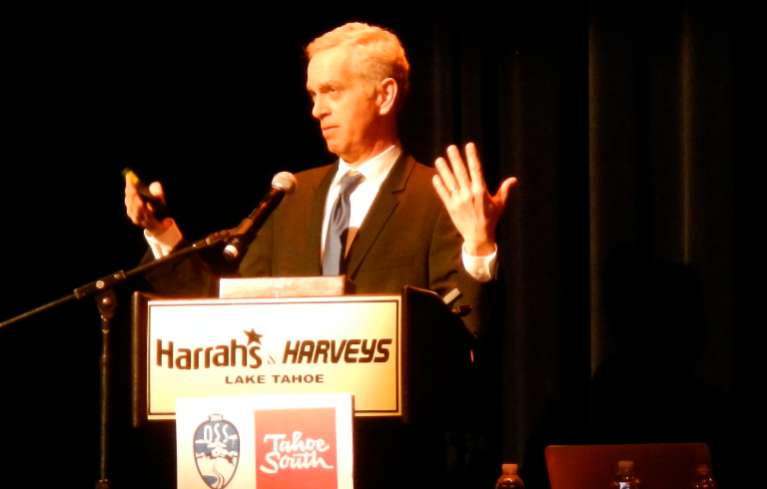
“We still do have a choice. That is the very real reason for optimism,” Bill Collins told a group of more than 40 people Jan. 10 at Harrah’s Lake Tahoe.

Collins was the keynote speaker Friday for the three-day Operation Sierra Storm Meteorologist’s Conference. He is the lead author of the Intergovernmental Panel on Climate Change, heads the Climate Sciences Department at Berkeley Lab and teaches at Cal.

Climate change expert Bill Collins talks Jan. 10 at Harrah's Lake Tahoe in Stateline. Photo/Kathryn Reed

Climate change expert Bill Collins talks Jan. 10 at Harrah’s Lake Tahoe in Stateline. Photo/Kathryn Reed

Climate change is evident from 2012 being a record hot year in the United States, to Australia breaking 123 records in 90 days in 2012, to the world temperature increasing about three-quarters of a degree centigrade since 1900, to the sea level rising 200 millimeters in the last 100 years.

Cities abutting major water bodies like San Francisco and Oakland are looking at how to handle the rising water. In the Maldives where the elevation is 1 meter above sea level Collins said people are experimenting with building artificial islands.

“Carbon dioxide is increasing from human activities,” Collins said.

In 1950 there were 270 parts per million, whereas in 2010 there were 400 parts per million in the atmosphere.

“Through isotopic analysis we know it is man-made. The source is fossil fuels,” Collins said.

That is what people have control over – the use of fossil fuels. What they don’t have power over are volcanoes and the sun, which are the two primary natural causes of climate change.

A potential irony is that as the Arctic ice melts, it will be easier to drill for oil there.

Forecasting models are split when it comes to whether the United States will see more precipitation or less because of the storm tracks. But what is known is what does fall from the sky is going to be in the form of more rain and less snow. This has significant consequences for places like California and Nevada that depend on snowpack for their reservoir storage and sustained water supply.

“It’s critically important to all of us. Water is irreplaceable. Fossil fuel is replaceable,” Collins said.

It is a warming Earth that alters moisture and rainfall.

“What was unusual will become the usual by the end of the 21st century,” Collins said. This is because of the change in the hydrological cycle.


Nevada lacking doctors, nurses

By Andrew Doughman, Las Vegas Sun

The chronic shortage of doctors that afflicts Nevadans may grow worse, lawmakers were warned Wednesday.

A group of health care experts reviewed the state’s longstanding deficiency in providing an adequate health care workforce for Nevada’s residents at a legislative committee, providing fresh data showing that Nevada still ranks poorly among states for the number of doctors and nurses it counts among its population.

That shortage of doctors, nurses and other health care professionals isn’t going away anytime soon, experts say. Instead, it could actually be getting worse.

The advent of the Patient Protection and Affordable Care Act mandates and provides subsidies for people to get health insurance, and with hundreds of thousands of Nevadans predicted to get insurance, there’s even more pressure on the health care system to have enough professionals to see patients like you.

Read the whole story


Senior gambling addiction rates soaring

By Lynn Stuart Parramore, AlterNet

Atlantic City boasts fabulous amenities for America’s senior citizens. See the broad boardwalk, perfect for fresh air and exercise. Notice the limited-mobility seniors rolling along on rented scooters and the wheelchair-bound joining the fun at easily accessible slot machines and blackjack tables. Feast your eyes on dozens of exotic and affordable buffets, and don’t miss the drug discounts and free lunch coupons handed out at every turn. All day and far into the night, the buses zip to and from retirement centers, carrying promises of excitement. And did you hear? Tony Bennett’s here tonight, crooning all those songbook classics grandma knows by heart. And she’s not going alone. She found a date on an Atlantic City senior hookup site.

Look: just over there is your neighbor Mr. Jones, professional man and pillar of the community. At 68 he’s the picture of respectability and sound judgment.

Only now he’s hunched over a blackjack table, hands trembling over a stack of plastic chips. Mr. Jones has blown through $200,000 of his retirement savings so far this year. He has fallen behind on his house payments. His children, who live far away, don’t have a clue what Dad has been doing every afternoon these last few months since Mom died. Mr. Jones keeps his habit a secret. Once a sunny optimist, he feel humiliated. Mr. Jones hates the person he has become.

Seniors are the fastest growing population of gamblers. They are gambling away their income, their savings, and their chance for a secure future. When they lose, they can’t make it up or start over. It’s a no-win game, driven by a greedy industry united in unholy alliance with policy makers and politicians who turn a blind eye to the social and economic costs of gambling.

Read the whole story


Squaw Valley Olympics — a first in many ways

By Kathryn Reed

The 1960 Winter Olympics at Squaw Valley set the stage for future Games in ways that organizers could not have foreseen. It was the first to have the athletes housed in a contained area close to the action, the first for a downhill racer to use a composite ski, the first to have a computer to tabulate scores, the first to have a theatrical opening and closing ceremony, the first for biathlon and the first to be broadcast live throughout the country.

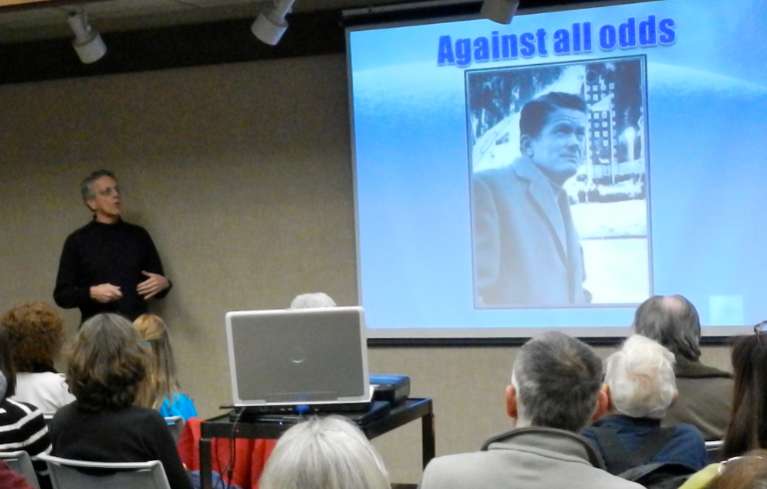
David Antonucci spoke Jan. 7 to a crowd of more than 60 people at the South Lake Tahoe Library about how the Olympics came to the Tahoe area 54 years ago and what they were like.

Antonucci is the author of “Snowball’s Chance: The Story of the 1960 Winter Olympic Games Squaw Valley & Lake Tahoe” and “The 1960 Winter Olympics” – the latter being more photos than words.

His interest in the Games occurred somewhat accidentally. The Tahoma resident began investigating the trails he could see around his house. They turned out to be cross country trails used during the Games.

David Antonucci talks Jan. 8 about how Alex Cushing secured the 1960 Winter Olympics at Squaw Valley. Photo/Kathryn Reed

David Antonucci talks Jan. 8 about how Alex Cushing secured the 1960 Winter Games at Squaw Valley. Photo/Kathryn Reed

At the time they were all on private property so all the structures were torn down. But now much of the land is part of Sugar Pine Point State Park, trails have been resurrected, and cross country and biathlon events are staged there.

Antonucci recognized Martin Hollay, who was in the audience. Now in his 90s, Hollay helped build the 20-kilometer trail system.

With all the construction, the cross country events had to be moved 15 miles south near Tahoma.

Much has been written about how Alex Cushing, then owner of Squaw Valley ski resort, didn’t expect the U.S. Olympic Committee, let alone the international folks to award his one lift, two-rope tow resort the Olympics. But they did. And in the intervening four years a destination for the world to embrace was created.

Antonucci explained why Highway 89 between Truckee and Tahoe City is so wide. It was so three lanes of traffic could get to Squaw in the morning and three lanes could leave when the day’s competition came to a close.

Plans for Interstate 80 were on the drawing board. Construction between Sacramento and Truckee was put on the fast track to get people to the Games.

Blythe Arena was built so the heat extracted from the ice-making unit would melt the snow on the roof. Someone forgot about that fact and in 1983 the roof collapsed because of a heavy snowload.

Two A-frame structures allowed spectators to watch multiple events at once. Only the men’s downhill finished mid-mountain.

The Seabees were brought in to make a temporary parking lot out of snow and sawdust.

“Originally they wanted to pave the meadow,” Antonucci said.

IBM needed an entire building for its one computer that was used for scoring. This was the first Olympics where athletes didn’t have to wait hours to know the results. Twenty-six people were needed to operate the 5 megabyte machine.

Antonucci had many stories to tell of athletes in various sports for different countries, including the original hockey team that beat the Russians and took home gold after beating the Czechs.

—-

Notes:

David Antonucci will speak and give a slideshow presentation at the Museum of Sierra Ski History in Tahoe City on Jan. 16. The Olympic Museum Mixer is from 5:30-7:30pm and is part of the Olympic Heritage Celebration.