El Dorado Trail captures route of old railroad
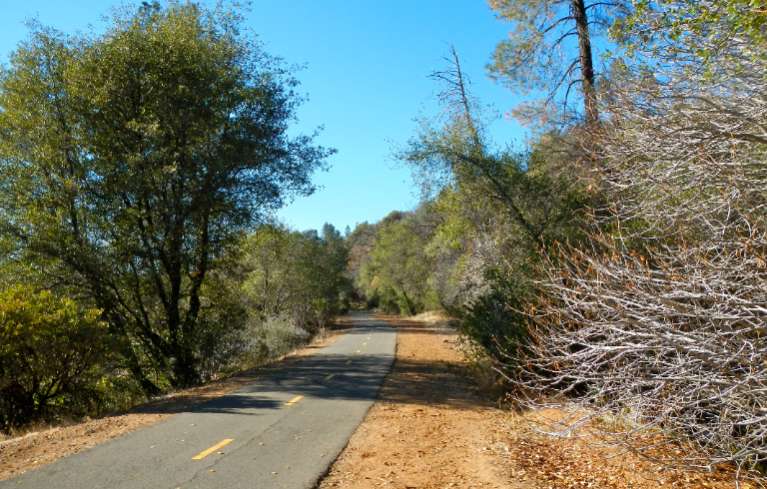
El Dorado Trail goes from Camino to Folsom. Photos/Kathryn Reed

El Dorado Trail goes from Camino to Folsom. Photos/Kathryn Reed

By Kathryn Reed

PLACERVILLE – Spring in January. It’s not something I want to get used to. But it is something I’m going to enjoy for hopefully what is just a brief interruption of winter.

Not wanting to endure ice on the trails, we opted to head off the hill last weekend in search of exploring new terrain at a lower elevation. We had seen a sign for the El Dorado Trail on one of our wine excursions and knew we would be back to explore.

What we didn’t know is where it went, how long it was or anything about it.
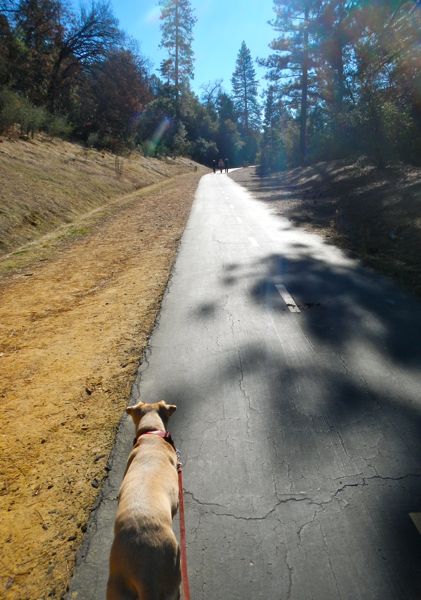
AJ leads the way.

AJ leads the way.

It’s a trail in progress. But the completed section we were on is great. It’s a paved multi-use trail – and is well used based on the walkers, cyclists and horse doo-doo.

Going out it is all uphill as we make our way toward Camino. An overpass crosses Highway 50 so then we are on the south side of the road. AJ didn’t know what to make of the cars below her and got a little skittish. Dogs are allowed on the trail on leash.

What’s interesting is how many times we have driven this stretch of highway and never knew there was a trail below us. We looked for it on our way home but could not see it.

The distinctive Apple Café sign on the hill is one of the few identifying markers for us to know where we are.

Benches along the way provide an opportunity to rest or just take in the scenery. The foothills, with the mix of pine and oak, stretch for miles. Several residences are above and below the wide path. More things not noticeable from the highway.

It’s disconcerting, though, how dry everything is. What should be green is brown. And it’s so warm – 68 degrees on Jan. 18. I could easily have been in shorts, as some people were.

At times the trail is shady, other times it is in full sun. I can imagine it would not be a great place to be in mid-summer because of the heat.

A man out with his dog told us when we hit the dirt trail we could keep going, but we opted to turn around at that point. Above us, though it’s not visible, is where the Valero gas station in Camino is. We think round-trip it was a little less than 5 miles.

But there is much more to the El Dorado Trail than what we did. The paved portion continues on the other side of the road from where we started. According to websites I read, it is paved from Camino to just south of Folsom – 35 miles in total.

Views between Placerville and Camino.

Views between Placerville and Camino.

The trail follows old railroad lines – Southern Pacific and Michigan-California railroads.

Work on the route started after the July 1991 purchase of the line from the Southern Pacific Railway Corporation by the Sacramento-Placerville Transportation Corridor Joint Powers Authority. The former rail line is a part of the Designated Cross State Bicycle Route that goes from San Francisco to South Lake Tahoe.

Friends of El Dorado Trails is working to extend the trail east. Their website says discussions are under way for the route to go to Pacific House east of Pollock Pines, then follow the former Pony Express trail into South Lake Tahoe.

—-

Getting there:

From South Lake Tahoe, take Highway 50 west. Take the Smith Flat Road exit near Placerville. Turn right on Smith Flat School Road. Take the first left on Smith Flat Road. Turn right on Jacquier Road. Parking lot is on right. There is a big sign that says El Dorado Trail.



Vail taps young Midwest market to fill its bigger resorts

By Andrea Petersen, Wall Street Journal

Vail Resorts has come up with a novel way to combat the leveling off of skiing’s popularity: buying up little Midwestern hills.

The goal is to hook families on the sport at spots close to home and groom them for vacations at the company’s pricier Western mountains like Canyons Resort in Utah and Breckenridge Ski Resort in Colorado. Vail Resorts has already bought resorts in Minnesota and Michigan and spent $20 million to renovate and upgrade them.

It is a long-term strategy, says Rob Katz, Vail Resorts Inc.’s chief executive. “There are kids in those [Midwestern] markets whose parents may not ski — maybe they are 12. If we can make a connection with that kid, we have a great opportunity to keep him in our family as he gets older and begins making his own decisions about where he is going to travel,” he says.

Skiing and snowboarding are looking to attract younger participants to replace aging baby boomers. The percentage of skiers and snowboarders ages 24 and younger fell to 22.8 percent in the 2012-13 ski season, down from 30.6 percent in 1997-98, according to a survey of visitors to 88 U.S. resorts by the National Ski Areas Association, a trade group. During the same stretch, the percentage of people ages 45 to 54 increased to 19.8 percent, up from 14 percent.

Read the whole story


Calif. higher ed officials pledge to cooperate

By Larry Gordon, Los Angeles Times

SAN FRANCISCO — The leaders of California’s three public higher education systems Wednesday pledged more cooperation, particularly in transferring students, while Gov. Jerry Brown urged them to develop more innovative collaborations.

In a rare gathering, University of California President Janet Napolitano, California State University Chancellor Timothy P. White and California Community Colleges Chancellor Brice W. Harris said they want to break through some of the walls set up by the state’s 1960 Master Plan for Higher Education, which established different roles and student enrollment criteria for each sector. Yet they also said they want to maintain the plan’s basic tenets.

Napolitano said she hoped the systems would create a “student-centered” website that could track the academic progress of community college students and keep them on course to transfer to UC or Cal State.

Read the whole story


Upgrades taking root at Al Tahoe ball fields

This is a rendering by Design Workshop of what the Al Tahoe ball fields are likely to look like.

This is a rendering by Design Workshop of what the Al Tahoe ball fields are likely to look like.

By Kathryn Reed

Work will be begin this spring on a multi-use softball and Little League field at the Al Tahoe complex in South Lake Tahoe.

Steve Noll, who is on the Fields Advisory Committee for the South Lake Tahoe Recreation Facilities Joint Powers Authority, explained Jan. 24 to the JPA board how the area will be reconfigured to allow more play to be going on at once.

The T-ball area will be moved almost due east of where it is now.

“The T-ball will be next to the play structures. I think it will be a better setting than where it was next to the road,” Noll told the board.

Multi-use turf will be laid there.

The new diamond will not have grass, which will allow for the dual use. Plus, it will have a removable pitching mound.

With all of the changes will also come a realignment of how the soccer field is configured. That is still going to be decided by AYSO officials. But what soccer aficionados get out of this is more warm-up areas.

Lake Tahoe Unified School District’s board approved the plans Jan. 14. The district owns the land where all of this is taking place.

Money for the project is coming from Measure R, the reworked Measure S recreation tax that property owners on the California side of the South Shore pay.

Without knowing what the bids will come in at, it’s possible not everything will get done. For example, it would be easy to remove a second set of bleachers and have that added when the pot of money is replenished.

There is about $276,000 in the bank for this project and that is what estimates have come in at to do the work.

Technically all of the work is three projects. One is the new field, the second is relocation of the T-ball fields and the third is upgrades to the existing two ball fields. The latter includes fencing on Rufus Allen Boulevard and bleachers. (Here is a PDF of the South Tahoe ball fields illustration.)

Bids for the project are likely to go out in April so construction could begin in May. Completion is expected in the fall.

Work could be in phases so baseball season is not interrupted.

Initial work will include removing existing asphalt and running irrigation lines. The asphalt coming out is at the two rarely used basketball courts at the old Al Tahoe Elementary School. It was noted when South Tahoe Middle School renovations were done that new basketball standards were put in there.

Noll said with previous irrigation systems being pieced together, that after work is done this summer the water lines will all make sense and flow more smoothly.

In other news:

• Shay Navarro with the Bicycle Advisory Committee told the JPA board that the bridges over the Upper Truckee River and Trout Creek would be replaced this year.

• JPA board Chairwoman Norma Santiago said El Dorado County is looking into snow removal on bike trails.

• Bike advisory member Chuck Nelson suggested the board consider another parcel tax to up the amount collected from property owners in order to better fund recreation projects.

• Judy Clot, board member representing Tahoe Paradise Resort Improvement District, said at the July 25 meeting she will have a proposal for what that area needs to improve and will possibly ask for its $50,000 annual allocation to be increased.


‘Expired’ food to get a second life

By Lindsay Abrams, Salon

The former president of Trader Joe’s thinks he can sell the food that other stores throw out.

At first glance, that sentence looks like it tells you everything you need to know: Like Jeff Bezos’ vision of delivery-by-drones, or Elon Musk’s proposed hyperloop, Doug Rauch’s new venture sounds at once promising and kind of out-there, and like it’s possibly just a publicity stunt.

In interviews with NPR and the New York Times magazine, Rauch laid out the basics: The Daily Table, due to open in May, will be part grocery store and part cafe, specializing in healthy, inexpensive food and catering to the underserved population in Dorchester, Mass. What makes it controversial – at least at first glance – is Rauch’s business model: His store will exclusively collect and sell food that had crept past its “sell-by” date, rendering it unsellable in other, more conventional supermarkets.

As it turns out, so-called expired food is something of an overlooked commodity. At some point along the chain of production, from when it’s grown to when it’s left on a consumer’s dinner plate, 40 percent of the food produced in the U.S. each year is wasted, and $165 billion goes in the trash.

Read the whole story


No sure bet when it comes to Super Bowl

By Case Keefer, Las Vegas Sun

Odds are Las Vegas will never play host to a Super Bowl.

That’s fine, because our city stages the game within the game on an annual basis. The NFL can try to deny the role gambling has played in making it the country’s most popular sports league all it wants, but it’s a futile exercise this time of year.

Prognosticating the Super Bowl through the lens of the betting line is as much of a tradition as debating quarterbacks and judging commercials. And the topic is most enveloping locally, where everyone seems to have an opinion.

Read the whole story


Drugs a leading cause of women’s incarceration

By Kathryn Reed

STATELINE – Drugs, alcohol and violence are the three primary reasons women end up in jail in El Dorado County. And meth is the drug of choice.

It takes a minimum of six years to kick the habit. And the deterioration of what one looks like is rapid and dramatic. But sometimes by the time they get out of jail they are returning to their original selves.

El Dorado County sheriff’s Capt. Randy Peshon spoke last week to Soroptimist International South Lake Tahoe about women behind bars and what is going on with the two county jails. The Placerville facility has 311 beds, while the one in South Lake Tahoe has 158. Both are co-ed, though seldom do the two populations mix.

El Dorado County sheriff's Capt. Randy Peshon talks Jan. 22 about women in jail. Photo/LTN

El Dorado County sheriff’s Capt. Randy Peshon talks Jan. 22 about women in jail. Photo/LTN

There are between 60 and 75 women in the jails at any given time. Most are between the ages of 24 and 56.

“The No. 1 tool for managing a jail is the TV,” Peshon said. “If a fight breaks out, the TV is turned off.”

He said it’s a lot like raising children. Take away what they want and the behavior is likely to change.

“There’s not a lot of difference between the females and males in jail except for relationships,” Peshon said. “They care for each other unless you’ve committed a crime against a child. That’s where the men and women are the same.”

Riot gear is needed to deal with problems with the men. Sitting down and talking is how issues with the women are handled.

Women like the dormitory style housing because it is more sociable. The men don’t like this because it means living with other men.

Peshon has been in the jail division for decades. Before being promoted to captain a few years ago he ran the South Lake Tahoe facility. Now he is in charge of the entire jail system for the county.

He’s a big believer in programs for inmates instead of just having them sit around. The goal is to keep them productive. Peshon said about 80 percent of the people have problems that can be worked on, while there isn’t anything that can be done for the other 20 percent.

Mental health services are needed by 18 percent of the population. This is 4 percent higher than the national average.

“Jails have become the mental health providers of the county,” Peshon said.

It’s possible to obtain a full general educational development certificate, work skills, resume writing and other basic skills. Inmates may obtain a laundry manager certificate, which doesn’t cost the county a dime. This is the second year adult education classes have been offered.

One of the most successful programs started in 2007 is a partnership with Lake Tahoe Community College. The culinary arts program teaches them skills in the kitchen. They make meals for their peers and there is also a catering component.

Ninety percent of the inmates in the culinary program find a job – not necessarily in a restaurant – when they are released.

While most facilities would never put men and women together, Peshon likes to challenge the status quo. The culinary program and GED are co-ed. The thinking is that if one of the problems to begin with was the inability to get along with the opposite sex, isolation during incarceration is not going to help when they get out.

All the teaching also helps keep people from making a return stay at the jail. And it’s working. El Dorado County is renting out bed space to other counties.


Calif. closer to banning plastic bags

By Laurel Rosenhall, Sacramento Bee

Disposable plastic bags would be banned from grocery check-out stands in California and consumers would pay at least a dime for a paper or re-usable plastic bag under a compromise proposal negotiated with key opponents of last year’s bill to ban plastic shopping bags.

Lawmakers plan to unveil the deal Friday at a Los Angeles-area manufacturing plant.

Senate Bill 270 seeks to temper some manufacturing industry opposition by providing $2 million from state recycling funds. Plastic bag makers would be able to apply for grants to re-train their workers or re-engineer their operations to make plastic bags that meet new criteria spelled out in the bill.

Read the whole story


Common sense needed with dry conditions

By Teri Mizuhara

With the lack of rain, our local vegetation is tinder dry. All you have to do is go outside to hear the crackle and crunch of pine needles and leaves under your feet.

Add wind to this scenario and you are looking at very critical fire conditions — red flag conditions.

We are responding to wildfires almost daily, which is not at all normal for January in the foothills of the Sierra. We have increased our staffing levels to meet the need and can quickly augment that if it becomes necessary, but we need everyone’s help if we are to remain fire safe.

Fire safety tips for red flag conditions:

· Do not burn when it is windy. As illustrated by the Colby Fire near Glendora last week, wind can cause a small fire to become a raging wildfire.

· Do not drive into tall dry weeds or brush because your vehicle can catch the vegetation on fire since the exhaust system of your vehicle is hot enough to ignite a fire. If you must pull to the side of the road, make sure the area is clear of vegetation.

· Do not use gas powered equipment when it is warm and windy because a single spark can cause a wildland fire which can quickly grow out of control. Wait for a day when there is no wind and work in the early morning hours or after 6pm when the humidity is higher and a chance of a wildfire is lessened.

We understand that many people are taking advantage of this weather and are outdoors creating additional defensible space around their homes. We want to encourage this, but at the same time, we want folks to be fire safe.

Following these fire safety tips will allow you to work safely in your yard.

Teri Mizuhara is with the El Dorado-Amador unit of Calfire.


Lack of moisture threatens El Dorado vineyards

By Kathryn Reed

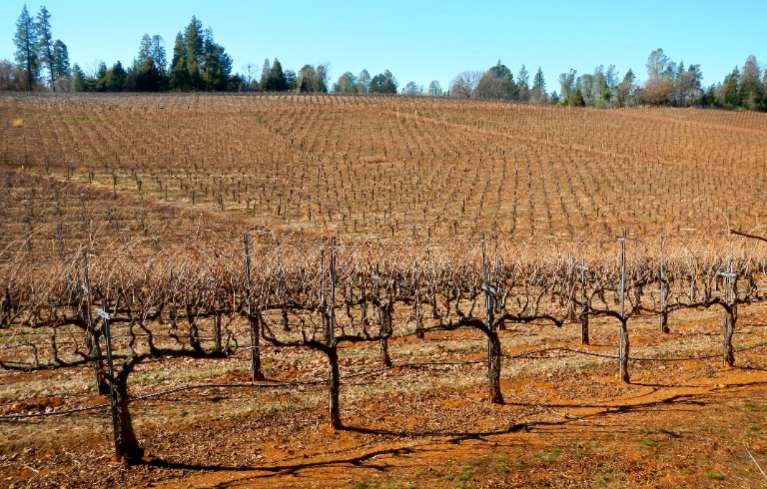
PLACERVILLE – Brittle brown. That’s what the El Dorado County wine country looks like.

While the vines are normally dormant this time of year, the ground between them is usually a lush green. Instead, it’s barren.

Rick Wickham has never seen is so bad in the 30 years he has been in the vineyard management business. Meyers Ranch Vineyards Services Co. based in Somerset manages nearly 800 acres. Most are in El Dorado County, with some in Amador County. The acreage covers 34 vineyards for about a dozen wineries.

“In El Dorado County our aquifer is recharged from snowpack and that doesn’t look good. Most in El Dorado County are on well water and well water is affected by the gallons per minute you can pump,” Wickham told Lake Tahoe News.

Vineyard manager in El Dorado County are worried because of lack of rain this winter. Photo/Kathryn Reed

Vineyard managers in El Dorado County are worried because of lack of rain this winter. Photo/Kathryn Reed

Eldorado Irrigation District supplies many vineyards with water. A drought stage has not been enacted – yet. But with Gov. Jerry Brown declaring last week that the state is in a drought, water districts are apt to follow suit. This could be especially troubling in the heart of the summer when Mother Nature could decide to unleash a heat wave.

In a meeting of vineyard managers on Jan. 13 the talk was about how everyone is worried about water.

Lynn Wunderlich, a UC Cooperative Extension farm advisor, is giving a drought seminar for farmers on Feb. 20 at UC Davis. Wickham is sending several of his people to it.

January 2014 is set to go down in the books – for many locations in California – as one of the driest and warmest on record.

Charlie Jones, owner of Lava Cap Winery in Placerville, said in a normal year about 38 inches of rain falls. Last year about 25 inches fell. To date about 5 inches have accumulated. He, too, has been in the business for 30 years and has never seen it so bad.

Soil in El Dorado County is alluvial and granitic so it does not hold water well. This is the opposite of Amador County where it is more like clay and traps water better.

One way to test the soil for water is with a neutron probe. Usually this is done in early June, with the presumption irrigation will start in mid-June if need be. But Wickham started probing this month and is finding alarming results.

“It’s as low as it normally would be in September,” Wickham said.

Jones knows of people who are watering the vines so the water will freeze to the plants. This forms an insulation.

It’s not just El Dorado County vineyards that are threatened by the lack of rain. Paso Robles has an ordinance that bans planting of new crops that need irrigation.

The soil is also warm. This is a prelude to bud break. One way to combat that is to water now so the soil gets colder.

“We are very fearful they are going to start sprouting,” Davell Hays of Chateau Davell in Camino told Lake Tahoe News.

As a micro-winery with less than 5 acres, there is even less wriggle room for Chateau Davell if winter never comes.

If buds start sprouting now or in the coming weeks, it’s likely the fruit would be damaged or wiped out with a hard freeze. Freezes often come to the foothills as late as May.

One thing Jones has going for his vineyards is that the slope allows for a great deal of air movement, which helps prevent frost.

Deciding when to prune is on everyone’s mind. Typically pruning is done later in El Dorado County because of the threat of a hard frost.

Jones is considering a double prune, which could buy him two weeks.

“The other thing that affects us is weed control. It requires rain within 22 days of application,” Wickham said. “We should be doing weed control now and we are holding off for a little better precipitation in the weeks to come.”

But the forecast is not looking like anything different than what has been the norm for weeks — sun and warmth.