CDC: Medical bills a burden for many U.S. families

By Karen Kaplan, Los Angeles Times

A crushing medical bill can cause money problems not just for a cash-strapped patient but for his or her entire family. Data from the Centers for Disease Control and Prevention show more than one in four U.S. families recently experienced a financial burden due to the cost of medical care.

Among Americans who participated in the National Health Interview Survey in 2012, 8.9 percent said they were currently having problems paying a medical bill and another 7.6 percent said they had been in that situation sometime in the previous 12 months. In addition, 21.4 percent of those surveyed said they were in the process of paying off a medical bill over an extended period of time.

Altogether, 26.8 percent of people reached by the interviewers said they experienced some type of financial burden due to medical bills in the previous year, according to a report released Tuesday by the CDC’s National Center for Health Statistics.

Read the whole story


Latinos about to be Calif.’s largest racial-ethnic group

By Mark Hugo Lopez, Pew Research Center

According to Gov. Jerry Brown’s new state budget, Latinos are projected to become the largest single racial-ethnic group in the state by March, making up 39 percent of the state’s population. That will make California only the second state, behind New Mexico, where whites are not the majority and Latinos are the plurality, meaning they are not more than half but they comprise the largest percentage of any group.

California’s demographers also project that in mid-2014, the state’s residents will be 38.8 percent white non-Hispanic, 13 percent Asian American or Pacific Islander, 5.8 percent black non-Hispanic, and less than 1 percent Native American.

But the state’s demographics in 2014 are very different from what they had been. In 2000, California’s 33.9 million residents were 46.6 percent white non-Hispanic, 32.3 percent Latino, 11.1 percent Asian American or Pacific Islander, 6.4 percent black non-Hispanic and about 1 percnet Native American. In 1990, white non-Hispanics made up more than half (57.4 percent) of the state’s then 29.7 million residents, while 25.4 percent of Californians were Latino, 9.2 percent were Asian American or Pacific Islander, 7.1 percent were black non-Hispanic and about 1 percent were Native American.

Read the whole story


Tahoe immune from drastic Calif. water rules

By Kathryn Reed

While state water officials scramble to contend with a worsening drought, Lake Tahoe taps are not going to go dry.

Water purveyors in the Lake Tahoe Basin use groundwater or the lake.

And while the lake level is dropping at a time when it should be replenishing, there are so many acre-feet in it that the lack of rain and/or snow would have to continue for quite a few years to impact water users in the basin.

Who is likely to be affected are marina owners and the affiliated businesses when it comes to getting recreational boats into the water and commercial boats to the dock.

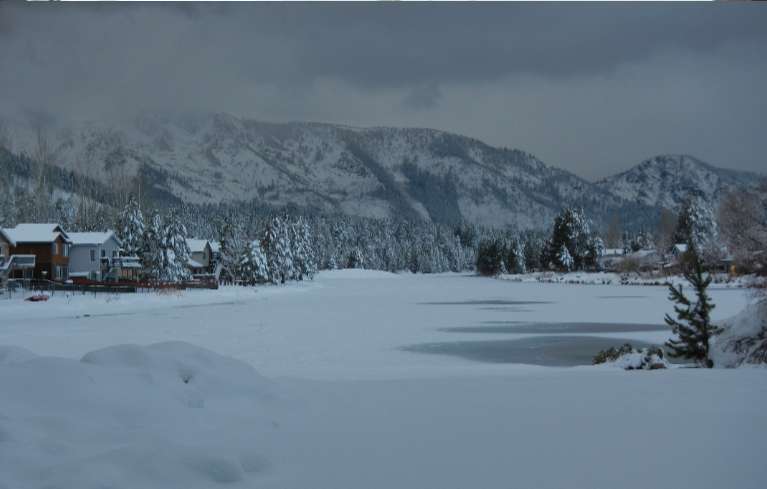
While it looks like winter in Lake Tahoe, California remains parched. Photo/Kathryn Reed

While it looks like winter in Lake Tahoe, California remains parched. Photo/Kathryn Reed

Private well owners could also be impacted as the groundwater is depleted.

South Tahoe Public Utility District is not worried, as its wells are between 200 and 600 feet deep. The district, the largest water company in the basin, is completely on well water. If need be, another well could be drilled. But doing so comes with a $2 million price tag.

District staff members will make a presentation to the City Council on March 18 about how the drought is affecting STPUD.

Water from Lake Tahoe flows into the Truckee River at the dam in Tahoe City and then it goes to Nevada. Nevada water users in the Reno-Sparks area are impacted by Tahoe’s water level.

The basin is in the Nevada watershed – not California. Because of this the drastic news out of Sacramento on Friday does not affect Tahoe directly.

But the residents of Tahoe will be affected because the drought severely impacts farmers. It means fewer crops will be planted and the price of food will go up. Fisheries are being hurt. The drought is affecting the environment as well as the economy, and it will get worse the longer it stays dry.

Simply put, for most of California the demand for water is greater than the supply.

It was announced Friday that entities that receive water from the State Water Project will get zero water. This is the first time that has happened in the 54-year history of the agency. SWP services 25 water agencies that supply water to 25 million people and approximately 750,000 acres of irrigated farmland.

This decision could be revised if it begins to snow and rain. For now, those agencies will have to rely on well water, local reservoirs and other supplies.

“We are two-thirds through the wet season. The state would have to experience heavy rainfall every other day through May to get back to normal. Even then we would face drought conditions,” Mark Cowin, Department of Water Resources director, said during the Jan. 31 press conference in Sacramento.

The decisions on Friday will affect municipal water users, farmers and fisheries. The goal is to share the pain and not point fingers.

Charlton Bonham, director of the state Department of Fish and Wildlife, said his agency has never been in this predicament.

“It is about making really hard decisions in a real time basis where we may have to accept some impact now to avoid a much greater impact tomorrow,” Bonham said.

There is concern the salmon run is threatened because they cannot get upstream to spawn. Delta smelt and other fish are also on people’s radar as water levels decrease.

Actions that have been taken:

• CDFW restricted fishing on some waterways due to low water flows worsened by the drought. More rivers and streams could be impacted in the coming weeks.

• Gov. Jerry Brown declared a drought state of emergency in January.

• CalFire hired 125 additional firefighters to help address the increased fire threat due to drought conditions.

• California Department of Public Health identified and offered assistance to communities at risk of severe drinking water shortages.

Tom Howard, executive director of the state Water Resources Control Board, signed an emergency order Friday to alter the flow of water from reservoirs. This is so some will be saved in storage if things continue to be dry or get worse.

Public health and safety will play a role in how much is released; so will the need to keep salt water from San Francisco Bay out of the Delta.

This is the third dry year for California. The last significant drought was in 1976-77. Reservoirs are lower today then they were then. And the snow survey on Thursday revealed a record low for water content at 12 percent. Lake Oroville, the principal State Water Project reservoir, is at 36 percent of capacity when normally it is at 55 percent this time of year. Shasta Lake, California’s and the federal Central Valley Project’s largest reservoir, is at 36 percent capacity when it should be at 54 percent.

“Today is a stark reminder that we all have to save every drop we can in our homes and places of work. Conservation is always important, but today it’s an absolute necessity,” Cowin said.

Brown has called on all Californians to voluntarily reduce water usage by 20 percent.

South Tahoe PUD does not expect to ration water this summer. Customers have already been on an odd-even watering schedule. What is likely to change is the district will enforce that policy.

“This summer we expect to up our efforts at water conservation,” Richard Solbrig, general manager of STPUD, told Lake Tahoe News. “If you look at the bigger picture, water conservation is the right thing to do. We should not be wasting water.”

Solbrig said the district is likely to make a more concerted effort to promote the turf buyback program, rebates for replacing old washing machines, education about taking shorter showers, running full dishwashers and turning off the spigot while brushing teeth.

He knows people will start irrigating sooner than usual if it does not rain or snow more this winter.

“If people are not water conscientious and careful, that demand peak will increase compared to the previous year,” Solbrig said.

This in turn means a greater depletion of the groundwater.

Solbrig said for his agency’s needs it doesn’t matter if it rains or snows — both fill the aquifer. But there is no substantive moisture in the forecast.


Lack of online records leaves parents in dark

By Katharine Mieszkowski, Center for Investigative Reporting

The infant boy had been left alone in a closet. He was strapped into a car seat, facing a wall on the second floor of a Milpitas day care.

A state inspector discovered the isolated boy when she visited in April and shut down the day care that Stephanie Newbrough had run out of her home for more than 18 years. Newbrough had been a respected member of the local community. Many parents who left children in her care lived nearby or learned about her day care through word of mouth.

But behind that neighborly image, the day care had a long history of breaking state rules, including a lack of supervision of children in its care. Parents like Denise Davis knew nothing of the problems. “It’s your worst nightmare,” she said.

Click for larger image Denise Davis, shown in her daughter’s bedroom in her San Jose, Calif., home, used to send her children to a day care in Stephanie Newbrough’s home in Milpitas. The day care was shut down last year after a long history of breaking state rules, including a lack of supervision of children. Davis says she would not have sent her children there if she had known about its record. Credit: Noah Berger/The Center for Investigative Reporting

Denise Davis, shown in her daughter’s bedroom in her San Jose, Calif., used to send her children to a day care that was shut down last year after a long history of breaking state rules.
Photo/Noah Berger/Center for Investigative Reporting

The violations were so severe that Newbrough ultimately lost her license and was banned for life from operating a day care in California.

California doesn’t make it easy for parents to find out what’s going on at the places that care for their children.

The state keeps a vast archive of inspection and complaint reports against nearly 48,000 state-licensed day care, preschool and after-school programs. But for the most part, these records remain stored away in obscure government offices, making access difficult for busy parents of the 1.1 million children who attend these programs.

The majority of states already make public reports available online. California has no plans to do so, despite years of pressure from state and now federal officials who want to give parents a complete picture of what the state knows about the care of their children.

Davis, who’d known Newbrough since she was a teen, said she would not have sent her three children to the day care if she had known about its record. She did not know the records existed, much less what they said about Newbrough’s day care when she sent her children there.

The Center of Investigative Reporting is trying to get electronic copies from the state under the California Public Records Act with the hopes of putting them online. The state Department of Social Services says it will cost more than $20,000 and take more than two years for CIR to get the public data.

Experts say the request should take minimal time and money because databases are designed to be able to export information easily.

“That’s just embarrassing. Do they really want to be known as the dumbest, most backward government agency in California?” said David Cuillier, an expert on public records who directs the University of Arizona’s School of Journalism. “Because if they cannot export data quickly, then they’ve got problems.”

Contrast California with other large states, like Texas.

Google “Texas child care,” and the first search result that comes up is the Texas Department of Family and Protective Services’ site for day care records. “Don’t be in the dark about child care!” the website warns. “Before entrusting your child to a day care, check its state record.”

In California, a top official at the Department of Social Services admitted the problem and called its technology “old and outdated.”

“We all expect that any information that we want to know, we just Google it, and we should be able to pull up everything,” said Pat Leary, chief deputy director. “And it’s frustrating for parents, I know, when they can’t just get easy access to information.”

Research shows that putting the reports online improves the quality of child care.

That’s one reason that the federal government is finalizing regulations that will require states to put records online in order to receive subsidies for low-income families.

California is the nation’s largest recipient from the U.S. Department of Health and Human Services’ Child Care and Development Fund, pulling in more than half a billion dollars a year. It’s the only one of the four largest states that doesn’t already make investigation and inspection information available on the Web.

The U.S. Health and Human Services Department considers the records an essential tool for parents choosing child care. “Limiting access to this information creates a burden for parents,” its proposed new rule says.

Ann Dryden Witte, an economist at the National Bureau of Economic Research, found in 2004 that providers’ quality of care for children of low-income families went up when the reports went online in Broward County, Florida. The mean assessment score of local providers went from 89 to 91, on par with education efforts to improve classroom environment or curriculum. Inspectors also were more productive, completing an average of 14 more inspections a year.

“As a result, they cleaned up their act,” Witte said.

In California, parents can contact child care resource and referral agencies to find out which child care providers are licensed. But these agencies don’t have access to the state’s inspection and complaint records. The agencies tell the parents they must get in touch with one of the state’s regional licensing offices.

Calling or visiting such a little-known office is too high a barrier for busy parents of young children, the state auditor concluded in a 2006 report. The offices are open only during typical work hours, and most parents who send their children to child care do so because they’re at work.

For more than seven years, the Department of Social Services has been pledging to get the records online. In 2006, the department assured the state auditor that it was working on it but warned that it needed money to do so. More than five years later, it told the auditor that it planned to use stimulus money to get the job done.

In 2012, the state auditor gave up on the department, saying it had no confidence the state would put the records online. The Department of Social Services ended up getting $1 million in education stimulus money, but it’s being spent on other things. Leary said that money didn’t cover the costs for the project. The department still doesn’t have a plan to get the records online.

For CIR’s request, the department estimates that extracting the data from its database would require more than 500 hours of staff time at a cost of $41 an hour, totaling at least $20,500. The agency also says it can devote only four hours per week to this project, so it would take more than two years to complete.

Experts say that estimate strains credulity. “If it takes someone working full time for 12 and a half weeks to export data, that is probably one of the worst government computer systems I’ve ever heard of,” Cuillier said.

In Milpitas, Davis and her husband abruptly pulled their children out of the Newbrough’s day care in 2010 when they learned from a worker at the day care that their infant daughter was put down for naps in her car seat, which may inhibit the child’s breathing. Newbrough subsequently sued the parents for breach of contract in small claims court and won.

The inspector who found the infant in the closet and shut down the facility also discovered that there weren’t enough caregivers providing supervision, a violation that Newbrough had received before. In years prior, inspectors cited the day care seven times for threatening the health, safety or rights of children, its most serious violation.

Newbrough, who didn’t respond to requests for comment, is no longer operating a day care. But that doesn’t mean she’s entirely out of the child care business in the state.

Newbrough still is listed as the president and founder of Prince and Princess Sitters on the company’s website. It is a baby-sitting and nanny placement agency in San Jose.



Nevadans making push to legalize marijuana

By Andrew Doughman, Las Vegas Sun

Marijuana advocates say they are crafting the necessary initiative language for Nevada voters to approve the use of pot for recreational purposes, perhaps by next year.

In their best scenario, enough Nevada voters — a minimum of about 102,000 — will sign petitions supporting legalization of marijuana, setting the stage for a vote in the state Legislature in 2015. If the measure fails to win the support of two-thirds of the lawmakers, the question would go to voters in 2016.

Touting the benefits of regulating and taxing what is now an underground industry in Nevada, advocates say they’re confident they’ll have the money and votes required to pass an initiative similar to the one that Colorado voters approved in 2012.

Read the whole story


Homewood dispute settled; project to start in 2015

By Dale Kasler, Sacramento Bee

Developers and environmentalists said Thursday they have settled a lawsuit that blocked a major redevelopment of Homewood Mountain Resort.

The settlement means the project, which will cost $400 million to $500 million, will break ground in spring 2015, said Art Chapman of JMA Ventures, the owner of Homewood.

The settlement came a year after a federal judge in Sacramento halted the Homewood project from going forward, saying the environmental impact statement needed revision. Under the settlement, the project will be scaled back somewhat. Under the settlement, JMA agreed to put certain parcels of land off-limits to development and cancel 13 of the housing units.

While the project was approved by Placer County officials and the Tahoe Regional Planning Agency, it was hit with a lawsuit by the Sierra Club and Friends of the West Shore. U.S District Judge William Shubb halted the project last January, saying there were environmental deficiencies.

Read the whole story


Snowstorm makes ski resorts happy, but water content in Sierra at 12% of normal

A layer of fresh snow cannot disguise the fact that the snowpack is in dismal shape.

The second snow survey of the season on Jan. 30 revealed the snowpack water content statewide is at 12 percent of normal. This sets a record.

A Caltrans plow maneuvers Jan. 30 around stalled cars on Echo Summit. Photos/Kathryn Reed

A Caltrans plow maneuvers Jan. 30 around stalled cars on Echo Summit. Photos/Kathryn Reed

Prior to Thursday, the lowest snowpack water content readings for this time of year were 21 percent of average in 1991 and 1963, 22 percent in 1976, 25 percent in 1977 and 35 percent in 2012. Recordkeeping started in 1960.

At the Echo Summit reading near the entrance of Sierra-at-Tahoe the measurements were even worse. The water content is 7 percent of normal, with 12.4 inches of snow containing 1.4 inches of water.

“This winter remains dry, making it very unlikely our record drought will be broken this year,” Mark Cowin, Department of Water Resources director, said in a press release. “Now more than ever, we all need to save every drop we can in our homes and places of work.”

While water officials found nothing to celebrate on Thursday, ski resorts were thrilled. With the initial white stuff being heavy and wet, it will make for a good base. What has fallen since the predawn snowfall has been lighter – giving skiers something to be joyful about.

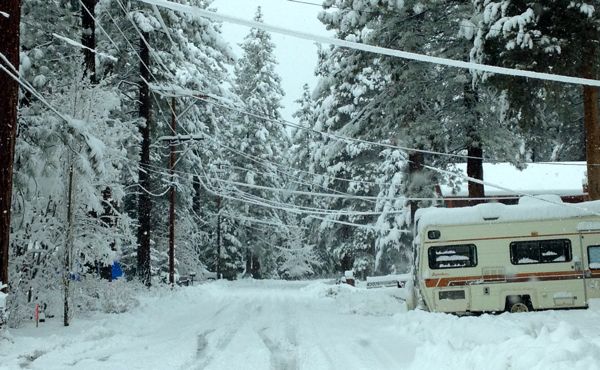
Power and cable lines are sagging in South Lake Tahoe.

Power and cable lines are sagging in South Lake Tahoe.

The conditions, though, are ripe for avalanches to occur. The Sierra Avalanche Center issued a “high” level threat. This comes after weeks of it being at “low”.

Some ski resorts were waiting for the snow to settle before allowing riders everywhere.

Roads have been a mess. Late-morning spin outs on Echo Summit had the road closed temporarily. The commute into Carson City felt like driving over a washboard.

Power lines are sagging from the weight of the wet snow, but Liberty Utilities is reporting no problems as of 1pm.

Some tree limbs have also fallen because of the added weight.

— Lake Tahoe News staff report


Nev. lawmakers reluctant to define gifts

By Andrew Doughman, Las Vegas Sun

Several state legislators took a jaunt to Israel last year, touring the Holy Land and dining beside the Sea of Galilee.

The largest Israeli lobbying group in the United States bankrolled the all-expenses trip, but when it came time this month for elected officials to report gifts they received in 2013, there was no reference to the trip.

The traveling lawmakers were only some of the elected officials in Nevada who accepted gifts sometimes worth thousands of dollars but declined to report them as required by state law.

Some of them dispute whether they legally need to report these gifts — in part because there is no explicit definition of a “gift” in state law.

Read the whole story


South Shore businesses seek tools for success

By Kathryn Reed

A brainstorming session of more than 70 business owners and employees on Tuesday uncovered a wealth of topics designed to make the South Shore more successful.

At the annual Lake Tahoe South Shore Chamber of Commerce breakfast Jan. 28 much of the focus was on tapping into what the people in the room want for the coming year.

The chamber plans to host three industry lunches in 2014, with the first being in April. It will focus on health and wellness services that complement traditional medicine. The other two lunch topics may come from ideas generated this week.

B Gorman, CEO of Lake Tahoe South Shore Chamber of Commerce, talks Jan. 28 about plans for this year. Photo/Provided

B Gorman, CEO of Lake Tahoe South Shore Chamber of Commerce, talks Jan. 28 about plans for this year. Photo/Provided

Chamber officials were also looking for ideas for Tech Tuesdays, a segment the business group introduced last year.

While the events are geared toward chamber members, most are open to non-members at a higher price.

Businesses want to know how to manage their information off-site, how to recover after a disaster, more about Excel, search engine optimization, constant social media updates, and the basics of databases.

They also want more in-depth sessions on recreation, events, how to retain good employees in the shoulder season, how to increase their business’ value, low-income housing, nonprofits, how to engage other businesses in an event, aging infrastructure, federal health care regulations, how businesses can adapt to climate change, and soft skills.

The various tables were also asked to talk among themselves about challenges they overcame in 2013 and successful best management practices.

Paula Lambdin, who works for Golden Sierra, complimented Brent Truax of the Landing Resort Hotel on how well his employees are trained. They noticed her government license plate and were very attentive.

“At some properties I don’t get the time of day,” Lambdin told her tablemates.

Truax said his philosophy is to hire personalities as much as it is to hire people with experience.

Eric Swartz with Peak 1 Group brought up the importance of managing online reviews and that positive and negative comments deserve a response.

Truax’s rule is to respond to 80 percent of the negative comments and 20 percent of the positive.

Barb Tenney at Après Wine Co. uses comments as a teaching moment with employees. The positive ones get forwarded to everyone, while a one-on-one talk occurs with the person who is the subject of a less flattering review.

B Gorman, who runs the chamber, said new this year would be political endorsements. The group is starting with the California side. There is a South Lake Tahoe City Council race, El Dorado County Board of Supervisors, Lake Tahoe Unified, Lake Tahoe Community College, South Tahoe Public Utility District, potential local initiatives, possible tax issues and other county positions on the ballot.

As with past years, a group will make excursions to Sacramento and Carson City to lobby lawmakers.

The chamber is also planning a trip to Park City April 2-5. Promotional material says, “During our visit to Park City, we will be looking at innovative ideas and strategies in the areas of transportation, walkable main streets, mixed use redevelopment as well as affordable living and performing arts.”


Plenty of tickets available for Sochi Games

By Mason Levinson, Bloomberg

Sochi may attract the fewest American visitors to a Winter Olympics in 20 years amid terrorism concerns, a lack of luxury hotel rooms and difficulties procuring visas, according to U.S. tour operators.

Russia’s plan to spend $50 billion on hotels and other infrastructure to convert a small city on the Black Sea into a year-round resort hasn’t resulted in enough high-end hotels, and the existing facilities have raised prices by 121 percent for the event, according to trivago.co.uk, a U.K. website.

Russia’s Olympic organizing committee said that 30 percent of tickets remained unsold three weeks before the Feb. 7 opening ceremony. The Vancouver Games in 2010 wound up selling 97 percent of its seats. With few international flights directly into the Sochi airport, and most Westerners requiring visas, a last-minute rush is unlikely, tour operators say.

Sochi has planned to sell 1.1 million tickets, according to an International Olympic Committee marketing document, meaning about 330,000 remained available as of the latest update from the organizing committee.

Read the whole story