Slow start to ski season impacts visitor numbers

By Danny King, Travel Weekly

Drought conditions in the Western U.S. are chipping away at North American ski-resort demand that had shown initial gains from the combination of a resurgent economy and early-season storms.

Despite the fact that some Colorado resorts late last month received their largest single- and two-day snowfall amounts in more than a decade, well-below-average snowfall at Lake Tahoe and Mammoth Mountain threaten to pull overall numbers down as prospective skiers shift their sights to warmer-weather destinations.

With lift-ticket sales down by as much as a third from last year because of dry conditions, it will be “virtually impossible” for North American resorts to meet the 2012-13 season total of almost 57 million skier days this season, said Ralf Garrison, director of DestiMetrics (formerly MTRiP).

Moreover, 2013-14 activity will be far below the record 61 million North American skier days in 2010-11, when many resorts received record snowfall.

Through Jan. 5, Vail Resorts’ lift-ticket revenue from its eight mountains rose 3.9 percent from a year earlier, as a 7.4 percent increase in Colorado and Utah ski visits more than offset the effect of a 23 percent plunge in visits to its three Lake Tahoe resorts.

Read the whole story


Could water supply be found under the ocean?

By Andrew Alden, KQED-TV

Underground boundaries between land and sea aren’t as stark as they are to us as we stand on the beach. Water knows this. Groundwater everywhere responds slowly to changes above, even geological changes. In most of the Earth’s crust, water moves around a meter per year. This enormous contrast between surface water and groundwater may be the big fact that hydrologists appreciate more than the rest of us, even geologists, who know a lot about slow things.

Seawater moving inland is a well-known problem for coastal cities. It arises when groundwater is pumped out faster than it can be replenished, and saltwater moves into the space. In the city of Fremont, the Alameda County Water District successfully manages saltwater intrusion in its major water source, the Niles Cone, by effectively building a wall of freshwater along the outer rim of the cone.

The opposite situation, freshwater intrusion, can occur offshore. Fresh groundwater lying above sea level on land would have the pressure needed to push aside the denser, salty water of the ocean once it reached that level. And scientists have known for a long time about freshwater springs that occur offshore. In the 1970s, U.S. government geologists learned that fresh water may underlie the seafloor for a surprising distance offshore, up to 100 kilometers in places.

Read the whole story


SLT council can’t decide how to allocate surplus

Jim Marino with the South Lake Tahoe Public Works Department goes over the dilapidated conditions of city infrastructure at the Feb. 10 workshop. Photo/Kathryn Reed

Jim Marino with the South Lake Tahoe Public Works Department goes over the dilapidated conditions of city infrastructure at the Feb. 10 workshop. Photos/Kathryn Reed

By Kathryn Reed

A workshop Monday was designed for the South Lake Tahoe City Council to figure out how to allocate any surpluses so policy is in place before the money is in hand and it doesn’t get wasted. The council fell short of that goal.

City Manager Nancy Kerry said part of the goal was “to be more strategic” so the council, and therefore staff, would have a policy to follow instead of being reactive.

While some council members talked about divvying up the money by percentages, no consensus was found to create such a policy. Although hotel tax dollars are not as robust in January and February because of the lack of snow, there is still the possibility that at the March mid-year budget session a half million dollars will need to be allocated.

Instead, the council adopted a community investment policy that says, “We will focus on the built environment based on critical need and prioritize investment in geographic locations that strive to achieve the greatest return on investment.”

A line item will be added to the budget for the community investment. But there was no true definition of the investment.

South Lake Tahoe has plenty of things it needs to spend money on, but the money to do so is lacking. However, revenues are on the upswing, so such a policy is needed so the money is not frittered away.

Only two members of the public attended the 2½-hour meeting. Neither spoke.

While these five electeds heard a presentation from public works about the need for roads, facilities and fleet investments, any council could redefine community investment. Even these five, while sympathetic to the needs, did not commit to their being the focus of any new money.

The South Lake Tahoe City Council members, from left, Tom Davis, JoAnn Conner, Angela Swanson, Hal Cole and Brooke Laine, are unable to decide how to deal with potential surpluses.

The South Lake Tahoe City Council members, from left, Tom Davis, JoAnn Conner, Angela Swanson, Hal Cole and Brooke Laine, are unable to decide Feb. 10 how to deal with potential budget  surpluses.

Jim Marino, No. 2 guy at public works, said if the 256 lane miles of city roads had been maintained properly, the weather the past few days would not have created the number of potholes that it has.

He told the council more than 47 percent of the roads in the city have about five years of life left to them. It would cost $119,522,327 to replace current roads. The deferred maintenance backlog is at more than $26 million. If no more money is put toward roads, the deferred maintenance bill grows by $3 million annually.

To fix the roads, replace aging vehicles and bring facilities into the 21st century, the city would need to spend about $300 million, Marino said.

While the city has seen $80.5 million worth of capital improvements this century, 71 percent of those dollars came from state or federal sources.

“Those are new facilities we need to maintain,” Marino pointed out. But the maintenance fund has not increased. That is why the deferred maintenance bill keeps increasing.

There was agreement that recreation should be its own category when it comes to “extra” investing.

The other thing the council agreed to on Feb. 10 was for an analysis of the reserve policy to be conducted.

Consultant Mike Levison, who has a history of helping the city with strategic planning, said most cities have a reserve of about 18 percent. South Lake Tahoe, more than 10 years ago, set the policy to have a 25 percent reserve. This was after not having any extra in the kitty.

Excess reserves – money beyond the 25 percent – have been used in the lean years of late. But the 25 percent has not been tapped. To alter the 25 percent rule would take four out the five council members.

In other action:

• There was talk of Tahoe Olympians. Sierra-at-Tahoe is taking the lead in figuring out how best to celebrate the accomplishments of its three Olympians – Jamie Anderson, Hannah Teter and Maddie Bowman. All are residents of Meyers. South Lake Tahoe and Lake Tahoe Visitors Authority have offered to help. What the community event will be has not been determined. Sierra is not allowed to advertise anything involving its athletes until the Games are over.

• El Dorado County Elections Department has ruled that if the council at its regular meeting Feb. 18 decides to put a paid parking question to voters, that it can be on the June ballot.



Snowmobilers, Heavenly, T-D Fire challenge USFS

By Barbara Barte Osborn, Sacramento Bee

The U.S. Forest Service’s refusal to revise existing restrictions on snowmobile use in the Lake Tahoe Basin is one of a dozen objections filed by groups and individuals against the agency’s proposed updated land-management plan.

The objection charges that the current 25-year-old restrictions do not address the effects of additional snowmobile outfitters, permitted by the Forest Service, whose machines allegedly endanger cross-country skiers and snowshoers on popular trails and cause noise, air and water pollution.

The Tahoe Douglas Fire Protection District says the plan’s fire suppression tactics in roadless areas near homes, rather than leaving continuous fuels in place, should have community safety as a primary objective. And Heavenly Mountain Resort officials ask that the plan be revised to clarify a 200-acre limitation on development, lest it encourage a development race between resorts.

Read the whole story


Mancuso earns bronze in super combined

United States skier Julia Mancuso celebrates as she finishes the slalom portion of the women's super-combined to win the bronze medal at the Sochi Games on Monday in Krasnaya Polyana, Russia. (Luca Bruno, The Associated Press)

Julia Mancuso of Squaw Valley celebrates as she finishes the slalom portion of the women’s super-combined to win the bronze medal Feb. 10. Photo/Luca Bruno/AP

By AP

American Julia Mancuso won a bronze medal in the super combined Monday in Sochi, securing her status as a prime time performer on the slopes.

It was Mancuso’s fourth career Olympic medal for Team USA. No other American woman has won more than two.

The 29-year-old from Squaw Valley soared to the top of the leaderboard in the downhill portion of the two-part event, finishing the challenging course in 1 minute 42.68 seconds. She notched the bronze medal after the slalom.

Germany’s Maria Hoefl-Riesch won her second straight gold in the event. Hoefl-Riesch was fifth fastest in the downhill, but her superior slalom skills gave her the super-combined title.

The German’s two-run time of 2 minutes, 34.62 seconds was 0.40 seconds faster than silver medalist Nicole Hosp of Austria.

Mancuso, 0.53 behind Hoefl-Riesch, punched the air with her right first after the race.

At the 2010 Vancouver Olympics, Hoefl-Riesch won the super-combined and Mancuso took silver.

Hoefl-Riesch stood in the snow at the finish area to watch Mancuso’s run and let her skis fall to the ground after seeing her rival’s time flash up on the giant screen.

She turned to face fans in the grandstand, placed her hands to her head then kneeled on the snow.

The 29-year-old German matched Janica Kostelic in winning two straight combined titles. The Croatian great won gold in the traditional version, which includes two slalom runs, in 2002 and 2006.

Mancuso’s Olympic tally includes two medals in super-combined, a gold in giant slalom from the 2006 Turin Olympics and silver in downhill in Vancouver.

Mancuso raised her level on the biggest stage again in the first of five women’s events despite having a best result of only seventh on this season’s World Cup circuit.

An event which tests racers’ all-around ability to be fast and technically correct proved to be challenging, especially on a steep slalom track lit by floodlights on a cloudy afternoon.

Four of the 10 fastest downhill racers failed to get down the slalom, including Lara Gut of Switzerland, who had been second behind Mancuso.

One pre-race favorite for a medal, Marie-Michele Gagnon of Canada, fell in the slalom and appeared to injure her left wrist.

Gagnon trailed badly in the morning downhill, then straddled a slalom gate and crashed forward on the snow.


Doctor: High cholesterol not a reason to panic

By Kathryn Reed

Diet, exercise and body weight are critical factors when it comes to dealing with cholesterol.

David Young, a doctor with Barton cardiology, outlined the steps people can take to prevent getting high cholesterol as well as what to do when the numbers are above a good range.

“It is one of the most indolent diseases we have. It can start as a teenager and not manifest until five decades later,” Young told the more than 60 people gathered at Lake Tahoe Community College on Feb. 5.

Dr. David Young talks Feb. 5 about cholesterol. Photo/LTN

Dr. David Young talks Feb. 5 about cholesterol. Photo/LTN

While fat is needed, there are various types of fats. Trans fats are the ones to avoid. As Young said, they are “inflammatory to the body” and should be avoided at all costs.

Too much cholesterol leads to narrowing of the arteries, and in turn heart attacks and strokes may be triggered. A plaque rupture can also occur. This is when cholesterol material spills into the bloodstream.

“It causes an acute heart attack and chopper trip to Reno,” Young said.

A blood test is how people find out if their cholesterol is normal or high. The HDL is what’s considered the good cholesterol. LDL is the bad cholesterol.

Results with less than ideal numbers are not something to panic about, Young said. Most of the time a change in diet and an increase in aerobic exercise can lower the numbers. Losing weight and stopping smoking are other ways to improve ones cholesterol.

Cholesterol issues are also hereditary. Thyroid and kidney issues can also impact cholesterol, as well as certain medications.

When it comes to medication statins is often the route Young chooses. He said there is a lot of misinformation about these types of drugs and often he has to battle with patients to convince them to take them.

“Statin is a drug that inhibits cholesterol in the body and acts in the liver,” Young said. “There are many different types of statins. Not all are equal. All have their own intensities.”

One that is often advertised on television is Lipitor. It’s considered a high intensity statin.

A criticism of statins is that they increase the chances of getting diabetes. Young said there is about a 1.09 percent chance of that occurring. What isn’t known is how statins and diabetes are linked.

“Some say it’s unmasking those who are predisposed to diabetes,” Young said.

A complaint of statin users is muscle pain. Young said between 2 and 11 percent of his patients on statins suffer from muscle aches.

The American Heart Association has an online cardiovascular risk calculator.

“If you get 10 percent or above, that is when you have a conversation with your doctor about should I be on statins,” Young said. “Everything we do in medicine has risk and benefits. Keep the end goal in mind.”

—-

Notes:

• David Young will speak on the same topic Feb. 12 from 6-7pm at Sierra Nevada College, Tahoe Center for Environmental Sciences, Room 139, Incline Village. The lecture put on by Barton Health is free.


Middle class continues to erode in U.S.

By Nelson D Schwartz, New York Times

In Manhattan, the upscale clothing retailer Barneys will replace the bankrupt discounter Loehmann’s, whose Chelsea store closes in a few weeks. Across the country, Olive Garden and Red Lobster restaurants are struggling, while fine-dining chains like Capital Grille are thriving. And at General Electric, the increase in demand for high-end dishwashers and refrigerators dwarfs sales growth of mass-market models.

As politicians and pundits in Washington continue to spar over whether economic inequality is in fact deepening, in corporate America there really is no debate at all. The post-recession reality is that the customer base for businesses that appeal to the middle class is shrinking as the top tier pulls even further away.

If there is any doubt, the speed at which companies are adapting to the new consumer landscape serves as very convincing evidence. Within top consulting firms and among Wall Street analysts, the shift is being described with a frankness more often associated with left-wing academics than business experts.

Read the whole story


Anderson earns first gold medal for Tahoe

Jamie Anderson claims gold Feb. 9 in slopestyle at the Olympics. Photo/Andy Wong/AP

Jamie Anderson, who rides for Sierra-at-Tahoe, claims gold Feb. 9 in slopestyle at the Olympics. Photo/Andy Wong/AP

By Alyssa Roenigk, ESPN

KRASNAYA POLYANA, Russia — Jamie Anderson of Meyers stood atop the podium and lifted her arms in triumph, her long and sometimes draining quest for Olympic glory finally complete.

Anderson gave the United States a gold-medal sweep in the first Olympic slopestyle snowboarding competition on Sunday, while Jenny Jones took bronze to win Britain’s first medal in any snow sport.

Anderson soared to victory in a near flawless run in the women’s final on Sunday, a day after Sage Kotsenburg captured the men’s gold medal. The 23-year-old did it, as is her fashion, when the moment absolutely required it.

Down to one last trip through the treacherous Rosa Khutor Extreme Park course, Anderson took a deep breath, enjoyed a brief moment of “Zen” and showcased the skills that have made her the greatest slopestyle snowboarder of her generation.

Karly Shorr of Truckee finished sixth.

Read the whole story


Trails lead everywhere except to destination

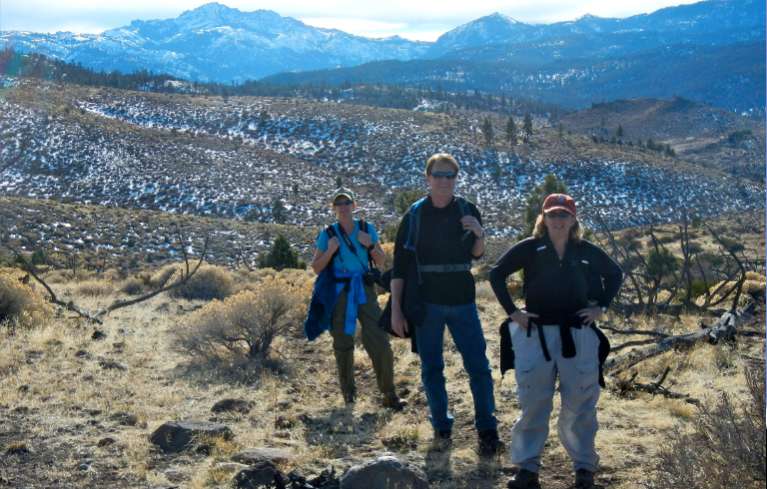
Pam Valentine, from left, Tom Ward and Sue Wood are having a hard time finding natural hot springs. Photos/Kathryn Reed

Pam Valentine, from left, Tom Ward and Sue Wood are having a hard time finding natural hot springs. Photos/Kathryn Reed

By Kathryn Reed

MARKLEEVILLE – Mystery hot springs between Markleeville and Gardnerville are still just that – a mystery.

I know they exist. I’ve seen pictures. I’ve heard stories. I’ve talked to someone who has been in the springs. I even had directions. But the four of us never found them.

I had been told about the springs from Linda who I volunteer with at Bread & Broth. These are part of the directions she gave me: “… continue for a couple of blocks along the fence, but you will eventually have to go cross country up to the ridge where you will find a trail. Follow it and it will eventually go downhill toward the river, which you’ll be able to see from the top. Two nice hot pools at the bottom of the road right on the river.”

The landscape, even at 5,500 feet, is much different than Tahoe.

The terrain, even at 5,500 feet, is much different than the Lake Tahoe Basin.

We hit many ridges. We saw three women on one who asked us if we knew where the hot springs were. This encouraged us. We might be in the right area – or we were all lost.

We never saw the trio again despite eventually heading in their direction.

Others have said getting to the springs from the Leviathan Mine side would be an option. Maybe we’ll try another day. Or maybe we’ll just hike along the river and skip the whole ridgetop thing. Someone else suggested a rafting trip would be a way to find the springs.

What we did find on the last Sunday of January was new territory to explore. While the trails are now covered in snow, on this particular day we were able to wear hiking boots to tromp through the sagebrush and chaparral for what was about a 5.5-mile hike.

I don’t know how distinct the trails are for snowshoeing.

There are no trail markers or signs to know where you are or where you are going. That’s why it is important to pay attention to your surroundings so you’ll be able to find your vehicle at the end of the day.

Trails are single-track and may see more cow traffic than human beings based on the amount of dung in the dirt.

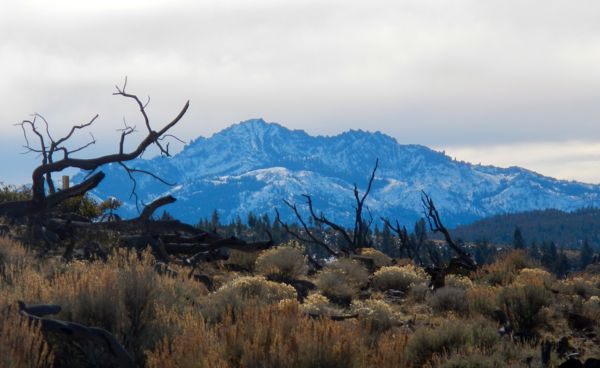
Snow covered mountains in the distance.

Snow covered mountains in the distance.

Sweeping views are visible from various high points. The contrast was stunning. At times the ruggedness of the Sierra penetrated the sky, while other times the parched Carson Valley unfolded below us.

It was an interesting trek to an area none of us had explored before. With its being lower in elevation than the Lake Tahoe Basin, the terrain was completely different. I could see how during summer this would be an unbearably hot place to hike because there would be little or no shade. Even two weeks ago Pam and I were in short-sleeves for part of the hike.

——–

Getting there:

From South Lake Tahoe go west on Highway 50. Turn left onto Highway 89 toward Hope Valley. At Picketts Junction, go left onto Highway 88. Turn right onto Highway 89 toward Markleeville. Turn left onto Diamond Valley Road. Cross the river and park on the left. Cross the road and enter through the cattle gate. Start exploring. (There are cattle gates on both sides of the road, but we only explored in one direction.)


Fishing ban expanded in California

By Aaron Kinney, Bay Area News Group

SACRAMENTO — Taking an even more aggressive approach to protecting drought-stricken fish, state wildlife officials on Wednesday tightened already unprecedented restrictions on recreational fishing in Northern California.

The California Fish and Game Commission voted unanimously to extend shutdowns along the northern coast until the spring to safeguard threatened steelhead and endangered coho salmon. The commission also expanded the prohibition to include most of the Russian River in the North Bay and key spawning habitat in the American River east of Sacramento.

Charlton Bonham, director of the state Department of Fish and Wildlife, acknowledged the bans will be difficult for anglers and rural towns whose livelihoods depend on steelhead fishing during the winter. But, he added, the fishing community is overwhelmingly supportive of the state’s intervention.

Read the whole story