Hikers give USFS static over radio plan for Jobs Peak

By Benjamin Spillman, Reno Gazette-Journal

A proposal by the Humboldt-Toiyabe National Forest to install a new radio repeater has raised the ire of hikers who say it would be a blight on an iconic Nevada peak.

The proposal calls for a 20-foot tower on a five-foot-high metal building on top of Job’s Peak, a 10,633-foot-tall peak located eight miles southwest of Minden.

The solar-powered repeater would improve reliability of radio communications for Forest Service workers in the Carson Range, which towers over Carson Valley to the northeast and Lake Tahoe to the northwest.

Read the whole story


Affordable housing — lots of talk, little action

By Kathryn Reed

An annual salary of $80,000 is what is required to rent a two-bedroom apartment in the Lake Tahoe Basin. Kings Beach and South Lake Tahoe were called the two poverty pockets in the basin.

These dire circumstances were illustrated by Heidi Hill Drum of the Tahoe Prosperity Center.

“At least 30 percent of the community is living at 150 percent of the federal poverty line. That is $36,000 a year for a family of four,” Drum said at this week’s TRPA meeting.

She gave a presentation Jan. 23 to the South Lake Tahoe City Council and then on Jan. 24 to the Tahoe Regional Planning Agency Governing Board. Joining her in Kings Beach at the TRPA meeting were representatives of the Mountain Housing Council based on the North Shore.

“We don’t want people living in motels or in trailers held together with duct tape,” Drum told the TRPA.

The nonprofit she heads up plans to create a demonstration affordable housing project. But like so much in the basin, the wheels of progress move slowly. While the plan is to turn a South Lake Tahoe hotel into affordable housing, no hotel has been selected, no developer is on board, no money has been secured to pay for it, there is no plan to decide who would get to live there, let alone there being an opening day.

“We’re just starting, so all these questions are to be answered during the first year of the process. We want it to be a very high-profile, public process,” Drum told Lake Tahoe News.

While there have been endless studies, a litany of meetings and multiple task forces put together, little has been done to solve the issue. (Lake Tahoe News ran an entire series on the topic in 2017.)

The lack of affordable housing is not an issue that is unique to the Lake Tahoe Basin, but there are constraints here other locales don’t have.

Tahoe has limited land to build on. It also has some of the most restrictive development requirements in the country, along with high permit fees. This in part is where TRPA might play a role in affordable housing. It could be through development rights or bonus units.

“We need to look at our own policy and development rights to make sure we are not a hindrance or at least we’re not the reason projects are not going forward,” TRPA board Chairman Jim Lawrence said.

California voters will be presented with an affordable housing bond in November. Thirteen counties will also have housing bonds on the ballot.

The day before the TRPA meeting the Nevada Legislature’s interim affordable housing committee met for the first time this year.

The Las Vegas Review-Journal reported, “U.S. Census Bureau data from 2016 shows nearly half of all renters in Nevada are cost burdened, meaning they spend more than 30 percent of their income on utilities and rent or mortgage. And recent reform of the federal tax code has devalued tax credits that incentivize private investors to help build apartments for low-income families.”

Austin Sass, who is South Lake Tahoe’s rep on the TRPA board, said, “We literally need close to 1,000 units to satisfy the hourly workers in this community. That sounds like projects or a big apartment. Given the density requirements, I’m not sure where we go. At the end of the day it doesn’t seem like there is a solution to put a dent in the housing problem.”

Affordable housing advocates have an eye toward Colorado, which is considered a leader in this arena. Ski resorts there have started to put tiny houses on campgrounds for employees.

Of the four members of the public who spoke to this issue at Wednesday’s TRPA meeting, one from Tahoe City said affordable housing has been a problem since the 1970s. He added that he’s trying to put a project together, but the “process is cumbersome.” Someone else said it’s time the ski resorts are held more accountable.

With the Lake Tahoe-Truckee area being a tourist destination, the problem is exacerbated with people wanting a second home here that stays vacant much of the year or is rented out to tourists – not locals.

In the Truckee-North Shore area, it was stated that 50 percent of the single family residents sit vacant 68 percent of time.

But this isn’t new. Twenty years ago it was reported that 70 percent of the homes in South Lake Tahoe were not occupied by full-time residents.

Never part of the affordable housing discussion is wages or whether employees should expect to live and work in the same town.


Calif. putting Sierra Nevada trees to work

By Julie Cart, CalMatters

This is going to be a big year for one of the state’s smallest agencies.

As California redoubles its efforts to reduce greenhouse gases, officials are rooting around for new ways to meet the state’s goals. Included in their plan: recruiting billions of redwood, oak and pine trees to help diminish planet-warming gases by pulling carbon dioxide from the atmosphere.

It’s a major pivot, from regulating harmful emissions solely from factories and cars to calling on nature to pitch in. Officials say 2018 is the moment for the state to harness, and fully measure, the role forests can play in addressing the pressing problems of wildfires and the dangerous releases of carbon that occur when millions of forested acres burn. Both issues are accelerating in alarming, parallel lines.

A good bit of the work will fall to the Sierra Nevada Conservancy, one of 10 conservancies within the state’s Natural Resources Agency.

The group—two dozen multitasking scientists, biologists and planners in a nondescript office park in Auburn, an old gold-rush town in the Sierra foothills—was born in 2004 with a mandate nearly as vast as the region. Like the state’s iconic coastline, the Sierra Nevada mountains are a defining feature of California, rising sharply to dizzying elevations, topping out at Mount Whitney’s 14,500 feet, the highest peak in the lower 48 states.

The range, tracing the spine of the state across 22 counties from the Oregon border to deep inside the Mojave Desert south of Bakersfield, holds most of California’s forested land and is the source of 60 percent of the state’s drinking water.

The conservancy is charged with restoring the Sierra’s environmental and economic health, on a modest $4.5 million annual operating budget derived entirely from the environmental license-plate fund. The bulk of its work, such as facilitating research and making grants for forest and watershed restoration projects, is paid for with state bond money.

The group has no bulldozers or chain saws; it’s largely a clearinghouse and planning entity. But its casual work space lacks the stuffiness of Capitol offices: jeans and hiking boots substitute for Sacramento’s skinny suits and wing-tip shoes. Even with an already full to-do list, executive director Jim Branham says, the organization is ready to take on an expanded role policing carbon in the region’s forests.

“There is a sense of urgency,” Branham said.

The Sierra forests are overgrown and susceptible to both fire and pests, Branham noted. Last year was the most destructive fire year on record, and the state and national forests within California’s boundaries are strewn with 129 million dead trees, felled by flames, disease and insects. Years of drought, disease and dead wood fed the infernos. The extent of forest loss could not have been foreseen, Branham said.

“Some of the best scientists in the world have looked at this and didn’t come close to predicting what happened,” he said. “Our worst fears were nowhere near what actually happened. It’s been far worse.”

It’s the conservancy’s unique job to fashion a response appealing to a mosaic of land owners—including the federal government, whose land is included in the conservancy’s brief. The federal component alone is a contentious issue for some of the three-quarter-million Sierra residents.

The sprawling Sierra, its deep forests studded with icy blue lakes, is not just a geological divide but also a political one. Towns tucked into these foothills and mountains are often deeply conservative and proudly self-sufficient.

Some residents are of the opinion that government—Sacramento and Washington alike—is already too present in their lives and businesses. The California Farm Bureau was on record opposing the establishment of the conservancy. When the Legislature created it, some locals looked askance at what they anticipated would be yet another bureaucratic agency bossing them around.

Doug Teeter was among those residents. Teeter, who is on the Butte County Board of Supervisors, said increasing limits on the use of off-road vehicles and other recreation on federal lands had caused him to harbor anti-government views. When it became his turn to sit on the conservancy’s 16-member board, he was skeptical.

“I was hesitant,” he said, fearing the influence of outside environmentalists would impose their will on the region.

But while the agency often conceives of and oversees projects, it does not have the staff to undertake them, instead funding local, state or federal agencies and groups. When it became clear that the conservancy’s focus was clearing out forests and shoring up watersheds, Teeter was won over. The agency has doled out $60 million in grants since its inception, rather than hand down edicts, and that has gone a long way to win over locals, he said.

“My community has been a big recipient of SNC grants,” Teeter said. Grants to Butte County have gone to restoration of natural streams, the thinning of forests for fire safety and a wastewater project in the town of Paradise, near Chico. “I see the on-the-ground effort that the conservancy has made in our community. Money talks, and people listen when they want that money.”

The Sierra had a once-booming economy as the center of the gold rush and timber cutting, but those industries are in the rearview mirror. Today, people are hurting. Branham, who has been running the conservancy since its inception and is sensitive to local sentiment, found a way to marry the needs of the forest to the economy. He made a strategic decision to achieve results by bringing together groups historically indisposed to sitting at the same table: county officials, timber companies, environmental groups and federal land managers.

Lacking the regulatory teeth to force landowners or counties to act, the conservancy took a soft-power approach, acting as a broker to champion projects that either employed local businesses or boosted the region’s economy through forest clearing or watershed projects.

Restoring forests is “a tremendous economic driver” Branham said. “That’s the other part of our mission. It puts people to work and produces material from, the forest. It was a pretty nice fit to say this ecological restoration initiative across the region serves to make the environment healthier, but it can also serve to make the economy work better.”

The scope of the conservancy’s mission narrowed after the devastating 2013 Rim Fire, which raged for more than a year, burning a quarter-million acres of forest in the central Sierra. That fire made it clear the conservancy could not mend every broken place in its portfolio.

Since then, Branham said, the agency’s work has focused more on forest thinning to minimize fire threats and sustain healthier trees, which stabilize slopes that store valuable water underground. That work clearly dovetails with the state’s interest in using forests to capture carbon emissions and finding ways to reduce the significant carbon release that accompanies massive wildfires.

The conservancy has recently partnered with CalFire, the state firefighting agency, which is turning over $5 million in proceeds from the state’s cap-and-trade system for reducing harmful emissions. The money will pay for forest and watershed restoration around Lake Tahoe that is expected to create multiple benefits: Clearing crowded forests allows more healthy trees to grow, take in and store carbon in the ground and stabilize soils that hold water.

“I applaud the Sierra Nevada Conservancy’s work to increase the amount of carbon captured by our forests,” said state Sen. Bob Wieckowski, a Democrat from Fremont who chairs the Senate Environmental Quality Committee. “The more we can rely on our green infrastructure and let nature help us to mitigate climate change…, the better off we will be.”

But even the most generous of grants, welcome as they are, don’t go a long way across a vast landscape. A $25 million grant from a state water bond was greeted with excitement but tempered by the enormity of the Sierra itself.

“We thought, ‘Awesome, that’s, uh, … one … dollar …. per… acre,’“ said Brittany Covich, the agency’s outreach manager.

More money and political will may be available this year, from more cap-and-trade revenue and funding directed by the state Air Resources Board to manage greenhouse gases. Projects those funds could pay for are in the planning stages.

Branham has been around long enough to know that the political spotlight seldom lingers, and the important thing is to act quickly.

“My experience with these issues is sometimes those opportunities close quicker than you would expect,” he said. “It’s a matter of how much can we do.”

Study: Humidity contributes to snowpack’s loss

By Mike Wolterbeek

The future of snowpack and water resources in the American West now has another variable in the equation for water managers – humidity, which can actually increase snowmelt even on a cloudy day.

In a study published in Proceedings of the National Academy of Sciences, UNR Assistant Professor Adrian Harpold and his colleague University of Utah Professor Paul Brooks show that changes in humidity may determine how the contribution of snowpack to streams, lakes and groundwater changes as the climate warms.

Surprisingly, cloudy, gray and humid winter days actually causes the snowpack to warm, increasing the likelihood of melt during winter months when the snowpack should be growing, according to the study. In contrast, under clear skies and low humidity the snow can become colder than the air, preserving the snowpack until spring.

Harpold, an ecohydrologist, and Brooks, a hydrologist and biogeochemist, looked at snowpack data from more than 400 locations around the West, from the humid Pacific Northwest to the arid desert southwest. Across that range of environments, they found dry and humid environments responded to climate warming with episodes of snowpack loss during the winter. In humid areas, though, the episodes were primarily winter snowmelt, while in dry areas the episodes were dominated by winter sublimation – direct loss of snow to the atmosphere.

“And these effects are likely to become more intense with more warming,” Harpold said. “We found that relative humidity generally has been both increasing in the Pacific Northwest and decreasing in the desert southwest over the last 30 years, reinforcing the patterns of winter melt in the Pacific Northwest and sublimation in the southwest.”

Researchers have evaluated different mechanisms that could account for declining snowpack in a warming world: earlier onset of snowmelt, a change in melt rates and shifts from snow to rain under certain conditions. Climate change may also tweak winter humidity up in some regions and down in others. Brooks said that researchers have known that a changing climate could have major impacts on snowmelt-derived water resources.

“But it has been unclear up to this point,” Brooks said, “why some areas seem to be much more sensitive to change while other locations seem resilient.”

Cloudy, humid days reverse the cooling from both radiation and sublimation – cloud cover prevents snow from emitting energy, and condensation of water vapor on the snow releases latent heat, warming the snow. That is why a couple of humid days with temperatures right around freezing result in large melt events and even minor flooding. An extreme case of this can come on foggy days, Brooks said. Snow on dry days can “sublimate,” or change directly from a solid to vapor. This process, just like evaporation, absorbs heat and further cools the snow, slowing snowmelt.

“Up to now, future trends in winter humidity have not been a focus of prediction,” Harpold said. “Our work shows this will be a key variable that we will have to predict under climate change.”

If humidity increases, water managers may be faced with the challenge of storing water for longer periods while mitigating mid-winter flooding. In contrast, a decrease in humidity will further stress already limited water supplies.

“Long-term planning for reservoirs, water storage and water supply systems is also key for water managers,” Harpold, whose Nevada Mountain Ecohydrology Lab is based in the College of Agriculture, Biotechnology and Natural Resources, said. “For example, in the Sierra and Lake Tahoe you may see a yearly pattern of humid air masses moving over the region, so plans should be made with these regional patterns in mind.

“As we reach a tipping point and see our customary water storage system, the snowpack, melting more and earlier in the winter, systems that rely on snowmelt will need to be reevaluated and modified. It means that trends and patterns in humidity will be very important to the future of snowpack,” Harpold said.

Mike Wolterbeek works for UNR.


SLT mayor engaging residents in conversation

Matt Sanchez talks about issues at the hotel he manages as Councilmembers Wendy David and Tom Davis, back right, listen. Photo/Kathryn Reed

By Kathryn Reed

While vacation home rentals, marijuana and SnowGlobe were prominent topics at the inaugural “mayor’s conversation,” other issues came to light that aren’t always before the South Lake Tahoe City Council.

Mayor Wendy David launched the monthly get-together on Jan. 24. The purpose is to have an informal discussion with anyone in a relaxed atmosphere. She plans to bring a guest with her each time, with Councilman Tom Davis being her partner on Wednesday.

While people have the opportunity to come before the entire council at the meetings and talk for three minutes on any topic, the state open meeting law prevents the electeds from engaging in a dialogue. These sessions, though, allow for back-and-forth communication without legalities getting in the way.

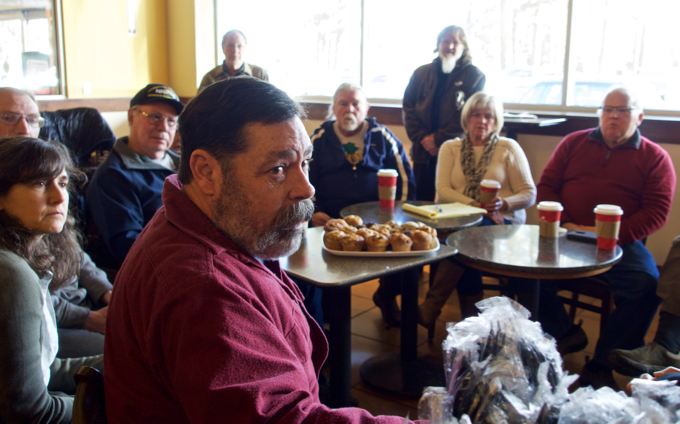
More than two dozen people wandered in for this first gathering at Peet’s inside Raley’s at the Y.

Matt Sanchez, the new manager of the Elizabeth Lodge on Pioneer Trail, spoke about his frustrations with a seedy element of the community hanging around his property “because of its past reputation.”

“Our place is safe now,” he said. There was a time, he said, when a different class of people paid a nightly fee. That’s not true anymore. But they are still in the neighborhood, loitering and giving off an unsafe vibe, according to Sanchez.

Police Chief Brian Uhler, who stopped by briefly, vowed to increase patrols in the area. But he said hanging out isn’t a crime, pointing to how the U.S. Supreme Court has stuck down most loitering laws.

Another person asked about what is going to happen with roads since the ballot measure failed last fall.

David said obviously the need to fix the roads has not gone away, but there is no timeline to put it on the agenda for the council to have a discussion about it.

Davis said pot holes will continue to be filled, touched on Sierra Boulevard being revamped, and revealed Third Street leading to Barton Memorial Hospital will be seeing improvements this year.

A former El Dorado County snowplow driver voiced his frustration with snow removal in the city limits.

Dan Browne, a frequent critic of the City Council, was at the meeting with an opinion on just about every topic. He asked why the city spent $100,000 on the fireplace at the airport when “80 percent of the population won’t see it.”

Instead of listening to the mayor’s response, he got up and went to talk to someone else. David, though, explained to the others who chose listen that the money came from a land deal with Barton Health which per FAA rules mandated the proceeds be spent at the airport. In addition, the heating and air conditioning systems had outlived their usefulness, so much of what was done was efficiency oriented, not cosmetic. Even so, what the airport lobby – aka City Hall – looked like prior the renovation was sketchy at best.

As for the VHRs, pot and SnowGlobe, it was like a rehash of any council meeting when those subjects are on the agenda.

—–

Note:

·      The mayor conversations will be the Wednesday after the second City Council meeting starting at 9am. Locations will vary.


Calif. lawmakers preparing for more disasters

By Liam Dillon, Los Angeles Times
 
Dozens of Californians lost their lives in wildfires and other natural disasters in recent months.

In response to the widespread emergencies, Gov. Jerry Brown and legislators want to change insurance rules, emergency alert systems and debris removal policies and spend more money on fire protection. If passed, these new laws would add to the many protections already enshrined in state law for those who have experienced natural disasters, including substantial relief from property taxes.

State officials are warning residents should expect more natural disasters due to the effects of climate change.

Read the whole story


Pioneering snow-sports filmmaker Warren Miller dies

Warren Miller’s legacy as a snow-sports icon will live on. Photo/LTN

By Ron Judd, Pacific NW Magazine

Warren A. Miller, the pioneering snow-sports filmmaker whose infectious zeal for the “pure freedom” associated with skiing, snowboarding and other pursuits inspired multiple generations of adventure-seekers around the globe, died Jan. 24 at his home on Orcas Island. He was 93.

A quick-witted, self-taught filmmaker who first filmed his own scenes for an annual self-narrated ski movie shown in small venues, Mr. Miller produced more than 500 adventure-sport films. His name, carried forward in a sports-media company, Warren Miller Entertainment, from which he was disassociated in his later years, became synonymous with snow sports across North America.

To his legions of fans, Mr. Miller’s annual ski flick amounted to cinematic manna from heaven — an overdue shot of cold air and deep snow to stoke the fires within winter warriors who had suffered through the long, hot months of snowless summer.

Read the whole story


Panel: Tahoe snowfall a casualty of climate change

Noah Diffenbaugh, a professor at Stanford University, talks climate change Jan. 23 at Harveys. Photo/Terra Breeden

By Terra Breeden

STATELINE – In Lake Tahoe, warm weather patterns are affecting snow levels. A panel of weather experts pointed out the difference between the snowfall in 2017 and current snow conditions as an example of extreme weather events.

“When you have snow in November last year and now it’s January and there’s no snow, you can call that extreme weather,” meteorologist and CNN weather supervisor Brandon Miller said.

Miller is one of several people in town this week for Operation Sierra Storm, a national weather conference. In part the participants are addressing global climate change and the growing occurrence of extreme weather events, like the recent California drought.

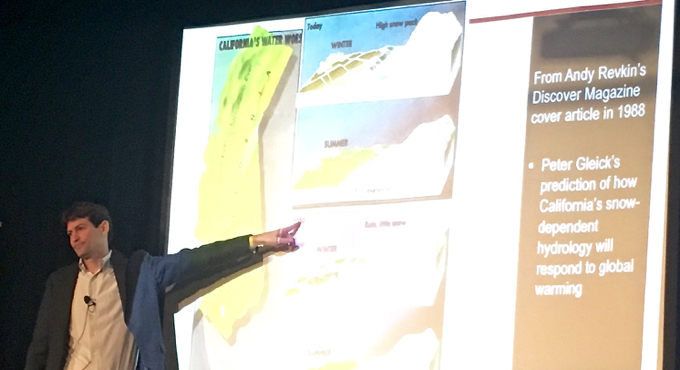
The conference on Jan. 23 was led by keynote speaker Noah Diffenbaugh, a geoscientist and professor of earth system science at Stanford University, and included a panel of renowned meteorologists from U.S. news sources.

One of the reasons for having the conference in Lake Tahoe is to discuss how global warming is affecting snowfall conditions and how extreme weather events contribute to visitation and the economy of the community. National trends in climate change were addressed as well.

“The National Weather Service asserts that climate change is happening, and it is caused by mankind. The question we cover is what does that mean for the future,” Paul Goodloe, a TV meteorologist for the Weather Channel said.

Goodloe, who covered the winter storm in Tahoe last week for the Weather Channel, said that the heavy rain and lack of snow was caused by a warm tropical air mass at 8,000 feet. He asserted that as global warming continues, weather will be prone to “wild swings” in California at high elevations, as seen in the substantial difference between last year’s snowfall and this year’s.

“This is the type of pattern caused by climate change,” he said. “You start to see snow levels at higher feet and more drought in California.”

Goodloe pointed to Louisiana towns currently being threatened by rising seawater and major storm events in Alaska and North Dakota as other instances of extreme weather caused by global warming.

“Eventually, it’s going to mean relocating people from their native land,” Goodloe said.

Diffenbaugh began his presentation at Harveys by pointing out that humans are altering the chemistry of the atmosphere and ocean by emitting greenhouse gases.

“As scientists we know this because we can measure it,” he said. “Altering carbon dioxide levels alters the Earth’s temperature.”

2017 was the second warmest year on record, with 2016 being the warmest. Scientific research taken from different studies points to humans as the cause.

Diffenbaugh lives in California and has studied the California drought extensively. Although droughts do happen naturally in the state, research shows that drought occurrences have doubled in California in the last century. Diffenbaugh believes that the extreme weather related to the last drought was caused by global warming.

“The California drought was a severe event for the state’s economy. It also killed over 100 million trees and led to the wildfires we’ve experienced,” he said.

Warmer temperatures and less precipitation means less water in California. Diffenbaugh noted that we can expect warmer weather patterns and events as global temperatures rise. This could mean warmer winters and less snow in Tahoe.

“We are getting to the point where every year is a warm year,” he said. “If we look to the future, what we find when we look at climate change models for California is that the likelihood of another warm year is 100 percent.”

It seems as if extreme weather events like the California drought will become the “new normal” as global temperatures rise. Although there are still people who deny the existence of climate change, many people now consider global warming an impending threat.

“Polls tell us that people trust scientists more than politicians,” Angela Fritz, meteorologist and deputy editor of the Washington Post, said. “They know that climate change is happening and that they have to make changes to accommodate it.”

Over the years, public opinion has shifted on global warming, going from outright denial to a widely accepted fact, which has made climate change easier for journalists to cover. However, 10-15 years ago, it wasn’t that way.

Miller shared a personal anecdote about how he had a conservative upbringing and denied the existence of climate change for many years. Even as a young meteorologist, when he witnessed the growing number of extreme weather events such as storms and floods, he didn’t accept that the events were caused by climate change. It took years of seeing weather patterns grow warmer for him to believe in climate change.

Miller’s story related to the current White House administration’s climate change denial, which all the panelists agreed would not affect the progress the U.S. has made to adapt to and moderate global warming.

“The administration can do as much as they want to unravel the progress we’ve made in the last decade, but industries and the public are already on the same page,” Fritz said. “They’re going to do what’s in their and everyone else’s best interest.”

To demonstrate how industries are already adapting to climate change., Goodloe showed a short video about an automobile manufacturing plant in Ohio that is harnessing wind energy as a source of renewable power.

The panelists also addressed the U.S. withdrawal from the Paris Agreement, an agreement within the United Nations to aggressively curb greenhouse gas emissions and limit global warming by 2 degrees Celsius. The meteorologists admitted that the U.S. withdrawal created a setback for climate change, especially when America is the second largest contributor of greenhouse gases in the world.

However, the panelists pointed to states like California that continue to honor the Paris Agreement despite the decisions made by national leaders.

“California is setting the standard and it will be a leader and trend-setter for the nation,” Goodloe said.


Rural discontent settles in the state of Jefferson

By Tay Wiles, High Country News

It was a pleasant day for September in California’s Central Valley, sunny and hot but not unbearably so. Kayla Brown sat cross-legged on the grass under an oak tree in a public park, surrounded by friends and family, including her husband, parents and two sons. Brown, who is 27 and sprightly, with a blonde ponytail and blue eyes, was holding court on 19th century American history and the run-up to the Civil War. A lot of Californians “actually sympathized with the Confederates,” she said.

Brown was in Marysville, just north of Sacramento, to take part in a Civil War re-enactment, a hobby she’s had since she was 11. Today, as usual, she was dressed as a Confederate. “I’ve been dying epically, valiantly, for the South for three days,” one member of the group said, smiling, as they took a break from the day’s skirmishes. Brown added: “The North was morally right, but somebody’s got to be a Confederate.”

Brown’s youngest son, 18 months old, toddled by, swinging a slice of apple tied to a string, making swooshing airplane sounds. “I hate public schools,” Brown said, moving the conversation from history to contemporary politics. The Common Core curriculum is a sham, she said; grade-schoolers are forced to learn about topics like contraception and gender identity. That’s why she is homeschooling her children. Gun laws are too strict in California, and mountain lions are over-protected. “We have more lions than anywhere else in the country,” one member of the group said. “That’s because we’re not allowed to shoot them for eating our livestock,” another added. (California residents can, in fact, shoot a mountain lion that is killing domestic animals, though they need to obtain a permit from the state.)

People here call far Northern California — the 20 or so counties north of Sacramento — the North State. The region is largely rural and white (though the Latino population has risen in recent years and there are several Native American tribes), and its politics are mostly red (only four counties went for Hillary Clinton in 2016). But the North State is also an idea that encompasses a shared regional identity for people like Brown, who has lived here her whole life and never wants to leave. “You have a lot of rural folk, people who have been here for three, four, sometimes even five generations,” she told me at the re-enactment. “We’re literally tied to the land.”

Read the whole story


Nevada snowboard maker a consistent top seller

By Noah Bond, KOLO-TV

Did you know one of the snowboard makers recognized as best in the world is in Northern Nevada? Online professional magazines consistently rank Smokin Snowboards at the top.

The snowboard making company has earned awards like “best park board.”

The company started because of one man who moved from the East Coast to snowboard.

“I moved out to Lake Tahoe in 1990. I was one of the first pro riders to move out west and that’s what got me into snowboarding,” said President and CEO of Smokin Snowboards Jay Quintin.

Read the whole story