Drought’s impact on agriculture varies

By Alex Park and Julia Lurie, Mother Jones

California, supplier of nearly half of all U.S. fruits, veggies, and nuts, is on track to experience the driest year in the past half millennium.

Farms use about 80 percent of the state’s “developed water,” or water that’s moved from its natural source to other areas via pipes and aqueducts.

Much of California’s agriculture is concentrated in the parts of the state that the drought has hit the hardest. For example: Monterey County, which is currently enduring an “exceptional drought,” according to the U.S. Drought Monitor, grew nearly half of America’s lettuce and broccoli in 2012.

When it comes to water use, not all plants are created equal.

Read the whole story


LTCC inching closer to putting bond on ballot

By Kathryn Reed

Lake Tahoe taxpayers have not directly paid for any of the buildings at Lake Tahoe Community College. But that could soon change.

The college is contemplating going to the voters in November with a general obligation bond between $35 million and $55 million. This would be spent on facilities.

The board this month agreed to hire Fairbank, Maslin, Maullin, Metz & Associates to conduct a survey of 400 registered voters in the district to gauge their opinion of the proposed bond. The research firm will be paid $19,500. The board had budgeted $20,000 for this expense.

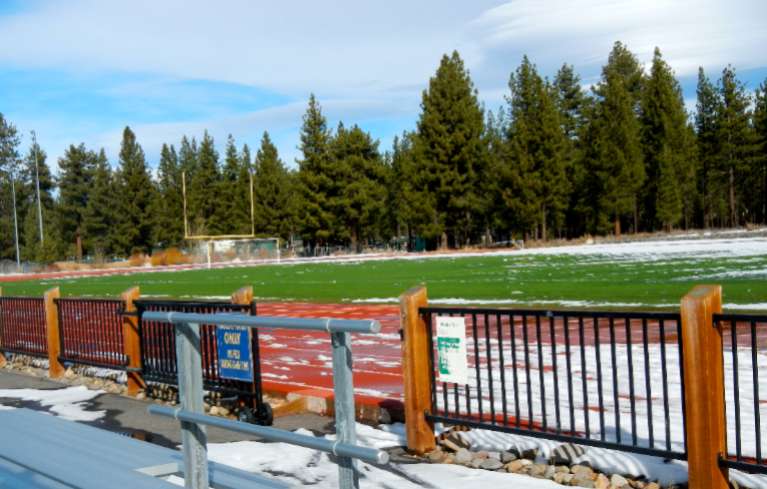
Lights at South Tahoe Middle School are a possibility. Photo/LTN

Lights at South Tahoe Middle School are a possibility. Photo/LTN

Different questions will be put to voters to find out what dollar amount, if any, they support. The survey will last about 19 minutes.

South Lake Tahoe will pay for a portion of the survey because it will have specific questions asked at the end. They will be multiple-choice questions, but the exact questions are not known.

Results of the survey will be presented to the board at the April 8 meeting.

The answers will help the board decide if it wants to go forward with the bond measure.

College President Kindred Murillo told Lake Tahoe News this would be the community’s opportunity to decide if it wants to help fund the college. The college would hope to leverage the taxpayer money like Lake Tahoe Unified School District did so there would be even more money available for improvements.

While the college has not definitively decided how it would spend the money, it has a list of ideas.

One idea is to put lights on the South Tahoe Middle School field so there are more opportunities to play football and soccer at night. With the college starting soccer programs in the fall, it will mean more demand for fields.

The college field is half on city property, half on college land. It is maintained by the city and governed by the recreation joint powers authority. The college, though, has priority over using it for classes and intercollegiate play.

Part of the bond money could go toward adding bleachers and dugouts at the college field.

“There’s a possibility of putting a bubble over it in the winter,” Murillo told Lake Tahoe News. “One major problem with artificial turf is snow.” She said snow is more damaging than something like a SnowGlobe music festival.

The expense of a bubble is being researched.

Three capital outlay projects have been submitted to the state. The first priority is a remodel for efficiency that would include an overhaul of the science labs, student services and technology. This will include a university center. This is needed as the college looks at offering four-year baccalaureate degrees.

The next project is for a regional public safety training facility. This could include having a city fire station on campus.

The third idea was for a sports medicine facility, but with South Tahoe High having just built one the college now sees this as being redundant. Instead, another project could be adaptive physical education or a sustainability center to go with environmental studies.

Safety improvements would be made throughout the campus, along with technology upgrades.

The college is also looking at improving the trails people use so they are clearly marked and in good condition.

Dorms are another project.

“They are essential to make a destination college real,” Murillo said.

Today students have to live at home or rent an apartment or house.

With improvements the city is making to Harrison Avenue and what the college could do in the future, Murillo foresees the area from Al Tahoe Boulevard to Lakeview Commons being a hub for college students.

Murillo also envisions creating an early childhood education center by taking the existing Child Development Center and perhaps moving the Tahoe Parents Nursery School to the campus.

Build-out of the projects is likely to take 10 years and the bond payments would last 20.

“We want to make the community feel like it’s theirs,” Murillo said of the college.


Study: U.S. exercise habits atrocious

By Dominique Mosbergen, Huffington Post

The exercise habits of the average American are appalling, according to a study recently published in Mayo Clinic Proceedings.

For the study, scientists tracked the activity of 2,600 people for two years. They found that obese women average a mere 11 seconds a day of vigorous exercise (that’s about an hour a year), while men and women of normal weight exercised vigorously — engaging in fat-burning activities such as jogging or jumping rope — for fewer than two minutes daily, the Los Angeles Times reported.

The Centers for Disease Control and Prevention (CDC) recommend that adults get at least 75 minutes of vigorous-intensity exercise or 150 minutes of moderate-intensity exercise every week, in addition to bi-weekly muscle-strengthening activities.

Read the whole story


Concern for driving high grows

By NPR

The Lodo Wellness Center in Denver has been selling medical marijuana for several years. But since Jan. 1, when marijuana in Colorado officially moved from underground to behind-the-counter, they’ve also been selling legal, recreational pot.

A majority of Americans now say they support full legalization, and the trend is spreading: Legal weed is coming soon to Washington state.

Meanwhile, the public health community is warning of a potential safety problem: more people driving while stoned. But health officials and law enforcement don’t yet have the data or tools to address the concern.

Read the whole story


West Tahoe fault overdue for major temblor

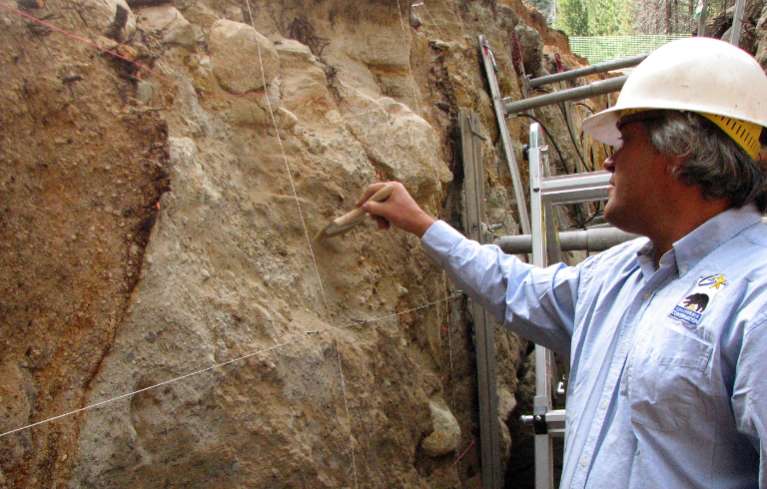
Gordon Seitz in the trench brushing dirt from the walls. The dark diagonal line or crack you see in the wall of the trench is the actual fault line. Photos/Provided

Gordon Seitz in the trench brushing dirt from the walls. The dark diagonal line or crack in the wall of the trench is the fault line. Photos/Provided

By Jessie Marchesseau

Anyone who has lived in Lake Tahoe for a while has heard stories of the impending tsunami if an earthquake occurs. In reality, those stories may not be too far off. And the earthquake may not be either.

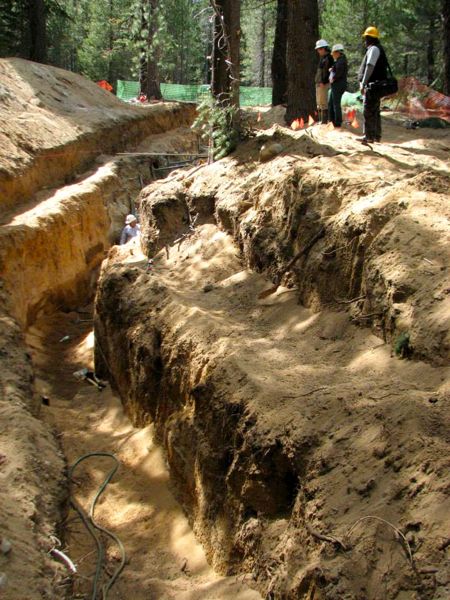
The California Geological Survey has been taking a closer look at the West Tahoe fault, the most active and most hazardous of the three faults in the Lake Tahoe Basin. Last October, the agency dug a trench approximately 15 feet deep and 15 feet wide across part of the fault near Meyers.

The project was years in the making, with the CGS working closely with the TRPA, USFS and Lahontan making sure the project was a low-impact as possible. The trench has already been filled in again and the land restored.

Gordon Seitz, engineering geologist with the CGS and lead on this project, said trenches are a relatively common way to study fault lines. By examining and sampling layers of sediment below the surface, geologists can determine frequency and magnitude of past earthquakes.

Seitz and his crew were able to learn quite a bit about what has happened at the fault since the last Ice Age (about 12,000 years ago). They found two earthquakes, each one shifting the earth on the west side of the fault higher than the east side resulting in a full 12-foot difference between the two sides.

“If we had an earthquake tomorrow, there would be a step, a vertical step on the fault,” Seitz told Lake Tahoe News. “It would be about 6-feet high.”

the trench itself before it was filled back in.

The trench before it was filled back in.

An earthquake tomorrow is not exactly out of the question, either. It will be a few more months before exact results are back from the lab, but so far it looks as if earthquakes happen on the West Tahoe fault about every 4,000 years. And how long has it been since the last one? About 4,000 years.

“If it happened tomorrow in Tahoe, I wouldn’t be surprised. But I’m not expecting it to either,” Seitz said.

The West Tahoe fault travels from just west of Meyers through Fallen Leaf Lake, down into the bottom of Lake Tahoe and back out again near Dollar Point. What Seitz said makes the Tahoe area so interesting is that in most places the biggest hazard during an earthquake is the shaking, but when the west side of the fault, 1,200 feet below the surface of Lake Tahoe, rises up 6, maybe even as much as 18-feet higher than the east side, a giant wave will ensue.

“If we have a shift like we see in the trench at the bottom of the lake, we will have a large wave, that’s a given,” Seitz said. “What we don’t know is how big the wave is or the impact.”

This is something else he is working on. Last July, Seitz was part of a team that took a remotely operated submarine-like vehicle 1,100 feet down into Lake Tahoe. What they saw was not a 12-foot step from the west to the east side of the fault like in Meyers, but a 36-foot step. This means there are either more earthquakes down there, or they are just bigger.

The team hopes to take the remote operated vehicle down again this summer for further investigation, and to hopefully determine which of those scenarios it really is.

Seitz expects to have solid data on the earthquakes of the West Tahoe fault within the next five years. However, he said the more difficult part of all of this is what to do with that data. The hope is to have reports, maps and computer models to explain where the fault is and how it and the waters of Lake Tahoe will behave in different scenarios. All this could be used for future planning in our communities, especially in the realm of emergency response plans.

“Overall, even though it sounds scary,” Seitz said, “it should make people feel better that we’re working on it.”


Obama proposes shift in wildfire funding

By Coral Davenport, New York Times

WASHINGTON — President Obama’s annual budget request to Congress will propose a significant change in how the government pays to fight wildfires, administration officials said, a move that they say reflects the ways in which climate change is increasing the risk for and cost of those fires.

The wildfire funding shift is one in a series of recent White House actions related to climate change as Obama tries to highlight the issue and build political support for his administration’s more muscular policies, like curbing carbon emissions from coal-fired power plants. On Monday, Mr. Obama plans to describe his proposal at a meeting in Washington with governors of Western states that have been ravaged recently by severe drought and wildfires.

The proposal will ask Congress to pay the costs of fighting extreme wildfires in the same way it finances the federal response to disasters like hurricanes and tornadoes, the officials said. When unpredictable events like Hurricane Sandy are destructive enough to be declared disasters by the president, the Federal Emergency Management Agency is authorized to exceed its annual budget and draw on a special disaster account. The account is adjusted each year to reflect the 10-year average cost of responding to such events.

Read the whole story


Internal BLM memo shows mustang woes

By Scott Sonner, AP

RENO — The head of the government’s $70 million wild-horse management program warned last summer that it is headed for financial collapse unless “drastic changes” are made in the decades-old roundup policy she said could be setting U.S. rangeland-improvement goals back 20 years.

In a strongly worded internal memo to an assistant director of the U.S. Bureau of Land Management, Wild Horse and Burro Division Chief Joan Guilfoyle recommended suspending all roundups until thousands of mustangs currently in federal corrals are sold or adopted.
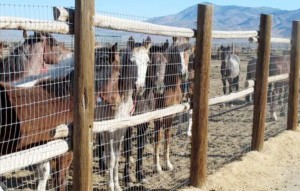
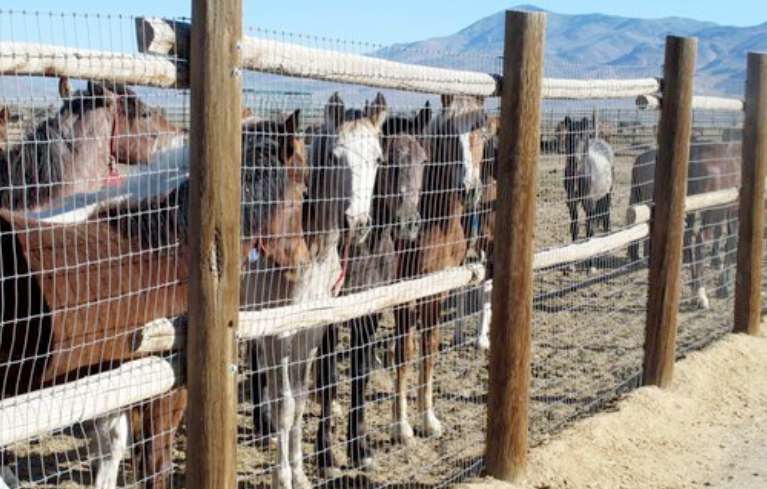
Scott Sonner, File/AP Photo FILE - In this June 5, 2013, file photo, horses stand behind a fence at the Bureau of Land Management's Palomino Valley holding facility in Palomino Valley, Nev. The head of the government's $70 million wild horse management program warned last summer it is headed for financial collapse unless ``drastic changes'' are made. Lingering drought, a record 49,000 mustangs in long- and short-term holding, and an on-range population that doubles every four years and is projected to exceed 60,000 in 2015, threaten the program's future. close window Read more here: http://www.sacbee.com/2014/02/22/6180608_a6180602/ap-newsbreak-internal-blm-memo.html#storylink=cpy

Horses stand behind a fence at the Bureau of Land Management’s Palomino Valley holding facility in Palomino Valley, Nev. Photo/Scott Sonner/AP file

Guilfoyle also said sterilization should be considered, and she recommended for the first time euthanizing wild horses on the range “as an act of mercy if animals decline to near-death condition as a result of declining water and forage resources.”

Those are among the few realistic alternatives given a crippling combination of congressional budget cuts, spiraling costs, lingering drought, a record 49,000 mustangs in long- and short-term holding, and an on-range population that doubles every four years and is expected to surpass 60,000 in 2015, Guilfoyle said.

It’s “nearing the point of financial insolvency due to undesirable trends in every aspect of the program,” she said in the August memo to Greg Shoop, assistant director for renewable resources and planning.

“Drastic changes in course are mandatory to remain financially solvent and reverse trends” undermining the Bureau of Land Management’s goals, she wrote. “Considering the circumstances, on-range management goals may not be achieved for another 20 years.”

Labeled “Internal Working Document,” the Texas-based Wild Horse Freedom Federation obtained the memo under the Freedom of Information Act and first posted it on its website Wednesday. The Associated Press also independently obtained a copy Wednesday but couldn’t confirm its authenticity until Friday.

Bureau of Land Management spokesman Tom Gorey said it was a “preliminary discussion document” produced in “recognition of the tight fiscal climate” and based on projections Congress would cut more from the agency’s budget than it ended up doing last fall.

“It explores a range of interim measures that could be implemented until more sustainable actions are available, such as the development of longer-acting, effective contraceptives and the reduction of holding costs,” Gorey said in an email to the AP.

The three-page memo offers a candid look at the political and public pressure fueling the controversy that has raged for decades but intensified since the number of animals in holding first exceeded those on the range two years ago. Last fiscal year, holding costs topped $46 million — 61 percent of the horse program’s overall budget.

Guilfoyle noted “heightened and increasing interest” in policy changes among conservationists, ranchers, horse activists and Congress. She said things “we can’t do” include “remove animals,” “new research” and “reduce or curb on-range population growth.”

“Funding and space prohibit the removal of any animals in the near future. Euthanasia of near-death animals is the only responsible alternative,” she said.

While Guilfoyle’s assessment was unusually frank, it echoes the General Accounting Office’s conclusion in a 2008 report to Congress that there was no end in sight to rising holding costs. A year later, then-Interior Secretary Ken Salazar warned “the current path of the wild horse and burro program is not sustainable.”

Last June, Arizona Rep. Raul Grijalva, the ranking Democrat on a public lands subcommittee, and 29 colleagues including Rep. Dina Titus, D-Nev., told Interior Secretary Sally Jewell the program’s soaring costs had created an “untenable situation” for both the mustangs and taxpayers.

The Bureau of Land Management suspended roundups shortly after Guilfoyle’s memo and has not formally scheduled any this year. But it awarded two helicopter contracts in January that could be used for gathers.

The Nevada Farm Bureau Federation and Nevada Association Counties argue roundups are necessary to cull overpopulated herds competing with livestock for forage. They filed a lawsuit in December trying to force the Bureau of Land Management to sell some older horses deemed unadoptable without the usual prohibition on resale for slaughter — an idea the agency has opposed.

Ginger Kathrens, executive director of the Colorado-based Cloud Foundation, said euthanizing or sterilizing mustangs would violate the 1971 Wild Free-Roaming Horses and Burros Act. The foundation is dedicated to the preservation of wild horses on public lands.

“It would be unconscionable to even consider use of these strategies,” she said.


Calstar provides fast transport in an emergency

By Kathryn Reed

In many ways it’s an emergency room or intensive care unit that flies.

Calstar – or California Shock Trauma Air Rescue – has a base at Lake Tahoe Airport that makes runs down to Mammoth, far into Nevada, up to Quincy and over to Georgetown. But much of the work the pilots and flight nurses do starts on the South Shore.

The air ambulance often finds people who are lost in the wilderness, whisks them from the backcountry and delivers them to the appropriate hospital to get further treatment. Two critical care certified nurses are on each flight. Some of the care patients receive is equivalent to what a doctor would do in the ER.

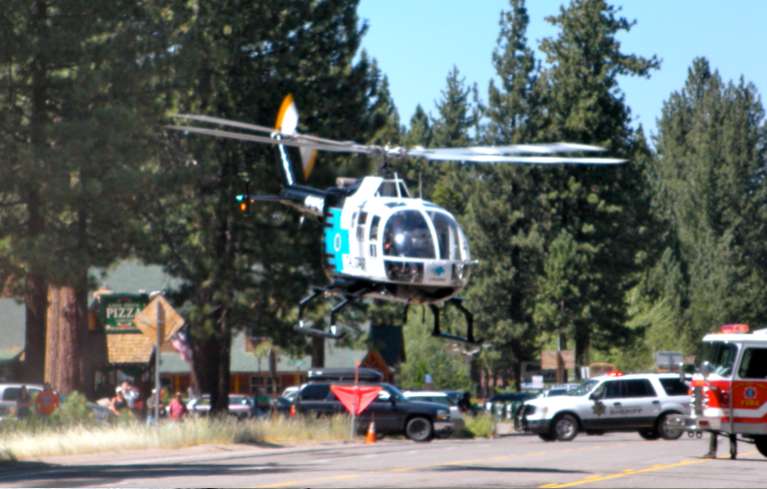
Calstar can land in many locations -- including the middle of Highway 50. Photo/LTN file

Calstar can land in many locations — including the middle of Highway 50. Photo/LTN file

Many trips are made between Barton Memorial Hospital and facilities that have specialties the South Shore care center doesn’t have.

This time of year the helicopter is busy with getting injured skiers from the slopes to the appropriate medical facility.

Night vision goggles, like what the military uses, help find people on the ground. With most everyone having a cell phone, the pilot will ask the lost person to turn their phone around and wave it. That is the easiest way for a pilot to see someone on the ground at night.

Bryan Pond, one of the two original members who opened the South Lake Tahoe operations in October 2001, spoke at the Soroptimist International Tahoe Sierra meeting last week about Calstar.

Last week was Critical Care Transport Nurses Day.

“On Feb. 18, 1943, the first class of flight nurses marched from the base chapel after graduating from their specialized course of medical training at Bowman Field in Louisville, Ky. On this day, the new field of transport nursing emerged as a specialty as both the Army and Navy instituted flight nurse programs,” Pond, who is a flight nurse, told Lake Tahoe News. “These nurses were trained to care for wounded soldiers during transport on converted cargo planes and on the field of battle. Since that time, nurses have expanded their role in this field to include the civilian sector, responding to care for patients in ambulances, helicopters and airplanes.”

Not all trips are of a life and death nature. Sometimes it’s a simple broken ankle. The problem could be the injured person is miles from his or her vehicle and can’t walk out or be carried out by friends. Calstar can get to most any location.

The California Highway Patrol helicopter crewmen work with Calstar on rescues at Lovers Leap because they can hoist people down. Then they bring the rock climber to Calstar, which is waiting in a meadow.

CareFlight is another partner agency. They have helicopters in Gardnerville, Reno and Auburn.

There are times when so much is going that multiple medical helicopters are circling about.

The Calstar helicopter can take two patients at once depending on their weight.

It’s run as a nonprofit that includes membership. Members may use the service for free after their insurance is billed. For more info, go online.


Drought could lead to record wildfire season

By Mark Koba, CNBC

Three years of severe drought have made plenty of misery for California and other Western states. Now to make matters worse, the extremely dry conditions are creating the potential for a devastating fire season.

“All the pieces are in place for a really bad season of wildfires,” said Malcolm North, a research ecologist with the U.S. Forest Service. “We’re likely to set a record for fires this year.”

The drought has hit hard in states like Montana, Nevada, New Mexico, Texas and especially California, where the snowpack in the Sierra Nevada is at 12 percent of the annual average. Snowpack in the Cascades in Washington and Oregon is also below normal.

That has dried out the trees, shrubs and grasses that end up fueling the fires.

Read the whole story


Nev. slot players able to use prepaid cards

By Richard N. Velotta, Las Vegas Sun

Gamblers will soon be able to use prepaid access cards to play slot machines in Nevada, a technological advancement that has some critics concerned that easier access to cash in a casino would broaden problem gambling.

The Nevada Gaming Commission on Thursday approved amendments to two regulations that would allow the use of prepaid access instruments in conjunction with approved wagering accounts.

The amendments take effect immediately, and technical standards will be published soon to guide companies. The amended regulations enable state Gaming Control Board Chairman A.G. Burnett to administratively approve the use of equipment.

Read the whole story