FDA overhauling food labels

By Ryan Jaslow, CBS

Nutrition fact labels are finally undergoing a makeover. The Food and Drug Administration has proposed new changes to labels on food packaging that are aimed at making them easier to understand — the first major update since about 1994.

Under the changes, serving sizes will be made easier to understand, calories will be featured more prominently and for the first time, added sugars will be included.

The label updates aim to incorporate the new science that has since come out on how eating foods might raise risk for obesity and chronic disease, according to the FDA. For example, old labels focused more on fats, but calorie consumption is what really drives weight gain and obesity, researchers have since determined.

Read the whole story


Restaurants do their part to conserve water

By Bethany Clough, Fresno Bee

The California Restaurant Association urged restaurants Wednesday to conserve water as the state deals with a historic drought, including only serving water to customers upon their request.

Local association representatives say there’s even more that restaurants can do, despite an existing emphasis on water conservation learned in past droughts.

Many valley restaurants stopped serving glasses of water to customers unless they requested them years ago after drought put a spotlight on the practice. And although Fresno homeowners recently had water meters installed, restaurants have had them for as long as restaurateur Tom Ferdinandi can remember.

Read the whole story


S. Tahoe embarks — again — on a plan for the Y

The cover of the draft Tahoe Valley Community Plan from March 2007. The area of study is largely the same today. Photo/LTN

The cover of the draft Tahoe Valley Community Plan from March 2007. The area of study is largely the same today. Photo/LTN

By Kathryn Reed

A greenbelt going behind McDonald’s and CVS at the Y in South Lake Tahoe. Another on the other side of Highway 50. Both being multidimensional by being stormwater basins, greenways and recreation conduits.

Those are ideas being floated in the Tahoe Valley Area Plan.

More than 60 people interested in what South Lake Tahoe is going to do with the Y attended a meeting Feb. 27 to offer input and hear what the city is thinking. Area plans are the Tahoe Regional Planning Agency’s latest planning tool for jurisdictions.

The city for years has tried to come up with a plan for what is considered the locals’ side of town. It has never happened.

A team of community members in 2007 came up with a plan only to have the city wrestle it from their grip.

In a September 2009 Lake Tahoe News story Pat Frega, who served as a city planning commissioner and a Tahoe Valley Community Plan committee member, said at the time that even after two years, a majority of the dozen citizens who served on the community group still felt the project “was hijacked” by a council subcommittee because “we were going on a different course than what they wanted.”

The city took over and came up with a plan. It, too, went nowhere.

City officials say they are determined to have a plan approved, with the goal of it being completed by the end of the year.

Another idea is to have a health care campus concept for Barton Health.

“We are encouraging the hospital to create a master plan for the whole district,” John Hitchcock, city planner, said. “It would integrate all of their facilities.”

The original plan talked about having a mountain feel. But it was acknowledged that could mean different things to different people.

Paul Brusso, owner of Ernie’s restaurant, and Dan Passaretti of Passaretti’s restaurant both voiced concern about whether their businesses would conform to whatever zoning rules the city implements. “Yes” was the answer.

People had the opportunity to place sticky dots on pictures of mountain architecture they liked. The Cedar House Sport Hotel in Truckee had the most dots.

One person expressed a desire to have mountain architecture, but hoped that there would still be room for originality so everything did not look the same.

Architect Keith Klein said it’s important to take into consideration what people see at eye level, especially if eye level is from the seat of a vehicle.

“You can put up a 3-foot fence and hide cars,” Klein said in a veiled reference to Runnels Automotive.

John Runnels said he has wanted to make improvements since the 1980s. Interest rates stopped him in 1981 and then the city said wait until the 1993 plan was done. But no plan has ever been approved for the Y.

While people embraced connecting the areas of town, several said they never see the Y area as someplace that will be pedestrian oriented, especially when it comes to locals going to stores via foot from their residences.

Height of buildings has been an issue with other area plans in the basin. On Thursday it did not present a huge dilemma. People wanted to understand what 56 feet would look like. That is what the TRPA Regional Plan allows for in town centers.

Embassy Suites is 80 feet, the parking garage is about 50 feet.

Chuck Nelson had a handout of an elevated circular bypass for cyclists that Holland has built that he could see being put in at the Y.

Jerome Evans, who worked on community plan, told Lake Tahoe News, “There is no reason to believe any of this will happen. They are making everyone feel good and nothing is happening.”

The area plan is not a project, but instead a blueprint for what the Y could evolve into. It will be up to the city and private individuals to devise projects that will go through a separate approval process.

—

Notes:

• The South Lake Tahoe Planning Commission will discuss the area plan March 13.

• The City Council will talk about it April 1.

• Another public workshop is set for late April.


Snowpack improving, but not fast enough

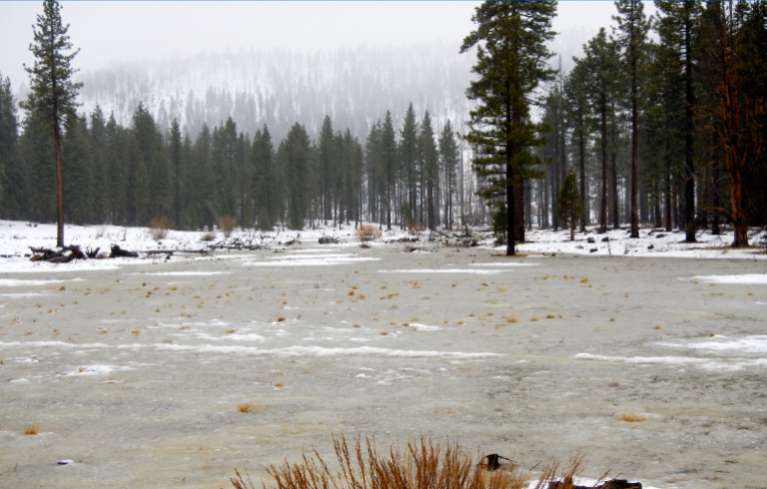
A wet February in Lake Tahoe has improved the overall water picture, but not enough to end the drought. Photo/LTN

A wet February in Lake Tahoe has improved the overall water picture, but not enough to end the drought. Photo/LTN

By Kathryn Reed

Maybe the Department of Water Resources ought to schedule snow surveys more often because snow fell each of the last two times.

While every drop of moisture helps, California is not likely to get out of its drought this season. Still, things are slightly improved, but still worrisome.

Statewide, the water content on Feb. 27 was 24 percent of average for the date. On Echo Summit near the entrance of Sierra-at-Tahoe the story was a little better. The 25.7 inches of snow have a water content of 8.1 inches, which is 33 percent of normal.

A month ago, statewide the water content was 12 percent of normal and the Echo reading was 7 percent.

“We welcome the late storms, but they are not enough to end the drought,” DWR Director Mark Cowin said in a statement. “We can’t control the weather, but we can control the amount of water we use. This drought is a wake-up call that we all have to take water conservation seriously and make it a way of life.”

This is the third consecutive dry winter for California. The snowpack normally provides about a third of the water used by cities and farms as it melts into streams and reservoirs in spring and early summer. The reservoirs store the water for famers and municipalities. But without snow there is nothing to store.

Lake Oroville, the State Water Project’s principal reservoir, is at 39 percent of its 3.5 million acre-foot capacity. Normally it is at 57 percent this time of year. Shasta Lake, California and the federal Central Valley Project’s largest reservoir, is at 38 percent when it should be at 52 percent.

And with the lack of storage, the end users are not getting what they expect or need. Some cities in California have invoked water restrictions. Farmers are leaving fields fallow. Only water for health and safety reasons will be delivered from the State Water Project.

January and February are typically the wet months in the Sierra. While a Miracle March could happen, it can’t make up for three years of below normal snow and rain.

February will end on a wet note. The National Weather Service in Reno is calling for a 100 percent chance of snow in Lake Tahoe.

Also on Thursday, the Legislature sent Gov. Jerry Brown a $687 million drought relief package. Much of the money would come from bond money that has not been spent. Most of the money — $500 million – would be allocated for communities to build systems to capture stormwater and then use the grey water. Money is also available for communities if they run out of potable water.


South Tahoe adds ladder truck to fire fleet

South Lake Tahoe's ladder truck is the fire department's newest piece of equipment. Photo/Provided

South Lake Tahoe’s ladder truck is the fire department’s newest piece of equipment. Photo/Provided

By Kathryn Reed

A million dollar truck is rolling around South Lake Tahoe. It’s the fire department’s ladder truck.

The old ladder truck was so decrepit it was taken out of service in 2012. The city has possession of the new one, but a few things still need to be done before it hits the streets.

“There will be extensive training, installation of radios and equipment and fire station 2 needs to be remodeled to account for its size; it’s a bit over 48-feet-long,” Fire Chief Jeff Meston told Lake Tahoe News. “Our folks will get lots of drivers training before she goes into service.”

South Tahoe has been able to rely on neighboring agencies in the interim. It was Tahoe Douglas Fire that supplied the ladder truck when the house went up in flames on Pioneer Trail in April 2012.

One of the conditions in the original contract for the Chateau project near Stateline was to be able to provide adequate fire protection. This meant the city had to have a ladder truck. It did when the contract was signed.

Ladder trucks tend to have a lifespan of 15 years. South Tahoe doubled that number with its last truck. But it was also costing the city about $100,000 in annual maintenance costs. And then it got to the point where parts were no longer available.

It’s possible with better equipment and improvements being made to South Tahoe Public Utility District and Lukins Brothers Water District water lines that the city’s ISO rating could improve.

ISO provides advisory services and information to many insurance companies.

In March 2012, the city received an ISO rating of four. This is out of nine, with one being the best.

“For a city our size, four is very good. This rate has little affect on homeowners insurance. It’s more about commercial rates for businesses,” Meston said. “We could add staff to improve the rating, but that is costly.”

Ratings are done about every six years.


Catalyst project gone; Meyers’ future undecided

By Kathryn Reed

MEYERS – “The catalyst project is dead. You have my word on it. If you want, I’ll put it in writing.”

That’s how El Dorado County Supervisor Norma Santiago started Wednesday night’s meeting about the Meyers Area Plan.

It ended with local resident Steve Bannar pointing out the good aspects of Meyers, that the policymakers are not the enemies, and that it is time to concentrate on the positives and for people to get involved. His words were met with the loudest round of applause during the two-hour meeting at the CCC offices.

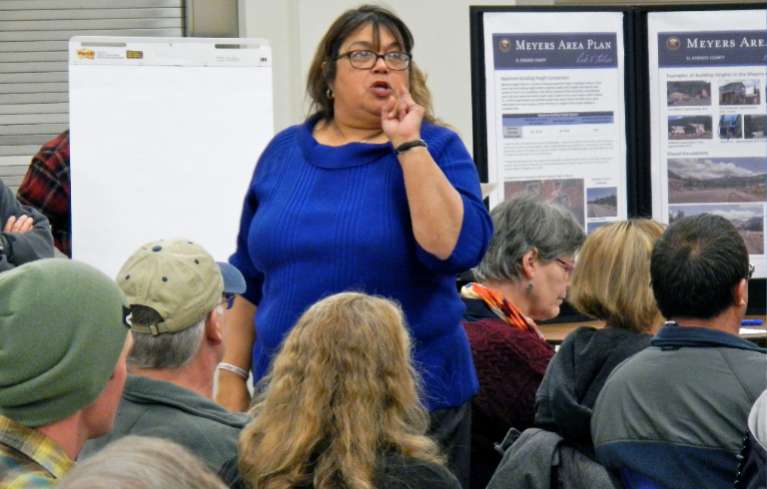
El Dorado County Supervisor Norma Santiago pulls the plug on the catalyst project. for Meyers. Photo/Kathryn Reed

El Dorado County Supervisor Norma Santiago pulls the plug on the catalyst project for Meyers. Photo/Kathryn Reed

In between those two speakers was an hour of Q&A where about 30 of the nearly 150 people in attendance spoke. At times it was contentious, but mostly it was passion that came through.

In the audience were South Tahoe High students getting extra credit for their AP environmental studies class.

The first hour of the Feb. 26 meeting was county and Tahoe Regional Planning Agency officials comparing the 1993 community plan to the draft area plan.

Catalyst project shelved

The so-called catalyst project was something Santiago spearheaded. She is the one who directed Kim Kerr, assistant county administrative officer, to process the contract that was then signed by CAO Terri Daly.

It was $25,000 worth of taxpayer money that is now in the trash.

“I caused a lot of angst, anxiety, fear and all kinds of things in this community, even divisiveness. I am sorry for that,” Santiago said in her apology for having pushed the catalyst project through.

Symbolically, she then crossed the project off the board.

While One Globe’s idea is off the table, the draft Meyers Area Plan as it stands today would allow anyone to come forward with a similar idea. Santiago only has the power to nix this particular idea because she was the driving force behind it.

Santiago later said it’s possible to add to the area plan that the community does not support a large development.

Differences between 1993 and 2014

Adam Lewandowski with TRPA went over the basics:

• Meyers has about 33,000-square-feet of commercial floor area.

• There are 17 leftover tourist accommodation units from a former hotel. Ten new TAUs are available.

• Eight residential units may be built.

“Those numbers are not set in stone. You can transfer development rights,” Lewandowski said.

He said the TRPA Regional Plan update did not change the density and height for Meyers, but instead allows Meyers to have a say in what the rules will be.

The old plan had five special districts. The new plan condenses them. The old plan allowed lodging in specific areas. The new one allows it in more areas.

The draft plan includes a recreation district that encompasses the campground and golf courses. New residences would not be allowed in that zone, whereas the old plan would allow that use.

The draft plan adds 357 acres of conservation land that includes land for hiking, trails and other recreation.

A big change from 21 years ago is the two-tiered incentive program.

“It’s definitely the most controversial part of the area plan based on comments and the petition that is circulating,” Lewandowski said.

If developers met certain criteria, they would be allowed to build a taller, denser building than the baseline regulations.

Meyers used the TRPA standard for height in the community plan. The range is 24 to 42 feet, with a slew of factors determining what can go where.

The draft plan calls for 35 feet to be the maximum, but 45 feet if incentives are met.

The CCC building is 35-feet tall and Lira’s is 36 feet.

The existing plan calls for motels to allow 40 units per acre, apartments 15 per acre.

The draft calls for 30 hotel units per acre or 40 if incentives are met. Apartments would be 20 per acre or 25 with incentives.

Going forward

Scenic issues are a big concern for residents that go beyond the typical TRPA definition.

While the view corridor will be protected so a building does not obscure the mountain vistas, the whole look of the area could be improved through the area plan. This includes landscaping and signs.

No matter what plan is approved, Caltrans this summer will be putting in major water quality improvements. Included in this is a crosswalk on Highway 50 at Apache Avenue.

The county has money to improve the Pat Lowe bike trail.

Grants are being sought for other projects.

Brendan Ferry, chief planner for the county, said implementation is a huge component of the area plan. That is one reason he is actively seeking grant money to make Meyers a more walkable, bikeable community.

A couple people questioned whether there could be wriggle room with the height in case a unique project came forward that would need more space, such as a climbing wall or ski ramp like Woodward at Boreal has.

Some want to keep the old plan as the law of the land.

John Friedrich asked who is going to decide whose ideas eventually end up in the final document. Santiago did not have a concise answer, but instead said it will be based on general consensus.

Bruce Grego proposed the voters have final say. Santiago told him he was free to do just that, adding that she would not bring it to the Board of Supervisors to consider placing it on the ballot.

—-

Notes:

• The next meeting on the draft area plan is March 19 at 6pm at the CCC building.

• No deadline has been set for when comments will end.

• Comments and responses will be posted on the county’s website.

• Comments may be emailed to MeyersAreaPlan@edcgov.us.


Couple’s gold-coin find called greatest in U.S. history

This image provided by the Saddle Ridge Hoard discoverers via Kagin's, Inc., shows one of the 1800s-era U.S. gold coins unearthed in California by two people who want to remain anonymous. The value of the "Saddle Ridge Hoard" treasure trove is estimated at $10 million or more. (AP Photo/Saddle Ridge Hoard discoverers via Kagin's, Inc.)

This image shows one of the 1800s-era U.S. gold coins unearthed in California. Photo/AP/Saddle Ridge Hoard discoverers via Kagin’s Inc.

By Ruben Vives, Los Angeles Times

A cache of 19th century gold coins uncovered by a California couple on their daily walk could end up selling for more than $10 million, making it the greatest buried treasure ever unearthed in the United States, experts said.

Donald Kagin, president of Kagin’s Inc., a numismatic firm that specializes in U.S. gold coins, announced the discovery Tuesday. The company is representing the couple, who wish to remain anonymous.

Identified by the firm only as “John and Mary”, the couple told Kagin they couldn’t believe they had made such a big discovery and were grateful for it. They unearthed the coins after noticing an old can sticking out of the dirt on a section of their property, the firm said.

Read the whole story


NASA to use space images to monitor drought

By Laila Kearney, Reuters

NASA scientists plan to use images shot from space and within the Earth’s atmosphere to help California monitor one of the worst droughts in its recorded history, officials said on Tuesday.

Scientists said they would deploy imaging tools to measure snowpack and groundwater levels and use a host of other technologies to help better map and assess the water resources in a state that produces half the nation’s fruits and vegetables.

The California Department of Water Resources has contracted with NASA to use data that will be collected next month with airplane mapping tools to measure water stored in the California snowpack, according to Jeanine Jones, the department’s interstate water resources manager.

Read the whole story


Community vision, determination brought college to South Lake Tahoe 40 years ago

By Kathryn Reed

No was not a word people who wanted a community college in South Lake Tahoe were willing to embrace. Their tenacity paid off and this year Lake Tahoe Community College District is celebrating its 40th year.

As Los Rios Community College District was forming in the 1950s there was a push to have all of El Dorado County be part of it. But Nels Nelson convinced the powers that be that it didn’t make sense for Tahoe to be included.

Besides the legacy of a hardware store in town that bears his name, Nelson has a bench in his honor near the college’s Demonstration Garden that was donated by his daughter Anne Johnson.

Had he not been so persuasive, South Lake Tahoe might be like Placerville, a city without a college and part of a district that doesn’t make sense.

It was in the 1960s that serious discussions began about having a community college in town. Ann and Bill Harriman had two children in high school and didn’t want to have to send them out of town. They approached Lake Tahoe Unified School District officials about starting a community college.

Superintendent Tony Magliari and Business Manager Bill Hauck were completely supportive of the idea. A committee was put together to figure out how to do this, what was needed and gather support of the community.

Magliari went before the state board of education on Dec. 15, 1967, with the proposal and was told “no”.

Not giving up

The idea cooled off for a bit until legislation was passed saying every area in the state must belong to a community college district. The state thought Tahoe, Alpine County and Mono County should be a district. Alpine County residents weren’t thrilled with this idea.

The El Dorado County Committee on School District Organization spent about three years studying what would be best for the area. Roberta Mason, LTCC board member, and Gene Bellisario were the Supervisor 5 committee members. Each of the five supervisorial districts had two members on the committee, plus there was one at-large member.
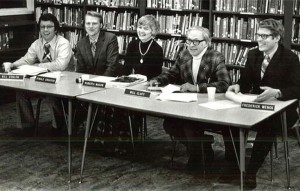
“First Board” is the very first Board of Trustees, voted in on March 5, 1974. Caption should read: from left to right, William Conlon, Rev. Donald Swanson, President Roberta Mason, Dr. Will Cluff, and Dr. Fritz Wenck. So Roberta was our very first Board president, and she was sworn in as Board president once again for this year. Photos/LTCC

LTCC’s first elected board: William Conlon, Donald Swanson, President Roberta Mason, Will Cluff and Fritz Wenck.Photos/LTCC

Mason said the reason the state wanted areas to be part of a district was to collect more taxes. Those outside a district paid 10 cents per $100,000 of assessed property per year, while in districts the tax could be 90 cents.

The state said “no” again to Tahoe when advocates lobbied for a solo district.

Then state Sen. Claire Berryhill arranged for a special election where Tahoe and Alpine County would vote on the district. But it was up to the Alpine County superintendent to call the election because the Legislature had said the county with the largest geographic area was in charge. Alpine stalled; ranchers didn’t want higher taxes.

Hazel Hoak, assistant superintendent of schools for El Dorado County, got involved.

“She and I went to court to force Alpine County to call an election,” Mason told Lake Tahoe News. It worked.

A radio campaign was launched to convince voters. Brooke Laine, who was 9, and David Foster’s kids did some of the spots, saying how they wanted to one day go to a local college. Dick Shehadi was the main outspoken opponent to the college district.

A college in South Lake Tahoe

On March 5, 1974, voters in the Tahoe area of El Dorado County and all of Alpine County were asked if Lake Tahoe Community College District should come to fruition. Tahoe said “yes” and Alpine “no”.
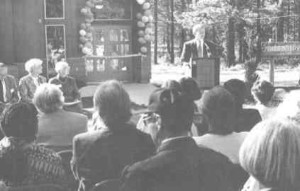
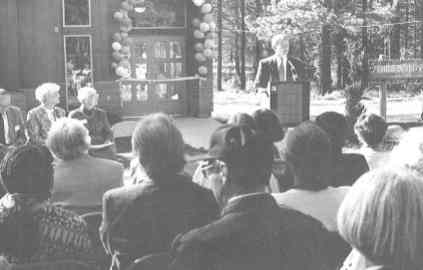
“CDC opens” is the Child Development Center’s grand opening, w/then-President Guy Lease doing the honors. September 1993

Then-President Guy Lease opens the Child Development Center in September 1993.

They also voted for the first board, with one seat for an Alpine County rep. Since that county said no to the district, the board started with four members. They were Mason, Donald Swanson, Will Cluff and Fritz Wenck. Wenck is also still on the board. In a special election for a fifth member, Bill Conlon was elected.

Mason was the first board president. She is also the current president. Her plan is to not run again when her term expires at the end of the year.

With the creation of the college district, it meant property owners would be paying 72 cents for every $100,000 of assessed value.

Hoak, who lives in Shingle Springs, filled in as interim college president until the board hired someone.

Mason said that was the board’s biggest decision – who to hire. A consultant was brought in to help find a president and figure out a salary.

“Jim Duke came to the top because he had quite a bit of experience with starting community colleges and four-year colleges,” Mason said. “Fritz and I were selected to make an offer to Jim.”

Duke’s response was that he was already making more than what was being offered. A second offer was made and Duke left Canada College in the Bay Area. He started with LTCC in September 1974. The county advanced the district the money to pay him and for some other start up costs.

“We had nothing but a post office box,” Mason said. “Jim said I’ll have a campus in eight years.” He missed the mark by a few years, but stayed long enough to be part of the permanent facility.
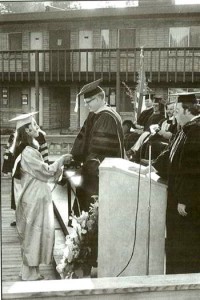
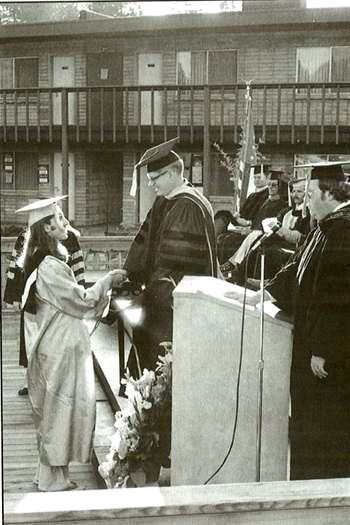
“First graduation” is from June 1976, with just 11 grads, back at the old motel. That’s Dr. Fritz Wenck handing out the diploma…still a Board member today.

Board member Fritz Wenck hands out diplomas at LTCC’s first graduation in June 1976.

Duke’s initial task was to hire a secretary. Angie Burns still lives in Tahoe. The two first worked out of a basement in a building on Ski Run Boulevard that is now owned by Wenck. Real estate agents came up with tons of ideas for where the first classes could be conducted.

Ultimately the board decided on the old Gerkin motel on Highway 50, which is now the Econo Lodge. The pool was covered and the ice rink turned into science labs. Walls were taken out of some rooms to make them bigger. Classes started in September 1975.

The first year the college opened there were 119 classes and 1,407 students. Eleven people graduated in 1976. Tuition was free at California community colleges at that time.

“The biggest argument was do we buy electric or manual typewriters,” Mason said. They went with IBM Selectrics.

To start with, a general education curriculum and business courses were offered. Through the years more programs have been added, some eliminated.

The building where the former mattress outlet was housed the first library. The building behind it had a computer lab.

At the same time Duke was busy looking for land to build what is today’s LTCC campus. The 164 acres were bought from Shell Oil Company for just less than $900,000. Money was being set aside every year to buy the land.

It was state money that built all the buildings that are on the campus today. The oldest building is the administration/commons area, and the newest is the library.

But the college is not done growing – in terms of curriculum or facilities. It has plans to be around for another 40 years.

—-

Significant dates:

• March 5, 1974, 66 percent of the voters say yes to the formation of Lake Tahoe Community College District. The initial board was elected.

• The board was sworn in on March 25, 1974.

• September 1974, the board hires Jim Duke as the first president.

• Sept. 18, 1975, classes begin in a converted motel on Highway 50.

• Dec. 27, 1979, the district buys 164 acres from Shell Oil Company.

• July 8, 1986, construction begins on the first phase of the permanent campus.

• October 1988, the college moves to its current location.

• June 30, 1990, Duke retires and Guy Lease takes over as president.

• September 1993, the Child Development Center opens.

• 1994, the college has men’s and women’s cross country teams.

• 1995, a women’s volleyball team is formed.

• 1996, the technology wing and theater open; portables are brought in for the garden classrooms.

• 1999, a Nordic ski team is formed.

• 2002, the physical education building opens.

• 2006, the library and Haldan Art Gallery open.

• June 2007, Lease retires.

• July 2008, Paul Killpatrick becomes president.

• July 2011, Kindred Murillo is hired as the fourth president.

• March 5, 2014, at 11am the college and public are returning to the old hotel, now the Econo Lodge on Highway 50, to celebrate the election 40 years ago.

• June 7, 2014, the college celebrates its 40th anniversary with a sit-down dinner from 6-8pm, plus the unveiling of the David Allan Barkley Memorial created by former Art Department Chair David Foster. For more info, email Julie Booth at Booth@ltcc.edu or call (530) 541.4660, ext. 245.

• Fall 2014, men’s and women’s intercollegiate soccer begins.


Nev., Del. sign online gaming agreement

By Steve Tetreault and Howard Stutz, Las Vegas Review Journal

WILMINGTON, Del. – The governors of Nevada and Delaware signed an agreement Tuesday morning that join their states in a partnership for online poker.

Documents signed by Gov. Brian Sandoval of Nevada and Gov. Jack Markell of Delaware established a legal framework for the first interstate Internet gambling relationship, officials said. The governors spent the weekend in Washington at a conference of the National Governors Association.

The deal aims to expand the marketplace for online poker in the small states that by themselves are not seen as having significant populations for Internet gambling to flourish. Nevada has legalized poker-only online for players logging on within the state, while Delaware has green-lit online slots, blackjack, roulette and poker.

Read the whole story