Utah plan would link 7 ski resorts

By Brady McCombs, AP

SALT LAKE CITY — More than three decades after the idea was first discussed, general managers at seven Utah ski resorts announced Wednesday they are committed to finally building a series of chairlifts that would link their ski areas and give the state a European-style experience.

But it won’t be available to skiers anytime soon.

Utah ski officials made clear during a news conference that it’s a concept, not a plan, with no hard timeline. Dozens of key decisions still need to be made, and the project will require permits and approvals from government officials. One general manager said he thinks it could take a decade to complete.

Mike Goar, from Canyons Resort, speaks with reporters following a news conference Wednesday, March 19, 2014, in Salt Lake City. A coalition of Utah ski resort managers from Alta Ski Area, Brighton Resort, Canyons Resort, Deer Valley Resort, Park City Mountain Resort, Snowbird Ski and Summer Resort and Solitude Mountain Resort are reviving their plans for a series of interconnected chairlifts that would link seven ski areas that would give the state a Euro-style experience. (AP Photo/Rick Bowmer)

Mike Goar of Canyons Resort speaks March 19 about reviving plans for a series of interconnected chairlifts that would link seven ski areas. Photo/Rick Bowmner/AP

The project is expected to cost up to $30 million, paid for entirely by the resorts, said Nathan Rafferty, president of Ski Utah, a trade organization representing the ski resorts.

It would link Alta Ski Area, Brighton Resort, Canyons Resort, Deer Valley Resort, Park City Mountain Resort, Snowbird Ski Resort and Solitude Mountain Resort. Skiers who buy one pass would have access to 100 lifts, 750 ski runs and more than 18,000 skiable acres.

By combining 25 square miles of terrain, the Utah resorts could offer North America’s largest skiing complex — three times the size of Vail, Colo., and twice as big as Whistler Blackcomb in British Columbia.

Rafferty said it would create an experience unique to North America. In Europe, lifts connecting ski areas are common. In the U.S., a daily pass to a ski resort usually confines you to that resort no matter how close a neighboring resort is.

If completed, the linking lifts would bring the spotlight to Utah’s ski community and put it in prime position to lure skiers from popular resorts in Colorado and California, ski officials said.

“You combine that with our accessibility and the airport, and there’s not a ski community in this country that can beat us,” said Jenni Smith, Park City Mountain Resort general manager.

The new proposal will reopen a debate that has long triggered strong opposition from backcountry skiers, wilderness advocates and municipal water officials.

Carl Fisher, executive director of Save Our Canyons, said the ski resorts already have a sufficient footprint on the Wasatch Range, and linking lifts would ruin pristine areas used by outdoor enthusiasts.

“It’s a gimmick, a marketing ploy,” he said. “They are trying to use to attract more tourists.”

Rafferty said the resorts are committed to maintaining the watershed, preserving backcountry ski terrain and going through all the necessary public permitting. They’ll continue talking with Fisher’s group and others with concerns, he said.

The latest proposal calls for the lifts to be built on private land. However, Fisher said he doesn’t think it’s possible for linking lifts to avoid affecting public land. Even if the lifts are on private property woven amid public parcels, the ski runs likely would be on forest land, he said.

And it’s not just about ski season. Hiking trails used in the summer would be affected as well, Fisher noted.

“You’re going to be hiking around lift towers instead of rocks and trees,” he said. “You’re going to be looking at cable and chairs instead of wildlife.”

Alta Ski Area general manager Onno Wieringa said he hopes the project can be accomplished in the next decade. But he said it will come down to each ski area crunching the numbers and seeing if it makes sense financially.

“Before we would invest $10 million or $5 million or whatever, we’ve got to feel that we’re going to get some return on that money,” Wieringa said.

Though completion of the concept may be years away, having all seven ski resorts agree on the parameters is a significant step, said Mike Goar, general manager at Canyons Resort. They’ve reached outlines for revenue sharing and identified three sites for connection points. The project now has a name, “One Wasatch,” and a website with maps and information.

“The idea was finally baked enough,” Goar said.

All seven said making it happen is long overdue. When Wieringa’s children, now in their early 20s, were tiny, he and his wife dreamed of their children being able to take an interconnected lift from the small town of Alta over the mountain ridge to Park City to go to school.

“It gets off the dime and makes us accountable to the process,” Wieringa said. “It is going to put a little heat on us.”
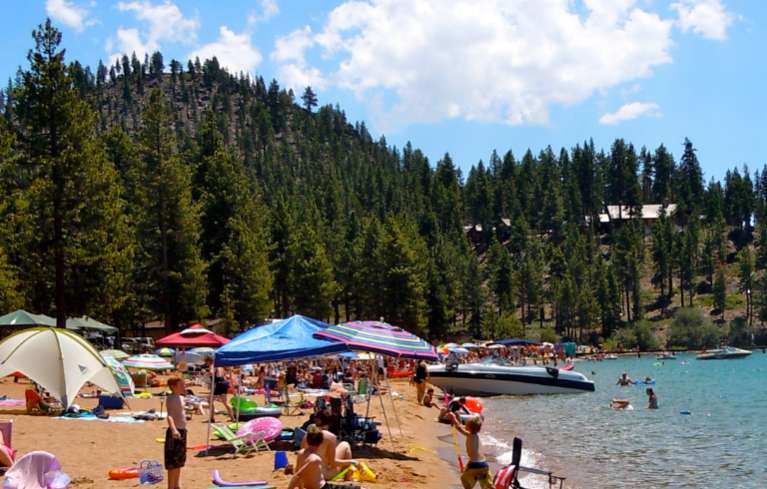



Changes coming to South Shore beaches

By Kathryn Reed

Expect some changes at the beaches this summer on the Nevada side of the South Shore.

Now that the Forvilly family does not have the concession at Round Hill Pines Beach it also means the Bleu Wave boat is not docked there. It is at Zephyr Cove.

Frank Forvilly, who with his wife Susan for decades operated the Round Hill Pines operation under the oversight of the U.S. Forest Service, told Lake Tahoe News their son, Ryan, is taking over the business.

Round Hill Pines Beach will be under new operators this summer for the first time since 1968. Photo/LTN file

Round Hill Pines Beach will be under new operators this summer for the first time since 1968. Photo/LTN file

Aramark, which runs the operations on the USFS owned-Zephyr Cove site, and Forvilly solidified a contract this month. Neither returned phone calls.

The Bleu Wave is a luxury yacht. This compares to the M.S. Dixie II that Aramark runs which is an old-fashioned paddle-wheeler.

Aramark has a permit from the Tahoe Regional Planning Agency to run four boats out of Zephyr Cove.

“Regarding the operation at Aramark, TRPA is not monitoring how many boats they are running out of Zephyr Cove. They might have four, but if not, then theoretically they could bring the Bleu Wave in under their permit,” Jeff Cowen, TRPA spokesman, told Lake Tahoe News. “We would need to document it, but it may require a permit revision.”

Forvilly is also looking to conduct weddings at Nevada Beach this summer.

“Forest Service concessionaires do have the ability to sublease services, like kayak rentals, etc., but we don’t have any information about a new wedding concessionaire at the Nevada Beach pavilion,” Lisa Herron, USFS spokeswoman, told Lake Tahoe News.

Forvilly will be subleasing from Steve Lannoy, who owns Kayak Tahoe. Lannoy has the concession at Nevada Beach and other South Shore locations.

This will be the first season Bob and Tammy Hassett have operated Round Hill Pines Beach. Bob Hassett has run several marina operations on the California side for years, as well as being owner of Beacon restaurant at Camp Richardson.

Herron said potential improvements at Round Hill Pines are still in the permitting phase.

“Nothing has been submitted for the Round Hill Pines Beach location. It remains to be seen if they will need a TRPA permit. Minor modifications and maintaining the current uses are usually exempt from TRPA requirements,” Cowen said.


Meyers plan making incremental progress

By Kathryn Reed

MEYERS – Passion for their community is one thing Meyers residents have in common. Oh, and most also think any future buildings should not be more than 35-feet tall.

What started Wednesday night as a meeting to address six issues turned into a 2½-hour opportunity for about a dozen of the more than 100 attendees to give their two cents about what they want this small enclave at the base of Echo Summit to be.

It all has to do with Meyers trying to create an area plan that will be the planning tool for the next 20 years. It will also be incorporated into the Tahoe Regional Planning Agency’s Regional Plan. That bi-state regulatory agency and the El Dorado County Board of Supervisors must each approve the plan.

Dave Reichel of the Meyers Community Advisory Council talks March 19 as fellow members John Garofalos, Rebecca Schwartz and Rene Brjec. Photo/LTN

Dave Reichel of the Meyers Community Advisory Council talks March 19 as fellow members John Garofalos, Rebecca Schwartz and Rene Brejc listen. Photo/LTN

The issues on the March 19 agenda included:

• Should there be an incentive program for developers

• Maximum height

• The number of hotels per acre and where those tourist accommodation units should be located

• The composition of the Meyers Community Advisory Council and how it is selected

• What to do with the Tveten property

• Promoting local businesses.

These subjects came about as the most pressing issues from the more than 100 comments submitted to the county since the Feb. 26 meeting.

By a show of hands people were overwhelmingly in favor of 35 feet being the basic height limit in the commercial and industrial areas.

But when it came to incentives for developers the audience was not as cohesive in its beliefs. However, most came around to believing there could be a time when fewer restrictions on height and density may be needed to attract the ideal business to Meyers. A recreation oriented business or broader tourist entity like a discovery museum had people getting on board with realizing that type of facility would need to be larger in size.

While “variances” was used, that word will have to change. This is because in TRPA’s world variances are not allowed.

And another reason to have “variances-incentives-exemptions” (call it what you will) in the area plan is because if they weren’t, the proposed project seeking the exemptions would have to do an environmental analysis. This is because it would in essence be changing the Regional Plan because the area plan becomes part of the Regional Plan.

County and TRPA reps will devise, again, verbiage for a potential incentive program and the potential types of development that could be allowed outside the 35-foot limit.

Who exactly would determine if the project were “right” for Meyers remains an unknown. But the masses leaned toward a more substantive Meyers Community Advisory Council (MCAC) that would be appointed by Meyers residents. But whether that is legally possible remains to be seen. It is not the common protocol. Nor would it be realistic for MCAC members to be elected because of the cost and time involved.

Normal procedure is for the Board of Supervisors to appoint people to advisory panels.

The goal, though, is this advisory body will be more formal. This includes being subject to state open meeting laws. It’s possible it could have a significant say in design review.

Ultimately, though, projects are the decision of the county and TRPA, depending on the size.

People seemed more amenable to hotels having fewer units per acre – more like 15 units per acre instead of 40.

What were lacking from the presentation were visual examples of buildings of certain heights as well as designs. At the Tahoe Valley Area Plan meeting for South Lake Tahoe last month photographs were shown depicting various types of alpine architecture at various heights, as well as density.

A comment form was passed out Wednesday night asking people their preference on the incentive program, height regulations, and hotel locations and density.

The verbal and written comments will be taken for a limited time that has yet to be determined. After that the county will come up with a final draft document that will be circulated. Then environmental paperwork will be created. Eventually this all goes for a vote before the governing bodies, with public comment taken at those meetings.

Meyers Area Plan documents and other information are on the county’s website. Comments may be emailed to MeyersAreaPlan@edcgov.us.


Calif. paves way for U.S. to reduce carbon emissions

By Stephen Siciliano, Bloomberg

State actions on climate change are reducing emissions and offering templates for effective federal standards, according to Mary Nichols, chairwoman of the California Air Resources Board.

Currently, Nichols said, climate regulation is on dual tracks, one state and one federal.

California, she said, is on pace to achieve the 80 percent emissions reductions by 2050 called for under its greenhouse gas emissions law, AB32. Its 33 percent of energy supply mandate, “now begins to look like business as usual” while cap-and-trade allowance auctions have become routine.

Read the whole story


Nev. struggling with student literacy issue

By Trevon Milliar, Las Vegas Review-Journal

The vast majority of Nevada students struggle to read, conceded several local education officials on Tuesday.

They didn’t debate the data. They focused on how to change it.

Federal assessments show only 30 percent of Nevada eighth-graders read at the level they should, slightly more than the 27 percent of fourth-graders who are proficient in reading. Trace Nevada’s high school dropouts back to fourth grade and nine out of 10 of them were behind in reading skills, according to the Nevada Department of Education.

“The statistics in Nevada are unacceptable,” said Nevada Deputy Superintendent of Student Achievement Steven Canavero to 175 people representing a who’s who of state lawmakers and public school leaders gathered to hear about the battle against illiteracy.

Read the whole story


DNA at center of Swanson murder trial

By Kathryn Reed

PLACERVILLE – DNA, motive and crime scene tactics will play a prominent role in the prosecution and defense of Andrew Sanford.

Nearly two years to the day after being arrested in the 1980 murder of Richard Swanson, Sanford went on trial March 18 in El Dorado County Superior Court before Judge James Wagoner.

Swanson was a 16-year-old South Tahoe High School student working the graveyard shift at the former Shell station at the Y when he was bound with duct tape and left to die of asphyxiation.

Until March 2010 no one had been arrested in the murder that took place Aug. 14, 1980.

The local Secret Witness program was started because of the Richard Swanson case.

The local Secret Witness program was started because of the Richard Swanson case.

The District Attorney’s Office believes DNA, which was not used in cases at the time, will prove 52-year-old Sanford is the murderer. The defense believes there is no proof Sanford committed the murder because the crime scene was so contaminated and that with Sanford regularly working on his vehicle at the station proves his DNA would be at the scene.

For Swanson’s parents, who now live in Sonora, they are grateful that nearly 33 years after their son’s death someone is standing trial.

Swanson’s father, Ronald, told Lake Tahoe News, “It was a great relief (when an arrest was made).” Mother, Sharon, said of her son’s death, “You learn to live with it, but it won’t go away.”

Their son, Bob, who is eight years younger than Richard, was with them in the Placerville courtroom. Mostly they were expressionless as they sat behind the assistant district attorneys.

Sanford, dressed in a gray pinstripe suit, sat next to his attorney at times taking notes, other times reading legal documents.

The trial is not expected to be over soon.

On Tuesday the eight-woman, four-man jury heard opening statements from both sides and testimony by the first five prosecution witnesses.

“Andrew Sanford – he is a thief. He stole money from the Shell station and more important he stole Mr. Swanson’s life,” Trish Kelliher, El Dorado County assistant district attorney, said in her opening statement.

“The evidence will be insufficient to demonstrate that Mr. Sanford was responsible for this criminal offense. You will ask yourself, ‘Is that all there is?’” defense attorney Erik Schlueter said in his opening remarks.

The prosecution says: Sanford lived in South Lake Tahoe at the time of the murder. He left shortly thereafter. He was convicted in 1982 for stealing a truck. At times he used a different name.

The defense says: The South Lake Tahoe Police Department used a maintenance man to collect evidence. At times gloves were not used, other times they touched multiple items. Pictures show evidence was moved.

Robert Blasier, DNA expert for the defense, said it’s impossible to detect when DNA got on an item or if was transferred there unknowingly.

Ronald Swanson was the first witness of the day. He relived what it was like to be contacted by officers at work at Coldwell Banker, to have to go home and tell his wife their son had been killed, and then go the mortuary to identify him. As a former Ventura County sheriff’s deputy and officer with the California Highway Patrol, Swanson knew the protocol of a crime scene. Even though he went to the Shell station, he said he didn’t cross the yellow crime scene tape to see where his son had died.

By the time Swanson got to the mortuary the duct tape that had covered his son’s mouth and nose, and bound his hands behind his back were removed. He stayed there for about a half hour.

“It was hard to leave,” Swanson testified.

Then Timothy Deal, who worked at the Shell station at the time, talked about what it was like to work there and the different procedures. He swung by the station about 2 the morning of the murder to do some paperwork. Deal said everything was fine at that hour.

Rodney Jones was working a construction job back in 1980 and staying at the KOA campground in Meyers. Almost daily they filled up at the Shell station. When Kelliher asked him if he recalled telling officers that there was no one to pay that morning he had no recollection. Reading the police report didn’t jar his memory either.

Kelliher kept trying to ask if Jones had a propensity to lie to cops. The judge didn’t allow the line of questioning.

Frederick Hudson was spending that August in Meeks Bay with his family, but he still had to drive to Watsonville on occasion to work. Aug. 14 was on of those days. He filled up at the shell station about 5am.

“(The officer) said I was one of the last people to see the young man who took my credit card. You don’t hear that too often,” Hudson said.

Hudson gave his statement to police over the phone; never met them in person. He testified that he was never shown a picture of Swanson.

Patrick Riley was the pathologist who performed the autopsy on Swanson. He was working for Reno-based Laboratory Medicine Consultants. He relied on his written report at the time for details about what he found during the autopsy.

“There was a laceration from the middle left of the scalp extending from the top of the head to essentially to the left ear,” Riley said.

Several black specks were found in the laceration, which he said were pieces of bone from the skull.

Officers at the time had asked him if any wood fragments were found. “No” was the answer. Schlueter, in his opening statement, said a pipe was found a few days after the murder but that it was later destroyed.

The device used to whack Swanson over the head has not been recovered.

Riley testified that Swanson died after the blow to the head.

He said death would have occurred three to four minutes after Swanson’s mouth and nose were taped.

Testimony continues today at 8:30am.


Warmest winter on record worsens Calif. drought

By Laila Kearney, Reuters

SAN FRANCISCO — California is coming off of its warmest winter on record, aggravating an enduring drought in the most populous state, federal weather scientists said Monday.

The state had a average temperature of 48 for December, January and February, an increase from 47.2 F in 1980-81, the last hottest winter, and more than 4 degrees hotter than the 20th-century average in California, the National Oceanic and Atmospheric Administration said in a statement.

Warmer winters could make the already parched state even drier by making it less likely for snow to accumulate in the Sierra Nevada Mountains, NOAA spokesman Brady Phillips said. That snow, melting in the spring and summer and running down through the state’s rivers, is vital for providing water in the summer, when the state typically experiences little rain.

Read the whole story


Ski resort accidents difficult to verify

By Elyce Kirchner, Kevin Nious and Jeremy Carroll, NBC Bay Area

Unlike accidents on our highways, waterways, and theme parks, there is no system for independently tracking accidents at ski resorts, despite the fact that in California, most resorts are on federal land.

Instead, accident tracking is left up to the ski industry to self-report, with little transparency.

The NBC Bay Area Investigative Unit analyzed injury data from the National Ski Areas Association from 2005 to 2012.

According to the NSAA, during those eight seasons, an average of 47 people were seriously injured (defined as paralysis, broken neck or back, traumatic brain injuries, and other serious injuries) at resorts nationwide. That’s 47 serious injuries out of more than 50 million annual visits to ski areas.

It’s a stellar safety record that NBC Bay Area was unable to verify. The Investigative Unit asked for details showing exactly how the industry tracks and defines these injuries and was repeatedly told that information is confidential.

Read the whole story


Early spring means allergy season for Tahoe

By Kathryn Reed

Eyes swollen? Nose running?

It’s allergy season in Tahoe and technically it’s not even spring.

Mother Nature apparently has her own calendar. Trees are flowering in the Lake Tahoe Basin, bulbs are sprouting and some early bloomers are shining through.

Spring is in air in the Lake Tahoe Basin. Photo/LTN

Spring is in air in the Lake Tahoe Basin. Photo/LTN

According to the Weather Channel, the pollen forecast for today on the South Shore is “high” and will be “very high” on Wednesday and Thursday. The active trees are juniper, sycamore and willow.

“An earlier spring means there is more pollen earlier in the season and for perhaps a longer duration, too. It does not mean the allergy season will shorten – we are more likely to experience the opposite,” Ron Roth, otolaryngologist with Barton Health, told Lake Tahoe News. “Seasons in Tahoe vary and there is no ‘normal’ here for allergy season.”

With the temperatures forecast to be in the 50s all week, the outdoors is calling. But that’s the worst place to be for some allergy suffers. But if dust is your problem, then calling in sick because you need to be outdoors could be the solution.

“To combat allergies, avoid contact with allergens to which you have sensitivities. That may involve limiting exposure to pets, dust, or time outdoors,” Roth said. He said the most common allergies this time of year are pet dander, dust, pollen and insects.

Symptoms of allergies include runny or itchy nose, itchy and watery eyes, and sometimes a scratchy throat.

“The allergy skin test is the quickest, most inexpensive, and most accurate way to find out what you are allergic to, whether it’s mold, grass pollen, or a type of weed,” says Neil Kao, an internal medicine physician specializing in allergy and immunology at the Allergic Disease and Asthma Center in Greenville, S.C., told WebMD.

Over the counter medications should help most people.

“Avoid chronic use of nose sprays such as nasal sprays that are supposed to last for 12 hour periods. Frequent use over time can lead to inflammation and cause the congestion and nasal obstruction you are trying to resolve,” Roth warned.


Festivals — an untapped millennial gold mine

By Henry Grabar, Salon

If you were driving on an American highway earlier this month, you probably passed one. They came from Nashville, New York and New Orleans, from Boston and Seattle and Chicago and Los Angeles, and from four dozen other countries entirely: 2,000 musical acts, in vans brimming with equipment and ambition and hope, rolling toward Austin, Texas, for South by Southwest like filings drawn to a magnet.

It’s a big week for these aspiring musicians. Like preseason football hopefuls, many will do two-a-days, playing to land a label or a spot at a big summer festival. But it’s also a big week for Austin. Like a polished party host, the city doesn’t flaunt its own hospitality. But after nearly three decades, the festival’s brand of forward-thinking, creative cool seems perfectly aligned with Austin’s own.

This symbiotic relationship has turned heads in municipalities across the country. Cities have historically competed for visitors by building cavernous convention centers and taxpayer-funded stadiums, and though economic wisdom frowns on these expenditures, they still build them. But festivals represent an alternative growing in popularity. Industry conferences and major sporting events, like your average American family, do not visit the same city year after year. Festivals, by contrast, are a municipal golden goose. And they don’t just stick around: They can float a cultural aura that helps affirm a city’s identity year-round. For Austin, that’s live music. For Miami Beach, it’s art. Nearly everyone agrees it’s a concept worth imitating — so why do so few American cities have world-class festivals?

Read the whole story