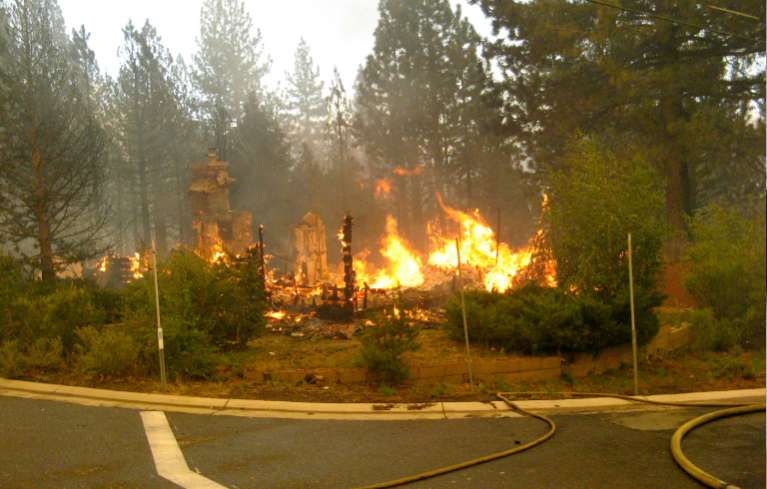
Drill keeps first responders’ skills sharp

Emery Mulligan and Jack Suglian support each other after being shot April 8 at Tahoe Valley Elementary School. photo/lesia witkowsky

Emery Mulligan and Jack Suglian comfort each other after being “shot” April 7 at Tahoe Valley. Photos/Lesia Witkowsky

By Kathryn Reed

Shots have been fired at Tahoe Valley Elementary School. A guy has been seen with a gun. Sirens wail in the distance. Officers in helmets, some carrying AR-15 semi-automatic rifles make their way to the front of the building before entering. A shot goes off as they enter, but they proceed.

This was all a drill on Monday as members of the South Lake Tahoe fire and police departments practiced what they would do if there had been a shooting. They played out the same scenario a week ago at Lake Tahoe Community College, using the two facilities during their respective spring breaks. Lake Valley firefighters participated in last week’s training.

All the first responders knew is that the drill involved an active shooter. They didn’t know where he was, how many were wounded or the extent of their injuries.

Two members of Barton Health’s staff are there, too. Cate Neal is a trauma nurse coordinator and Tina Bruess is the grief counselor. They would be doing the same thing if this were real.

Ultimately it’s up to Barton to decide which patients go to what hospital.

Paramedics have the wounded – who are high school drama students – stretched out on green, yellow and red tarmacs. Red is for people with the severest wounds. The deceased are off to the side. The shooter, once apprehended, it kept far from his victims.

Some of the wounded have walked out on their own; rescue personnel assisted others. The paramedics assess their condition, putting a triage tag around their neck so once they get to the hospital the medical personnel will have some idea of what they are dealing with.

Gone are the days when the wounded are tended to after the shooter is in custody or killed. The old policy had victims waiting hours to receive medical care.

“We make it as safe as we can and then get people inside help,” police Lt. David Stevenson told Lake Tahoe News.

While the scenario had nowhere near the intensity of a real tragedy, it still provides those involved with an opportunity to get a feel for what it would be like.

“Our mass casualty incident training days provided us excellent training opportunities to work on our skills in responding to an incident with multiple victims. These events can be very challenging for responders due to the complexity of the required steps to triage, treat and transport multiple patients,” Kim George, SLTFD engineer, told Lake Tahoe News. She coordinated the event. “This live drill training provides us all with a memory to call upon if we encounter a true incident that is similar in nature and that gives us an advantage.”

Douglas County loaned the city its camera that was posted high in the air to capture what was going on. This was being relayed back to Lake Tahoe Airport, which doubles as the command post for the Office of Emergency Services, where Fire Chief Jeff Meston was watching his charges.

With mass shootings happening throughout the country, and close by – Carson City iHop in 2011 – this type of scenario could be a reality in South Lake Tahoe. The closest school shooting was last year at Sparks Middle School where a student killed a teacher before shooting himself.

Mother Jones has been tracking mass shootings. There have been 67 mass shootings in the last three decades. Most shooters got their weapons legally.

ngg_shortcode_0_placeholder (Click on photos to enlarge.)


Sandoval slams BLM for ‘First Amendment Area’

By Laura Myers, Las Vegas Review-Journal

Gov. Brian Sandoval on Tuesday accused the Bureau of Land Management of violating Nevadans’ constitutional rights to protest a BLM roundup of cattle on federal land and slammed the agency for creating an “atmosphere of intimidation.”

Sandoval called on the BLM to dismantle a so-called “First Amendment Area” the agency designated to allow demonstrators to protest the gathering of rancher Cliven Bundy’s 500 head of cattle. The federal government is rounding up the cattle around Bunkerville because Bundy has refused for 20 years to pay grazing fees.

“Due to the roundup by the BLM, my office has received numerous complaints of BLM conduct, road closures and other disturbances,” Sandoval said in a statement. “I have recently met with state legislators, county officials and concerned citizens to listen to their concerns.”

“I have expressed those concerns directly to the BLM,” he added. “Most disturbing to me is the BLM’s establishment of a ‘First Amendment Area’ that tramples upon Nevadans’ fundamental rights under the U.S. Constitution.”

Read the whole story


Barton Ranch on path to be destroyed

The multiple buildings that once was the Barton Ranch are slated to be demolished. Photo/LTN

The multiple buildings that once were the Barton Ranch are slated to be demolished. Photo/LTN

By Linda Fine Conaboy

Sometime soon, if family members have their way, the iconic cluster of buildings at the South Lake Tahoe Y known as the Barton Ranch will become nothing more than a heap of historic rubble. Slated for demolition are the barn, ranch house, guesthouses, cabin, cottage and shed.

Even though the property is on the Tahoe Regional Planning Agency’s list of historic sites, family members maintain that they are subjected to risk and liability from trespassers, graffiti, abandoned cars, mold, mildew and lead-based paint.

The process to clear the property, which started several years ago but has stalled along the way, may now be moving along a smoother path, as the family has jumped successfully through myriad obstacles along the destruction path.

People have until April 25 to comment on the negative declaration. There will be a public hearing before the Planning Commission on May 8 at 3pm at Lake Tahoe Airport, with the panel being asked to approve the negative declaration and plans for demolition of all of the remaining structures associated with the old Barton dairy ranch located at 1080 Emerald Bay Road.

Gary Midkiff, a land use and permitting consultant, is the spokesman for the Ledbetter and Mosher families. They are the property owners and descendents of the Bartons. He explained that the request for removal and destruction of the structures began close to three years ago.

“We’ve been working with the city of South Lake Tahoe to address the issues that city staff was anticipating would be raised by the community,” he said.

“So far, we haven’t gotten any comments. The notice was published at the California State Clearing House, where all environmental documents are sent under CEQA. But we’re expecting comments from the Clearing House after the comment period closes. If there are questions we need to address, we will address them,” Midkiff told Lake Tahoe News.

Midkiff said he contacted the Lake Tahoe Historical Society three or four years ago and offered them the buildings for removal or relocation, however, he said he hasn’t talked to them lately.

He added, “There is no rule that says because it’s a historical site the buildings have to be retained.”

South Lake Tahoe is an important player in this continuing story, too. Judy Finn, associate planner for the city, said there are problems such as black mold, asbestos, graffiti and people breaking in and attempting to live in the buildings; generally reiterating the owners’ list of grievances.

“The family wants to restore and revegetate the property, and may want to look at more viable uses in the future,” Finn told Lake Tahoe News.

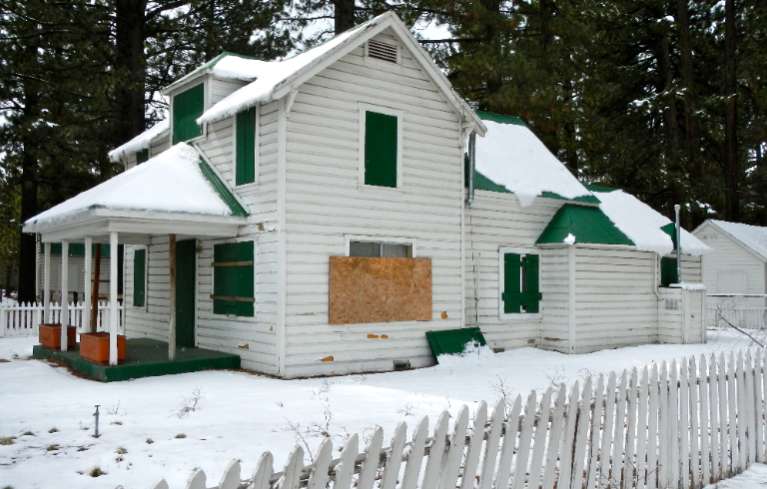
The buildings in question, with their green roofs and white exteriors, were once stately. Boarded windows make it look like a forlorn relic waiting for whatever the fates have in mind. The property looks abandoned, even though it’s nestled into an idyllic setting amid tall trees on 4 acres of land next to the Raley’s shopping center.

The history of the legendary Barton family is important to Lake Tahoe. According to a fall 1972 Lake Tahoe Historical Society newsletter, more than a century ago the Bartons spent their summers ranching their property in Hope Valley and on land they homesteaded in Meyers.

In 1915, they moved to the South Shore and settled in an area that is now the Lake Tahoe Airport. There they established a dairy known as Meadow’s Edge. They ran a milk route to Echo Lakes, Camp Sacramento, Twin Bridges, Tahoe Meadow and Beecher’s Country Club, where Harrah’s is now located.

Several years later the property at the Y was developed, when this region was wide-open and the only road in the basin was Pioneer Trail. Through the years South Lake Tahoe has been the beneficiary of the Barton family generosity, including a gift of land upon which now stands Barton Memorial Hospital.

Although clearing of the land is not a foregone conclusion, there are those individuals and entities that are feeling the crush of an important part of history coming to an end and the need for its preservation.

Lake Tahoe Historical Society spokesperson and board member Lee Vestal is one of those interested parties.

“All I personally want to see with the Barton Ranch is that it gets a fair shake to survive,” he said. “If all the environmental reviews, including hazmat remediation for the suspected contamination, say knock it down, then knock it down. But the ranch needs a fair review and the involvement of the community. If the community wants it saved, it needs to step up and provide financial and emotional support.”

Vestal said the historical society has been working quietly behind the scenes to find out what the property owners really want and to see what options are available to save the ranch.

“We’ve sent letters to the Tahoe Regional Planning Agency and to City Manager Nancy Kerry,” he said. However, he said, to date there have been no replies.

At the very least, Vestal said that everything at the ranch will be photographed and the story will be captured by the historical society.

Catherine Whelan, who is president of the historical society, said the family has a right to sell the land.

“But you would think the city would want to preserve it. There are so few old buildings left. The ranches were big here before the casinos went in. This could show the history of the Tahoe basin,” Whelan told Lake Tahoe News. “The city has a perfect opportunity to turn this property into a cultural center showcasing the ranching period of South Lake Tahoe. I think they’re missing a huge opportunity to make money.”

Lake Tahoe News was unable to make contact with the property owners – the Mosher family and members of the Ledbetter family; however, Jessica Ledbetter, a cousin, had this to say: “I’ve worked with Gary Midkiff in the past and I think he is an outstanding representative for my Aunt Melba Mosher and my cousins, William Mosher, Faye Krull and Ouida Garms.

“Whatever decisions my aunt and my cousins have come to, I know it hasn’t been easy. It’s been an extremely emotional decision for them. We’ve recently talked about all the wonderful times we’ve spent on the property and all the wonderful memories. I support any decision they make.”

Midkiff added, “They are not a development family.”

But the question remains, where will the final journey take the old Barton site?

“There are no plans for use of the property at this time,” Midkiff said. “They’re watching the area plan that is being drawn up by the city and TRPA closely to see the outcome. Based on that, based on the economy, and based on interest by any commercial entity, they may make future plans.”


WHS test scores on a steady decline

By Kathryn Reed

STATELINE – Despite the show of support from staff and board members, the news out of Whittell High School is not good. Student test scores are going down.

Principal Crespin Esquivel delivered the numbers April 8 at the school board meeting. Math and reading scores have been tumbling at all grade levels to the point that most are not at the proficient level in reading, math or science.

Esquivel said in part it has to do with seventh- and eighth-graders being in some combined classes. This is because the student population is so low – there are 208 kids in the 7-12 school – grade levels have to be combined. It means the rigor is not there for all students.

The Zephyr Cove school in many ways is run as though it is two schools — as a middle school and high school.

Asked by board member Cindy Trigg if there is one thing that could make a difference to help turn things around, Esquivel said a vice principal. He also said it’s imperative teachers are retained even if fewer students are on the attendance roll. He said having someone else on board would give him more time to focus on critical issues, even visit classrooms more often.

While hiring another administrator is not likely to happen based on budget constraints, money is being spent to assess some of the issues that are going on and to help come up with solutions. Ray Sidney’s entire donation for the basketball renovation was not spent and he said it would be fine to use it on other things.

One of those other things was hiring consultant Bev Ducey to “examine successful small schools and identify several for further research into their keys to successful student learning outcomes.”

Those schools that Esquivel will be contacting are in Telluride, Colo., Chester and Quincy. The goal is to dig deep to see what they have done to be successful and to ideally find ideas that would work at WHS.

Esquivel also recognizes the need to get some mentoring for himself to help learn how to satisfy the ongoing mandates from the state, balance the need for better oversight of teachers, and focus on getting students the help they need to achieve at a higher level.

The positive info delivered Tuesday afternoon was that in 2013 93 percent, or 40 of the 43, students graduated. This year the school earned state championships for the girls’ ski and boys’ basketball teams for the first time.

In other news:

• Nancy Cauley, principal at Zephyr Cove Elementary, said her students are making progress in growth and proficiency on standardized tests.

• No offers have been made to purchase Kingsbury Middle School. The item will be back on the agenda in May.


Sage grouse, wild horses dominate BLM budget

By Martin Griffith, AP

RENO -— Wild-horse fertility control and sage-grouse habitat conservation are among top priorities in the proposed $1.1 billion budget for the federal Bureau of Land Management.

President Obama’s request for the 2015 fiscal year calls for an increase of $2.8 million in funding for the agency’s wild horse and burro program, and would allow it to continue studies to develop more effective contraceptive drugs and techniques.

The BLM has pledged to step up the use of fertility control as an alternative to controversial roundups of what it calls overpopulated mustang herds on U.S. rangelands in the West.

If approved by Congress, the request would further the BLM’s implementation of recommendations made by an independent panel of the National Academy of Sciences in 2013, agency officials said.

In a report highly critical of the BLM, the panel said the agency should invest in widespread fertility control of the mustangs instead of spending millions to house them.

It concluded the BLM’s removal of nearly 100,000 horses from the Western range over the past decade is probably having the opposite effect of its intention to ease ecological damage and reduce overpopulated herds.

The BLM treated about 1,000 mares in 2012 but only about half that last year, records show, far short of the annual goal of 2,000 then-BLM Director Bob Abbey announced in 2011.

Anne Novak of California-based Protect Mustangs questioned the value of fertility control and called on Congress to embrace “holistic” land management by keeping mustangs on the range to rebuild soil and reverse desertification. She thinks the agency’s horse roundups have caused the herds to have an increased birthrate.

“Throwing more drugs, sterilizations and pesticides on native wild horses is a backwards approach,” Novak said. “It’s time to help our American wild horses contribute to the thriving natural balance of the ecosystem using fresh science.”

The budget also seeks to maintain funding for the BLM’s initiative to conserve sage-grouse habitat across the West to avoid the bird’s listing as an endangered or threatened species. The agency plans to complete the plan in the upcoming fiscal year. Such a listing would have economic consequences for ranching, mining and alternative energy development across large swaths of land.

Another top budget priority is authorization of a nonprofit foundation to help provide the BLM with new ways to work with the public on landscapes and programs, including wild horse and burro management.

“The BLM carries a great responsibility in its stewardship of roughly 10 percent of the nation’s land,” BLM Principal Deputy Director Neil Kornze said in a statement. “We strive each day to strike the right balance under our multiple use and sustained yield mandate.”

Kornze testified on the budget at a hearing Friday before the House Subcommittee on Interior, Environment and Related Agencies.


Brown: ‘Promote tourism and clean industries’

Kevin Brown

Kevin Brown

Publisher’s note: Lake Tahoe News asked the six El Dorado County supervisor candidates a series of questions. All are the same except for one that is specific to each candidate. The responses are being run in the order they were received by LTN. One candidate chose not to answer the questions.

Name: Kevin Brown

Age: 50

Occupation: Business owner

Education: Graduated Del Mar High School, San Jose 1981, AS Degree in electronics, Condie Jr. College, Campbell 1989

What elected, civic, nonprofit boards or groups are or have you been affiliated with and in what capacity?:

• El Dorado Union High School District board of trustees, president 2013, 2014.

• El Dorado County Chamber of Commerce board 13 years, president 2006.

• El Dorado County Economic Development Advisory Committee, 2006-08.

• Pollock Pines Design and Review Committee 8 years, vice chair.

• MORE Board 2006-13.

• El Dorado County Child Abuse Prevention Council, vice chair.

• Placerville Economic Advisory Committee, chair.

• Cub Master Pack 104, 2002-06.

• Scout Master Troop 170, 2006-11.

• Big Brothers/Big Sisters volunteer.

• Prevention Works, volunteer.

• The Center for Violence Free Relationships, state certified volunteer.

• Kiwanis, Shriner.

* Partial list.

Traffic is horrible on Fridays and Sundays throughout the county. Will you commit to not voting for any big subdivisions unless there is a plan to widen Highway 50? Why or why not?: Highway 50 is a state highway and our TIM fees would be insufficient to cover such improvements. We’ll need help from our state and federal officials, as well as regional governments to forge a solution for Highway 50. I would favor development plans that value businesses over rooftops and believe development must pay its share of traffic mitigation.

What is your opinion on a proposed November initiative to control growth?: I don’t think a ballot-box moratorium is the right path. Instead we need to elect leaders with a commitment to support sensible policies that create jobs. The county needs revenue to provide the services our residents want and deserve like public safety, snow removal. Those costs continue to rise, so it is essential that El Dorado County encourage job-creating economic development.

What are your thoughts of making Lake Tahoe its own county?: I am not aware of a serious proposal to create a separate county and would not likely support a split. I recognize that SLT has been underrepresented by the county, but I would prefer to heal that divide rather than split the county. Many of the fiscal challenges facing counties are created by unfunded mandates from the state, and a big part of the county budget is spent administering state programs. Forming a separate county would result in diverting funds to pay for law enforcement (county jail), prosecution, fire, road maintenance, health and human services, and other services that would not be sustainable.

What entities would you not take money from?: I think everyone who gives money is a “special interest” and it is cynical to single out specific interests for political purposes. Instead, I have made my position clear — decisions will be based on my vision for El Dorado County. If you agree and want to contribute, you are investing in my vision; if you disagree, money won’t change my mind.

What would you do to boost the economy?: We need to promote tourism and clean industries like programming, entertainment and medical records management. I will fight for more TOT dollars be spent in the basin to increase tourism. I would use my experience in economic development to find businesses that fit the environment and culture of the basin to bring jobs and tax revenue. We should be working with groups on infrastructure investments, like high-speed Internet that can spur technology investment in South Lake Tahoe.

What is the No. 1 issue facing District 5 and how do you propose to resolve it?: In the past, I would have said high unemployment. But after talking with many people I have found the biggest concern is that South Lake Tahoe feels isolated by and from the county. Some feel that regardless of whom they elect, their needs are not heard or met in Placerville. “Resolve” makes it sound like a one-time fix; but I think it takes an ongoing commitment. I will use relationships I have built over the past 15 years to ensure SLT issues are heard, I will fight to unite our communities so we can work to solve problems that many of us share and I will maintain a supervisor’s office in South Lake (even if I need to raise the funds to pay for it) and hold regular office hours. The basin will be heard and represented.

Supervisors meet only once a year in Lake Tahoe. Do you believe this is fair representation? Why or why not?: Absolutely not. I would fight for a more equitable arrangement — and would require hearings in SLT on issues that impact SLT.

Would you have voted for Red Hawk to be built and to divert Caltrans funds for interchanges? Those decisions are still negatively affecting the South Shore. Is there anything you would do to change the status quo?: The funding and the approval are separate issues. The county did not have the authority to block Red Hawk. The issue was whether to resist or work cooperatively with them to resolve as many concerns as possible. Either way the casino would have been built, so a no vote would have achieved nothing. In terms of the interchanges, money was not diverted, the casino dedicated about $110 million over time to pay for the interchange and Highway 50 improvements, however if they were not built, traffic to the casino would have been forced onto Grassy Run Road, Rolling Rock Road and Reservation Road — narrow rural roads with many homes that would have been impacted. In terms of changing the status quo, we need to work better regionally to prioritize transportation funding, focus on job-creating business growth, and expanding tourism dollars.

Would you support having more tax dollars from the county coming to the South Shore? Currently, more dollars leave the basin than come back.: That is simply not fair, and I would work to for equitable distribution.

The county and city of South Lake Tahoe have a long history of not getting along. How would you propose to improve the relationship?: I have a record of bringing people together and working with others to solve problems. Part of better communication is “showing up” — that is why I will maintain a supervisor’s office in SLT and hold regular office hours. I will sit down with the city to forge plans to together, find our common ground and build a new, better relationship between South Lake Tahoe and the county.

What is your vision for Meyers and how will you make it a reality?: I believe Meyers residents want the current Area Plan reverted to be more like the ’93 zoning plan. From what I have learned and heard, they oppose major developments in the Town Center area. They want more input into in the planning process and assurances that the Catalyst Project is dead. I will involve more people in the planning and implementation of the changes and final plan. I believe we can better inform the public of meetings and critical issues. As supervisor, I’ll push for better notification and efforts to engage the community.

Why should someone vote for you over someone else?: I have spent the last 15 years helping solve problems. I have run a business, improved student performance as a school board member, helped create a better plan for creating jobs, and built a foundation of trust and respect throughout the entire West Slope. I will tap those relationships to ensure Tahoe gets the attention and respect it deserves. My relationships with the county, nonprofits and the private sector give me the best chance to unite our communities and bring South Lake Tahoe and the county together.

You have received financial assistance in your prior campaign from Serrano Construction. How do you like their two projects that are before the county?: First, we should correct the perception — I was featured in joint mailer with another school board candidate paid for by Serrano and Associates Home Owners Association, not the construction company. There were a group of homeowners with children who went to school together from kindergarten to the 8th grade, they played in the same soccer and Little League games — they grew up together. An arbitrary boundary meant some of them would be forced to leave their friends and go to a high school well outside of their neighborhood. I don’t care much about the politics — that is just wrong. I proposed a transfer policy that would allow these students to attend the same high school as their lifelong friends. Despite some misconceptions, the policy has no effect on development. The projects you refer to are proposed by Parker Development, who built Serrano. My priority for construction is to focus on long-term, good paying jobs over sprawling development in our rural lands that impacts not only our traffic but our beauty and existing residents.

What do you do for fun?: My wife and I love to hike. We take day hikes often throughout the area. Enjoying our beautiful scenic treasures we call home, El Dorado County.

Tell us something about yourself that people might not know: In March of 2007 I was invited by a friend to play in a Texas Hold’em Tournament at Harrah’s Reno. Other than friendly games with my friends I had never played poker, much less in a tournament. Surprising everyone (including myself), I won and went on to play in the World Series of Poker Main Event in Las Vegas in July 2007. I outlasted poker legends like Daniel Negreanu, Mike Matusow, Phil Ivey and Men “The Master” Nguyen, but did not place in the money. It was exciting, and literally a once-in-a-lifetime experience.


TRPA wins Regional Plan lawsuit vs. Sierra Club

By Kathryn Reed

A judge on Monday sided with the Tahoe Regional Planning Agency in a lawsuit that would have unraveled the bi-state regulatory agency’s Regional Plan that was adopted in December 2012.

In February 2013, the Sierra Club and Friends of the West Shore filed a lawsuit in U.S. District Court in Sacramento to stop the Regional Plan from taking effect in its entirety.

U.S. District Court Judge John Mendez on April 7 said the agency could keep the document in place. In June he had handed TRPA a partial victory by saying the Regional Plan update does not violate California law by allowing local jurisdictions to have more authority. That was one of the items in the lawsuit.

Total maximum daily load, concentrated coverage, soil conservation, best management practices and the ozone threshold were the main issues the two groups have problems with in the latest Regional Plan. In each case the judge sided with the TRPA, saying the agency was adequately addressing the concerns.

No one from the Tahoe Area Sierra Club was available for comment.

“We respect the concerns of our colleagues at the Sierra Club, Friends of West Shore and Earthjustice about the new Regional Plan. It is not a perfect plan, but the League to Save Lake Tahoe also recognizes that it has the potential to help Tahoe’s environment through multiple safeguards that require restoration and environmental improvements with any new development or redevelopment,” Darcie Goodman Collins, executive director of the League, said in a statement.

In the past the League and Sierra Club have been lockstep in challenging the TRPA. Not so in this case.

“It will give investors more confidence and homeowners more confidence,” Jeff Cowen with TRPA told Lake Tahoe News of the judge’s decision.

With the Lake Tahoe Basin being one of the more litigious oriented areas in the country, as well as overregulated, some investors are said to have shied away from doing business here.

TRPA had been operating as though the Regional Plan update was the law of the land because no injunction had been imposed. This is proven by the adoption of two area plans at the lake in the 16 months since the plan was ratifeid. These are planning documents that are now required by TRPA by jurisdictions in the basin to create.


Calif. groundwater depletion could be catastrophic

By Tom Knudson, Sacramento Bee

LOS BANOS — Flat as a tabletop, the furrowed, brown farm fields east of this San Joaquin Valley town are some of the most productive on Earth.

Every spring, they are planted with a smorgasbord of crops that in one form or another are trucked to grocery stores across America, from fresh juicy tomatoes to freeze-dried onion flakes, honeydew melons to tortilla chips.

Now that bounty is threatened by a crisis of geological proportions: The land is sinking – crippling the region’s irrigation and flood control infrastructure and damaging aquifers that are buffers against climate change.

Nature, though, is not to blame. This problem is self-inflicted, driven by the frontier-style exploitation of the last unregulated resource in California: groundwater.

“We are looking at a material impact of a magnitude that is potentially catastrophic,” said Cannon Michael, a sixth-generation farmer who grows tomatoes, onions and other crops near Los Banos.

Today’s drama is only the latest chapter in a long-running saga of sinking. Three generations ago, so much groundwater was pumped from aquifers that half the valley sank like a giant pie crust, sagging 28 feet near Mendota and inflicting damage to irrigation canals, pipelines, bridges, roads and other infrastructure.

What stopped it were two massive government-funded irrigation efforts – the federal Central Valley Project and California State Water Project – that flooded the region with water from distant California mountains, relieving pressure on the area’s natural underground water supply. But the fix was temporary. Today, drought, climate change and other forces have unleashed a new era of groundwater pumping, triggering some of the worst land subsidence ever seen in California. Near Michael’s farm, the valley is predicted to drop 17 feet by 2060.

Read the whole story


Tahoe Keys Blvd., state streets to be torn up

By Kathryn Reed

Avoiding Tahoe Keys Boulevard this summer might make for a better driving experience.

Gerhardt & Berry Construction out of Sparks will begin a water line replacement project the first week of May that could take all summer.

The South Tahoe Public Utility District board last week awarded the $3,346,572.70 bid. Nine bids were submitted for what engineers had estimated would be at $4.1 million project.

The state streets water line project in South Lake Tahoe will be finished this year. Photo/LTN

The state streets water line project in South Lake Tahoe will be finished this year. Photo/LTN

The 2- and 4-inch lines will be replaced with 6-, 8- or 12-inch lines. The side streets get the 6-inch lines and Tahoe Keys Boulevard 12-inch, while Michael Street will have 8-inch. There will be 11,752 feet of pipe installed.

All the affected houses will also get meters.

This is the second phase of the State Street Water Line Project. South Tahoe PUD is making a concerted effort to replace water lines throughout its service area so fire suppression regulations are met. As the South Lake Tahoe-based agency does so, it is putting in the state mandated meters. All STPUD customers are expected to have meters in the next five years to meet the 2025 state deadline.

Sierra Nevada Construction, the second lowest responsive and responsible bidder, had filed a bid protest. No one from the company was at Thursday’s meeting.

The company was challenging the subcontractor being used for the jack and bore work, the pipe bedding supplier and the experience of Gerhardt & Berry. Staff and the board members didn’t believe the challenges were sufficient to not award the bid to Gerhardt & Berry.

Work on Tahoe Keys Boulevard will be Monday-Thursday. One lane will always be open, but that means delays as the traffic is controlled. Formal detours will not be set up, but there are ways to circle around throughout neighborhood streets or use Fifteenth Street off Highway 89.

“We will try to get as much done before Memorial Day as we can,” Shannon Cotulla, STPUD engineering department manager, told Lake Tahoe News, after the April 3 meeting.

Some of the state streets had work done in 2013. This year the remainder of the side streets off both sides of Tahoe Keys Boulevard will get new water lines down to Jeffery Street.

The other project South Tahoe PUD will be doing is installing a force main bypass for sewage. On Tahoe Keys the sanitary force main was installed in the 1960s, so if there were a failure, there is no backup. In other words, there is no place for sewage to go except for spilling or to create a backup into residences. The bypass will create an alternative if there were ever to be a breach in the line.

During the water line replacement STPUD will place door hangers at residences when construction will take place out front or if water will have to be turned off. At times people will not be allowed to park on their street. Access to driveways will always be allowed, but it may require getting the construction crews to move a metal plate over an open trench.


Why homes are lost to wildfire

2007 was the worst fire season in the Lake Tahoe Basin when 254 houses on the South Shore were destroyed. Photo/Lake Valley Fire

2007 was the worst fire season in the Lake Tahoe Basin when 254 houses on the South Shore were destroyed. Photo/Lake Valley Fire

By Melissa Mylchreest, High Country News

Each year, wildfires claim hundreds of homes throughout the West in what’s known as the wildland-urban interface. This issue roars into the national spotlight every summer as footage of engulfed subdivisions flickers on TVs across the country. National fire suppression budgets reach into the billions of dollars every year, much of that cost associated with protecting homes and structures. But are we approaching the problem from the right angle?

Jack Cohen is a research physical fire scientist with the U.S. Forest Service, based at the Missoula Fire Sciences Laboratory. With four decades of experience, he is a preeminent expert on wildfire and home ignitions, and a founder of the Firewise Communities recognition program, a project of the National Fire Protection Association that helps homeowners protect their property against wildfire.

Years of study have convinced Cohen that the loss of homes to wildfire is as much a sociopolitical problem as it is a physical, on-the-ground problem. Agencies and the public alike approach the issue as a question of fire suppression and control. Cohen, on the other hand, believes that fire is here to stay, and that proper mitigation, awareness and planning can make living with fire a whole lot easier – and safer.

Read the whole story