All of Calif. in at least a moderate drought

By Olivia Allen-Price, KQED-TV

For the first time in the 15-year history of the National Weather Service Drought Monitor, 100 percent of California is judged to be in moderate to exceptional drought.

It’s a dramatic-sounding milestone, although the state has been lingering at the 99.8 percent mark since March 18.

Though it’s a first for California to be completely in drought, other states have been there before, including New Mexico in June 2013, and Texas from September through November 2011.

You’d need to return to a time before the Drought Monitor existed to see California in such a dire situation.

Read the whole story


Dispatch center a constant hum of activity

Sue Keast keeps an eye on three monitors in the South Lake Tahoe dispatch center. Photo/Lesia Witkowsky

Sue Keast keeps an eye on three monitors in the South Lake Tahoe dispatch center. Photo/Lesia Witkowsky

By Kathryn Reed

“When you pick up the phone and hear screaming, you know it’s not going to be a good call.”

Those are the words of a South Lake Tahoe dispatcher. It’s something they deal with around the clock, seven days a week.

But then there are the calls from people wanting to know what the weather is like or asking when power will be restored. They end up tying up one of the five dedicated 911 lines. Those questions are not why the emergency system was installed nor are they questions dispatchers should have to deal with.

Sometimes people are surprised to get a busy signal when they call 911. But if everyone calls when they see a wreck, those five lines will get tied up pretty fast.

Besides phones going off, the dispatchers are monitoring three screens. Soon there will be a fourth that will have mapping software.

A new phone system is coming, too.

They are dispatching for city police officers, and fire calls for the city, Lake Valley and Fallen Leaf Lake, and all ambulances on the South Shore.

Stressful work

One ear is paying attention to the person on the phone, the other to the officers, firefighters or paramedics. Sometimes they are helping direct CalStar to a scene.

All the while they are typing what’s going on.

And multiple calls at a time are the norm.

They work in a relatively small room that only has artificial light. The one window is covered because it looks out to the front waiting area. This is where they take breaks. A trip to the bathroom better be fast.

They work as a team and consider the other person their partner.

While there are four desks, no one can remember when four dispatchers actually worked at the same time. The dispatch center is so understaffed that often only one person is working. Otherwise it’s two people. And it’s always two people on Friday and Saturday nights. Fourth of July and New Year’s Eve often warrant three dispatchers.

“We try not to work more than 14 hours except in cases like New Year’s Eve. Sometimes you might have to work longer, or if there is a fire or some sort of incident where you can’t leave,” Sue Keast, who supervises the dispatchers, told Lake Tahoe News.

Checking probation status, driver’s license, warrants – it’s all part of the job. They are the records department after normal business hours. Dispatchers enter citations and warrants.

Not that long ago they didn’t provide a caller with much medical help. Today there are a slew of issues they can help with. A computer program prompts them to ask questions based on the answer given.

Linda, a dispatcher who doesn’t want her last name used, says the goal is to calm people down, to try to provide whatever assistance they can before paramedics arrive. It could be a life and death situation if a person can start CPR before the ambulance arrives.

Personal involvement

Being such a small area it’s not unusual for the dispatchers to know the caller or victim.

“I was on the fire radio and my mom called 911. My partner took the call. She recognized the address and tried to get my attention. When I saw the address you could hear my voice shaking as I dispatched an ambulance out to my parents’ house,” Keast said. “Everyone’s fear is they are going to dispatch to a family member.”

Coming this year people will be able text 911. It’s a federal mandate. While this is seen as a good thing for when there is a prowler or another circumstance where it’s best if the intended victim doesn’t say something, the use of pictures is what worries dispatchers.

It’s bad enough hearing everything that is going on. They don’t need pictures.

For Joe, who also just wanted to use his first name, someone died every day the first two weeks he trained.

Everyone has stories to tell – like the lady on the phone whose husband was face down in the bathtub. She was too frail to turn him over and could only watch him drown. The dispatcher could only listen to her tears.

Debriefing for dispatchers is only now becoming part of the norm. They were not included in the debriefing after the Angora Fire – yet they all knew people who lost their homes – including one of the dispatchers.

It’s not always a single event that lingers, but the accumulation of calls. Last summer, the dispatchers say, was one of the worst. There were two murders, several deaths, the child at Camp Sacramento who went into anaphylactic shock and died, the swimmer who drowned at Emerald Bay.

“It was pretty devastating to our staff,” Keast said of all the tragedies. She said the department is getting better at addressing the stress involved with being a dispatcher.

Ambulance issues

South Lake Tahoe believes it is subsidizing the CalTahoe JPA by $60,000 a year in dispatch services. The JPA contract pays $90,000, but the city says the cost is more like $150,000.

Funding for ambulance JPAs in the county differ.

“The West slope JPA was started before the passage of Prop. 13. Accordingly, the West Slope ambulance JPA gets a portion of the base 1 percent of each tax bill on the West Slope. That is what state law requires,” Joe Harn, El Dorado County auditor-controller, told Lake Tahoe News. “The CalTahoe Ambulance JPA was after the passage of Prop. 13. Accordingly, the CalTahoe Ambulance JPA does not get a portion of the base 1 percent of each tax bill in Tahoe. That is what state law requires.”

Counties can decide how ambulance service is provided. Mike Applegarth who works in the chief administrative office chose not to answer the following basic questions:

• Why is the county in the ambulance business?

• Why not let the fire departments run it themselves?

“As part of the JPA contract we have to provide dispatch, ambulances have to meet certain criteria. It’s a comprehensive package,” Jeff Meston, South Lake Tahoe fire chief, told Lake Tahoe News. “It favors the county.”

Meston said the county is getting money via taxpayers and by billing for ambulance service, but all of it is not returned to the CalTahoe JPA.

“The money exists in accounts we cannot get our hands on,” Meston said.

Last year the JPA board sent out a request for proposal for dispatch service, but it wasn’t done properly so it never went anywhere. The board is made up of two Lake Valley Fire Protection District board members and two South Lake Tahoe City Council members. North Tahoe Fire used to be part of the JPA, so then there was a fifth vote.

CalTahoe Ambulance JPA has been without an executive director until Monday when Ryan Wagoner was hired. He recently took a medical retirement from the city police department. He has also been on Lake Valley’s board. He is also an emergency medical technician.

Other than being dispatched to calls, Wagoner said he is not yet privy to the intricacies of issues surrounding dispatch.

“I heard it will be one of the first things the chiefs want to talk about,” Wagoner told Lake Tahoe News.



Survey: SLT voters warm to upping some taxes

By Kathryn Reed

South Lake Tahoe voters are open to spending money on infrastructure, but they don’t want to foot the entire bill.

The city submitted a few questions for a recent survey that Lake Tahoe Community College contracted for in regards to its proposed general obligation bond.  The city paid for 25 percent of the survey at a cost of less than $5,000.

“Since the college was conducting a survey, which is typically expensive, it was a good opportunity to see if for very little cost the city could tag onto the college’s survey,” City Manager Nancy Kerry explained.

Harrison Avenue upgrades are being funded by a variety of sources. Photo/LTN file

Harrison Avenue upgrades are being funded by a variety of sources. Photo/LTN file

The results show that 65 percent of voters would support increasing the hotel tax. On previous city surveys the voters have said the same thing – it would be fine to up the transient occupancy tax.

When it came to be willing to support a sales tax for infrastructure, slightly more than half the voters, or 54 percent, said do it.

“The City Council does not have on its work plan to go to the voters anytime soon on a tax increase,” Kerry told Lake Tahoe News.

Still, money is needed if the city is going to make any kind of dent in upgrading, maintaining and bringing some of its infrastructure to code.

“We also need money for recreation upgrades and facilities and services. The question is whether there is an appetite of the community to invest in these key strategies – infrastructure and recreation – or if funding will need to come from another source,” Kerry said.

The massive Harrison Avenue project, which has started, in part is being funded by the city taking out a loan.

Here are the actual survey results.


Fallen Leaf Lake trail network to be revamped

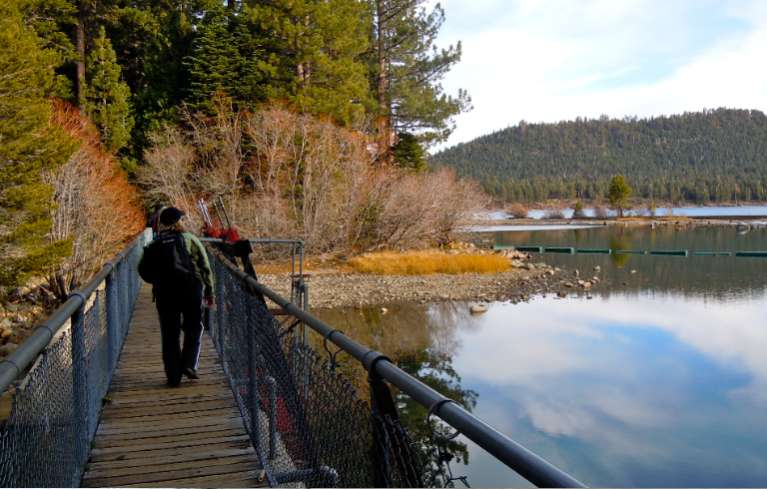
Improvements are coming to Fallen Leaf Lake dam and surrounding trails. Photo/LTN file

Improvements are coming to Fallen Leaf Lake dam and surrounding trails. Photo/LTN file

Upgrading the trails around Fallen Leaf Lake and creating new ones could take five years, with the first phase beginning next week.

This summer a new bike path from Fallen Leaf Campground to the Pope Baldwin Bike Path will be built. (The latter trail is better known as the Camp Rich paved path.) Several trails on the north end of Fallen Leaf Lake will receive upgrades, and others will be rerouted and reconstructed. A number of user-created trails will be decommissioned.

The trail along the west side of Taylor Creek that runs north and south will remain, but be improved. This includes slope stabilization. The Clark and Church trails will also stay.

The polo field parking lot near the entrance to Valhalla has been incorporated into the Tallac Site plans. Improvements to the Camp Richardson paved trail will be part of the Camp Rich plans. While the projects are separate, the Forest Service has an eye on the big picture so everything is designed to flow together and complement the other.

Expect temporary closures or restrictions in the areas being worked on. The U.S. Forest Service, which owns the land, is warning that noise and visual impacts may affect the Fallen Leaf campground and surrounding areas.

Two of the goals of the project are to reduce congestion and user conflicts. These trails are heavily accessed by locals and visitors. The hope is that with more trails it will better disperse users.

The entire project area encompasses 14,960 acres on the South Shore.

Future work will include reconstruction and rerouting portions of the Mount Tallac Trail, new trailheads and parking areas developed in several locations along the Highway 89 between Camp Richardson and Spring Creek Road, and the last one-quarter mile of the Camp Rich trail will to be moved to a more appropriate crossing and access point on Highway 89.

The 80-year-old dam at Fallen Leaf Lake-Taylor Creek will also be revamped to allow for cyclists to ride over it without having to lift a bike up steps.

Plans call for a new trail connecting the Pope Baldwin Bike Path from the Spring Creek Road area to Fallen Leaf Lake, a trail connecting the Fallen Leaf Campground area to Angora Ridge, and a trail connecting Angora Ridge to the North Upper Truckee neighborhoods. All of that is dependent on money.

The work scheduled for this season comes from the Forest Service Legacy Trails Capital Maintenance and Improvement Fund.

More info about the project is online.

— Lake Tahoe News staff report


STHS grad washes away poverty with soap

By Kathryn Reed

Changing the world one bar of soap at a time.

That is the goal of four Chapman University students, including 2013 South Tahoe High School graduate John Cefalu. The four (Max Wysong, Ajay Dhameja and Daniel Cruz) have formed the nonprofit Health 2 Humanity to help orphans in Africa.

They have created their own line of soap. Through trial and error working out of their dorm rooms and a garage they came up with a 5-ounce bar made of natural ingredients. They now have a manufacturer producing the soap.

John Cefalu with children he met in Kenya in 2013. Photos/Provided

John Cefalu with children he met in Kenya in 2013. Photos/Provided

To start with, an orphanage in Kenya with more than 300 kids is the beneficiary. Each child is getting a bar of soap every month. Eventually the four friends want to reach as many orphanages as possible.

“We could just give soap and call it a day, but when the bar is gone where are they left?” Cefalu told Lake Tahoe News. “Our thought process is we teach them how to make it themselves. It helps them have economic opportunities.”

For every 250 bars of soap that are sold, Health 2 Humanity is able to sponsor another orphanage. Bars cost $7.99. (They are available at Gaia-Licious in South Lake Tahoe.)

Cefalu came up with the idea last summer when he went on an excursion to Kenya and saw people were living without the basic needs that he took for granted.

“It really changed my life and shaped what I wanted to do in the future,” the business major said.

Health 2 Humanity is partnering with Think Kindness so it can operate as a nonprofit as well as benefit from that group’s experience.

Money raised from soap purchases are divided in half.

“Fifty percent is put into a fund to bring resources and training to a developing country, while at the same time we teach someone how to make soap and also how to run a business,” Cefalu said. “Then, after the person we train makes the soap, a bar is given to each child in the orphanage that is being sponsored. Whatever soap is left over is then sold by the person that we train and hire and 100 percent of the profits from their soap goes back to the sponsored orphanage.”

Soap is available at Gaia-Licious in South Lake Tahoe for $7.99.

Soap is available at Gaia-Licious in South Tahoe for $7.99.

The other half goes back into Health 2 Humanity to make more soap, for marketing and other overhead expenses, including what will likely be at least two trips to Africa a year.

Besides the hygiene benefits, the goal is people will be taught how to make the soap and be able to sell it for a profit – thus there is ideally a huge economic benefit to the area by providing jobs. The end goal is each orphanage becomes self-sufficient and the men of Health 2 Humanity move on to the next location that is in need of their help.

—

Notes:

• More info is available at Health 2 Humanity’s website or contact John Cefalu at 530.307.2314 or cefalu@health2humanity.org.

• The group takes donations in addition to selling bars of soap.


Online poker becomes tourism draw

By John Brennan, New Jersey Record

On any given Sunday, Mike Azzaro — or mikeycasino, as he’s known online — will travel from his home in Yonkers, N.Y., to a Ramsey hotel room for the night.

The reason is not glamorous, but it is profitable: Azzaro, 27, is a professional poker player.

Of the online players who have signed up to play in New Jersey at PartyPoker.com, 15 percent don’t live in the state. You must be within New Jersey’s borders to play, but residency isn’t required. That so many out-of-state players are traveling to New Jersey — call it “poker tourism” — is an encouraging sign for the fledgling industry, which so far has been generating less than $2 million per month in tax revenue for the state budget.

Mike Azzaro, sitting by the window, and other out-of-towners playing online at the Borgata in Atlantic City on Friday.

That figure is less than a tenth of the projections made last year by the Christie administration, but it is far closer to the amount anticipated by most industry analysts in the first year of play.

By crossing into New Jersey, Azzaro can engage in unlimited hours of legal online poker. New Jersey is one of three states that permit such play. The state’s rollout of a variety of online games in November followed a similar move by Delaware a month earlier. Last spring Nevada — the state best known for gambling — became the first to offer online poker.

New Jersey benefits when Azzaro and friends cross the Hudson and pay for hotel rooms and room service. And Azzaro admits he has “splurged” on purchases in the state to celebrate wins, such as after he won more than $15,000 in PartyPoker’s first two tournaments in December.

Read the whole story


Calif. drought puts animals at risk

By Edward Ortiz, Sacramento Bee

California’s drought is imperiling tricolored blackbirds, large trees and native fish, with some of the affected species already on the state’s endangered list and others likely headed there because of rapidly declining numbers, scientists say.

“The problems created by the drought are just a harbinger of things to come,” said Peter Moyle, a professor at the UC Davis Center for Watershed Sciences, which hosted a daylong Capitol summit Friday on economic and environmental costs of the drought.

“Native fishes and the ecosystems that support them are incredibly vulnerable to drought,” Moyle said. “There are currently 37 species of fish on the endangered species list in California – and there is every sign that that number will increase,” he said.

Eighty percent of those species face extinction by the year 2100 if present trends continue, Moyle said.

Read the whole story


Cal-OSHA investigating Tahoe Keys Marina

By Kathryn Reed

Cal-OSHA officials were at Tahoe Keys Marina earlier this month looking to see if the South Lake Tahoe facility is in compliance. It’s not.

“We are working on getting all of our forklifts and equipment up to standard,” a marina employee who didn’t want to be named told Lake Tahoe News. “We are trying to upgrade everything to get everything up to standard so we have a good summer.”

Marina General Manager Robert Spinnato did not return multiple calls.

Per Cal-OSHA, forklifts are not supposed to be used by Tahoe Keys Marina staff. Photo/LTN

Per Cal-OSHA, forklifts are not supposed to be used by Tahoe Keys Marina staff. Photo/LTN

Despite the state ban on using certain equipment, a source close to the marina told Lake Tahoe News that employees are continuing to use the equipment and did so last week to unload a handful of boats.

Boats can still launch and the Fresh Ketch restaurant is open. But the marina is not supposed to be using some of its equipment because employees have not been properly trained and inspections have not regularly been completed per state law.

OSHA is reportedly looking at service manuals to know when and how equipment was maintained.

“We have an open inspection with them. We don’t release information until the investigation is complete,” William Estakhri with Cal-OSHA told Lake Tahoe News. “That is usually six months.”

The state Occupational Safety and Health Administration opens an investigation when an employee files a complaint, there has been an injury or a complaint has been filed. Cal-OSHA is designed to protect workers from health and safety hazards in the workplace.

Peter Milton, spokesman for Cal-OSHA, told Lake Tahoe News that every business is supposed to have an injury and illness prevention program. They are also required to have a training and safety program.

It is possible the marina will be fined if any infractions are found at the end of the investigation.

The marina uses a 1979 travel lift to haul boats out. It is rated at a maximum capacity of 69,000 pounds, but has been used to transport vessels weighing more than that, according to a boat owner who didn’t want to be named.

The marina is also having to deal with a lake level that will be unseasonably low this year because of the drought. While an employee said the paperwork for a dredging permit has been submitted, the permitting agency said that is not true.

Alan Miller with the Lahontan Regional Water Quality Control Board told Lake Tahoe News his office has spoken with a consultant for the marina, but no application has been submitted. He added that one is expected this week.

Lahontan has 30 days to review the permit to make sure it is complete. It’s possible a permit could be issued within two weeks.

Miller added that he is expecting the application to be multifaceted and to also include chemical treatments.

The Tahoe Keys Property Owners Association is responsible for the main channel that homeowners use. The organization has not filed for a dredging permit, according to Miller.


U.S. middle class no longer the wealthiest in the world

By David Leonhardt and Kevin Quealy, New York Times

The American middle class, long the most affluent in the world, has lost that distinction.

While the wealthiest Americans are outpacing many of their global peers, a New York Times analysis shows that across the lower- and middle-income tiers, citizens of other advanced countries have received considerably larger raises over the last three decades.

After-tax middle-class incomes in Canada — substantially behind in 2000 — now appear to be higher than in the United States. The poor in much of Europe earn more than poor Americans.

The numbers, based on surveys conducted over the past 35 years, offer some of the most detailed publicly available comparisons for different income groups in different countries over time. They suggest that most American families are paying a steep price for high and rising income inequality.

Read the whole story


Calif. courts strike down local sex-offender ordinances

By Sam Stanton, Sacramento Bee

The California Supreme Court has left intact a lower-court ruling that invalidates local ordinances aimed at restricting the movements of registered sex offenders in dozens of cities statewide.

The court’s decision Wednesday not to hear a case involving a Southern California sex offender means city and county ordinances banning such offenders from public parks and other public areas no longer may be enforced, attorneys say. Instead, a state law governing where sex offenders on parole may live now stands as the main restriction.

“If I read the tea leaves correctly, it’s probably dead everywhere in California,” Susan Kang Schroeder, chief of staff to Orange County District Attorney Tony Rackauckas said Thursday.

Read the whole story