EDC supe candidates try to sway voters

Candidates for El Dorado County District 5 seat are Angela Swanson, from left, Teresa Piper, Sue Novasel, Gerri Grego, Kevin Brown and Kenny Curtzwiler. Photo/LTN

Candidates for El Dorado County District 5 seat are Angela Swanson, from left, Teresa Piper, Sue Novasel, Gerri Grego, Kevin Brown and Kenny Curtzwiler. Photo/LTN

By Kathryn Reed

MEYERS – Few specifics and little substance came out of the first candidates’ forum on the South Shore for El Dorado County District 5 supervisor.

While economic vitality and the need for jobs that pay more than minimum wage were themes echoed throughout the night, the details of how to make that a reality were lacking from the six candidates.

What specific companies might make the difference were not mentioned – not even the genre – other than perhaps Internet based. And like so many discussions on this topic, what wasn’t addressed is why aren’t the companies with high paying jobs already here.

The Lake Tahoe South Shore Chamber of Commerce and Tahoe Regional Young Professionals sponsored the May 6 event at the California Conservation Corps.

Some of the questions were directed to all of the candidates, while others were to specific individuals. The audience had a chance to submit questions as well. The questions that could not be asked and answered within the two hours will be given to the candidates, with responses posted on TRYP’s website.

Gerri Grego was asked for an example of how she would stimulate job growth.

Her response – Fewer government regulations. She is worried about an increase in recreation jobs because they don’t pay well. She would like the area to focus on what she calls the “silver tsunami” – or the aging population – as a sector that will need care and therefore jobs specific to cater to that group.

Angela Swanson was asked how she would balance economic vitality with a healthy environment.

Her response – She said the economy and environment are inseparable. She pointed to the Tahoe Regional Planning Agency’s Regional Plan as the answer – that good science will make all the difference.

Teresa Piper was asked how she would give Meyers a voice.

Her response – She said it’s not just Meyers that feels disenfranchised, but every community east of Placerville does. She said with the East Slope having water and recreation that support the West Slope, it’s time the West Slope gives something back. She would like that something to be jobs; Internet based specifically.

Kevin Brown was asked how he would fit in with others.

His response – He is an advocate of partnerships, finding solutions together. He would like to establish a county newsletter to reach people. And he wants advisors throughout the district to give a voice to more people.

Sue Novasel was asked how she would engage constituents of all ages.

Her response – She would also like to establish an online newsletter so it reached people who get their info via their computer or smart phone and don’t necessarily go to meetings. She said it’s important to be involved with all sectors of the district.

Kenny Curtzwiler was asked how he would hold agencies, businesses and individuals accountable.

His response – He said it’s time for residents to take over and make sure everything agencies have talked about is implemented, and for the agencies to take a back seat.

The public’s questions were more specific and concise. One was about what the candidates would do about mental health.

Grego – She said the biggest problem is getting services to the people who need it.

Piper – First responders need more training.

Brown – Hold people’s feet to the fire and figure out the real reason for the continual turnover in Child Protective Services.

Novasel – There needs to better coordination between first responders and service providers.

Curtzwiler – Too much of the time people are reactive instead of proactive.

Swanson – The culture in Placerville needs to change, it’s dysfunctional, especially with 11 human resource directors in the last nine years.

They all agreed not much could be done about Red Hawk money being spent on the West Slope and that the Indian casino is an economic knife in the South Shore’s back.

They also agree the Meyers Area Plan should be slowed down. Swanson proposed Meyers create a community service district so then they would have more of a say as well as more elected oversight. Curtzwiler said the decision should be made when there is a new supervisor later this year.

Another question was about how best to represent the county as a whole when on other boards like TRPA and the California Tahoe Conservancy.

Brown said he would likely appoint a representative to TRPA like Placer County does. He also pointed out how the three Nevada representatives live outside the Lake Tahoe Basin.

The others said being on those other boards is critical because they are Tahoe centric.

They were asked how they would decide if a project that comes before TRPA is good for Tahoe.

Swanson – Projects will have to meet community plan area guidelines, and most will be rebuilds, not new development.

Curtzwiler – Cities and the county should be making those decisions, not TRPA.

Grego – High-rises are not needed, but instead be sensible and considerate projects. She pointed out that it’s not up to board members what projects come before them.

Brown – There are regulations in place that have to be met. It’s a team approach, not one person’s decision on a project.

Novasel – Local representation is important on boards.

Piper – Look to see if it fits an area and don’t base decisions on personal choice.

The election is June 3. To win outright, a candidate must receive 50 percent plus one vote. Otherwise the top two vote getters will head to a November runoff.

Soroptimist International of South Lake Tahoe is hosting a supervisor forum on May 14 from  11:30am-1:30pm.  For reservations, email soroptimistslt@gmail.com by May 12. Cost of the lunch at Harrah’s Lake Tahoe is $10.




Big money, many actors, little oversight of Calif. water

By Tim Reid, Reuters

In the middle of one of the worst droughts in California’s history, no one knows exactly how many agencies supply the state with water.

While state regulators supervise three companies that provide gas and electricity for most of California, drinking water is delivered through a vast network of agencies which collectively do billions of dollars of business, setting rates and handing out contracts with scant oversight.

There are so many agencies, in fact, that the California Department of Water Resource, which is responsible for managing and protecting the state’s water, concedes that it does not even know the exact number.

“We think the total number is about 3,000 but there is no definitive resting place for those numbers,” a department spokesman said.

Some state officials and water experts are calling for change, arguing that the process of providing water should be as clear as the product, especially in the middle of a drought. As one of the nation’s agricultural leaders and a trendsetter in environmental regulation, California’s actions could be felt beyond its borders.

Wes Strickland, an attorney who specializes in water law, says most of these water agencies do a good job. Cities and towns like controlling their own resources, and most of the agencies are elected, assuring a level of accountability.

Read the whole story


Climate change assessment paints stark picture of potential damage

Barren ground at last week's snow survey near Echo Summit. Photo/LTN

Barren ground at last week’s snow survey near Echo Summit. Photo/LTN

By Neela Banerjee and Kathleen Hennessey, Los Angeles Times

The warming of Earth, with human consumption of fossil fuels as the main cause, will have severe consequences for every region of the United States, according to the Third National Climate Assessment released Tuesday morning by the Obama administration.

Mandated by Congress and published every four years, the report is a science-based resource that is meant to inform public policy and private sector decisions.

The report concludes that extreme weather events influenced by climate change have grown more frequent and intense, including heat waves, drought and severe precipitation. “These and other aspects of climate change are disrupting people’s lives and damaging some sectors of our economy,” the report said.

Most Americans believe that climate change is happening or will happen in their lifetimes, according to a March Gallup poll. But only one in three sees it as “serious threat” to their way of life, the poll reported.

Read the whole story


Douglas County classified staff to receive 3% raise; teachers going to arbitration

By Kathryn Reed

Contracts with seven of the eight bargaining units within Douglas County School District should be complete after today’s special meeting.

The board is meeting at 4:30pm May 6 in Minden to approve a two-year contract with the Douglas County Support Staff Organization. It calls for a 3 percent raise retroactive to July 1. Salaries would remain at that level for the 2014-15 school year.

Completed contracts:

• Bus drivers – 2½ percent raise.

• Classified supervisors – 2½ percent raise.

• Cabinet level administrators – 2½ percent raise.

• Confidential secretaries – 7 percent raise.

• Superintendent – did not seek raise.

• Administrators at the site level – five-year contract that goes through 2016. No salary increase. Four more paid days were added to the contract. Pay could be increased based on performance, which is mandated by the Legislature.

The teachers are the last to settle. And that may not happen until the start of next school year because an arbitrator will settle the dispute between teachers and the district. Arbitration is set for June 16, 17, 18, 23 and 24. It could be a month after that before a decision is made.

Salary is the main sticking point. But it has not been made public how far apart the two sides are.

The district offered fact finding where an independent third party would go over numbers and help resolve the dispute. The district also proposed mediation. The Douglas County Professional Education Association chose to go straight to arbitration from impasse.

Brian Rippet, president of DCPEA, did not respond to questions.

Teachers have not had a raise for more than four years. However, those who have qualified still receive their step and ladder increases. These are automatic bumps in pay based on years of service and education levels.

Superintendent Lisa Noonan told Lake Tahoe News she is not allowed to talk specifics about the negotiations.

She said Assistant Superintendent Rich Alexander, CFO Holly Luna and often a principal are the district’s representatives at the bargaining table.

In other news:

• The district is not issuing any pink slips this year; mostly because enrollment is stable. There is expected to be at least one teacher retirement at the lake.

• U.S. News & World Report ranked Whittell High School as No. 810 for best high school in the U.S. , and No. 2 in the state.

• Noonan does not anticipate additional personnel resources being brought in at Whittell, despite the seventh- and eighth-grade test scores being lackluster and the principal’s request for more help. She questions whether the four-day school day is appropriate for this age group.

• The board is having another special meeting May 9 at 3pm at Carson Valley Middle School regarding the strategic plan.


U.S. exporting water to Asia via crops

By Christi Turner, High Country News

Severe drought plagues California, the Colorado River is perilously low, and yet billions of gallons of water are being “virtually exported” via one of the West’s thirstiest crops: alfalfa.

Robert Glennon, author of “Unquenchable: America’s Water Crisis and What to Do About It”, estimates about 50 billion gallons of Western water – enough to supply 500,000 families annually – were sent to China via alfalfa in 2012. China isn’t the world’s biggest hay buyer – land-poor Japan leads, followed by the United Arab Emirates – but its hunger is rapidly growing.

Water also leaves in the form of food exports such as rice, wheat or almonds, but alfalfa stands out as a low-value forage crop, Glennon says. China’s consumption of milk and meat is skyrocketing, and it can’t feed 42 million cattle on its own.

Read the whole story


Drug resistant superbugs a serious threat worldwide, says WHO

By Kate Kelland, Reuters

The spread of deadly superbugs that evade even the most powerful antibiotics is no longer a prediction but is happening right now across the world, United Nations officials said on this week.

Antibiotic resistance has the potential to affect anyone, of any age, in any country, the U.N.’s World Health Organisation (WHO) said in a report. It is now a major threat to public health, of which “the implications will be devastating”.

“The world is headed for a post-antibiotic era, in which common infections and minor injuries which have been treatable for decades can once again kill,” said Keiji Fukuda, the WHO’s assistant director-general for health security.

In its first global report on antibiotic resistance, with data from 114 countries, the WHO said superbugs able to evade event the hardest-hitting antibiotics – a class of drugs called carbapenems – has now been found in all regions of the world.

Read the whole story


Cadets learn wildland fire skills in the field

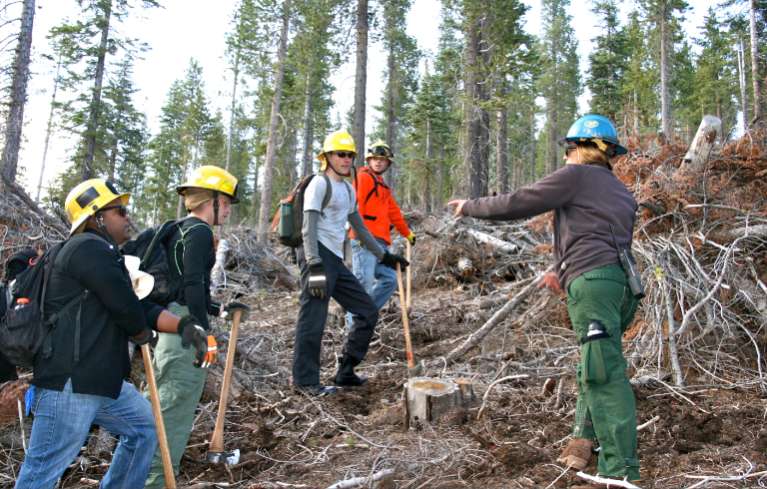
USFS Firefighter Elsa Gaule instructs Fire Academy Cadets on how to build a line to prevent the progression of a wildland fire.

U.S. Forest Service firefighter Elsa Gaule instructs fire academy cadets May 3 on how to build a line to prevent the progression of a wildland fire. Photos/Leona Allen

By Kathryn Reed

Fighting a wildland fire is nothing like a structure fire.

The tools are different, the terrain is not the same and the amount of time it might take to knock down the fire could be the difference between days and hours.

It’s a skill unto itself.

That is why a component of the Lake Tahoe Basin Fire Academy is wildland fire training.

The 24 cadets, who are set to graduate at the end of June, spent Saturday putting to practice much of what they have been learning in the classroom when it comes to fighting a wildland fire. All day May 3 they were cutting lines on Spooner Summit.

“They need the ability to cut vegetation, wherever that is. It doesn’t have to be a forest,” Leona Allen, who coordinates much of the academy operations, told Lake Tahoe News.

US Forest Service Firefighter Corey Buckley checks to make sure that Cadets are correctly using their fire shelters.

U.S. Forest Service firefighter Corey Buckley checks to make sure cadets are correctly using their fire shelters.

Then they worked on deploying shelters, having to think about where the safe zone is if the fire is racing uphill – because fire travels so much faster uphill.

Successful completion of this section of the academy earns them a certificate in basic wildland firefighting. It’s not uncommon for a cadet or two to get picked up by an outfit before they graduate.

“They have to go through several sections of classes that all together are part of the basic wildland certificate. It includes everything from basic wildland skills, tools used in wildland fires, weather, fire behavior and a leadership class,” Allen said.

Leadership, while always important in the fire world, is even more critical on a wildland fire because crews can be so spread apart. It’s very much a team concept, where everyone has one person they report to so there is structure among the ranks.

The cadets must become proficient with the tools involved in wildland fires. They include a Pulaski, which looks like an ax that is turned sideways. They can dig and chop with it.

“They can chop manzanita or another deep rooted shrub out of the ground to remove the fuel,” Allen explained.

There is the McLeod, which is like a big square rake, shovels and a combi tool that is used mostly for digging.

Cadets run up a hill with fire shelters to escape from fire in a scenario from their wildland fire training.

Cadets run uphill with fire shelters to escape from fire in a scenario from their wildland fire training.

Adeptly being able to wield a chain saw is a higher-level skill that firefighters can achieve. Then they would be known as a sawyer.

The Tahoe academy uses the national model so then the cadets could work anywhere – not just California. People who do this type of work for a living teach courses.

“We are serious about this training because it’s all about your safety. I don’t want to have to knock on your door and explain to your parents, your spouse or your children that you won’t be coming home ever again,” Forest Service Capt. John Chester told the cadets.

CalFire also has training, but it would not allow cadets to be hired right out of the academy with the U.S. Forest Service or Bureau of Land Management or out of state. However, it’s likely next year with changes to the CalFire curriculum it will be incorporated into what the academy at Lake Tahoe Community College offers.

Plenty more training is available, including command classes and other specialties. Wildland firefighting isn’t just about being on the line. Firefighters are on engines, work as prevention officers, and are in helicopters as well as airplanes.

The need for skilled wildland firefighters is expected to be even greater this fire season because of how dry everything is as the drought continues to persist in much of the West.

“I hope everybody takes to heart that we are hotter and drier earlier than normal and fire danger is imminent,” Allen said. She lost her house once – in June 2007 during the Angora Fire – and is ready if things go sideways this year.

In early April a small wildland fire was quickly extinguished by the U.S. Forest Service and Lake Valley firefighters. (Allen works for Lake Valley as the public information officer.)

“The majority of fires are human caused. Where we need to start is with prevention. Behind that, good defensible space; good evacuation skills for your family; and preparedness in general,” Allen said.

—-

Notes:

• Lake Tahoe Basin Fire Academy graduation is June 28 at noon in the Duke Theater at Lake Tahoe Community College.

• For those interested in the academy, there is a mandatory orientation Aug. 7 at 6pm. For more info, email lallen@mail.ltcc.edu or call 530.544.4660, ext. 540. The program is twice a week from September to June.


USFS firefighting tanker fleet inadequate

By Michael R. Blood, AP

LOS ANGELES — With a vast swath of the West primed for wildfires, federal foresters are preparing for the worst with a budget that might run dry and a fleet of air tankers that in some cases aren’t ready for takeoff.

A combination of extended drought, warming weather and an abundance of withered trees and grasses have created ideal conditions for fire – more than 22 million acres were blackened by wildfires from 2011-13, primarily across the West.

“It looks like it’s going to be a serious enough season to where we run out of money again,” Tom Harbour, director of fire and aviation management for the U.S. Forest Service, warned in an interview with the Associated Press.

“I’m really concerned, there is no question,” Harbour said. “I think we are going to have a lot of fire.”

The agency is doing what it can to prepare for wildfire season by burning sections of forest in high-risk areas to remove dead or dry vegetation that could fuel a fire. In another step, crews will launch a major forest-thinning project on Lake Tahoe’s North Shore.

In no place is the situation more worrisome than in California, where several years of stingy rainfall have turned forests and scrub into matchsticks and tens of thousands of homes are perched along fire-prone areas.

Firefighters battled a blaze in the mountains east of Los Angeles last week, where temperatures neared triple digits. And states from New Mexico through southern Oregon have been left sere by a lack of rain and snow.

But even as fire risk has increased in recent years, the number of large air tankers dropped.

About a decade ago the Forest Service had more than 40 of the big tankers at its disposal – the draft horses of firefighting aircraft that can dump thousands of gallons of flame-snuffing retardant in a single swoop, far more than a helicopter.

According to federal analysts, the fleet hit a low of eight aircraft at one point last year, depleted by age and concerns over the ability of the planes, in some cases flying since the dawn of the Cold War, to stay in the sky.

Deadly crashes – including when a 57-year-old tanker flew into the side of a Utah mountain in June 2012, killing the pilot and co-pilot – fanned doubts about safety. A federal investigation into the cause of that crash is incomplete.

The agency has been working for several years to modernize its creaky fleet of tankers, with checkered results.

The core of the fleet was expected to include 17 aircraft for 2014, but seven of those planes aren’t ready to fly.

The fleet is anchored to eight aircraft with an average age of half a century. As part of a modernization blueprint, the Forest Service contracted last year for seven newer tankers that can fly twice as fast as the older planes and carry larger payloads, but only two are on the runway.

The others are eight months late on delivery. Among the issues: The tankers have yet to obtain Federal Aviation Administration certification, a requirement to fly.

The agency hopes to have all the tankers off the ground by summer, but Sen. Mark Udall, D-Colo., has called the delay unacceptable.

“These tankers promised to be a game-changer for Western communities grappling with the perennial threat of modern mega-fires,” Udall wrote to the Forest Service in April. “I am deeply concerned that delivery of the remaining five will be further delayed and unavailable for the 2014 wildfire season.”

Federal studies suggest the agency needs as many as 28 of the newer, faster tankers, but that target remains years away.

Meanwhile, plans for two other large tankers have been sidelined by a dispute over a contract that called for paying up to $496 million over nine years to a Montana company for exclusive use of two aircraft. A decision has not been made whether to scrap the deal or try to fix it.

In another glitch, federal legislation gave the Forest Service the authority to obtain up to five extra air tankers, but didn’t provide the funds to lease them.

The agency can also draw on eight military tankers, if needed. Eight others can be dispatched from Alaska and Canada, but those are not always available.

Federal foresters are moving earlier this year to get firefighters and equipment into threatened areas.

“We are going to be looking at the weather and conditions … and move things as we need to, to try to head things off before they get ahead of us,” said agency spokesman Mike Ferris.

The Forest Service does not own the large tankers but strikes agreements with aviation companies that buy used aircraft, modify them for firefighting duty and then offer them for government lease. The agency also leases helicopters and smaller aircraft to douse fires.

The up-and-down pursuit of a faster, more reliable tanker fleet has played out against a backdrop of increasingly destructive blazes.

From 2000 to 2008, at least 10 states had fires of record-breaking size. In 2011, a wildfire scorched 538,000 acres in Arizona and New Mexico, an area so large it would cover much of the state of Rhode Island.

Costs for daily air tanker availability doubled from $15 million in 2007 to $33 million in 2010. Meanwhile, the cost of fighting wildfires has soared, up from 13 percent of the agency’s budget a decade ago to over 40 percent. That’s forced the agency to strip funds from other programs to keep up, officials say.

A government report last week said federal agencies expect to spend $1.8 billion fighting wildfires this year, but that’s $470 million more than what’s available for the job.

When homes or lives are lost, the Forest Service often faces questions about a lack of tankers, or how it uses them.

Shortly before 19 members of a firefighting Hotshot crew were killed in Arizona last year, records showed officials summoned six air tankers, but none arrived because of the limited number of tankers in the fleet and dangerous weather conditions. Fire officials said even if the big planes were available, winds were so strong they couldn’t have been used to save the firefighters. Among recommendations after the deaths, investigators said more instructions were needed for the “effective use” of the largest tankers.

As part of the commemoration of the deaths this year, Forest Service firefighters will hold discussions on risks and hazards “to avoid (a) similar outcome,” Ferris said in an email.

Government studies generally agree tankers play an important role in suppressing wildfires, particularly in “initial attack” – the early stages when failure to knock down a blaze quickly can lead to an inferno.

Harbour and other experts stress that the biggest job of extinguishing fires remains with ground crews, since embers and brush can continue to burn after a water or retardant hit. Instances of aircraft extinguishing fire are rare.

In another move by Congress, the Forest Service would receive seven, large HC-130 aircraft from the Coast Guard for firefighting. But it could be at least 2017 before they are all modified to carry retardant.

For now, the planes remain with the Coast Guard, even though the law aimed to have them transferred months ago.

“Is there part of me that hopes, starting July 4, it starts raining?” Harbour asked. “You bet.”


Raw sewage spills into Tahoe at Keys Marina

Sewage from the Fresh Ketch restaurant spills onto a walkway before it reaches Lake Tahoe. Photo/Andrew Lubrano

Sewage from the Fresh Ketch restaurant spills onto a walkway before it reaches Lake Tahoe. Photo/Andrew Lubrano

By Kathryn Reed

Sewage from an overflow tank at the Fresh Ketch restaurant flowed into Lake Tahoe for at least 24 hours this weekend.

People at the restaurant first saw the spill Friday night, but Summit Plumbing of South Lake Tahoe said they didn’t receive a call for service until 6:08pm May 3.

Employees with the El Dorado County Environmental Health Department went to the restaurant Saturday afternoon. Dry bleach was used on the surface areas where people frequent.

“There is not much you can do once it is in the water because algae starts taking up the nutrients. Bacteria has only a certain amount of time it can stay viable,” Lauri Kemper with Lahontan Regional Water Quality Control Board told Lake Tahoe News.

The cold temperature of the lake and sunlight would dissipate the bacteria quickly.

However, her agency will be at the Tahoe Keys Marina on Monday to take samples for bacteria.

It is near impossible to know how much sewage made its way into Lake Tahoe, but several gallons, according to witnesses.

No one from the marina or restaurant was available for comment.

The expanded outdoor seating area behind the restaurant has tables and chairs that sit over the overflow tank for the restaurant. This is where the problem was.

“We walked up and there was a very large puddle and an interesting odor. When we got up to it we saw toilet paper, etcetera coming from the old pump out station,” Andrew Lubrano told Lake Tahoe News.

This was on May 2. He went back out the next morning and saw the problem had not been fixed. He called the 800 number for Lahontan to report the spill.

Kemper said her agency would work with the county to see what it has found, as well as with South Tahoe Public Utility District.

“With all the facilities connected, they may need a larger tank or to maintain the lines better. They could be dumping grease. STPUD has ordinances against dumping grease into their lines,” Kemper said.

This will be the second investigation Lahontan will have involving the Tahoe Keys Marina. The other is the fueling dock. Kemper said she is not at liberty to discuss that case further at this time.


Zephyr Cove tennis facility being elevated

Becky Darrow returns a shot while practicing at the Zephyr Cove courts May 2. Photos/Kathryn Reed

Becky Darrow returns a shot while practicing at the Zephyr Cove courts May 2. Photos/Kathryn Reed

By Kathryn Reed

Douglas County is about to redefine what public tennis courts are all about.

County commissioners at their May 15 meeting are expected to sign a contract for the Zephyr Cove Tennis Club Foundation to operate the six courts in Zephyr Cove for the next five seasons.

“Overall, it will make for a better tennis facility,” Scott Morgan, who runs the county’s recreation facilities, told Lake Tahoe News. “Money from the contract will go back into the courts. The tennis operator saves us money.”

A back section of the library will become the pro shop.

A back section of the library will become the pro shop.

The county has had a tennis professional operate the facility for the last 15 years. And while a pro was one of the two to bid on the concessionaire contract, it is the foundation (which is awaiting its official nonprofit status) that the county staff is recommending be the operator. Morgan said part of the reason to do so is the foundation intends to hire a pro, plus do much more than what a pro has done in the past.

Rob Wheatley is set to return as the pro. The foundation is expected to execute his one-year contract after the commission meeting.

“This kind of operation on public courts is unique, but successful,” Brian Fitzgerald, with county parks and rec, told Lake Tahoe News.

The contract calls for the foundation to pay the county $3,000 this year, $3,500 in 2015, $4,000 in 2016, $4,500 in 2017 and $5,000 in 2018.

Like in years past, the foundation will charge a seasonal use fee, or people may pay by the hour. Here is the list of court fees.

While people at times gripe about paying to play at public courts, property tax dollars don’t fund Zephyr Cove Park. It is hotel room and sales taxes that pay for it.

Improving the facility

The operation and look of the facility will be more like a traditional tennis club.

Morgan said the physical upgrades should be complete in the next two weeks.

Already gates have been put in on the right side of the courts, on the library side. This is because the library is going to have another purpose – it is going to be a clubhouse of sorts for the tennis foundation.

Spectators will be among the trees, with better views of more courts when improvements are complete.

Spectators will be among the trees, with better views of more courts when improvements are complete.

This means players will be more apt to congregate there instead of by the shack and slab of concrete on the other side.

Paths, built with a permeable material, are being created that will lead to the courts so people aren’t tromping through manzanita.

“We are adding a viewing area that will add much better viewing for play,” foundation President Carolyn Wright told Lake Tahoe News. “It will be an elevated area where the sun is behind you.”

Seating will be the next item to be installed.

“It’s a beautiful facility that we are enhancing,” Wright said.

Besides no longer having to sit in the dirt to watch play on the upper courts, the new area should allow spectators to see more courts at once as well as a sliver of Lake Tahoe.

The backboard on court two will be moved to the other end so it blocks the shack. The shack will remain for storage. This is also where the ice machine will go. It can’t go in the pro shop area because there was not a water line that would work.

A little remodeling is taking place at the library so a pro shop will operate there. It will carry basic tennis supplies, food and beverages. The county negotiated a deal with the library folks to make all of this work.

Whenever the pro shop is open, players will have access to the library bathrooms. Hours have not been set, but will most likely be at least from 8am-noon.

The foundation

An 11-person board is in charge of the foundation.

As with so many things, it was a simple idea that then led to the creation of the 501(c)3 and subsequently the desire to be the operators of the tennis courts. Players just wanted something other than the nasty port-a-potties, which were overused when beach-goers would stop by.

With eight USTA teams playing out of Zephyr last fall, it was getting embarrassing to have such rank bathroom facilities for locals, and especially for the teams traveling to the South Shore to play. (This reporter plays on a USTA team at Zephyr Cove.)

Wright, along with Ross Rittiman and Bob Beutenmiller, were the three main people responsible for working with the county and getting the foundation off the ground. They are all board members.

(Other board members are Grant Thompson, Bob Green, Holly Rittiman, Joyce Youngs, Neil Trebotich, Ray Fugitt, Sheryl Herschman and Hersch Herschman.)

Membership allows people to vote on the foundation’s board of directors. Members will serve for two- and three-year staggered terms. Everyone is a volunteer. Committees are set up to handle fundraising, operate the facility and put on events. The season kickoff party is May 24.

The foundation will now run the annual Tahoe Tennis Classic tournament in August.

The contract with the county mandates two youth events be put on each year, and a certain amount of free play time allowed.

Foundation documents call for all proceeds to return to the facility.

“The foundation will keep the courts in better repair than what the county can provide,” Wright said. “The long-term goal is indoor courts for year-round play.”

The county has talked about this for a number of years.

—-

Notes:

• Douglas County Commission meeting is May 15 at 1:30pm, 169 Highway 50, Stateline.

• Zephyr Cove Tennis Club is online; memberships are available online.

• Questions about the club or foundation may be emailed to zctennisclub@gmail.com.

• The club is also on Facebook.