Brown unveils ‘good news’ budget

By Josh Richman, Jessica Calefati and Tracy Seipel, San Jose Mercury News

SACRAMENTO — Gov. Jerry Brown said today that his revised budget proposal is “good news for California,” paying down $11 billion in debt while for the first time setting the state “on a plan to fully fund our teachers’ pension system.”

But saving money for harder times remains a priority, he said. Brown stood flanked by charts, one of which showed that “balanced budgets have quickly been followed by huge deficits” and the other depicting how unpredictable capital-gains tax revenue — one of the state’s most important and most volatile funding sources — can be from year to year.

“Most of that is paid by the most fortunate among us,” Brown said. “That variability has to be captured in the rainy-day fund.”

And costs of new Medi-Cal enrollment under the nation’s new health care law increased by $1 billion just from January to May, Brown noted. That, he said, is another argument for having deep reserves.

Read the whole story


Millions in Calif. fail to register to vote

By Jim Miller, Sacramento Bee

Zyler Hartman of Sacramento was too young to participate, but he closely followed the campaigns of November 2012, especially the debate over Proposition 37, the ballot measure that would have imposed new labeling requirements on genetically engineered foods.

Hartman is 19 now and could vote in next month’s primary election. But taking the first step – registering to vote – “is just the furthest thing from my mind at the moment,” he said last week near Sacramento City College, where he is taking a full load of classes.

When polls close next month, voter turnout will be the main benchmark of Californians’ election engagement. But missing from the calculation will be millions of Californians who could have voted but did not register.

In a chronic phenomenon of under-enfranchisement in the Golden State, there are at least 6.4 million residents who are eligible to vote but were not on the registration rolls as of early April. California’s registration rate is close to last in the United States, and its legions of eligible but unregistered voters make up a disproportionate share of the nationwide total.

Experts say there are multiple reasons for the shortfall, such as residents here moving more often, bureaucratic hurdles and uncompetitive statewide contests that fail to capture the public’s attention. Whatever the causes, the result is the same: an electorate that is whiter, older and wealthier than the state as a whole and a large share of the population disengaged from the laws and representatives chosen in its name.

Read the whole story


Master gardeners teach techniques for Tahoe

Publisher’s note: This is one in a random series of stories about gardening in Lake Tahoe.

By Kathryn Reed

People have been gardening in Tahoe for eons with varying degrees of success.

But 23 residents of the basin are masters at it.

This is the second summer for the UC Cooperative Extension Lake Tahoe Master Gardeners. While master gardeners have been around for some time, the concept is new to Tahoe.

She is demonstrating a strategy for managing a gopher problem--an example of what we do that a nursery doesn't.

A master gardener demonstrates a strategy for managing a gopher problem at the Evans Family Garden in the Angora burn area. Photo/Provided

They’ve been busy. In 2013, 1,200 volunteer hours were logged and they made contact with 1,421 people at events, workshops and farmers markets.

“We are a little intimidated ourselves about being master gardeners. People spend their entire career on one butterfly and we are tying to deal with all of Tahoe,” Bonnie Turnbull, one of the master gardeners, told Lake Tahoe News. “Our primary focus is educating people on science-based information. We are trying to make sure people are trying to take care of their environment.”

They are doing this by having booths at events like Earth Day, the Tuesday farmers market that starts next month in South Lake Tahoe, and putting on workshops. All involved are volunteers.

Coming up June 7 is the June Day Jamboree: Vegetable Gardening Seminar and Plant Sale. The 9am-1pm event is at Lake Tahoe Community College’s demonstration garden and costs $15. (Call 530.543.1501, ext. 101 for info or to register.)

Topics include: Choosing What to Grow, Improving Your Soil, Planning Your Layout, Strategies for Extending the Growing Season, Summer Maintenance, and Harvest.

Part of the protocol of being a master gardener is not making a profit. Money collected should only cover the costs involved to put on a program.

Worm bins and composting were the popular topics at the South Shore Earth Day event.

“I think the only trouble is if people expect us to answer every question,” Turnbull said. While an answer may not be immediate, the gardeners do have the resources to track down the information and get it to the person.

Issues they are interested in run the gamut from wanting to educate people about how flammable juniper is to knowing invasive weeds to proper watering to what veggies grow well.

Turnbull was picking asparagus, Swiss chard and spinach from her garden last month.

“You have to be flexible and willing to deal with disappointment,” Turnbull said of growing vegetables in the basin.

—-

Notes:

• More info about UCCE Master Gardeners Lake Tahoe is available online.

• The group is on Facebook.

• Here is a list of master gardener events for this summer.


How high is too high to drive?

By Rob Hotakainen, McClatchy Washington Bureau

WASHINGTON — Josephine Drum says her daughter was “cheated out of life” when she was killed while driving to work in downtown Seattle in 2012, hit by a man in a Jeep whose blood tested positive for marijuana.

“I feel if you smoke marijuana and you have to smoke it, that you should not be able to drive under the influence,” said Drum of Stockton. “I’m 84 years old. To have lost my daughter is something hard for me to accept.”

With the push to legalize marijuana surging in popularity, states want to assure the public that roads will be safe. But they face a perplexing question: How stoned is too stoned to drive?

With no conclusive research, states are all over the map as they try to assess intoxication by measuring blood levels of THC, the main ingredient in marijuana.

There’s no easy way to do it, with marijuana stored in fat cells and detectable in blood long after it’s smoked or consumed, for days or weeks, depending on individual tolerance and level of use.

Read the whole story


Federal agents seek to loosen rules on hacking computers

By Chris Strohm, Bloomberg

The top U.S. law-enforcement agency wants to give investigators greater leeway to secretly access suspected criminals’ computers in bunches, not simply one at a time.

The Justice Department says the proposal, made public last week, is an attempt to keep up with technology that lets people hide identities online. Privacy advocates contend the more aggressive hacking powers may violate rights of the innocent.

The proposal arrives at a precipitous time for a government still managing backlash to electronic-spying practices by the National Security Agency that were exposed last year by former contractor Edward Snowden.

“I don’t think many Americans would be comfortable with the government sending code onto their computers without their knowledge or consent,” Nathan Freed Wessler, a lawyer with the American Civil Liberties Union, said in a telephone interview. “The power they’re seeking is certainly a broad one.”

A committee of judges that sets national policy governing criminal investigations will have to sort it out, taking rules written for searching property and modernizing them for the Internet age.

Read the whole story


Editorial: Vote ‘no’ on Measure P

Publisher’s note: Lake Tahoe News convened an editorial panel of six South Shore residents to decide on this endorsement for the June primary.

Paid parking at beaches on the South Shore has been the norm for decades. It’s about time South Lake Tahoe caught up.

We believe the city needs to find ways to increase revenues. Continuing with the paid parking program is a logical way to fill coffers because it is a user fee. Only people who are using that area to park have to pay. In other words, it’s a choice to park where it costs money.

Tourists have discretionary money for incidentals like parking. And locals know where to find free parking if they don’t want to pay for the premium spots that are closer to the venue.

Keep paid parking; vote "no" on Measure P.

Keep paid parking; vote “no” on Measure P on June 3. Photo/LTN

Voters in South Lake Tahoe on June 3 will be asked if they want to keep the kiosks at Lakeview Commons and Lakeside Beach. A “no” vote keeps the meters in place indefinitely. And that is exactly how Lake Tahoe News is recommending voters vote.

Since the parking program at these locations started last summer (June at Lakeside, July for Lakeview Commons), $190,000 has been collected in parking revenue through April.

The city is projecting all kiosks – this includes Bellamy Court and Transit Way – would bring in $300,000 per year.

Fines are in addition to those figures. There has been a 98.5 percent compliance rate at the kiosks, so relatively few tickets are handed out. And as people become more familiar with the program the city anticipates the number of citations to go down 10 percent each year.

The annual expenses are practically nil. The kiosks are $48,000 for the next four years – whether they are used or not. They are solar-powered. The only expense that could go away if the program vanishes is the costs associated with one-quarter of an employee. Even then, that person could be assigned to other work.

We like that the money generated is going back into the area where it’s collected. Maintenance and operation costs are seldom considered when projects are built. This is why so many entities end up with deferred maintenance expenses that are rolled over from one budget year to the next, and why facilities become dilapidated. If we can help prevent this, especially at someplace as new as the $65 million Lakeview Commons, we owe it to ourselves to do what we can. Supporting paid parking is one of the things we can and should do.

Once we lose a revenue source, it is near impossible to get it back again.

It is time to move beyond how poorly the whole program was sold to the public and then rolled out.

We like that the city is willing to make changes. It is good that there is a $40 locals’ pass, that hours have been changed and citations have been reduced to $35.

However, if people continue to get cited because signage is lacking and kiosks aren’t obvious, then shame on the entire city – electeds and staff. Aggressive behavior is not warranted, either. Citing someone when a kiosk ticket is placed upside down on a dashboard is inane. How hard is it to tell someone walking away from their vehicle that they need to pay instead of waiting until they are gone to write them a ticket?

We realize the city has a temporary permit from the Tahoe Regional Planning Agency that allows for parking at Lakeside on the dirt. The caveat was that money raised from that area would fund the asphalt, other infrastructure improvements and realignment of the street. But the city has tabled the paving project until at least after the election.

This is wrong. The city and TRPA should be models for environmentally sound practices. It’s hard to believe fine sediment reaching Lake Tahoe is the primary source of the decline of lake clarity when parking on dirt – and paying to do so – is allowed. The duplicity of this policy is mindboggling.

For that reason, Lake Tahoe News puts an asterisk next to the “vote no on Measure P” endorsement. We also say “no to any parking on dirt.” Lakeside should be roped off until it is paved and not contributing to the degradation of Lake Tahoe.

Just as the city deserves to generate money from parking, the lake deserves to not be ruined because of it.


South Tahoe, Lake Valley fire on heightened alert

By Jeff Meston

The South Lake Tahoe Fire Department and Lake Valley Fire Protection District have joined in developing a Community Wildfire Protection Plan (CWPP) for South Lake Tahoe.

A CWPP enables a community to plan how it will reduce the risk of wildfire. The plan identifies strategic sites and methods for fuel reduction projects across the landscape and jurisdictional boundaries.

We are asking the community to participate in a survey for developing the CWPP. Please complete the following survey.

A CWPP is a vehicle for incorporating the fire adapted community recommendations into community design and maintenance, and for taking communities to the next step in wildfire preparedness. CWPP planning assists communities in establishing priorities for protecting life, property and infrastructure. The plans can take a variety of forms, but at a minimum must:

• Be developed collaboratively.

• Identify and prioritize areas and methods for hazardous fuel-reduction treatments.

• Recommend measures to reduce the ignitability of structures throughout the community.

For more opportunities to learn about CWPP development, consider attending one of the following events:

• May 20 9am, South Lake Tahoe City Council meeting at 1901 Airport Road, South Lake Tahoe

• May 22 5-7pm,CWPP public input meeting at 1901 Airport Road, South Lake Tahoe, airport conference room.

In addition, South Lake Tahoe Fire Department will implement a program this year to help inform and educate citizens on when the weather adds to our existing fire danger. The 2014 fire season could be catastrophic with our drought conditions and we need our citizens’ help. Fire crews will monitor the National Weather Service and when the weather reaches a red flag warning, we will implement the following procedures.

We will raise a red flag at each fire station to inform the public.

We will add extra personnel to staff a Type 3 (brush) engine for an aggressive fire attack. The personnel assigned to the engine will patrol our highest fire danger areas. The staffed engine will have a red flag banner to help alert the community. The banner will say “Red Flag Day- Critical Fire Weather”.

When citizens see these indicators of the additional fire danger within our community they should be especially mindful of the following:

• Avoid outdoor burning, such as campfires, or any other open flame. Even grilling is not advised when red flag days exist.

• Dispose of cigarettes and other smoking materials into fire safe containers. Tossing smoldering cigarettes onto the ground should never occur.

• Properly store flammable materials such as gasoline, alcohol, paint, lighter, and matches. These materials may reach their critical points during hot weather and can possibly result in fire.

• Be extremely careful when using and fueling chain saws, lawn mowers, weed eaters and other lawn care equipment. High heat conditions make ignition of the fuel vapors more likely. Find shade if possible and allow the machinery to cool if it has been running. Also avoid welding in dangerously dry conditions, as the sparks can easily ignite the dry vegetation around you.

• Be careful where you park your vehicles. The hot underside of a car or truck filled with gasoline parked over dead grass or leaves is an explosion waiting to happen. Be sure to park on concrete or solid dirt or gravel, especially during red flag days. Do not park where vegetation touches the vehicle.

Jeff Meston is fire chief of South Lake Tahoe. Martin Goldberg, with Lake Valley Fire, contributed to this story.


Employer-provided health plans may disappear

By Neil Irwin, New York Times

The days of Americans getting health insurance through their employers may be numbered — and the change could be just as profound as the shift of employers forcing employees to manage their own retirement savings.

As the Affordable Care Act goes from thousands of pages of legalese to actual, real-life public policy, the future of employer-provided health insurance is one of the most fascinating questions. Will employers call for — and their workers accept — the practice of buying health insurance through government exchanges? How much will companies save, and will they pass those savings onto employees? Will it make workers more mobile and ready to shift jobs, or will employer-paid health insurance become a sought-after perk?

The answers go to the heart of how things work in a sector that is one-eighth of the American economy. A new report gives some hints of how large the impact might be.

By 2020, about 90 percent of American workers who now receive health insurance through their employers will be shifted to government exchanges created by the health law, according to a projection by S&P Capital IQ, a research firm serving the financial industry.

Read the whole story


CTC to raze, restore 3 SLT commercial parcels

The CTC board on May 12 is expired to complete the approval process to buy the Alta Mira building in South Lake Tahoe. Photos/Kathryn Reed

The CTC board on May 12 is expected to complete the approval process to buy the Alta Mira building in South Lake.  Photos/Kathryn Reed

By Kathryn Reed

Three commercial properties in South Lake Tahoe are about to be owned by the state.

On May 9 the California Tahoe Conservancy board agreed to buy the South Y Lodge on Emerald Bay Road for $320,000 and the property on Highway 50 that houses the Smoke Shop and Tahoe Psychic for $325,000. On Monday there is a special board meeting to finalize the $2.5 million acquisition of the Alta Mira building.

The board started Friday’s meeting by touring the three locations.

CTC board members learn about the South Y Lodge property.

CTC board members learn about the South Y Lodge property.

The goal for all three is to tear down the existing structures and improve the land, while also giving the public access.

The first two properties share the same drainage, meaning the runoff ends up in the same filtration area before reaching Upper Truckee River. Water from the Emerald Bay property flows across the highway, then through a system going north on Highway 50.

The South Y Lodge rents rooms by the month; there are currently three tenants. Relocation for them will be part of the deal. The nine tourist accommodation units will be banked, as will the one residential unit and 14,400 square feet of hard coverage.

It’s possible the structure would come down in September.

Immediately to the north is another parcel the CTC owns. And next to it is the Barton Ranch, whose future remains unknown. Next to that is the Raley’s center at the Y.

On the current vacant CTC property is where the city has talked about creating a greenway and bike trails that would be part of the Tahoe Valley Area Plan. This area is also part of the city’s Tahoe Valley erosion control project.

These two structures sit in an stream zone.

These two structures sit in a stream zone.

This same trail system and greenway would cross the highway and tie in with the existing dilapidated trail network behind McDonald’s. Those all would ideally be upgraded, but is not part of the transactions that took place this week.

The two buildings on the less than one-half acre parcel fronting Highway 50 are in a stream zone. Puddles and mud from the previous night’s storm sat in the back area, proving drainage is inadequate.

The psychic owners must have been clairvoyant when they signed a three-year lease with the current owner the day before the Conservancy began negotiations. This means either the tenants will stay or the state buys out the lease. Those particulars still need to be worked out. As for the Smoke Shop, the owner is on a month-to-month lease.

Demolition at this site could be staggered, with the Smoke Shop likely not to be razed until next summer.

CTC will work with the city on water quality improvements in the area.

These two pieces of property have the same owner. Negotiations only started in the last few months and have progressed rapidly. This is in contrast to the Alta Mira building acquisition, which has been in the works for more than five years.

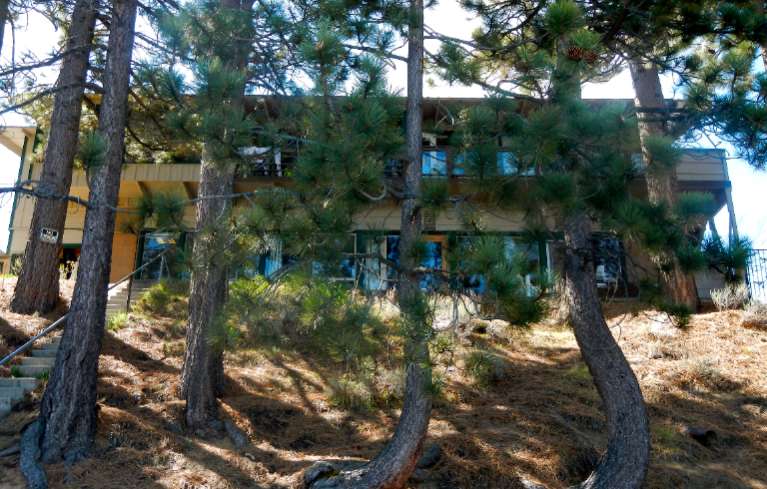
The Alta Mira site needs attention to be deemed safe for the public.

The Alta Mira site needs attention to be deemed safe for the public.

That purchase price is much higher because it is nearly 1 acre on the lake. It comes with 150 feet of Highway 50 frontage and 190 feet of beach.

“The purpose is primarily to enhance the public lake access,” Bruce Eisner with the CTC told the board. Visual and physical improvements are part of the plans.

To begin with, the physical upgrade will be to remove the building to open the view corridor to the lake. The six commercial and two residential tenants will be given money to relocate.

The Conservancy will need to improve fencing for safety reasons. The current stairs may not have met any sort of code when they were put in. The concrete slabs are narrow, steep and uneven.

From the beach looking up it is obvious slope stabilization is required as roots of several trees are exposed.

“We don’t know the future uses of the property other than lake access,” Eisner said.

This stretch will tie into the Lakeview Commons project to the south that the Conservancy funded at a cost of $65 million.

The city will play a role in what the future of this land mass looks like.


S. Tahoe man’s lawsuit against Facebook reinstated

By Bay City News

A federal appeals court ruled in San Francisco this week that Facebook users can go ahead with breach-of-contract and fraud claims against the online social network for allegedly allowing advertisers to obtain their personal information in 2010.

A three-judge panel of the 9th U.S. Circuit Court of Appeals reinstated those claims in a lawsuit filed against Menlo Park-based Facebook Inc. in federal court in San Jose in 2010. It overruled a decision in which now-retired U.S. District Judge James Ware dismissed those claims in 2011.

The lawsuit alleges that at least between February and May of 2010, Facebook violated its privacy promises by providing advertisers with headers revealing the user information of people who clicked on Facebook ads.

The lawsuit, originally filed by Facebook users Mike Robertson of Marin County and David Gould of South Lake Tahoe, seeks to be certified as a class action on behalf of an unspecified “millions” of users allegedly affected by the policy.

Read the whole story