Marijuana boom spawns ancillary businesses

By David Pierson, Los Angeles Times

Ben Wu took a six-figure pay cut when he left a career in private equity for a shot at the marijuana boom.

Trained to spot small businesses with big potential, he started this year as chief executive of Kush Bottles, a Santa Ana company that sells child-resistant plastic cannabis containers.

It took some persuading to get his parents and girlfriend to embrace the move. But Wu insists it was a sound business decision. As the pot industry blossoms, he reasoned, a robust supply chain is needed to help grow, package and market legal marijuana.

“The sky’s the limit,” said Wu, 35, a New York University business school graduate and former vice president at Wedbush Capital Partners. “As long as states continue to adopt, we’re going to double growth each and every year.”

Read the whole story


Demo veggie garden being cultivated in SLT

Publisher’s note: This is one in a random series of stories about gardening in Lake Tahoe.

By Kathryn Reed

Getting one’s hands dirty is not only a physical workout it is a mental recharger.

“There is a biological link between soil and people. We have lost that because we are no longer an agrarian society,” De-Anne Hooper told Lake Tahoe News.

Hooper runs the South Lake Tahoe Family Resource Center and is the driving force behind a demonstration garden at the site that will break ground June 2.

The dirt to the right of the Family Resource Center will become a garden. Photo/LTN

The dirt to the right of the Family Resource Center will become a garden. Photo/LTN

Providing prevention and early intervention when it comes to mental health issues are two of the center’s core objectives. The garden will be a component to help people cope.

“Not many people have the opportunity to get their hands dirty in South Lake Tahoe, especially kids. We thought this would be a perfect match,” Hooper said.

She is working in cooperation with Brian Hirdman, who teaches gardening classes through Lake Tahoe Community College’s Connect Community Education. He has been trying to start a community garden for the last three years. And while this 30-foot-by-50-foot plot isn’t big enough to feed a community, it will act as a way to show people what can grow in the basin and how to grow it.

Right now the growing area is raw dirt between the center and chain link fence for the ball field. First to be built is the fence that will enclose the growing area. This will be a joint project by the FRC and Lake Tahoe Unified School District, which owns the property.

Hirdman has some logs, boulders and planter boxes that will be used. The center has boxes already planted on the other side of the parking area that have herbs growing.

“This isn’t a farm, so we are not going to have a super high volume of food, especially the first year. It will provide an opportunity for people to dig in the dirt and there is scientific evidence that it helps mental illness and that is the biggest part for me,” Hooper said.

The goal is to have a summer program for the kids so they can be tending to the garden.

Hirdman will be teaching a four-part class through Connect Ed where the practical aspect is working at the demo garden. FRC students and their parents are expected to be the long-term caretakers.

The classes may be taken individually. The first one – Creating Healthy Soil – is May 31. July 12 is about which plants grow well here. It will include creating a hoop house to create a microclimate. July 19 focuses on advanced growing techniques. Permaculture and biodynamic growing principles are part of this class. The July 26 class is about xeriscape, which is about being smart about water use.

“This summer I will have workshops with kids. I will teach them how to plant trees, plant vegetables and get in the dirt,” Hirdman told Lake Tahoe News. “My goal is to train a group of volunteer leaders who can go about and train kids.”

Hirdman would like to plant fruit trees that have been grafted to stand up to Tahoe’s climate. These could include apple, cherry, plum, apricot and pear.

Large shrubs like elderberries and smaller ones like raspberry, blueberries and currants grow well here.

Another lesson will be learning what annuals work in Tahoe versus perennials.

Hirdman envisions a salsa garden where tomatoes, peppers and cilantro are grown. He also wants to show how squash and corn can be cultivated in Tahoe.

“It will be just like your standard garden … nothing too exotic,” Hirdman said.

—–

Notes:

• Information about the Connect Ed classes as well as how to register is online.

• Brian Hirdman may be reached at naturesgardener@hotmail.com.

• De-Anne Hooper is available at 530.542.0740.


Pre-K availability varies by state

By AP

WASHINGTON — The availability of state-funded pre-kindergarten programs varies widely from one part of the country to another, says a report.

For example, more than 9 in 10 4-year-olds in the District of Columbia attended such a program during the 2012-13 school year, while 10 states have no such program.

A number of states had fairly high enrollments, according to the report released Tuesday, though slightly lower than the District. More than 7 out of 10 4-year-olds in Florida, Oklahoma and Vermont were in such programs, while about 6 in 10 in Iowa, Georgia, West Virginia and Wisconsin were enrolled.

In fact, even as lawmakers from both parties have embraced the idea of expanding early childhood programs, the number of children enrolled in state preschool programs saw a modest decline of about 9,200 children in the 2012-13 school year — the first such reduction since 2002, when researchers at Rutgers University started tracking pre-K trends. Even as funding increased from a year earlier, more than half of states with programs made cuts. California alone, for example, lost nearly 15,000 slots.

Overall, $5.4 billion was spent by states on pre-K funding for about 1.3 million preschoolers.

The report is from the National Institute for Early Education Research at Rutgers in collaboration with the Education Department’s National Center for Education Statistics.

Given announcements of support by politicians for preschool, Steven Barnett, the director of the institute at Rutgers, said he expected more growth to be reflected in the findings, and yet, “the numbers aren’t there.”

“We were very surprised,” Barnett said.

Education Secretary Arne Duncan said the data is a “reminder of how much work we still have to do to ensure that every child gets a running start.”

President Obama has advocated for universal preschool for America’s 4-year-olds. He’s found Democratic allies in the effort on Capitol Hill, but Republicans such as Rep. John Kline, R-Minn., the chairman of the House Education Committee, have said improving existing federally funded early childhood programs should be the priority.

Outside of Washington, governors from both parties have advocated for creating or expanding preschool. In Indiana, GOP Gov. Mike Pence, for example, signed into law in March a new pilot program for low-income children. In Connecticut, Gov. Dannel Malloy, a Democrat, recently successfully pushed through an expansion of about 1,000 preschool slots.

Those changes aren’t reflected in the report’s findings, nor are program expansions passed in New York that could have New York City alone add tens of thousands of children to state-funded preschool programs, possibly as soon as the fall.

Supporters say preschool programs help level the playing field for young children who enter kindergarten well behind their peers and never catch up, and members of the business community are among those advocates for preschool expansion. But the quality of such programs varies.

No states require preschoolers to attend school. Some states seek to offer it universally. Others base eligibility on family income. Under some setups, a community-based program receives public dollars. Other programs are within elementary schools.

While some states offer state-funded preschool to 3-year-olds, the programs are much more popular for 4-year-olds.

The District of Columbia serves about three-quarters of 3-year-olds. New Jersey and Vermont serve about 1 in 5 3-year-olds.

Public preschool programs can cost thousands of dollars per child annually. The District of Columbia — the highest spender — spent $14,690 per child in the 2012-13 school year, according to the report.

Barnett has said previously that about half of U.S. children attend any kind of preschool program at ages 3 and 4, and for about a third of these children it is a publicly supported program.

A separate study by the Education Commission of the States finds that in the current fiscal year, 30 states and the District of Columbia increased appropriations for state-funded preschools.


Social media impacting hiring practices

By John Weber, Wall Street Journal

Social networks offer a window into how people live their lives.

But should employers be looking into that window?

It’s becoming an increasingly important question. The number of people fired over social-media posts is rising, and many employers look closely at a job candidate’s online presence before making a decision.

For an idea of how prevalent those practices have become, consider a 2013 survey from CareerBuilder, which helps corporations target and attract workers. According to the survey, 39 percent of employers dig into candidates on social sites, while 43% said they had found something that made them deep-six a candidate—such as posting inappropriate photos or information, or bad-mouthing a former boss.

On the flip side, 19 percent said they found information that sold them on a candidate, such as communication skills or a professional image.

Read the whole story


Editorial: Measure L – vote yes in June

Publisher’s note: Lake Tahoe News convened an editorial panel of six South Shore residents to decide on this endorsement for the June primary.

Twenty bucks doesn’t get you much these days unless you are at the South Lake Tahoe Library.

For that amount of money you get unlimited access to books, periodicals, an array of events, time on computers and the ability to pick the brain of the experts who work behind the counter.

In all of those resources a whole new world could be discovered – life beyond the confines of Tahoe, as well as imaginary places. Books stimulate the imagination, they educate us, they relax us and they challenge us to think differently.

Libraries are the great equalizer. The cost is the same for everyone – free. This is because property owners pay the taxes to keep them going.

But they are also an equalizer in that they provide access to information. Even in this high-tech world we live in, not everyone has a personal computer or smart phone. Nor does everyone have the means to purchase books.

Even for those who do have the money to buy books, the library is still a resource. So many people don’t want to buys books so the libraries “rent” them. These days they can even be checked out as an ebook. Many people who are in book clubs choose the library over the bookstore.

Audio books are also available. These are great for long car rides or for those whose eyesight isn’t what it was.

Programs are offered starting with infants. Study after study proves that reading to children will better prepare them for school, and thus life. For adults whose first language is not English, these programs help teach them a new written and verbal language as well.

The library is constantly coming up with creative ways to reach people. The “appy hour” was developed to help people with smart phones learn how to use various apps.

Then there is the Friends of the Library that brings in authors to give readings and sign books. This nonprofit group is an extension of the library and is able to provide events beyond what the county can do.

But the problem is the tax that supports the library is about to expire. If it does, it means the South Lake Tahoe Library would have to cut hours and programs, and one day may not exist.

We can’t imagine our town without a library. That is why we whole-heartedly support Measure L.

Measure L will be on the June 3 ballot. It is specific to the South Lake Tahoe library. It asks residents to continue paying the $20 year fee per parcel. This is not a new tax, but would be continuing the one already in place. The amount could go up based on the Consumer Price Index of no more than 3 percent per year. It will never exceed $28.50 per year. It would expire in 12 years. It will require two-thirds of the voters’ approval for passage.


Naming Nev. cove after Twain dead in the water

By Martin Griffith, AP

RENO -— A state panel has effectively killed a bid to name a Lake Tahoe cove for Mark Twain, citing opposition from a tribe that says he held racist views on Native Americans.

The Nevada State Board on Geographic Names this week voted to indefinitely table the request after hearing opposition from the Washoe Tribe of Nevada and California, whose ancestral homeland includes Lake Tahoe.

Supporters had sought to name a scenic cove on the lake’s northeast shore for Samuel Clemens, Twain’s real name.

But Darrel Cruz, head of the tribe’s cultural resource department, said Twain was undeserving of the honor because of derogatory comments about the Washoe and other tribes in his writings.

Among other things, he cited Twain’s opposition to the naming of the lake as Tahoe, which is derived from the Washoe word “da ow” for lake.

Cruz also objected to a Twain quote about Lake Tahoe: “People say that Tahoe means ‘Silver Lake’ — ‘Limpid Water’ — ‘Falling Leaf.’ Bosh! It means grasshopper soup, the favorite dish of the digger tribe — and of the Pi-utes as well.”

Cruz said Washoes dislike being referred to as the “digger tribe,” a derogatory term applied to some tribes in the West who dug roots for food. Other tribes ate grasshoppers.

“Samuel Clemens had racist views on the native people of this country and has captured those views in his literature,” Cruz wrote in a letter to the board. “Therefore, we cannot support the notion of giving a place name in Lake Tahoe to Samuel Clemens.”

But James Hulse, history professor emeritus at UNR said it’s irrelevant whether Twain’s writings were insulting to Native Americans.

The cove should be named for Twain because he praised Tahoe’s beauty while visiting the lake in 1861-62, and he became one of America’s most beloved authors after assuming his pen name as a Nevada newspaper reporter around the same time, Hulse said.

“In his early days, (Twain’s) ironic-comic mode was insulting to everyone, including governors, legislators, mine bosses and journalistic colleagues,” he told the board. “He learned and overcame his prejudices far better than most of his contemporaries and successors.”

Thomas Quirk, an English professor emeritus at the University of Missouri and leading Twain scholar, said the author eventually overcame his racism against blacks. But Quirk said he has found no evidence that he significantly changed his views on American Indians.

Twain did not embrace the idea of idolizing what he called the “noble red man,” Quirk said, and poked fun at writer James Fenimore Cooper for doing so.

“When it comes to African Americans, he was ahead of his time substantially,” he said. “When it comes to Native Americans, his record is not very good. If he were alive today, he would sing a different tune.”

Board member Robert Stewart, who initiated the plan to name the cove for Clemens, said it’s unlikely it would resurface.

He said he dropped his support of it, even though he learned about a later letter Twain wrote objecting to the treatment of tribes in Arizona and New Mexico.

“I have a great deal of respect for the Washoe Tribe. And if their cultural committee is unhappy with naming the cove for Mark Twain, I’m not going to fight them,” Stewart said. “We need to show sensitivity to the tribe.”

Stewart said he still believes the cove near Incline Village is where Twain camped and accidentally started a wildfire while preparing to cook dinner in September 1861. But David Antonucci, a civil engineer from Homewood, maintains Twain camped on the California side of the lake.

It’s the second time the bid to name the cove for Twain failed. In 2011, the U.S. Board on Geographic Names rejected the request after the U.S. Forest Service said Twain’s influence on the Sierra Nevada lake was minimal and other historical figures were more deserving of the honor.

Supporters sought to honor him because there is no geographic feature in the state named for Twain, whose book “Roughing It” put Nevada on the map.


Parents rail against Common Core math

By Michael Rubinkam, AP

An Iowa woman jokingly calls it “Satan’s handiwork.” A California mom says she’s broken down in tears. A Pennsylvania parent says it “makes my blood boil.”

What could be so horrible? Grade-school math.

As schools around the U.S. implement national Common Core learning standards, parents trying to help their kids with math homework say that adding, subtracting, multiplying and dividing has become as complicated as calculus.

They’re stumped by unfamiliar terms like “rectangular array” and “area model.” They wrestle with division that requires the use of squares, slashes and dots. They rage over impenetrable word problems.

Stacey Jacobson-Francis, 41, of Berkeley, said her daughter’s homework requires her to know four different ways to add.

“That is way too much to ask of a first-grader,” she said. “She can’t remember them all, and I don’t know them all, so we just do the best that we can.”

Simple arithmetic isn’t so simple anymore, leading to plenty of angst at home. Even celebrities aren’t immune: The comedian Louis C.K. took to Twitter recently to vent about his kids’ convoluted homework, writing that his daughters went from loving math to crying about it.

Adopted by 44 states, the Common Core is a set of English and math standards that spell out what students should know and when. The standards for elementary math emphasize that kids should not only be able to solve arithmetic problems using the tried-and-true methods their parents learned, but understand how numbers relate to each other.

“Part of what we are trying to teach children is to become problem solvers and thinkers,” said Diane Briars, president of the National Council of Teachers of Mathematics. “We want students to understand what they’re doing, not just get the right answer.”

That’s a radically different approach than many parents are accustomed to.

Jennie Barnds, 40, of Davenport, Iowa, was puzzled by her fourth-grade daughter’s long division homework, a foreign amalgam of boxes, slashes and dots with nary a quotient or dividend in sight.

“If we are sitting there for 20 minutes trying to do a simple problem, how is an 8-, 9-, 10-year-old supposed to figure it out?” she said. “It’s incredibly frustrating for the student and the parent.”

Whether Common Core itself is responsible for the homework headaches is a contentious issue.

Some experts say Common Core promotes reform math, a teaching method that gained currency in the 1990s. Derided as “fuzzy” math by critics, reform math says kids should explore and understand concepts like place value before they become fluent in the standard way of doing arithmetic. Critics say it fails to stress basic computational skills, leaving students unprepared for higher math.

Stanford University mathematician James Milgram calls the reform math-inspired standards a “complete mess” — too advanced for younger students, not nearly rigorous enough in the upper grades. And teachers, he contends, are largely ill-prepared to put the standards into practice.

“You are asking teachers to teach something that is incredibly complicated to kids who aren’t ready for it,” said Milgram, who voted against the standards as part of the committee that reviewed them. “If you don’t think craziness will result, then you’re being fundamentally naive.”

Common Core supporters insist the standards are developmentally appropriate and driven by research.

“For years there has been a raging debate in mathematics education about which is more important, procedural fluency or conceptual understanding. The obvious answer is ‘both’ and the standards give that answer,” said University of Arizona mathematician Bill McCallum, who co-wrote the math standards.

Common Core advocates acknowledge parents are frustrated, but blame the problems on botched implementation, insufficient training or poorly written math programs that predate Common Core.

They say schools also need to communicate better.

“The homework can appear ridiculous when it is taken out of context — that’s where the biggest problem lies,” said Steve O’Connor, a fifth-grade math teacher in Wells, N.Y. “Parents don’t have the context, nor have they been given the means to see the context.”

O’Connor has set up a website in an effort to reduce parents’ frustration over homework. Other school districts have held workshops for parents to learn alongside their children.

But many parents say they’ve been on their own, complaining that districts have foisted new math curricula with little explanation.

In Pennsylvania, which signed on to the national Common Core in 2010 but developed its own version, Allison Lienhard said homework sessions with her 10-year-old have ended in tears.

“She gets frustrated because I can’t do it the way they are supposed to do it,” Lienhard said. “To me, math is numbers, it’s concrete, it’s black-and-white. I don’t understand why you need to bring this conceptual thing into math — at least not at this age.”


Sonoma — a full bodied experience

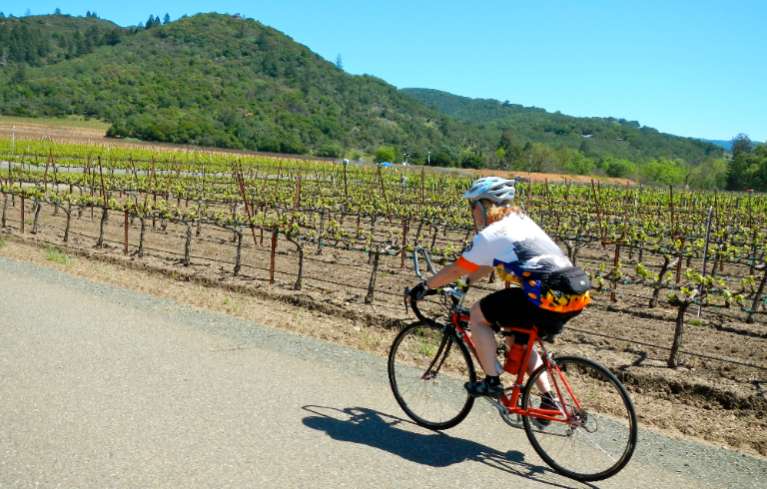
Sue Wood pedals past a vineyard on her way to Chateau St. Jean. Photos/Kathryn Reed

Sue Wood pedals past a vineyard on her way to Chateau St. Jean. Photos/Kathryn Reed

By Kathryn Reed

SONOMA – History beckons from our doorstep. A mission, wineries, early California, Jack London. But contemporary times are just outside, too, including innovative winemaking, cutting edge restaurants, logical trail networks, well-trained massage therapists.

Sonoma. It has it all.

Staying at the Sonoma Valley Inn was the perfect launching pad for a long weekend of fun to celebrate Sue’s birthday last month. The Best Western is just off the Sonoma Square.
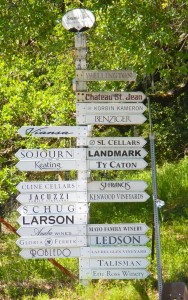
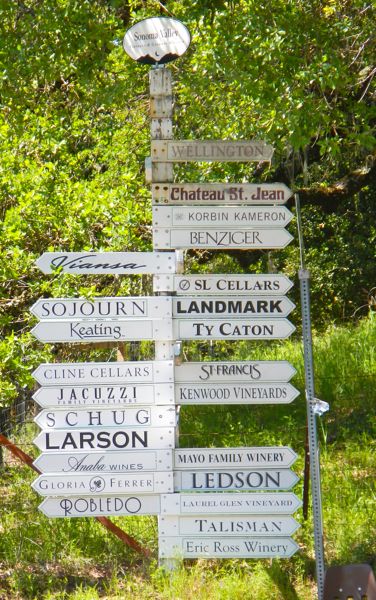
Plenty of wineries to choose from.

Plenty of wineries to choose from.

We start our first full day with a bike ride that ends up being 32 miles through vineyards, a stop at a state park and a leisurely wine tasting.

Zipping along a few city streets – with clearly marked bike lanes – and then onto a trail system, we then end up on Highway 12. The highway part of the ride is not ideal if you get nervous about traffic while on a two-wheeler. But it’s no biggie for those who ride the highways in Lake Tahoe.

After Sue changes my flat, we turn on Madrone Road and head toward Jack London Historic Park. Calmness comes over us as the cars are now few and far between. Instead it’s all about the vineyards that are budding and lush grass on the hills.

Jack London's works on display at the state park named after him.

Jack London’s works on display at the state park that was once his homestead.

The park is 9.8 miles via this bike route from our hotel. The woman taking our money says the mountain bike trails are worth exploring. That was not going to happen with our thin tires and me being out of replacement tubes.

Fortunately, we had been to the park before because it’s not ideal to explore in clip-on bike shoes. And knowing we hadn’t even made it to our halfway point, we didn’t want to linger too long. Still, we took a quick trip through the museum to reacquaint ourselves with one of California’s most famous writers.

On we pedal, now with Chateau St. Jean as our destination. We are allowing ourselves one tasting while on two wheels.

Idyllic, sweeping grounds beckon. A water feature is soothing. I have thoughts of hiring a car to give us a lift back. But it’s Sue’s birthday, so pedaling is how we return to the hotel.

We fuel up on a light lunch at the winery and sip their wines. Tastings are normally $15 per person, but one of the great things about the Sonoma Valley Inn is they have free tasting coupons for some of the nearby wineries. That’s one of the things that led us to Chateau St. Jean – that and it had been years since we were there, and we like their wine.

The hotel

We soothe our muscles in the hotel’s hot tub that is steps from our backdoor patio. It feels like we are in a secluded garden because of the mature landscaping. It’s quiet, except for the other guests. Traffic cannot be heard. Just the birds telling stories.

A pool, fire pit and steam room are part of the courtyard. Many of the rooms at this two-story hotel look out onto this area.
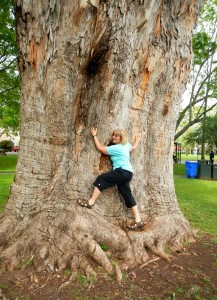
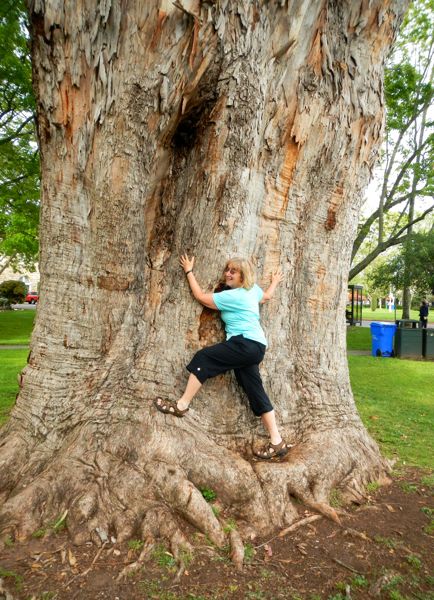
Sue Wood tried to do a little tree climbing at Sonoma Square.

Sue Wood tries to do a little tree climbing at Sonoma Square.

While there are children staying at the hotel, it has a definite adult feel to it. Maybe it’s because everyone seems to be there to go wine tasting – a distinctly adult activity.

We have our four-legged kid with us. AJ likes that she has her own grassy area to do her business.

And the staff all seems to understand people are there to unwind, have a good time and not be rushed. The service is several steps up from the typical Best Western.

The room is plenty big – larger than a typical hotel room, but not quite large enough to fit two massage tables.

A fireplace with a “fake” log is in the corner, adding a bit of ambiance as the evening cools off.

The only downside to the hotel is how far away the complimentary breakfast area is. While it wasn’t a big deal while we were there, had it been raining, it could have been a miserable experience.

Plenty of wineries

From historic to contemporary, from average priced to breaking the bank, from run of the mill service to off the charts – the wineries of Sonoma have it all.

One spot I wanted to visit was Buena Vista. It was my parents’ favorite winery and where my sisters and I threw them a surprise 25th anniversary party.

It was founded in 1857 and is considered California’s first premium winery. It is also the state’s oldest commercial winery. It is undergoing a multiyear, extensive renovation.

Close by is Gundlach Bundschu. It started a year later and is California’s oldest continuously family-owned winery.

In the opposite direction are Jacuzzi Winery and Cline Cellars. Both are owned by the same family, with Cline having been established first. And, yes, Jacuzzi is the hot tub family. The winery is built as a replica to the family’s estate in Italy.
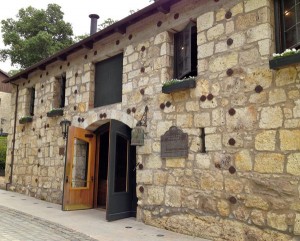
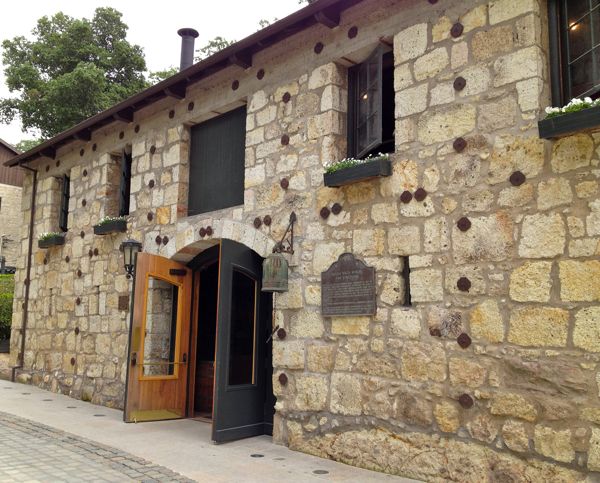
Buena Vista Winery

Buena Vista Winery

We learn about the Sip California card  from women in the hotel hot tub. The discount card costs $50 and is good at more than 20 wineries for the year. They gave us theirs so now we “have” to go back to Sonoma County this year.

Other things

Driving into San Francisco was easy from the Sonoma Valley Inn. We took in a (losing) Giants game that weekend.

We had contemplated getting a massage in our room, but I knew there was no way two tables would fit. So off we went to Spa Sonoma. It was about a five-minute drive.

It was the antithesis of a high-end spa – exactly to my liking. It was a little funky. But the most important part, each of our massages had our bodies feeling like putty.

One night we ate outdoors at the Plaza Bistro. Sue is still raving about the salmon special she had that came with little cherry tomatoes and roasted potatoes. My mushroom risotto was great. We shared a salad of greens and beets as well as crème brûlée.

Another night we opted for Mexican at Maya restaurant. While Mexican food is easy to make vegetarian, so many places don’t. It was nice to look at a menu with choices where I didn’t have to ask for anything to be removed. Sue indulged in the fish tacos. This was clearly a locals place just by overhearing conversations.

And it was nice having a Whole Foods market across the street from the hotel to provide picnic fare and an excellent selection of Sonoma and Napa wines.

—–

Notes:

• Sonoma Valley Inn is on 2nd Street West. Details are online. AJ was an extra $35 for the entire stay.

• Spa Sonoma is a short drive from the hotel, or therapists will come to your room.

• Jack London State Historic Park is accessible via bike for $5 or $10 per vehicle.


LTWC moving to 27 acres in South Lake Tahoe

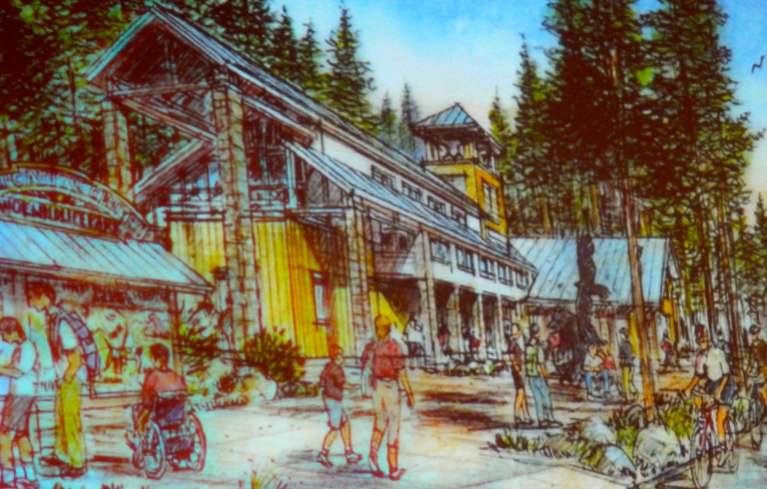
This is an artist's rendering of what Lake Tahoe Wildlife Care will look like.

This is an artist’s rendering of what Lake Tahoe Wildlife Care will look like.

By Kathryn Reed

STATELINE – Lake Tahoe Wildlife Care is moving from the founders’ backyard that is less than 1 acre to 27 acres in South Lake Tahoe.

Tom and Cheryl Millham, who have run the wildlife rehabilitation facility for more than 36 years, were teary-eyed as they made the announcement May 17 at MontBleu casino during a break in the annual volunteer training.

Negotiations to buy the triangular-shaped parcel owned by Marjorie Springmeyer on Al Tahoe Boulevard near Pioneer Trail and the Pioneer Village housing development have been going on since September. This is across from open space called the Springmeyer Land Conservancy.

The lease with an option to buy contract was signed May 15. The price has not been disclosed. Barbara Hartoonian left a substantial sum to LTWC that is allowing for the land acquisition. There is money for the first phase, but extensive fundraising will be required to build the facility the Millhams have been dreaming about for decades.

Cheryl and Tom Millham on May 17 announce the deal to move LTWC into the city limits. Photo/LTN

Cheryl and Tom Millham on May 17 announce the deal to move LTWC into the city limits. Photo/LTN

The money left by Hartoonian will only cover a fraction of the more than $10 million that the new facility plus lease is expected to cost.

Bonnie Springmeyer told Lake Tahoe News one of the driving reasons her mother-in-law decided to part with this parcel was because her friend Hartoonian believed in LTWC.

The elder Springmeyer turns 92 this summer. Her family – the Johnsons and that of her late husband Buzz’s – were pioneers on the South Shore as well in the Carson Valley. They still own a tremendous amount of land in both locations.

It has not been decided what aspect of the facility will be named after Springmeyer, but part of the deal is this will also be part of Marjorie Springmeyer’s legacy.

This property was looked at 12 years ago, but Springmeyer was not ready to sell at that time.

The next step is to secure the necessary permits from the city and Tahoe Regional Planning Agency. A zoning change will also be required.

The goal is to break ground in May 2015. Cages have been designed.

Phase one will be the rehabilitation center, including medical facility for the animals. It will also have caretaker’s quarters. Denise Upton, who has been an instrumental part of LTWC in recent years, will take over for Executive Director Cheryl Millham.

“We will be advisers and counselors to the people running the facility,” Tom Millham told Lake Tahoe News.

The Millhams have wanted to retire for years. But they haven’t been able to because the animals are in their backyard. It was in 2001 that El Dorado County told them they had to find another place for the center. It has taken this long to find a suitable location.

The second phase will include an education center that will have a conference center and gift shop.

Fencing will allow for animals that cannot return to the wild to live on site and give a different kind of educational experience for people.

“It will be great economic development for the community. It will give people another reason to stay and play,” South Lake Tahoe City Manager Nancy Kerry told Lake Tahoe News. “It will help diversify the economy.”

She added, “It’s great recognition for one of the founding families of Lake Tahoe.”

Through the years, LTWC has taken in more than 24,000 animals, returned 15,000-plus to the wild, and has trained more than 2,000 people to help care for these animals. LTWC is California’s only rehab facility for bear cubs.


Europe bans pesticide-coated U.S. apples

By Carey Gillam, Reuters

U.S.-grown apples are widely coated with a pesticide that has been newly banned in the European Union amid health concerns, and the United States is at least a year behind in a required scientific assessment of the pesticide, an environmental group said last month.

The Environmental Working Group, a nonprofit health and environmental advocacy group, sent a letter to the Environmental Protection Agency asking for the agency to halt the use of diphenylamine, also called DPA, until a new analysis shows DPA levels on food are safe, the group said.

DPA, which is sprayed on apples after they are harvested to help prevent browning, was first registered as a pesticide in the United States in 1947, according to the EPA.

But recent concerns about the pesticide’s potential links to cancer led the European Union to ban fruits containing more than 0.1 part per million of DPA. That regulation took effect in March.

Read the whole story