Prescription drug use in U.S. keeps climbing

By Dennis Thompson, HealthDay

Prescription drugs are playing an increasingly larger role in U.S. life, with nearly half of all Americans taking one or more medications.

Among adults, the most common prescription drugs are for cardiovascular disease and high cholesterol.

Those are two of several key findings in the federal government’s annual comprehensive report on the nation’s health that was released Wednesday.

The relationship between Americans and their prescriptions is complex, according to the report produced by the U.S. Centers for Disease Control and Prevention.

On the one hand, more people than ever are receiving effective treatment for chronic conditions like diabetes, high blood pressure, elevated cholesterol levels and depression.

But doctors and pharmacists also find themselves struggling with unintended consequences of drug use, such as prescription narcotics abuse and the advent of antibiotic-resistant germs.

Read the whole story


Laws to track Calif.’s biggest water users ignored

By Katharine Mieszkowski, Center for Investigative Journalism

The last time California endured a drought, legislators set their sights on the state’s heaviest water users: farmers.

The state designed laws to push agricultural water districts to closely track their water flow and make the largest districts charge farmers based on how much they use. The economic theory is simple: If you aren’t paying for how much water you actually use, you have little incentive to try to consume less.

But those rules are widely being ignored as they come into effect in the midst of one of the state’s most severe droughts on record.

All but the smallest agricultural water districts were required to track and report to the state how much water they deliver to customers as the result of a 2007 law. Only 20 percent – 48 of 242 districts – have filed those reports, according to California Department of Water Resources data. They were due 10 months ago.

Shasta Dam is an integral component of California's water system. Photo/LTN file

Shasta Dam is an integral component of California’s water system. Photo/LTN file

Under a 2009 law, the 55 largest agricultural water districts also are required to more precisely measure how much water each farmer is using. They’re then required to charge farmers – at least in part – on that basis.

The state doesn’t know how many suppliers are meeting this requirement or are even taking steps toward doing so, because almost half of them have failed to turn in the relevant reports, records show.

Charging for water based on use had been common in some agricultural areas where water is scarce, like the San Joaquin Valley. But now, it’s mandatory for large districts throughout California. These water management plans, which spell out how the districts will make the changes, were due at the end of 2012. Districts face few consequences for failing to comply.

By contrast, most residential water customers in California, whose use is metered, have long seen how much water they use reflected in the bills they receive.

“Throughout the state, people should be paying for water based on how much they use, and that will drive conservation,” said Peter Brostrom, program manager of water use efficiency for the Department of Water Resources.

Agriculture, which accounts for some 80 percent of the water that’s used in the state, has met the new rules with skepticism and indifference, as growers cope with the drought.

The Tulelake Irrigation District in Siskiyou and Modoc counties is not following the new rules. Earl Danosky, the district’s manager, said he has no plans to charge farmers for how much water they use individually. The district currently charges a flat per-acre fee once a year.

“I don’t believe it would save one drop of water,” Danosky said. He said he believes farmers there already are careful with the water they use out of necessity. “Too much water will damage the crop.”

Danosky said he didn’t realize he was supposed to be turning the reports in to the state. The district serves hundreds of family farms, which grow potatoes, onions, alfalfa and mint near the state’s northern border with Oregon.

Down in the Sacramento Valley, Reclamation District 108 is on track to meet the state’s new requirements. Still, farmers there doubt the changes will inspire much water conservation in their area.

“It’s a one size fits all for the state, and for us, it didn’t fit,” said Fritz Durst, the district’s board president, who grows rice, sunflowers, alfalfa and corn. “There’s probably areas where it would give people incentives to use less water, but with the way we manage our water here, there is no benefit.”

Water flows from the district’s system of canals through farm gates and into ditches next to the farmers’ fields, where it is used for irrigation. Rice especially relies on a lot of water. Growers flood the fields, allowing plants to sit in four inches of water. Water that drains off the fields is reused on other fields, accounting for about 40 percent of the total water the district delivers.

Local farmers voted to install a $2 million system to measure how much water comes out of these canals. Now, changing the district’s pricing to meet the regulations will require another vote. District officials hope to have the new pricing in place by the start of irrigation in spring 2016.

If Durst’s water bill goes way up, he said he likely won’t use less water. He said he’ll probably just grow a specialty rice that will fetch more on the market.

Districts’ failure to comply with the requirements troubles environmentalists who promote conservation as one tool for taking on the state’s water woes.

“Unless these districts start taking this seriously, it’s going to be their customers that suffer,” said Claire O’Connor, agricultural water policy analyst for the Natural Resources Defense Council.

The Department of Water Resources has had to rely on letters and workshops to try to cajole districts into complying. There’s no penalty for agricultural districts that don’t report how much water they’re delivering to farms.

Large districts that haven’t submitted their water management plans to the state have lost access to $472 million in state grants to encourage conservation and improve water management. But once they turn in their plans, they are eligible for funds again.

That money could be used to help farmers in their districts install more efficient irrigation systems, for instance.

A third party could sue districts for not fulfilling the requirements, but there’s little talk of this being in the works.

Farmers aren’t the only ones whose water use came under the legislative microscope during the last drought. The state is now trying to achieve a 20 percent reduction in urban per-capita water use by the end of 2020, based on the same law that targeted large agricultural districts.


Lake Tahoe Airport on course to remain open without return of commercial service

By Kathryn Reed

Lake Tahoe Airport is not going to have commercial air service any time soon, if ever. Lake Tahoe Airport is not going to stop being an airport. Lake Tahoe Airport could be more than it is.

Those were the major points delivered Thursday night at a meeting about the master plan for the South Lake Tahoe airport.

Michael Hotaling with the consulting firm putting together the master plan for the city and FAA on May 29 went over issues that were brought up from the February meeting – which centered on making it more than a general aviation facility and closing it down.

Hotaling said to have commercial flights it would require a subsidy. Mammoth subsidizes its airport by $2.5 million a year. City Manager Nancy Kerry said she has been asking people at meetings if they think that is a wise use of city funds – assuming the city had that kind of cash – and the overwhelming response is “no”. The same outcome came Thursday night.

Lake Tahoe Airport is not apt to see commercial service any time soon. Photo/LTN file

Lake Tahoe Airport is not apt to see commercial service any time soon. Photo/LTN file

When the airport had commercial service in the past there were subsidies as well as marketing support for some of the airlines.

The city is already spending $300,000 a year from the general fund to support the airport. This is down from a high of $600,000.

But the city is in no position to cough up money to support this type of enterprise when the few “extra” dollars it thought it would see this fiscal year are evaporating because of the dismal winter and potential loss of parking revenue.

“It doesn’t make sense for only city residents to fund this airport,” Kerry said.

She would like El Dorado and Douglas counties to have a financial stake because they benefit from people flying in.

The Federal Aviation Administration would have the ultimate say over whether the airport closes. And even it said “yes”, the city would have to repay the nearly $20 million in grants it has received from the federal agency.

Going forward, Hotaling said, the city needs to consider options for the airport beyond current uses.

“The niche could be catering to folks who already are coming here,” he said. This would involve enhancing the facilities in some manner – making it a destination of sorts.

More than a dozen of the nearly 80 people at the meeting had a question or comment.

Transportation beyond air service was a concern of several people. Some remarks had to do with how people get to other parts of Tahoe once they fly in. Others questioned the environmental impact of air service in terms of how will people get around once they are in Tahoe.

It was brought up how there is no bus service to the airport.

An air shuttle service between South Lake Tahoe and Sacramento and Reno was also broached. Kerry said this idea has been talked about but has not gotten off the ground.

One person suggested there be pilots’ quarters over hangars, as well as having the drive-up market stop at the airport and then be shuttled to their final destination.

Reducing the runway in some form – like shortening it – was an idea.

Sherry Miller, airport manager, said if that were to occur, then the airport would be less viable and the FAA may not approve doing this. Concerns are whether large firefighting aircraft would then be able to land, as well as safety concerns because of the air density involved during the summer.

“They don’t like airports to limit their use,” Miller said of the FAA.

The airport runways’ width have been reduce from 150 feet to 100 feet in recent years. This has allowed the city to bank stream environmental zone credits. But no one has come calling for them, so that commodity isn’t much of a revenue stream or incentive to get rid of more coverage.

More information about the airport master plan may be found online.


State suing several Tahoe gas station owners

By Kathryn Reed

Several Lake Tahoe gas station owners are being sued by the state of California for allegedly mishandling underground storage tanks.

The State Water Resources Control Board has been after many of these defendants for years, with fines being levied in the past.

Besides tanks in El Dorado and Placer counties, the defendants also own property in Contra Costa, Sacramento and Yolo counties that are part of the lawsuit.

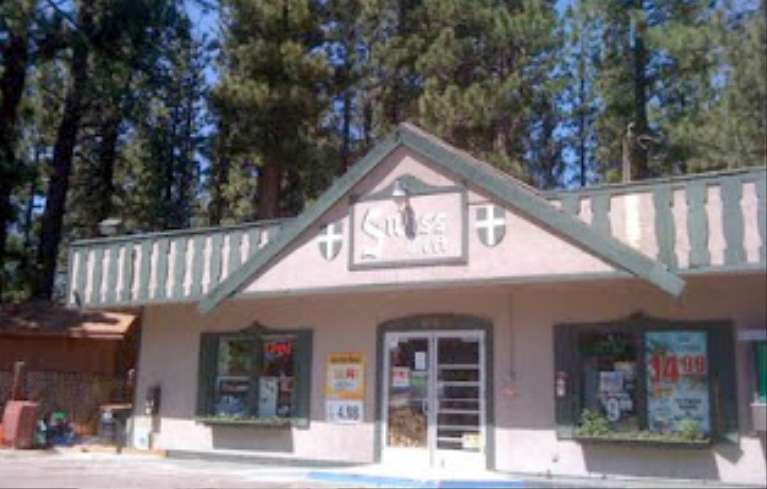
Owners of the Swiss Mart on Emerald Bay in South Lake Tahoe are being sued by the state.

Owners of the Swiss Mart on Emerald Bay in South Lake Tahoe are being sued by the state.

According to a press release, the Attorney General’s Office “is seeking a permanent injunction, civil penalties, and other equitable relief to remedy numerous violations observed at the facilities. Applying the minimum civil penalty of $500 per-day per-tank for each violation, the penalties could reach several million dollars.”

Lake Tahoe properties include:

• 1140 Emerald Bay Road, South Lake Tahoe – American Oil.

• 3208 Highway 50, Meyers – Meyers Beacon.

• 2304 Lake Tahoe Blvd., South Lake Tahoe – South Lake Tahoe Mobile.

• 913 Emerald Bay Road, South Lake Tahoe – Swiss Mart.

• 8070 North Lake Blvd., Kings Beach – North Tahoe Station, TransAm, North Tahoe Beacon, North Tahoe Mobil.

The 30-page complaint says Azad Amiri and Sarbjit Singh Kang were the masterminds behind everything, including using family and friends as “strawmen” as a way to “conceal their actual ownership, operation and control of the real properties.”

They are accused of failing to install and/or maintain automatic line leak detectors on underground-pressurized pipes that carry a hazardous substance at six locations, including 1140 Emerald Bay Road, 2304 Lake Tahoe Blvd. and 8070 North Lake Blvd. This would violate several state Health and Safety Codes.

At the above locations, and in Meyers and the Swiss Mart they are accused of failing to test and certify underground storage tank monitoring equipment.

They face several other charges related to how they operated the stations and storage tanks.

The complains also alleges they: commingled funds and other assets, failed to segregate funds of the separate entities, diverted corporate funds or assets without authority, failed to maintain adequate corporate records, used the corporate entity to procure labor-service-merchandise for another person, manipulated assets between entities, and used a corporation as subterfuge of illegal actions.

The complaint lists the following people connected to Lake Tahoe:

  • Azad Amiri owned properties at 1140 Emerald Bay Road and 913 Emerald Bay Road, both in South Lake Tahoe. He owned or operated the underground storage tanks at these locations.
  • Dilpal Singh Dhillon is the owner of the property and underground storage tanks at 2304 Lake Tahoe Blvd., South Lake Tahoe.
  • Satar Hidarinejd was an officer, director or member or partner of Aria Oil Company that operated the underground storage tanks at 1140 Emerald Bay Road.
  • Darshan Singh Kang, who lives in El Dorado County, was an officer or partner in South Tahoe Station Inc. and North Tahoe Station Inc. He has been at least a partial owner of the 3208 Highway 50 property in Meyers that locals know better as the Tveten parcel. Kang was responsible for operating the underground storage tanks there.
  • Kaur Kang also has an interest in the Meyers parcel as well as the 913 Emerald Bay properties; and was an operator of the underground storage tanks.
  • Sarbjit Singh Kang, a resident of El Dorado County, was partner or director for Kang Property Inc, North Tahoe Station Inc., South Tahoe Station Incl., and Tahoe 3208 Highway 50 Corp. He was part owner of the Meyers property, 913 Emerald Bay, 1140 Emerald Bay, and 2304 Lake Tahoe Blvd.
  • Darshan S. Singh of El Dorado County is part owner of the Meyers property.
  • Parmjit Singh is part owner of the 1140 Emerald Bay and 2304 Lake Tahoe Blvd. properties.
  • Rajinder Singh was a director or officer in North Tahoe Station Inc.
  • Raman S. Singh was part owner of the 2304 Lake Tahoe Blvd. property.

Companies with Tahoe ties that have been named include: Ameri Oil Company, Dara Petroleum Inc., Emerald Business Group Inc., Kang Property Inc., Meyers Holding Co., North Tahoe Station Inc., South Tahoe Station Inc., Tahoe 3208 Highway 50 Corp., Tahoe Blue LLC, Tahoe Blue Property Inc., and Tahoe Station Inc.


Laxalt adds twist to Nevada AG race

By Jon Ralston, Politico

Dick Cheney calls him “courageous” and says electing him “is of the highest priority.”

John Bolton traveled across the country to headline a fundraiser for him. Newt Gingrich, Frank Fahrenkopf, Tom Ridge and Ed Meese (remember him?) all appeared at the same D.C. event to celebrate his candidacy. Donald Rumsfeld gave him a personal check for $5,000, part of a half-million-dollar haul.

Who is this remarkable contender attracting such a list of national GOP luminaries? What remarkably accomplished figure could warrant such attention? Who can command encomia from a former vice president, attorney general, defense secretary, House speaker, chairman of the Republican National Committee and Homeland Security secretary?

Adam Laxalt, that’s who.

Who?

Laxalt is only 34, has never run for office before and is campaigning for attorney general—attorney general!—in Nevada, where he has been a cipher until just recently and whose last name explains … everything. That’s because Laxalt has one of the most unusual pedigrees in American politics: He’s the grandson of Paul Laxalt, the former senator and Ronald Reagan confidant once known as “the first friend” — still, at 91, casting a long if not always visible shadow in Nevada politics.

Awkwardly, young Laxalt is also the illegitimate son of Sen. Pete Domenici, his grandfather’s longtime Senate colleague. In fact, it was only last year that Adam Laxalt’s mother Michelle, a 24-year-old Reagan operative at the time of the affair and now a well-known Washington lobbyist, revealed her son’s parentage for the first time, a sensational revelation that almost certainly had the effect of clearing the way for his political career.

It gets better. Laxalt’s Democratic foe is another political royal, Nevada Secretary of State Ross Miller, the son of a former governor and the overwhelming favorite to win. But that’s also what’s made the race such a spectacle: Miller, the Nevada Democratic Party’s rising star and presumed 2018 gubernatorial candidate, has become a top target of Republican potentates like casino magnate Sheldon Adelson, who has launched a Stop Miller Now campaign and is bankrolling Laxalt along with his grandfather’s Reagan-era friends.

As one prominent Nevada Republican puts it, “If his name were Adam Smith, this race would be a total joke.” But his name is Adam Laxalt, and that’s why Democrats aren’t laughing.

Read the whole story


California Chrome fever swells in Gardnerville

By Susan Wood

GARDNERVILLE – When California Chrome co-owner Steve Coburn told his wife, Carolyn, he was going to Sharkey’s Casino to bet on their winning thoroughbred to launch his march with destiny, she stood by her man – and her horse.

“I gave him the money to do it,” she told Lake Tahoe News of the undisclosed amount.

The Coburns, and hundreds of new friends, on May 28 were at the Carson Valley casino where they had placed that bet. They and their horse were bestowed with gifts, kudos and well wishes for another win in Elmont, N.Y., on June 7.

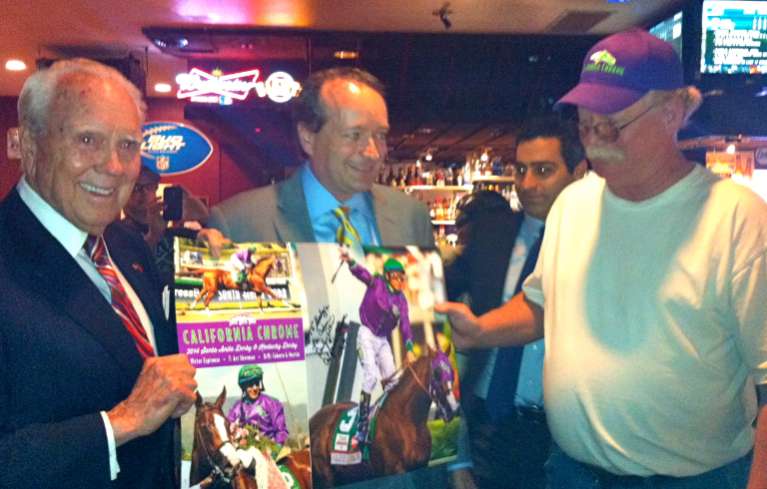
Steve Coburn, right, with Joe Asher, CEO of William Hil Sportbook and l, sharkey's owner Harold holder; by susan wood

Steve Coburn, right, with Joe Asher, CEO of William Hill Sportbook, and Sharkey’s owner Harold Holder. Photos/Susan Wood

The chestnut colt won the Kentucky Derby on May 3 – against 200 to 1 odds. It was the first time in 52 years a California horse won the first jewel of the horse-racing industry’s Triple Crown. The horse continued its quest two weeks later and won the Preakness, along with the hearts and souls of many people who longed for a Cinderella story.

And that it is.

The prized horse only cost the Topaz Lake couple and co-owner Perry Martin of Yuba City $10,000. It has also brought redemption to 77-year-old trainer Art Sherman after a long Derby drought.

California Chrome – who gets his name from his white markings called “chrome” — also shares the same birthday with Steve Coburn’s late sister Brenda, who gets a prayer before every race. To this day, it’s difficult for Coburn to mention the connection without getting choked up, and Wednesday was no exception in his little hometown casino. The horse’s quest has also given jockey Victor Espinoza something for his brother, a former rider, to cheer about after a traumatic brain injury ended his career.

“Victor knows that horse. They understand each other,” Carolyn Coburn said, while sitting with family friend Teri Vandenberg at the casino bar. One could say the same about the Coburns, who have been married for 20 years.

“They are the most small-town, modest, humble people – so down to earth. They’ve been made celebrities overnight, and they’re overwhelmed,” Vandenberg said.

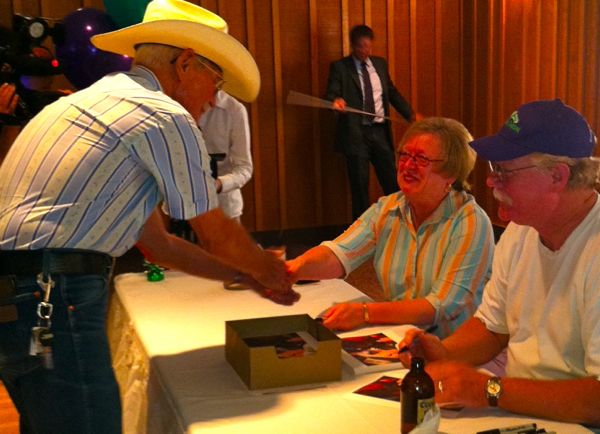
Carolyn and Steve Coburn on May 28 meeting hundreds of fans and sign autographs at Sharkey in Gardnerville.

Carolyn and Steve Coburn on May 28 meeting hundreds of fans and signing  autographs at Sharkey’s in Gardnerville.

Despite the fame, Steve Coburn went back to work at a company in Gardnerville that makes magnetic strips for items such as credit cards. On Wednesday, he bellied up to the bar clad in blue jeans, a T-shirt and a cap for a swig of beer and to take time out from the hoopla. He was soon surrounded by patrons wanting a picture taken with him and an autograph. His wife quietly watched from a distance.

Unlike her more well known husband, the Coburn matriarch is soft spoken, but a powerhouse anchor for the family, which now includes a four-legged equine who aptly pays for his board and keep.

Despite the rural Nevada roots, Carolyn Coburn dressed the part of a racehorse owner at the Derby with a signature hat.

“At the winner’s circle, it blew off,” she said.

The Coburns and Martins co-owned California Chrome’s mother, Love the Chase, but she didn’t have the same love of running like her son. What both horses loved were cookies from Mrs. Pastures.

Most in attendance at the Sharkey’s ceremony and around the country say the same thing: “There’s something about that horse,” a thoroughbred that’s become a working-class hero when he beat the million-dollar babies in Louisville.

Back in Gardnerville, fans couldn’t be more pleased with seeing their connection to the horse – the Coburns.

“We’re honored the Coburns like Sharkey’s. This is such a Cinderella story,” Sharkey’s owner Harold Holder told Lake Tahoe News. He and the executives at the sportsbook company William Hill US stood out in their suits, but blended in with their enthusiasm.

Holder and William Hill CEO Joe Asher presented Coburn with a blanket so the Cinderella-storied horse can slip into something comfortable after the Belmont Stakes in June.

“I hope he wears it,” Holder said.

“Oh, he will,” Coburn quickly replied, as if speaking of a son. The executives also gave Coburn a $1,000 check to bet on his horse for a charity of his choice.

With no hesitation, Coburn promised the adoring crowd another win for California Chrome, which would be the first time a horse has won the Triple Crown since Affirmed took the title in 1978. A dozen others have tried since then.

“There’s no doubt in my mind he’ll win the Triple Crown,” Coburn announced. “The whole state of Nevada, and hell, the whole state of Kentucky is pulling for us.”

The local crowd cheered.

The same crowd went upstairs to stand in line for autographs of various items. Some came bearing gifts, including that of a Nevada license plate by an aide of Gov. Brian Sandoval’s. Carolyn Coburn was touched by a well-wisher presenting a necklace and earrings.

What’s the first thing the couple plans to do upon winning the Triple Crown?

“Probably cry,” they both said.


As Earth warms, West Nile spreads

By Brittany Patterson, Atlantic

The day that everything changed was a broiling Thursday in July—95 degrees, the kind of dry heat that Sacramento Valley residents are used to. If you have to work outside, you do it before noon, swathed in long sleeves and pants to keep the sun at bay and the mosquitoes from eating you alive.

On this day, however, my grandmother, an active and spritely woman even at 80, never made it outside to the garden. She mentioned at breakfast that she wasn’t feeling well, and my grandfather suggested that she take a nap in the sunroom. When he finally woke her up at 4pm, she still felt ill and feverish. The nearest emergency room is more than an hour’s drive from their 20-acre farm in rural northern California, but they decided to make the trip. The doctors performed a CAT scan, gave my grandmother some Tylenol, and sent her home.

When my grandparents finally got back at around 11pm, my grandfather tried to convince my grandmother to eat something; she said that she could manage a piece of toast. A few days later he found the toast, one bite taken out of it, abandoned in the microwave.

Although it may be possible to disregard the slow changes happening within our climate, it’s less easy to ignore the effects of a disease ravaging a family.

While getting ready for bed, my grandmother went into the bathroom and stood in the dark for 10 minutes. “I asked her what she was doing, and she said she was washing her teeth,” my grandfather recalls. He coaxed her out, and they climbed into bed.

It was around 4am when the tumult began. “I’m falling out of bed!” my grandmother screamed. Half asleep, my grandfather tried to push her back in, but when he touched her, she shrieked and began sobbing. He rushed down the hallway, phoned the hospital, and was told to call 911. By the time that he could get back to the bedroom, my grandmother was slumped on the floor, her head against the bedside table, babbling incoherently. The paramedics arrived within 15 minutes.

“I wasn’t thinking of it being anything,” my grandfather says now. “I thought it was something she would get treated for and get better.”

My grandmother — or Oma, as we call her, the German word for grandmother — had always been a picture of perfect health, a trait that she and Opa, my grandfather, attributed to decades spent farming organic produce and tending to their land. But as Oma spent the next 32 days in the hospital and then three weeks in a rehabilitation facility, my family came to realize that the first night of terror was just the beginning. Despite the best efforts of her doctors, Oma did not get better.

* * *

On Aug. 23, 1999, an infectious disease doctor in northern Queens reported two patients with encephalitis—swelling of the brain—to the New York City Department of Health, according to a Centers for Disease Control and prevention (CDC) report from October 1999. Upon investigation, the health department identified six patients with identical diagnoses who lived in the same vicinity.

In what appeared to be an unrelated development, crows were being found dead all over New York state that summer. It was as if they were dropping from the sky. In early September, a cormorant, two captive-bred Chilean flamingos, and an Asian pheasant died at the Bronx Zoo. The unexplained deaths filled the papers with foreboding stories. It was thought that mosquitoes were spreading some kind of virus, but which one, and whether it could spread to humans, was unknown.

The local mosquito vector control agency jumped into action and began spraying pesticides. About 300,000 cans of DEET-based mosquito repellent and 750,000 pamphlets with information about personal protection against mosquito bites were distributed to NYC residents, according to the same CDC report.

On Sept. 20, samples from the deceased birds at the Bronx Zoo were tested and sent to the CDC. DNA sequencing revealed a viral strain, closely related to West Nile virus found in other parts of the world, but never before found in the Western Hemisphere. Around the same time, the CDC, while performing tests on a human brain specimen from an encephalitis case, discovered a strain of West Nile virus identical to the one found in the bird. Over the course of the next few months, the same match between the viruses in the birds and those in humans was found dozens of times. A previously undetected strain of West Nile virus, it seemed, was now in the United States.

Like all viruses, West Nile requires a host to survive and reproduce—in this case, birds. Like most arboviruses (diseases transmitted by blood-feeding insects), it is transmitted by mosquitoes. West Nile is also a neurotropic virus, which means that, in some cases, it can infect the brain.

“When West Nile first showed up, it was big news,” says Stephen Ostroff, formerly the associate director for epidemiologic science at the National Center for Infectious Diseases, which is part of the CDC. Hundreds of newspaper articles were published about the emerging disease, often with frightening headlines like “As Fears Rise About Virus, the Answers Are Elusive.”

Multiple local governments were forced by their health departments to spray pesticides from helicopters and trucks to reduce the adult mosquito population.

The answers were elusive in part because of controversy, which is still ongoing, about how best to stop the spread of the virus. Multiple local governments were forced by their health departments to spray pesticides from helicopters and trucks to reduce the adult mosquito population, according to a Journal of Urban Health article from 2002 and the media struggled to compare the risks of pesticide spraying with the risks of the virus.

Just as feared, the problem quickly began to spread to other states. Ostroff was appointed point person for the investigation by the Department of Health and Human Services.

“As we watched it march across the country, in different years there would be different hotspots,” he says. “One year Louisiana, one year Chicago. It would reproduce all of the issues, concerns, and questions about control measures.”

In 2002, West Nile made it to California. By 2004, it had been found in every state in the contiguous United States, according to the American Society for Microbiology’s report on West Nile virus.

In a new climate change report, the National Climate Assessment, which was prepared by a large scientific panel with the oversight of the federal government, the authors write that climate is “one of the factors that influence the distribution of diseases borne by vectors, such as fleas, ticks, and mosquitoes, which spread pathogens that cause illness.”

They go on to write that outbreaks of this diseases are sensitive to local weather and human modifications to the landscape. There are a lot of different variables that influence outbreaks, but they conclude with this: “Enhanced vector surveillance and human disease tracking are needed to address these concerns.”

But after the march of West Nile across the country, our monetary investment in the disease petered out, due in part to the amorphous nature of the disease itself. Unlike the flu, which will arrive every year without fail, the severity of a West Nile outbreak varies hugely.

The authors write that “summers are longer and hotter, and extended periods of unusual heat last longer than any living American has ever experienced. Winters are generally shorter and warmer. Rain comes in heavier downpours.”

Although it will vary by region, these characteristics fomented by climate change, don’t bode well for West Nile outbreaks. And although it may be possible to disregard the slow changes happening within our climate, it’s less easy to ignore the effects of a disease ravaging a family.


Eating invasive species may help eliminate them

Tahoe Lobster Co. was the first to harvest invasive crawfish from Lake Tahoe . Photo/LTN file

Tahoe Lobster Co. was the first to harvest invasive crawfish from Lake Tahoe . Photo/LTN file

By Ramit Plushnick-Masti, Washington Post

HOUSTON — It seems like a simple proposition: American lakes, rivers and offshore waters are filling up with destructive fish and crustaceans originally from other parts of the world, and many of them are potential sources of food.

So why not control these invasive populations by getting people to eat them?

The idea gained momentum recently when lionfish, which invaded the Gulf of Mexico, were successfully marketed to restaurants and appear to be in decline.

But businesses and scientists have struggled to repeat this apparent triumph with other species. Some, such as Asian carp, are not appetizing to Americans. Others, such as feral hogs, reproduce too quickly for the strategy to make a dent. And then there’s the question of whether turning the animals into sought-after cuisine undermines the larger goal of eliminating them.

“Eating invasive species is not a silver bullet,” said Laura Huffman, the Nature Conservancy’s director in Texas. But it can still be “a way to get people engaged in the topic and in the solution.”

Read the whole story


Beach cleanup program launches; future of South Shore fireworks still on shaky ground

By Kathryn Reed

Whether the South Shore has fireworks after this summer remains to be seen. But what is known is the public beaches will be cleaned.

After a lawsuit was filed last year by a Marla Bay couple in regards to the debris that washed ashore following the July 4 and Labor Day shows and the potential degradation of Lake Tahoe’s water, Adopt-a-Beach-Tahoe was created.

It won’t be just about tending to the beaches after the fireworks. It’s a seasonlong program that launches today with a party at Edgewood Tahoe Golf Course from 5-6pm.

South Lake Tahoe, Douglas County, Lake Tahoe Visitors Authority, League to Save Lake Tahoe, and U.S. Forest Service Lake Tahoe Basin Management Unit are spearheading the cleanup days that will run June 15-Sept. 15. The goal is to get service clubs, companies and individuals to sponsor a day – which means being responsible for regularly cleaning up one of the public beaches on the South Shore. Or it could be a group of friends taking the lead; or random volunteers showing up to help.

“It’s up to the community to make this idea work,” South Lake Tahoe City Manager Nancy Kerry told Lake Tahoe News.

After all, people said they would do anything to ensure the beaches are clean and the fireworks continue.

This was after the 30-plus year tradition was threatened. Part of the lawsuit settlement  is that better cleanup needs to occur – which includes being more prompt.

While the LTVA has had a cleanup protocol in place, it either didn’t work well enough last year, the winds were unique or non-commercial grade debris found its way onto beaches – mostly in Nevada that are downwind from the show that has been traditionally been shot off from a barge that is anchored in South Lake Tahoe waters.

“Joe and I think the beach cleanup is a super idea. It offers the opportunity for civic groups and individuals to give back to the community in a very meaningful way. It should result in cleaner beaches that will benefit tourism and our locals all year long,” Joan Truxler told Lake Tahoe News.

The Truxlers filed the lawsuit that was settled earlier this year.

As a result of the lawsuit, Tahoe Douglas Fire Protection District will be issuing a permit for the fireworks. This also means they will be shot off in Nevada now, not California.

“As we navigate the requirements of the TDFD permit, which is somewhat based upon the settlement agreement, we are hitting brick walls with the clean up (regarding) access to USFS and private beaches, etc,” Carol Chaplin, LTVA executive director, told Lake Tahoe News. “Suffice it to say that we are looking at the exposure going forward, and whether or not the LTVA will sponsor fireworks in the future is uncertain. We are, as we speak, looking for alternative ways to be supportive and yet not be in that lead role. The important thing is that the events continue, not who gets credit for them.”

There is nothing stopping someone else from filing another lawsuit against the LTVA or any other fireworks that occur within the Lake Tahoe Basin.

—–

Notes:

• Beach cleanup kits are being put together by the LTVA. Supplies will include buckets and trash grabber tools, which will be available at Lake Tahoe Visitor Center in California (3066 Lake Tahoe Blvd., South Lake Tahoe) and Nevada (169 Highway 50, Stateline). Debris will be recorded by League officials who will share them with various agencies so people know what is being left on shore or washing up. For more info about volunteering, call 530.544.5050, ext. 223.


Squaw Valley at a distinct crossroads

By Julie Brown, Powder

I am the product of a Squaw Valley romance. In 1974, my dad moved there to join the ski patrol, a job he had been dreaming of since he was a high school misfit growing up in Sacramento. Six years later, he met my mom, a Chico State college student who spent her winter semester loading chairs. They fell in love over deep Sierra snow and lived happily as newlyweds in a shack on Squaw Valley Road that was so cold the water would freeze in the dog bowl every night. They taught me how to ski at Squaw, and as a result, I’ve pursued a life in the mountains. But the home I know is on the precipice of a radical change.

Ten miles north of Lake Tahoe, the second deepest lake in the U.S., Squaw Valley Ski Resort sits at the far end of a U-shaped valley. A vibrant meadow and a bitterly cold creek run up to the foot of a towering granite wall, the masthead to the five peaks that collectively make up the ski resort. Each mountain stacks up behind the other, higher and higher up the valley, a staircase that rises 3,000 vertical feet until the top of 9,050-foot Granite Chief. In the best of years, storms pound on Squaw’s mountains from November to May and can drop several feet of snow in a day. And after the storm retreats, the sky is the clearest of blues. Meanwhile, chairlifts climb to the tops of all the summits a skier can see, granting them the best access to the steepest terrain around. Gnarled rock is etched into the mountains’ embankments, forming features with names like the Fingers, the Chimney, and China Wall, cliffs that generations of skiers have approached to prove their worth.

At the bottom of the mountain, vast parking lots stretch to the east and to the north. That’s where Squaw Valley’s development plan, now going through the approval process, would increase the size of the base area sevenfold. The proposal most recently submitted to Placer County outlines a completely revamped village with buildings that could reach seven stories, 1,757 additional bedrooms, and a 90,000-square-foot water-based recreation center that Squaw management said would attract 300,000 annual visitors. In short, Squaw Valley is on the verge of its biggest overhaul since the 1960 Winter Olympics came to town.
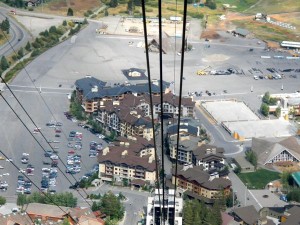
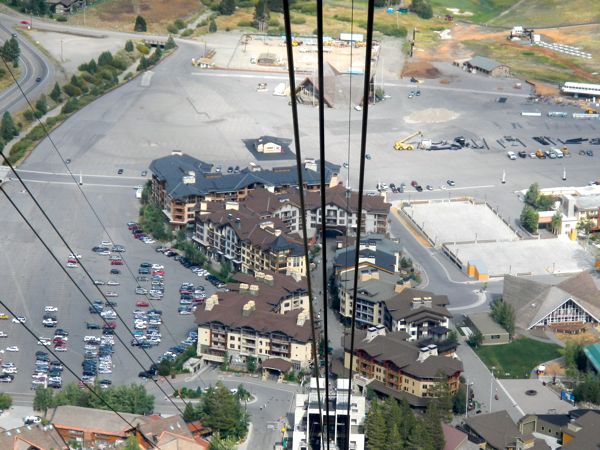
Resort owners want to completely transform Squaw Valley's village area. Photo/Kathryn Reed

Resort owners want to completely transform Squaw Valley’s village area. Photo/Kathryn Reed

On Dec. 6, 2010, Nancy Cushing, the widow of Squaw Valley founder Alex Cushing, sold Squaw Valley Ski Corp for an undisclosed amount to KSL Capital Partners, one of Denver’s largest private equity firms. Eric Resnick, KSL’s managing director and a former executive at Vail Resorts, told the Denver Post that his company had found a “crown jewel.” Along with the ski area’s iconic mountains, the company saw a blank canvas primed for building a resort destination.

“Squaw Valley is the birthplace of the modern mountain resort in the United States, with a heritage, history, amenities, and perhaps most of all, extraordinary terrain that can never be replicated,” Resnick said at the time.

The acquisition added Squaw Valley to a list of well-known hotels, spas, golf courses, and elite clubs that KSL has owned across the globe, including places like the Grand Wailea Resort Hotel & Spa in Maui, the historic Hotel del Coronado in San Diego, and ClubCorp, the largest owner of golf and country clubs in the country. KSL outlines its investment philosophy on its website—they acquire assets in the travel and leisure sector, assign an independent team to manage that asset, pour money into growing the business, and “generate attractive rates of return for its investors,” which include public state and corporate pension funds, private and university endowments, and wealthy individuals, among other sources. In the months leading up to the transaction, KSL named Andy Wirth as the new CEO. Wirth had previously led similar ventures for Intrawest at Steamboat Springs, Colo.

“This mountain, this organization needed new ownership,” says Wirth. “It’s an incredibly soulful mountain, a remarkable mountain. The company itself—the facilities were undercapitalized, poorly marketed, and not very effectively managed. And frankly, virtually everybody in the ski industry knew this.”

In three years, Wirth cleaned house at Squaw. Management focused on customer service and the lifties said hello more often. Starbucks moved in with a ski-in/ski-out coffee stand. Wirth said the resort reduced its environmental footprint by 15 percent. And in September 2011, KSL bought neighboring Alpine Meadows, unifying two of the best ski areas in Tahoe. But the biggest change didn’t roll out until the following December. In an effort to globally compete as a resort destination, Squaw Valley submitted an application to the Placer County Planning Department to build a new village.

The latest draft of their proposal calls for more condos, hotels, and cabins, plazas and courtyards, shops and restaurants. It includes pedestrian-friendly walkways and a world-class training facility called the Mountain Adventure Center, complete with pools, waterslides, zip lines, and a lazy river, according to the latest renderings. Attempting to be a good valley neighbor, Squaw is planning to mitigate its environmental impact. The development plans include restoration of Squaw Creek, which has been listed by the Environmental Protection Agency as an impaired waterway since 2002, and nearly all of the project is infill development, so the structures will be built on property that has already been disturbed, like parking lots. Additionally, Squaw would commit $1 million annually to fund environmental projects. According to the resort, the development would double the resort’s employment capacity, bring in some $20 million in additional tax revenue, and diversify the ski resort’s business so it can be successful year-round, with or without snow, an aspect of the business that’s become glaringly relevant as Tahoe goes through its third drought year in a row.

“We sure as hell have the mountains,” says Wirth. As he sees it, it’s not the skiing that’s holding Squaw Valley back. It’s the lack of places for people to stay. According to Wirth, Squaw Valley has the capacity to move 58,000 skiers an hour on the hill, which is slightly less than Whistler/Blackcomb, but the resort has just 15 percent as many hotel rooms.

“Aesthetically, the parking lots are acres of parking lots,” says Wirth. “I haven’t found a single person, opponent or proponent, to stand with me in the parking lot and do a 360 and tell me there’s a whole lot of soul in these parking lots. They’re parking lots and we think they could be something better.”

Inside Wirth’s office, a large black and white photo of the late Shane McConkey dominates the wall behind his desk. McConkey, a longtime Squaw local who became one of the most influential skiers in history, is skiing Eagle’s Nest, a short but sheer pitch next to the KT-22 chairlift. The photo captured an intense moment when McConkey paused to peer down the steep flutes, a shower of slough spilling out from under his skis. Wirth is no stranger to crucial moments of decision like the one portrayed in the photograph. The day I met with him was one of his first days back in the office after a skydiving accident almost ripped out his right arm and nearly killed him. His quick survival instincts saved his life. Ever the optimist, reflecting back on that incident, Wirth told me life has since been outstanding. “I look at it and say a whole bunch of great things came out of that day,” he says.

Wirth talks fast, but he still takes the time to choose his words. It’s easy to understand his vision: the economy needs stimulus, Squaw Valley is undercapitalized, change is needed. But as is the case in most ski towns, the ski area CEO is controversial. People trust Wirth or they don’t. When he moved to town, he immediately got involved with the community, supporting popular causes and nonprofits like Disabled Sports USA Far West and the High Fives Foundation, both of which recently recognized Wirth with awards for his community service and partnership. Despite that show of civic-mindedness, opponents of the Squaw Valley development tend to see him as the wolf in sheep’s clothing for a corporation that had a plan to execute.

“He seems like a puppet,” says Jamie Schectman, co-founder of the Mountain Riders Alliance, a group dedicated to “creating sustainable mountain playgrounds.” “These guys are so competitive and so driven, they’ll do anything.”

Wirth met the executives at KSL while he was at Steamboat Mountain Resort in Colorado, where he had been working for 20 years, starting as an unpaid intern and leaving as the resort’s top executive. While at Steamboat, Wirth helped bring in more nonstop flights from large metropolitan areas and played a role in building the Steamboat Grand, a large luxury hotel at the base of the ski area. But, as he likes to point out, he wasn’t always the ski resort executive. Wirth worked as a backcountry ranger in Rocky Mountain National Park and fought wildfires on a hotshot crew in northern New Mexico. Wirth now lives in one of Truckee’s wealthiest neighborhoods, but when he was working as an intern at Steamboat, he ate ramen and worked the nighttime audit shift at a local hotel.

“We’re mountain people at the core,” says Wirth. “We’re of that cloth. We think we can create opportunity for employment, to create jobs. We think it can be soulful and be appropriate to the Squaw Valley brand.”

Wirth admits the level of development, growth, and change he intends to bring to Squaw Valley is significant.

“This is not a little bit of change. Not a bucket of change,” he says. “This is a 50-gallon barrel of change. And I think people were caught off guard.”

Read the whole story