Early wildflower season in Lake Tahoe

Wildflowers in Washoe Meadows State Park. Photos/Kathryn Reed

Wildflowers in Washoe Meadows State Park. Photos/Kathryn Reed

By Kathryn Reed

MEYERS – Wildflower season in Lake Tahoe is going to be a bit unusual this year because of the drought. There is less of everything now compared to this time last year.

Lisa Berry with the California Native Plant Society on June 1 led two dozen people on an excursion to find wildflowers in Washoe Meadows State Park. And while there were plenty to see, it was better with an experienced guide because some of them are so tiny the average person would just walk on by.

But two flowers that might be more prolific because of the drought are death camas and Sierra wall flowers, according to Berry. She added, that this area is already in midseason when it comes to wildflowers.

Lisa Berry shows the various aspects of a flower.

Lisa Berry shows the various aspects of a flower.

Some people were rather serious during the three-hour trek as they took copious notes and a multitude of photos. Others admitted to having guidebooks they didn’t find useful, while some said they identify flowers by nothing more than color.

“All of these wildflowers do not like a controlled environment,” Berry told the group. This means they want freedom to grow and not to be given water like one does to flowers at their home.

Sunday was also a lesson in anatomy as Berry went over the different parts of a flower that went well beyond flower, stem and petal. Berry talked about the long stock starwort having “a superior ovary.” There are four main parts of a flower’s anatomy — pistils, stamens, petals, and sepals. Those are all important so they can reproduce.

Nuttall’s larkspur is one of the taller flowers with its deep lavender petals. This is the most common larkspur.

Suzanne Stone uses a discovery scope to better see small flowers.

Suzanne Stone uses a discovery scope to better see small flowers.

For some of the smaller flowers Berry passed around a discovery scope which magnifies the image. The anatomy is much easier to understand this way.

Wild strawberries are tucked just off the trail and about 12 free from where a distinct bear paw print has been left in the mud. And while this fruit, which is part of the rose family, is edible by humans, usually critters get to them before people ever can.

The hike is also a lesson in the importance of vernal pools – like the one that sits in front of the old Celio barn in one of the meadows, as well as fens that filter out sediment.

Some of the other flowers along the walk included graceful phlox, paintbrushes, star lily, cinquefoil, ladies tresses, dwarf monkey flower and pussypaws.

Washoe Meadows Community organized the free excursion.

“We like to get people to know about the park,” Lynne Paulson with the community group told Lake Tahoe News.

Washoe Meadows Community is fighting California State Parks over its desire to move part of Lake Tahoe Golf Course into the park area. Berry said it would be a mistake to encroach on this area with its wild flora.

—-

Notes:

• Lisa Berry is teaching Wildflower Hikes at Lake Tahoe Community College in July. The course number is WLD-137C.

• The Lake Tahoe chapter of the California Native Plant Society is online.

• More info about Washoe Meadows Community is online.



2 Calif. counties trying to form new state

By Reuters

Creating the state of California took a revolt that led to the short-lived Bear Republic, a war with Mexico, and various international treaties. Now, some northern natives hope to take it apart, starting with a couple of ballot initiatives.

Tuesday, voters in Del Norte and Tehama counties will consider a measure calling for separation from California and the formation of a new state. Supporters are hoping to generate momentum for pulling together portions of northern California and southern Oregon into an entity to be called Jefferson. Thomas Jefferson once imagined that part of western North America might develop into a freestanding republic.

Local vexations with state government were cited by Aaron Funk, an aptly named organizer of the movement: “lack of representation, lack of infrastructure, inability to use a lot of our resources.”

Opponents of the measure say it sounds an economic death knell for the area, given its poverty and high unemployment.

Efforts to chop up California boast a long history. Disgruntled residents first proposed a state of Jefferson, also comprising counties in nearby southern Oregon, in the 1940s.

Read the whole story


Undeclared voters on the rise in California

By Patrick McGreevy, Los Angeles Times

California’s chief elections officer reported Friday that the percentage of voters registered with no party preference has increased while the percentages for registered Republicans and Democrats declined.

Compared with four years ago, the number of registered voters has increased by about 1 percent, to 73.3 percent of the number of people eligible to register, according to the report by Secretary of State Debra Bowen.

The percentage of voters who registered with no party preference has gone from 20.17 percent four years ago to 21.16 percent today, an increase of about 325,000 voters, the report said.

Read the whole story


Website provides detailed SLT budget data

By Kathryn Reed

Accountability and transparency are buzzwords in government circles.

South Lake Tahoe wants to take ownership of them by allowing the public to delve into the city’s multi-million dollar budget in ways it has never been able to until now.

In May the city unveiled its partnership with Open Gov, a firm that puts a government’s budget online in a way that allows users to drill down into expenses and revenues. Colorful charts pop up, with just the numbers below.

Data goes back to the 2008-09 budget year.

South Lake Tahoe City Manager Nancy Kerry demonstrates how Open Gov works. Photo/Kathryn Reed

South Lake Tahoe City Manager Nancy Kerry demonstrates how Open Gov works. Photo/Kathryn Reed

Budgets by nature are cumbersome. There are restricted and unrestricted funds. This simply means some dollars have strings attached, others don’t. Part has to do with where the money comes from, and part has to do with what it is being spent on.

Things people might not ordinarily think about can be found – like how much money has been spent to pay on-call employees to remove snow on city streets. In 2009-10, it was a whopping $76,633. It plunged to $16,199 in 2012-13. While $25,000 was budgeted this year, the final numbers aren’t in.

Accounts are updated quarterly. The finance staff sends them to Open Gov to upload. The city then does a check to make sure it was done correctly.

But like anything, the data is only as good as what is provided. And in an era of extreme public distrust of nearly all political entities, how is the public to know what is being presented is really the truth? Just look at the city of Bell or California State Parks – distrust still lingers.

“Bell had an auditing firm without access to the budget. Our auditor gets the budget,” South Lake Tahoe City Manager Nancy Kerry told Lake Tahoe News.

It’s an independent auditor who is reviewing the city’s budget. That is the public’s assurance that the numbers the city provides are factual – that there are no hidden accounts, that the income stated is true and what it’s spent on is factual.

What Open Gov does is allow people to more easily find the numbers. The actual budget document is so thick and convoluted that a few years ago Lake Tahoe News paid a financial expert to help sift through it in an attempt to bring understanding to it. Even then it was near impossible to grasp everything.

While Open Gov is a step in the right direction, it is still a bit clunky. So far there is no search button. The company is working on one, but has no time line for when it will be live.

Like most websites, there are multiple ways to get to what a person is looking for. The “reset” button at the top left is likely to be used a lot as people search for things.

In 2010, with the city changing how it categorized items, it makes the system seem a bit less fluid. After all, how many people know that in 2010-11 the vacation rental program enforcement became the job of the police department?

Open Gov cost the city $7,000 in start up expenses and will be a $4,000 line item each year for the company to upload and maintain the data.

This data, as well as the more than 40 other cities on Open Gov, is available to anyone. Kerry foresees this potentially being good for investors doing research on South Lake Tahoe to see how solvent the city is.

But her main goal with Open Gov is to get more engagement from locals in the budget process – for them to see where money is coming from and where it is going.

—-

Notes:

• Here is a link to South Lake Tahoe’s Open Gov site.

• For help with Open Gov, call Debbie or Olga in the finance department at 530.542.6000.


Calif. bill would let authorities temporarily remove guns

By Kimberly Kindy, Washington Post

On Wednesday, in response to the Isla Vista shootings, a bill was introduced in the California Legislature that would give families, neighbors, friends and law enforcement the ability to appeal to a judge to temporarily remove firearms while a court determines a person’s competency.

Assemblywoman Nancy Skinner, D-Berkeley, who introduced Assembly Bill 1014, said it would function like a temporary restraining order, providing people who were the subject of the court action with due process rights to make their case to keep their firearms. If they did not prevail, they could also appeal to the court to have them returned at a later date, after the court deems the person to no longer be a threat to themselves or to others.

The bill would not give the court or authorities the ability to remove other weapons, like knives, which were used by Rodger to kill his two roommates as well as a college friend who was visiting the two young men.

“This is a common sense tool that could be used by a family member, a roommate or a concerned friend who saw clear warning signals that a person was a clear threat of violence to themselves or others,” Skinner said in an interview.

The legal language for the bill was drafted immediately after the shooting at Sandy Hook Elementary School last year that left 20 children and six adult staff members dead. It was set aside, in favor of a package of other bills that seemed to have greater support at the time.

Read the whole story


Worst U.S. measles outbreak in 20 years

By Tony Pugh, McClatchy Washington Bureau

WASHINGTON — After declaring in 2000 that measles had been eliminated from the U.S. through a successful vaccination program, government officials now say the number of confirmed cases has reached a 20-year high as people who get the disease abroad bring it back to America.

Unvaccinated Americans and foreign visitors who traveled to the Philippines, Europe, Africa and Asia are the main culprits in a growing spike of U.S. measles cases that began several years ago and exploded this year.

As of last month, 288 cases have been reported in 18 states, the highest year-to-date total since 1994, when 963 cases were reported by year’s end. Ninety-seven percent – 280 – of the 2014 U.S. cases were imported from other countries.

A highly contagious viral respiratory disease that grows in cells at the back of the throat and lungs, measles is spread through the air by coughing, sneezing and even breathing. It can cause fever and coldlike symptoms, along with a stubborn rash.

Read the whole story


Ropes course tests physical, mental strength

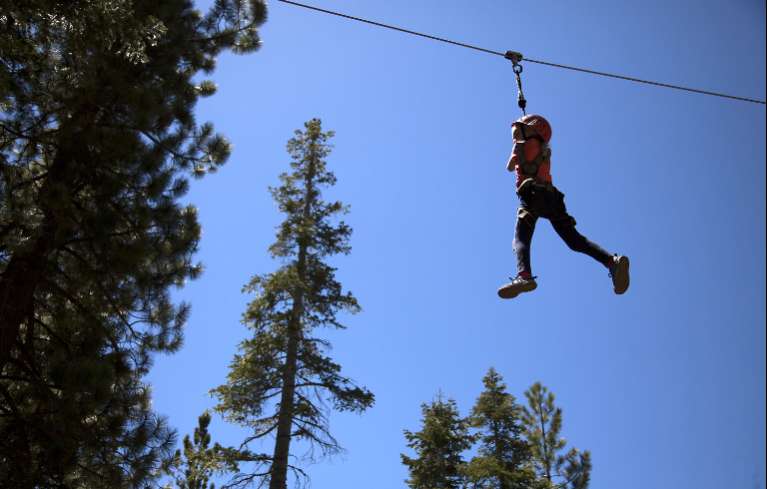
Gabriella Thompson, 6, flies through the air at the ropes course in Tahoe City. http://northtahoeadventures.com/

Gabriella Thompson, 6, flies through the air at the ropes course in Tahoe City. Photo Copyright 2014 Carolyn E. Wright

By Kathryn Reed

TAHOE CITY – A cable to walk on that is no bigger around than the diameter of an average finger, balance beams swinging a hundred feet off the ground, bridges swaying even without the wind, ropes that turn climbers into spiderpeople. These are just a few of the contraptions of the ropes course at Granlibakken.

“I’m like Indiana Jones,” 8-year-old Jace Smith of Vancouver, Wash., says as he scampers along a bridge. His parents are below with cameras and words of encouragement.

His friend, Gabriella Thompson, 6, of Corpus Christi, Texas, is all smiles as she whirs through the air on a zipline.

They are on the Flying Squirrel course, which is designed for kids as young as 5. Apparatuses are closer to the ground and the safety equipment is different than what it is used on the adult course. But big kids can go on this one, too.

Bridges is a loosely used word by designers. It’s really some contraption to get from Point A to Point B. And never is it a solid bridge in the traditional sense, where one feels secure and doesn’t think twice about crossing it.

These bridges are tricky. They all move. Sometimes the only thing to hang onto is your harness. Steps can be at angles or much farther apart than is comfortable. Ropes to grasp sometimes feel out of reach.

One “bridge” is really a snowboard suspended in air that requires hanging on like you’re water skiing.

And the ground, well, it’s always quite a ways down.

Some of the courses have ziplines going from one platform to another. These are brief opportunities to catch your breath, or take a look around at the incredible scenery. But that’s assuming ziplines don’t take your breath away.

All the stations are tucked into the woods.

The whole thing is like an adult jungle gym.

These ropes courses are not for people who like staying in control and in their comfort zone.

Ricki and Mark Viray came over from Marysville for the day to test their agility in the Monkey zone. There are five options – one beginner, three intermediate and one advanced. It’s possible to do all five in the time allotted.

Even though Mark Viray has a desk job, it’s in the military, so he has more practice doing things like this. His wife shows off her balancing skills by not holding onto ropes or her harness as she cautiously puts one foot in front of the other.

Carolyn Wright of Zephyr Cove is thanking her Pilate’s instructor for building up her core muscles.

Balance and a bit of upper body strength, along with the mindset that fear of heights is not going to cause paralysis, are helpful.

“Fear of heights is such a common fear. I don’t think you overcome it, but you learn to manage that fear,” Jesse Dessens, president and CEO of North Tahoe Adventures, told Lake Tahoe News.

Besides friends and couples who want to challenge themselves, the courses are often used by families and as team building excursions by companies.

Twenty people can go in a group, with groups starting every hour.

This will be the third summer North Tahoe Adventures has operated the ropes courses at the Tahoe City resort. Their Squaw Valley operation has existed for 16 years.

—

Notes:

• North Tahoe Adventures runs the ropes course at Granlibakken. More info is online.

• Phone – 530.581.7563

• Cost — $50 for 13 and older; $40 ages 5-12. Sessions are 2½ hours.

• Maximum weight – 260 pounds.

• Open year-round.

ngg_shortcode_0_placeholder (Click on photos to enlarge.)


School districts push back on federal lunch menu

By Tom Hamburger, Washington Post

In Georgia, kids resisted the loss of their beloved fried chicken. In New Mexico, whole-wheat tortillas went straight to the trash can. And in Tennessee, after schools replaced familiar flaky white biscuits with a whole-grain variety, one official reported a “severe amount of rejection.”

What began as an effort led by first lady Michelle Obama to serve more-healthful food to American schoolchildren has turned into a clash of cultures across the country — and, now, a high-profile Washington lobbying battle.

At stake in the argument over lunch menus, beyond the natural tension between nutrition and children’s taste buds, are the profits of several large food companies that sell frozen pizzas, french fries and other prepared foods to schools.

The dispute provides a fresh illustration of the ways special interests can assert power in Washington. In this case, food companies forged an alliance with a key lobbying group, the School Nutrition Association, and pushed it to shift its position from publicly supporting the Obama-backed standards to pressing Congress for relief.

On Thursday, a House committee voted for a Republican-backed measure that would allow school districts to temporarily opt out of the nutrition standards, which were passed in 2010 with the support of the White House and set mandates to reduce sodium and increase whole grains and servings of fresh fruits and vegetables.

The party-line vote served as a rebuke of sorts to the first lady, who has made curbing childhood obesity a priority and delivered a series of public pronouncements in recent days decrying the opt-out proposal as a full embrace of junk food.

The measure is expected to be considered later this summer when House and Senate members meet to negotiate spending bills.

Read the whole story


Nev. says “no” to betting on presidential elections

By Sandra Chereb, AP

Proposals to allow betting on federal elections and monitoring taverns and slot parlors for compliance of “incidental” gambling activities failed to garner support of a legislative panel Tuesday.

Both measures were debated during the 2013 session and there was little to no appetite by members of the Committee to Conduct an Interim Study Concerning the Impact of Technology Upon Gaming to sponsor bills rehashing the issues when lawmakers meet again next year.

State Sen. Tick Segerblom, D-Las Vegas, had hoped to persuade the panel to request a bill draft for the 2015 session allowing Nevada sports books to take pari-mutuel wagers on elections for president, U.S. Senate and House of Representatives.

The Senate Judiciary Committee, chaired by Segerblom, introduced a similar bill that died in the 2013 session. Segerblom has said election betting could be a boon for state gambling revenues.

Interim committee members were not swayed Tuesday, and state Sen. Greg Brower, R-Reno, said betting on elections was inappropriate.

The effort for the committee’s backing fizzled when no one made a motion for a bill draft request, though the concept could still be resurrected in 2015.

Panel members also beat back urgings by Clark County Commission Chairman Steve Sisolak and Assemblyman William Horne, D-Las Vegas, to again wade into the ongoing dispute over slot machines in taverns and slot parlors.

Current regulations state restricted licenses for up to 15 slot machines may only be granted “if the operation of slot machines is incidental to the primary business.”

Sisolak said state law needs to more clearly define “incidental,” arguing that some taverns and slot parlors rake in a large percentage of their proceeds from gambling.

Horne, chairman of the interim panel, also urged committee intervention, if anything to define the different between traditional taverns and slot parlors, but a motion on his recommendation died when no one seconded it.

Peter Bernhard, chairman of the Nevada Gaming Commission, said the issue has been vetted several times over the past decade and suggested that local governments can set their own restrictions.

“Traditionally, local governments have determined where local taverns can be located,” he said. “The county commission and city councils should make those decisions.”

Bernhard also dismissed allegations that slot parlors have proliferated in recent years, saying they have emerged as an innovative business model to adapt to a changing market and economic conditions.

“Just because you happen to see them more than you’ve seen them before, it is because people with a competitive interest have brought them to our attention,” he said.

Bernhard suggested that a simpler way to resolve the issue was to delete the word “incidental” from the statute entirely.


LTCC putting finishing touches on Nov. bond

By Kathryn Reed

Everything is in place for Lake Tahoe Community College to proceed with a general obligation bond in November – except for the board voting to do so.

That is expected to take place at the June 10 board meeting. At the meeting this week the board approved an agreement with Keygent Advisors to provide bond financial advisory services, approved the contract with Orrick, Herrington and Sutcliffe LLP for bond counsel, and had the first reading of the list of projects the bond would cover.

The college, which will celebrate its 40th anniversary next month, is going to voters for the first time to ask for money that will only be spent on facilities. Some of it will be for upgrades, some for new things.

The exact amount has yet to be determined. In some ways it’s a guessing game based on what interest rates and assessed values will be. The college does not want people to pay more than $25 per $100,000 of assessed value on their property.

Joanna Bowes with Keygent went over different scenarios that would bring the college between $28.29 million and $53.729 million.

Her recommendation is to go out for a mix of current interest and capital appreciation bonds that would bring in $47.36 million at interest rates ranging from 1.5 percent to 3.5 percent, the former for this year and the later estimated for 2016-17. (Bonds are traditionally sold over the course of several years.) This scenario also calls for longer-term assessed value to increase 4.25 percent per year.

One issue staff and the board will have to deal with is the price tag for the project list is $55 million.

Jeff DeFranco, vice president of administrative services, told board members they will have to prioritize the projects. It’s also possible matching funds could come in higher or that the 3 percent inflation rate that is built into the numbers would not come to fruition.

While it was acknowledged the general consensus is the campus is fairly new, the truth is many of the buildings are aging as are the parts inside. The main building was built in 1988, Child Development Center 1993, four garden trailers 1996, two garden trailers 1999, student center/culinary and physical education 2002, and the library in 2005.

The campus includes 164 acres. The idea is to try to cluster buildings and avoid sprawl.

Per Tahoe Regional Planning Agency definitions, the college has 696,723 square feet of coverage. The proposed projects would bring that total to 485,864 square feet. The unallocated coverage would be 110,059 square feet.

Five projects the college hopes will receive state money to supplement the bond dollars include:

• Remodeling the science lab so it is efficient and has 21st century equipment;

• Building a public safety training center;

• Modernizing the main building, which includes enhancing the commons;

• Creating an environmental studies and sustainability center;

• Erecting a multipurpose building.

This last project was originally going to be an expansion of the phys ed facility, but has morphed into more than that. It would provide classrooms when the garden trailers are removed, storage and meeting space, and physical education rooms.

Money just from the bond would go to:

• Expanding the early learning center, which includes having room for Tahoe Parents Nursery School.

• Solar generating storage facility to house vehicles and equipment. It could be a demonstration site for sustainable studies related to solar generation.