Pioneer spirit rests in El Dorado County
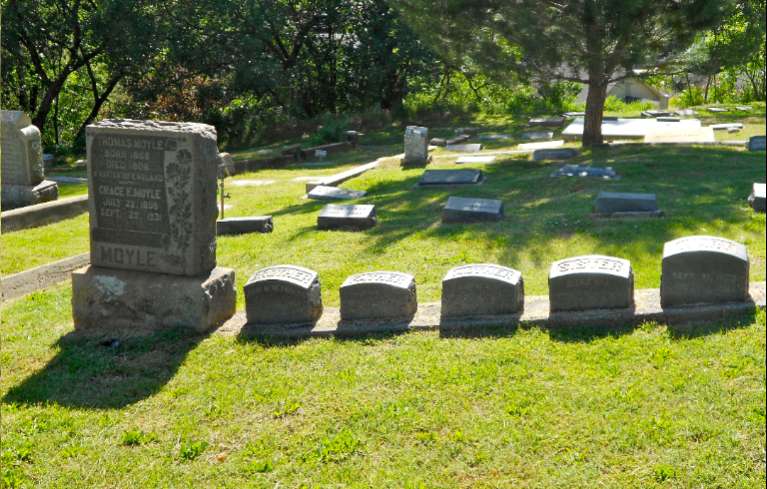
An entire family is buried next to each other at the Placerville Union Cemetery. Photos/Joann Eisenbrandt

An entire family is buried next to each other at the Placerville Union Cemetery. Photos/Joann Eisenbrandt

Publisher’s note: This is the first of two stories about El Dorado County’s pioneer cemeteries.

I first moved to South Lake Tahoe in 1979, and lived there off and on for more than three decades. Seven months ago, I moved to Placerville, where I now live near the top of Sacramento Hill, which rises steeply up from Main Street. For a month or so, I drove carefully up and down my narrow, winding driveway that dead ends onto Chamberlain Street, focused only on not sliding off. One day, as I stopped to get the mail out of my box on Chamberlain, I looked across the street and realized there was a cemetery there. I’d driven past Happy Homestead in South Lake Tahoe thousands of times, but never had the occasion to go in. From Johnson Boulevard it seemed neat and well tended, with cropped green grass in summer and tidy flowers at the gravesites. This cemetery was different. There was a wooden fence across the front and an arched wrought iron sign with the words “Old City Cemetery” in delicate capital letters. I walked across the street and looked over a low part of the fence. There was a weather-beaten gravestone carved from variegated white marble just two feet away. I went inside the open gate and saw the burial date on it – 1856. I had to know more.

— Joann Eisenbrandt

By Joann Eisenbrandt

PLACERVILLE — Those who live in Placerville and the Sierra foothills of El Dorado County are surrounded by reminders of Gold Rush history, often without knowing it. The area is dotted with more than 100, some say closer to 200, Pioneer Cemeteries dating back to the 1850s. Eighteen of these cemeteries are formally operated by El Dorado County, two by the city of Placerville, and others by family or nonprofit groups or rural cemetery associations. Some have been lost to history, with older graves buried over, unmarked, or partially hidden under modern parking lots or buildings. Some are well cared for. Others have been severely vandalized or remain largely untended and overgrown with weeds and broken gravestones.

These pioneer cemeteries tell the history of Placerville and El Dorado County.

The rush to find fortune

After the discovery of gold in 1848 at Sutter’s Mill in Coloma, estimates say that from 100,000 to 200,000 gold seekers rushed to what is now El Dorado County in hopes of making their fortunes. Early on, gold was plentiful, much of it right on the surface. Mining camps formed their own basic laws. There was little conflict, as there was enough gold to go around.
Who are the people buried at the pioneer cemeteries?     Lizzie Baldwin: Buried in Old City Cemetery, she died in 1866 at 15. The Mountain Democrat obituary says, “Deceased was a resident of Georgetown, but had been for a considerable time, an attendant of the Placerville Academy, and during her sojourn here, by her gentle disposition and winning manners, made for herself a circle of warm friends. The loss of one so suddenly stricken down in the bloom of youth, is sincerely mourned by her class-mates and companions, who paid their last tribute of respect by following the body in procession to its final resting place.”     Joseph Brindley: Came over from England, was living in Greenwood, but had been a Placerville blacksmith with a shop on Sacramento Street. He was one of many pioneers who were termed in their obituaries to have “died suddenly.” The February 1877 Mountain Democrat obituary goes on, “For some time his health had been in a precarious condition, and last Wednesday he came over on the Auburn stage to see if he could not have something done to improve his physical condition. When the stage drew up to the Ohio House and he had to get out of it, he fell forward upon the sidewalk, blood gushing from his mouth, and died in a few minutes.” He is buried in Old City Cemetery.     W.H. Bailey: Buried in an unmarked grave at Old City Cemetery, Bailey died in June of 1900 at the “advanced age” of 75. “W.H. Bailey arrived at the Ohio House Thursday noon from Amador,” the Mountain Democrat obituary of June 2, 1900, begins, “He ate lunch and took a seat on the porch in the shade and apparently fell asleep. Several hours passed and as he showed no sign of awakening, an attempt was made to arouse him when it was found that the man was paralyzed. Dr. Rantz was called in and everything possible done for the relief of the unfortunate man, but death ensued early the next morning.”     Peter Finsterwalter: A native of Germany, Finsterwalter, a railroad laborer, died at around age 30 in 1890 and is buried in Old City Cemetery, the victim of a runaway train accident. The Feb. 15, 1890, Mountain Democrat article entitled “A Ride To Death – A Wild Engine’s Awful Plunge,” spares no gruesome details. “It was about one o’clock, and the engineer was returning from Placerville, where it had been to take the crew ... to dinner. The engine crew were riding inside of the engine and five of the laborers were riding on the pilot. As the engine reached the top of the grade, near Krahner’s, she began to move faster, and as she started down a steep grade, the engineer lost control of it. Rounding a sharp curve in a deep cut, the engine and its human freight plunged into the caboose of the gravel train, and death came in its most sudden and horrible form to three of the unfortunate laborers in front of the engine. Peter Finsterwalter received the greater blow, as a car wheel seems to have struck him as the track went up. He was thrown to the side of the track, with an arm nearly severed, his breast laid open, and his head cut in two, one half of it just hanging to the trunk by a mere shred.”     Bernard Carlson: Also a native of Germany, Carlson died in November 1900 at around the age of 40. The Mountain Democrat obituary of Nov. 10, 1900, terms it “Accidentally Killed.” A laborer, Carlson “fell from the loft of his employers barn, Tuesday morning at 6 o’clock, injuring his spine which caused his death. What caused Carlson to fall is unknown. He had been drinking to some extent the night previous, but from appearances not enough to become intoxicated. The Coroner’s jury brought in a verdict of accidental death.” He was buried in Old City Cemetery.
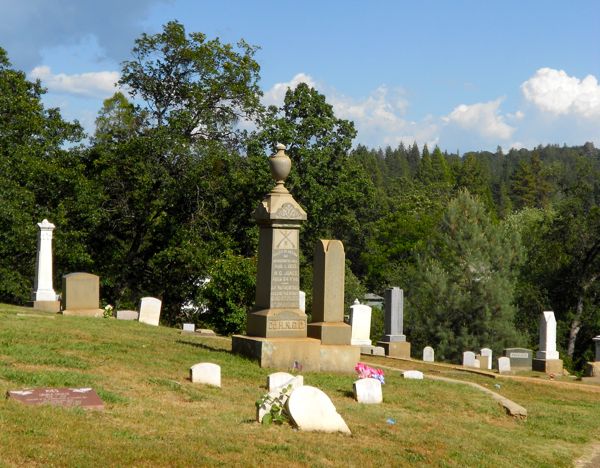
Who are some of the people buried at the pioneer cemeteries?
Lizzie Baldwin: Buried in Old City Cemetery, she died in 1866 at 15. The Mountain Democrat obituary says, “Deceased was a resident of Georgetown, but had been for a considerable time, an attendant of the Placerville Academy, and during her sojourn here, by her gentle disposition and winning manners, made for herself a circle of warm friends. The loss of one so suddenly stricken down in the bloom of youth, is sincerely mourned by her class-mates and companions, who paid their last tribute of respect by following the body in procession to its final resting place.”
Joseph Brindley: Came over from England, was living in Greenwood, but had been a Placerville blacksmith with a shop on Sacramento Street. He was one of many pioneers who were termed in their obituaries to have “died suddenly.” The February 1877 Mountain Democrat obituary goes on, “For some time his health had been in a precarious condition, and last Wednesday he came over on the Auburn stage to see if he could not have something done to improve his physical condition. When the stage drew up to the Ohio House and he had to get out of it, he fell forward upon the sidewalk, blood gushing from his mouth, and died in a few minutes.” He is buried in Old City Cemetery.
W.H. Bailey: Buried in an unmarked grave at Old City Cemetery, Bailey died in June of 1900 at the “advanced age” of 75. “W.H. Bailey arrived at the Ohio House Thursday noon from Amador,” the Mountain Democrat obituary of June 2, 1900, begins, “He ate lunch and took a seat on the porch in the shade and apparently fell asleep. Several hours passed and as he showed no sign of awakening, an attempt was made to arouse him when it was found that the man was paralyzed. Dr. Rantz was called in and everything possible done for the relief of the unfortunate man, but death ensued early the next morning.”
Peter Finsterwalter: A native of Germany, Finsterwalter, a railroad laborer, died at around age 30 in 1890 and is buried in Old City Cemetery, the victim of a runaway train accident. The Feb. 15, 1890, Mountain Democrat article entitled “A Ride To Death – A Wild Engine’s Awful Plunge,” spares no gruesome details. “It was about one o’clock, and the engineer was returning from Placerville, where it had been to take the crew … to dinner. The engine crew were riding inside of the engine and five of the laborers were riding on the pilot. As the engine reached the top of the grade, near Krahner’s, she began to move faster, and as she started down a steep grade, the engineer lost control of it. Rounding a sharp curve in a deep cut, the engine and its human freight plunged into the caboose of the gravel train, and death came in its most sudden and horrible form to three of the unfortunate laborers in front of the engine. Peter Finsterwalter received the greater blow, as a car wheel seems to have struck him as the track went up. He was thrown to the side of the track, with an arm nearly severed, his breast laid open, and his head cut in two, one half of it just hanging to the trunk by a mere shred.”
Bernard Carlson: Also a native of Germany, Carlson died in November 1900 at around the age of 40. The Mountain Democrat obituary of Nov. 10, 1900, terms it “Accidentally Killed.” A laborer, Carlson “fell from the loft of his employers barn, Tuesday morning at 6 o’clock, injuring his spine which caused his death. What caused Carlson to fall is unknown. He had been drinking to some extent the night previous, but from appearances not enough to become intoxicated. The Coroner’s jury brought in a verdict of accidental death.” He was buried in Old City Cemetery.

Miners staked claims, each about 15 square feet, and when one was depleted they simply moved on to another. By 1849, most of the surface gold had been mined.

Women and children began arriving and larger settlements were built. The more labor-intensive “Placer Mining” began – digging gold out of the dirt and bedrock deposited at the bottom of streams and then washing it out.

El Dorado County was created by the Legislature in 1850, and by 1852 had a population of 40,000. The first county seat was in Coloma, and later transferred to Placerville in 1857. There were two main roads into the area, from Sacramento to Coloma and from Sacramento to Placerville. Roadhouses, small settlements and churches sprung up along these roads. As there became more miners but less gold, the increasingly frantic search for what remained brought crime, fighting, excessive drinking, sickness and death.

Life and death

Basic staples and necessities were in short supply. Fresh vegetables, fruit and meat were scarce. Lack of vitamin C led to scurvy. Many emigrants had arrived exhausted or ill from the long trip west. That and overindulgence in alcohol made the miners vulnerable to opportunistic diseases. Many of them lived in canvas tents with little protection from the elements.

Only a small number of the gold seekers actually “made their fortunes” from the often brutal work. Many remained poor and couldn’t afford medical care at the few existing medical facilities, or were fearful of entering hospitals and never leaving. Many people were dying all at once. Some reports indicate as many as 20 percent of those who came died within the first five years, often in remote locations near their mining claims.

Burying the dead in formally dedicated consecrated ground was often unworkable. Those who expired from diseases like cholera or smallpox were buried quickly, close to where they died.

Small cemeteries emerged on private property, or on hilltops near clusters of claims — “Boot Hills” — often without the knowledge of or permission from the landowner. One burial followed another and such sites soon became known as “public cemeteries.”

Coffins and grave markers, if they existed, were crude, often made of wood. The burial areas were rarely fenced off. Roadhouses and the small communities surrounding them along the main routes into gold country also had their own close-by cemeteries, watched over by local citizens or churches.

Formal cemeteries emerge

As easily accessible gold reserves dried up, many of the original claims and small encampments around the mining sites or roadhouses were abandoned and the local cemeteries that had served them became overgrown.

By the late 1850s, Placerville sought to centralize burials into two designated locations. An ordinance of the Placerville City Common Council from Feb. 12, 1859, states, “It shall be unlawful for any person or persons, to bury any corpse, or dead body of any human being, at any point or place within the corporate limits of the city of Placerville other than in the burial grounds now enclosed and used as such on the hill near the west line of said city, or in the burial grounds on Cedar Ravine, near the Methodist Church.”

The city created the office of city sexton to, “enter upon and take possession of the city burying ground, situated on the hill at the West end of said city, which ground shall hereafter be known as the City Cemetery. He shall keep the fence around the same in good repair and order, so as to exclude therefrom all domestic animals of every description. He shall keep and maintain the said ground in a good order, condition and repair as the same now are or may hereafter be put into.”

City Cemetery, now known as Old City Cemetery, is located on Rector and Chamberlain streets on Sacramento Hill just above Main Street and downtown Placerville.

In the mid-1850s, burials were occurring in what later became Placerville Union Cemetery, located up a steep hill on Bee Street several blocks above and north of Highway 50.

In 1871, a group of four fraternal organizations — the F. & A. Masons, Independent Order of Odd Fellows, Independent Order of Red Men, and the California Grove of United Ancient Order of Druids — purchased the land on which the cemetery had developed. Each fraternal organization managed an allotment of gravesites, some selling graves and others giving them to members. Over the years, the cemetery changed hands, eventually falling into disrepair, with the California Cemetery Board threatening to shut it down.

Although the cemetery is within Placerville city limits, the city and county reached an agreement to oversee it together, with the county being responsible for the grounds and maintenance, plus the sale of plots and interments, and the city for providing water and public safety. The land was deeded to the county in October 2006.
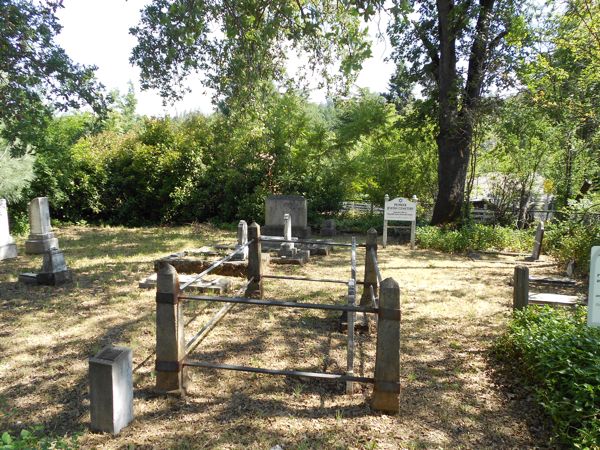
Jewish Pioneer Cemetery Photos/Joann Eisenbrandt

Jewish Pioneer Cemetery

Old City and Placerville Union cemeteries are two of the larger and best-known Gold Rush era cemeteries in Placerville, but many more exist within and outside the city limits. Some, like Pioneer Cemetery, established about 1850 above the current intersection of Main Street and Cedar Ravine, have been partly or fully-obliterated and lie under pavement. The graves in St. Patrick’s Catholic Cemetery on Sacramento Hill above downtown Placerville were built over when a church was constructed in the 1960s, with a marker now commemorating the site. Some, like the Pioneer Jewish Cemetery, are maintained by private groups. It is fenced, locked and inaccessible to the public.

Uppertown Cemetery, also owned by Placerville, was established about 1850 in what was then known as the distinct settlement of Upper Placerville, just east of downtown Main Street. Like the sites of many still existing pioneer cemeteries, its location is not obvious. The oldest marked grave at Uppertown dates to June 1850, although earlier burials may have occurred.

In the unincorporated areas of the county, many more cemeteries still exist at the sites of former roadhouses, rural settlements, churches, on private property, or outside the permanent communities that later took hold there.

A window into the past

Those buried in these pioneer cemeteries came from across the United States and the oceans. The death records for Old City Cemetery show burials of emigrants from at least 20 states and foreign countries including England, Ireland, Scotland, Prussia, Wales, Switzerland, Denmark, France, Peru, Italy and Brazil. The obituaries of those who came from America’s East Coast via a water route rather than overland, labeled them as “Argonauts.”

These obituaries, which appeared in the Mountain Democrat as early as 1854, offer a window into the pioneer past. Most striking is the fact that most of the gold seekers died young, and many of their children, very young. The report of City Sexton John Roy for interments in City Cemetery for 1861, lists 24 burials with ages ranging from 5 months to 47 years, almost half of them for those younger than 11. Those who survived into adulthood often died from what was called “the ravages of advanced age,” defined in obituaries as between 60 and 70 years.

A look at the death records from Old City Cemetery bears this out. August Hunger was 35 when he died in 1871. His four children had pre-deceased him, all before their ninth birthdays. Sisters Ella Mae and Fannie Page, buried next to each other at Old City, died in 1864 and 1865, respectively at the ages of 3 years, 9 months, 4 days and 1 year, 11 months and 4 days.

The headstones that do remain from such early family losses reflect the sadness. The parents of Mary Titus, who died in 1865 at age 4 years, 1 month and 11 days, inscribed her tombstone, “Rest our Darling Minnie.”

The obituaries, written in a style quite different from those of today, exuded a sense of familiarity and personal sadness, as the one for Lizzie Baldwin who died in 1866 at the age of 15. “By her gentle disposition and winning manners,” the Mountain Democrat obituary explains, “(she) made for herself a circle of warm friends. The loss of one so suddenly stricken down in the bloom of youth, is sincerely mourned by her class-mates and companions….”

Those who didn’t die in childhood often fell victim to the era’s limited medical knowledge. Causes of death from the 1861 City Cemetery interment report include: delirium tremens, consumption, congestion of brain, stillborn, putrid sore throat, diphtheria, inflammation of lungs, disease of heart and whooping cough. Many were said to have “died suddenly” without any further explanation, not because they just keeled over without warning, but more likely because the exact cause of death was not known.
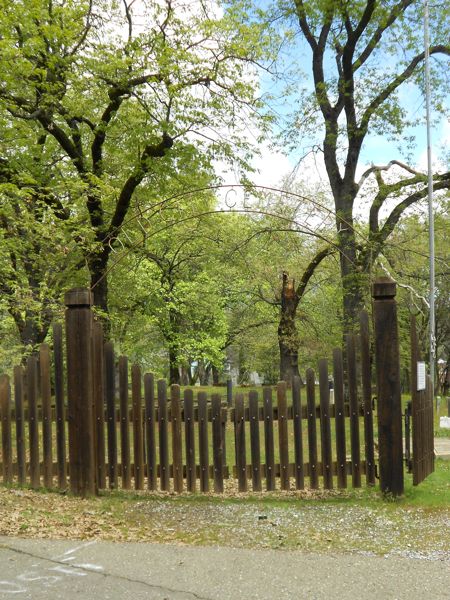
Old City Cemetery

Old City Cemetery

The pioneer lifestyle was hazardous. Those who now rest in the area’s pioneer cemeteries worked hard and often celebrated even harder. The search for gold, especially early on, was done largely by hand with simple tools or machines, as miners hacked the nuggets from beneath streambeds or from the sides of ravines that cut through Placerville. Lacking the safeguards of modern technology, accidents were common, and frequently fatal.

Crime and violence also took their toll, with the victims and perpetrators sometimes buried in the same cemetery. Joseph Staples, the first El Dorado County peace officer killed in the line of duty while trying to apprehend stage robbers, is buried in Placerville Union Cemetery. A plaque commemorating the event stands outside Placerville City Hall on Main Street.

Isaiah Zumwalt, infamous even in those times for the June 1900 murder of his son, grandson and former wife, is buried in an unmarked grave at Old City Cemetery.

There is also no lack of important local and statewide figures buried at Old City and elsewhere. Benjamin Franklin Keene, a physician and founder and first president of the California Medical Society, who died in 1856 at the age of 43 and is buried in Old City Cemetery.

The lifestyle of Placerville’s early pioneers is also revealed by what they left behind. Peyton Wright Benn died in 1896 at the age of 62, and was buried at Old City Cemetery. An inventory of the contents of his miner’s cabin included: one shot gun, one rifle, one Colt’s pistol, one stove and fixtures, 2 cross-cut saws, 1 hand saw, picks and a shovel, blacksmith tools, 1 Rabbit plane, hoe and sluice fork and one gold scale.

An announcement in the Sept. 10, 1887, Mountain Democrat for the public auction of personal property by the administrator of the estate of Joseph Keespe, also buried in Old City Cemetery, includes: 49 glass candy jars, 41 chairs, 5 children’s’ high chairs, 1 cider press, 1 cook stove, 1 guitar, 100 old school books, 38 jars of preserves, large lot of marbles, 142 pounds of candy, 118 pounds of peanuts, 26 pounds of almonds, 94 pounds of dried apples, 94 pounds of dried pears, 256 pounds of dried plums, 40 gallons vinegar, 20 empty barrels, 1 shotgun.


Remote Nev. trail has rugged political path

By Benjamin Spillman, AP

RENO — Hot, dry and dusty.

That’s how someone who buzzed across Nevada on Interstate 80 or Highway 50 might describe the scenery.

But crossing the state on foot via the American Discovery Trail is a completely different experience.

The national, coast-to-coast trail stretches 496 miles through Nevada from Baker to Incline Village, goes over 10,000 and 12,000 foot mountain summits, through thick stands of aspen, crosses paths of elk herds and mountain lions and along the shore of Lake Tahoe.

“It’s paradise, man,” said Brian Stark, who in 2011 ran the Nevada section of the trail in 11 days, seven hours and 28 minutes. “It was a world of difference between running the highway and running actual trail across the state of Nevada.”

Stark, 42, has run across 31 states and made the trip in part to highlight the significance of the American Discovery Trail, which goes between Cape Henlopen State Park in Delaware and Point Reyes National Seashore in California.

Although sections of the trail have been in existence before the United States was a country, the American Discovery Trail hasn’t yet been recognized by Congress. Recognition, according to Stark and others, would make it possible to post trail markers for runners, cyclists and equestrians and help elevate the visibility of the route.

For Nevada, it would mean exposing some of the nation’s best backcountry to a wider audience of potential visitors, extreme athletes and adventurers.

“When I got to those woods and bearing down on Lake Tahoe, the alpine forest, the pine needles, the blue lakes … it was just a really, really great thing to see,” Stark told the Reno Gazette-Journal, describing the experience. “The thought of Nevada from people who don’t live there is flat and brown but that is not the case.”

While the trail is an opportunity to see parts of Nevada, and the country, most people never see, the politics of getting the designation from Congress is all too familiar.

From about 1998, Congress has seen several proposals to designate the American Discovery Trail, but the job remains undone.

Backers say they have a difficult time identifying specific problems they could address because it’s not getting derailed out in the open. It’s merely languishing without action while supporters try to assuage vague concerns about the trail representing an increase in federal control of the land.

Peter Schoettle of the American Discovery Trail Society said westerners in particular have a tendency to view any sort of federal designation as an expansion of the federal government.

“Everybody east of the Mississippi laughs at that and thinks it is loony,” Schoettle said. “I think there is a real split in the country.”

Backers merely want Congress to add the American Discovery Trail to the National Trails System, which was created in 1968 as a system of scenic, historic and recreational trails. There are now eight National Scenic Trails, 15 National Historic Trails and more than 1,000 National Recreational Trails.

The American Discovery would be unique because of its length and fact it goes east-to-west, unlike the Pacific Crest, Appalachian and Continental Divide trails, which go north and south. It would also be a new category of trail that would link urban and rural communities in addition to backcountry.

The bill doesn’t call for any spending, nor would it include restrictions on building, energy development, mining or grazing.

“This is not a wilderness trail. We are not trying to protect any wilderness areas,” Schoettle said. “If somebody wants to build something right next to the trail that’s fine.”

The most recent effort is a Senate bill introduced in May by Sen. Chris Coons, D-Del., and Sen. Mark Kirk, R-Ill. There’s also a companion bill in the House.

Ted Oxborrow of Carson City, who, along with his son, Trevor, supported Stark’s run, has been trying to gain support from Nevada’s representatives. He said it’s been difficult even getting staff members to take the time to listen to the proposal, even though Nevada’s backcountry is a highlight of the entire trail.

Rep. Mark Amodei, R-Nev., whose district includes part of the trail, wouldn’t take a stance for or against the idea.

“Rep. Amodei is not opposed, but as is his practice, he will need to talk with local stakeholders before throwing his full support behind it,” spokesman Brian Baluta said.

Sen. Dean Heller, R-Nev., wouldn’t even go that far.

“Senator Heller is continuing to review this legislation,” spokeswoman Chandler Smith wrote in response to the proposal.

Rep. Steven Horsford, R-Nev., was also noncommittal.

“At this point, Congressman Horsford will further review the bill to determine what it means for Nevada,” spokesman Tim Hogan said.

Senate Majority Leader Harry Reid, D-Nev., is in favor of the bill, said spokeswoman Kristen Orthman.

Although the bill appears non-controversial, it doesn’t make it a slam dunk, according to Orthman.

“It has been tough to move any land bills, frankly,” she said.

Earlier this year a bill with bipartisan, Nevada support to create the Tule Springs Fossil Bed National Monument got derailed in the House after Rep. Rob Bishop, R-Utah, a leader on the Natural Resources Committee, sponsored a change that would have directed proceeds of public land auctions in Nevada back to Washington, D.C.

Oxborrow, 72, who has done the Nevada section of the trail about a dozen times, has no plans to back off lobbying in favor of the designation. He’s already got signs to post as soon as he can get approval from the Bureau of Land Management, which needs Congress to act first.

“People question why I do this,” Oxborrow said. “The answer is because I have a history here.”

His great-grandparents, Mary and Joseph Oxborrow, helped found the small town of Lund in the late 19th century. Oxborrow, of Carson City, acknowledges his style of persuasion could be grating to lawmakers and their representatives.

“I’m older and I tend to be less patient with bureaucracy,” he said. “I tend to say ‘let’s cut the crap and get to the heart of it’.”


Wildland firefighting takes funds from other programs

By Jodi Peterson, High Country News

A federal report this week shows how dollars meant for forest restoration and wildfire preparedness often get diverted to fighting wildfires. It’s been that way for years, and as fires get bigger and more expensive to fight, the problem only gets worse.

As we reported last summer: “Just a few days before (the Rim Fire scorched Yosemite), U.S. Department of Agriculture Chief Tom Tidwell had ordered an immediate Forest Service spending freeze for restoration programs, employee travel, and other personnel costs to help funnel an additional $600 million into the agency’s suppression account, which had been bled down to a mere $50 million, about half of what’s typically needed to cover a single week at Level 5, reports E&E News. Such borrowing has happened six other times in the last decade, totaling $2.7 billion. Of that Congress eventually restored $2.3 billion, ‘but not without disruptions to important agency programs’ – many of them the kind that could help lessen fire risks in the future. The FLAME Act of 2009 was supposed to help head off that dynamic by creating a reserve fund for firefighting, but it doesn’t appear to be working, perhaps because of fluctuating appropriations.”

The Forest Service now spends 40 percent of its budget on firefighting, compared to 15 percent in the early 1990s.

This year, it expects to spend about $1.5 billion on suppression, and will probably overrun the fire budget by close to $500 million, according to a May report from Interior.

To keep up, the agency transfers funding from other forest management programs – which means that all kinds of important projects, including those meant to reduce fire danger, go begging.

Read the whole story


High aspirations for Tahoe hockey players

By Jessie Marchesseau

Hockey isn’t about slamming people into walls, starting fights or broken teeth. It’s not even about scoring goals, blocking the puck or being able to move around on a 3mm wide slice of metal. For South Lake Tahoe’s junior hockey players, the sport is really about hard work, dedication, teamwork and friendship.

“It’s a commitment, and it makes you feel connected when you’re with other kids that do the same thing,” said 14-year-old Katie Sonntag, who met her best friend Leah Marino at hockey practice.

Tucker Cannon, center, maneuvers around defenders. Photo/Provided

Tucker Cannon, center, maneuvers around defenders. Photo/Provided

Being part of a team is one of Sonntag’s favorite things about the sport. As a hockey player, she spends a lot of time training, and consequently a lot of time with her teammates.

The season goes from August to April, and sometimes includes post-season tournaments and summer camps, making it a year-round activity for many of the players. Tahoe teams have practice twice per week, consisting mainly of passing drills, skating practice, conditioning and shooting. But players don’t necessarily stop there.

Tucker Cannon, 12, has been playing for five years and is a center for the Tahoe Grizzlies. In addition to twice-weekly practices and weekend games, he gets on the ice for some skate time two more days per week. Marino, 13, plays defense for the Grizzlies. She has been on the team since she was 6 and spends extra time off the ice working on her stick handling and shooting skills, plus doing basic core and leg workouts.

Sonntag has transitioned from the Grizzlies to playing center for the San Jose Junior Sharks girls’ team. As a member of this team, she has practice and/or games six days per week and still puts in workout time outside the rink. She practices in Tahoe during the week, then travels to either San Jose or another game location every weekend.

Without many nearby hockey communities, players and their families generally travel to the Bay Area or even farther for weekend games and tournaments. This requires a big commitment on the part of parents as well.

“The logistics can be challenging,” said Pete Sonntag, Katie’s father, “but I wouldn’t do anything but support them to the fullest extent possible.”

Even with so much time and energy dedicated to hockey, these players still find time to participate in other organized sports. Sonntag is on a track and field team, Marino plays soccer, and Cannon plays baseball and soccer but says hockey is the hardest.

“It’s one of those sports that makes them better athletes for every other sport,” Tyler Cannon, Tucker’s father, told Lake Tahoe News. He describes it as requiring the hand-eye coordination of baseball and the foot speed of soccer.

Katie Sonntag, who is about to score, wants to be on the U.S. hockey team one day. Photo/Provided

Katie Sonntag, who is about to score, wants to be on the U.S. hockey team one day. Photo/Provided

But athleticism isn’t the only aspect of playing hockey that carries over into other parts of their lives. All three players agree hockey has taught them even more important lessons such as the benefits of hard work and dedication, and it has also instilled a sense of self-confidence.

“The more confidence you have in yourself, the better you play,” Marino told Lake Tahoe News. “It’s the same in the world, too.”

As they move forward, these players are all looking forward to new experiences in hockey. Cannon had the opportunity to play AAA elite hockey with the Bay Area Blazers in the spring post-season which took him to tournaments as far away as Chicago, the heart of hockey country. Marino has been invited to try out for the San Jose Junior Sharks girls’ team. And Sonntag is considering the idea of a hockey prep school.

While Cannon seems content to just see where hockey takes him, the girls, on the other hand, have lined out some pretty specific hockey goals. Both have set their sights on the Olympics, along with stints playing Division I college hockey and on the U.S. Women’s National team. Not even in high school yet, they are already talking about what college teams they want to play for and the benefits of attending hockey prep schools for a better chance of getting recruited.

All of this may seem like a lot for the kids and their families, but Pete Sonntag said it is all worth it to see his daughter doing something she loves so much and living out her dreams.

He has already made a significant commitment to his daughter’s hockey aspirations and said he will continue to support her as much as possible. “If she has a dream she wants to pursue,” he said, “I can’t think of something better for a kid to go after.”


Men struggling to have it all — family, work

By Lauren Weber and Joann S. Lublin, Wall Street Journal

Can working fathers have it all? Some of them are giving it a shot.

A new generation of fathers with corporate jobs is joining the debate about balancing work and family, a conversation long driven by working women. As the number of dual-earner couples grows and more men make sacrifices to support their wives’ careers, some fathers are asking employers for guidance and action or tapping flexible-workplace policies originally designed for working mothers. Others are curbing their career goals to spend more time at home.

Employers have been slow to recognize men’s role as caregivers, fathers and researchers say. And, as a younger generation brings new expectations for fatherhood into the office, they will have to challenge an assumption their female colleagues have faced for years: It is impossible to be both an involved parent and a star performer.

The shift comes at a time when more women are out-earning their husbands—a percentage that has risen steadily from 3.5 percent of families in 1960 to 15 percent of families in 2011, according to the Pew Research Center—and men are redefining what it means to be a dad. A study by the Boston College Center for Work & Family found that a majority of fathers, especially those under 40, are moving away from the traditional “breadwinner” role and see themselves as responsible for both the emotional and financial needs of their children.

Read the whole story


Long history of select Lake Tahoe Basin gas stations contaminating soil, groundwater

By Lauri Kemper

The Lahontan Water Board is considering closing a groundwater pollution cleanup case at the USA gas station in South Lake Tahoe after years of cleanup work following fuel spills and leaks at the site. The site is now considered a low threat to the environment and drinking water supplies.

The USA gas station is one of five Lake Tahoe Basin gas stations named in a recent lawsuit filed by the attorney general on behalf of the State Water Resources Control Board. In the past, the five sites all caused significant groundwater contamination and threatened or shut down community water supplies.

The lawsuit filed in May, alleges that Azad Amiri, Sarbjit S. Kang, and their affiliates committed numerous leak prevention violations at 10 underground storage tank facilities in Contra Costa, El Dorado, Placer, Sacramento and Yolo counties. The facilities are fueling and convenience stores that operate under several brand names. The lawsuit addresses current and ongoing violations at the sites.

Lahontan Water Board staff efforts have resulted in the restoration of water quality and protection of drinking water at the five locations in the Tahoe basin that are named in the lawsuit.

Below is a summary of the Lahontan Board’s regulatory activities at those five stations:

Former USA Gas Station No. 7, 1140 Emerald Bay Road, South Lake Tahoe

In 1983, fuel was observed leaking from an underground storage tank following excavation work at the site. The tanks and some contaminated soil were removed and new tanks installed. From 1986 through 1993, some groundwater monitoring was conducted, but the responsible party failed to meet Water Board orders.

By 1996, Water Board staff determined an additional release of petroleum occurred at the site based on high concentrations of MTBE in groundwater. In 1997, the Water Board issued its third cleanup and abatement order to the owners.

From 1997-2013 significant cleanup efforts were conducted. At its maximum, the contaminated groundwater plume extended approximately 2,000 feet north, west, and northwest of the source area, and affected or threatened private and community drinking water supply wells in the area. Currently, the residual petroleum plume is about 150 feet long, and MTBE has been removed except for a small area surrounding one monitoring well.

The responsible party has requested case closure under the State Water Board’s Low-threat Underground Storage Tank Case Closure Policy. Water Board initiated a 60-day comment period. In response to comments by the South Tahoe Public Utility District, the Water Board has requested additional information from the responsible party to support case closure.

Former Beacon Station, 8070 North Lake Blvd., Kings Beach

In 1998, North Tahoe Public Utility District staff notified the Water Board of gasoline sheen on Lake Tahoe, near its drinking water intake pipeline. Gasoline discovered in monitoring wells between the lake and gas station confirmed leaks in the underground storage tanks.

With the station within 100 feet of the lake, the North Tahoe PUD ceased pumping lake water at Secline Avenue for municipal water supply. Over the next 10 years, the Tesoro Company, which owned the gas station operated by Kang and Amiri, spent hundreds of thousands of dollars to clean up soil and groundwater pollution (funds reimbursed by the State Underground Storage Tank Cleanup Fund). When cleanup was completed in 2010, the Water Board closed the case. The North Tahoe PUD resumed pumping the Secline Avenue intake pipeline for municipal water supply.

The site now operates as a Mobil Gas Station.

Former Beacon Station, 3208 Highway 50, Meyers

In 1997, South Tahoe Public Utility District shared with the Water Board sampling results of MTBE (a fuel additive) in two municipal supply wells in Meyers. The Lahontan Water Board issued orders to five businesses in Meyers requiring all to conduct groundwater sampling. The results showed extensive contamination at the Beacon station at the west end of Meyers. Further investigations showed gasoline had moved through the porous granitic soils from leaking pipelines, dispenser pumps, and tank sumps at the gas station.

The station was owned by Tveten Corporation and operated by Sarbjit Singh Kang.

STPUD ceased operating the affected municipal supply wells along with a third supply well located farther away. The loss of these wells created a burden on STPUD to provide enough drinking water to its customers.

Upon the death of the property owner, the Water Board took on cleanup of the site using special State funds earmarked for emergency, abandoned, and recalcitrant sites. A contractor hired by the Water Board spent the next six years investigating the extent of groundwater contamination and conducting cleanup actions. When the drinking water aquifer had been restored in 2005, the Water Board closed the case.

Slightly more than $1 million was spent to investigate and cleanup the contamination. The Water Board issued a fine in 1999 to Kang, the estate of Joe Tveten, and the J.E. Tveten Corporation in the amount of $112,500, which was never paid.

Swiss Mart Gas Station, 913 Emerald Bay Road, South Lake Tahoe

State mandated tank upgrades resulted in the identification of soil and groundwater contamination at the Swiss Mart gas station in 1998 from leaking tanks, pipelines and dispensers. The business was owned by the Amiri Oil Company and operated by Sarbjit Singh Kang.

Gasoline and diesel impacted one of the Lukins Brothers Water Company’s municipal supply wells located one block away and two private domestic wells two blocks away. The municipal well was taken out of service. Under Water Board orders, some groundwater cleanup, with off and on operations of the system occurred over 10 years. Failure to comply with cleanup and abatement orders resulted in the Water Board levying fines in 1999 and 2009, of which $256,000 are still unpaid.

The Water Board also pursued injunctive relief in El Dorado County Superior Court to require Kang and Amiri to keep operating the remediation system in order to protect nearby water supply wells. The site was cleaned up in 2010 and the case was closed.

Former Beacon 3688, 2304 Lake Tahoe Blvd., South Lake Tahoe

In 1988, a site assessment by Beacon indicated petroleum vapors in the subsurface. The Water Board required groundwater investigation and by 1991, soil and ground water cleanup began. In 1992, the underground storage tanks were replaced and approximately 1,500 cubic yards of contaminated soil was removed.

In 1998, a leaking gas dispenser was observed, and monitoring showed MTBE in groundwater at previously clean locations. In response to these detections, South Tahoe Public Utility District preemptively shut down their Helen supply wells.

Because of this new release Beacon increased the pumping rate of their groundwater treatment system. By 2002, more than 22 million gallons of contaminated groundwater was pumped and treated at the site. The site was closed in 2004 with groundwater contaminant levels at or near laboratory detection limits.

The Lahontan Regional Water Quality Control Board’s mission is to preserve, protect, enhance and restore the quality of California’s water resources for the benefit of present and future generations. For more info about contaminated sites, go online.  Here is a link to the gas station maps.

Lauri Kemper is assistant executive officer of Lahontan Regional Water Quality Control Board.


Pampered pooch on Tahoe weekend getaway

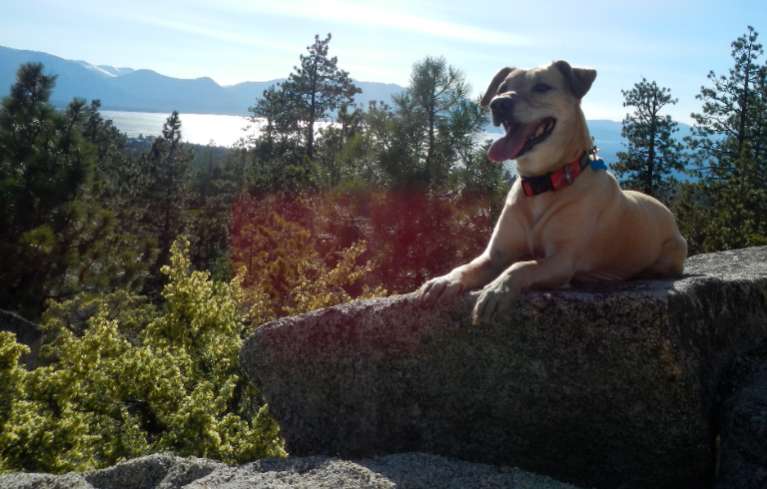
AJ on top of the boulders at the vista point in Van Sickle Bi-State Park. Photos/Kathryn Reed

AJ on top of the boulders at the vista point in Van Sickle Bi-State Park. Photos/Kathryn Reed

By AJ Rothschild-Reed

STATELINE – Mommy is letting some strange guy take my bed. I’m not sure about this.

Suddenly there’s a knock on the door. I must protect my person. Oh, but wait, what do we have here? Some other guy has my bed and mommy seems to be paying for it. That seems strange.

Wow, look at that view. The window comes down low enough that I can see Lake Tahoe to my left. And there’s a big stage. I might have to check that out, pretend like I’m a star. There looks like a lot of exploring to be had beyond these four walls.

But these four walls aren’t too shabby, either. Harveys is pretty cool with providing me snacks, matching bowls, a placemat of sorts and a nifty pouch full of poopy bags. This is better than at home. (Bet mommy the editor strikes that part out.) And that king-size bed. You know who is going to be lounging there when my peeps take off.

Harveys, for two years, has had 12 rooms designated for dogs. Stefan Humer, hotel manager, says special cleaning supplies are used, housekeeping receives extra training and rooms are vacuumed daily. Two dogs per room are allowed, with a 50-pound limit per dog.

Wow, mommy isn’t immediately sitting in front of the stupid computer. The leash is out – always a good sign. She tells me we are going to explore Van Sickle Bi-State Park. But I’m a little worried. Ken the bellhop said to watch out for coyotes. Then a guy in the parking lot says to beware of the homeless camp.

(We didn’t see either.)

Just get a whiff of that. Oh, never mind, but you are missing out. If you two-leggeds could smell what we four-leggeds smell, you would want to pee on everything, too. Sure it’s pretty – but the smells, really, that’s the best part of a hike.

Mommy can’t stop taking pictures from the vista point that was only about a half mile in from the trailhead. She’s babbling on about how pretty this would be at sunset. I can’t believe she just wants to sit on these boulders – how boring. They don’t smell.

We’re both getting hungry, but I overhear a conversation between the mommies that means I have to wait. We head back out the way we came in and never once see another person. Pretty cool to have the country’s only bi-state park all to ourselves.

But our solitude is quickly gone as we walk through the bustling Heavenly Village. We sit at a table at Base Camp Pizza waiting for the other mommy to arrive. The waiter brings three waters. I’m liking this kind of service. Talk about smells. There are crumbs all over the place from messy patrons sitting outside. I love it.

I see some of my own kind at other tables spread out between the two outdoor areas. We do our secret acknowledgement that our peeps don’t know about.

Mommy is clearly feeling guilty about not having fed me because I never get people food from the table. This pizza crust is pretty darn tasty. I’m going to put that on my list of people food to beg for.

After a good night’s sleep it’s time to head for the special area Harveys has outside for me to do my business.

My mommies say they are off to watch some horse race. Whatever. I’m part greyhound; they see me run all the time. But I’m not allowed to go.

At check in I saw mommy sign a waiver that said I would have to leave if I created a disturbance, went into the gaming area, lounged by the pool or went to one of the casino’s restaurants.

The hotel manager said some unruly dogs have been shown the door. Kennels are an option at Harrah’s Lake Tahoe for $10/day. Harveys charges $75/night for a dog.

Today we are going on another excursion that the bellhop recommended – Nevada Beach. Mommy likes the idea of not having to get in the Jeep all weekend.

The brochure provided by the hotel suggests outdoor play at Hawley Grade, Fallen Leaf Lake, Kiva Beach and Tallac Historic Site. These all require getting in a vehicle.

Lots of BS’ing here. That’s butt sniffing in our language. It’s flat, and apparently pretty, according to mommy lingo. I just know there is a lake at the end. Mommies perch themselves in the sand as I figure out how to tame these waves.

Later in the afternoon mommy takes me for a walk around outside. I ask about that stage I could see from the window. Mommy lets me get on stage. Pretty cool. I can hear the applause now. Just call me princess.

Dagnabit. Mommy interrupts my fantasy. It’s time to go back to the room.

I’m not too sure about escalators, but the elevators seem like some form of space travel.

The next morning the three of us head off to find breakfast. Well, I ate before we left. Still, I’m wondering what new people food I might indulge in.

We sit outside Driftwood Cafe. No table service, but they allow mommies to get food to go so the three of us can dine together. I’m not getting a scrap. What’s up with this? I am the reason we are on this mini trip. Why isn’t it all about me?

I guess we better get back and check out. But I could get used to this lifestyle of living on the 14th floor with a view of Lake Tahoe.

ngg_shortcode_0_placeholder (Click on photos to enlarge.)


Nevada GOP primary signals move to middle

By Scott Sonner, AP

RENO — Republican regulars are relishing what they view as a return to normalcy after mainstream candidates defeated more conservative primary challengers in their struggle with tea party activists for control of Nevada’s GOP.

Political analysts said it won’t be clear until November whether the results of Tuesday’s primary were driven most by the hugely popular Gov. Brian Sandoval’s coattails, the power of incumbency or a move toward moderation with fading support for the right wing’s agenda.

The rift between the mainstream and the more conservative politicians who have assumed state GOP leadership positions was in the spotlight, most notably in the lieutenant governor’s race, where Sandoval’s backing helped carry Mark Hutchison past the GOP-endorsed Sue Lowden.

The governor’s picks also prevailed in a key 4th District congressional primary where first-term Assemblyman Cresent Hardy defeated tea party strategist Niger Innis, and in the Legislature where Senate Minority Leader Michael Roberson of Henderson, Assembly Minority Leader Pat Hickey of Reno and assistant Senate floor leader Ben Kieckhefer of Reno all withstood anti-establishment challenges from the right.

“We saw races where conservatives were trying to prove they were more conservative, and in those elections, it did not go well for tea-party types,” said Fred Lokken, a political science professor at Truckee Meadows Community College in Reno.

“It could be the first indications that Republican conservatives are tiring of the fight,” he said. “They may be realizing the split is providing far more damage than any benefit — that you either produce a weakened candidate more likely to lose to a Democratic challenger, or someone who does not work and play within the government process that elected them, and doesn’t get anything done for the district or the state.”

Republican angst had been growing in Nevada since tea party darling Sharron Angle beat Lowden and Danny Tarkanian for the GOP’s U.S. Senate nomination in 2010 before losing to Democratic Sen. Harry Reid, 50 percent to 46 percent.

Mainstream GOP leaders like their prospects for unseating the U.S. Senate’s majority leader much better if Sandoval takes him on in 2016. The governor insists he plans to serve a full four-year term if re-elected, but his impressive showing with 90 percent of the vote in Tuesday’s primary will only encourage his cheerleaders.

“It is tough to get 90 percent even if you are running unopposed,” said Eric Herzik, a political science professor at UNR.

Sandoval’s popularity helped scare off serious Democratic challengers in an eight-candidate field, where relative unknown Bob Goodman claimed the nomination with 25 percent of the vote in an embarrassing primary where “none of these candidates” led with 30 percent.

Even Democrats at the polls voiced support for Sandoval.

“As a Democrat, I can’t vote for Sandoval, but I feel he’s doing a good job and I hope he continues,” said Las Vegas resident Celso Adriano, 87, who is a World War II veteran. “I was watching what he’s doing. … He keeps good track of the budget.”

Lokken said that should get the attention of state party leaders, who last year elected Michael McDonald chairman over the Sandoval-backed Robert Uithoven, then later changed the party’s endorsement process over the governor’s objections.

“The primary was kind of a setback for the attitude the state GOP could go its own way. The governor is for all intents and purposes the leader of the party,” Lokken said. “The message back to the state GOP is it probably should be working much harder to work with the sitting governor, who is very popular and pretty mainstream.”

For his part, Nevada GOP chairman McDonald immediately issued a post-primary call for unity that he says is the key to winning in November “by practicing the politics of addition, not division.”

“I urge you to end the Republican ‘civil war’ that is so often reported about,” he said in an email to party members. “Now is the time that we must band together and truly become the Nevada Republican Party.”

Herzik said it’s too early to tell if the Republicans’ internal wounds are healing. He also cautioned against reading too much into the tea party setbacks.

“If traditional Republicans overstate this, that it means they are not important, that would be a mistake,” he said. Herzik said Hutchison and Hardy both were better-financed favorites in their races and the “conservative challenges to Roberson and Kieckhefer in particular, didn’t have any legs.”

“This kind of conservative backlash was louder than it was actual,” Herzik said. “I don’t think this election brought peace and harmony to the Republican Party. I don’t think there is any guarantee that the disaffected conservative Republicans will fall in line and immediately back their fellow Republicans.”


Travelers spend record sum in Calif. in ’13

By Mark Glover, Sacramento Bee

More than 235 million people – visitors and residents alike – traveled within California in 2013, spending an all-time record of $109.6 billion, according to a report released by Visit California, the nonprofit that helps develop the state’s travel and tourism marketing programs.

Visit California said last year’s travel-related spending generated $2.8 billion in local tax revenues and $4.3 billion in state tax revenues.

The report, compiled by Portland-based Dean Runyan Associates and commissioned by Visit California, also noted that the state’s travel industry last year employed 965,800 people, the highest number since 1992, when employment data started being tallied.

“California tourism is on the rise, and that means new potential for creating jobs and increasing economic impact throughout the state,” said Caroline Beteta, president and CEO of Visit California, in a statement.

Read the whole story


Lake Tahoe’s 2 tourism agencies as unique as the destinations they represent

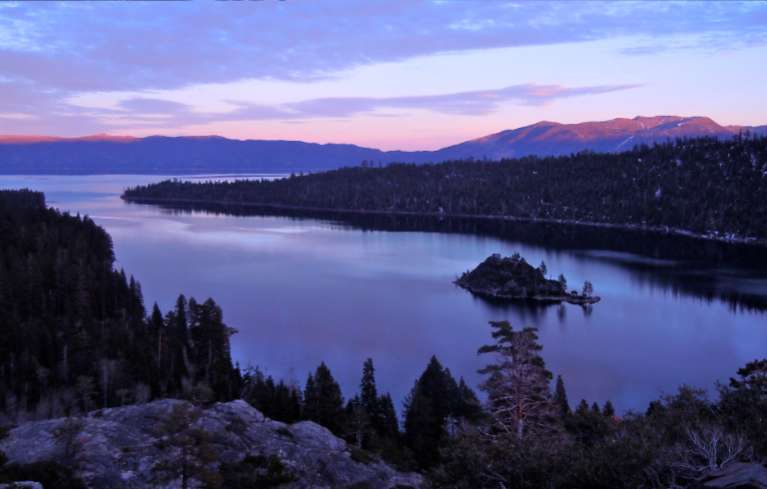
Emerald Bay is one icon all tourism agencies at Lake Tahoe promote. Photo/LTN file

Emerald Bay is one icon all tourism agencies at Lake Tahoe promote. Photo/LTN file

Publisher’s note: This is this first of an occasional series of stories about the Lake Tahoe Visitors Authority and North Lake Tahoe Resort Association.

By Anne Knowles

Last year’s room nights on the South Shore were worth celebrating. After more than a decade of declines, save for a minor uptick a few years ago, room rentals were on the rise again, jumping 10 percent on the California side and almost 1 percent on the more active Nevada side between October 2012 and September 2013.

The new 12-month rolling year started auspiciously, too. In October 2013, room nights in California climbed about 11 percent to nearly 34,000 and just more than 9 percent to more than 45,000 in Nevada.

Then winter arrived. And the snow didn’t follow. Room nights started to fall, dropping in the California market by as much as 43 percent in January from the same month a year earlier.

The cumulative effect is that in the five months from October 2013 to February 2014, room nights throughout the South Shore of Lake Tahoe fell by almost 8 percent.

“Winter wasn’t good to us,” Carol Chaplin, executive director of the Lake Tahoe Visitors Authority, told Lake Tahoe News.

The LTVA is one of two major organizations at the lake tasked with marketing the area, driving tourism and putting heads in beds.

The other is the North Lake Tahoe Resort Association. The two divide the 72-mile shoreline into north and south, including a branding campaign that identifies the two Tahoe markets simply as North and South.

The LTVA and NLTRA are similar but different and cooperate and compete. And they are not always well understood by those who live at the lake who rely on tourism to drive their communities’ economy.

Both organizations, like the industry they serve, have evolved over the last decade.

Lake Tahoe Visitors Association

The LTVA, for example, no longer is financed by the city of South Lake Tahoe, which for years supported the LTVA through its general fund.

Room taxes from Stateline casinos are a substantial part of the LTVA's budget. Photo/LTN file

Room taxes from Stateline casinos are a substantial part of the LTVA’s budget. Photo/LTN file

“City of South Lake Tahoe historically funded LTVA through the (transient occupancy tax), but they kept reducing it and in 2008 the last $350,000 was cut and the (Tourism Improvement District) was formed to replace the contribution,” Chaplin explained.

The TID consists of all lodging businesses — hotels/motels, timeshares, condos, triplexes, duplexes and homes under management contracts — located within the city limits of South Lake Tahoe.

Initially, they were each assessed a flat rate per paid occupied room per night of $2 on hotels and motels and $3 per on timeshares, condos, triplexes, duplexes and homes. That recently was raised, through 2018, to $3 and $4.50 per night, respectively.

LTVA receives 95 percent of those fees, on a monthly basis, while the TID retains the remainder for special projects. For fiscal year 2015, that amounts to about $1.8 million.

The other half of LTVA’s budget – about $2 million – comes from Tahoe Douglas Visitors Authority, which was created in 1997 to levy a separate lodging tax for the benefit of the Tahoe township, which is better known as Stateline. Those LTVA funds are made of 60 percent of the 10 percent room tax charged by the TDVA as well as two-thirds of an additional 3 percent lodging license fee the county began charging a few years ago.

The budget is divvied up between what LTVA calls sales, or promoting the destination internationally, usually through tour operators. The cost of some of that — in Australia, United Kingdom and France, specifically – is shared with NLTRA.

There’s advertising and social media, which runs the gamut from TV ads running on Comcast during Oakland A’s games to its website.

The LTVA and NLTRA share a single-page website that links back to their respective and separate websites.

All advertising decisions are made by the LTVA board based on recommendations from its marketing committee. That committee recently expanded from seven to 11 members. It is comprised of members from ski resorts, casinos, condos, marketing firms and Barton Health.

“A lot of the roll-up-your-sleeves work is done at that level,” Chaplin said.

The seven-member LTVA board, which has public monthly meetings, consists of two representatives appointed by the TID (currently Chairman Patrick Ronan and Jerry Bindel), two placed by TDVA (Bryan Davis with Edgewood and Harrah’s/Harveys Lake Tahoe’s John Koster), a South Lake Tahoe City Council member (Tom Davis), a member chosen by the South Lake Tahoe Chamber of Commerce (Heavenly Mountain Resort’s Peter Sonntag) and the district’s Douglas County commissioner (Nancy McDermid).

There are no term limits, but the members from the TID and chamber, Chaplin said, tend to serve for the same period they serve on the boards they are appointed from.

Finally, there are events, including the American Century Championship celebrity tournament at Edgewood Tahoe Golf Course each July. Chaplin said the LTVA, though, is in the process of reevaluating its event strategy since the recent brouhaha over the Fourth of July fireworks display, which unexpectedly cost the organization approximately $33,000 in legal fees.

“It’s changed the way we look at our involvement with events producers. We’ll be spending more on legal contracts and consultants. We’re rethinking how we’re going with fireworks,” said Chaplin. “But we heard the message loud and clear from the community that it is a big event for us.”

The LTVA may also pull back on small grants to other events for help with their marketing, a decision that will be made after this month’s board meeting.

“We are asked a lot to bring large events here, but we don’t have the infrastructure to support them,” Chaplin said.

North Lake Tahoe Resort Association

Infrastructure is one key way the LTVA and the NLTRA differ.

This is one of the ads created for North Lake Tahoe by School of Thought.

This is one of the ads created for North Lake Tahoe by School of Thought. Photo/Provided

NLTRA is tasked with, and has a specific funding source, for transportation and infrastructure projects. NLTRA recommends the work to the Placer County Board of Supervisors which approves it. That’s funded by an additional 2 percent TOT approved by voters through 2022.

Overall, NLTRA receives 60 percent of TOT collected in eastern Placer County. In 2013-14, the group’s budget was $4.4 million from TOT, minus about $1.5 million which is set aside for county services.

NLTRA once adhered to a spending formula that was replaced in 2012 with a “priority-based” method, but it still spends about 42 percent on marketing and 58 percent on transportation and infrastructure, said Sandy Evans Hall, chief executive officer/executive director.

NLTRA, formed in 1995 after a master plan study of tourism recommended it, comprises two entities: the North Lake Tahoe Chamber of Commerce and the Tahoe North Visitors and Convention Bureau.

“We have three functions,” Hall told Lake Tahoe News. “The chamber, the visitors’ bureau and making recommendations on transportation and infrastructure.”

Like the LTVA, the NLTRA has a board, which has final say over marketing and advertising campaigns brought to it by a marketing committee.

The NLTRA outsources to two outside agencies — School of Thought in San Francisco and the Abbi Agency in Reno — to develop advertising and public relations campaigns.

“The staff works with the agencies, tells them here’s what we want to do, we give them the budget and they come back,” Hall said. “Then the NLTRA board has the final say.”

Nine members of the 11-member board are elected by NLTRA membership. They run to represent different categories such large lodging, small lodging or dining, serve on the board for three years and are limited to two terms. The other two members are appointed without term limits as is a third, non-voting member.

The committees are appointed by the board and besides the 13-member marketing panel, there are groups that advise the board on lodging, membership, finance, infrastructure/transportation and group sales.

The NLTRA also works closely with the Incline Village Crystal Bay Visitors Authority under an agreement forged six years ago, which created the North Lake Tahoe Marketing Coop, which is intricately involved in marketing decisions made by NLTRA.

“Six years ago we sat down and decided had competing messages,” said Hall. “We said we should market as one destination.”