Brown reshaping California’s Supreme court

By Paul Elias, AP

SAN FRANCISCO — If Gov. Jerry Brown wins re-election in November, he will be given an unprecedented opportunity to overhaul the California Supreme Court.

Voters in 1987 rejected Brown’s first makeover when they removed Chief Justice Rose Bird and two other of his appointees from the high court because of their refusal to enforce the death penalty and consistently liberal rulings.

Three decades later, Brown could be presented another chance to shape one of the most influential courts in the country. Justice Marvin Baxter, a reliably conservative member of the court, announced last week that he will retire in January, which would give Brown his third vacancy to fill on the seven-member court if re-elected.

Jerry Brown is likely to have a lasting impact on the California Supreme Court. Photo/LTN

Gov. Jerry Brown is likely to have a lasting impact on the California Supreme Court. Photo/LTN

In 2011, he filled a vacancy by appointing University of California Boalt Hall School of Law professor Goodwin Liu to the state’s highest court after Senate Republicans blocked his nomination to the 9th U.S. Circuit Court of Appeals. The second opening he has to fill was created by the retirement of Justice Joyce Kennard, 78, in April, and the third opening will be created in January when Baxter retires.

While nobody wants to predict precisely who the independent-minded Brown will nominate to fill those two slots, it’s expected he will appoint more mainstream candidates than he did during his first eight years as governor.

“I would not expect Gov. Brown to appoint another Rose Bird,” said Jon Eisenberg, a lawyer who has appeared in the state Supreme Court numerous times. “He’s older and more mature.”

Since leaving the governor’s office in 1983, Brown, 76, has served as mayor of Oakland and as California attorney general. In both positions, Brown was a proponent of tough policing policies. As attorney general, he said he would “follow the law” and not oppose capital punishment, a departure from his outspoken anti-death penalty position during his first stint of governor and the reason for appointing Bird and other justices to the Supreme Court.

“The Rose Bird court has to be at least in the back of his mind,” said appellate specialist Curt Cutting, who has appeared before the state Supreme Court. “But it’s still going to be a less conservative court. There are going to be big changes.”

It’s widely expected the decades-long era of a moderate Republican court that was friendly to corporate interests and dominated by appointees of governors George Deukmejian and Pete Wilson is about to end.

Brown will have been responsible for filling at least three vacancies — and likely five — on the seven-member court if he is re-elected to another four-year term in November.

The governor has not said when he will fill the current vacancy caused by Kennard’s retirement and hasn’t disclosed a short list of candidates. Nor has he said what he wants the Supreme Court to look like during his second term.

“We’re moving expeditiously to fill these vacancies and remain focused on appointing the best possible judges from a broad, diverse and experienced pool of candidates,” governor’s spokesman Evan Westrup said.

In appointing Liu, 43, Brown resisted pressure from minority groups to nominate a Latino or black candidate to replace Justice Carlos Moreno, who is now U.S. Ambassador to Belize. Brown said at the 2011 news conference announcing the appointment that the high-profile failure of Liu’s nomination to federal court propelled him to the top of Brown’s list for the California Supreme Court vacancy.

“It is hard to tell with Brown,” Cutting said. “But what we have seen so far is that he more interested in finding someone who is going to be a really smart contributor to the court for a long time as opposed to pandering to a particular constituency.”

At the Liu news conference, the governor said he has no litmus test for judicial appointments and didn’t ask Liu about his positions on the death penalty, gay marriage or other hot-button social issues. Instead, he asked Liu for his “theory of the law.”

“That was a game changer,” said Gerald Uelmen, a Santa Clara University law school professor who studies the Supreme Court.

Uelmen said he expects the court to move left politically when Brown fills the current vacancy and the opening created by Baxter’s retirement, predicting that the two new Brown appointees would team up with Liu and Justice Kathryn Werdegar to form a majority liberal bloc.

Uelmen said that’s a dramatic departure from a court that was — until Liu’s appointment — unanimously Republican and reliably conservative on most issues, with a few notable exceptions that include the 4-3 vote to strike down California’s same-sex marriage ban.

Appellate specialist Jon Eisenberg said filling Baxter’s vacancy will put the Supreme Court on a far different course than charted by Chief Justice Ron George, who led a Republican majority for 15 years before his retirement in January 2011.

“Jerry Brown has the opportunity to appoint a member very different than Justice Baxter,” Eisenberg said.

Brown is under pressure again to appoint a Latino and black to a bench lacking both, he said.

Eisenberg speculates that the next two vacancies will be filled by minorities.

“After that, he will have the political freedom to pick whoever he wants,” Eisenberg said. “That’s when it will get really interesting.”


Lake Tahoe patrols prepared for more boaters

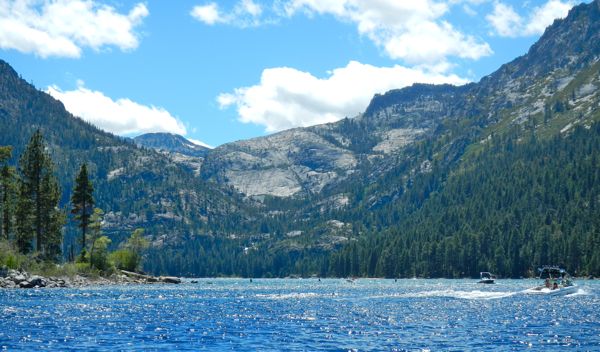
Les Lovell with El Dorado County Sheriff's Department cites personal watercraft riders who were allegedly speeding in Emerald Bay. Photos/Kathryn Reed

Les Lovell with El Dorado County Sheriff’s Department cites personal watercraft riders who were allegedly speeding in Emerald Bay. Photos/Kathryn Reed

By Kathryn Reed

CAMP RICHARDSON – The drought may be good and bad news for Lake Tahoe.

Many reservoirs in California and Nevada are well below normal levels. Folsom Lake slip owners have until today to remove their boats because of the rapidly declining water level. Lahontan and Rye Patch reservoirs’ boat launches in Nevada are closed.

All of those boaters and other could be headed for Lake Tahoe.

But Tahoe marinas are also affected by the lack of water. The runoff is at a trickle. Sand Harbor marina officials say launches could stop mid-summer. Meeks Bay recently dredged. Even so, they could only go to the bulkhead.

Emerald Bay presents the most problems for boat patrollers, especially on July 4 when hundreds of vessels are there.

Emerald Bay presents the most problems for boat patrollers, especially on July 4 when hundreds of vessels are there.

El Dorado County Sheriff’s Department’s marine vessel could not maneuver into that West Shore marina on June 27 without risking damaging the prop. The boat was kicking up sand before it reached the buoy near the entrance.

Getting gas at Camp Richardson was a bit precarious on Friday, too. Kahl Eidam had to carefully maneuver the 27-foot Almar to the dock. A dockhand said Bob Hassett, who operates the marina, is going to get a longer hose so it stretches farther down the dock where vessels are waiting in deeper water.

(Eidam, a former sergeant with the California Highway Patrol, is in his first year with the sheriff’s boat patrol.)

The sheriff’s boat is operating out of Camp Rich right now after being at Tahoe Keys Marina for 20 years. A long-term lease with Tahoe Keys is being negotiated.

Marinas throughout Tahoe could be affected by the declining water level.

“I don’t know how they are going to get some of the bigger boats out in the future,” Les Lovell said of vessels at Tahoe Keys because of the shallow water.

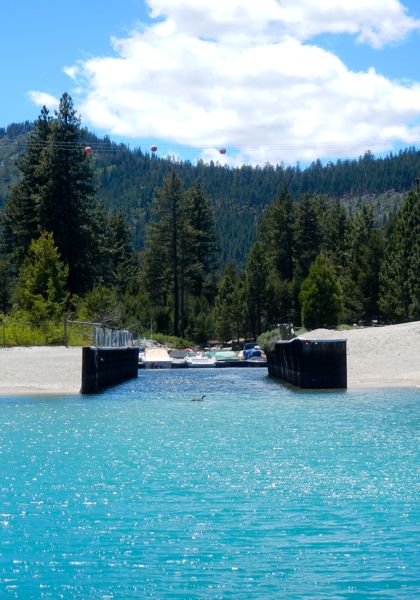
Meeks Bay Marina was dredged this season, but the approach was not.

Meeks Bay Marina was dredged this season, but the approach was not.

Lovell, a former lieutenant at the department who has been on boat patrol for three years, said he expects there to be more issues this season because of the lower water level and potential for more boaters at Tahoe because of the lack of water elsewhere.

“Because of the low water level this year there will be a lot of crashes into rocks. You can’t mark them all,” Lovell told Lake Tahoe News.

He is also fearful people will run into sandbars during Fourth of July. This is always a precarious evening for people returning to marinas. Many have been drinking and all are ready to be home by the time the fireworks are over.

Hitting a sandbar usually means instantly stopping and often people are thrown overboard.

Lovell said his biggest worry is near Cove East before the Tahoe Keys Marina where the water level is so shallow and the long sand bar is not marked.

South Lake Tahoe officials are also worried about the water level.

“A concern for this year is the shallowness of the water. There is a concern of boaters literally getting stuck in the shallow waters this year,” Tracy Franklin, spokeswoman for the city, told Lake Tahoe News.

She said off Regan Beach the depth is 2½ feet quite a ways from shore.

Emerald Bay is El Dorado County’s biggest spot to patrol. While there were about a dozen incidents last season, some including people being thrown from their vessel, there were no major injuries. Property damage was the big issue because of the rocks.

A rock garden of sorts is protruding on the right side of the entrance to Emerald Bay. This might be better than last year when the shallow rocks weren’t visible.

Not far from D.L. Bliss State Park is a tree that is about 50-feet down. About a foot of it is now above the surface. A buoy that looks like an old balloon is attached to it to warn boaters. Still, the boat guys predict boaters or those on personal water craft will run into it.

The dropping water level will keep exposing rocks and trees – thus becoming a hazard. Not all will be marked.

Jumping off rocks is also an issue.  There’s a group near Rooster Rock along the Rubicon hiking trail taking pictures. But this is where many opt to do bit a jumping off into Lake Tahoe. California State Parks, which owns the land, has made this a big no-no. The boat patrollers have the authority to cite them.

A tree stump is one of many obstacles in the way of boaters on Lake Tahoe.

A tree stump is one of many obstacles in the way of boaters on Lake Tahoe.

While it’s OK to operate a boat with alcohol in hand, it’s not OK to be inebriated. The same 0.08 blood alcohol level while driving a car applies to a boat.

Most of the agencies at Lake Tahoe with boat patrols are participating in Operation Dry Water, a three-day enhanced boating under the influence program that ends today. Besides getting drunken boaters off the lake, it is also an opportunity to educate people.

Education is a large part of what the boat patrolmen do.

On Friday, the boat guys were talking to people about their speed in Emerald Bay. It’s a 15 mph zone. Around a buoy field – like near the boat-in campground – it’s is a maximum of 5 mph within 200 feet.

On this day it’s tourists who are contacted. Some are in rental boats. A clue to a rental vessel is if the registration ends in LE.

Lovell is quick to spot boats with outdated registration. When they prove they have their paperwork, they are given a warning. But citations may be issued. And if they are drunk, they are going to jail.

But it’s not just the water these guys patrol. They also can and do patrol the beaches.

The U.S. Coast Guard, which operates out of the North Shore, may board any vessel. All other law enforcement on the lake must have probable cause to stop someone.

Registration is a biggie with motorboats, while lifejackets is an issue with others. Anyone using a paddle needs to have a lifejacket that fits him or her. If the person is 14 or older, it’s OK to have the jacket in or on the vessel.

But Lovell pointed out that a jacket attached to a standup paddleboard isn’t going to help the person if they hit their head on the board or are in deep water. After all, the surface temperature of Lake Tahoe has not hit 60 degrees and hypothermia can then become factor.


Online gaming revenue falls short

By Adrienne Lu, Stateline.org

State lawmakers who dream of dollar signs from legalized online gambling might want to pause for a moment to consider Delaware, Nevada and New Jersey.

Last year, the three states became the first in the country to legalize Internet gaming. But as New Jersey Treasurer Andrew Sidamon-Eristoff told state lawmakers earlier this year: “Clearly, the results so far have not met our expectations.”

New Jersey officials initially predicted legal online gambling would boost state tax revenues by $180 million in fiscal 2014. By the time Republican Gov. Chris Christie signed the budget last June, the figure had been revised downward to $160 million.

By the end of May, one month shy of the fiscal year’s end, the state had taken in just $9.3 million in revenue from online gambling, according to the nonpartisan Office of Legislative Services. And with collections in April and May falling below those in March, online gambling isn’t even trending upward. State officials have blamed the slow start on technology glitches and payment processing issues.

Nevada and Delaware, which have much smaller populations than New Jersey, also have collected only modest revenue from online gambling.

In Delaware, state officials had counted on $7.5 million in additional tax revenue in fiscal year 2014. But because of a delayed rollout and one-time startup costs, Internet gaming made no net contributions to the state budget in fiscal 2014, state officials said. The startup costs included software design and data servers to host the gambling.

In Nevada, officials opted not to make revenue projections for the nascent industry – or to count on the money in its budget. The state, which legalized only interactive poker, generated about $700,000 in tax revenue from about $10.2 million in gaming wins from May 2013 through April of this year, according to Michael Lawton, a senior research analyst with the Nevada State Gaming Control Board.

“We just didn’t feel that it would be wise to put out a number,” Lawton said. “It was just too much unknown.”

In March, Morgan Stanley chopped its market projection for the U.S. online gaming industry by 30 percent, from $5 billion to $3.5 billion by 2017, “to better reflect the insights we have gained following the first few months of operations” in Delaware, Nevada and New Jersey.

Read the whole story


Nev. group pushes for marriage equality

By Yesenia Amaro, Las Vegas Review-Journal

There’s a new group in Nevada, and its goal is to establish marriage equality in the state in 2016 or sooner.

Freedom Nevada, a nonprofit coalition, this month formed a statewide 20-member advisory committee that includes lawmakers, attorneys, religious organizations and equal opportunity organizations, among others.

“People have a fundamental right to form families,” said Bishop Dan T. Edwards with the Episcopal Diocese of Nevada, which has taken “heat” for its position of this issue. “This is a matter of civil rights when it comes to state law.”

Those on the committee will lay the groundwork to rally state voters to say “yes” in 2016 to a ballot measure allowing all couples, including same-sex couples, to have the freedom to marry.

The effort is modeled on similar work that has proved successful in states such as Maryland, Maine and Washington, where voters approved same-sex marriage ballot measures, organizers said.

In 2013, the Nevada Legislature approved Senate Joint Resolution 13 to amend the state’s constitution to recognize all marriages, regardless of gender. The legislation would need to be approved by lawmakers again during the 2015 legislative session before going to the voters in 2016.

Read the whole story


1968 U.S. Olympic track team, Echo Summit training site continue to make history

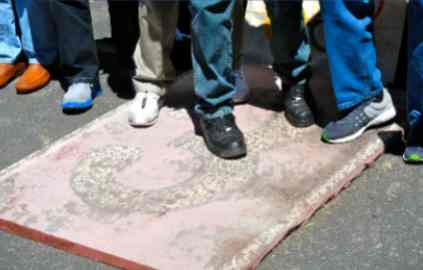
Athletes from the 1968 U.S. Olympic track team stand and part of the track they trained on at Echo Summit. Photos/Kathryn Reed

Athletes from the 1968 U.S. Olympic track team stand on part of the track they trained on at Echo Summit. Photos/Kathryn Reed

By Kathryn Reed

1968 was not all about free love and feeling groovy. Martin Luther King Jr. and Robert Kennedy were assassinated within two months of each other. Vietnam was raging. The country was polarized.

Even though the Civil Rights Act was signed 50 years ago this summer, it did not mean equality was immediate – and certainly not four years later.

Echo Summit played a role in that tumultuous summer.

John Carlos and Tommie Smith remember training at Echo Summit with fondness.

John Carlos and Tommie Smith remember training at Echo Summit with fondness.

Laurence Crabtree, Eldorado National Forest supervisor, said it was human rights history that began at Echo Summit in the summer of 1968. This is where the U.S. Track and Field trained for the Mexico City Olympics. The elevation of the two locations is about the same – with Echo Summit being 28 feet higher at 7,377 feet.

Tommie Smith won gold in the 200 meters and John Carlos bronze. While on the podium listening to the national anthem they bowed their heads and raised a fist with a black glove – a salute to black power and a stand against racial inequality.

Smith and Carlos, along with nine other members of that historic team, returned to Echo Summit on June 27 to be honored as well as acknowledge the site is now a California Historical Landmark.

“This track and field team is regarded as the best in history. And they have never gotten their due,” Jill Geer with USA Track & Field said. “They were heroic in so many ways – on and off the field.”

The Olympic flag flies proudly June 27 at Echo Summit.

The Olympic flag flies proudly June 27 at Echo Summit.

They brought home 20 medals, including 12 gold. Smith’s world record of 19.83 seconds stood for 11 years. They won more gold and set more records (six world) than any previous team had. Twenty of them are in the National Track and Field Hall of Fame.

“This is where the love and bonding started amongst all of the individuals,” Carlos said. “I hear many people talk about how great this team was. The greatness came from this location.”

Walt Little, with the city of South Lake Tahoe, recommended the location. The U.S. Olympic Committee approved it.

In addition to the men’s track team, the men and women’s volleyball teams and women’s gymnastic teams also trained in South Lake Tahoe.

At the track and field trials on the 400-meter oval at Echo Summit, four world records were set in September 1968. The Games were a month later.

This is the state's fifth sports site landmark and first civil rights.

This is the state’s fifth sports site landmark and first civil rights.

Hundreds of trees remained in the middle of the track. Boulders were part of the landscape. It made for some interesting perspectives.

Smith remembers watching Bob Seagren, who went on to win gold in pole vault, train. “I thought he had fallen out of a tree,” Smith said as Seagren tumbled 11-plus feet after clearing the bar.

For most of the athletes, this chilly Friday morning was the first time they had been back to Tahoe.

Triple jumper Norm Tate was overheard saying, “This brings back memories of coming out here in the morning and freezing.”

One of the conditions of the U.S. Forest Service allowing the track to be built was for it to have little impact on the environment and that it would be removed quickly. That track went to South Tahoe Middle School. It was in 1992 that the last high school track meet was run at that track. It had outlived its lifespan. In 2007, it was replaced.

A piece is given to each athlete.

Each athlete has a piece of the track.

But Anthony Davis, who runs community events at the STMS track, has pieces of the track. He had some cut up to give to each of the athletes. Part of lane No. 3 was front and center during the festivities. Davis told Lake Tahoe News one day he would like to secure the funds to have it framed and placed in a public place.

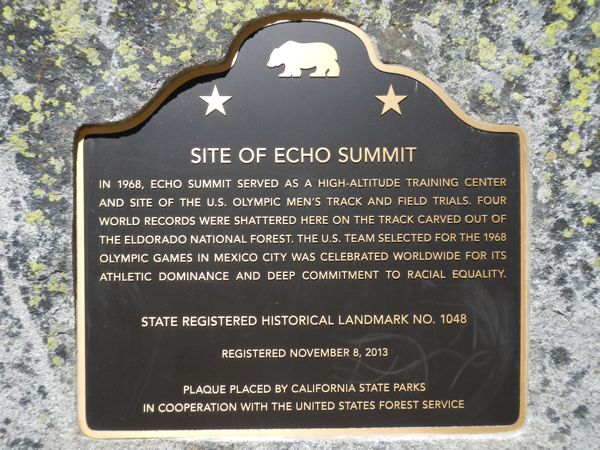
A plaque on a granite boulder commemorates the site. It is located just off Highway 50 where Adventure Mountain is located.

Athletes were also honored Friday night at Sacramento State during the USA Track & Field Championships.


Poll: Californians financially better off

By Josh Richman, San Jose Mercury News

For the first time in seven years, more California voters say they’re financially better off compared to the previous year than not, a Field Poll finds.

Forty-four percent of the state’s registered voters are feeling they’re doing better now than a year ago, while 28 percent say they’re worse off and 28 percent say there’s no change, the poll found. But the level of optimism on this and other questions differ dramatically, depending on where the voters live and how much money they make.

Nowhere is the outlook sunnier than in the Bay Area, where those who say California is having good economic times are tied with those who say we’re in bad times, at 35 percent each. This probably is the result of who lives and works in the Bay Area: Democrats and more affluent people are far likelier to say we’re having good times, according to the poll.

But the rest of the state is also feeling somewhat better.

Read the whole story


Drought taking toll on Nev. wildlife

By AP

RENO — Lingering drought is taking a toll on wildlife across Northern Nevada, shrinking deer herds on the high desert, drying up fisheries in the valleys and starting to push everything from bears to snakes into urban neighborhoods they normally don’t frequent.

Mule deer especially are showing signs of stress, and some fisheries may be lost altogether by the end of the summer as a result of a third consecutive year of serious drought, state wildlife officials say.

“It’s stressing the animals, and it’s stressing the habitat itself,” David Catalano, a supervisory biologist with the Nevada Department of Wildlife, told the Reno Gazette-Journal.

Snowpack was low after a dismal winter, leading streams and creeks that normally flow into July or later to go dry in March or April, Catalano said. That’s causing small animals like rabbits and squirrels to flock to neighborhoods where water, grass and insects are plentiful.

“They’ve got a mini-ecosystem that is flourishing, so all these little critters are drawn there,” Catalano said. “Now they are all competing a lot more for shelter and for foraging.”

The rodents in turn attract predators. Catalano said calls regarding snakes on people’s property in the Reno-Sparks area have increased significantly since the drought began.

At Lake Tahoe and across the Carson Range, hungry bears are on the move because they can’t find the berries and other natural food sources they normally depend on.

Meanwhile, since 2012, Nevada’s mule deer herd has declined from an estimated 112,000 animals to about 108,000 this year, said Cody Schroeder, the department’s specialist on the animal.

The grasses and flowering plants mule deer eat in the summer are increasingly scarce, as well as the sagebrush and bitterbrush they consume in winter. As a result, the deer are slowly wasting, and the youngest are most at risk, Schroeder said.

Fish are in trouble, too.

Kim Tisdale, Nevada’s supervisory fisheries biologist, said the Carson and Walker rivers could go dry.

“We could lose those fisheries,” Tisdale said. “It’s a possibility. We’re hoping not.”

They lack the same upstream storage of the Truckee River, which likely will have enough water to protect fish there, Tisdale said.

But Lahontan and Rye Patch reservoirs are down significantly. Very hot weather this summer could kill off fish by robbing those fisheries of dissolved oxygen, Tisdale said.

Wildhorse and Willow Creek reservoirs in Elko County are facing serious risks of a die-off. The state lifted catch limits in the two lakes in mid-May to try to empty them of fish before conditions become uninhabitable.


Future of Meyers Area Plan in limbo

By Kathryn Reed

MEYERS – While El Dorado County doesn’t have plans for another Meyers Area Plan meeting before it goes before the Board of Supervisors, members of the Meyers Advisory Council are coordinating a get-together without agency involvement.

That was the outcome of a three-hour meeting June 26 at the California Conservation Corps center. MAC members told Lake Tahoe News they are shooting for late July to bring the community together to hash out issues that stand in people’s way from signing off on what officials have presented.

As for the county, it was the intention of officials the Thursday meeting would be the last before the environmental process begins. (It was reported that Supervisor Norma Santiago was ill and that is why she was not in attendance.)

Meyers is struggling to figure out what it wants to look like in the future. Photo/LTN

Meyers is struggling to figure out what it wants to look like in the future. Photo/LTN

“We need to talk internally, with TRPA and Norma to see where we go,” Brendan Ferry, chief planner for El Dorado County, told Lake Tahoe News after the meeting.

Many of the nearly 50-person audience believed not enough outreach had occurred, that more community involvement is needed and the process needs to be slowed down – and perhaps delayed until after November when the area will be represented by a new supervisor.

If the process goes forward, there are at least five more public meeting where comments would be taken and changes could be made to the plan. Two are before the county and three involve TRPA.

While seven people acknowledged this was their first Meyers Area Plan meeting, the process has been going on for more than two years – with many public meetings. Postcards were mailed for the first time to residents announcing the meeting. However, they only went to people living or with businesses in the confines of the Tahoe Paradise Resort Improvement District, which is a fraction of the greater Meyers area.

Other than having a plan from 1993 on the books and needing to live with the rules within it, there is no legal reason the county or Tahoe Regional Planning Agency must move forward with the Meyers Area Plan. The TRPA’s Regional Plan allows these area plans; with an overriding goal to give local jurisdictions more say over planning.

Still, there is a template of sorts for these documents based on what is in the Regional Plan and laws regarding the reduction of green house gas emissions. It is not a document that is created from scratch.

The plan would be the planning blueprint for the Meyers area going forward for the next 20 years. However, it is recommended that whatever community group takes over for the Meyers Area Council reviews the plan every year.

Some of the main sticking points include determining how Meyers has a voice going forward.

County documents handed out at the meeting say, “The county is evaluating the establishment of a Community Services District, which would review proposed projects in Meyers, initiate future revisions to the plan, and direct some funding for local improvement projects.”

Stephanie McCorkle, the outside public relations person hired by the county, facilitated the meeting. She was also adamant that the county is not going to form a CSD; that it would be up to the residents of Meyers to do so if that’s what they want.

However, Ferry said, while it has not been fully flushed out, the idea of a municipal advisory council for Meyers has also been floated. He said members could be elected by the public or appointed by the Board of Supervisors.

Adam Lewandowsky with TRPA said, “The plan calls for a formal advisory council.”

With differing answers to the same question – Who is the voice for Meyers going forward? – this is an example of how distrust has become an issue when it comes to finding consensus about the plan.

Another concern is the density of multifamily homes has arbitrarily been bumped from 15 units to 20 units per acre. Some community members are not happy with that possibility.

Others want the California Tahoe Conservancy lots in Meyers to have more defined future uses. The state agency has agreed for the land use to be changed from residential/tourist to recreation. But recreation could still mean developable. That is what upsets some people.


‘Net neutrality’ a growing concern

By Edmund Lee, Bloomberg

The Internet is a set of pipes. It’s also a set of values. Whose? The people who consider it a great social equalizer, a playing field that has to be level? Or the ones who think of it as a marketplace subject to the laws of supply and demand?

It’s a philosophical contest that’s being fought under the banner of “net neutrality,” a slogan that inspires rhetorical devotion but eludes precise definition. Broadly, it means everything on the Internet should be equally accessible — that the Internet should be a place where great ideas compete on equal terms with big money. Even in the contentious arena of net neutrality, that’s a principle everybody claims to honor. Interpreting it is a different story.

With Internet use and related costs rising fast, the U.S. Federal Communications Commission proposed in May to let Internet providers like AT&T offer better technology at a premium price to content companies like Netflix, mainly for faster delivery of video. If approved, the new FCC rules would mean that for the first time some Internet content could get preferential treatment based on how much a publisher pays, instead of on whether it improves a network’s technical efficiency. Critics said that would give deep-pocketed companies an unfair advantage over upstarts, stifling the development of a new generation of Googles and Facebooks, costing customers more and opening the door to corporate censorship.

Supporters said it would simply create a “fast lane,” an improved alternate Internet where equals compete against equals.

Both sides invoked “net neutrality,” as do countries with widely varying definitions of the principle.

Read the whole story


Report: 30% of Nev. kindergartners are obese

By Paul Takahashi, Las Vegas Sun

Nearly a third of Nevada children are considered obese by the time they enter kindergarten, according to a recent UNLV report.

Since 2008, the Nevada Institute for Children’s Research and Policy has issued an annual report listing demographic and health information for some of the state’s youngest residents: incoming kindergartners. This year, more than 7,300 surveys were collected from parents with the help of the Nevada Division of Public and Behavioral Health and the state’s 17 school districts. About 60 percent of survey respondents were from Clark County.

UNLV’s report found that 30 percent of Nevada’s 4- and 5-year-olds are overweight or obese, a 1.4 percent increase from last year. The Silver State’s share of overweight children has hovered around 30 percent since the survey was first administered five years ago.

Nationally, childhood obesity has more than doubled in young children over the past three decades, according to the Centers for Disease Control and Prevention. About a third of American children ages 6 to 11 are considered overweight or obese.

Read the whole story