Ritz takes local, seasonal foods to a higher level

Manzanita at the Ritz-Carlton, Lake Tahoe is serving up season cuisine that is locally sourced. Photos/Kathryn Reed

Manzanita at the Ritz-Carlton, Lake Tahoe is serving up seasonal cuisine that is locally sourced. Photos/Kathryn Reed

By Kathryn Reed

TRUCKEE – “I’ll be taking my plate out back and licking it.” “Brown butter is like my crack.” “The pork was out of this world.” “I can’t eat enough apricots right now.” “With the rosemary, it doesn’t make the ice cream too sweet.”

Those were some of the comments as guests devoured a four-course dinner at Manzanita restaurant at the Ritz-Carlton, Lake Tahoe.

It was a night for Chef Stanley Miller to show off what is in season, what is new and that he has more than filled the shoes of Traci Des Jardins. Des Jardins opened the restaurant in December 2009. Miller took over executive chef duties a year ago this month.

" share recipes because if you don’t know how to make it, it doesn’t matter.”  -- Chef Stanley Miller

“I share recipes because if you don’t know how to make it, it doesn’t matter.”  Stanley Miller

Sitting outside at the “long table”, the backdrop is of the slopes at Northstar. The table is exquisitely set – giving it a mountain feel with carved wood, plants in cylinder vases and muted colors. Warding off the cool evening temps are heat lamps, including a long gas fireplace not far from the dining table.

An herb garden on the back patio includes things like purple sage, lemon balm and edible flowers. Chefs are picking them as guests mill about. Soon they will be incorporated into various dishes.

Miller uses 10-year-old starter for his sourdough bread. He had it shipped to California when he moved here. Before being hired he told management he would not buy bread.

His first course is a salad. It has greens from Del Rio Botanical in West Sacramento that were not ordinary. One diner said she had been pulling those same greens from her garden because she thought they were weeds.

Frog Hollows apricots, ricotta and goat cheese stuffed squash blossom, with a pistachio vinaigrette topped the salad. The blend of flavors and earthiness of greens make it so the salad could be a meal unto itself.

The "long table" at Manzanita.

The “long table” at Manzanita.

It is complemented with a Viognier from Terre Rouge in Plymouth. The rest of the meal is paired with a delicious Barbera from Nevada City Winery.

A crispy soft shell crab on top of a shaved vegetable salad with Capay Organics potato gnocchi, Riverdog Farms charred onion and spring garlic dressing was the next course.

Miller said tomatoes and berries would be sweeter this summer because of the drought.

He got his start in the food industry as a teenager in Ohio working in his family’s butcher shop. Miller grew up where food was strictly for nourishment. He was one of the first boys to take a home ec class.

“I remember sewing my first apron. Baking was very easy for me,” Miller said. Winning a baking award in high school made him realize maybe he could do something more with his skills.

To this day, he says, “Cooking for me is fun.” Plus, he no longer has to wash dishes.

He started the third dish long before the guests arrived. The pork is slow roasted for three to four hours.

“It’s so good with the richness of corn and peaches,” Miller said.
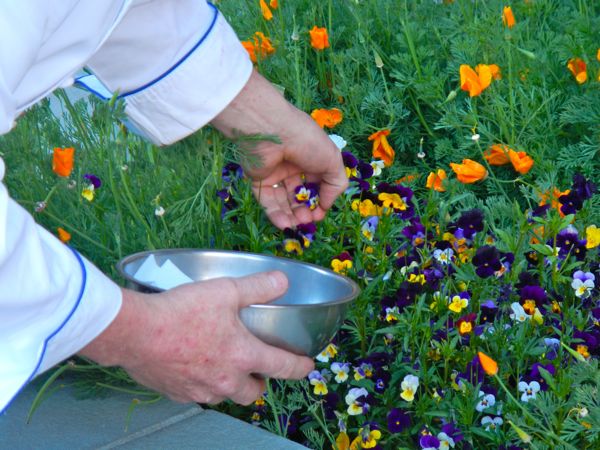
Fresh herbs are part of many dishes.

Fresh herbs grown on site are part of many dishes.

The roasted Salmon Creek natural pork was served with Dwelly Farms bean and white corn succotash, porcini mushrooms, and Twin Peak Orchard peach chimichurri.

“The mushrooms are my favorite. They are like candy. It’s rare for people to use fresh porcini,” Miller said.

Some called the ensemble earthy. Most agreed the pork was incredibly tender and just melted in their mouths.

Dessert was a blueberry brown butter tart with rosemary ice cream and candied lemon.

Had people not been so full, seconds would have been in order.

Other seasonal dishes at the Ritz include grilled Monterey calamari, watermelon salad, Tuscan kale salad, heirloom tomato salad, king salmon, flatbread pizzas with summer vegetables or smoked tomato and mozzarella and more.

“I share recipes because if you don’t know how to make it, it doesn’t matter,” Miller said. “Plus, I keep making new ones.”

He said he has volumes of recipes, but no book – yet – to show for it.

The blueberry brown butter tart was the perfect finishing touch.

The blueberry brown butter tart is the perfect finishing touch.

The Ritz this summer is putting on various food and wine events so people can have experiences beyond eating at the hotel’s various restaurants.

Winemaker dinners will be on select Thursday evenings at Manzanita. They will feature Northern California wineries and a five-course meal prepared with fresh, local ingredients by chef de cuisine Jeremy Grossman.

A six-week, themed cooking class series hosted by the hotel’s culinary team will be offered on Fridays  from 3:30-5pm starting July 11 and concluding Aug. 15. Classes include grilling, summer entertaining, super foods and healthy foods, date night cooking, sweets and treats and farm-to-table.

For more info about the Ritz’s culinary options, go online.


Logging companies must report water use

By Matt Weiser, Sacramento Bee

Logging companies in the Sierra Nevada and elsewhere in California will now be required to report how much water they extract from streams for dust control.

The California Board of Forestry adopted the emergency regulations in response to the drought. The action arose from concerns that very low water flows in many mountain streams could be further depleted by water extractions related to logging.

Logging companies commonly draw water from streams to fill tanker trucks, which then spray the water on dirt roads to control dust. Known as water drafting, the procedure is intended to protect animals, vegetation and people from the dust generated by heavy logging trucks.

Existing regulations require logging companies to report their water use only in streams where salmon or steelhead fish are present. They are also required to obtain stream alteration permits from the state Department of Fish and Wildlife. The new regulations, which became effective June 19, extend those requirements to all other streams in California.

Read the whole story


Experts: Government, corporations a threat to Internet

By Hayley Tsukayama, Washington Post

What are the biggest threats to the Internet in the next 20 years? According to experts canvassed by Pew, the biggest threats aren’t a rise in hacking attacks or new waves of Internet crime. They’re government and big online corporations.

Control and consolidation were the top threats for experts canvassed by Pew’s Internet and American Life Project in a study published Thursday. The think tank asked more than 1,400 experts — academics, theorists and those who work in the technology industry — to weigh in on what risks the Internet faces through 2025.

The majority pointed to government surveillance, restrictive regulation and corporate greed as the things most likely to kill the idea that the Web is a free-flowing network of information. Plenty expressed concern that the Internet will fracture due to government policies, such as those that limit access to the Web as some governments did during the Arab Spring, aggressive intellectual property laws or even well-meaning policies in Canada and Australia that aggressively filter all Internet traffic to combat child pornography. These efforts, experts said, cross the line — or at least flirt with it.

Read the whole story


USFS using herbicides to kill invasive weeds

By Kathryn Reed

U.S. Forest Service employees are using three herbicides now through September to rid the Lake Tahoe Basin of invasive weeds.

The chemical treatment will cover about 12½ acres in nearly 70 locations.

“This is part of a continuing terrestrial invasive plant treatment project since 2011. Most infestations that have been chemically treated exhibited greatly reduced quantities of invasive plants in following years. Many now have no plants at all,” Courtney Rowe, forest botanist, told Lake Tahoe News. “This is part of a larger ‘early detection, rapid response’ invasive plant management strategy, in which the LTBMU tries to eradicate or control certain priority invasive species that have high ecological impacts but currently exist at a low number of infestations before these species spread to a point that their eradication/control is unfeasible.”

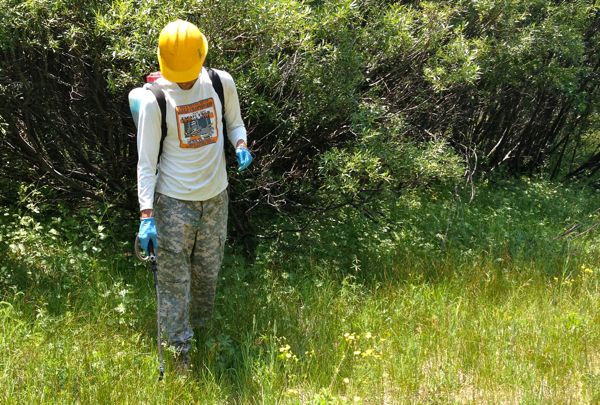
The USFS is trying to eliminate invasive weeds from the Lake Tahoe Basin. Photo/Courtney Rowe

The USFS is trying to eliminate invasive weeds from the Lake Tahoe Basin. Photo/Courtney Rowe

The plants the Forest Service is trying to eradicate are whitetop, Dalmatian toadflax, yellow toadflax, hoary cress and Canada thistle.

Rodeo, Milestone, and Telar are the products that will be applied via backpack sprayers and other handheld tools.

The agency conducted an environmental analysis in 2010 that addressed safety concerns.

“That analysis states that the project’s control methods would pose little safety risk to workers or the public as long as safety practices and resource protection measures are enforced,” Rowe said.

Rowe said the drought tends to make plants flower sooner, but there is no evidence there are more of them.

The problem with the invasive non-natives is that they can overrun native species, which leads to their disappearance. This can then impact wildlife, cause erosion problems, which then impairs waterways.

The project areas include: the 64 Acres parking lot, Angora Fire area, Baldwin Beach meadow, Burke Creek trail, Luther Pass campground, Heavenly Creek Meadow, Heavenly Mountain Resort, Rabe Meadow, Lower Truckee River below Tahoe City, and Spooner Summit fire station.

Weed infestations on Forest Service urban lots will be treated near: Ralph Drive, Terry Lane, Ski Run Boulevard, and Mt. Rainier Drive in South Lake Tahoe, Sugar Pine Drive in Incline Village, Marge Court in Zephyr Cove, and Pine Street on Kingsbury Grade.

During spraying, caution signs will be posted for at least 48 hours after treatment. Orange and black caution tape will mark the boundary around each treatment area. Rowe said most of the areas are small, and some include targeting less than a handful of plants.


Nevada gets 1-year reprieve on NCLB

By Sean Whaley, Las Vegas Review-Journal

CARSON CITY — Nevada has received a one-year extension from the U.S. Department of Education for flexibility from some provisions of the No Child Left Behind Act, a state education official said Thursday.

Superintendent of Public Instruction Dale Erquiaga said the extension of its flexibility waiver will run through the 2014-15 school year.

Nevada’s waiver has been effective in providing support for the critical elements of reform in the state’s annual plan to improve student achievement, he said.

Nevada, along with 41 other states and the District of Columbia, are currently operating under requests for flexibility from certain provisions of what the state Education Department called the “outmoded” No Child Left Behind Act.

Without the extension, Nevada would be required under federal law to meet the requirements of the act and “adequate yearly progress” would again be the measure of school performance.

Read the whole story


Water fetching record prices in California

By Garance Burke, AP

SAN FRANCISCO — Throughout California’s desperately dry Central Valley, those with water to spare are cashing in.

As a third parched summer forces farmers to fallow fields and lay off workers, two water districts and a pair of landowners in the heart of the state’s farmland are making millions of dollars by auctioning off their private caches.

Nearly 40 others also are seeking to sell their surplus water this year, according to state and federal records.

Economists say it’s been decades since the water market has been this hot. In the last five years alone, the price has grown tenfold to as much as $2,200 an acre-foot — enough to cover a football field with a foot of water.

Unlike the previous drought in 2009, the state has been hands-off, letting the market set the price even though severe shortages prompted a statewide drought emergency declaration this year.

The price spike comes after repeated calls from scientists that global warming will worsen droughts and increase the cost of maintaining California’s strained water supply systems.

Some water economists have called for more regulations to keep aquifers from being depleted and ensure the market is not subject to manipulation such as that seen in the energy crisis of summer 2001, when the state was besieged by rolling blackouts.

“If you have a really scarce natural resource that the state’s economy depends on, it would be nice to have it run efficiently and transparently,” said Richard Howitt, professor emeritus at UC Davis.

Private water sales are becoming more common in states that have been hit by drought, including Texas and Colorado.

In California, the sellers include those who hold claims on water that date back a century, private firms who are extracting groundwater and landowners who stored water when it was plentiful in underground caverns known as water banks.

“This year the market is unbelievable,” said Thomas Greci, the general manager of the Madera Irrigation District, which recently made nearly $7 million from selling about 3,200 acre-feet. “And this is a way to pay our bills.”

All of the district’s water went to farms; the city of Santa Barbara, which has its own water shortages, was outbid.

The prices are so high in some rural pockets that water auctions have become a spectacle.

One agricultural water district amid the almond orchards and derrick fields northwest of Bakersfield recently announced it would sell off extra water it acquired through a more than century-old right to use flows from the Kern River.

Local TV crews and journalists flocked to the district’s office in February to watch as manager Maurice Etchechury unveiled bids enclosed in about 50 sealed envelopes before the cameras.

“Now everyone’s mad at me saying I increased the price of water. I didn’t do it, the weather did it,” said Etchechury, who manages the Buena Vista Water Storage District, which netted about $13.5 million from the auction of 12,000 acre-feet of water.

Competition for water in California is heightened by the state’s geography: The north has the water resources but the biggest water consumers are to the south, including most of the country’s produce crops.

The amount shipped south through a network of pumps, pipes and aqueducts is limited by the drought and legal restrictions on pumping to save a threatened fish.

During the last drought, the state Department of Water Resources ran a drought water bank, which helped broker deals between those who were short of water and those who had plenty. But several environmental groups sued, alleging the state failed to comply with the California Environmental Quality Act in approving the sales, and won.

This year, the state is standing aside, saying buyers and sellers have not asked for the state’s help. “We think that buyers and sellers can negotiate their own deals better than the state,” said Nancy Quan, a supervising engineer with the department.

Quan’s department, the U.S. Bureau of Reclamation and the State Water Resources Control Board have tracked at least 38 separate sales this year, but the agencies are not aware of all sales, nor do they keep track of the price of water sold, officials said.

The maximum volume that could change hands through the 38 transactions is 730,323 acre-feet, which is about 25 percent of what the State Water Project has delivered to farms and cities in an average year in the last decade.

That figure still doesn’t include the many private water sales that do not require any use of government-run pipes or canals, including the three chronicled by the AP. It’s not clear however how much of this water will be sold via auctions.

Some of those in the best position to sell water this year have been able to store their excess supplies in underground banks, a tool widely embraced in the West for making water supplies reliable and marketable. The area surrounding Bakersfield is home to some of the country’s largest water banks.

The drought is so severe that aggressive pumping of the banked supplies may cause some wells to run dry by year’s end, said Eric Averett, general manager the Rosedale Rio Bravo District, located next to several of the state’s largest underground caches.

Farther north in the long, flat Central Valley, others are drilling new wells to sell off groundwater.

A water district board in Stanislaus County approved a pilot project this month to buy up to 26,000 acre-feet of groundwater pumped over two years from 14 wells on two landowners’ parcels in neighboring Merced County.

Since the district is getting no water from the federal government this year, the extra water will let farmers keep their trees alive, said Anthea Hansen, general manager of the arid Del Puerto Water District.

Hansen estimated growers would ultimately pay $775 to $980 an acre-foot — a total of roughly $20 million to $25.5 million.

“We have to try to keep them alive,” Hansen said. “It’s too much loss in the investment and the local economy to not try.”


Similarities in U.S. today compared to 1776

By Dave Richards

This year’s Fourth of July marks the 237th birthday of the United States of America. Between then and now, the country and the world have changed in ways the Founding Fathers, including George Washington, likely never imagined.

From our vantage point in history we can appreciate how much things have changed; but, on the other hand, there are many national issues today that remain eerily similar to the problems faced 237 years ago.

History not only allows us to appreciate what those before us endured, but also reminds us of the lessons we apparently have yet to learn.

Here are some common denominators linking Revolutionary War-era America to the country we live in today:

• Desertions were such a problem that George Washington actually feared the Continental Army might dissolve. When the Revolutionary War began, soldiers were enthusiastic about fighting for independence. But once they realized that the war was not going to end soon and started to endure severe hardships, their enthusiasm to fight diminished and huge numbers of them deserted.

Now, of course, the subject of desertion is getting much attention. Despite the fact that we simply don’t know the full story behind Sgt. Bowe Bergdahl’s former status as a POW, many citizens are dissatisfied with the deal to free him in exchange for five prominent Taliban prisoners, because they perceive Bergdahl as a deserter.

• George Washington and Alexander Hamilton actually feared the Revolution might be followed by chaos or even a civil war. Of course, the American Civil War eventually did follow, and resentment from fringe groups lingers in the South today.

Additionally, contemporary separatist movements have emerged throughout the United States, including Texas, Alaska, North Colorado, South Florida, Upper Peninsula (Michigan), Baja Arizona, State of Jefferson (Northern California and southern Oregon), South California, Cook County (Illinois), Northwest Angle (Minnesota), Independent Long Island, Northern Virginia, Killington (Vermont) and Western Maryland.

• National lotteries were established by the Continental Congress as a way to help finance the war. By any standards of the 18th century, the American army was a rag-tag group with insufficient resources. So Congress resorted to try, among other things, national lotteries to pay for goods, which were sorely needed in Washington’s shanty army camps.

Today some states use lotteries to obtain revenue for educational purposes. But given the United States’ standing on educational standards among first-world countries, one could argue that what’s lacking is the kind of will, leadership and ingenuity that won us the war against the British.

• During the Revolutionary War we had term limits; no delegate could serve for more than three years during any six-year period.

As Congress’ low job approval rating has hovered around 15 and 16 percent between 2010 and 2014, according to Gallup, and with Tea party members and others calling for term limits, many are feeling closer to their Revolutionary-era roots. Various American interest groups would like to see a return of term limits.

• Soldiers and officers in the Continental Army went months, if not years, without pay during the war. In the autumn of 1782, many Revolutionary War officers in the Hudson Highlands were angry and frustrated that they had not been paid in months – years, for some. Eventually, the anger and frustration led to a budding army insurrection known as the Newburgh Conspiracy, which Washington fortunately snuffed out.

Today we see Americans growing almost as angry and frustrated as they hear about the trouble with the Department of Veterans Affairs – its struggles to treat nearly 9 million vets, and the dozens of VA facilities now under investigation after complaints about falsified records and treatment delays, which may have led to patient deaths and a cover-up by top administrators in Phoenix. After the resignation of former department head Eric Shinseki, House Speaker John Boehner is calling for more action to correct the VA’s struggles.

Dave Richards is the author of “Swords in Their Hands: George Washington and the Newburgh Conspiracy”. Richards served seven years in the U.S. Army, primarily in military intelligence.


GOP: EPA rule could ruin Fourth of July

By Michael Bastasch, Daily Caller

While Americans get ready for the thousands of fireworks shows that will be occurring across the country this weekend, Republicans are warning that pending federal water regulations could ruin fireworks displays next year.

The Environmental Protection Agency is trying to expand its authority under the Clean Water Act. Republicans warn that the agency’s proposal to expand the definition of “waters of the United States” could allow the EPA to regulate bodies of water on private property.

Republicans are now warning that EPA water rules could threaten fireworks by allowing environmental activists to sue and shut down shows across the country.

“If the proposed ‘waters of the United States’ rule becomes final and serves as the eventual basis for future citizen suits against those who organize fireworks shows, we fear fewer homeowners, communities, or local organizations will be able to conduct fireworks displays as they have for decades or longer,” wrote Republican Senators, including David Vitter of Louisiana and John Barrasso of Wyoming, in a letter to the EPA.

Environmentalists have already been using litigation to stop fireworks shows from happening near or over federally protected waters. Environmentalists sued the Lake Tahoe Visitors Authority alleging their fireworks show violated the Clean Water Act.

Environmentalists said the fireworks show would result in the unpermitted discharge of pollutants into the lake. The lawsuit demanded that Lake Tahoe pay $37,500 per day in penalties for each violation of the Clean Water Act. Lake Tahoe officials nearly canceled the show. The lawsuit was settled in April.

“By expanding federal Clean Water Act jurisdiction to include ditches, small streams, ponds, and other purely local waterbodies, EPA and the [Army Corps of Engineers] may be exposing landowners and municipalities across the country to costly citizen suit litigation if they should attempt to conduct a neighborhood fireworks show,” Republicans wrote.

“Commemorative fireworks displays have been a part of our nation’s history since its founding. However, there are individuals and groups who would like to significantly limit this tradition through heavy-handed citizen suit litigation under the Clean Water Act and other laws,” Republicans added.

In March, the EPA published its proposed “waters of the United States” rule. The agency said the rule was meant to clear up confusion surrounding two federal court decisions on the agency’s Clean Water Act authority.

But Republicans have said it’s no more than a power grab by the Obama administration. The rule could allow federal agents to regulate water on private property, they warned.

“As expected, the EPA’s proposed water rule expands the agency’s control over natural and man-made streams, lakes, ponds and wetlands,” said Rep. Lamar Smith, R-Texas. “If approved, this rule could allow the EPA to regulate virtually every body of water in the United States.”

The EPA’s draft rule defines “waters of the United States” as “traditional navigable waters; interstate waters, including interstate wetlands; the territorial seas; impoundments of traditional navigable waters, interstate waters, including interstate wetlands, the territorial seas, and tributaries, as defined, of such waters; tributaries, as defined, of traditional navigable waters, interstate waters, or the territorial seas; and adjacent waters, including adjacent wetlands.”

But the agency says additional bodies of water could be regulated if they have a “significant nexus” to a “traditional navigable water, interstate water, or the territorial seas.” The EPA says it will provide a definition of “significant nexus” when the rule is published.

These waters need not even be navigable — the type of water body the federal government has traditionally regulated. Republicans have questioned how the EPA could justify regulating water bodies that are no longer connected to navigable waterways or other traditionally regulated bodies of water.

“In preparing this proposal, the EPA failed to incorporate adequate peer-reviewed science in accordance with the agency’s own statutory obligations,” Smith said. “It’s troubling that the administration proposed this expansion before its independent science advisers have had the chance to complete its review of the underlying science. The Obama administration continues to sidestep scientific integrity in order to fast track an abusive regulatory agenda.”


Fireworks injuries, sales on the rise

By Steven Overly, Washington Post

It’s all pomp and patriotism until someone burns a limb.

The number of fireworks-related injuries soared to their highest level in more than a decade last year, according to a U.S. Consumer Product Safety Commission report released last week. An estimated 11,400 injuries were reported during 2013, a staggering 31 percent climb compared to 8,700 injuries reported the year before.

Bob Adler, the commission’s acting chairman, said a direct cause for the jump is difficult to determine. On the one hand, he said, states such as Michigan, Maine and Arizona made fireworks more accessible to consumers. In other states, however, people may be taking safety for granted regardless of regulations.

“My first hope is that it’s just a fluke and an aberration,” Adler said. But “what we’ve seen is an expansion in the ability for members of the public to get access to fireworks, and that’s not necessarily a good thing.”

The 44-page report also details eight deaths in 2013 caused by head and chest trauma, or house fires that resulted from mishandled fireworks.

Still, the sudden rise in injuries may be a cause for concern as the nation prepares for the Fourth of July holiday and families load up on sparklers, bottle rockets and other backyard pyrotechnics. The American Pyrotechnics Association in Bethesda, Md., predicts sales of consumer fireworks will exceed $675 million in 2014, an all-time record.

Read the whole story


Flowers create colorful path to Showers Lake

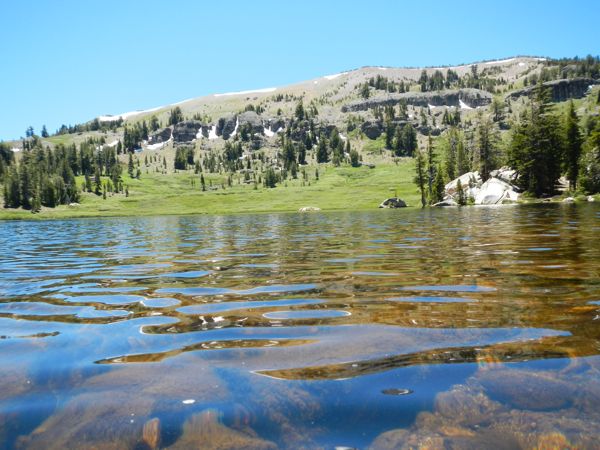
Showers Lake is a popular overnight spot for PCT hikers. Photos/Kathryn Reed

Showers Lake is a popular overnight spot for PCT hikers. Photos/Kathryn Reed

By Kathryn Reed

Showers Lake is so idyllic that it is one of the more sought after resting points for hikers on the Pacific Crest Trail.

The terrain is flat, which is ideal for pitching a tent. While the water is colder than Lake Tahoe, one guy said it felt warm to him because he had been swimming at lakes even higher in elevation. Showers Lake is at 8,560 feet.

Kim and Susan arrived before us. A woman asked them if they minded nudity. Nope. And off she went for a skinny dip.

We had hiked in with Lisa and Ken, whom we unexpectedly ran into at the trailhead. Lisa likes the start of the hike because it doesn’t seem like the typical Tahoe trek because of the expansiveness, greenery and volcanic rock.

Sue and I had to agree with her impression.

There were plenty of wildflowers to gawk at on Saturday, though Lisa and Kim – two veterans of this hike – said what we were seeing was nothing compared to a non-drought year. After the last heavy snow year there were flowers reaching 6-feet into the air. Nothing was close to that this year.

It’s bound to be a short wildflower season this year because of the lack of moisture for consecutive years. Plus, the temperatures are higher than normal in and around the Lake Tahoe Basin. It’s supposed to remain into the 80s into next week, with the hottest day being Sunday at 89 degrees in South Lake Tahoe.

Still, Kim counted 23 flowers plus a puffball, which is a fungus. She said it’s edible, but would only choose to eat it if she had to.

Already the unusual monument plant has flowered and what’s left is a tall green stalk that looks out of place in the Sierra.

Some of the flowers along the way included: lupine, Indian paintbrush, bluebells, phlox, sulphur buckwheat, scarlet gilia, Alpine daisy, groundsel flower and larkspur.

From the top of the ridge we turn around to see the runs at Kirkwood Mountain Resort.

In front of us and to the right is Meiss Meadow, which hasn’t dried out yet. Meiss Lake is to the left and then Round Top Lake with its distinctive buttress. And then Lake Tahoe is to the far left.

Just below the ridge is a strip of snow that AJ laps at to quench her thirst.

The descent into Showers Lake is a little steep. The rocks on the soft dirt make paying attention necessary. It’s the one spot where poles would have been nice.

Boulders around the lake are perfect lunch and lounging spots. A fisherman has waded out to one of the rock islands in hopes of catching a more substantive meal. He didn’t seem to be having much luck.

And while we had the trail to ourselves, the lake became crowded by the afternoon. I’m guessing that midweek would be the most tranquil time to visit.

There are multiple ways to reach Showers Lake. Deciding which route to take will depend on how much time you have, how far you want to go, and if you want a one-way or round-trip excursion. Going in from Echo Summit you will be on the Tahoe Rim Trail part of the time. Starting at Big Meadow trailhead, the trek goes through Meiss Meadow. Carson Pass has a few connections that lead to Showers Lake.

ngg_shortcode_0_placeholder (Click on photos to enlarge.)