Gambling has an impact on seniors

By Michael De Groote, Deseret News

WENDOVER — Deep inside the perpetual twilight of a windowless casino in this border town, a sudden noise rises above the background of buzzes, gongs, bells and music riffs. Somewhere behind this or that row of slot machines, an insistent, staccato “ding, ding, ding, ding” accompanies a flashing light signaling someone has won.

The winner is a dark-haired older woman. She sits in front of the gleaming metal and vibrant dancing colors of a video slot machine, leaning forward, shoulders slumped. She seems to be almost in a trance. A yellow cord attached to her clothes links her to a card in the machine — a plastic card called a “players card” that helps the casino keep track of all her betting, winning and losing.

This woman, playing on a recent Tuesday afternoon, is like many other seniors who visit casinos in America. According to a 2013 report by the American Gaming Association, one-third of Americans (34 percent) visited a casino in the past 12 months. Twenty-eight percent of people aged 65 and older visited a casino in the past 12 months. An article in Psychology Today, however, puts the percentage much higher: David Oslin at the University of Pennsylvania claims that 70 percent of people 65 years and older “had gambled in the previous year and that one in 11 had bet more than he or she could comfortably afford to lose.”

A measly 6 percent of senior casino visitors go because they want to win and like to gamble, according to a 2002 study by Janet Hope and Linda Havir in the Journal of Aging Studies; rather, most say gaming gives them something to do (24 percent) or they participate for fun and socialization (35 percent). Yet, when they do frequent a casino, they enter a carefully constructed world that is less social than it is primarily solitary.

Read the whole story


Calif. parks short on water, including D.L. Bliss

By Tom Verdin, AP

SACRAMENTO — California’s drought is beginning to dry up the water supplies for some state parks, including some of the system’s most popular places.

Restrooms with flush toilets have been closed at D.L. Bliss State Park, the Hearst Castle Visitor Center and Hearst San Simeon State Park, replaced with portable toilets. The showers at D.L. Bliss, San Simeon and Portola Redwoods State Park also are shut down.

Each park relies on a local water supply, and in some cases, that’s a creek or spring. D.L. Bliss, which gets more than 12,000 campers a year, relies on a spring that dropped noticeably just before Fourth of July weekend.

What water remains at the affected parks is being reserved for potable water at individual campsites and for firefighting, California Department of Parks and Recreation spokeswoman Vicky Waters told the Associated Press on Friday.

Some of the closures, such as at D.L. Bliss, are coming at the height of camping season. She said the Lake Tahoe campers who have reservations are being notified through automated phone calls and will be allowed to cancel without penalty.

“We’re really trying to minimize the impact to our visitors because we know how important it is … but we’re in this situation across the state,” Waters said.

The Hearst Castle Visitor Center receives 660,000 visitors a year, while the nearby San Simeon campground receives 83,000.

Waters said many parks, especially those in remote areas, have limited control over their water supplies. She said the department has taken steps to reduce consumption at all its parks and is monitoring the water supplies throughout the system.

At D.L. Bliss, popular for its sandy beach, crystal clear water and proximity to Emerald Bay, it is the first time the park has ever had to close bathrooms or showers because of a lack of water, District Superintendent Marilyn Linkem said.

She was notified July 2, just ahead of the holiday weekend, that the amount of water coming in from the spring that supplies the park was not keeping up with the demand. That prompted the closure of the showers and flush toilets in a park that typically swarms with families throughout summer.

Some visitors were upset, she said, but others understood because they’re already aware of the severity of the state’s drought.

If the spring runs completely dry, she said the park is considering trucking in water to maintain potable sources at the campsites through Labor Day weekend. Meanwhile, the portable toilets are costing $1,200 a week, according to the state parks department.

Linkem said the park staff realizes the inconvenience to campers who made reservations months ago expecting flush toilets and showers.

“It’s hard for us, too. We’re used to providing quality customer services,” she said. “We’re doing the best we can.”


Al Tahoe residents jittery over marsh plans

By Kathryn Reed

Proposed work by South Tahoe Public Utility District in the Upper Truckee Marsh has raised the awareness of Al Tahoe residents to the larger project the California Tahoe Conservancy is likely to undertake.

While the two are not related, they do involve the same area.

Trout Creek now runs close to STPUD infrastructure. Photos/Kathryn Reed

Trout Creek now runs close to STPUD infrastructure. Photos/Kathryn Reed

South Tahoe PUD’s project is on the Conservancy board’s July 17 agenda.

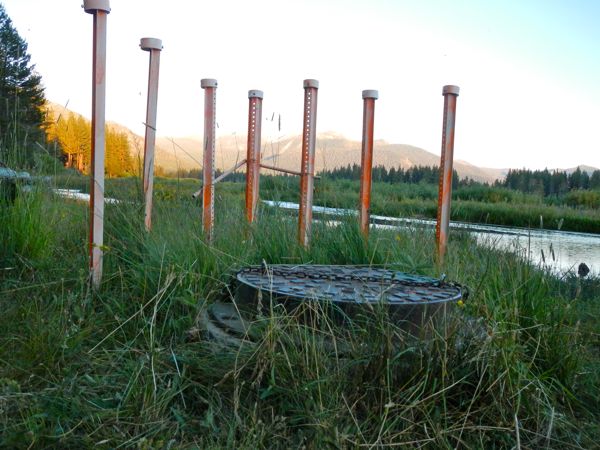
The heavy winter of 2011 saw Trout Creek flood its banks and the channel has been changed ever since. The problem with this is that is brings the stream close to the district’s facilities at the end of Bellevue Avenue. A manhole cover is now just feet from the water.

“The district is planning to do a smaller type project to nudge water to the other side of the channel,” Scott Carroll with CTC told Lake Tahoe News. “They want to redirect the water to the left so their site dries out.”

The work to be done is on CTC property.

Members of the Al Tahoe neighborhood are planning to be at the CTC meeting to talk about this project and the final environment documents that are in the works.

While the comment period closed a year ago regarding restoring the 600-acres in the middle of South Lake Tahoe, there is a group of residents who now wants to have a say on what the preferred alternative is when the final environmental impact report/environmental impact statement is released.

Residents have had two meetings, with the latest being July 9. They are crafting a letter to present to the CTC board.

“We feel that the plan for the recreation component of the environmental impact report is beyond what really needs to be done in the marsh. It is going to have a negative impact on the welfare and nesting habitats of wildlife,” Greg Poseley, an Al Tahoe resident, told Lake Tahoe News.

Today, this eastern side of the marsh has user-created trails that go to Barton Beach. May through July the Conservancy bans dogs from the area. This property is also where the Tahoe Yellow Cress grows. It doesn’t exist anyplace outside the Lake Tahoe Basin.

Upper Truckee Marsh is one of the most sensitive areas in the basin.

Upper Truckee Marsh is one of the most sensitive areas in the Lake Tahoe Basin.

Several of the proposals in the draft EIR/EIS call for boardwalks into the marsh. Some would be viewing areas, others would be bike trails. And some of those bike trails would link to Cove East on the west side of the marsh that is accessed via Tahoe Keys.

The only way to make that link feasible for all cyclists would be to pave the Cove East trail. It is currently an earthen trail that is not conducive to road bikes.

“[The proposals] seem opposed to the principal vision of the Conservancy, which is restoration, conservancy and preservation of habitat. Somewhere along the line the pressure of a recreation component has been introduced to the Conservancy,” Poseley said. “They are more on board for helping with public access into this habitat as opposed to the preservation and conservation side of it. We feel they have lost sight of their original mission.”

Another concern is that this would bring more people to the neighborhood which does not have public parking, other than in front of residences. At Wednesday’s meeting neighbors voiced concern that the CTC lots in the area could be paved to solve that problem. They also brought up the Al Tahoe Plan Area Statement that says, “Access to and parking for the Barton Beach area should not be improved.”

The Conservancy is working on a preferred alternative for the entire marsh restoration, which could be a combination of the initial four as well as include components from comments submitted last year.

It’s possible the board will take action at the Sept. 18 meeting.

—

Notes:

• California Tahoe Conservancy meets July 17, 9:30am in the board room at Lake Tahoe Community College.

• Info about the draft Upper Truckee River restoration project in online.


Pesticide blamed for bee deaths linked to bird declines

By Geoffrey Mohan, Los Angeles Times

A class of pesticides linked to the catastrophic collapse of bee colonies has now been linked to declines in bird populations, according to a Dutch study.

The researchers found a strong correlation between pesticide concentrations measured in surface freshwater and lower or negative local population growth rates of 14 species of birds since the introduction of the pesticide imidacloprid in the Netherlands in the 1990s, according to a study published online Wednesday in the journal Nature.

The chemical belongs to the neonicotinoid family of pesticides, which have been associated with the sudden collapse of colonies of domesticated honeybees, used to pollinate food crops worldwide.

Read the whole story


Student debt a rising burden in U.S.

By Janet Lorin, Bloomberg

In terms of American exceptionalism, student loan debt stands out. No other country imposes the kind of costs on college and university students that the U.S. does, and nowhere else do loans cover so much of those costs.

Experts think the $1.2 trillion in outstanding education debt in the U.S. is more than that of the rest of the world combined. It’s a situation that educators, consumer advocates and members of both political parties all decry. Agreement on solutions is harder to find.

In the meantime, the level of student loans is increasingly seen not just as a burden on students, but as a drag on the nation’s economy. Young adults are delaying setting up their own households in the face of a mountain of debt while default rates rise to dangerous levels. Recent studies also show a growing economic divergence between young Americans with and without student loans.

There’s widespread agreement as to who is worst off: college dropouts. They’re stuck with debt, but without the higher earnings a degree might have brought to help pay it off.

Read the whole story


Tahoe celebrity golf tourney aging gracefully

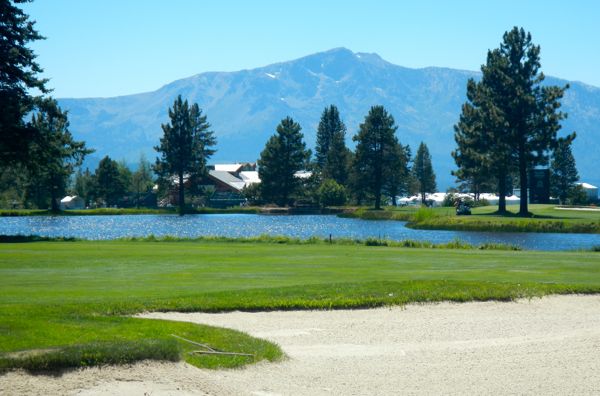
Edgewood Tahoe has been home to the ACC golf tournament all 25 years. Photos/LTN file

Edgewood Tahoe has been home to the ACC golf tournament all 25 years. Photos/LTN file

By Kathryn Reed

Combine a stunning setting with a mix of serious and comical golf played by athletes and stars who most people only dream of meeting, but suddenly are signing their program, and the result is the annual celebrity golf tournament at Lake Tahoe.

“The venue is a perfect storm in a positive way. You can’t ask for a nicer backdrop,” Gary Quinn, vice president of programming for NBC, told Lake Tahoe News. “You would be hard pressed to duplicate that setting anyplace else this time of year.”

A week from today a field of more than 80 celebrity golfers will tee off in the 25th annual American Century Championship golf tournament at Edgewood Tahoe in Stateline.

In this era of give me more, give me something bigger, better, new and different – making it to year 25 is an accomplishment. And everyone anticipates there being another 25 years.

Those who are intimately responsible for putting the event on attribute the success to the partnership of American Century (title sponsor since 1998), NBC, Harrah’s, Lake Tahoe Visitors Authority and Korbel.
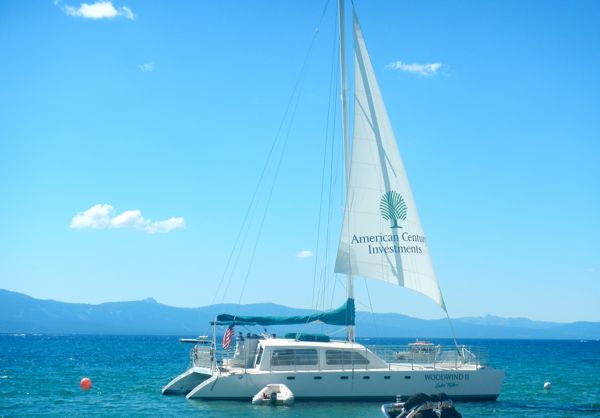
American Century Investments has been the title sponsor since 1998.

American Century Investments has been the title sponsor since 1998.

“I think it is partially the spirit of the destination and the people that has helped forge strong bonds and helps to support its long running success. It is the highlight of our summer, if not the entire year,” Carol Chaplin, LTVA executive director, told Lake Tahoe News.

The five entities work closely to keep the feel of the tournament the same without having it get stale and introducing new elements that don’t distract too much. That’s a careful balance.

Edgewood Tahoe is another key player. While the privately-owned golf course is embarking on developing a hotel on property, it means holes will be changed. They have been meeting with tournament officials about this for the last two years.

“They made contingencies so it won’t impact our event. We have been thankful to them for being overcommunicative and letting us know what is going on,” Quinn said. “We are excited about what it will become. It could be an added new component (to the tournament coverage) when it is done.”

Success has not come without challenges. There was the year a truck lost its brakes on Highway 50, came barreling onto the course and landed in a creek on the third or fourth hole. Fortunately, no one was hurt.

Lightning has struck once, which caused everyone to scramble. Now NBC has someone on site to monitor passing storms.

The Angora Fire in 2007 also threatened to disrupt the tournament because no one knew how long it would last or if people would be in the mood for that kind of entertainment.

Charles Barkley and others toured the burn area. He gave $100,000 to recovery efforts and took firefighters out to dinner.

Officials point to how the community has embraced the event. This is hardly just something tourists attend.
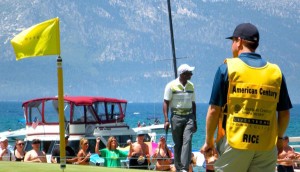
Jerry Rice often interacts with the gallery perched in the sand and on boats at Hole 17.

Jerry Rice often interacts with the gallery perched in the sand and on boats at Hole 17.

“What has changed in the last seven years, maybe eight, it that it just seems the event has clicked in the community,” Mike Milthorpe, tournament director for the past 23 years, told Lake Tahoe News. “People take vacation, there are more boats on 17. It’s now the event in the community.”

It’s also an affordable family attraction. Ticket prices haven’t been raised in at least 10 years. Crowds have been topping 40,000 in recent years, with attendance records regularly broken.

Still, it is a major moneymaker for the area.

“It has an annual economic impact estimated at $15 million [per year] and is consistent with our economic vitality focus area of capitalizing on outdoor recreation and lifestyle,” Lisa Granahan, Douglas County economic vitality manager, told Lake Tahoe News.

South Lake Tahoe City Manager Nancy Kerry said, “Equally as important are the lasting benefits from national television coverage promoting Lake Tahoe’s South Shore to the nation. Viewers watching the event on television may be inspired to visit Lake Tahoe. NBC does a good job weaving in local stories, stunning photographs of our unparalleled beauty promoting the importance of protecting our natural resource. The end result is an event that significantly supports the economy, promotes the natural environment, and even provides donations to local charities.”

According to the LTVA, the tournament since it started has:

• Brought in $360 million to the community;

• $600,000 to local charities and service groups;

• National media exposure exceeding $120 million in value, which includes coverage in 168 media outlets.

The LTVA says there are 6.5 million TV viewers per year.

“In the summer it is a challenging time because on the weekends people are out and about,” NBC’s Quinn said of getting people in front of televisions. “The audience has been fairly consistent. This is an unheard of made-for-TV event.”

The Golf Channel re-airing the broadcast will double this year’s coverage to 18 hours.

Pairings on Friday are based in large part on what plays well to viewers and on-site spectators – like having hall of fame pitchers in a foursome, or all the NASCAR guys together.

“We try to keep balance between the fun side because that is why they tune into a celebrity event, but some of these guys are very good golfers,” Quinn said.

David Justice and most of the stars have no problems signing autographs and being included in selfies.

David Justice and most of the stars have no problems signing autographs and being included in selfies.

The same anchors are the ones who will be broadcasting the U.S. Senior Open this weekend for NBC.

Quinn also expects viewers will be interested in seeing Annika Sorenstam play with the guys. Sorenstam, who has a second home in Incline Village, is thought of as the best women’s golfer of all time. She retired in 2008 after having won 72 LPGA tournaments, including 10 majors and 18 other international tournaments.

It was Milthorpe’s idea to invite Sorenstam.

“I called Annika’s husband back in January. His initial response he said, ‘I don’t think she’ll play.’ Five minutes later he said she was in,” Milthorpe said.

Keeping the field balanced with known celebrities, longtime favorites and newbies is a challenge. Jack Wagoner, John Elway, Mike Eruzione and Jim McMahon have played every year. It’s easier to get athletes than Hollywood-type celebs because their schedules are more concrete. And some entertainment folks aren’t ready for their golf game to go prime time.

“If you are going to play in this event, you have to be comfortable playing in front of people. If you are not good, you have to have a sense of humor and laugh,” Milthorpe said.

—-

Notes:

• For more info about the tournament, go online.

• Schedule: July 15 – Lake Tahoe Visitors Authority Tahoe South Celebrity-Am; July 16 – Practice round; July 17 – American Century Celeb-Am Tournament; July 18-20 – American Century Celebrity Golf Championship.

• TV coverage: July 18 live on NBC Sports Network, 1-4pm; July 19 live on NBC from noon-3pm; July 20 live on NBC from noon-3pm.

• Tickets: $15 Tuesday-Thursday, $25 Friday-Sunday.


EPA approves treatment for zebra, quagga mussels; boats bound for Tahoe stopped

By Kathryn Reed

The EPA on July 8 approved a treatment to combat invasive zebra and quagga mussels in lakes, rivers, recreation areas and other open bodies of water.

Zequanox was created by Davis-based Marrone Bio Innovations. The chemical was first approved by the EPA in 2012 to be used in enclosed systems, which includes intake pipes for dams, manufacturers and golf courses.

These invasive species have crippled the Great Lakes region as well as Lake Mead in Southern Nevada, Lake Powell in Utah, and rivers in Mississippi, Arkansas, Tennessee and Colorado. While they have not reached Lake Tahoe, they are a threat. These mussels are some of species that the decontamination stations are looking for before boaters are able to launch at Tahoe.

On July 9 a boat coming from Lake Mead was inspected at the Spooner Summit station. Inspectors found quagga mussels and an unidentified snail species hiding in the anchor locker.

During the Fourth of July weekend, more than 725 boats were screened for invasive species at four inspection stations surrounding the Tahoe, which is a 17 percent increase from 2013.

Since May, inspectors have intercepted 24 boats containing invasive species bound for the waters of Lake Tahoe. Eight of these boats contained invasive mussels and another four boats were carrying several different snail species.

The mussels disrupt the ecosystem and cause proliferation of toxic blue-green algae. They decrease game fish populations, which can have a serious effect on the economy. Swimmers run the risk of injury from the invasive mussels’ sharp shells, and water intakes from infested lakes and rivers used for irrigation, fire suppression and drinking water can suffer impeded or blocked flow and damage to infrastructure and equipment.

Zequanox is composed of dead cells derived from a naturally occurring soil microbe, and it controls mussels in all life stages. Unlike toxic treatments, such as potash and copper-based solutions, Zequanox is biodegradable, noncorrosive and nonvolatile. In addition, Zequanox is highly selective to control only the invasive zebra and quagga mussels, is effective in a broad range of water conditions and according to the EPA, its active ingredient has “low toxicity and presents little risk to non-target organisms.”

“The product is not damaging to aquatic life, humans or infrastructure,” Jessi DeMartini, research center coordinator with the Forest Preserve District of DuPage County, Ill., said in a statement. “Zequanox produced high mortality of the zebra mussels – reaching 97 percent at the peak of application – while native fish exposed to the product remained unharmed. After further testing we concluded there were no lasting impacts to water quality.”

DeMartini was part of two collaborative open water studies at the Deep Quarry Lake in DuPage County in 2012 and 2013.

Zequanox is applied directly into a lake or river using standard injection equipment. Treatments can occur during any time of the day while people and pets are present, and can be completed within hours.

Tahoe’s goal is to prevent the mussels from ever reaching the lake.


Dan Kerr — 1937-2014

Dan Kerr

Dan Kerr

Avid volunteer and longtime Lake Tahoe resident Daniel Lee Kerr has died.

Mr. Kerr died June 27. He was 76.

He was born in Seattle on Oct. 7, 1937, weighing only 2.2 pounds. As a young boy the family moved to San Diego. That is where his love of surfing developed. He proclaimed himself to be a “beach rat”.

Mr. Kerr would also call himself “Dan the Mountain Man”. In his younger days he was an avid hiker.

Mr. Kerr moved to the South Shore in the late 1970s to take care of his mother after his father passed away. They lived on the top of Kingsbury Grade.

For six years Mr. Kerr was in the Marine Corps, which included serving in Vietnam. He was honorably discharged in 1967 with the rank of sergeant.

He earned a bachelor’s degree in history/philosophy from the University of San Diego and then a master’s in education from the University of Santa Clara.

Mr. Kerr was a teacher and administrator in California and Colorado before moving to Stateline. He put his experience to use as a substitute teacher in Douglas County School District.

Marilyn Richardson with DCSD said, “He was a very sweet man.” With his K-12 substitute license, he could be called on to work at any grade level for any subject. Mostly he preferred to work at the lake schools. He was part of DCSD from 1988-2013.

Volunteering was his vocation. Starting in 1985 he worked with the Barton Auxiliary, including as president of the nonprofit in 2001, 2002, 2004, 2005, 2009 and 2010.

“He loved what he did. He did amazing things for the hospital,” said Judy Cefalu, who worked with Mr. Kerr on the Auxiliary.

Mr. Kerr was instrumental in bringing more workers into The Attic thrift store and changing how things were run there.

Giving blood and coordinating blood drives was another passion of his. Locally, he donated more than 200 pints of blood. The only reason he stopped giving was because of his age.

He served on the Sacramento Blood Source Blood Drive since 1979 and chaired the South Lake Tahoe Community Blood Drive for 35 years.

Mr. Kerr also volunteered for the Sacramento Valley Area Council of Hospital Volunteers for many years as a board member and president.

He joined Sons in Retirement Inc. in 2012 and was “little sir” for the branch.

Mr. Kerr was a devoted Catholic, giving countless hours to Our Lady of Tahoe Church in Zephyr Cove. He never missed Mass.

Survivors include sons Glenn Ciganek and Ronald Ciganek of Florida, and Todd Ciganek of Illinois; daughter Traci Powers of Colorado; cousin Joe Wicker; and eight grandchildren.

Services will be July 24 at 11am at Our Lady of Tahoe on Elks Point Road in Zephyr Cove. Following the service will be a reception in the adjoining Father Bain Hall. Burial will be at 1:30pm at Happy Homestead Cemetery in South Lake Tahoe.

In lieu of flowers, donations may be sent to Barton Memorial Hospital Auxiliary, Attn: Memorial Fund for Dan Kerr, 2170 South St., South Lake Tahoe, CA 96150; BloodSource, Attn: Memorial Fund for Dan Kerr, 10536 Peter A McCuen Blvd., Mather, CA 95655-4128; Our Lady of Tahoe, Attn: Memorial Fund for Dan Kerr, P.O. Box 115, Zephyr Cove, NV 89448.


Tahoe fire crew achieves hotshot status

The Tallac Hand Crew is now the Tallac Hotshots. Photo/USFS

The Tallac Hand Crew is now the Tallac Hotshots. Photo/USFS

By Kathryn Reed

Twenty of the best firefighters in the country are now based out of South Lake Tahoe.

The Tallac Hand Crew that was created in 2001 is now the Tallac Hotshots. They went through a rigorous process to ascend to this prestigious status.

“It’s a pretty big deal and a pretty big accomplishment,” Kit Bailey, Lake Tahoe Basin Management Unit fire management officer, told Lake Tahoe News.

These are the most elite firefighters. There is no higher level than this Type 1 team. They are assigned to the complex fires and work the toughest terrain in remote locations where their lives are often on the line.

Days off are rare, though things have changed since Bailey was a hotshot. In those days bosses were not as cognizant to the need for a little down time and the ability to reconnect with their families. Still, a day off may only come every 14 days.

tallac hotshots“When I was on a hotshot crew, you’d think you are going home and you get about five miles from the station and then you get another call. You make a left turn and who knows where you will be for the next week,” Bailey said. “You can’t even expect you are going home until you walk in the front door. And that may only be for a few hours.”

Supervisors are expected to be available 24/7.

Of the 20 members, eight are full-time, year-round employees, while 12 are seasonal. The one woman is in a supervisory position. Some are graduates of the Lake Tahoe Community College Fire Academy.

While the physical strength required for the job is obvious, the mental toughness is another aspect. That isn’t something that can be taught. They have to deal with working practically around the clock in an uncontrolled environment, under conditions that are brutally hot.

Because of this it was teamwork, leadership and the administrative capabilities that were most scrutinized when the group of evaluators examined the Tallac crew.

The final test of the multiyear process to become a hotshot team was a three-day review by a cadre of Forest Service personnel.

“The biggest part is leadership and qualifications for those leaders,” Bailey said.

Nearly a day and a half was spent making sure the team had its administrative and management skills in place. This is because all of the parts and pieces of fighting a fire are complex, Bailey said. It’s so much more than putting water on fire and the muscle to do so.

Then the inspection team did a 1-on-1 leadership exercise, and went over all their equipment and vehicles.

Finally, it was time to get outside to prove their moxie. They had been given a scenario of a mock fire. They cut line for more than four hours. All that time their speed and progress was being timed and measured. Surprises were thrown at them like a spot fire crossing the line.

“There is a lot of emphasis on crew communication,” Bailey said.

Suddenly a radio is out. Now communication must be face-to-face. A power line crosses their path. Aircraft is incoming with water or retardant.

How the crew deals with these situations is being tested.

One of their own goes down, creating an incident within an incident.

Ultimately they must deploy their shelters.

They passed every test they were given.

Besides this three-day test, the Tallac crew has been peer reviewed while in the field at real fires. There are about 2,000 hotshots through the United States.

While other teams in the Lake Tahoe Basin have tried to achieve hotshot status, this is the first to successfully do so.

“It gives us a higher level of knowledge, skill and experience we can rely and depend on in basin,” Bailey said.

But like all hotshot teams, they are not solely assigned to fires in their home territory. The local crew has been working the Coleman Fire in northwest Nevada just south of the Oregon border.

“They are a national resource,” Bailey said of all hotshots.


Aquarium fish found near Kings Beach creek

By Heather Segale

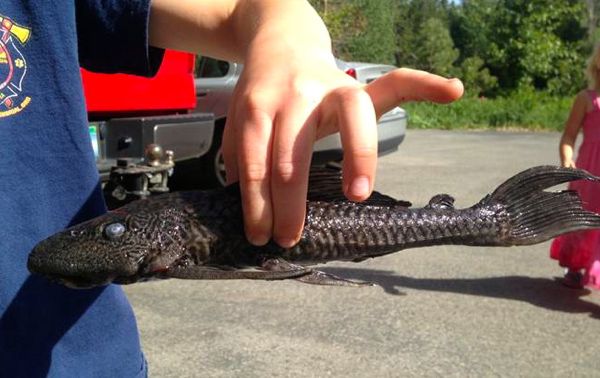
Lucas McNamara, 7, was hiking around Griff Creek near Kings Beach Fire Station last week with his family when he saw a black, spiny fish, about 1-foot-long lying dead in the creek. He ran up the creek bed, yelling, “Dad, you need to look at the big crazy fish!”

Lucas’ parents, Steve and Jen McNamara, decided to make this a teachable moment for their son, who already shows active interest in science and the environment.

“I told Lucas that this fish is not normal for Lake Tahoe and may be harmful to the other fish and animals in the lake,” Steve McNamara said.

They brought the fish to the UC Davis Tahoe Environmental Research Center in Incline Village.

Lucas McNamara, age 7, finds non-native fish in Griff Creek near Kings Beach. Photo/Steve McNamara

Lucas McNamara,  7, finds a non-native fish in Griff Creek near Kings Beach. Photo/Steve McNamara

UC Davis TERC fish biologist Brant Allen recognized the fish as a Plecostomus, or common algae-eating aquarium fish. These fish can grow too large for their tanks. Allen presumed someone made the bad decision to release the non-native fish into the wild.

“This prehistoric-looking, tropical fish may have died because it couldn’t survive the cold creek temperatures or didn’t have enough accessible food,” Allen said. “Either way, it highlights the continued lack of understanding of aquarium dumping at Lake Tahoe.”

Goldfish found in the Tahoe Keys were most likely the result of private citizens dumping their unwanted pets. The goldfish were able to find mates, spawn, and have babies in the lake. Some of the goldfish caught in Lake Tahoe had grown to between 7 and 15 inches in length, and approximately 0.3 to 4 pounds.

Other non-native warmwater species such as largemouth bass, bluegill and crappies have also gotten a foothold in the lake and are competing with native fishes and changing the food web in ways that are still being investigated. UNR and California Department of Fish and Wildlife researchers have removed more than 50,000 fish (weighing 7,000 pounds) from the Tahoe Keys through mechanical removal electroshocking projects in an attempt to reduce the harmful impact on the native fish populations.

“One of the most powerful tools in keeping Lake Tahoe beautiful is the connection between people using the lake and scientists trying to understand what may be impacting it,” said UNR researcher Marion Wittmann.

She commended the McNamara family for taking the extra step to inform scientists of unknown organisms found in or near the lake. An organism like this tropical fish that does not belong here could potentially impact the lake’s health.

Citizen monitoring gives scientists quick notice about problems before they can become greater problems.

“I think it’s exciting to show my son and others the importance of protecting our environment,” McNamara said.

This past holiday weekend had a huge number of people visiting the Lake Tahoe region. There was also a high amount of careless behavior, including littering, vandalism, dangerous fireworks and non-native species transport. Volunteer beach clean-up events organized by the League to Save Lake Tahoe indicated that 2,260 pounds of trash were picked up from five sites around the lake.

Thankfully, there were also a large number of caring volunteers and citizens who had their boats inspected for invasive species, cleaned up the beaches, picked up trash, and did their part to protect the environment at Lake Tahoe.

Watercraft are the largest transporters of aquatic invasive species (AIS), and the boat inspection program is critical to preventing the spread of AIS into Lake Tahoe and the surrounding water bodies. A new invasive species infestation in Lake Tahoe could have devastating impacts.

Invasive species multiply quickly and can colonize on all underwater objects including docs, water pipes, filtration systems, piers, ramps, and boats. They destroy fish habitat, impair boat engines and negatively impact water quality and recreation.

This season alone, inspectors have intercepted and decontaminated 23 boats containing invasive species bound for the waters of Lake Tahoe. Some of these boats contained invasive quagga mussels, and some were carrying unidentified snail species. Without natural predators, these invasive species pose serious threats to the ecology, recreation and local economies of the Lake Tahoe Basin.

Heather Segale works for the UC Davis Tahoe Environmental Research Center in Incline Village.