Bottled water coming from drought-stricken Calif.

By Julia Lurie, Mother Jones

Bottled-water drinkers, we have a problem: There’s a good chance that your water comes from California, a state experiencing the third-driest year on record.

The details of where and how bottling companies get their water are often quite murky, but generally speaking, bottled water falls into two categories. The first is “spring water,” or groundwater that’s collected, according to the EPA, “at the point where water flows naturally to the earth’s surface or from a borehole that taps into the underground source.” About 55 percent of bottled water in the United States is spring water, including Crystal Geyser and Arrowhead.

The other 45 percent comes from the municipal water supply, meaning that companies, including Aquafina and Dasani, simply treat tap water—the same stuff that comes out of your faucet at home—and bottle it up. (Weird, right?)

But regardless of whether companies bottle from springs or the tap, lots of them are using water in exactly the areas that need it most right now.

Read the whole story


Calif. drought transforms global food market

By Alan Bjerga, Bloomberg

For more than 70 years, Fred Starrh’s family was among the most prominent cotton growers in California’s San Joaquin Valley. Then shifting global markets and rising water prices told him that wouldn’t work anymore.

So he replaced most of the cotton plants on his farm near Shafter, 120 miles northwest of Los Angeles, and planted almonds, which make more money per acre and are increasingly popular with consumers in Asia.

“You can’t pay $1,000 an acre-foot to grow cotton,” said Starrh, 85, crouching to inspect a drip irrigator gently gurgling under an almond tree.

Such crop switching is one sign of a sweeping transformation going on in California — the nation’s biggest agricultural state by value — driven by a three-year drought that climate scientists say is a glimpse of a drier future. The result will affect everything from the price of milk in China to the source of cherries eaten by Americans. It has already inflamed competition for water between farmers and homeowners.

Growers have adapted to the record-low rainfall by installing high-technology irrigation systems, watering with treated municipal wastewater and even recycling waste from the processing of pomegranates to feed dairy cows. Some are taking land out of production altogether, bulldozing withered orange trees and leaving hundreds of thousands of acres unplanted.

“There will be some definite changes, probably structural changes, to the entire industry” as drought persists, said American Farm Bureau Federation President Bob Stallman. “Farmers have made changes. They’ve shifted. This is what farmers do.”

Read the whole story


Old S. Tahoe hotel gets much needed upgrades

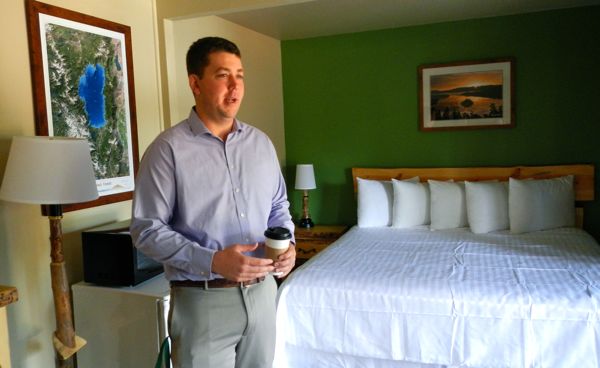
Chris Nielsen, general manager of the Trailhead, shows improvements to the rooms. Photos/Kathryn Reed

Chris Nielsen, general manager of the Trailhead, shows improvements to the rooms. Photos/Kathryn Reed

By Kathryn Reed

There is one less hotel in South Lake Tahoe renting by the week or month.

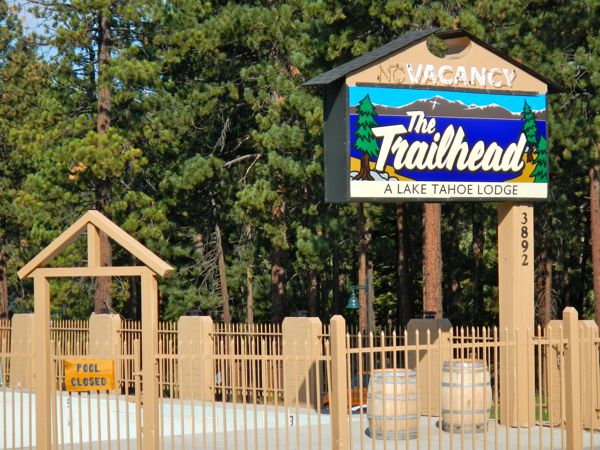
The Vagabond Inn on Highway 50 is now the Trailhead – A Lake Tahoe Lodge.

Owners from China took over at the first of the year, having paid $1.3 million for the property that is walking distance to the state line. The half a million dollar-remodel began after the ski season ended. Of the 34 rooms, five are deluxe. And more improvements are planned.

“I want the entrance and exit off Midway (Road) and I want to get rid of the pool. It’s from 1959,” Chris Nielsen, general manager of the property, told Lake Tahoe News. The pool is empty and unusable.

Rooming the empty pool near Highway 50 is a goal.

Removing the empty pool near Highway 50 is a goal.

The hotel was originally the Brooks Lodge in 1947. In 1959, it was remodeled to accommodate visitors coming to Lake Tahoe for the 1960 Squaw Valley Winter Olympics. In the 1980s it became a Vagabond – and remained that until June 1.

It had become rundown and was attracting a different clientele than it is today. Now the hotel wants to compete with the likes of Holiday Inn Express and 968 Park.

Every room has new beds. Nielsen was surprised when the mattresses from 1993 were being snatched up by other hoteliers in the neighborhood.

Gone, too, are the blue floral bedspreads from the 1990s, and 1980s-era televisions.

Tahoe Timber Uniques created all of the lamps. Like its name, each one is unique.

Cody’s Tree Service used locally sourced Jeffery pines to make the furniture, including headboards and towel holders.

The goal was to have the rooms feel like a guest is in Tahoe instead of Anyplace, USA. This was also accomplished with the array of old Tahoe photos on the walls.

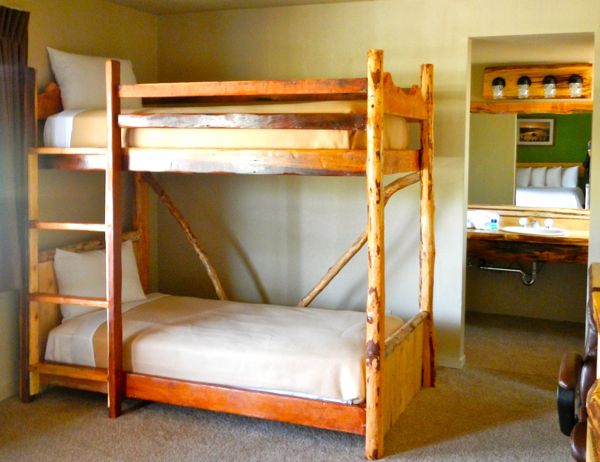
Two rooms have a king bed plus a bunk bed. This is designed for families – whether it’s parents with kids, or three generations traveling together.

Nielsen has a ton of ideas about what he would like the property to evolve into. He said it’s just a matter of the investors cutting a check.

“I want to bulldoze the parking lot. I would like to have a restaurant,” Nielsen said standing on the walkway of the second floor.

He knows this would help with the slow off-seasons by being able to attract locals to the property. His vision is to have quick, good food to go that people could order ahead of time and take with them to the beach or wherever.

Bunk beds in two rooms allow for more sleeping options.

Bunk beds in two rooms allow for more sleeping options.

“We could have a mobile app where they put in their food order and have it ready when they get here,” Nielsen said.

Nielsen also envisions getting rid of the room closest to the office and possibly putting in a small wine and beer bar with a patio.

To build on the Trailhead name of the hotel, the office is stocked with maps from the U.S. Forest Service about where people can go exploring. Plus, Nielsen has been working in the hotel industry locally and knows what’s expected in terms of being able to direct people to restaurants and sightseeing destinations.

A continental breakfast is served each morning. Dogs are allowed for $20 per night. There is a grassy area out front for them.

The word is getting out about the transformation of the hotel. The Trailhead was sold-out Fourth of July and has been doing steady business all summer.


Casinos banking on slot players

By Brad Plumer, Vox

The next time you find yourself in a casino, pause for a second to appreciate the architecture.

Casinos put an enormous amount of thought into their designs. The layout of the tables, the patterns on the carpet, the lighting — they’re all explicitly engineered to make gambling more seductive and get you to spend more money.

One surprising example are the curving hallways around the property. Many casinos try to avoid making you ever have to turn at a 90° angle. As Natasha Dow Schüll explains in her fascinating book, Addiction By Design: Machine Gambling in Las Vegas, a right-angle turn forces people to call upon the decision-making parts of their brain — to stop and reflect on what they’re doing. “Casinos don’t want that,” Schüll told me. “They want to curve you gently to where they want you to go.”

But as Schüll discovered, almost nothing in a modern-day casino is more carefully engineered than its slot machines.

Slot machines and video gambling were once marginal to the success of casinos — but nowadays, they account for up to 85 percent of the gaming industry’s profits. And casinos have devised a dizzying array of strategies to make these machines as addictive as possible, from the elaborate algorithms beneath the hood to the position of the armrests.

Schüll, a cultural anthropologist at MIT, spent 15 years in Las Vegas tracking the evolution of slot machines, exploring how and why they’ve become so addictive. We spoke recently by phone about how gambling has changed dramatically over time and how the gaming industry has drawn on psychological insights to make its games more addictive — often with tragic consequences.

Read the whole story


Nev. casinos in spending war over online game

By J.D. Morris, Las Vegas Sun

Online gaming remains a divisive issue for Nevada casino companies, which are pouring money into lobbying on the issue while they joust over a potential ban.

The proposed ban, contained in a measure championed by Sen. Lindsey Graham, R-S.C., and Rep. Jason Chaffetz, R-Utah, has helped trigger hundreds of thousands of dollars in spending from the gaming industry. One side, led by Las Vegas Sands CEO Sheldon Adelson, is in favor of the prohibition. Others, including Caesars Entertainment, are fiercely opposed.

But amid the flurry of spending, congressional action is moving slowly. Legislators left for their August recess without seriously advancing a measure introduced in March that would prohibit online gaming nationwide, and its fate for the rest of the year is uncertain.

If enacted, the Restoration of America’s Wire Act from Graham and Chaffetz would make gambling on the Internet illegal. The legislation was referred to committees in both chambers but hasn’t moved any further.

Read the whole story


Tahoe paddle exposes lakefront architecture

Sue and AJ paddle from Cave Rock to Zephyr Cove. Photos/Kathryn Reed

Sue and AJ paddle from Cave Rock to Zephyr Cove. Photos/Kathryn Reed

By Kathryn Reed

GLENBROOK – While normally it’s the natural beauty that is so captivating when paddling on Lake Tahoe, last weekend was a bit of an architectural tour.

What I didn’t know until last Sunday is that Lake Tahoe has dinosaurs. There are two of them calling a stretch of beach between Cave Rock and Zephyr Cove home. I have pictures to prove it.

Some of the houses are obscenely sprawling and a bit garish, while others are exquisite and fit into the natural environment. A couple that jutted out on the rocks had such low decks that in a normal or high water year it would seem like the lake would be practically inside the structure.

Many come with their own beaches. Nevada and California have different rules about what is public property. In California, the public has the right to be on the land up to the high water mark. Not so in the Silver State. That is why paddlers must be cognizant not to stop unless they have permission.

Some people had erected little light posts on the rocks as indicators for boaters navigating at night.

While plenty of people want to regulate piers, buoys, what can built on the shoreline and the windows in a home that can be seen from the lake, we thoroughly enjoyed the view of these houses, their docks, boats bouncing in the water, and chairs with perfect views of Mount Tallac and the gorgeous sunsets we’ve been having.

It’s good to see people enjoying their part of Tahoe. And from our vantage point, they were taking care of their property. The only thing I wouldn’t like if I lived there is how close the houses are to one another.

I had to wonder if this stretch of Tahoe water is more pristine than in South Lake Tahoe, where I spend the bulk of my time, because there aren’t as many people in the water. All those swimmers at public beaches aren’t running to the rest rooms. Could that problem mixed with the continual warming of Tahoe be adding to the murkiness of water by public beaches? Plus, there aren’t as many regulatory agencies in Nevada. This stretch of Tahoe water was so pristine it reminded me of what the South Shore was in the late 1980s.

An advantage of the low water level at Lake Tahoe is boats are less likely to be near the shore, which makes for an even more enjoyable paddle.

Most of the activity we saw was from people playing on shore or in the water. So many rocks are exposed or barely submerged that at times it looked like people were standing on the water as they stood on a boulder.

Even in a canoe we needed to have our eyes peeled for rocks more than 100 yards from shore. The lake is that low. Other times we could see at least 20 feet to the bottom.

The overcast sky made for interesting lighting on the lake, causing the water’s colors to change from cobalt to teal to aqua.

AJ was happy to finally get out at Zephyr Cove. This was her first time in the canoe. We already bought her a lifejacket since now we know she has no problem being paddled around the lake like a princess.

While she enjoyed the lake water, we imbibed on a Zephyr Zombie. Good, strong, but definitely didn’t duplicate the original Rum Runner of Camp Rich.

When we started the lot at Cave Rock was full, but they let us launch. Paddlers do so at the beach, not the boat ramp. Had we parked there it would have cost $10 being from California. Nevada residents pay $8. Sue could park the truck on Highway 50. We had to pay $1 each as walk-ins.

By car it is 2.2 miles from Cave Rock to Zephyr Cove.

ngg_shortcode_0_placeholder (Click on photos to enlarge.)


Nev. has weakest rise in consumer spending in U.S.

RENO — Consumer spending in Nevada rose to its highest level in five years in 2012 but continued to lag far behind the national average, according to a report released Thursday showing a wide discrepancy in economic recovery from the recession across the country.

Personal consumption expenditures jumped 28 percent in North Dakota, the largest gain nationwide, from 2010 through 2012. It surged nearly 16 percent in Oklahoma, the U.S. Bureau of Economic Analysis report said.

By contrast, spending rose a scant 3.5 percent in Nevada, the weakest for any state and far below the 10.7 percent national average during that two-year stretch.

The study shows consumer spending in Nevada went on a wild ride for nearly a decade, doubling from $39.5 billion in 1999 to $80.5 billion in 2007, but had fallen off to $76.6 billion by 2009 before slowing climbing again the next three years to a peak of $81.4 billion in 2012.

For the whole period from 1997-2012, Nevada’s 6.4 percent growth was second only to Hawaii’s 6.8 percent — half again as much as the national average of 4.1 percent.

But it truly was a roller coaster like few other states experienced — doubling the national average with 12.9 percent growth in 2004 at the peak of Nevada’s housing boom, and five years later suffering a 4.6 percent decline that was three times worse than the U.S. average in 2009 when the state led the nation in bankruptcies, foreclosures and unemployment.

And while Nevada’s growth from 2010 to 2012 was the nation’s worst, it was one of only four places that posted a gain in 2012 compared with 2011 — 3.8 percent compared to 2 percent. The others were Arizona, North Carolina, Utah and the District of Columbia.


Brown pitches $6 billion water bond

By Melanie Mason, Los Angeles Times

Seeking to balance the state’s water needs with his reputation for fiscal caution, Gov. Jerry Brown called for a “no-frills, no pork” $6-billion water bond in an email to campaign supporters Tuesday afternoon.

Brown kicked off the letter by noting that “drought conditions in California grow more serious by the day,” and acknowledging more must be done for the state’s water infrastructure.

But, he says, the $11.1-billion bond currently set to go before voters in November has “a price tag beyond what’s reasonable or affordable.” He describes the measure, originally written in 2009, as “pork-laden.”

Instead, Brown pitches a $6-billion plan similar to the framework his office circulated in June. The proposal, he says, “invests in the most critical projects without breaking the bank.”

Read the whole story


Equipment failures to cost STPUD $3 mil.

The aeration basin at South Tahoe Public Utility District. Photo/Ross Johnson

The aeration basin at South Tahoe Public Utility District. Photos/Ross Johnson

By Kathryn Reed

South Tahoe Public Utility District is facing unexpected multimillion-dollar equipment expenses. Two of the three aeration units at the sewer plant need to be replaced.

When the PVC pipe started to require multiple repairs the material was sent out to be investigated to see why it was failing. The plastic and couplers were falling apart.

Normal PVC pipe that is put in the ground is expected to last 50 to 100 years. These aeration pipes at the plant are 27 years old. Only a handful of companies make this specific pipe for aeration systems and they can make them to the standards they want. The manufacturer told South Tahoe PUD these specific pipes only have a life expectancy of 20 years.

“One would think with manufacturing processes it could be longer,” Paul Sciuto, deputy general manager, told Lake Tahoe News.

It will cost about $3 million to replace the two aerators. The board this summer approved a contract for the design of the first aerator. It’s anticipated it will be operational next spring, with the second one coming on board in 2016.

During the design phase the district will look at what options exist beyond the material and design that is in place now.

Until that time the maintenance team for the district will be extra vigilant to make sure things get fixed when they do breakdown. Epoxy and steel metal bands are two of the methods to do so.

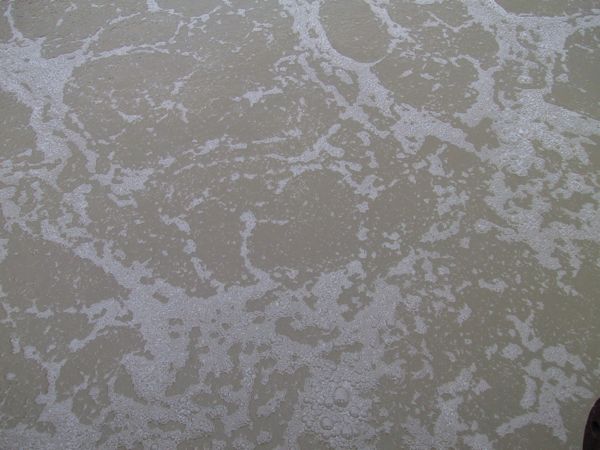
Activated sludge at the sewer plant.

Activated sludge at the sewer plant.

“We have a 4 million gallon river coming at us every day so can’t shut the plant down,” Sciuto said.

That is why there are redundancies built into the system and backups to the backup.

The district has met its treated water quality requirements since 1995 and does not want to mar that record. It’s not like the aeration process can be skipped.

“The aeration basins are a critical part of the biological process at the treatment plant,” Sciuto said. “It’s almost like you see bubbling chocolate milk. It’s pretty uniform when you look at the surface of the water. If there is an area with less bubbles, there is probably a failure in the air pipe.”

The air is helping breakdown the organic material. Air is being blown 24/7. Each basin is about 20 feet by 100 feet.

Usually only one is in operation at a time. However, two were required over Fourth of July.

While the district knew the aerators would eventually need to be replaced, it was not on the capital improvement list for the near future. To deal with the unexpected expense money will be used from the sewer enterprise fund that had been earmarked for other projects. Some work in Diamond Valley and a couple collection system projects will be pushed out a few years. There could be other projects that will be delayed.


Tahoe distance swimmer relives historic event

Publisher’s note: Erline Christopherson, the first woman to complete a length-wise swim of Lake Tahoe, will talk about her experience Aug. 20 at 6pm at the South Lake Tahoe Library.

By Erline Christopherson

As a young child, I always wanted to be in the water and by age 4 I could swim. As soon as possible, mom had me in swimming lessons. Around age 10, I was race swimming at Robbie’s Olympic Club. I did pretty well, but my love was distance swimming.

Mr. and Mrs. Harold Thurman lived across the street from us in Lodi and we sort of considered them our grandparents. They took my sister, Francine, and me to their cabin at Lake Tahoe when we were ages 8 and 9. The first time I saw the Lake, I told Mr. Thurman I would someday swim across it. He laughed and said, “OK.” When we came home, I told my father what a beautiful lake it was and my dream. He laughed and said, “OK. When you’re ready, just tell me.”

Little did they realize I was serious.

Erline Christopherson, right, with her mother, Elizabeth. Photo/Provided

Erline Christopherson, right, with her mother, Elizabeth. Photo/Provided

When I was 14, I told dad I was ready to start training for distance instead of racing. I read any book I could find on distance swimming, but nothing told what to eat or grease with, or how to train. I was pretty frustrated, but determined. I started swimming laps for hours at a time at the pool, then going to the Mokelumne River and swimming against the current. It was so strong I stayed in one spot for hours.

Mom came up with broth and sugar water. She would cook a roast for hours and then pour off the pure broth. We decided on a Honey Bear squeeze bottle as my drink dispenser.

About a month before each swim, the Thurmans would let Fran, my friend Mary DeMartini and me stay at the cabin. This way I could adjust to the altitude and practice in the lake. I would swim to the mouth of Emerald Bay and then go around the island and back down each morning. Fran and Mary would row the little boat beside me. At that time, there was no traffic on the lake like today.

Dad did not tell me the exact day I was going to swim because he was afraid I wouldn’t sleep. I knew, sort of, because I would swim the width a few days before trying the length to see if I was ready. Dad had decided that we could use the grease he used on the wheel hubs of his hay baler, so that was that. Now, getting it off was another story.

Walt Little, editor of Lake Tahoe News (which was a print publication with no affiliation to the online LTN), interviewed me for his column Little Quotes and KHVR-FM radio (located with the newspaper office). He was very nice to us, as was everyone. We went to the Coast Guard station to ask permission to swim, as we didn’t know if there were rules against it. The people there were very kind, saying they couldn’t give us permission, but the lake is so big they wouldn’t look for me.

My first attempt was Aug. 30, 1961 at age 15. We started at Bijou Beach straight up the state line to Cal-Neva Lodge. Just one mile from shore the Coast Guard came out to get me. We had been fighting storms for five hours and dad’s boat was swamped. They were bailing water. I had been in the water 18 hours, being pushed backward with waves hitting me in the face and over my head. There were times I was down in the slough of a wave so high dad couldn’t see me. It was getting dangerous for everyone. Dad said, “This great lake really gave us a beating.”

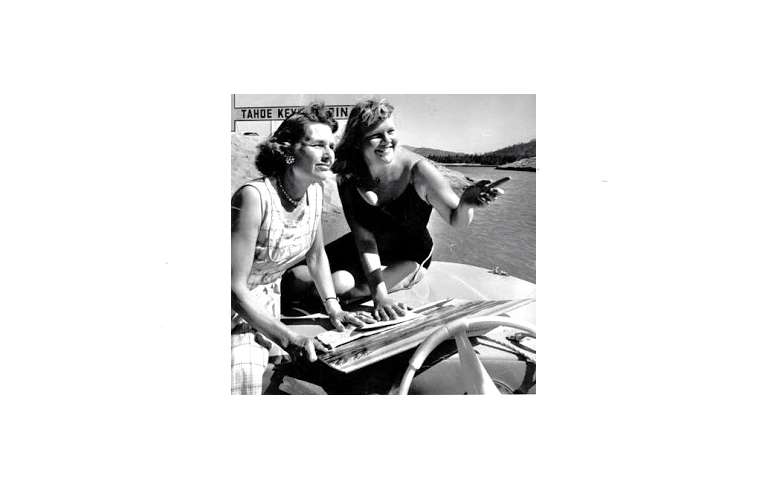
So, at age 16 we did all the same practices, but decided to go north to south and come in at Tahoe Keys, which was just being built. We hit storms again. About 3 miles out I was battling waves and swimming straight up and down. Colette, my sister, dived in and coaxed me out. I had been swimming 16 hours and mom was seasick.

Three weeks later, dad decided he had the answer — we would start earlier. It was now or never. On July 29, 1962, we started at 2am to beat the storms. It was scary to swim in the dark all alone. Dad tried to keep a spotlight on me. We were all anxious for dawn to break. Fran sang songs, making up words that were about me. Her voice was so beautiful, echoing over the lake in the stillness of the morning. She gave me comfort in the darkness of the night.

Wes Stetson, Thurmans’ neighbor at Tahoe, had a seaplane and gave tours over the lake to tourists. His daughter, Sierra and I were friends. He flew over and landed, telling dad he was following the shoreline and I was swimming farther than I had to, also telling us when I was in a current and going backward so I could change my stroke.

This time our goal was North Shore. The storms started rolling in around 3pm, so we headed for Dollar Point. The water was so clear I could see the bottom; 30 feet down. Finally, after 13 hours, 37 minutes, I was on the shore. The waves were so rough dad had to bring the boat in a quarter mile down shore. I walked to the boat with everyone beside me. It was a wonderful feeling.

Sacramento sportscaster Stu Nahan came a few days earlier and took pictures of us playing and training in Lake Tahoe. After the swim, he interviewed me. It aired on the 11pm news so I never got to see it — it was past my bedtime and I was not allowed to stay up. I was treated no differently than my sisters — there were chores to do on the ranch and mine were still mine.

I love Lake Tahoe — the most beautiful lake in the world, in my opinion. Its waters comfort me, like being covered in silk. I love to stand and just look at its beauty.