U.S. wine market fastest growing in world

By Cathy Huyghe, Forbes

NAPA — “If you’re in the wine business and you’re not making money today, it’s not the industry’s fault. Check your business model.”

That’s Adam Beak, Bank of the West’s managing director of the North Coast Agricultural Banking Center/Premium Wine Group, during a phone interview last week from his office in downtown Napa.

Beak would know. He oversees all winery, vineyard and wine industry related business for Bank of the West’s portfolio of almost 300 clients, which range from large international businesses to small, vertically-integrated ultra premium players. Dealing with clients from distributors and negoçiants to cork and glass producers, Beak’s perspective on the financial health of the wine industry is closer to 360 degrees than most.

The American wine market in particular is the fastest-growing market worldwide, with overall wine sales totaling $36.3 billion. American tastes are also evolving and maturing: quality and consumption across all price points continue to grow, but especially in the premium and luxury wine categories. “Premium” wine is defined as $10-13, “Super premium” as $13 to 25, and “Luxury” as $25 and above.

Most of the growth in recent years has been in the luxury category, whose recovery outpaced even the premium categories since the meltdown of 2008-2009. “What that indicates to me is that we’re seeing a trade-up, an evolution, and a maturation of the US wine palate,” Beak said. “All the trends are moving positively.”

Read the whole story


The wolf’s controversial return to California

By Alexandra Ossola, Popular Science

In 2011, a male gray wolf called OR-7 left his pack in Oregon and traversed over 1,200 miles. While this sort of travel isn’t atypical for gray wolves, the terrain that OR-7 covered set him apart from the pack; he became the first confirmed wolf in California in almost a century, making him an apple of the public eye.

Since OR-7 broke away from his group — the Imnaha pack in northeast Oregon — his life looks different. OR-7 traveled a small way back North and found a mate in the Cascades of southern Oregon. The Oregon Department of Fish and Wildlife (ODFW) has confirmed that the pair produced at least three pups, although there may be more.

But OR-7’s notable route to fatherhood has reawakened a debate in California that is almost as old as the state itself: how to manage the gray wolf. With OR-7’s wolf family knocking at California’s door, the state must make a plan for how to manage a species that inspires an entire range of emotions within California’s population.

“The public is fascinated by the issue of wolves in the West,” said Karen Kovacs, Wildlife Program Manager for the California Department of Fish and Wildlife (CDFW). “People have some perceptions of how wolves are that are oftentimes not compatible with the regulatory authorities of the states that manage [the wolf population].”

As recently as the 1970s, the West had no wolves at all. That’s a stark contrast to the 1800s, when settlers found their livestock populations constantly ravaged by wolves. In each state, extermination programs were put in place to ensure the total eradication of wolves; before 2011, the last confirmed sighting of a wolf in California was in 1924.
“The public is fascinated by the issue of wolves in the West.”

But after a small wolf population reappeared in Montana in the 1980s, the U.S. Fish and Wildlife Service (USFWS) was inspired to reintroduce an “experimental population” of wolves to Yellowstone National Park. The ecosystem there, it appeared, was out of balance without wolves at the top of the food chain: elk populations were out of control, and overgrazing drastically reduced the amount of vegetation. The flow of rivers had even changed, as barren river banks eroded more easily.

Much of the public was enamored with the idea; a 1985 survey of visitors to Yellowstone National Park showed that three quarters of those polled were in favor of reintroducing wolves. And since then, the praise has only become more frenzied. Videos and op-eds abound singing the wolf’s praise, calling it a keystone species and “an American hero.”

But not everyone was so happy. A small group of dissenters — especially farmers — were very much against the plan, believing their livestocks would be targeted by the new predator. An intense public debate ensued, but after a nearly decade-long fight, the U.S. Secretary of Interior signed the decision for the reintroduction of gray wolves to Yellowstone; wolves were then captured in Canada and transported to the national park.

Read the whole story


Tahoe shoreline troubles a mystery to scientists

By Kathryn Reed

It doesn’t take science for people to know Lake Tahoe’s shoreline is growing as the drought persists. But it does take science to determine the health of those waters.

The annual “Tahoe: State of the Lake Report 2014” was released today by the Tahoe Environmental Research Center at UC Davis.

“While this year’s data shows that progress is being made on many fronts, the biggest concern is what is not able to be shown,” TERC Director Geoff Schladow said in a statement Aug. 14. “This really applies to the near shore where most people experience the lake. Even with the planned increase in monitoring, why it is continuing to degrade is poorly understood. I’m hoping the near shore network will start to fill that void.”

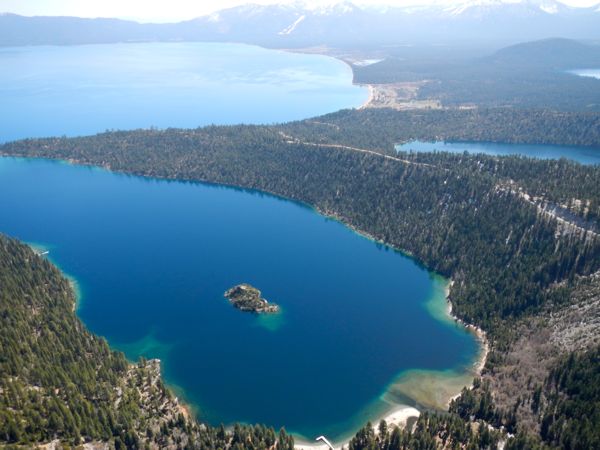
Emerald Bay and Lake Tahoe in April 2013. Photo/LTN file

Emerald Bay and Lake Tahoe in April 2013. Photo/LTN file

The Near Shore Agency Working Group is tasked with figuring out why there is so much muck near the shore line. Algae and other plant life have been steadily growing, and the once clear waters are often brown. Periphyton is the algae found on rocks.

It wasn’t until this year that scientists in the respective agencies that regulate and study Lake Tahoe decided to make a concerted effort to find out why the degradation is occurring and what can done about it. The first six of 20 near shore monitoring stations will be installed this month. This will give researchers real-time data about water quality. They will be installed on private and public property.

Most of the studies that have been conducted at Lake Tahoe since 1968 involve monitoring the clarity in the middle of the lake with a disc that looks like a white dinner plate. While some of that data will help with near shore issues, most of it won’t.

The good thing about a drought is that it means less sediment reaching the lake from runoff. It’s fine sediment that scientists say is the leading cause of the decline of lake clarity.

The current State of the Lake Report explains how drought, climate change, and other natural and human factors are driving changes at Lake Tahoe.

2013 was the second consecutive year Lake Tahoe did not mix to its full depth. The lack of mixing was because surface temperatures were higher.

July 2013’s surface temp of 65.6 degrees was the highest recorded in five years. This was 1.8 degrees more than 2012.

The loss of near shore clarity and rising temperatures creates a breeding ground for invasive species.

Alan Heyvaert, an associate research professor and director of the Center for Watersheds and Environmental Sustainability at the Desert Research Institute, is leading a group of researchers studying the near shore.

UNR and DRI researchers have installed cameras on mountaintops that in part are being used to study the near shore. They have documented a 90 percent decline in small species that live in the sand at the bottom of the lake – stoneflies, worms and bottom shrimp. Those species are important to the lake’s food chain.

But also alarming is the discovery of new species.

“Changes in the length of seasons will alter the way in which water moves in the lake, leading to the possible loss of dissolved oxygen at the bottom of the lake,” the State of the Lake Report says.

This in turn will also change the ecosystem because the chemical balance in the lake will be altered. This, too, will affect aquatic life.

Researchers are predicting that by the end of this century, summer may be two months longer than it was in the 1960s, and maximum temperatures may have risen by 8 degrees.

“With regard to climate change, we have really only scratched the surface,” Schladow said. “We have little understanding of how extreme events will play out and impact the Tahoe basin and the Sierra.”

——-

Notes:
• Tahoe Environmental Research Center Director Geoff Schladow will present highlights from “Tahoe: State of the Lake 2014” on Aug. 14 from 5:30-7:30pm at TERC, 291 Country Club Drive, Incline Village.
• Here is the full report.


Consensus lacking for future of Regan Beach

By Jessie Marchesseau

Upward of 100 people congregated on Regan Beach on Tuesday evening for the South Lake Tahoe Parks and Recreation Commission’s workshop to help determine the future of this area.

“We can’t have a community project without community input,” said Parks and Recreation Commission Chairman Pete Fink as he opened the evening’s workshop.

Luckily, most of the attendees on Aug. 12 were practically bursting with input.

The crowd was promptly broken into groups, each led by a representative from either the commission or city staff. They were toured around the entire Regan Beach site as leaders pointed out areas of concern and encouraged residents to make suggestions, come up with new ideas and express opinions.

It is no surprise that more than one heated discussion ensued. It seemed few people agreed on anything.

One Al Tahoe resident suggested all parking be removed so the park is accessible only to those on foot or bicycle, coinciding with a citywide effort to become a more bikeable, walkable community. Others were adamant the free parking should remain for residents who don’t live nearby and so those with children or mobility issues can still easily access the park.

There was some talk of doing away with weddings at the beach, a service which brings in between $30,000 and $40,000 per year in rental fees according to Recreation Manager Lauren Thomaselli, but blocks off portions of the beach on most summer weekends. Others argued for it to stay, saying it was not only an important source of income to the city, but provided a place for residents and visitors alike to have an affordable wedding in Tahoe.

South Tahoe residents offer ideas about what Regan Beach should be going forward. Photo/Jessie Marchesseau

South Tahoe residents offer ideas about what Regan Beach should be going forward. Photos/Jessie Marchesseau

Some suggested Regan Beach should be restored to what it was in the 1950s, a sloped natural beach; others said that would result in too much erosion and all the sand being washed away. Lakeview Commons kept popping up as a point of comparison. Some people want to see Regan Beach more like its popular neighbor; some want it as different as possible.

One nearby homeowner would like to see Regan Beach remain virtually as it is now, except for maybe cutting all the trees down to improve views for adjacent homeowners.

Many of the attendees were residents or homeowners in the Al Tahoe neighborhood. This may explain why some of them seemed to have agendas to keep as many people out of the park as possible, pushing out groups, weddings, people with dogs and people with cars.

To one such comment a woman chimed in: “Everyone wants to be the last one in and shut the door behind them. Do you want to be a neighborhood or a bunch of Nazis?”

Through the many debates and discussions of the evening, two issues stood out as hot topics: legal enforcement and dogs.

Some residents pushed for stricter enforcement of just about everything: bigger fines for having dogs outside the dog area, fines for dogs pooping, fines for glass on the beach, for smoking, for drinking, for being there after hours, and more. Some were advocating hefty fines for these offenses, $200-$500, with a theory that if violators are fined, they will have more respect of the town and lake. Others just commented this could be a good revenue source for the city since they did away with the paid parking plan.

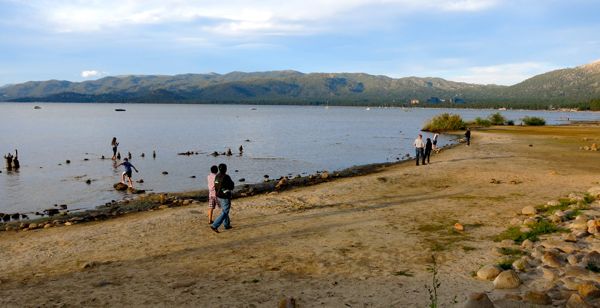
With Lake Tahoe so low, there is more to Regan Beach.

With Lake Tahoe so low, there is more to Regan Beach.

As for the dogs, part of Regan Beach is currently designated as a dog water park while dogs are prohibited on the rest of the beach. There is some signage alerting beach-goers of this policy, but it is minimal and dogs often end up in the dog-free zone. Clean-up baggies are provided at the entrance to the dog area, but not all dog owners are inclined to use them, resulting in unwanted dog waste lying about.

For some, the solution is to ban dogs entirely. Others would like the dog park to stay, but implement better signage and/or impose fines for violations. One attendee was adamant there should not be a dog park anywhere near the lake, submitting an article discussing the toxicity of dog feces for planners to review. Meanwhile, another resident suggested Regan Beach would be an ideal place to implement the Park Spark Project, installing devices which turn dog waste into energy to power things like street lights.

Organizers handed out 100 surveys and maps for attendees to fill out during the workshop. Questions included which neighborhood you live in, how often you visit the park, what amenities you think are important, what amenities you would like to see in the future and how often you would come if those things were implemented. People were encouraged to draw on the maps, indicating what changes they would like to see and where. Those who did not receive a map were asked to place sticky notes with suggestions on the big map displayed under the tent.

The sticky notes included comments such as: “remove grass”, “keep grass”, “no dogs”, “allow dogs”, “add more playground equipment”, “remove playground”.

After the evening’s workshop, ideas for the future of Regan Beach appear to be all over the board. But one thing is for certain: the city and Parks and Recreation Commission have their work cut out for them in trying to come up with a plan which the community can agree on.

Tuesday’s workshop was just the beginning of a long process. City Manager Nancy Kerry said there will be plenty of public meetings and lots of planning to come. If things move quickly, construction could start as early as next year.

The last time Regan Beach saw a major overhaul was in the 1990s. Kerry said according to surveys conducted by the city over the last year, it is one of the top three public areas respondents would like to see improved, and thanks to some recent restructuring of debt she hopes to have between $1.5 million and $2 million to dedicate to the project.


Catholic school in S. Lake Tahoe not opening

By Kathryn Reed

There will be no Catholic grade school on the South Shore this fall.

“We had a hail Mary pass out there with a donor who came in with great support, but it was just short of the goal line,” Stella Roper, spokeswoman for what was to be Lake Tahoe Catholic Academy, told Lake Tahoe News. “We had to look at it with less passion and with more responsibility.”

The decision to not open the South Lake Tahoe school was made Aug. 12.

A group of parents, teachers and community members had rallied together since June to try to open the academy after the Catholic Diocese said St. Theresa School had to close because of declining enrollment and not enough money being generated from the K-8 school.

The academy had hoped to open Sept. 2.

Roper said funding, and commitment from parents and teachers could have sustained the school for a couple years, but not in the long term. The decision was that it would be better for all involved to not open rather than to have to close again in what could be a handful of years.

The corporation formed to run the school still exists, and may continue to. Supporters of faith-based education are not ruling out trying again to create a sustainable education model for the area.

Roper said organizers are not upset they tried to resurrect the school, and found a tremendous amount of community support for such an education platform. But, ultimately, the numbers did not pan out.

Now those students, of which there were 50 last school year, need to find another place to be schooled this fall. Douglas County School District starts Aug. 18 and Lake Tahoe Unified’s first day is Aug. 25.


Project aims to lessen surprise of extreme wildfires

By Louis Sahagun, Los Angeles Times

Are wildfires becoming more extreme?

As part of an effort to answer that question, Nevada researcher Tamara Wall is calling on current and past wildland firefighters across the nation to share personal experiences of instances in which they witnessed surprising fire behavior.

“This project is driven by a phrase increasingly heard among fire agencies at the management level: I’ve never seen a fire behave like that before,” said Wall, who is leading a collaborative effort between the U.S. Forest Service and the Desert Research Institute, a nonprofit research campus of the Nevada System of Higher Education.

Participants are encouraged to provide as many experiences as they want in an online program that takes as little as five minutes to complete.

Read the whole story


Stateline nightclubs No. 1 problem for DCSO

By Kathryn Reed

Simple batteries and assaults at Stateline nightclubs are the No. 1 call Douglas County sheriff’s deputies respond to.

“It’s just a younger, more rambunctious person that tends to go to the clubs,” Undersheriff Paul Howell told Lake Tahoe News. “When you mix alcohol and young people, you get fights. When I talk to my counterparts in Reno and Vegas, they see the same problems.”

On occasion, shoplifters at the big box stores in the Carson Valley eclipse fights at the casinos. Such was the case in July. Last month deputies responded to 62 thefts in the valley and 51 assaults at the lake. Still, 95 percent of the thefts throughout the county are in the valley, while 95 percent of the fights in the county are at the clubs.

Nightclubs on the South Shore keep Douglas Count sheriff's deputies busy. Photo/LTN

Nightclubs on the South Shore keep Douglas County sheriff’s deputies busy. Photo/LTN

Howell said the number of altercations at the Tahoe casinos has declined through the years as gaming has slid in popularity in the basin. Plus, the numbers fluctuate based on how many people are in town. And summer is always a more violent time than winter.

A simple assault is defined as pushing, shoving, slapping and punching – “something that does not cause serious injuries.”

Not all the people deputies run into are arrested. Sometimes security at the clubs has defused the situation. Howell said his officers work hand-in-hand with casino security to quell the unrest. It is usually security that calls in DCSO for reinforcements.

Many times the situation is resolved by people willingly leaving the club. Often people don’t want to press charges, so no arrests are made.

Between 95 and 98 percent of the people causing the disturbance are visitors; with most of them being from the Sacramento or Bay Area, according to Howell.

Howell doesn’t blame the free alcohol at the casinos as the problem. He said the people gambling are seldom the same ones who are in the clubs. People in the clubs are paying for their booze and it’s not always cheap, especially with bottle and VIP services.

But there are opportunities to drink for cheap or free. At Opal Ultra Lounge inside MontBleu drinks are a buck on Thursdays, while women drink for free on Fridays until 2am.

No one from MontBleu nor Harrah’s returned phone calls. Those two casinos are home to the main nightclubs in Stateline.

XHale – Hookah Bar and Lounge, which opened in May in part of the building that used to be Bill’s Casino, has seen deputies show up a few times.

“When people are intoxicated, they don’t know what they are doing and they get all physical,” Sunny Patel, owner of XHale, told Lake Tahoe News. “My security guards try to break up the two people who are fighting. Usually it’s the other person not fighting who gets in the middle and ends up getting hurt.”

Patel said he has cameras in many locations so there is evidence to prove who did what when. He added that it hasn’t always been guys at XHale who are the instigators.

But Howell said deputies mostly interact with guys in their 20s.

He doesn’t anticipate the Hard Rock Hotel, when it opens in the winter, will add to his deputies’ workload. Howell said a property of that caliber tends to hire the appropriate number of security officers and that they tend to be highly trained.


Drought could increase tree beetle problem

By Associated Press

RENO  — Scientists say there’s been a significant reduction in the amount of Nevada forest under assault from bark beetles and similar bugs, but they fear lingering drought will further weaken trees and make them more susceptible to future attacks.

Nevada Division of Forestry forest health specialist Gene Phillips says aerial surveys show populations of the tree-killing insects plummeted across the state last year compared to 2012 — from 500,000 acres to only about 50,000.

“These are some pretty dramatic decreases,” Phillips told the Reno Gazette-Journal.

The trend was seen with the Pinyon Engraver beetle, also called the Ips, which infested some 12,000 acres of forest across Nevada in 2012. Last year, surveys concluded only about 2,500 acres were infested, a drop of more than 80 percent.

Infestation by mountain pine beetles — which have decimated forests in Colorado, Idaho, Montana and British Columbia — also dropped significantly in Nevada, down from 3,650 acres to 1,100, Phillips said.

The most dramatic reduction, nearly 90 percent, came in the amount of land under assault by the Pinyon needle scale, a pinhead-sized critter shaped like a bean. That infestation fell from an estimated 487,000 acres to only 49,000.

Phillips said it’s most likely part of a normal cycle that produces booms and busts in insect populations.

Significant overpopulation of an insect species is often followed by a crash in numbers, he said. Big beetle populations can result in spikes in the number of natural predators like wasps, which then whittle down beetle numbers.

“Insect outbreaks are very cyclical,” Phillips said. “They increase dramatically and they decrease dramatically. They increase and then they crash.”

The biggest concern is that a 3-year-old drought may continue, stressing already-stressed trees to make them more susceptible to insect attack.

“It doesn’t mean we might not see a dramatic increase this year,” Phillips said. “If this drought continues, all tree species in Nevada are going to continue to be stressed and bark beetles sense that. That’s when they get going.”

Healthy trees can easily fend off attacks by a limited number of bark beetles by secreting resin and essentially booting the bugs out of their bark. But when trees are stressed by drought, their defense mechanisms are weakened. Beetles can then attack successfully and while doing so, secrete perfume-like pheromones that attract hordes of more aggressive beetles than can overwhelm trees relatively quickly.

Drought has resulted in huge spikes in beetle populations and widespread tree die-offs before, said Gary Blomquist, a biochemist at UNR who has studied beetle pheromones.

The extensive drought the Reno-Tahoe area experienced from 1987 to 1994 resulted in nearly a third of the trees in the Lake Tahoe Basin being killed by beetles, Blomquist said.

That beetle infestation didn’t peak until the drought had lasted four to five years, he said.

“We’ve actually been very fortunate in this area. We haven’t seen that much in the Sierra yet,” Blomquist said. “We’re going to see more of them.”


EDC residents wage ballot battle over growth

By Peter Hecht, Sacramento Bee

El Dorado County’s growth wars are headed to the November ballot with unexpected drama, quixotic political alliances and developer dollars flowing in conflicting directions.

Local environmentalists and advocates have qualified separate November initiatives – Measure M and Measure O – that seek to protect rural lifestyles, prevent gridlock on Highway 50 and stop traffic-inducing subdivisions in the Sierra foothills region.

Those initiatives, plus a third measure originally backed by a Sacramento group representing commercial builders, are drawing financial opposition from housing developers as well as real estate and engineering firms that are banking on continued residential growth in the county of 180,000 residents.

At stake are competing visions of the future for the county, where a 2004 general growth plan anticipates 21,000 new houses.

The latest ballot battles come 16 years after a voter revolt over the county’s approval of projects bringing 11,000 new houses to El Dorado Hills. Measure Y in 1998 prohibited any residential project of five or more units that caused or worsened traffic gridlock. It was reaffirmed by voters in 2008.

Read the whole story


Hefty retiree package for Meeks Bay fire chief

By Kathryn Reed

Questions are swirling on the West Shore and in Placerville because of the package John Pang received when he retired as fire chief from Meeks Bay Fire Protection District earlier this year.

Pang, who worked for the district from January 1995 to April 2014, will receive a $6,746.09 check each month in retirement pay, according to CalPERS. That’s $80,953.08 a year to do nothing. It’s possible the monthly rate will be recalculated once CalPERS has all of the 2014 payout information.

While he was fire chief his total wages were $146,212 in 2013 and $131,776 in 2012. This was to manage a handful of employees. Meeks responds to about 200 calls a year, most of which are medical aid.

This compares to the South Lake Tahoe fire chief who oversees 37 employees and is paid $157,131.73 per year. In 2013 the South Lake Tahoe Fire Department responded to 3,293 calls; approximately 70 percent were medical aid.

John Pang

John Pang

When members of the Meeks district, who have voluntarily voted to tax themselves to help pay for fire costs, started asking questions the district had outside counsel look into the legalities.

Ed Miller, president of the fire district board, had a prepared statement ready when LTN called. He told Lake Tahoe News further questions could be asked in public at the next board meeting later this month. The statement states that Stephen Lieberman, independent counsel, reviewed Pang’s contract, salary, sick and vacation pay and determined it did not violate CalPERS rules and there was no gifting of public money.

The statement says, “Chief Pang retired with well earned retirement benefits ….”

Miller, at the urging of Lieberman, is not releasing the attorney’s full report. Attorney-client confidentiality was cited.

In 2012, the state Public Employee Retirement System instituted new rules, part of the Public Employees Pension Reform Act. Some of the changes deal with spiking of salaries. This means generating questionable extra pay in the last few years to inflate what the pension payout will be.

CalPERS is using Pang’s last year of wages to calculate his pension. His last year is inflated because of the sick time and vacation payouts.

In 2012, Pang exercised his contractual option to receive a 7.3 percent salary increase in lieu of the district continuing to pay 8 percent into deferred compensation.

In July 2012, El Dorado County Auditor-Controller Joe Harn sent a letter to Miller stating, “Implementing this change will cause an increase to your district PERS actuarial rate for many years to come. Additionally, implementing this change could be construed as income spiking. CalPERS is very sensitive to cases of income spiking and has a research unit dedicated to the review of these potential cases.”

Rosanna Westmoreland with CalPERS said while the agency does 20 to 30 audits a year, spiking and other inappropriate actions are usually investigated when someone anonymously calls the ethics hotline – 866.513.4216. Meeks Bay Fire has not been audited, according to Westmoreland.

“Unless it’s reported, we don’t look to see if there is something inappropriate,” Westmoreland told Lake Tahoe News.

CalPERS relies on the public agency to provide the salary and compensation information for retirees.

Another issue involving Pang is that he used sick leave hours to buy credit in the CalPERS system. In a letter dated July 25, 2014, Harn questions Miller about the legitimacy of doing this. Pang’s final termination pay was worth $503,597. Of that, $302,939 was to be used to purchase additional PERS service from his unused sick leave.

“Since a significant portion of these sick leave hours were awarded to Pang pursuant to his various employment contracts and not accrued by Pang, I believe that it is inappropriate that these hours be used to purchase PERS credits,” Harn wrote.

The district has never responded to Harn.

Included in that final half million-dollar payout was $195,012.54 for Nationwide to pay for Pang’s post-employment health plan. In other words, part of his ongoing perks are taxpayer funded health benefits for the rest of his life.

Ken Corcoran, a resident of the fire district and retired auditor-controller from Contra Costa County, raised similar and more questions. In a May 28, 2014, letter to the board, Corcoran said at most Pang should have been able to accumulate about 1,900 hours of sick time if he never called in sick. But the district paid out 5,080 worth of hours.

“… it is my belief that the proposed conversion of sick leave hours to service time will create an unfunded liability for the district, resulting in many years of increased retirement rates to cover this shortfall,” Corcoran wrote.

In public comments at the May board meeting, Corcoran submitted a letter stating, “I can honestly say that in my extensive work experience in the area of compensation I NEVER encountered a pay package so generous in almost every category. Considering the district has five full time employees, the pay and benefits provided to the chief appear wildly excessive.”

(Miller said in the last couple years the board has changed the compensation package for all new hires.)

Corcoran questioned the comp time vs. administrative leave, and the fact the board allowed Pang to accrue 25 weeks of vacation. (He received five weeks per year.)

But these are all things Miller, the board president, said his investigator found to be legal.

The ethics, according to others, is another matter.

El Dorado County has given the district $2,191,172 from fiscal year ending 2001 through fiscal year ending 2010 because Meeks fire cried poor and needed help.

The residents are paying for fire service. Each parcel is assessed $325 per year. Voters approved Measure Z in 1992 at $85 and Measure R in 1998 at $45. The board imposed a fire protection assessment of $195 in 2009.