Mass casualty training drill to test Tahoe crews

By Kathryn Reed

The Angora Fire of 2007 taught South Lake Tahoe officials a lot of things. But much of what needed to be improved was not implemented until this year. And those changes are about to be tested.

On Monday, a C130 airplane from the National Guard will be on the tarmac as though it crashed at Lake Tahoe Airport with more than 40 people on board. Injured passengers will be taken to Barton Memorial Hospital; others will be readied to be airlifted to regional trauma centers, though not actually flown. First responders from Reno and Sacramento have been invited to participate.

Aug. 25 is designed to be the largest drill South Lake Tahoe fire and police have had in years. Neighboring agencies will also be participating, including Barton. The recreation center will be the Red Cross center, just as it was during Angora.
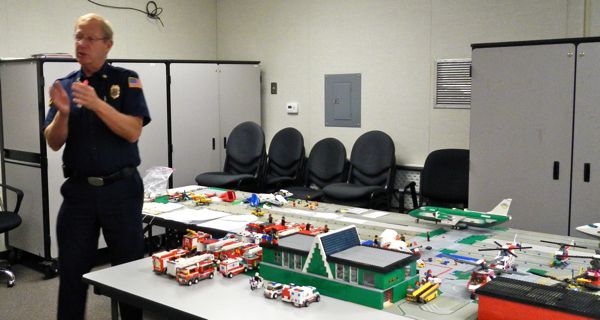
South Lake Tahoe Fire Chief Jeff Meston talks about preparations for the Aug. 25 drill. Photos/Kathryn Reed

South Lake Tahoe Fire Chief Jeff Meston talks about preparations for the Aug. 25 drill. Photos/Kathryn Reed

But it’s not just the normal emergency crews that will be deployed. Other city staff members are integral to the process to make sure everything works. Planning, logistics, finance and operations are the main components. Per city code, the city manager is the incident commander, however it’s the fire chief who is in charge of the local Office of Emergency Services. The planning department will lead planning, logistics falls to parks and recreation, finance is finance, and operations involves police, fire and public works.

“We really had to reinvent the emergency operations plan,” Fire Chief Jeff Meston told Lake Tahoe News.

That is one reason he was hired by City Manager Nancy Kerry – for his experience in such matters.

“My concern was since Angora the city hasn’t had any ongoing training since that major event,” Kerry told Lake Tahoe News. “I hope this becomes a regular part of the city’s role and responsibility.”

Communication at the start of the Angora Fire was atrocious. Part of the training has addressed that component. This also includes what is supposed to be better information getting to the media so they in turn can relay it to the public.

Evacuating the area during Angora proved to be another challenge, especially on that Tuesday when the fire jumped Highway 89 and Tahoe Keys residents were told to evacuate. The city, under Kerry’s direction, ordered evacuation signs that can be installed where needed. She plans in the coming months to work neighborhood by neighborhood to acquaint people with how best to leave their home depending on where the emergency is.

Meston revamped the training manual. It details who is to do what, and who the alternates are in case that person isn’t available. He made sure everything conforms to current county, state and federal requirements. If it doesn’t, there is the potential threat of state and federal dollars being withheld.

Part of the City Council chambers has been reconfigured with modernized technology.

Emergency power supply for cell phones is in place. Vests for those in charge have been bought.

Every city employee has gone through training. There is a phone tree as well as a plan to call in people who are not working at that hour. The paperwork process was simplified. Forms that need to be filled out have been put on computers to simplify the process.

All of the upgrades cost the city less than $5,000.

In the event the airport were to be off limits as the emergency center, the city has two other locales designated in town.

Meston said every disaster – no matter where it happens – provides first responders with lessons.

“We also learned from San Francisco,” he said of the 2013 Asiana crash at SFO. “One of the important things is we try not to run over people. That is not good.”

Fire Capt. Mark WyGand with Legos built the Lake Tahoe Airport crash scene to scale.

Fire Capt. Mark WyGant with Legos built the Lake Tahoe Airport crash scene to scale.

The drill

It will be determined that day if air space at Lake Tahoe Airport is off-limits.

The drill will involve many of the six helicopters that are within a 30-minute flight from South Lake Tahoe coming in, as well as fixed-wing aircraft. All that air support is necessary because Barton’s trauma capabilities are limited and many air ambulances can take two people at the most.

Triage tags will be placed on the California Conservation Corps members who will be made up as the plane crash victims. Some will go to Barton, others to the rec center. And while normally victims would not be transported to a shelter, some concessions need to be made for a drill.

Still, it would be the Red Cross’ responsibility to reunite victims with families.

One thing Meston will be looking for in his men and women is how they deal with this being a hazardous materials situation. A downed plane will have fuel that is ready to explode.

The California Highway Patrol is expected to be filming the incident from the air. This will be one way to assess how well everyone did. A debriefing will occur afterward. The drill will also be evaluated by people not affiliated with any local agency.

Adding to the potential chaos of the event is that this will be the first day of school for Lake Tahoe Unified.

And while most city resources will be devoted to this event, if there is a real emergency, those calls will take precedence.

—-

Notes:

  • The drill is Aug. 25 from 10am-12:30pm.
  • The training takes place at Lake Tahoe Airport, Barton Memorial Hospital and South Lake Tahoe Recreation Center.
  • To sign up for reverse 911 notifications in El Dorado County go online, then click on the image of the phone, cell phone and “@” symbol to fill out the form. Here is a link for Douglas County residents to sign up. South Lake Tahoe residents may signup here for various alerts.


Dispute could keep Park City lifts idle

By Jack Healy, New York Times

PARK CITY — Can a ski town survive if the ski lifts stop running?

The question is gripping this mountain town where celebrities gather each winter for the Sundance Film Festival and summer days glide by as placidly as kayakers on the nearby reservoir. Beneath the calm veneer, a ski resort’s eviction battle over land, leases and millions of dollars has erupted into a full-on civic crisis.

Businesses and town leaders worry that the festering dispute could, in the worst case, end up shuttering one of Utah’s most popular ski resorts for this winter, crippling a tourist economy that needs the chair lifts to run. Instead, those lifts could be uprooted from the mountains.

“Park City prides itself on its comity,” said Myles Rademan, a longtime resident and former town official who carried the Olympic torch when the Winter Games were held in Utah in 2002. “We worked hard to build our reputation as a place that gets along. This is all kind of a shock to our system.”

The dispute centers on the Park City Mountain Resort, a popular ski mountain in the heart of town whose lifts practically whisk visitors from Main Street to the slopes. It provides more than 1,200 jobs, draws thousands of skiers and tourists, and is an anchor of Park City’s postcard-perfect downtown.

For years, the resort had a lease that would make even a rent-controlled tenant in Manhattan jealous. While the proprietors owned the parking lots and much of the land at the base of the mountain, they leased the actual ski slopes, paying $155,000 a year for 2,800 acres of prime downhill terrain. It was an almost unimaginable bargain in a town where an unfinished house lot is on the market for $1.9 million.

But in 2011, the Powdr Corporation, which runs Park City Mountain, made what the Salt Lake Tribune called “one of the most monumental blunders in Utah business history”: It failed to renew the lease on time.

Read the whole story


Brown blasts CalPERS for allowing enhanced pay

By Jon Ortiz, Sacramento Bee

A divided CalPERS board on Tuesday approved a regulation that will allow nearly 100 different types of supplemental pay to count toward pension calculations for state and local government employees.

The 7-5 vote drew a swift rebuke from Gov. Jerry Brown, who signed pension overhaul legislation in 2012 that, in part, attempted to crack down on pension spiking. Specifically, Brown objected to CalPERS’ allowing pension calculations to include “temporary upgrade pay” for workers who briefly fill a higher-paying position to count toward retirement.

“… CalPERS got it wrong,” Brown said in a statement released shortly after the board’s action. “This vote undermines the pension reforms enacted just two years ago. I’ve asked my staff to determine what actions can be taken to protect the integrity of the Public Employees’ Pension Reform Act.”

That law required pension calculations based on “the normal monthly rate of pay or base pay” of employees who become retirement system members on Jan. 1, 2013 and later. It also disallowed “ad hoc” payments included in retirement benefit calculations, a key provision intended to thwart pension spiking.

Read the whole story


Family letters become Tahoe history book

By Kathryn Reed

For 30 years a treasure trove of Lake Tahoe area history sat in a closet unbeknownst to the owners.

The white wooden chest was in Mary K. Sonntag’s home in New Castle, Pa. Her mother, Myrtle McConahy Keefer, had sent it to her in 1962. In 1992, Sonntag’s daughter, Mary Jo Sonntag, said it was time to open it.

What they found were photographs and more than a century (1842-1962) worth of letters between family members in Vermont, Illinois, Pennsylvania and California. Those in California had settled in the Sierra.

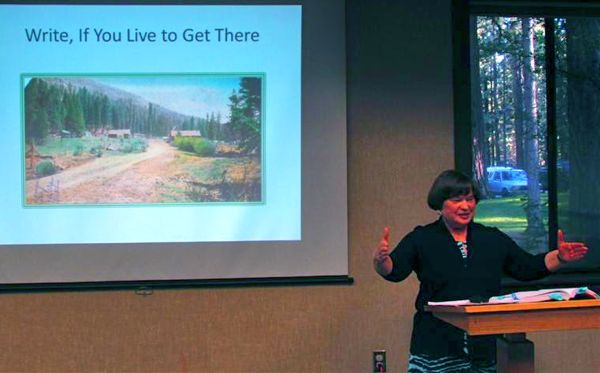
Mary Jo Sonntag speaks Aug. 13 at the South Lake Tahoe Library. Photo/Denise Haerr

Mary Jo Sonntag speaks Aug. 13 at South Lake Tahoe Library. Photo/Denise Haerr

Mary Jo Sonntag was in South Lake Tahoe last week talking about “Write If You Live to Get There”, the book she and her mom wrote from the letters and subsequent research.

In 1862, Sonntag ancestors bought 160 acres at what is now Phillips Station for $2,000. An old cabin is still inhabited there by family members. It’s on Highway 50 at the intersection of the road that leads to Sierra-at-Tahoe.

“Phillips burned down multiple times and they kept rebuilding,” Sonntag told the audience gathered at South Lake Tahoe Library.

The resort was rustic. Electricity didn’t exist. Icehouses were on the river. Meat came Placerville, vegetables from Gold Hill. It was a bit of a haul to get eggs and butter from Camp Richardson, which had been delivered there via train.

For $12 per week people could camp out at Phillips Station. Swimming, tennis and horseback riding filled days. Sitting by the bonfire was a ritual in the evening.

In the winter of 1952 most of the cabins collapsed from the weight of the snow in what turned out be an epic year.

Throughout her talk, Sonntag read passages of letters that are woven into the book.

The mother-daughter duo first came to California in 1993 to begin their research. Soon they discovered how their family had left quite a mark on the region.

Family is buried in Placerville and Truckee, as well as the private family cemetery at Phillips Station.

Meeks Bay Resort employees helped piece together facts. A curator at the El Dorado County Historical County Museum in Placerville said, “Sally must be thrilled you are here.” They didn’t know who Sally was.

Thus began the introduction to West Coast family. Those out here thought the Sonntag clan had long since perished. Mom Sonntag is now 94.

In addition to Phillips Station the family ran Meeks Bay Resort for the McKinneys and leased property at Rubicon Springs, where they ran another resort.

It was Joseph W. D. Phillips who started Phillips Station. His daughter, Sierra Nevada “Vade” Clark, took over. When she inquired with the Postal Service about what to call their post office because a Phillips already existed, she was told to call it Vade Post Office. At one point it was part of the Pony Express Trail.


Calif. gives away more rights to water than it has

By Kat Kerlin, UC Davis

California has allocated five times more surface water than the state actually has, making it hard for regulators to tell whose supplies should be cut during a drought, UC researchers reported.

The scientists said California’s water-rights regulator, the State Water Resources Control Board, needs a systematic overhaul of policies and procedures to bridge the gaping disparity, but lacks the legislative authority and funding to do so.

Ted Grantham, who explored the state’s water-rights database as a postdoctoral researcher with the UC Davis Center for Watershed Sciences, said the time is ripe for tightening the water-use accounting.

Better information might enable state regulators to better target water cutbacks in times of drought, Grantham said.

Read the whole story


Governors’ group calls to end ‘wildfire borrowing’

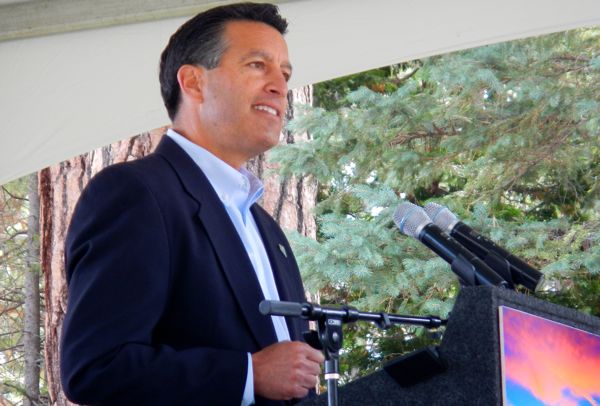
Nevada Gov. Brian Sandoval, who chairs the Western Governors' Association, spoke Aug. 19 in Tahoe about drought and fire. Photo/Kathryn Reed

Nevada Gov. Brian Sandoval, who chairs the Western Governors’ Association, spoke Aug. 19 in Tahoe about drought and fire. Photo/Kathryn Reed

By Jesse Paul, Denver Post

The Western Governors’ Association in a letter last week urged U.S. Senate and congressional leadership, and President Obama, to increase federal wildfire budgets so agencies can stop using fire prevention funds for fire suppression.

The association said the U.S. Forest Service is again on pace to utilize prevention funds for suppression — known as “fire borrowing” — in a season where Oregon, California and Washington have seen millions of acres of forestland burn.

“We end up robbing from the land managers,” said Kevin Klein, director of the Colorado Division of Homeland Security and Emergency Management. “We end up stealing from those [prevention] programs to fight the fire. Treating wildfires like we do with our other programs makes sense to me.”

“In the past decade, wildfires have increased in size and intensity and the fire season now extends 60-80 days longer than historic averages,” said the association, calling its position “long-standing.” “Ineffective management, droughts and insect infestations also have left Western forest far more susceptible to catastrophic fires.”

Despite the risk, federal wildfire budgets have remained stagnant, the association said, “reinforcing this damaging wildfire cycle.”

Read the whole story


World on track for 3rd hottest year on record

By Tom Randall, Bloomberg

If you live in California, Australia or Scandinavia, 2014 may feel like the hottest year on record. Not quite; on a global scale, it’s “only” third-hottest.

The global average surface temperature for January through July was 1.2 degrees Fahrenheit (0.66 degrees Celsius) above the 20th century average, tying with 2002 as the third warmest in records going back to 1880, according to National Climatic Data Center data released today.
Hottest Years on Record

The greatest share of global warming in recent years has been absorbed by the oceans. The beginnings of an El Nino warming pattern in the Pacific Ocean earlier this year threatened to stir up some of the heat. That hasn’t happened yet, and the forecast has been reduced to a 65 percent chance of a mild to moderate El Nino developing later this year. The last strong El Nino event was in 1998, the hottest year on record.

Thirteen of the 14 hottest years on record have all occurred in the 21st century. The recent clustering of heat records are one of many signs of the warming climate (click here for more). To put the last 135 years of global temps into perspective, the chart below stacks each year onto the same timeline. The five hottest years are in red: 2010, 2005, 1998, 2013 and 2003. This year, to date, is highlighted in green.

Read the whole story


Wildfire threat dominates enviro summit talks

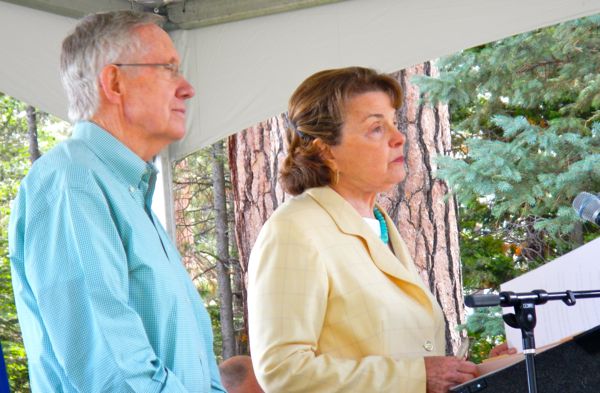
Sens. Harry Reid and Dianne Feinstein have been proponents of Lake Tahoe for years. Photos/Kathryn reed

Sens. Harry Reid and Dianne Feinstein have been proponents of Lake Tahoe for years. Photos/Kathryn reed

By Kathryn Reed

CAMP RICHARDSON – Now in its 18th year, the Lake Tahoe Environmental Summit is the place for politicians and others to tout how much they care about the basin, what they’ve done to make it great and what they want to do for the future.

Since the first summit, $1.74 billion has been invested through what’s called the environmental improvement program. Much of that is taxpayer money, with $323.7 million from the private sector. Those private dollars continue to grow as government at all levels has less to dole out.

But if the Lake Tahoe Restoration Act is reauthorized, it calls for $415 million from the feds. Rep. Mark Amodei, R-Carson City, is the sponsor of the bill.

Sen. Dianne Feinstein, D-Calif, who hosted the event at Valhalla, said the entire investment is working. At the first summit a white dinner plate-like device could be seen to a depth of 64 feet, while today the naked eye can view it at 75 feet. She rattled off the number of road miles that have been improved, acres of forest treated for fuels reduction and wildlife habitat restoration, and the commitment to preventing more invasive species from taking hold in Lake Tahoe.

Sen. Harry Reid speaks Aug. 19 at the annual environmental summit. Also on stage are Rep. Mark Amodei, Rep. John Garamendi, Sen. Dean Heller, Sen. Dianne Feinstein, Gov. Jerry Brown, Gov. Brian Sandoval, Rep. Tom McClintock, and Lt. Gov. Gavin Newsom.

Sen. Harry Reid speaks Aug. 19 at the annual environmental summit. Also on stage are Rep. Mark Amodei, Rep. John Garamendi, Sen. Dean Heller, Sen. Dianne Feinstein, Gov. Jerry Brown, Gov. Brian Sandoval, Rep. Tom McClintock, and Lt. Gov. Gavin Newsom.

The theme of the Aug. 19 event was Drought, Wildfire and Invasive Species: Confronting the Effects of Climate Change on Lake Tahoe. More than 300 people attended the event.

Wildfire dominated the talks, especially with the lawmakers signing a proclamation updating the multi-agency fuel reduction program that is led by the Lake Tahoe Fuels and Fire Team.

“This is important because fire is going to be with us and more so in the future,” Fire Chief Mike Brown with North Lake Tahoe Fire Department said.

It is designed to be a strategy to protect life and property in the basin. Fire chiefs from throughout the basin were in attendance – as they have been most years.

Fire has been a constant topic ever since the 2007 Angora Fire reduced 254 houses to ash. Many of those homes on the outskirts of South Lake Tahoe have since been rebuilt and the forest has new growth, but so many burned trees remain as a visual reminder of what happened that June.

While most of the electeds talked nice and about how well the California and Nevada delegations get along, it was Rep. Tom McClintock, R-Granite Bay, who had some of the most impassioned words of the day. He is an outspoken critic of the U.S. Forest Service and environmentalists, especially when it comes to harvesting timber after a fire. He singled out how the wood from last year’s Rim Fire is just standing there.

“Excess marketable timber should be sold and removed from the forests, with the proceeds used to provide for forest restoration and the reduction of ladder fuels,” the congressman who represents the California side of Lake Tahoe said. “The sale of excess timber and the use of biomass generation can substantially supplement the cost of fuels reduction, making the proper management of our forests cost-effective once again.

“The escalating costs of fighting fires should be treated as other natural disasters and not funded by shorting fuel reduction budgets.”

Nevada Gov. Brian Sandoval spoke of having recently hiked to Snow Valley Peak and being able to see the impact of drought in the high country. That lack of moisture ties into growing concerns that fire is a real threat to the area.

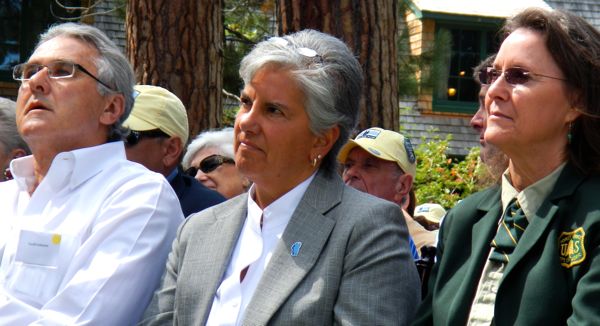
Geoff Schladow (TERC), Joanne Marchetta (TRPA) and Nancy Gibson (USFS) listen to the speakers.

Geoff Schladow (TERC), Joanne Marchetta (TRPA) and Nancy Gibson (USFS) listen to the speakers.

Geoff Schladow, executive director of Tahoe Environmental Research Center, also pointed out how wildfires inside and outside the basin impact air and water quality here.

Schladow said having data going back to the early 1960s has allowed scientists to understand how Tahoe has changed, and he added research needs to continue. But that takes money.

California Gov. Jerry Brown said, “The success to date give us a lot of encouragement. At the end of the day, nature rules.”


Tahoe youth shares his mindset for education

By Hayley Ringle, Phoenix Business Journal

At 14 years old, Logan LaPlante is introducing the world to “hackschooling,” a term he uses as he gains hands-on skills through internships for his alternative, DIY schooling.

LaPlante calls hackschooling “a mindset, not a system,” and says regardless of what type of school a child attends, they can apply this term to enhance their learning.

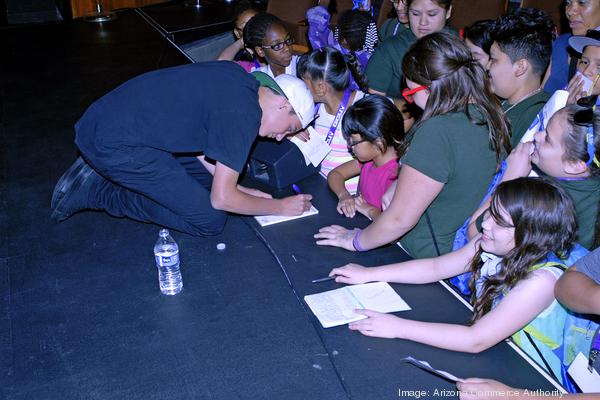
Logan LaPlante signs autographs. Photo/Arizona Commerce Society

Logan LaPlante signs autographs. Photo/Arizona Commerce Society

“I want to be happy and healthy, exercise and have time in nature,” said LaPlante, who lives in Lake Tahoe and is home-schooled. “All of these things are important to me. Trees make you tougher.”

LaPlante spoke about his unique background as the keynote speaker last week at the Arizona Innovation Summit in Scottsdale organized by the Arizona Commerce Authority, Arizona SciTech Festival and MIT Enterprise Forum Phoenix.

He gained prominence when his TEDx talk at the University of Nevada garnered global attention when it became the second most-watched video from the event last year with almost 6 million views.

LaPlante is a published writer, an aspiring filmmaker and graphic designer, a public speaker, director, skier and mountain biker who also likes history.

When his parents realized he wasn’t connecting and doing well in public school, they started home schooling him and allowing him to do these internships for his DIY education.

Read the whole story


Emergency preparedness needs to happen now

By Kathryn Reed

STATELINE – When the emergency happens it’s too late to think about what to take. That’s why it is necessary to have papers in place, an emergency kit packed and a rendezvous spot selected now – not later.

Leona Allen with Lake Valley Fire Protection District and Niki Congero with Lake Tahoe Humane Society last week dispersed a wealth of information and tips about what people should do for themselves and their pets.

Allen brought a suitcase to the Soroptimist International South Lake Tahoe meeting at Harrah’s Lake Tahoe. It wasn’t because she was staying the night. The contents are what will get her through a few days if she were evacuated.

First and larger emergency kits should be tailored to your specific needs.

First aid and larger emergency kits should be tailored to an individual or family’s specific needs.

And she knows all about being displaced. She and her husband lost their house in the 2007 Angora Fire.

“If you are not prepared to evacuate, you won’t come away with a lot of stuff,” Allen said.

She knows of people who showed up at a Red Cross shelter with the TV remote. During Angora one young person thought taking her dad’s prized elk that was in freezer was the most important thing. It ended up spoiling when the electricity went out at the house she took it to.

Allen said people have become complacent in the last seven years. And the rains of late also wrongly convince people the threat of fire has lessened. All that water just makes fire fuels grow.

But it’s not just a wildland fire that could sweep through the basin. It could be an individual house fire. It could be a flood. It could be an extended power outage. It could be a snow event. It could be any number of things.

Cell phones likely won’t work. How will you connect with loved ones? If your normal route out of town or to a friend’s house for shelter is blocked, what is Plan B? Do you know how to turn the electricity off?

Those are some the questions to answer now, not during an emergency.

Shutting windows and doors before leaving is imperative because embers can blow in and start a fire from the inside out.

Write a sign now on bright poster board that says “Home Evacuated” and then post it in a visible place outside before you leave. This saves first responders time as they go door-to-door to make sure everyone is out.

“Don’t turn the sprinkler system on the roof. It only takes away water pressure. That happened during Angora,” Allen said.

In Allen’s emergency bag she has a sleeping bag, dehydrated food she would use backpacking, water (that she changes every few months), towels, bandana (this helps with smoke, but don’t wet it because it could cause burns in the heat of a fire), first aid kit, can opener, box of disposable gloves, plastic bags, cell phone charger, flashlight, radio, note pad/pen (her dad kept a journal during Angora that proved invaluable when dealing with the insurance company), address book with phone numbers, maps and a knife.

Also in the kit is a computer disc with pictures of every room in the house, all of their insurance information, bank info, copies of utility bills, deed to the house, and vehicle registration.

“After the Angora Fire, this was priceless,” Allen said of the disc. She said to include anything on it that you think will help in the recovery process.

On top of the kit, have a list of things to grab at the last minute – money, credit cards, checkbook, and whatever else you might immediately need.

She said fireproof safes turned out not to work during Angora. Some people recovered melted jewelry, while others returned to charred cash. Bank safe deposit boxes are a good alternative. And during the Tahoe fire Tuff Sheds endured the wrath of fire and heat.

When it comes to pets, Congero recommends having a supply of food and water for 48 hours. They should have their own kit that includes food and water, stainless steel bowls (so they don’t melt), tags, medication, a carrier, collars, harness, leash, litter box, cleaner, paper towels, tub of Lysol wipes, first aid kit for animals, gauze wrap, and proof of vaccinations.

Post-Hurricane Katrina a law was created mandating communities set up shelters for animals if they want to receive federal dollars. Shelters must also be where their people are. And Congero said bring your pet’s favorite toy or blanket to the shelter, because they, too, get stressed.

The local Humane Society is prepared with two trailers full of kennels, running water and a vet ready if need be. They are ready for large animals, too. And they have aquariums for fish and could handle birds.

She said if for some reason you can’t take your pets, don’t tie them up. Leave them in the house. Fill the tub with water, put the toilet seats up and shut the dog/cat doors.