Plastic bag ban headed for approval in Calif.

By Jessica Calefati, San Jose Mercury News

SACRAMENTO — A bill that would ban single-use plastic grocery bags statewide — something California lawmakers have tried and failed to do more than a dozen times before — won approval from the state Assembly on Thursday after failing on the floor earlier this week.

The bill — which would make California the first state in the nation to ban the flimsy bags — still needs Senate approval, but is widely expected to pass in that chamber.

Touted by environmentalists as a way to reduce a pesky form of litter that pollutes the Pacific Ocean, the proposal has faced intense opposition from plastic and paper bag manufacturers who have been working hard to kill the bill.

Earlier this year, debate on the measure centered on jobs and the environment, but in recent days, criticism of the proposal became all about the 10-cent fee stores must charge for paper and thicker plastic bags under the bill.

Read the whole story


Drug policy shifting toward treatment over jail

By Katie Zezima, Washington Post

Over the past few years, the White House has shifted its drug policy away from putting low-level offenders in jail and prison and toward helping them access addiction treatment — an approach that dovetails with the life of acting drug czar Michael Botticelli, a recovering alcoholic.

It’s a strategy has a rare distinction nowadays: it has been embraced by both Republicans and Democrats.

As the nation grapples with fresh waves of prescription drug and heroin abuse, members of both parties are calling for a shift away from using the criminal justice system to address the problem, and toward public health-based approach to drug addiction.

“You just can’t bust enough people to solve this problem,” Republican Ohio Gov. John Kasich said in January. Drug overdose deaths in Ohio increased by 366 percent from 2000 to 2014. “The problem has to be solved at the beginning, which is to keep people from getting involved with these drugs.”

Why are politicians of all persuasions calling for treatment-oriented solutions?

The biggest reason: the spike in drug overdoses isn’t dropping and public opinion has increasingly tilted toward providing treatment to people with addiction issues.

A survey released in April by the Pew Research Center found an overwhelming majority of Americans believe the government’s approach to drug policy should focus on treatment.

Read the whole story


State provides disabled access to Vikingsholm

Vikingsholm is not accessible to people with disabilities. Photos/Kathryn Reed

Vikingsholm is now accessible to people with disabilities. Photos/Kathryn Reed

By Kathryn Reed

EMERALD BAY STATE PARK – While Lora Knight’s guests were always allowed to drive to her estate, that has not always been the case for California State Parks visitors.

This is the second year people with disabilities are allowed to drive to Vikingsholm at Emerald Bay State Park. Otherwise it’s a one-mile trek down that feels much longer going up.

Volunteers escort people to a parking area not far from the castle. Two guest cars are allowed per day. Everyone is in their own vehicle to avoid insurance issues.

The normal $10 parking fee is charged. The stay is for about two hours, which is long enough to tour the historic house.

Helen Smith, who summered at the estate when she was a child, is still involved with Vikingsholm. A section of the museum, which is separate from the house, is dedicated to her. Smith used to be a regular docent. Last week she was there for a fundraiser.

The main room as it was when Mrs. Knight owned the estate.

The main room as it was when Mrs. Knight owned the estate.

Fundraising is an ongoing endeavor for the nonprofit associated with Vikingsholm because the state does not provide enough money for all the repairs. Smith formed the Vikingsholm Project in 1999 to raise money for the estate where she spent 14 years as a child in the summer. This year the circular stone driveway was replaced. Next year planting wildflowers in the sod roof is the main project.

The state acquired the land – which now totals 282 acres – in 1953. It included the castle-like building and Fannette Island, where Mrs. Knight’s tea house sits in ruins.

In 1928, Mrs. Knight bought 250 acres at Emerald Bay for $250,000. That fall the foundation was laid for Vikingsholm, while it was finished in less than six months the following year. It was designed after Scandinavian castles.

Most of the materials came from the greater Lake Tahoe area. One condition of Mrs. Knight’s was that the trees at the bay not be harvested. The only things imported were the lead windows from Sweden.

Many of the furnishings in the home are original to Mrs. Knight. What she could not buy outright from Europe she had re-created by laborers in the States.

The kitchen at Vikingsholm.

The kitchen at Vikingsholm.

And while it only cost $125,000 to build the structure, the furnishings amounted to much more. The cashmere rug was $40,000. The Steinway piano is from 1929. The unusual thing about it is that it has six legs.

Fifteen servants were employed to cater to the summer guests. The top floor is where people stayed, while the bottom floor was for entertaining, including eating.

Today, visitors are able to see most of the rooms on the two main floors, but are not allowed to the third level where Mrs. Knight would sleep. All she had to do was turn her head to see Emerald Bay.

——-

Notes:
• Reservations for the ADA escort must be made 24 hours in advance by calling 530.525.9529.
• A disability placard is required.
• Dates are limited for when the service is provided. It is offered seasonally when the castle is open.
• Parking is $10; the tour is an additional $10 per adult.


Rim Fire salvage logging plan unveiled

By Diana Marcum, Los Angeles Times

The U.S. Forest Service on Wednesday unveiled a salvage logging operation for more than 15,000 acres of trees burned in last summer’s Rim Fire.

The plan — which calls for removing an additional 17,706 acres of trees along non-public roads — means the Forest Service will be selling more board feet of timber as a result of the Rim fire than the combined total sold last year in all of California’s national forests.

Because the value of burned trees for logging deteriorates quickly, the plan was formed under emergency rules allowing salvage to begin immediately after approval, without going through an administrative appeal process.

Read the whole story


Is fantasy football online gaming?

By Eddie Pells, AP

Some of the newest incarnations of fantasy football look a lot more like gambling than intricate, outsmart-your-opponent strategy games.

Since 2011, the billion-dollar fantasy market has been infused with dozens of daily and weekly games. Those games allow players to win huge prizes quickly, sometimes in one week, sometimes in just one night. With players betting thousands or even tens of thousands a night, legal experts believe it’s time to review the section of the 2006 federal law that was written specifically to protect fantasy sports from being banned the way online poker was.

“There’s importance in clarifying the law,” says Marc Edelman, a professor at Fordham Law School who studies the law as it applies to fantasy sports. “As long as there’s uncertainty about the legality of these games, some potential businesses that might enter the marketplace stay out.”

Seasonal leagues are largely the domain of billion-dollar companies such as CBS and ESPN, with close ties to the NFL. For now, they have remained on the sidelines of the short-term business, leaving it largely in the hands of companies such as FanDuel, which is expecting to triple its base to 500,000 fans this season.

“We have the most popular fantasy football game going,” said Kevin Ota of ESPN, which boasts an estimated 14 million fantasy players. “It’s been incredibly successful, and we’re focused on improving our game every year. We always keep our eye on opportunities to serve sports fans better.”

ESPN officials say they have no immediate plans for weekly cash games.

Traditional leagues at ESPN and elsewhere received their legal clearance from the 2006 Unlawful Internet Gambling Enforcement Act, which was designed mainly to stop Internet poker. It included an important “carve out” for fantasy football. Meanwhile, most state laws define fantasy football as skill-based propositions, which keeps them legal.

Peter Schoenke, chairman of the Fantasy Sports Trade Association, says daily and weekly games that adhere to the group’s rules also are protected by the 2006 law, and that the NFL and Major League Baseball “have fully embraced fantasy sports in all forms, both free and pay.”

“If a game operator doesn’t follow the UIEGA, the FSTA doesn’t consider the contest to be a true ‘fantasy sports’ contest,” Schoenke said.

Las Vegas-based attorney Tony Cabot, who has practiced gambling law for three decades, said it’s easy to argue that season-long games are skill based “because you exercise a great deal of skill in operating a team.”

“You have to figure out who to draft, play, trade and all those things to have a successful season,” Cabot said. “And because you’re doing all that, you’re betting on an outcome you can control.”

The day-game world can be much different and the skill level needed to “run” a team that exists for only one week is far lower than that for a season-long enterprise.

And a growing number of fantasy sites have games that “look very much like prop bets or parlay cards,” Cabot says, with some games as simple as paying an “entry” fee, and then choosing who, between two players, will finish a certain day with more receiving yards.

“It depends on how you run your game,” Cabot said. “If you said, ‘We’re going to do fantasy, quick pick, random drafts,’ I say, ‘How can that be skill based?’ But if it’s a daily game where you’re doing a draft, have the ability to change players halfway through the game and make all these decisions, then it’s much closer to a traditional model.”

In 2007, Cabot co-authored a legal paper titled “Fantasy Sports: One Form of Mainstream Wagering in the United States.” It offers a point-by-point deconstruction of the federal law that essentially legalized a growing industry that, to some, looks very much like gambling. One of Cabot’s key points is that the NFL, seeing the revenue and viewership possibilities of fantasy football, hired a well-paid lobbyist who helped smooth the way for an imperfect bill to become law.

Cabot’s conclusion is that the process “ultimately has done a great disservice to reasoned policymaking and, potentially, to the long-term future of the fantasy sports industry itself.”

He counts the growing day-game business as one area especially susceptible to confusion. Edelman agrees.

“One can argue whether the fantasy sports carve out applies to the short-duration game, given that, at the time the (federal law) was passed, there was no such thing as daily fantasy sports,” Edelman said.

Day games didn’t get much traction until 2011 — five years after the law was passed.

The games are pretty much unregulated, and they are exploding. They allow anyone over 18 to gamble on sports outcomes online, while traditional sports gambling is available online only in Nevada and, in some forms, in Delaware. The laws in the states take precedence over the federal law and they vary, most of them basing the legality of a game on how much of it is predicated on skill vs. chance. Last year, a federal court in Illinois dismissed a lawsuit alleging day games were games of chance.

A few of the bigger media players — most notably USA Today and Sports Illustrated — have gotten into the day-game business, seeing ample opportunity in an industry that drew an $11 million investment from Comcast Ventures, which plunked the money into FanDuel last year.

Meanwhile, the NFL, which did not respond to questions emailed by the Associated Press, keeps watching the numbers swell, while walking the line between using fantasy football to grow its game and maintaining its long-held, hard-line stance against anything perceived as gambling.

“Part of the problem with entrepreneurial endeavors on the Internet is that some people push the envelope and some cross the line,” Cabot said. “Until there’s some sort of enforcement action on some level, I think you’ll see them keep pushing that line out further and further.”




Tahoe putting emphasis on regional transit

By Kathryn Reed

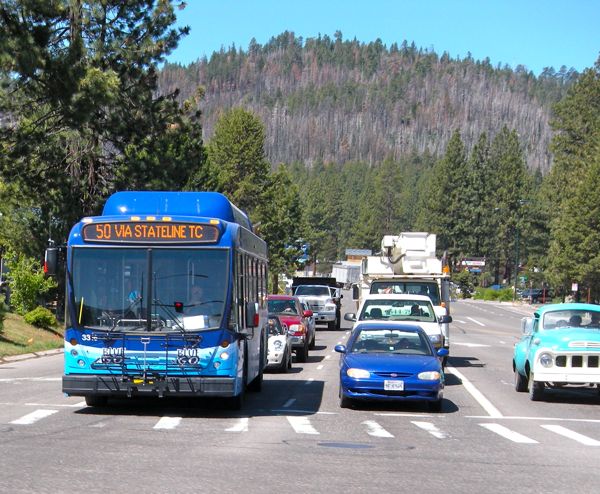
Lake Tahoe is making strides to have a coordinated regional transit system. A significant step is this week there will be a job posting by Tahoe Transportation District for a transit system program manager.

“We need to answer: ‘What does an integrated transit system in the entire Tahoe area look like?’,” Carl Hasty, TTD executive director, told Lake Tahoe News.

As TTD goes forward with developing the environmental documents for ferry service on the lake between the North and South shores, it must explain how the basin could have coordinated service. This is because if ferry passengers are left at the terminus without public transit, the boat will be a failure.

As it is now, the bus companies operating at the lake are not integrated.

Improvements are already happening on Highway 28, like the roundabout put in this season at the base of Mount Rose Highway. Photo/LTN

Improvements are already happening on Highway 28, like the roundabout at the base of Mount Rose Highway. Photo/LTN

The person who is hired will be tasked with coming up with a plan that links current systems and anticipates for future growth.

One thing planners are looking at is how the 6.5 million people who are in the Bay Area/Sacramento market could come to Tahoe. How will they get here? And how will they get around when they are here? And with the forecast calling for that number to grow by 4 million more in the next few decades, it could be gridlock in the basin if everyone is in a private vehicle.

That is why local transit officials are also looking at transit along Highway 50 to Sacramento, Interstate 80 to Sac and Highway 395 in Carson City-Reno and then the routes to Tahoe.

“The system needs to be attractive to riders who don’t typically ride,” Hasty said.

What that looks like still needs to be worked out.

While TTD is and will continue to do its own studies, it will also tap into other resources. One of those is the travel survey the Tahoe Regional Planning Agency did Aug. 15-24.The survey conducted by NuStats Research Solutions was intended primarily to gather data on travel patterns involving commercial and recreation areas.

TTD is not letting the lack of a coordinated transit manager slow down its progress in making the region more transit friendly.

Instead of going on a project-by-project basis, the new thinking is to look at the entire transit corridor. This was and is still being done along Highway 28 from Spooner to Incline Village. Fourteen stakeholders are involved.

BlueGo helps eliminate the need for a vehicle on the South Shore. Photo/LTN file

BlueGo helps eliminate the need for a vehicle on the South Shore. Photo/LTN file

The roundabout at Highway 28 and the Mount Rose Highway is one component, as is the East Shore Express bus that operates in the summer.

Now those stakeholders – which include public land owners, NDOT, IVGID and others – are working on a state highway erosion control project that will include highway parking lots. A park and ride at Spooner is being considered, as well as a different location for the aquatic invasive species decontamination operation. It’s possible fire hydrants will be installed along Highway 28.

Incline Village General Improvement District needs to move its sewage export line that sits in the highway. That line would be moved into the forest where 11 miles of bike trail are proposed. If the trail goes where the line is, then IVGID would be responsible for the maintenance of it.

The economies of scale approach to planning means total implementation costs less, maintenance could be less and more gets done. Ideally, it’s mostly for the public benefit.

Hasty said a coordinated synergy exists today that hasn’t been there in the past that is allowing for this cooperative approach to take place.

The corridor approach will be used whenever possible and practical, he said. The Y section of South Lake Tahoe from about Trout Creek to Emerald Bay has been plotted as a corridor, as has Trout Creek to Zephyr Cove.


Pediatricians prescribe later school start

By Fred Barbash, Washington Post

Starting the school day before 8:30 in the morning is bad for kids. It’s bad for their physical health, their mental health and their academic performance.

So says the American Academy of Pediatrics, which issued a formal policy statement Monday recommending that middle and high schools do away with those 7:30 or 8am school bells and begin no later than 8:30.

“Chronic sleep loss in children and adolescents is one of the most common – and easily fixable – public health issues in the U.S. today,” said pediatrician Judith Owens, lead author of the policy statement. She added, “The research is clear that adolescents who get enough sleep have a reduced risk of being overweight or suffering depression, are less likely to be involved in automobile accidents, and have better grades, higher standardized test scores and an overall better quality of life. Studies have shown that delaying early school start times is one key factor that can help adolescents get the sleep they need to grow and learn.”

Read the whole story


Bill would repeal sports book tax

By Howard Stutz Las Vegas Review-Journal

CG Technology CEO Lee Amaitis wanted to know the whereabouts of about $9 million that Nevada sports book operators paid to the federal government last year through a tax on all sports wagers.

It seemed like a simple question.

Amaitis asked Rep Dina Titus, D-Nev., if she could find out.

The Internal Revenue Service took several months to answer the query posed by Titus’ legislative director, David Rosenbaum.

The question seemed to perplex the agency. The IRS couldn’t answer how the money was being used.

The congresswoman then devised her own response. She introduced a bill last month to repeal the tax.

“The IRS didn’t even know it existed,” Titus said. “The money just went into some black hole in the general fund.”

In the grand scheme of the federal government, we’re not talking about a lot of money.

Nevada sports book operators pay 0.0025 percent in a federal handle tax on every sports wager placed in the Silver State.

In 2013, based on the record $3.6 billion wagered on college and professional sports, the amount sent to the IRS was $9 million.

Read the whole story


Drill tests readiness of Tahoe’s first responders

First responders deal with 47 injuries and a plane on fire during a drill at Lake Tahoe Airport. Photos/Kathryn Reed

First responders contend with 47 injuries and a plane on fire during a drill at Lake Tahoe Airport. Photos/Kathryn Reed

By Kathryn Reed

It was controlled chaos inside and outside of the airport in South Lake Tahoe on Monday as first responders and staff were put to the test in a mass casualty incident.

A C130J airplane carrying 47 people crashed while landing – at least that was the scenario for the Aug. 25 drill.

The city has a specialized fire truck stationed at the airport just in case of an incident like this. It can pump 1,500 gallons of water, while a normal fire engine has 500 to 700 gallons. Normally an engineer with the fire department would operate this truck, though there are a handful of airport employees who are also trained to use it.

In addition to the water it has a foam substance that is used because it acts as a barrier by cutting off oxygen for the fuel. Purple K is a powder substance that the truck has for engine fires.

South Lake Tahoe Fire Chief Jeff Meston, standing, checks in at the emergency operations center.

South Lake Tahoe Fire Chief Jeff Meston, standing, checks in at the emergency operations center.

While a complete debriefing is yet to come, the initial reactions from South Lake Tahoe Fire Chief Jeff Meston and City Manager Nancy Kerry is that it went well.

The biggest glitch was the technology breakdown in the emergency operations center. The Internet was down. Email wasn’t working.

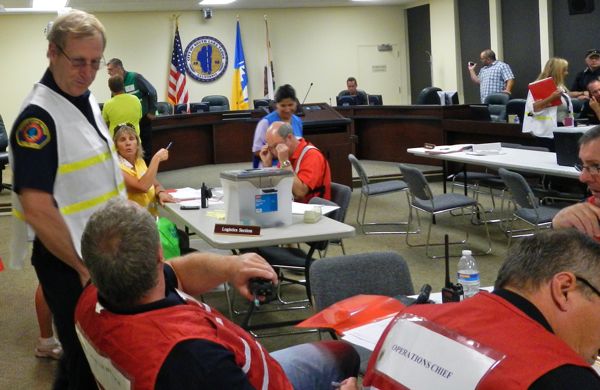
Staff was tasked with doing jobs they don’t normally do. In the emergency center, which is where the City Council meets and in an actual incident would be off-limits to the media, there are predesignated groups in charge of specialized tasks.

Victims in the path of a fire hose.

Victims in the path of a fire hose.

Lauren Thomaselli, who works in parks and rec, is handling logistics. She has to figure out where the chaplain can meet with family members. A bus has been ordered to take able-bodied victims to the Red Cross shelter at the city’s recreation center.

Lts. Brian Williams and David Stevenson are working the law enforcement side. (Normally only one of them would be at the center.) They are making sure there are refrigerated trucks for the bodies. They have contacted the FBI in case this turns out to be a terrorist attack. The National Transportation Safety Board and Federal Aviation Administration are contacted.

People are constantly being interrupted to be updated with facts – number of those injured, killed, where they had been taken, that the FAA is on site, that the media needs to be briefed.

Paramedics lift a victim onto a gurney.

Paramedics lift a victim onto a gurney.

At various times the heads of each sector meet separately to assess how things are going, what needs to be done and what each will be doing going forward.

Hilary Roverud, who is in charge of the city’s planning department, leads these meetings.

“Hilary did a bang-up job as planning chief,” Meston tells Lake Tahoe News.

What Meston was initially most happy about was seeing the type of air support that is available to the city.

“I feel 1,000 percent better knowing that the military is a call away. They could have transported all the injured in their units,” Meston said.

Chinook and Black Hawk helicopters were part of the training. The C130J – had it not been the training module – is also designed to ferry people. Inside it is like a flying hospital, where patients can be stacked three high in the center on suspended gurneys. Flight nurses are registered nurses and the medical technicians have at least their EMT, while most are at the LVN level.

“Because we are so isolated and have one hospital, to fly people out is critical,” Meston said.

Still, the weather in Tahoe is not always conducive to flying.

That is why the fleet of ambulances was lined up on the tarmac as well. And with those vehicles come the paramedics whose job it is to assess the needs of those who are injured and get the most critically wounded to a hospital ASAP.

Just outside the danger zone is South Lake Tahoe firefighter/paramedic Mike Mileski. He has one of the more difficult jobs because he is coordinating the medical response.

People are yelling for tourniquets and backboards.

Ambulances are ready to whisk patients to Barton Memorial Hospital.

Ambulances are ready to whisk patients to Barton Hospital.

California Conservation Corps members are the victims. One has a foreign object sticking out of her shin; others have blood dripping from their faces. It takes personnel time to assess all the injured.

On the far side of the aircraft firefighters are putting out the “fire”, even getting some victims wet. South Lake Tahoe Capt. Mark WyGant is working along side firefighter Steve Pevenage of Lake Valley fire. It shows the cooperation that would take place in a real scenario.

While these two agencies often work together, others who were part of the drill are not always immediate partners. But they would be in situation like this or if there were another Angora Fire.

Some of the other agencies involved in the drill were, South Lake Tahoe police, Fallen Leaf Lake fire, Carson City fire, El Dorado County sheriff’s, El Dorado search and rescue, CalFire, CareFlight, Air National Guard, El Dorado probation, Barton, CalStar, North Lake Tahoe fire, Tahoe Douglas fire, Meeks Bay fire and Truckee fire.


Early jail releases surge in Calif. after prison realignment

By Paige St. John, Los Angeles Times

Jesus Ysasaga had been arrested multiple times and ordered by the court to keep away from his ex-girlfriend. Two parole boards sentenced him to nearly a year in jail for stalking, drunkenness and battery.

But the Fresno County jail would not keep him.

Four times in the summer of 2012, authorities let Ysasaga go, refusing two times to even book him. The jail had no room.

Ysasaga’s attorney, Jerry Lowe, said the parade of convicted offenders being turned away from the jail was common. “It became quite a joke,” he said.

Across California, more than 13,500 inmates are being released early each month to relieve crowding in local jails — a 34 percent increase over the last three years. A Times investigation shows a significant shift in who is being let out of jail, how early and where.

The releases spring from an effort begun in 2011 to divert low-level offenders from crowded state prisons to local jails. The move had a cascade effect, forcing local authorities to release their least dangerous inmates to make room for more serious offenders.

Read the whole story