More workers claiming ‘wage theft’

By Steven Greenhouse, New York Times

MIRA LOMA — Week after week, Guadalupe Rangel worked seven days straight, sometimes 11 hours a day, unloading dining room sets, trampolines, television stands and other imports from Asia that would soon be shipped to Walmart stores.

Even though he often clocked 70 hours a week at the Schneider warehouse here, he was never paid time-and-a-half overtime, he said. And now, having joined a lawsuit involving hundreds of warehouse workers, Rangel stands to receive more than $20,000 in back pay as part of a recent $21 million legal settlement with Schneider, a national trucking company.

“Sometimes I’d work 60, even 90 days in a row,” said Rangel, a soft-spoken immigrant from Mexico. “They never paid overtime.”

The lawsuit is part of a flood of recent cases — brought in California and across the nation — that accuse employers of violating minimum wage and overtime laws, erasing work hours and wrongfully taking employees’ tips. Worker advocates call these practices “wage theft,” insisting it has become far too prevalent.

Some federal and state officials agree. They assert that more companies are violating wage laws than ever before, pointing to the record number of enforcement actions they have pursued. They complain that more employers — perhaps motivated by fierce competition or a desire for higher profits — are flouting wage laws.

Many business groups counter that government officials have drummed up a flurry of wage enforcement actions, largely to score points with union allies. If anything, employers have become more scrupulous in complying with wage laws, the groups say, in response to the much publicized lawsuits about so-called off-the-clock work that were filed against Walmart and other large companies a decade ago.

Read the whole story


Eagles flying high on record-breaking tour

Timothy B. Schmit dazzles the crowd at Harveys on Aug. 30. Photos/Kathryn Reed

Timothy B. Schmit dazzles the crowd at Harveys on Aug. 30. Photos/Kathryn Reed

By Susan Wood

STATELINE – I was 12 years old when the Eagles’ debut album came out. I spent so many hours in my room listening to it that my mom would occasionally feel the need to check on me.

I loved the melodic harmony and kickback California style so much that it set the ground for my longing to leave the East Coast for the West. More than half the songs off the album became hits, from one of their favorite early garage-type jams “Witchy Woman” and heavy guitar rhythm “Already Gone” to top-down cruisey “Take It Easy” and sway-inducing “Train Leaves Here This Morning.”

From there, I was hooked – gobbling up LPs from “On the Border” to the more recent “Long Road Out of Eden.” This was the first full studio album in 28 years for one of the most popular rock bands of all time.

Some would say the group’s signature country-rock blend was a first for this popular mix and definitely not the last.

The Eagles wrapped up the Harveys Outdoor Concert Series this weekend with two sold-out shows. This part of their box-office record-breaking “History” tour was so named to coincide with a 2013 documentary of the same name. The band, which is led by front men Glenn Frey, Don Henley, Joe Walsh and Timothy B. Schmit, will continue on its massive $145 million tour that started July 2013.

Glenn Frey and Don Henley

Glenn Frey and Don Henley

The core singers and musicians returned to Stateline for the second time. This time original guitarist and banjo plucker Bernie Leadon joined them, much to the delight of the heavy baby boomer crowd. The band members looked older, but still had it — as they were on key and in sync with their guitars, percussion and keyboards.

Always considered the proverbial bad boy of the band, the longhaired Walsh even delivered on his own major hits “Life’s Been Good” and “Rocky Mountain Way.” He engaged the crowd with a call to perfect a guttural chant and provided his own classic contorted facial expressions.
Through the years, Walsh, Henley and Frey have shown their mettle in going solo.

Henley – always widely respected for his ability to sing as a drummer, launched the band into his own mega hit “Dirty Laundry.” The timeless piece showed news images depicting the public’s fascination with misfortunes in the news cycles.
Even Schmit, who mainly plays with the band, took the lead for his sweet, high-pitched honest depiction of a romance gone awry with “I Can’t Tell You Why.”

And later Frey tipped the band’s hat to the Beach Boys, indicating how the 1960s beach soft rock group led by Brian Wilson inspired his band’s harmonious sound.

“The Eagles were settlers, but the Beach Boys were pioneers,” he said.

With that, “Heartache Tonight” made the crowd rise again.

Then, Walsh cranked out the sexy “Those Shoes.”

After a fun-filled electric guitar challenge between Walsh and Frey in which the latter announced “you got to be funky,” the boys of summer got the crowd to its feet for “Life in the Fast Lane” – one of its biggest hits in more than four decades of making music.

The event brought hit after hit after hit.

I’ve never been to a concert where so many people knew most of the words to the songs. The couple behind us belted out a good majority of them.
Harrah’s entertainment director, John Packer, said before the Aug. 30 show to expect that based on Friday night’s concert.

“This is a bucket list show for people,” he said. “People hear they’re touring and don’t care what tickets cost.”

The Eagles shows are some of the priciest.

The first time the band played Stateline the shows sold-out immediately, prompting Harrah’s management to add a performance.
The Eagles apparently like returning to Lake Tahoe for however long they play together.

“They find out what a lot of what locals know. It’s nice here. And (the band members) get that vibe,” Packer said.

Some people don’t think twice about seeing this band more than once, as in Joe Patone of Belmont.

“I like the venue here,” he said, while the band opened with country tune “How Long.”

The group followed up with the audience sighing with a big “ah” for its soft melody “Take it to the Limit.”

From start to finish, the band gave the audience a walk down memory lane. When Henley and company left the stage before a triple encore; I could hear concertgoers declaring the band had to play “Hotel California.” The song, with its so-named album, became one of its biggest hits and marked its peak of commercial success in 1976.

But it was Henley standing in a plaid shirt at the mic for his melancholy “Desperado” that is moving enough to make the emotional cry. The lights even came up for the entire audience to sing, “you better let somebody love you.”

With yet another special pinnacle in the band’s storied career, the Eagles have sold more than 120 million albums worldwide, earning five No. 1 U.S. singles and six Grammy awards. In 1998, the band was inducted in the Rock & Roll Hall of Fame.



Sports betting v. the stock market

By Matt Egan, CNN Money

NEW YORK — Sports gamblers have lots in common with stock market investors.

They both believe they can predict the future, and they sometimes fall into the trap of making decisions with their hearts instead of their brains. And of course, they both hate to lose.

But don’t let those similarities fool you. Gambling on sports may be more fun, but it’s definitely a more risky use of money than putting it in the stock market.

In the long run, investors have the chance to make more money because there are fewer downside risks.

To put it another way, the stock market is a lot more forgiving than the MGM Grand (let alone your local sports bookie).

“A lot of people regard investing as gambling, but I frequently say no. Which casino in Atlantic City, Las Vegas or Macau pays the bettor 73 percent of the time?” said Sam Stovall, chief investment strategist at S&P Capital IQ.

That’s the percentage of time that Stovall’s research shows the S&P 500 — the gold standard in the stock market — has increased in value during the years since 1926.

Read the whole story


Pilgrimage to Tahoe plane crash site 50 years later

By Dave Nordstrand, Salinas Californian

One morning when Salinas’ Billy Harvey was a boy of 5 and still asleep, his parents arose.

Quietly as they could, they tiptoed to the front door and left the house.

“I never saw them again,” Harvey said.

Billy Harvey’s parents had put him and his two brothers in the care of an aunt. Then, they’d flown off to Lake Tahoe on what was supposed to be a fun-flight getaway, a day-long casino excursion. They planned to return home that night.

Only they, and many others, died in an airplane crash.

That was March 1, 1964, making this year the 50th anniversary of that disaster and its aftermath.

Billy Harvey is now 55. He drives a bus for special education children in the Salinas Union High School District.

In late July, Harvey, his wife and three children plus his brother, Jesse Harvey, and other family members headed for the Tahoe area.

First thing Harvey noticed was the crystal blue of the lake. He was stunned by the beauty of the setting. Harvey carried with him a wooden plaque, hand-painted and honoring his parents. “In Loving Memory of Billy and Patricia Harvey,” it said. He planned to leave it posted at the site where his parents had died 50 years ago.

At that site, Harvey found bits and pieces of the wreckage still scattered across the ground. “Shrapnel,” he called the fragments.

“I found pieces of the seat, pieces of the engine,” he said. “I took one piece back to Salinas. In a way, it was like bringing my mother and father home.

“Standing there on that site, I felt a peace that I hadn’t expected to feel,” Harvey said. “I cried. I would like to go again. It’s about keeping the memories alive now. It’s all about love.”

Read the whole story


Enchanting cluster of 5 lakes worth exploring

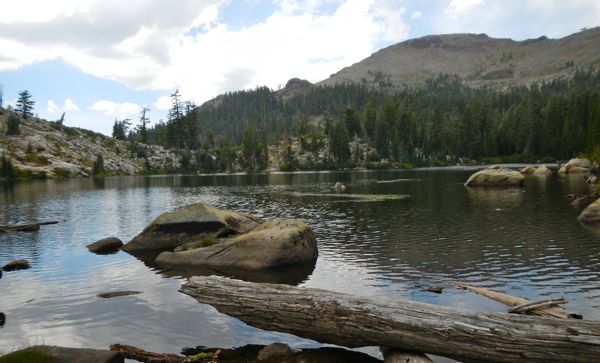
One of five lakes along a 5-mile roundtrip hike. Photos/Kathryn Reed

One of five lakes along a 5-mile roundtrip hike. Photos/Kathryn Reed


By Kathryn Reed

ALPINE MEADOWS – Small ripples float across the lake in the gentle breeze. A few ducks swim by to check out the four of us – five if you count AJ. She doesn’t faze them, even though she acts like they are intruding on our territory.

But where did all the people go?

There had been so many vehicles at the trailhead and several hikers along the way. But suddenly they were nowhere to be found.

Not that we were complaining. A private lunch spot along a lake in the Granite Chief Wilderness on a Sunday in August can be a rare experience. We embraced it.

Getting here was a bit of a climb at the start. The more than 900-feet of elevation gain is mostly at the beginning. It then levels off to where the ascent is hardly noticeable. Switchbacks are gradual so it doesn’t feel like you are in a spiral. The decomposed granite proved trickier coming down because it was slick. Poles would have been welcome.

The nearly five-mile roundtrip hike starts at 6,660 feet. The five lakes are at 7,520 feet. Maps call this cluster of lakes “5 Lakes” – they don’t have individual names.

One rock outcropping looks like a cumulus cloud made out of granite. Rounding another corner there is a wall of granite that looks like it would be fun if you were into rock climbing, but scary if it were ski season.

With much of the hike being so exposed, we wondered why we started in late morning. Sweat was dripping without exertion. Fortunately, there were shady spots to rest in. But it made sense why we saw so many people on their way out as we were just starting.

The trail starts on private land that separates Alpine Meadows and Squaw Valley ski resorts. Owners of the resorts are getting close to solidifying a deal with the private property owner to link the ski areas.

Chairlifts from both resorts as well as the terminuses are visible from different vantage points. The base lodge for Alpine is a wide spot below us. A reminder of how much snow this slice of the Sierra gets is a sign at the trailhead telling people not to pick up unexploded avalanche shells.

Looking up at all the lifts it proves just how sprawling Squaw is. Plus, it’s a reminder this is not true wilderness.

The lakes are in Granite Chief Wilderness.

It was surprising to overhear backpackers talk about the other lakes in a manner that proved they had not seen them. For us, seeing all five lakes was the goal.

There is a distinct fork in the trail as the landscape changes and the tree canopy becomes denser. Go left to make your way around to all five lakes. If you go straight, you get to what we called Lake 5.

The first two lakes are more swampy, but still beautiful. They just don’t beckon one to swim. The three other lakes seem more swimmable, with Lake 5 being where people were in the water.

No one was at Lake 3 or 4, which were the two lakes the four of us preferred. Everyone was at Lake 5.

Even in the backcountry there are a couple signs of drought. No water is running in what are now dry streambeds. At Lake 3 the water mark on some of the boulders is about 2 feet higher than the surface.

Still, so much of the area around the lakes is lush – almost tropical. A few wildflowers are still out, but nothing glorious. But the hike itself and the lakes are spectacular. An extensive trail network exists here, including the Pacific Crest Trail.
——–
Getting there:

From South Lake Tahoe, go north on Highway 89 to Tahoe City. Turn left at the Y into Tahoe City toward Truckee. Turn left onto Alpine Meadows Road. (River Ranch is on the corner.) Drive 2 miles and the trailhead is on the right at the junction of the second Deer Park Drive.

Notes:
• Dogs are prohibited in parts of Granite Chief Wilderness from May 15-July 15 during fawning season.

ngg_shortcode_0_placeholder (Click on photos to enlarge.)


EPA recommends significantly lower ozone standard

By Neela Banerjee and Tony Barboza, Los Angeles Times

The U.S. Environmental Protection Agency staff said Friday that the nation should tighten smog rules significantly, a step that would improve air quality in California but force costly new requirements on government and industry.

The EPA staff recommendation is the final step before the rule goes to the agency’s leadership and the White House. As a result of lawsuits by environmental and health groups, the agency must propose a new ozone rule by December and the final rule by October 2015.

Federal standards for ground-level ozone, the main ingredient in smog, have proved deeply contentious because they would compel many states, cities and industries to adopt new measures to cut air pollution at a cost of billions of dollars.

California would be particularly affected because much of the state does not meet the current, weaker standard for ozone that has been in place since 2008.

Read the whole story


4-year degrees at community colleges gain traction

By Alexei Koseff, Sacramento Bee

Driven by shifts in technology and educational expectations across industries, California’s higher education leaders know they face an unexpected economic challenge just six years after the recession ravaged the state’s workforce: a potential shortage by 2025 of 1 million bachelor’s degrees.

As California’s overburdened public universities consider ways to boost middling graduation rates, community colleges see an opportunity to step in and help close the gap.

Traditionally the domain of transfer and career technical education, community colleges are looking to offer bachelor’s degrees in vocational fields, a step that could be the biggest adjustment to the mission of the state’s three-segment system of public higher education since it was laid out more than 50 years ago in the California Master Plan for Higher Education.

“There’s no way the state universities can absorb the … demand or growth,” said Constance Carroll, chancellor of the San Diego Community College District, adding, “In California, the time is right” to follow 21 other states that already offer baccalaureates at the community college level.

Hans Johnson, a researcher at the Public Policy Institute of California who first calculated the often-cited million-degree figure in 2009, said a confluence of factors has driven educational expectations higher and higher, including a shift toward more technically advanced industries in California and a growing sense that college-educated employees are more effective.

Research suggests “there’s something about college itself that leads to these gains,” he said.

Johnson estimates that 40 percent of jobs will require a bachelor’s degree within a decade, up from about a third now. Yet, unless the public universities that educate most Californians improve outcomes or accept more students, the state won’t be able to meet that potential.

If SB 850 is signed, campuses, including Lake Tahoe Community College, will present applications to the California Community Colleges Board of Governors, then the selected degree programs will have to be accredited, said Vince Stewart, the system’s vice chancellor of government relations, so it could be another year or two before any are established.

Read the whole story


Ropes course a test of strength, balance

Eileen Fingerhut takes her time crossing moving logs. Photo/Carolyn E. Wright/Copyright

Eileen Fingerhut takes her time crossing moving logs. Photo Copyright 2014 Carolyn E. Wright

By Kathryn Reed

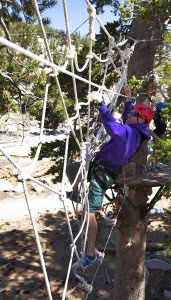
Snake Bridge nearly bit Pete Fingerhut as he carefully swung between the logs and held on to the thin ropes.

Vertical logs are linked together five at time, then three. And just when you have your rhythm, there are five single logs that test upper body strength, timing to step from one log to the next and agility to grasp the ropes.

London, a guide at Heavenly, described this feature as one of the more challenging ones. No wonder it is listed as black. (Elements are green for beginner, blue for intermediate and black for advanced just like ski runs.)

While this was Fingerhut’s first go-round at the Discovery Forest ropes course at Heavenly Mountain Resort, he and his family are now well versed at the resort’s courses. The week before he and his wife, Eileen, and daughter, Sydney, had done the Black Bear Challenge Course.

They split their time between Meyers and Moss Beach.

“This course was more challenging,” Fingerhut said at the end of the nearly two-hour session. “The other one is a lot of fun. It’s funner than it looks.”

Pete Fingerhut channels Spiderman for this feature. Photo/Carolyn E. Wright/Copyright

Pete Fingerhut channels Spiderman for this feature. Photo Copyright 2014 Carolyn E. Wright

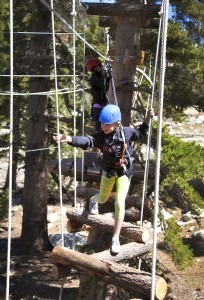
Sydney Fingerhut has not problem navigating the moving logs. Photo/Carolyn E. Wright/Copyright

Sydney Fingerhut has no problem navigating the moving logs. Photo Copyright 2014 Carolyn E. Wright

Heavenly this summer opened three ropes courses at the top of the Gondola to complement other activities in the area.

“All three have a spectrum of difficulty,” explained Liesl Kenney, Heavenly spokeswoman.

This is just the start of what resort operators hope will be widespread on-mountain entertainment that goes beyond skiing and snowboarding. The South Shore resort is in the process of seeking environmental approvals for future expansion.

The plan is to have the courses open in the winter.

“The only time we can’t run them is in high winds or there is moisture on the features,” Kenney told Lake Tahoe News.

Two guides escorted the six of us. Groups max out at 16 people.

“I liked having the guides there to ‘show us the ropes” and watch to make sure that all were safe. They were nice guys and fun,” Carolyn Wright said.

And while London and Kyle were nice and informative about what to expect or how to tackle a feature, the constant oversight on the one hand is great for feeling safe, and on the other hand seemed a bit overkill. (Skiing seems to have more inherent risks; there aren’t nearly the same number of employees on the slopes as there is on the ropes coursed compared to guests.)

Still, the features – at least in the Discovery Forest – are varied, fun and challenging.

Sydney seemed to have little problem keeping up with her parents. Her biggest problem at times was securing the cables to the guide wire. Part of her issue was height related. But my friend and I were having issues at times with getting it locked or unlocked.

From each platform there were multiple options. This cuts down on the waiting, and gives those who are looking for differing challenges the option to play side-by-side without peer pressure. Plus, if there is a feature that is particularly fun, it can be done over and over again.

It allows people to customize their experience instead of being on a set route.

Liesl Kenney demonstrates her balancing skills. Photo/Carolyn E. Wright/Copyright

Liesl Kenney demonstrates her balancing skills. Photo Copyright 2014 Carolyn E. Wright

Something always seems to be moving. Everyone seemed to struggle on the rolling logs.

“It’s really hard,” Eileen Fingerhut said once she reached the platform.

At one point she was nearly fully extended, more horizontal to the ground than vertical. That’s because the logs spin, so it is hard to stand upright while trying to walk. And, of course, all of this is while you are well above terra firma.

—–

Notes:
• Starting in September the ropes courses will be open weekends only. The gondola will close for regular maintenance in October. The resort opens for ski season Nov. 21.
• Weather will dictate if courses are open in winter.
• Must be at least 5 years old, weigh between 20 and 250 pounds, and be 42-inches tall.
• Prices:
o Discovery Forest Course plus gondola ticket: $89 adult, $78 teen/senior, $68 child.
o Discovery Forest Course: $60 with season pass or lift ticket.
o Black Bear Ropes plus gondola ticket: $79 adult, $68 teen/senior, $58 child.
o Black Bear Ropes: $50 with season pass or lift ticket.
o Boulder Cove Ropes plus gondola ticket: $79 adult, $68 teen/senior, $58 child.
o Boulder Cove Ropes: $50 with season pass or lift ticket.


STPUD employees may receive 3-year 9% raise

By Kathryn Reed

South Tahoe Public Utility District’s board on Sept. 4 is expected to approve a three-year contract with employees that includes raises each of those years.

The union this week ratified the contract. The deal affects about 100 of the 112 employees.

For the first year workers will receive a raise of 2 percent. This is retroactive to July 3, when the pay period started for the start of this fiscal year.

Raises for years two and three will be based on the Consumer Price Index for Small West Coast Cities All Urban Consumers. However, the minimum the raise can be is 2 percent for each the next two years. The maximum raise for the three years cannot be more than a combined 9 percent raise.

“What took us the most amount of time was to develop protections on the low and high side for workers and the district,” Richard Solbrig, general manager for the district, told Lake Tahoe News. He said there were 12 negotiation sessions.

Another change to the contract includes getting Martin Luther King Jr. off instead of Lincoln’s birthday. This takes effect in 2015.

In the past, employees received 11 set holidays plus three hours of floating holiday pay. That has been increased one full floating day.

The old contract called for an extra day of vacation to be added when employees reached years 20 and 25. That has been changed to years 15 and 20.

The management contract is still under review. It was a four-year contract that stipulated at year two, which is now, the contract could be opened to discuss salaries and the possibility of a market survey. Solbrig said there is no appetite to pay for a survey, but salaries are under consideration.

Medical insurance rates are not going up at the district in the next year.

Any CalPERS increases, per the contract, are split between the district and employees — at least up to the maximum CalPERS allows. After that, the district must pay the bill. This was a requirement carried over from the previous contract.


LTCC banking on Measure F to pay for upgrades

Lake Tahoe Community College is seeking its first general obligation bond. Photos/Kathryn Reed

Lake Tahoe Community College is seeking its first general obligation bond. Photos/Kathryn Reed

By Kathryn Reed

Lake Tahoe Community College is going to be different in the coming years. How different depends on voters.

Measure F – as in facilities – is on the Nov. 4 ballot. It is a $55 million general obligation bond that property owners in the district would pay back over the course of about 30 years. The amount owed cannot exceed $25 per $100,000 of assessed valued. That means owners of a house valued at $300,000 would pay $75 per year. To pass, it must receive at least 55 percent approval.

The college expects to deliver $107 million worth of projects over 10 years. The other $52 million will come from matching dollars from the state or other grants.

No argument in opposition to Measure F has been filed with the El Dorado County Elections Department.

The money is entirely for facilities. No money can go toward salaries or benefits.

While the South Lake Tahoe institution has been putting some money away for major repairs, those dollars are not enough to keep up with the major maintenance costs and ongoing technology upgrades that are needed. Nor does it come close to being able to cover expenses associated with new facilities. Plus, LTCC has been contending with five years of budget cuts.

Informational signs are scattered throughout the campus.

Informational signs are scattered throughout the campus.

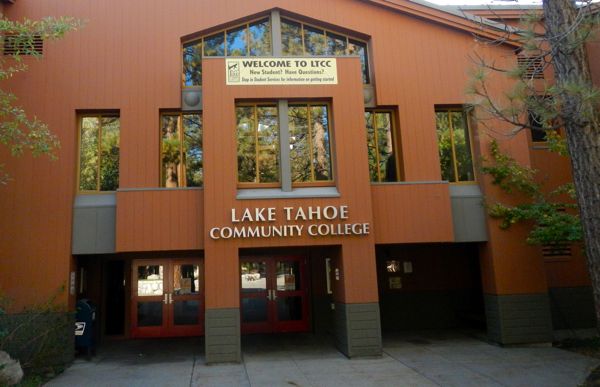
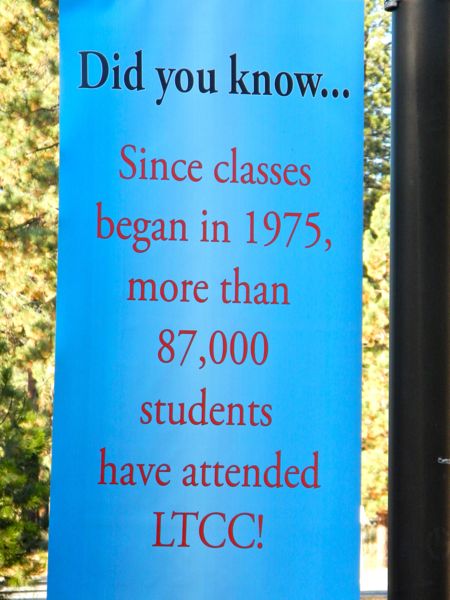
LTCC, while it turned 40 this year, has been at the current location for 25 years. To the untrained eye, the outside still looks fairly new. But President Kindred Murillo said closer inspection reveals the wear and tear on the facilities through the years, especially because of being located in a harsh climate like Lake Tahoe.

But the college is also contending with science labs that are 25 years old, a campus that doesn’t have adequate wireless capabilities for a generation of students who have their own mobile devices, and safety issues that decades ago were not even on the radar – like protecting people on campus if there were a gunman.

For students coming to LTCC from South Tahoe High School, the facilities are like taking a step backward after the multi-million upgrades delivered from the 2008-voter approved Measure G bond.

The college bond is designed to bring LTCC into the 21st century “to give students and teachers the best environment.”

“I hate to send a highly qualified instructor into a classroom where they have to fight with heating, cooling and technology,” Murillo told Lake Tahoe News.

Plus, some of the upgrades will actually reduce some bills – like electrical and heating.

And if the bond doesn’t pass?

“We will probably have to downsize classes and programs because we will need to shift money to things that need to be fixed,” Murillo said.

She said the vision of the college – to be California’s premier destination college – wouldn’t change. What will change is the time line to accomplish that goal. Murillo wouldn’t say how many years it would put the college behind, but said it would take a lot longer to get to where the staff and board want to go.

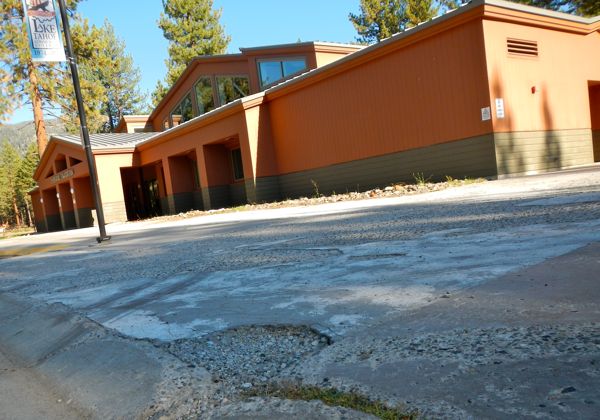
With passage of the bond, what people would notice right away is the main building would be modernized, which includes being retrofitted for energy efficient lighting; crumbled sidewalks near the gym replaced; and the patchwork of roof repairs gone.

Concrete in front the PE building gives the campus a rundown look.

Broken concrete in front the physical education building gives the campus a rundown look.

The college is seeking matching money from the state to build a public safety training facility. This would tie into the school’s fire academy. This would also act at the community’s office of emergency services.

LTCC is also planning to create a university center. Senate Bill 850 is on the governor’ desk. This would allow community colleges to offer baccalaureate degrees that don’t compete with those that are available in the CSU and UC systems.

Murillo said staff is discussing a program that would be Tahoe specific. The college could either offer its own four-year degree or partner with an established institution.

Friends of Lake Tahoe Community College has been established to be the advocacy group for Measure F. A website will be launched in September with more information.