Death Valley’s Racetrack seems otherworldly
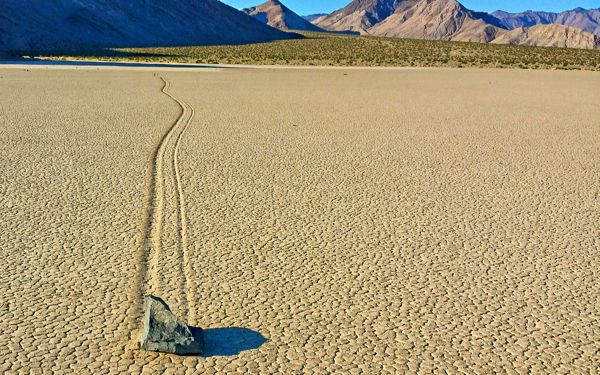
The Racetrack in Death Valley is mesmerizing. Photos/Toogee Sielsch

The Racetrack in Death Valley is mesmerizing. Photos/Toogee Sielsch

By Toogee Sielsch

DEATH VALLEY NATIONAL PARK – “It’s your call Ian. Do you want to spend the night around here and check out Scotty’s Castle in the morning, or should we drive the 27 more miles on dirt roads, in the dark, and check out that Racetrack thing in the morning?”

“Racetrack!(?)” Ian replies.

“Good answer!”

The Racetrack – a true scientific enigma until just this last year. Located in the northwest end of the Death Valley National Park, but many miles from Death Valley proper. The Racetrack is a dry ancient lakebed that sits at 3,600 feet. Its playa runs almost due south to north, is just less than 3-miles long by almost 1½-miles wide.
It’s also extremely flat. The difference in altitude from the south to the north end is barely 1.5 inches (4cm), which is basically attributed to a larger buildup of fine sediment at the north end.

It’s in a basin that is surrounded by spectacular colored mountains rich in minerals and even has evidence of an abandoned mining operation above the playa to the southeast side. Named “The Racetrack” for the rocks, called sailing stones, that somehow travel in a mostly south to north pattern across the playa leaving, depending on the size of what is moving across the lake bed, ruts in the rock hard, cracked dirt playa surface. We even found some thick tumbleweed branches that had felt inclined to join the rocks in their quest for the north end of the playa.
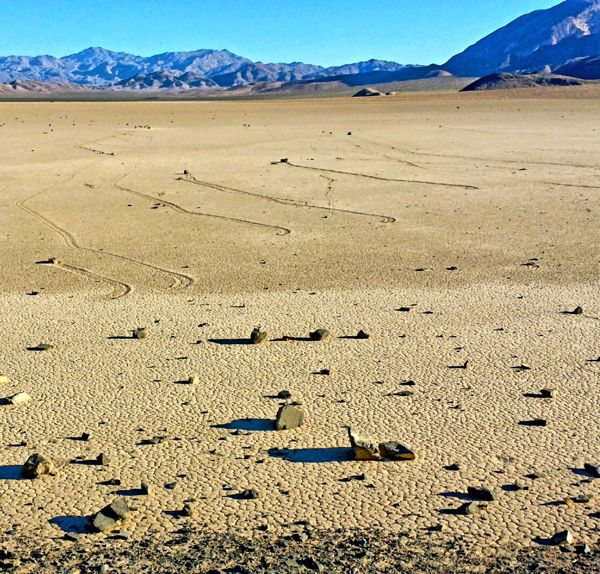
Rocks find their way onto the playa.

Rocks find their way onto the playa.

There have been many different stories and interpretations of this phenomenon, and most were centered on three elements. The perfect combination of water on the playa turning its surface into a slick and wet mud flat, freezing temperatures create a thin ice layer above the mud, and strong wind. But until just recently when a research team from UC San Diego used video, attached GPS units on some rocks they introduced onto the playa, and were even lucky enough to witness the phenomena, no one knew just exactly how, or even how fast these playa objects moved. Rocks varied in size from those weighing an ounce to those weighing upward of 100-plus pounds. The team clocked some of the rocks moving up to 20 feet per minute. That figure is not a typo. Up to 20 feet per minute, and some movement with winds as light as 10 mph. And as evidenced by their trails, their movement is only sometimes in a straight line. To paraphrase Bob Dylan, “These rocks don’t need a weatherman to know which way the wind is blowing!” The phenomenon takes place on the backside, or thawing phase, of a wet/freeze/thaw/wind event.

Never had I thought too hard about, but I had thought about it before on occasion, the question as to where the rocks came from. As we drove toward The Racetrack in the dark on fairly well maintained dirt roads the question grew in my mind. Along the drive something that stood out under the dark star-filled sky was the silhouette of the peaks and ridges all around us. Not the nice rolling landscape in meadow scenes, but stark hill and mountainsides with steep rocky inclines. By the time we arrived at the southern end of the playa, which was about 10:30pm, our first order of business was to walk out onto the playa a couple hundred yards and get a feel for the place. The sliver of a moon had already set, but the crystal clear sky was literally dirty with stars that emitted more than enough light to get a feel for the landscape that surrounded the playa. We even found a couple of small racers with their tracks leading off into the dark to the south of us.

It was time to hit the sack and get some rest. Sleep came fitfully, in part because of my excitement of what the morning light would reveal, coupled with a night sky literally overflowing with stars making me reluctant to close my eyes for fear of missing something.
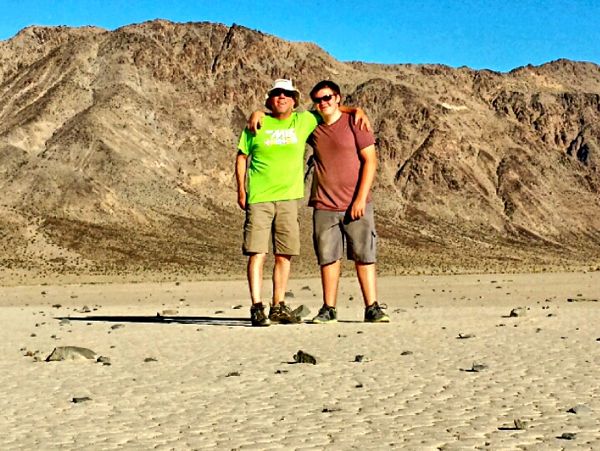
Toogee and Ian Sielsch explore The Racetrack.

Toogee and Ian Sielsch explore The Racetrack.

First light roused me from a deep sleep, and looking over at my navigator/co-pilot/ favorite youngest son, Ian, I knew he was an hour plus from waking. Time to go explore before the sun heats things up. Walking out on the hardpack cracked playa in the early morning with little air movement had an eerily calming effect akin to looking at sheer glass on Lake Tahoe in the early morning. Becoming more alert with every step onto the playa my attention was drawn to the south and southeast end of the playa, all the while walking among the “sailing rocks” and their trails. Now I want to clarify that the playa is not “littered” with these hapless racers. But the closer I approached the southern end, and many more racers are present, the answer to my nagging question was revealing itself. On that southern end and on the southeastern edge, there are steep inclines of rock outcroppings that sit about 6 feet back from the playa surface. The landscape around the rest of the playa, although ringed with steep ridges, has a gentler incline running hundreds of yards to the base of the inclines. Within that six feet sits a gravely pebble field.

Now I’m pretty sure that the scientists studying this phenomenon were quite content that the answer to my inner question was so rudimentary that they felt no need to highlight this point. But as I inspected this area that seemed to produce the highest amount of racers I felt that it was a very important part of the equation. This six-foot zone was the make or break for many of our rock racing friends. Without actually contacting the surface of the playa, it was quite evident that there would never be a chance of it being part of the legacy of rock racers. Which brought me to the conclusion that – tada – a rock, or a multiple rockslide must have enough velocity as it runs down a 30-plus percent grade (I’m guessing) to cross a rock strewn surface almost completely flat measuring about six feet to become a “Playa Player”!

Without being on the cracked, hard packed surface of the playa that rock’s dreams will never have a chance to be realized.

And in my world, rocks have hopes and dreams!

—-
Getting there:
If entering the park on California Highway 136 from Lone Pine, continue onto Highway 190 through Stovepipe Wells, then turn left about 6.3 miles on the road north to Scotty’s Castle for about 33 miles. When arriving at the junction, take a left to the Ubehebe Crater, than enter the dirt road on the Ubehebe Crater loop to the 27 miles to The Racetrack. The route we took was out of Big Pine taking Highway 168 to the Death Valley Road turnoff, and then on to the Scotty’s Castle Junction that is 76 miles, 60 miles or so on well cared for dirt roads. Then take a right to the Ubehebe Crater Loop.




Leisure, hospitality employment growing in Nev.

By J.D. Morris, Las Vegas Sun

Next year, the number of people employed in Nevada’s leisure and hospitality sector could return to the highest level it had reached before the recession hit.

Since falling to a low point of slightly fewer than 304,000 employees in November 2009, the state’s leisure and hospitality labor force has rebounded back to 335,500 people in July of this year, data from the U.S. Bureau of Labor Statistics show. Leisure and hospitality employees include casino, hotel, restaurant, nightlife and entertainment workers.

July’s level is only 7,100 jobs lower than the sector’s peak of 342,600 workers in December 2007. If employment grows at the current rate, the sector should close that gap in the second half of 2015.

“Basically, because the recession impacted consumer spending and disposable incomes so much, that sector was very hard hit. We’ve turned a corner, and we’ve been adding jobs the past couple of years,” said Bill Anderson, chief economist for the research and analysis bureau at the state Department of Employment, Training and Rehabilitation. “We think that reaching the pre-recessionary peak is in sight.”

Read the whole story


Davis: ‘I made promises and I kept them’

Publisher’s note: Lake Tahoe News asked the seven South Lake Tahoe City Council candidates a series of questions. All are the same except for one that is specific to each candidate. The responses are being run in the order LTN received them.

tom davisName: Tom Davis

Profession/work experience: Director of General Services for Heavenly Ski Resort; convention manager, transportation manager for Sahara Tahoe Hotel Casino; executive director of sales and marketing for Sahara Tahoe, High Sierra, Horizon hotel and casinos. Director of sales at the Ridge Tahoe, president and managing partner for Tahoe Keys Resort. For a short time director of marketing, casino host for MontBleu Resort Casino &Spa.

Age: 68

What organizations, committees or groups are you or have you been involved with?: Board of directors of the following organizations:
California Tahoe Conservancy
El Dorado County Fair Board
Lake Tahoe Visitors Authority
Lake Tahoe Wildlife Care
Christmas Cheer all Year (Food Bank)
Kiwanis Club Lake Tahoe.

Why are you running for City Council?: To make a difference, which I have done.

Why should people vote for you over the other candidates?: Because I have done what I said I was going to do. I made promises and I kept them. My brochure when I ran said we would invest in our future. The following were promised and completed: Highway 50 improvements with Caltrans $43.1 million. That is going on right now. Get the lawsuits settled at Lakeview Commons and get the project complete. That has been done. Get the Chateau project completed. That is finished. Get Harrison Avenue streetscape project going. That is going right now. Fire Station 2, new ladder truck to replace 33-year-old truck. That is done. Linear Park pedestrian lighting and landscaping and repaving of the bike path and pedestrian pathway. That is done. Pedestrian lighting curbs and gutter from Ski Run to Larch Avenue. That is done. New police vehicles. That is done. El Dorado Beach bathrooms. That is done. The Aspens 45 units affordable housing project. That is completed. The Bijou erosion control project that will keep 21,000 pounds of sediment out of the lake each year. That is done. That is completed Class 1 bicycle trail rehabilitation. That is done. I’ve been the common thread through all those projects because I believe in building bridges not fences.

What do you think is the most pressing issue facing South Lake Tahoe and how will you deal with it?: The economy, the economy, the economy. Improve the built environment just as we have been doing. More recreation facilities and opportunities and entertainment. Encouraging more retail to locate to Tahoe. Encourage locals to remodel their businesses. This can be accomplished with the incentives in the recently adopted area plans.

If the city cannot reach an agreement with its bargaining units, are you willing to go to impasse? Why or why not?: Yes, but it is my hope we will reach an agreement. Our employees are a valuable community asset.

How would you resolve the CalPERS and health care issues in the city?: CalPERS is a state issue that cities, counties and special districts have no control over. The California rule needs to be eliminated. That is shortages in CalPERS have to be made up by the local governments and special districts. They also keep changing the rules in the middle of the game which only adds to the liability. We have made some progress by our having our employees contribute to CalPERS. The city has been actively working to reduce the health care liability from retirees by having those over 65 go into Medicare. It has reduced the liability from $47 million to $25 million. The health care we provide for our current and retirees is too expensive and will be reduced over the next few years. The council has directed the city manager to reduce this unfunded liability. We have no choice but to do that. Every city is facing the same issues. In addition, all new hires do not receive that benefit. But much more needs to be done.

What is your opinion about term limits for the council?: The voters in South Lake Tahoe are educated and well informed. Every two years they can vote us in or out. And they do.

If the city has positive cash flow, where should the money be spent?: Infrastructure which includes paving our roads, improving our recreation facilities and protecting our citizens.

What are your ideas for increasing the city’s revenues?: This record July shows that our road to success lies with providing quality facilities in our city. Visitors and locals are now saying that the town looks great.

What is your vision for the 56-acre project?: We need to partner with the county because they actually own that property. However, they are working with us and are part of the recreation master plan process. This plan will establish the future of the 56-acre project. Looking forward to seeing the plan soon.

What would you do to improve relations with El Dorado County?: I have always had a good relationship with the county supervisors, most likely because I sit on the EL Dorado County Fair Board which provides me with opportunities to build friendships.

Is the city on the right course with restructuring debt and focusing on recreation? Why or why not?: Yes. We just refinanced and may do more because of lower interest rates which frees up millions for infrastructure and recreation.

Name one vote the City Council made in the last four years you are proud of and one you are disappointed in – and why?: I’m proud of voting to get the Chateau project done that helped fix the hole in the ground.

The hardest vote for me was reducing our workforce and laying off 70 employees which came to about one-third of our entire staff. We had no choice.

What is working in the city and what isn’t; and how would you go about changing what isn’t working?: What is working is that we are getting our financial house in order.

We could do a better job of communicating with the public and transparency in government in the city. To our credit we see the problem and are working on it. For instance you can go to the city web site and get information on the budget and most all of the city programs and all City Council meetings www.cityofslt.us
Or you can call me anytime at 530.545.1168.

Being on the council requires working with four others. Give readers an example of how you work well others in difficult situations with differing opinions: I believe in building bridges not fences and even when I’m in the minority on a vote I still respect the majority decision. I always respect the majority vote of the council and never try to undermine their decision even when I don’t agree.

What is your opinion about the following topics:

· Ferry service on Lake Tahoe?: I think it will be a financial black hole. There just isn’t enough demand for it. However, free bus service would be the smart place for the Tahoe Transportation District to seek grant funds. It is common sense that when fares are free rider ship goes way up and greatly benefit’s the working community.

· Loop road?: The city has made it clear that we will not seize properties through eminent domain. If it is possible to have all those who own property there to be willing sellers then if the TTD can accomplish that it is a better project.

· Future of Lake Tahoe Airport?: Airport proved its value in the 2007 Angora Fire disaster. We are seeing an increase in general aviation small plane traffic. What I would like to see is an airport district that would include portions of Douglas County, El Dorado County and our city. It’s a fact that our airport serves a regional market that should help bear the costs of the district.

· Increasing the transient occupancy tax?: Only if it was not going into the black hole. It would have to be for something that increased other revenues for our businesses and city government.

· Changing the vacation rental ordinance to reduce the number of such units in neighborhoods?: No. We have a very comprehensive city ordinance that addresses all the issues such as noise, number of people and parking. The ordinance also provides for elimination of a vacation rental if it is a recurring problem. I am in the vacation rental business and my company has provided many great family experiences. The problem we see is usually from out of town single home vacation owners (VRBO) who rent properties but don’t live here so they can’t supervise them. And local vacation rental companies are responsible good community neighbors and are proactive in policing the units they handle. They have staff that are available for that. Parties in quiet neighborhoods are not tolerated. The biggest complaints that I get are illegal marijuana in our neighborhoods. That is what I will push to have addressed. We must have safe neighborhoods. I was doing a ride along with our police department and witnessed a fire at a house used for a illegal marijuana grow. The renter had bypassed the electoral panel which overloaded the system and caused the fire.

Why do you have a concealed weapon permit? How often do you carry that weapon to council meetings or other public places?: The Second Amendment allows law-abiding citizens to have protection for them and their family. The whole point of concealed carry is just that. No I do not carry it to City Council meetings. The police provide security at our meetings.

Tell the voters something about yourself that they may not know: I hold a 100-ton United States Coast Guard license. (Currently inactive.) When I worked for the Sahara Tahoe Hotel Casino I took out on the hotel’s 42-foot yacht Elvis, Tom Jones, the Beach Boys, Johnny Cash, Joey Bishop, Engelbert Humperdinck, Liberace, Mac Davis, Helen Reedy. I met some great people.


Study: Music may close achievement gap between poor, affluent students

By Rebecca Klein, Huffington Post

Closing the achievement gap between low-income and affluent students could be as simple as do-re-mi.

In a study out Tuesday from Northwestern University, researchers looked at the impact of music education on at-risk children’s nervous systems and found that music lessons could help them develop language and reading skills. The study is the first to document the influence of after-school music education on the brains of disadvantaged children, as opposed to affluent children receiving private lessons.

Researchers from the Auditory Neuroscience Laboratory at Northwestern spent two summers with children in Los Angeles who were receiving music lessons through Harmony Project, a nonprofit organization providing free music education to low-income students. In order to document how music education changed children’s brains, students were hooked up to a neural probe that allowed researchers to see how children “distinguished similar speech sounds, a neural process that is linked to language and reading skills,” according to a press release.

Read the whole story


U.S. no longer dominated by ‘typical’ families

By Brigid Schulte, Washinton Post

The iconic 1950s family of the breadwinner father going off to work and caregiving mother taking care of the homefront, has been described by economists as the most efficient family structure. Everyone has a distinct job to do in their “separate spheres” of public and private life. And in the 1950s, the majority of children were being raised in such “typical” families.

We all know that’s not true anymore. But perhaps what we haven’t fully understood yet is that today, there is no one “typical” family. The breadwinner-homemaker family, the norm since the dawn of the Industrial Revolution in the 19th century, is being replaced by a new norm of diversity.

“There hasn’t been the collapse of one dominant family structure and the rise of another. It’s really a fanning out into all kinds of family structures,” said Philip Cohen, a sociologist at the University of Maryland. “Different is the new normal.”

In a report for the Council on Contemporary Families being released this week, Cohen notes that in the 1950s, 65 percent of all children under 15 were being raised in traditional breadwinner-homemaker families. Today, only 22 percent are.

Read the whole story


Tallac High focuses on prepping grads for work

By Kathryn Reed

A diploma doesn’t mean much if you don’t have any skills that translate to the working world. That is why Mount Tallac High School is changing its emphasis.

All the basics are still being taught at South Lake Tahoe’s continuation school. But now there is a focus on making the instruction more pertinent to real world situations.

“We are getting out of the old textbook which had a lot of drill and kill,” math instructor Jackie Tan told Lake Tahoe News. “I’m going to be able to make their math relevant.”

Algebra lessons might come in the form of having students getting into groups to start a business and then needing to work out inventory, pricing and other factors.

Working in groups is a new concept in Tan’s classroom, too. She is doing this because so often in the workplace it’s about being a team, working collaboratively and not solo.

Adrian Ortega talks with Joy Barney from the U.S. Forest Service. Photo/Holly Greenough

Adrian Ortega talks with Joy Barney from the U.S. Forest Service. Photos/Holly Greenough

The changes are the brainchild of Holly Greenough who is in her first year of being principal of the school. She had trained under Susan Baker, who retired in 2013 after 23 years in Lake Tahoe Unified School District. (Karen Tinlin was at Tallac last year and is now working out of South Tahoe Middle School on the School Attendance Review Board before she retires in December.)

“I’m working hard to change the program to become a work to career program so students are better prepared to serve our community in the service industry once they graduate,” Greenough told Lake Tahoe News.

She said most Tallac grads end up staying in the community. Being employable and then perhaps rising through the ranks to management positions is her goal for them.

The school is working with local businesses to make this successful. A job fair was conducted the first week of school to acquaint students with the type of work that exists on the South Shore and for employers to tell students the skills they will need.

But it’s not just about service industry jobs.

“We are looking for students with a positive attitude about working in the outdoors, who are committed to eight weeks of hard, physical work, and who are open to future opportunities or a career in natural resource management,” Joy Barney, conservation education program specialist with the U.S. Forest Service, said.

The Forest Service through its Generation Green has a history of working with Mount Tallac.

“We have employed between one and seven of their current and former students each year for the past seven years of the program – 15 to 25 percent of our summer employment program,” Barney told Lake Tahoe News.

Mount Tallac students talk with potential employers.

Mount Tallac students talk with potential employers.

Harveys-Harrah’s will let students take tours of the Stateline properties to get acquainted with the various jobs that are available. Different human resource specialists will be able to go to the campus.

Eric Campbell, manager at Bank of the West, is on board to teach students how to create a business plan.

“We don’t want to limit them with what they learn. We want to open doors and their minds to show them whatever they are interested in they can pursue,” Greenough said.

Developing certifications is something she is working on. This is so when students are learning to write resumes in Krista Serra’s class, they will have substantive information to put on it. Plus, it will be a relevant skill to use on a job. Certifications will range from CPR to 10 key to food safety. The school hopes to obtain grants to pay for the ones that require money to obtain, such as CPR.

Being bilingual, which many of the students are, is being promoted as a skill to hone. But it means proper Spanish and not just slang.

Many employers say issues they have with workers are soft skills – which translate to dressing appropriately, using proper language, being on time and not calling in sick on a powder day.

“If a student cusses, she says ‘you are fired’. It snaps you back to reality,” senior Joe Morales said.

The idea is for students to get in their heads what is right and wrong in the workplace.

While most have cell phones, if they have to take a call, it has to be done so outside. This makes them think if they should even be answering the phone.

Looking people in the eye, firm handshakes and the art of listening are being taught.

A big thing that is new is the students must clock in and out – just like some jobs require.

Adriana Aguilar, who is a senior, likes that things are much more structured this year.

“Having to check in every morning motivates you to be on time every day. It’s just like if you had an actual job,” Aguilar said.


Weak El Nino won’t be a drought buster

By Sharon Bernstein, Reuters

SACRAMENTO — The Pacific Ocean phenomenon called El Nino, which can lead to storms in the U.S. Southwest and other places, will likely start soon, but may not bring hoped-for relief to drought-parched California, U.S. government meteorologists said on Thursday.

Scientists with the National Oceanic and Atmospheric Administration said in a report the likelihood was increasing that El Nino, characterized by a warming of the ocean temperature in the eastern Pacific near the equator, would be weak this year.

A weak El Nino could still bring flooding, storms and even hurricanes to Southern California, but it is too soon to tell whether that will happen, said Eric Boldt, a meteorologist with the agency.

Read the whole story


Plunge in vaccination rate worries health officials

By Paloma Esquivel and Sandra Poindexter, Los Angeles Times

California parents are deciding against vaccinating their kindergarten-age children at twice the rate they did seven years ago, a fact public health experts said is contributing to the reemergence of measles across the state and may lead to outbreaks of other serious diseases.

The percentage of kindergartens in which at least 8 percent of students are not fully vaccinated because of personal beliefs has more than doubled as well, according to data on file with the state. That threshold is significant because communities must be immunized at a high rate to avoid widespread disease outbreaks. It is a concept known as herd immunity, and for measles and whooping cough at least 92% of kids need to be immune, experts say.
Public vs. private

High vaccination levels in the U.S. have helped millions of children avoid serious diseases and saved tens of thousands a year from paralysis, birth defects and death, experts say. But the risk of infectious disease remains a concern. Recent measles cases, for example, were brought into the country by travelers and quickly spread to several unvaccinated individuals.

Read the whole story


USFS trying to save native river mussel in Tahoe

Western pearlshell mussels are being measured, weighed and tagged. Photos/Kathryn Reed

Western pearlshell mussels in the Upper Truckee River are being measured, weighed and tagged. Photos/Kathryn Reed

By Kathryn Reed

Part of the U.S. Forest Service’s nearly $5 million restoration of its section of the Upper Truckee River includes relocating 12,000 Western pearlshell mussels.

This summer 10 percent of the mollusks are being plucked from the river’s bottom, weighed, measured and tagged, then put in coolers before being relocated to other sections of the river, as well as Trout Creek, as part of a pilot project.

Scientists want to see how the relocation works before all of the mussels are moved.

Different control plots have been created so if there is a die-off the scientists will ideally be able to isolate what went wrong.

Mason Bindl hovers on the water, splashing a bit as he uses a snorkel and mask to look for these mussels that look big enough to eat. He scoops them into a mesh bag.

On the riverbank are Cody Bear, Phil Meting Van Rijan and Erin Miller. They are recording the particulars about the mussels so as monitoring begins in October, and then continues every three months, officials will know the survival and growth rates.

Working on the project are, clockwise from right, Mason Bindl, Cody Bear, Phil Metting Van Rijan, and Erin Miller.

Working on the project are, clockwise from right, Mason Bindl, Cody Bear, Phil Metting Van Rijan, and Erin Miller.

If they aren’t removed, they all would die. This is because where they are will be drained in 2016 and then filled in with dirt. A final sweep of the current channel will be made that summer to retrieve any stragglers.

A new 7,000-foot river channel has been in the works for a few years.

Sarah Muskopf, fish biologist with the USFS, said, “It’s important to salvage this population. Not only is it the last one, but it’s a huge part of the ecosystem.”

The creatures, which can live to be 100 years old, are considered filter feeders. This means they feed off the nutrients and contaminants in the water, which in turn helps with clarity.

These native mussels used to be prolific in the Upper Truckee Watershed. Their numbers are diminishing. While scientists don’t know exactly why the decline has occurred, they point to declining habitat for the mussels.

“The habitat is marginal here at best,” Muskopf said.

They prefer cold, clean water with a cobble or gravel floor. That’s exactly what is being designed for the new channel.

Most of the current channel lacks gravel, is warming because it is so shallow and is murky because of all the sediment.

River otters are the mussels’ main predator. When the Lahontan cutthroat trout were in the river this also helped the mussel population grow because they would feed off the excrement.

Besides the Upper Truckee River, these pearlshell mussels are found in the lower Truckee River – beyond the dam in Tahoe City – and in other fresh water bodies in the Western United States.


STPUD board not unanimous in contract vote

By Kathryn Reed

On a 3-2 vote Thursday afternoon, the South Tahoe Public Utility District board approved a three-year contract for employees that calls for raises of at least 6 percent and up to 9 percent in that time period.

Voting no were Chris Cefalu and Randy Vogelgesang.

“I can do the 2 percent cost of living. I cannot cap it at 9 percent,” Cefalu said at the Sept. 4 meeting. “My decision has been known all along.” He thought 9 percent was too high.

Vogelgesang, though, changed his mind at the meeting. He suddenly was having issues with the three-year agreement. He said he wanted to be responsive to ratepayers who have concerns about the contract.

“Right now talking about it is not the time because we made the union an offer,” General Manager Richard Solbrig responded. “If you pull it off the table, there are consequences.”

Had the offer been changed or not approved, the district would have faced state sanctions regarding unfair labor practices.

The board adopted the agreement at an Aug. 15 special meeting. Cefalu was not at that meeting and Vogelgesang said he didn’t remember that decision.

Two members of the public spoke at Thursday’s meeting. Pamella Bondor-Wenziger, who attended meetings in the spring when rate increases were discussed, questioned why the public doesn’t have a say in salary increases.

Board President Eric Schafer assured her she was being heard, but it will be for future boards to take any action on what she had to say.
Kenny Curtzwiler said he believes the incoming board, of which there will be at least one new member (Schafer is stepping down) and the potential for two, should be deciding on the contract.

Schafer said the five seated were elected to do a job, were capable of doing it and those decisions should not be kicked down the road.

This is the second salary increase for STPUD employees in the last two years.

The board in November 2012 unanimously approved a four-year contract for the union and two-year for management that was retroactive to July 1, 2012. Union members received between a zero and 13.31 percent pay hike, while the management group increase was between zero and 14.1 percent. About two-thirds of the 92 union employees received a raise.

There are now 110 employees in the union and 17 managers not represented by the union.

The 2012 contracts allowed for salaries to be discussed at the two-year mark, which is now. Discussions about management wage increases are ongoing.

More details of the current contract are in this Lake Tahoe News story from Aug. 29.