Brown signs historic groundwater management legislation

By Melanie Mason, Los Angeles Times

Gov. Jerry Brown signed a trio of bills Tuesday establishing a framework for statewide regulation of California’s underground water sources, marking the first time in the state’s history that groundwater will be managed on a large scale.

“This is a big deal,” Brown said at a signing ceremony in the Capitol. “It’s been known about for decades that underground water has to be managed and regulated in some way.”

Since the state’s founding, water has been considered a property right; landowners have been able to pump as much water from the ground as they want. But increasing reliance on underground water, particularly during droughts, has led to more pumping from some basins than what is naturally being replaced.

Some areas already have begun managing their groundwater sources, but other key basins remain unregulated.


Read the whole story


Former Harrah’s president dies

Lloyd T. Dyer

Lloyd T. Dyer

By Guy Clifton, Reno Gazette-Journal

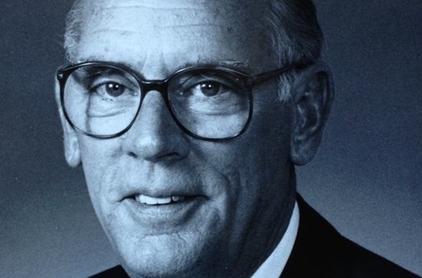
Lloyd T. Dyer, and former president and CEO of Harrah’s and a longtime Reno civic leader, died Sunday night.

He was 87 and died after a brief battle with cancer, his son, Greg, said Monday.

Lloyd Dyer went to work for Harrah’s in 1957, starting in the cashier’s office and working his way up through the company. In 1971, while serving as vice president of finance, he was instrumental in making Harrah’s the first pure gaming company to be publicly traded, first on the Pacific Stock Exchange and then the New York Stock Exchange.

Read the whole story


Illegal pot grows increasing problem in S. Tahoe

By Kathryn Reed

Inhale deeply in many South Lake Tahoe neighborhoods and the stench of skunk permeates the nostrils. But it isn’t wildlife; it’s marijuana being grown indoors.

Need some weed? South Lake Tahoe is your answer – especially for people with medical marijuana cards. Tahoe Wellness Cooperative, the only medicinal marijuana shop in the city since the other two were shutdown, has 19,000 members. (The whole city has 21,286 residents.) Cody Bass, who runs the dispensary, says 8,000 of them are locals. (This is more than the number of registered voters.)

The city in 2011 made pot shops legal with an array of rules that had to be followed. An audit of TWC this summer showed the collective didn’t provide the quantity of pot coming and going from the Highway 50 facility. This has Police Chief Brian Uhler concerned. For one, it’s part of the ordinance that the amount of pot bought and sold must be provided to city officials when requested. Second, it means it is hard to discern where the pot is coming from – locally, imported, clients, other. Third, officials don’t know if the outgoing pot is going to patients or being sold illegally.

Uhler gave a presentation to the South Lake Tahoe City Council on Sept. 16 that raised a number of questions.

“We don’t know marijuana is not being diverted into illegal markets because there are not adequate records,” Uhler said.

He said his main concern for getting a handle on the situation is for the health and safety of the community. Fire is of the utmost concern.

The blaze at the mobile home last week had an illegal marijuana grow inside.

However, Fire Chief Jeff Meston told Lake Tahoe News, “(The) fire was undetermined, so no conclusions if it was caused or not caused by the grow.”

Still, illegal grows are problematic. Many have overloaded the electrical system, which leaves the system susceptible to fire.

“Marijuana grows are 24 times more likely to catch fire than a normal structure,” Uhler said.

Thirteen grows have been found in the city this year. Gareth Harris, fire chief with Lake Valley, said in his jurisdiction 20 illegal grows have been found in 2014.

“We are just scratching the surface,” Uhler said.

He estimates there are 300 illegal grows in the city. Only nine are legally permitted. Matt Underhill, commander for South Lake El Dorado Narcotics Enforcement Team, told the council there could be just as many illegal grow houses on the South Shore of El Dorado County.

He said SLEDNET receives between six and 12 complaints a week about suspected illegal grows. Investigating them all takes time and resources, which diverts agents from dealing with the more serious drugs in the community like heroin, meth and cocaine.

Uhler believes if the pot ordinance were tweaked a bit to take away the financial incentives for growers, that there may be fewer issues in town. He wants the dispensary to only be able to receive marijuana from permitted residential cultivators. He also wants to make sure people are then growing the limited amount allowed. This, he said in his PowerPoint, would cut off “illegal cultivators from their source of revenue.”

Later this fall the council will revisit the issue. Tuesday’s session was just information and not an action item.


Study: More Americans have health insurance

By Sabrina Tavernise, New York Times

Federal researchers reported on Tuesday that the number of Americans without health insurance had declined substantially in the first quarter of this year, the first federal measure of the number of uninsured Americans since the Affordable Care Act extended coverage to millions of people in January.

The number of uninsured Americans fell by about 8 percent to 41 million people in the first quarter of this year, compared with 2013, a drop that represented about 3.8 million people and that roughly matched what experts were expecting based on polling by private groups, like Gallup. The survey also measured physical health but found little evidence of change.

The findings were part of the National Health Interview Survey, a nationally representative examination that is considered a gold standard by researchers. It interviewed about 27,000 people in the first quarter, fewer than Gallup, which interviewed 45,000 people in the second quarter alone. But researchers say it is considered particularly trustworthy because federal interviewers conduct the survey in Americans’ homes. It also sets a federal level that others can use as a benchmark.

Read the whole story


Iconic French restaurant in Stateline closing

Chef Camille Schwartz will be closing Mirabelle in Stateline on Sept. 28. Photos/Provided

Chef Camille Schwartz will be closing Mirabelle in Stateline on Sept. 28. Photos/Provided

By Kathryn Reed

The South Shore is saying au revoir to its only French restaurant.

Mirabelle, which has been a tradition here for 14 years, is closing Sept. 28.

“I have been cooking for the last 60 years. It is time for me to stop before it gets too bad … before I use sugar for salt,” chef Camille Schwartz told Lake Tahoe News.

The owner-chef who has never lost his French accent is ready to do new things – including enjoying Tahoe. Working six days a week and maintaining a relationship with his wife who lives in Santa Barbara has been challenging. Now he wants to spend his days hiking and snowshoeing, and getting to Southern California more often. And he wants a dog – something he hasn’t had time for based on his hours.

One thing he is a bit apprehensive about is cooking at home. He never does it.

“I always eat at the restaurant. I don’t have food in the refrigerator,” Schwartz said.

Mirabelle has plenty of regulars who also may have to learn to do more home cooking. This is what some of them have to say about Mirabelle:

• Bob Keller of Zephyr Cove: “I have enjoyed chef Camille’s wonderful cooking almost since the day he opened; many times by myself; many times with just a few friends; and many times with a large number of guests, including for Carolyn’s and my wedding dinner. When out-of-town friends or family have visited, Mirabelle has been a must on our agenda. Chef often would come out of the kitchen to talk with us. Many of the servers have become close friends. It was like going home. Of course, it helped that the food was always fabulous.”

• Carolyn Wright of Zephyr Cove: “Bob took me to Mirabelle during my first Tahoe visit with him. It’s since been an important and weekly part of our relationship – a place where everyone knows our name. Chef’s food always has been delicious, from his pureed soup to after-dinner sorbet. Chef would make a fortune selling his incredible lemon and mint sorbets.”

• Kim Wyatt of Meyers: “It’s our regular date night spot. I love the onion tart, the mushroom tart, the pasta, the soufflé, the care with which the food is made, and the ambiance.”

Schwartz doesn’t have a favorite dish to eat or prepare. He said he likes to change things around, whether it’s making a bouillabaisse, soufflé, foie gras or escargot.

His interest in food started when he was a boy in France.

“I grew up on a small farm. I was always interested in the smells in the kitchen, what my mom was cooking,” the 75-year-old said.

At 14 he was an apprentice cook in another part of France. From there he joined the navy and was a cook for the French fleet. Then he spent six years as a chef on ocean liners. Schwartz was working for a hotel chain in the late 1960s that transferred him to different locations in Canada and the United States. It was in Chicago where he met his wife. She’s American, but speaks French.

For 20 years he had a restaurant in Santa Barbara called Mimosas. He sold in 2005 because it was getting to be too difficult operating it and Mirabelle.

With the number of hours he spends at the restaurant, Schwartz is pretty sure he won’t miss the work.

“I will miss the contact with staff who is family, and with customers who have become friends through the years,” Schwartz said.

He has between five and eight employees depending on the season.

Schwartz knows the finality of it will take some time to sink in.

“I’m going to miss friends. It’s going to hit me later,” Schwartz said.


Laine: Advocate for enforcing city’s ordinances

Publisher’s note: Lake Tahoe News asked the seven South Lake Tahoe City Council candidates a series of questions. All are the same except for one that is specific to each candidate. This is the final one.

Brooke LaineName: Brooke Laine

Profession/work experience: Bank manager, US Bank — January 2014 to current
Assistant sales and service manager, Bank of the West — December 2007-March 2013
President, Laine Photolabs Inc. — January 1990-October 2010.

Age: 50 years old

What organizations, committees or groups are you or have you been involved with?: Sports: South Tahoe National Little League, Babe Ruth, Pop Warner Football, The Quarterback Club, American Youth Soccer Organization.

Volunteer: South Lake Tahoe Chamber of Commerce, Lake Tahoe Educational Foundation, Clean Tahoe Program, South Tahoe High School Alumni Foundation.

Liaisons (past and present): Tahoe Transportation District, LAFCo, Solid Waste JPA, Clean Tahoe Program, California Tahoe Conservancy, South Tahoe Public Utility District, Local Area Formation Committee.

Why are you running for City Council?: This community needs to continue heading down the positive path that we are currently on. Issues that can be resolved involving business, recreation and the environment will have my direct focus.
Why should people vote for you over the other candidates?: I am passionate. I am honest. I am focused. I get results.

What do you think is the most pressing issue facing South Lake Tahoe and how will you deal with it?: City unfunded health care is the elephant in the room. The City Council in partnership with our current employees and retired employees, are working hard to come to a positive resolution that will free this city from a financial burden so large that it cripples our ability to simply maintain our infrastructure let alone invest in new recreational opportunities.

If the city cannot reach an agreement with its bargaining units, are you willing to go to impasse? Why or why not?: I believe that the employees will resolve this matter under normal negotiations. The desire of our employees is as strong as the council’s desire to reach a mutually agreed upon and beneficial solution. I would be willing to go to impasse if necessary because we are putting our best offer on the table. We have nothing to hide.

How would you resolve the CalPERS and health care issues in the city?: The public retirement system, known as CalPERS, needs revamping. The recent internal corruption may create an opportunity for the state of California to examine their “system” and makes some necessary changes. In the meantime, the city must remain fiscally prudent in securing the necessary retirement dollars needed so that our employees are secure. We will continue to chisel away at the health care issues as we continue to negotiate with our current labor force.

What is your opinion about term limits for the council?: Absolutely. There is value in having experience but there is also value in turnover. This position takes a minimum of two years just to get your arms around some of the issues and to gain a sense of how government works. I feel that two to three terms max is plenty. Then it is time to move on and share this opportunity with others in the community who want to leave things better than the way we found them.

If the city has positive cash flow, where should the money be spent?: Invest wisely! No “tax and spend”. Infrastructure and sustainable business and recreation are vital.

What are your ideas for increasing the city’s revenues?: Investing in our core product, recreation, will attract the families and individuals who appreciate the outdoors and want to experience Tahoe. The city will prosper as the business sector prospers.

What is your vision for the 56-acre project?: I was instrumental in advocating that the city purchase property in the industrial area at the Y. The purchase of this property now affords the opportunity to relocate our public works yard that is currently next to the campground. This move will free up valuable land that can now be used for additional improvements and added amenities to the campground that are articulated in the 56-acre project.

What would you do to improve relations with El Dorado County?: I currently represent the city by serving on the Local Area Formation Committee which meets in Placerville on a monthly basis. The composition of that board is multi-jurisdictional with representatives from the city of Placerville, the city of South Lake Tahoe, and representatives from the El Dorado County Board of Supervisors in addition to others. We work hard on that board to establish a good working relationship with all of the representatives. This has allowed me a base to build from.

Is the city on the right course with restructuring debt and focusing on recreation? Why or why not?: At this time, it appears the city is on the right course. We restructured our debt to take advantage of lower interest rates. The city’s focus on recreation is right on.

Name one vote the City Council made in the last four years you are proud of and one you are disappointed in – and why?: I am proud of the council’s decision to support the direction of the TRPA’s – Regional Plan update which was an important, historical move toward returning power back to local government; giving back local control; and focusing on the larger issue for TRPA – as environmental governance and lake clarity. City government continues to improve with few disappointments at this time.

What is working in the city and what isn’t; and how would you go about changing what isn’t working?: The city of SLT has begun to view itself as a business.

What isn’t working: Enforcement. Policies are in place, but we lack the political will and financial resources to enforce our own rules. Our sign, outdoor display, and vacation rental ordinances stand out as perfect examples of lack of enforcement. I will advocate for proactive enforcement of the city’s ordinances and will support the necessary level of funding to make it happen.

Being on the council requires working with four others. Give readers an example of how you work well others in difficult situations with differing opinions: There are two meetings a month. Every meeting is a mutual meeting of the minds in an effort to manage the city. Differences may arise and are heard and resolved with a vote. Everyone brings something to the table. Elected officials must respect the opinions expressed.

What is your opinion about the following topics:

• Ferry service on Lake Tahoe?: I have always liked this idea.

• Loop road?: Depends on the option.

• Future of Lake Tahoe Airport?: General aviation has my support. Current facilities need a facelift.

• Increasing the transient occupancy tax?: Not supportive. I see this as a short-term remedy to a long-term solution. Growing the economy has greater impact in the long term.

• Changing the vacation rental ordinance to reduce the number of such units in neighborhoods?: Support.

Some consider you a good ole girl – in a negative way. How do you address this criticism?: What a kudo to be called a “good ole South Lake Tahoe girl” at 50! I am the product of parents who owned a successful business. I was born at Barton, educated in the SLT school system and a graduate of the University of California, Santa Cruz with a degree in economics. This is my hometown. I married my husband, Jose here. We raised two children in Tahoe.

It’s my honor to serve this community as a “thank you” to all SLT has afforded me and our family.

Living and working here makes this good ole girl with fresh ideas work harder for our community.

Tell the voters something about yourself that they may not know: I love to hike and do so on a daily basis. My goal is to complete every mile of the Rim Trail.


Millennials are saying no to credit cards

By Blake Ellis, CNN Money

NEW YORK — Debt-fearing millennials are saying no to credit cards.

More than six out of 10 millennials, or 63 percent, don’t have a single credit card, according to a Bankrate survey of 1,161 respondents. That compares to a mere 35 percent of Americans who are over the age of 30.

A tanking economy and mounting student loan debt have scared many millennials away from opening credit cards, says Jeanine Skowronski, an analyst at Bankrate.com. The CARD Act of 2009, legislation introduced to protect consumers from high interest and fees, also made it more difficult for younger Americans to get credit cards.

Instead, Millennials are turning to debit cards — especially prepaid debit cards, which are reloadable and often linked to bank accounts.

This credit card exodus is part of an ongoing trend. Last year, a report from credit scoring firm FICO found that the number of young Americans without credit cards had doubled between 2007 and 2012.

Read the whole stoy


Ironman Lake Tahoe — ultimate endurance test

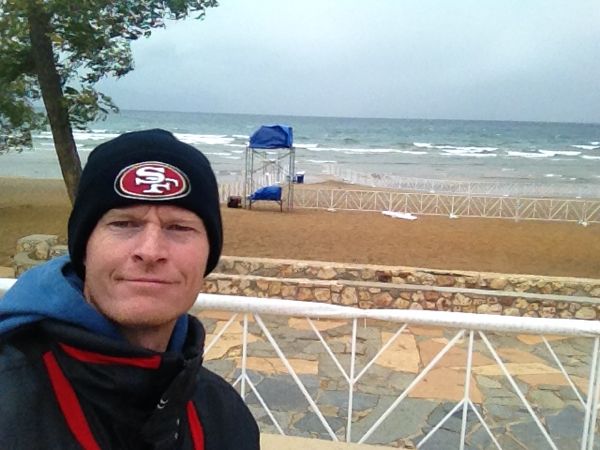
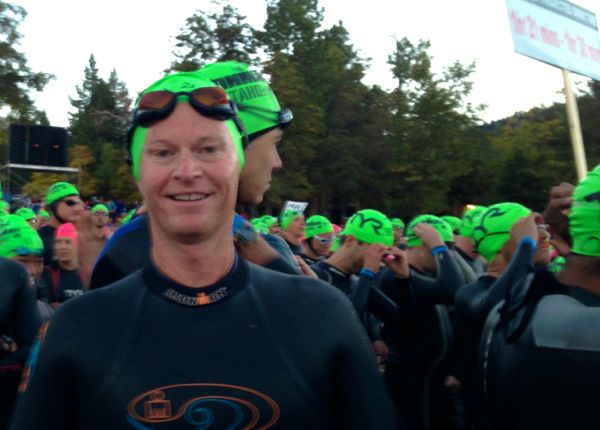
Dan Starkey before he begins the 2013 Lake Tahoe Ironman. Photos/Provided

Dan Starkey before he begins the 2013 Lake Tahoe Ironman. Photos/Provided

By Dan Starkey

Born and raised in the East Bay, Lake Tahoe has always held a special place in my heart for winter skiing and summer getaways. Last year, I added another unforgettable experience to my lifelong love of Lake Tahoe. On Sept. 22, 2013, I completed my first Ironman at Lake Tahoe.

This is my experience.

The conditions on race day were challenging, but they could’ve been a lot worse. The whole week leading up to the race was beautiful weather in the mid to upper 70s. Then, on Saturday, the day before the race, the weather turned awful. Cold wind and rain in the 50s, with waves crashing at Kings Beach. It even snowed in surrounding areas.

I spent the night before the race at the Resort at Squaw Creek. After a restless night’s sleep filled with anticipation, I got up at 4am to have a light breakfast of a bagel, yogurt, and a banana with a few sips of Diet Coke for caffeine. On a day that I would burn more than 15,000 calories, you would think I would eat a larger breakfast. However, I found swimming with a full stomach (the first of three legs of a triathlon) can lead to nauseousness. When we woke up on race day, the temperature was 29 degrees with a sunny forecast into the 60s. I took a hot shower to raise my body core temperature before bundling up and heading out to the bus.
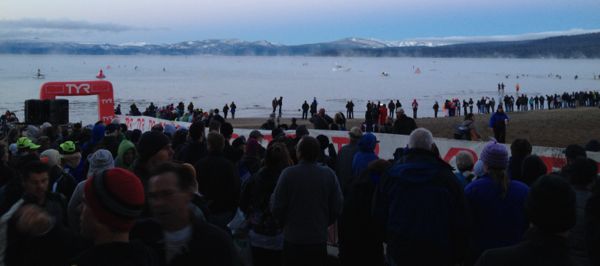
Kings Beach is where the swim takes place.

Kings Beach is where the swim takes place.

The bus ride from Squaw Valley to Kings Beach was in the pitch dark and we arrived 6am. I wore sunglasses, a 49ers ski hat and closed my eyes to visualize the day. Naturally, a Blues Brothers quote struck me as we drove away from Squaw Olympic Village knowing that I would return there some 14-plus hours later to cross the finish line: “It’s 140.6 miles to complete an Ironman. I’ve got a full a tank of gas (full stomach). A half of a banana. It’s dark. And I’m wearing sunglasses. Hit it!” – Elwood Blues

At the transition area at Kings Beach, the dangerous surf from just hours before was now glassy water in one of the most beautiful mountain lake settings in the world. The sun was starting to illuminate the sky as we neared the age-group swim start at 6:40am. The water temperature was in the low-mid 60s, providing excellent swimming conditions.

At 6:45am, my Ironman experience would begin telling myself “Pace, don’t race”. The swim course is a two-lap counter clockwise rectangular 2.4-mile course. Nine hundred meters out a long straight, 200 meters to the left then back in for lap one. Lake Tahoe is a dream to swim in, compared to say the Pacific Ocean where I completed my first 70.3 triathlon. In Santa Cruz, the water has a green tint and is freezing relative to Lake Tahoe. I remember wondering if a shark was going to attack. In Tahoe, the water is crystal clear and you can distract yourself watching peaceful sandy bottom, with its occasional boulders or fallen trees.

I maintained a steady stroke and stayed wide to seek calm waters where I would get kicked/punched less by other swimmers. I did get knocked about half a dozen times, but it’s to be expected. At the far turns, you lose sight of the lake floor in depths of more than 40 feet, but you are rewarded with 360 degree views of freshly dusted mountain tops surrounding the lake now illuminated by the rising morning sun.

“I can’t believe how beautiful this is,” I said to myself. “The day is here. I’m doing an Ironman.”

On the final straightaway, I smiled when I started seeing the sandy bottom again. Approaching the shore, as you lift your head out of the water, the underwater silence is shattered with rock music blaring (mind you, it’s still only 8:15am). The crowd is roaring and a guy on the loud speaker yelling out competitors’ names as they head to the first transition (T1). A friend of mine spotted me and cheered me on. It was great to see a familiar face. I achieved my target time of 1 hour and 15 minutes for the swim and kept my heart rate in check the whole time. Good start – but there’s a very long day ahead.

En route to the changing tent, two wetsuit strippers tell you to lie on the ground and they yank off your wetsuit in an instant. This was especially convenient since our hands on this morning were nearly frozen.

The swim-to-bike transition was a challenge. With temperatures still in the 30s, everyone was doing a full uniform change. The changing tent was over capacity so many of us had to change standing up balancing on one leg with racers all around us. While T1 usually takes about 5-10 minutes, it took most athletes 15-30 minutes on this day. Unfortunately, many athletes’ days ended with the swim when they could not recover from hypothermia.
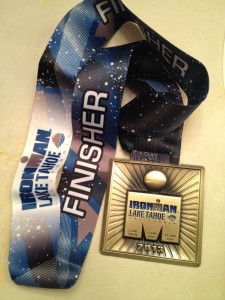
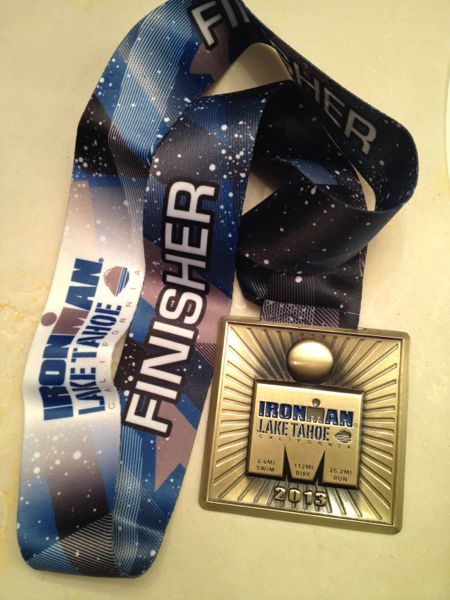
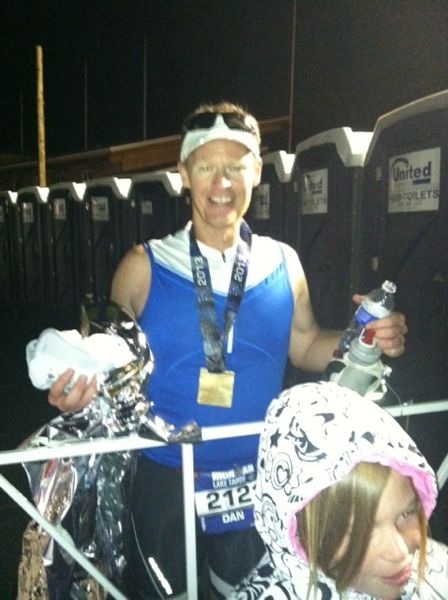
A select few have the coveted Ironman medal.

A select few have the coveted Ironman medal.

I left the warm humid T1 tent to jog out to my bike and head out on the chilly ride. The bike covered 112 miles over a 2 1/3 lap clockwise from Kings Beach through Carnelian Bay, Tahoe Vista, Dollar Point, Tahoe City, past Alpine Meadows and Squaw (I’ll see you more later, Squaw), to Truckee down through Martis Camp and Northstar back over Brockway Grade (7,185 feet) back to Kings Beach.

I elected for function over fashion and bundled up in more clothes than I’d worn in training since mid-Spring. My toes were numb for the first two hours of the bike from the wind and cold. I ate a little Clif Bar and water while I settled into my cycling stroke.

The majority of your nutrition is consumed on the bike. It’s hard on your stomach to eat much heavy food on the run. You need to hydrate well early in the race, especially being at 6,000-7,000-foot elevation. If you’re dehydrated by the time you get on the run, you’re probably not going to be able to recover. Ironman combines a physical test that you can’t cram for – and the need to game plan your exertion, nutrition and hydration in the face of extreme fatigue and the elements for up to 17 straight hours.

The first 35 miles along Highway 89 past Squaw up through Truckee are flat-to-downhill so you can maintain a brisk pace of 20 mph or more in the aero position without using too much energy. I really enjoyed the first part of the ride though reserved proper respect for the serious climbing ahead.

I anticipated that Brockway Grade on Highway 267 was going to be among the toughest sections of the entire race based on previous training rides. Martis Camp was the wild card. It was a private community adjacent to Northstar Resort that was off limits to the public prior to race day. We only knew from the course map that there was definitely climbing.
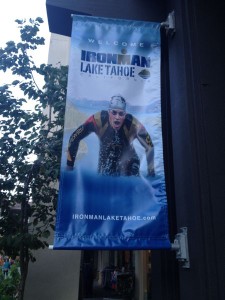
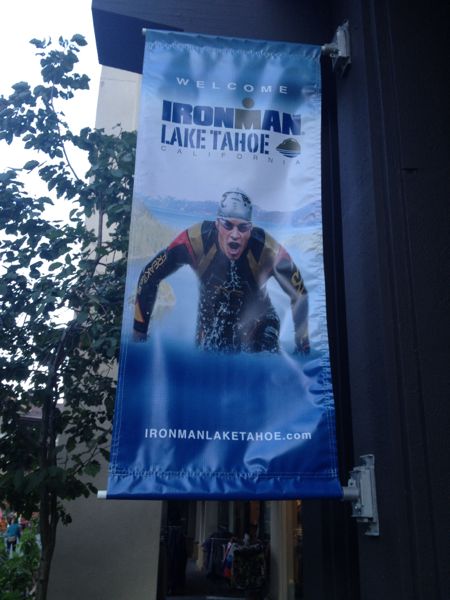
All events are on the North Shore.

All events are on the North Shore.

It turns out Martis Camp was a million switchbacks and lots of ups and downs that got you sweating, then cold on the downhill, then sweating and cold, etc. I was thrilled to see Northstar signs because it meant I was done with Martis Camp for this lap. Just past the entrance to the Ritz-Carlton was the dreaded Brockway Grade. Brockway is 2.5 miles of unforgiving uphill with grades up to 8-10 percent (that’s hard … wink!). My first ascent up Brockway actually went better than expected. At the top, I couldn’t believe I was thinking to myself that Martis Camp may have been more tiring than Brockway. As I started the 35-40 mph descent on the backside of Brockway into Kings Beach, I was already dreading those back-to-back climbs in about 45 miles.

By 11am, I was almost done with lap one on the bike under clear blue skies. I was right on pace with my pre-race target and feeling strong with nearly two hours of smooth road ahead. But before I got too satisfied, I reminded myself that I still had almost 100 miles of riding/running to go. Reality check.

In mile 60 past Tahoe City, I took my first dip into my Special Needs bag. Before the race, you can put anything you want or need into a bag that’s waiting for you halfway through each the bike and the run. My bag included ibuprofen, Tums, extra energy food and drinks, plus some fun snacks to just break up the monotony like Lay’s BBQ potato chips (tasty salt intake) and a Coca Cola (sweet tasting caffeine). I was fueled up and hoping to see my family in Truckee.

Through historic downtown Truckee, I coasted while standing up out of the saddle stretching my calves, hamstrings and lower back scanning both sides of the barricaded street for my support crew. I was so happy to spot them on the far side of Bridge Street. I stopped and chatted with everyone for a couple of minutes while the kids were jumping up and down and yelling excitedly! I shed my jacket now that it was up to 64 degrees – the ideal race temperature I never thought we’d see 24 hours before when it was snowing.

I hesitated to push off because I didn’t want to say goodbye so quickly. I got such a lift from seeing everyone that I carried with me into the mountain climbs ahead. The roads were definitely less crowded than earlier. On the second climb up Martis Camp, fewer riders nearby made the uphills feel even slower and longer. It wasn’t just a feeling. My second lap was about 1 mph slower than the first one, but I was still going steadily.

Brockway was definitely tougher the second time around. I counted down each 0.1 of a mile through the final steep half-mile section. At the top of Brockway, I stopped at the aid station to collect myself. I made a point of thanking volunteers as often as I could.
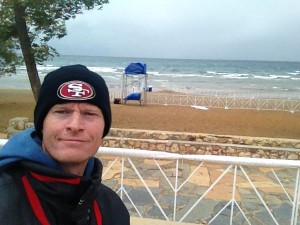
Dan Starkey all bundled up for the bike ride.

Dan Starkey all bundled up for the bike ride.

The support on this race was truly exceptional thanks to all of their help. They would hold your Needs bag for you while you picked what you needed from it. At aid stations (every 10 miles on bike and every 1 mile on run), they would take your bike bottles from you, twist off the cap, refill it and replace the cap and return it to you while you caught your breath for a moment. They would do anything that would make life easier on you in that moment.

Every gesture of kindness was welcomed on this tiring day. My favorite sign on the road was held by an 11-year-old boy: “I trained 6 months to hold this sign!” Honorable mention: “Pain is temporary. IM is forever.” I was also told, “You’re almost there!” about 12 times. Even in my poor mental state, I was onto them after the first 11 times.

Speaking of kind gestures, there were thousands of cheering people throughout the race course. It was fun to watch the reactions. There was an excitable group of twentysomething guys/girls on the left side of the road near Tahoe City at mile 95. I played along with them and waved my hand up, up telling them to raise the noise level. They ate it up and went crazy! They were as pumped for my participation in their rowdiness as I was to receive their energy. They may have been drunk.

Miles 90-110 to Squaw were pretty leisurely. I ate some Clif Bar, drank as needed and even chatted up a rider I’d seen many times on the ride. He was on his third IM and he called the Tahoe bike “10 times harder than Canada”. This sentiment would be repeated many times over. This was the highest Ironman ever held in North America and the most climbing (7,500 feet) on the bike ever.

Approaching Squaw Village for the second transition (T2), I was treated to lots of cheering family and friends. I was on a high! The swim and bike were done – and I was surprised how good I felt. In the T2 chute (like the end of a leg of the Tour de France), I yelled to no one in particular in the cheering crowd, “This is awesome!”

To make you feel like a champion, as you approach the T2, someone is waiting there to take your bike from you while you jog off in your bike shoes to go change into your running gear. I thought this only happened at Kona on TV. Nice touch.

A few minutes before 4pm, I was in my running shoes and heading off for the run – a 26.2-mile double lap out-and-back course along the Truckee River trail to Tahoe City. I saw more family as I started the run and rounded the corner through the throngs of cheering fans in the village. I actually started the run thinking that I could beat my personal best time for a marathon. This was a humorous delusion.

The first five miles of the run were good, but that’s where my feelings of “This is awesome!” abruptly came to end for good. I was having stomach pains that were aggravated with every step of running. I walked for the next five miles straight. Every time I tried to run again the pain in my gut jabbed at me. I couldn’t stomach eating anything either. No nutrition with 16 miles to go was not sustainable.

After turning around at mile 10 in Tahoe City, the stomach pain subsided enough for me to start mixing some jogging (very little … like 0.2 mile at a time) with the walking. I started extrapolating how long this marathon would take at this pace. Oh geez … this was going to be the longest 5-plus hours in my life.

Still, I reminded myself of Goal No. 1: Finish the Ironman.

I had these images in my mind of people collapsing and not finishing the Ironman. I would rather finish with a longer than expected marathon time than not finish at all.

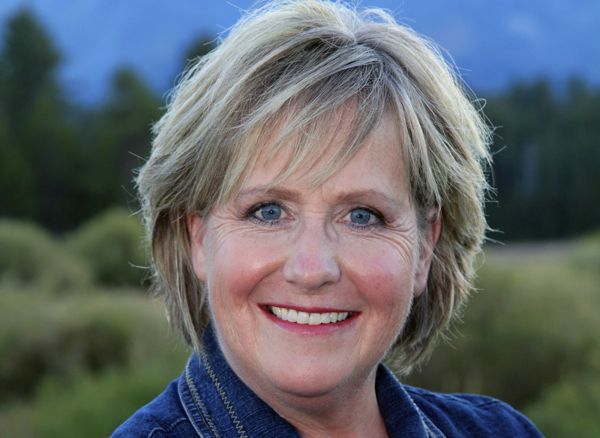
A smile from Dan Starkey after a grueling day at the Lake Tahoe Ironman.

A smile from Dan Starkey after a grueling day at the Lake Tahoe Ironman.

This race is a test of survival. My stomach would eventually accept some potato chips (to replenish some lost sodium), grapes, oranges and cola. On my return to the Squaw Village area, more family and friends cheered me on. My wife, Erica, ran along with me for several minutes and I got emotional in her confidence that I was on my way to becoming an Ironman. I still had 10 miles of foot numbing walking/jogging ahead.

Though, the last four miles in the dark seemed to take absolutely forever. I saw my buddy Jeff Judson on the course a couple of times on the run so we pumped each other up. I also talked to several multi-Ironman finishers. I asked them all the same question, “How does this one compare?” and I always got the same answer “This is the toughest one I’ve ever done … that bike was brutal.”

After the sun went down, the temp dropped quickly. I wore a space blanket over my shoulders and a headlamp for the last 2.5 hours of the marathon. The temperature had dropped back down to 40 degrees. I tried to stay “present” enough to acknowledge the encouragement of strangers, but to be honest, even a thumbs up (frequent throughout the bike course) was too much to muster.

Within miles of the finish line, the Squaw Village lights shined brightly through the darkness and you could hear the finish line announcer celebrating each finisher’s name. As I entered the final half-mile within the village, I soaked in the crowds along the barricades and slapped five with as many kids as I could. Approaching the grandstands, I was smiling broadly and searching to find my wife and kids. As the announcer boomed “Dan Starkey from Danville, California … You Are An Ironman!”, Erica screamed out my name from just right of the victor’s arch. My experience was complete to have Erica and the kids sharing it with me.

No more than three steps after crossing the finish line, a handler puts his arm around your shoulders — probably so you won’t fall over. He was also the handler for the third place pro, who called IMLT the toughest IM he’s ever done. The best pro time in IMLT (8 hour 55 minutes) was nearly an hour longer than Kona, for example. Most of us in IMLT found this race to take at least an hour longer than expected.

Finishing time: 14 hours, 44 minutes, 0 seconds.

After my photo was taken in front of the IM backdrop and I got hugs from the family, I scarfed down about seven pieces of pizza and a plate of chicken and pasta before getting a massage in the heated medical tent. It was also amazing to stay until almost midnight and watch some of the finishers who could barely stand upright shuffle across the line to earn their medals.

The memories of completing my first Ironman in Lake Tahoe remain a daily inspiration to me. The experience profoundly embodies the Ironman motto that “Anything Is Possible”.

Note: I’m looking forward to returning to complete the Ironman Lake Tahoe 70.3 on Sept. 21.


Wind makes scenic Echo Lake a challenge


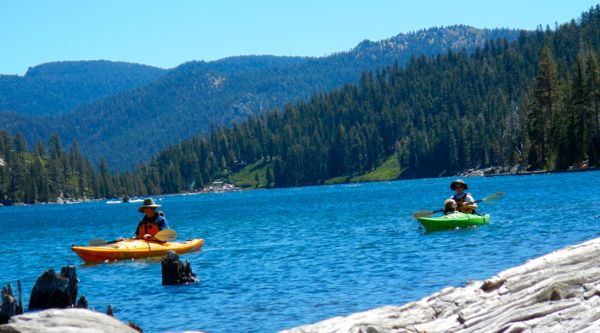
Tom and Pam kayak toward the channel at at Echo Lakes. Photos/Kathryn Reed

Tom and Pam kayak toward the channel at at Echo Lakes. Photos/Kathryn Reed

By Kathryn Reed

Paddling is always a good upper body workout. Paddling against the wind with white caps is definitely going to require some therapy afterward. Such was the case for the four of us on the Sunday of Labor Day weekend.

Wind wasn’t an issue when we left the house, so it came as a surprise when we got to Echo Lake. But we didn’t let it deter us.

While it was near impossible to find a parking spot, all those vehicles must have belonged to either hikers/backpackers or cabin owners, because the lake was relatively boat free. The shuttle boat was the main vessel on Lower Echo Lake.

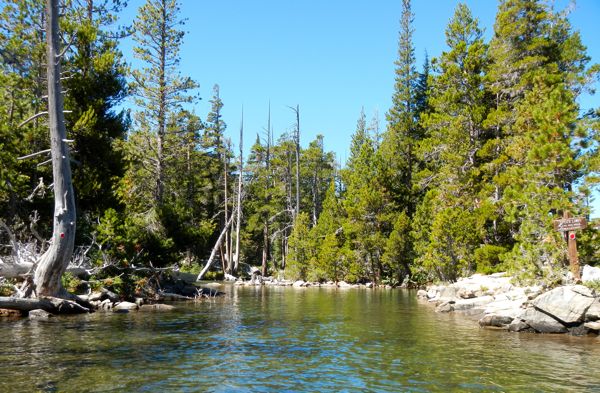
The channel separating the lakes.

The channel separating the lakes.

Before we even got on the water our canoe and kayaks had to be inspected. Clean-drain-dry is the motto here and throughout the region so aquatic invasive species are not transported from one body of water to the other. Echo Lakes doesn’t want the two types of milfoil or the Asian clams that Lake Tahoe has.

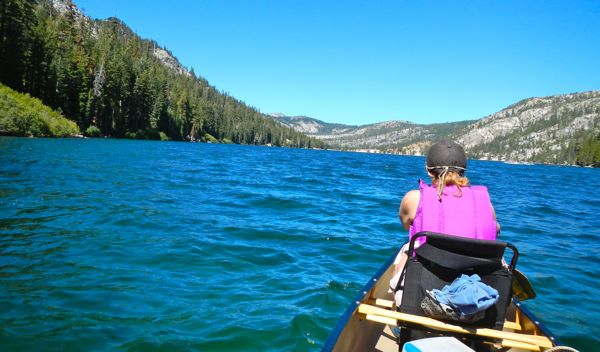
It was my intent to take Pam and Tom to both lakes, but the wind changed those plans. It was so gusty at times that we weren’t making forward progress. AJ didn’t seem fazed though as she lay in the middle of the canoe while Sue and I dug in as hard as we could when the gusts came up.

Still, we took plenty of opportunities to enjoy the towering granite to one side, and the fir and pine-lined shore on the other. Much of the shoreline is rugged, so there are limited opportunities to stop.

Near the end of the lake and on both sides are modest summer cabins on U.S. Forest Service land. They are only accessible by boat.

Sue at the helm of the canoe.

Sue at the helm of the canoe.

At the channel leading from Lower to Upper Echo Lake we paused for snacks and a chance to rest and stretch our legs. An expansive granite beach of sorts is at the entrance, which made for an ideal break area.

Upper Lake is the smaller of the two. A few islands are on it. No waterskiing is allowed there, so it can be more peaceful.

We meandered through the shallow, windy connector to the upper lake just to say we did it. We were all too tired to do anything more than paddle back to the boat ramp.

We thought we would have a tailwind, but instead we were being pushed into the center of the lake. It was a challenge in both directions. Fortunately, the store was open so we could reward ourselves with ice cream. Adult beverages in the hot tub were next. By that time the paddle didn’t seem so bad.

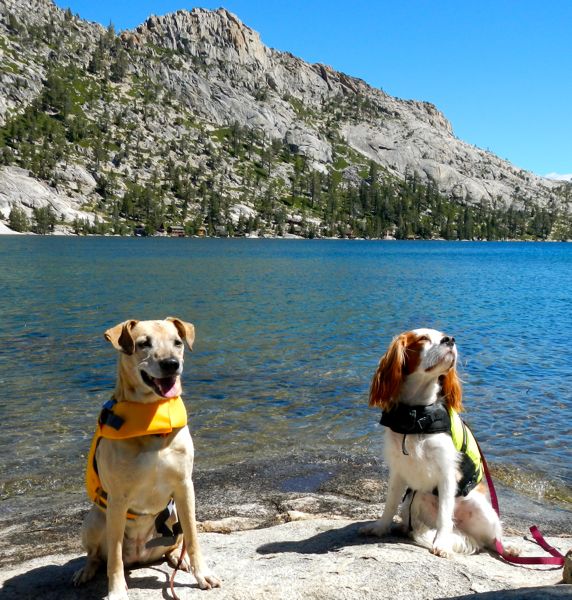
AJ and Britton had it easy.

AJ and Britton had it easy.

——

Getting there: From South Lake Tahoe, take Highway 50 west. A short distance after cresting Echo Summit, turn right on Johnson Pass Road. Stay to the left. The narrow road leads to the water.

Notes:

• The store is open Memorial Day to Labor Day.

• During that time it costs $5 to launch a human powered vessel.


Fire burning east of Pollock Pines

Updated 5:15pm:

Smoke drifting into Truckee and that is streaming over the ridge on the South Shore is from the King Fire burning out of control near Pollock Pines.

“Heavy fuels are burning and timber,” Terri Mizuhara, spokeswoman for CalFire, told Lake Tahoe News. “It’s traveling east, northeast with a rapid rate of spread.”

It is burning away from the town of Pollock Pines.

It was reported Sept. 13 at 4:32pm. Less than 24 hours later about 2,000 acres near Mountain Road had been consumed; with zero percent containment. This is a steep canyon area. Winds have been brisk.

Evacuations have been ordered for 188 residences, with more than 400 on voluntary evacuation. Pollock Pine Community Center was the evacuation center, with 120 people having shown up. However, it lost power. Red Cross has established an evacuation center at Sierra Ridge Middle School, 2700 Amber Trail, Pollock Pines.

Power is out in the area to about 4,000 PG&E customers.

Air and ground resources are attacking the fire. A strike team from Lake Valley Fire Protection District has been sent to the fire.

Highway 50 is open in both directions, but there are road closures closer to the fire.

At this time the cause is under investigation.

— Lake Tahoe News staff report