Calif. to vote on lighter penalties to relieve prisons

By Michael B. Marois, Bloomberg

California voters are being asked to lighten criminal penalties for low-level drug possession and nonviolent thefts such as shoplifting, to help ease crowding in the state’s prisons.

Support for the ballot initiative is uniting billionaires on opposite ends of the political spectrum, from financier George Soros and Netflix Inc. Chief Executive Officer Reed Hastings to Republican donor B. Wayne Hughes Jr., son of the founder of Public Storage, the largest self-storage business.

Proposition 47, reducing certain non-violent property and drug crimes from felonies to misdemeanors, is a turnabout for the state that enacted one of the first Three Strikes laws in 1994. It’s one of six measures on the statewide ballot that also asks voters to sell bonds for water works, stash money away for a rainy day, restrict increases in health care insurance premiums, and boost malpractice civil judgments.

“This is incredibly significant,” said Nichole Porter, director of policy advocacy for the Sentencing Project in Washington. “This could set the stage for the next 20 years in terms of rethinking the nation’s approach to criminal justice policy. If the voters of California authorize this ballot measure, that will really change the conversation nationally.”

Simple drug possession, bad checks under $950, shoplifting and petty theft with the same limits would be misdemeanors, generally punishable by a fine or a term in county jail, rather than a felony, requiring a prison sentence.

Read the whole story


Lake Tahoe Forest Service chief retiring

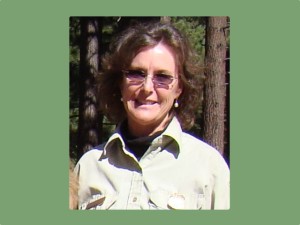
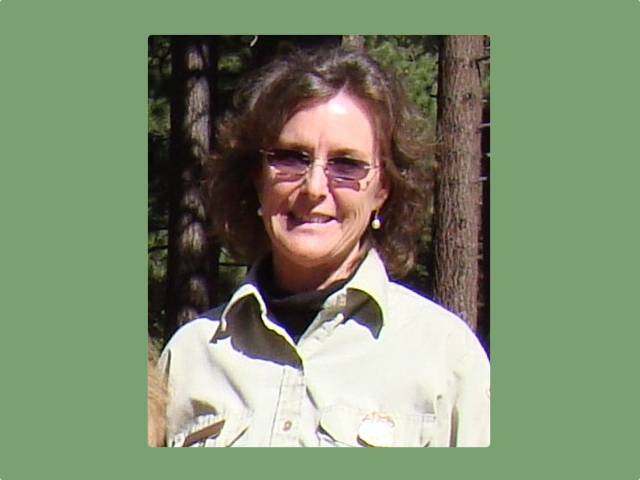
Nancy Gibson is retiring from the U.S. Forest Service in January. Photo/Provided

Nancy Gibson is retiring from the U.S. Forest Service in January. Photo/Provided

By Kathryn Reed

Relationships and collaboration are what have allowed Nancy Gibson to accomplish things her predecessors have not always been able to do.

While she has not done everything she has wanted, the forest supervisor of the Lake Tahoe Basin Management Unit knows the job could never completely be done. Such are the hazards of managing one of the more complex forests in the United States.

Gibson took over the top job with the local Forest Service office in March 2011. She will retire Jan. 3, 2015, after 37 years with the agency. This is Gibson’s second stint in Tahoe. She was on temporary assignment to LTBMU as deputy supervisor from November 2006 to March 2007.

But she’s not going anywhere. She and her husband built a house in Meyers that they moved into last year. She plans to take the advice of friends to learn to say “no” and not do too much the first year other than have fun. Her husband has been retired for six years, so she knew it was time for her to do the same.

During her tenure with the agency she has seen many changes.

“This evolution of forestry, national resource management and science coming together to better synthesize all disciplines has been pretty remarkable,” Gibson told Lake Tahoe News. “It’s getting back to our roots, but also reinventing ourselves as a conservation agency.”

Fifty years ago no one talked about climate change. Now it’s an integral part of nearly every decision regarding the forest.

Lake Tahoe is unique in many ways. It is the only forest with urban lots. (There are 3,500 scattered throughout the 155,000 acres. Seventy-eight percent of the land in the basin is managed by the USFS.)

What she’d like to do is teach tourists that dumping ashes from their vacation rental into the empty Forest Service lot next door is how wildland fires are started. It’s a problem her counterparts in other jurisdictions don’t have to deal with.

Fire is a huge part of this office – which is unusual for a forest supervisor’s headquarters. Initial attacks are more the work of ranger stations. Not so here.

Gibson says the work of the basin fire chiefs group is beneficial to the area in terms of fuels reduction and firefighting efforts.

Having the hotshot crew become certified this year points to the significant role firefighters have in Tahoe.

Normally the more acreage a forest has, the more complex it is. Not so with Tahoe. Size-wise, this is a small forest. Issues-wise it is huge. Most forests are in one state, and if it does go into another, it usually isn’t of much consequence.
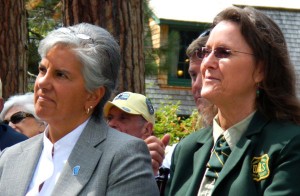
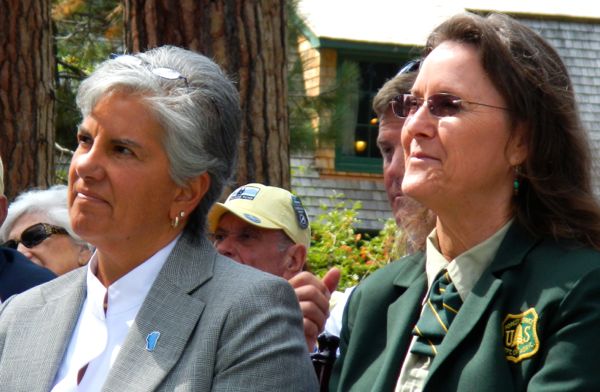
TRPA chief Joanne Marchetta and LTBMU head Nancy Gibson at the 2014 Lake Tahoe Environmental Summit. Photo/Kathryn Reed

TRPA chief Joanne Marchetta and LTBMU head Nancy Gibson at the 2014 Lake Tahoe Environmental Summit. Photo/Kathryn Reed

Also unique to Tahoe is the role of the Tahoe Regional Planning Agency – another federal agency. That relationship has become more amicable through the years.

When Gibson arrived the hostility between the USFS and Lahontan Regional Water Quality Control Board was palpable. That animosity evaporated with the leadership change at both organizations; which in turn filtered down to the rank and file employees.

“If we don’t have relationships, we don’t have the desired outcomes,” Gibson said.

Being able to work with her peers from other agencies has helped the USFS accomplish its goals. This is a new era in the basin where people are working together and being less territorial.

“All the players rely on each other to keep this environment sound,” Gibson said.

In a one-on-one with LTN, Gibson repeatedly spoke of the need to balance environmental, ecological and social concerns when it comes to making land management decisions.

When she arrived in Tahoe the discussions all focused on water. She helped change that so conversations center on forests. She said a holistic approach needs to be used when managing lands. Gibson pointed to how managing the uplands will ensure water clarity downstream.

Gibson’s employees are dealing with a forest that has more visitors per acre than any other forest in the United States.

When she got here there was no cohesive approach to dealing with Fourth of July, even though many visitors are spending time on a Forest Service beach. And it’s the busiest day of the year in the basin. It wasn’t until 2013 that the incident command system was put into place.

“Before we didn’t know where our employees were at all times,” Gibson said.

She has spent every July 4 in the field to witness what her employees are contending with.
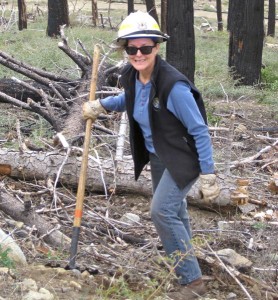
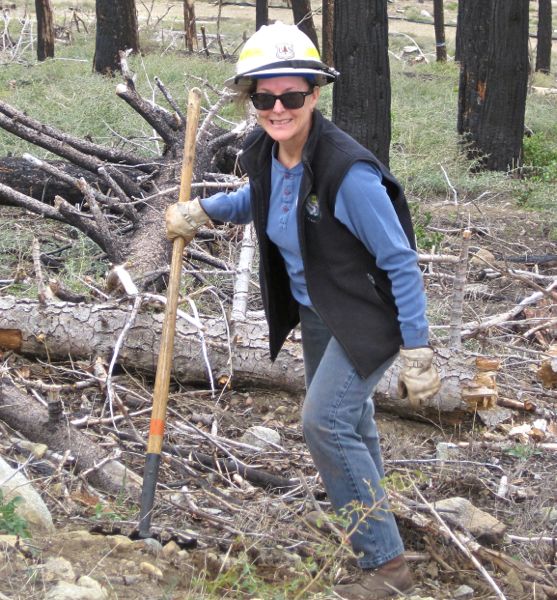
Nancy Gibson plants trees at Lake Tahoe. Photo/Provided

Nancy Gibson plants trees at Lake Tahoe. Photo/Provided

She is proud to be at the helm as work on the Forest Service’s reach of the Upper Truckee River started after having been in the planning stages for years. Implementation of the 10,000-acre South Shore Fuels Reduction project is another accomplishment.

While she had hoped the Zephyr fire lookout would have been moved to White Hill on Spooner Summit during her watch, that is doubtful because of an ownership dispute. Gibson said the Forest Service has documentation that the feds are the rightful owner. She is hoping for an amicable resolution so the lookout will be accessible to the public.

She also would have liked for the Forest Plan to be in place. That isn’t likely to happen until 2015 after she has moved on.

Gibson’s eyes light up when she speaks of continuing the work started with Generation Green, the youth program, and other times in her career when she has helped young people succeed and communities move forward. She can see doing something along those lines in retirement.

A replacement for Gibson has not been named. She’s hoping the next supervisor will be on board before she turns in her Forest Service greens for civilian clothing so she can introduce that person to the players in the basin, explain some of the nuances of the job and ease the transition into this unique forest.

Then it will be time for her to spend time with her two children, other family in Arizona and Montana, friends, as well as appreciate the Lake Tahoe Basin Management Unit from an entirely different perspective. While the demands of work only allow her to get out in the woods about one weekend a month, she plans see more of it after the first of the year.

DC commissioners waffle on water decisions

Douglas County residents are not happy with how the electeds are handling water issues at the lake. Photo/LTN

Douglas County residents are not happy with how the electeds are handling water issues at the lake. Photo/LTN

By Kathryn Reed

Water issues brought out the masses to Thursday’s Douglas County Commission meeting in Stateline.

People are not happy with the prospect of rates going up as much as 50 percent and the county’s going back on its June decision to consolidate water companies.

So many residents were at the Oct. 16 meeting that they didn’t fit into the room and had to stand in the lobby area of the county administrative building. The meeting, which started at 1:30pm, did not get over until after 9pm.

The districts affected are Zephyr Water Utility District, Cave Rock/Uppaway and Skyland – all at Lake Tahoe.

Residents thought everything was a done deal because in June the commissioners approved rates to go up and for consolidation. The idea was that combining maintenance and operation expenses would be more cost-effective. Debt, though, would have remained separate.

One enterprise fund has been created for the districts, but the county is keeping separate accounting departments for each system.

Consolidation of the water systems is now off the table indefinitely.

“ZWUD did a special assessment of $7,500 per parcel some years ago, thus the systems have too much difference in their infrastructure needs as well as current debt and operational/maintenance costs to do consolidation now,” Commissioner Nancy McDermid told Lake Tahoe News.

But it’s not like the commissioners didn’t know about the special assessment in June.

At the meeting McDermid said consolidation could be revisited.

On Thursday the commissioners unanimously approved ZWUD rates to increase. Monthly rates will go from $79.95 to $99.91 starting Nov. 1. This 25 percent increase will remain in effect for the next two years. The other water rate items were for discussion, with no vote being taken.

“We will be coming back to them with proposed rates based on the info they provided,” County Manager Jim Nichols told Lake Tahoe News.

Cave Rock has retained legal counsel.

“Cave Rock Water System likely will sue if this isn’t resolved correctly,” a customer at the meeting told Lake Tahoe News. “The county previously voted for consolidation, but now is changing its mind. We already are paying more than $200 a month and they want to increase that.”

Cave Rock customers support total consolidation.

A letter to the commission from the law firm Kaempfer Crowell in Reno says, “Through consolidation and an appropriate ratemaking process, the long-term viability of CRWS and the county’s other water systems can be ensured. Moreover, consolidation will allow the county to budget for and spread the costs of infrastructure overhauls over the long term and over the entire county.”

Lake Tahoe water district issues will continue to be on future commission agendas.


N.J. to approve real-money skill gambling, Nev. may follow

By Wayne Parry, AP

ATLANTIC CITY — Sure you love matching little candy pieces with each other, or spelling out words with your pals. But New Jersey gambling regulators want to let you do it for real money.

The state Division of Gaming Enforcement says it is seeking game developers’ proposals to conduct real-money gambling on skill-based games, which would make New Jersey a nationwide laboratory for a betting phenomenon many have predicted will become the next big thing.

And because of its vast potential reach, some are worried that the addictive nature of the games and their easy availability on smartphones and tablets could cause some people to get in way over their heads when the money is real. But New Jersey sees it as another way to help its struggling casino industry.

“More and more we’ve been watching the social gaming arena and hearing about the opportunities it presents,” said David Rebuck, director of New Jersey’s Division of Gaming Enforcement. “We thought, ‘Wait a minute: why aren’t these companies coming to us?’ We are ready, willing and able, under existing law, to deal with this. This is not theoretical anymore; this is real.”

Eric Meyerhofer, CEO of Gamblit Gaming, which adds gambling components to familiar social games, says the potential market in the United States for such betting is $8 billion to $10 billion.

“Casual games are played in such abundance across such a wide demographic,” he said. “We think there’s quite a large market for this.”

Players could face off against one another to compete for a prize, with the casino taking a fixed percentage of it.

Game developers would have to partner with one of Atlantic City’s eight casinos, in the same way that Internet gambling providers must do. And like online gamblers, players of real-money skill games must be physically located within New Jersey’s borders. (New Jersey can approach other jurisdictions about multi-state gambling compacts if there’s enough interest.) Nevada is considering a similar plan, and other countries including England and Mexico are testing similar technology.

Currently, most games offer free play up to certain limits. From there, players can buy additional chances to play or equipment to use in the game. Ashley Feinberg, a staff writer at Gizmodo.com, quickly burned through $286 in less than a month buying additional play time on Candy Crush Saga.

“It’s all very high-reward; you get sucked in and there’s this big reward and then it goes away and you keep trying to get it back,” she said. “Unless you actually seek out how much you’re actually spending on this, it goes like nothing. It feels like Monopoly money.”

After writing her first-person account, Feinberg kicked the habit — for a while.

“Then it went back downhill,” she said, adding she doesn’t know how much the second binge has cost her.

“I’m scared to look,” she said.

Gary Loveman, CEO of Caesars Entertainment, has long lamented that people spend millions of dollars on games like Farmville — where they buy equipment for a virtual farm — with none of that money going to his company.

“Millennials typically find traditional slot machines boring because there’s little or no skill involved; they’d much rather play games were there’s an element of skill and the opportunity to socialize or compete with friends while doing so,” said Caesars spokesman Gary Thompson. “It’s clear skill-based games are going to be a big part of the industry’s future.”

Les Bernal, national director of Stop Predatory Gambling, is worried New Jersey could be creating a new generation of problem gamblers.

“State officials know the future of New Jersey’s casinos hinges on luring kids to develop a gambling habit,” he said, adding that by taking games that thousands of young people already play and turning them into gambling games, the state is trying to create a new generation of gamblers to exploit.

Players would fund an account that would be good for in-person play on a casino floor, or remotely via a smartphone, tablet or computer. While details still need to be worked out, the games have to meet complex rules incorporating minimum payout standards that apply to slot machines, while also providing for the variable element of player skill.

So far, some of the biggest names are taking a pass. Zynga, which makes Words With Friends, has said it doesn’t favor real-money gambling on its platforms, preferring to focus on free-play. King Digital Entertainment, the makers of Candy Crush Saga, said it “does not have any plans to license Candy Crush Saga or any of our other games for use in casino slot machines or for any form of gambling.”


Douglas County manager ready to lead

Jim Nichols began his tenure as Douglas County manager on Sept. 29. Photo/Provided

Jim Nichols began his tenure as Douglas County manager on Sept. 29. Photo/Provided

Jim Nichols is finishing his third week as manager of Douglas County. He replaces Steve Mokrohisky who left in April for a job in Oregon.

Nichols was one of 72 applicants for the job. Most recently he was assistant city manager for Midland, Texas. He will be making $172,000 a year.

Lake Tahoe News caught up with him for a quick Q&A.

LTN: Since you are new to Northern Nevada, how do you expect to get up to speed? What few things are you focusing on first – besides learning everyone’s name?

Nichols: I am getting up to speed on Northern Nevada in a variety of ways. First, I am relying upon the insight of my staff who are all very familiar with the region. They are informing me of the issues of significance. Our commissioners are also providing me with valuable feedback on the county.

In addition, I am meeting with various community leaders, stakeholders and county partners to learn their priorities and the needs of the region.

Finally, I am trying to get out into the community so I can meet with residents and see the county firsthand and learn about everything we have to offer.

LTN: What do see as the biggest problem dividing the lake and the valley, and how do you expect to fix it?

Nichols: I don’t really see there being a “problem” dividing the lake and the valley. We are one county and one community all focused on continued prosperity. The only real disconnect between these two distinct parts of our community is distance.

However, as long as we respect and appreciate the unique aspects of each area that make them so important to Douglas County, there really shouldn’t be any problem dividing them.

LTN: Water is a growing issue in Nevada now that we just started year four of the drought. At the lake the issues center on potable water and recreation. In the valley potable water and ranching are the issues. What is your approach to managing water and what should be done that isn’t being done?

Nichols: I’m still being brought up to speed on the water situation in Douglas County so I don’t have all of the information on everything being done to address our current and future water needs. However, having recently worked in Texas during a prolonged drought affords me some perspective on dealing with Douglas County’s water situation. Fundamentally, I believe in looking at a community’s water from a regional perspective. When we become too focused on only our needs and concerns, we lose sight of potential opportunities and solutions that may exist just outside our borders.

LTN: You were living in Henderson when you moved to Douglas County and were last working in Texas. What were you doing when you weren’t employed, how long were you unemployed and why did you leave that job?

Nichols: Over the past year, I began to pursue executive-level positions that would have been a natural extension and progression in my career. I had served as a deputy-assistant city manager for nine years and was ready to lead an organization. I had advised my city manager of my intentions and had his full support on my career pursuits. However, earlier this year, my job interviews became public knowledge in the community and had the potential of becoming a distraction for my previous employer. Therefore, I decided it was best that I leave for the good of the organization. I left Midland in March with several job opportunities on the horizon. Unfortunately, none of them materialized. I remained in Henderson to oversee a rental property that I still own in the area while seeking a new position. I learned of the Douglas County manager opportunity and applied for it. I feel very fortunate to have been selected and am happy to call Douglas County my new home.

LTN: What in your background points to being to deal with how heavily regulated Lake Tahoe is?

Nichols: My applicable background related to Lake Tahoe goes back to my time as public works director/city engineer of Chehalis, Wash. During my time with the city, the Chehalis River was regulated by a TMDL. During my 5½ years of service with the city of Chehalis, I worked with the state’s environmental regulatory agency (DEP) regarding our wastewater treatment plant and specifically our discharge into the Chehalis River. I became well versed in the issues and intricacies associated with total maximum daily loads and feel comfortable in working on the regulatory needs of Lake Tahoe.

LTN: What is your opinion of the proposed realignment of Highway 50 at the lake – better known as the loop road?

Nichols: I am still getting up to speed on the U.S. 50/South Shore Community Revitalization Project and feel it would be premature for me to comment on it at this time.

LTN: Suppose you get to seek counsel with five Nevadans (or those who lived in the Silver State at one time) to dinner (living or dead), who would you summon and why?

Nichols: Wow – excellent question. I’ve never been asked that before. I would say that my five Nevadans to dine with would be: Donald Bently (because of the profound impact he’s had on Douglas County); Gov. Brian Sandoval (to learn his vision for the future of Nevada); Snowshoe Thompson (because of the important role he played in the history of Douglas County); Andre Agassi (to learn where he gets his competitive spirit); and Mark Twain (to learn the source of his wit and wisdom).

LTN: You’ve written a couple books, do you think you would write one out of your experiences in county-city manager offices? If so, can we get a sneak peek?

Nichols: Thank you for even taking note of my prior books. I do think a book that looks at city/county management and maybe even compares and contrasts the two would be an interesting subject. If I write another one (which I would love to do, as time allows), I will gladly offer you a sneak preview.

LTN: Where will we find you recreating in Lake Tahoe?

Nichols: I can be found anywhere that has a bike path or hiking trail. I am an avid bicycle enthusiast and hope to be able to take my bike to the lake regularly to enjoy the scenic views. I also enjoy hiking and hope to hike around the lake from time to time.

— Lake Tahoe News staff report


Barton prepped for Ebola patients

By Vicki McKenna

Barton Health is committed to the safety of our patients, visitors, staff, and physicians. After receiving several confirmed cases of the Ebola virus disease in the United States, Barton Health is prepared to care for and respond to suspected Ebola cases.

Though the Ebola virus has not reached California or Nevada and the risk is currently low, we take the threat very seriously. An Ebola virus disease workgroup comprised of Barton Health leaders and staff has been formed and we have developed an Ebola preparedness plan. By collaborating with the Centers for Disease Control and Prevention, El Dorado County Public Health, and other health agencies across the nation, Barton Health will be able to deliver the most up-to-date information and most effective action plan to combat the virus.

Barton Memorial Hospital currently follows the CDC’s recommendations for hospital infection control to safely manage and isolate a patient with Ebola or other highly infectious disease. Should it become necessary, Barton Health staff and physicians are prepared to care for possible Ebola patients and protect the community at large.

As described by a Centers for Disease Control official, the information about Ebola is changing “daily and rapidly.” To keep our patients, visitors, and community safe, Barton Health is taking actions should a suspected Ebola patient arrive. Actions include additional screening about travel history, isolation precautions and procedures, and ongoing education and training.

Travel history screening

As an additional precaution, patients who enter the Barton Health inpatient and outpatient offices will be asked about their travel history. If you or someone you know has traveled to a high-risk country in Africa within the last 21 days or has been exposed to someone who has, the second step is to monitor for Ebola’s signs and symptoms. Ebola resembles the flu and signs and symptoms may include a high fever, stomach ache, headache, vomiting, diarrhea, weakness, muscle aches, and unexplained bleeding. Ebola can only be spread by an infected patient if signs and symptoms are present.

Isolation precautions and procedures

For suspected Ebola patients, Barton Health has prepared isolation rooms and procedures to protect Barton Health patients, visitors, staff, and physicians. In addition, appropriate protective equipment and disposal methods are in place.

Education and training

Barton’s Emergency Management Services has implemented practice drills and walk-throughs to prepare for a real case scenario, should it arise. Ongoing education and training is also being conducted for clinical and non-clinical staff.

We encourage all members of the community to stay informed. Visit the Centers for Disease Control website for an Ebola checklist and the most updated information.

Vicki McKenna is an infection preventionist with Barton Health.


Weather Channel: Warm winter in Calif.-Nev.

By Weather Channel

The Weather Channel has issued its winter forecast for 2014-2015, and it looks a bit different from last winter.

Compared to 2013-14, which was one of the coldest winters in recent memory in the Upper Midwest, this winter the chill looks to be more focused on the East Coast and Gulf Coast, according to the winter forecast prepared by WSI, which along with The Weather Channel is part of The Weather Company.

The forecast, which looks ahead to temperatures from Dec. 1, 2014, through Feb. 28, 2015, is based on an analysis of several large-scale factors in the land-ocean-atmosphere system.

One factor is, as you might expect, the presence or absence of El Nino — an area of warmer-than-average water in the eastern Pacific Ocean near the equator.

While El Nino has not developed yet, WSI forecasters expect a weak to moderate El Nino to emerge over the winter months and potentially persist into the spring.

Read the whole story


Editorial: Keep Pierini as Douglas County sheriff

Ron Pierini

Ron Pierini

Publisher’s note: This is a version of the Douglas County sheriff’s endorsement that ran before the June primary.

On Nov. 4 Douglas County voters will have the opportunity to vote to retain the current sheriff or replace him with someone from the outside.

Dave Brady contends morale is not great within the department and a change in leadership is needed. If this were true, then we wonder why the Douglas County Sheriff’s Protective Association endorsed Sheriff Ron Pierini. The bargaining unit represents deputies, investigators and sergeants in the Douglas County Sheriff’s Office.

We concur with the bulk of the department’s employees that Pierini should continue to be sheriff, a position he was first elected to in 1997. He started with the department in 1976 – having been a captain in Tahoe, undersheriff and now sheriff.

Brady had been a reserve deputy for the department before he declared his candidacy.

While it’s not always in the best interest of a department to keep the status quo or to hire within, we also don’t believe in the need to change leadership for the sake of change.

Pierini has proven he is capable of weathering many storms. We believe he will continue to do so for the next four years. The sheriff’s department’s budget has been cut by $2 million and 10 positions have been eliminated in the past few years. Despite the cutbacks, the department’s arrest to prosecution rate is 38 percent. Nationwide the average is 22 percent.

He was at the helm when 9-year-old Krystal Steadman was kidnapped and killed in 2000 in Stateline. In 1980, he was a captain at the Tahoe substation when Harveys was bombed. While we don’t wish crimes like that to occur, it is reassuring to know someone with that breadth of experience will be directing the troops to find the bad guys.

By the nature of the job Pierini spends the bulk of his time in the valley. But he has a connection to Lake Tahoe that the other candidate doesn’t. This is another driving reason to keep Pierini in office. He works well with the other leaders at the lake – whether it is peers in other law enforcement agencies, fire personnel, casino executives or other business people.

Brady’s financial background is intriguing and something often not seen in the ranks of law enforcement. But already the voters of Douglas County ousted him out of office when he was a commissioner.

We need a sheriff who can reach across the aisle. We need someone who is capable of making tough decisions. We need someone who is a leader in his department as well as the community.

That person is Ron Pierini.


Community ski areas making a comeback

By Derek Taylor, GrindTV

Glen Plake, the famous South Lake Tahoe mohawked skier and sage of all things snow, once said that most skiing takes places at the end of a dirt road. He may have had Nevada’s Elko Snobowl in mind.

The sign for this taxpayer-supported ski area is a rock on the ground painted with white paint and surrounded by spent shotgun shells. It has one chairlift, with chairs sponsored by local residents and businesses, and just a few hundred vertical feet. It’s not easy to find, tucked several miles off the wrong side of the lonely stretch of highway connecting two of America’s great ski centers: Lake Tahoe and Salt Lake City.

For the past few decades there has been a stigma attached to small, community ski hills like Snobowl. They’re chastised by core skiers as “not very good,” and presented as places to be avoided if you value your time on snow. But to the communities they serve, they are indispensable.

“This area is mostly miners, and they want something for their families to do,” Roche Bush (pronounced Rocky, and yes, that’s his real name), manager of the Elko Snobowl, told me during my visit in 2013. “Skiing is good, clean, outdoor fun.”

For the ski and snowboard industry as a whole, community ski hills are even more important — if only the industry would just realize it.

“With the weekend average window ticket now over $93, and with baby boomers exiting faster than Gen X and Gen Y are entering skiing, the industry is cannibalizing itself,” says Jamie Schectman, chief executive of the Mountain Riders Alliance, an organization that aims to benefit small, independent ski areas. “Now more than ever, these smaller, feeder-breeder ski areas are important to the ecosystem.”

Read the whole story


Lake Tahoe about to hit natural rim

This was the Truckee River flowing from Lake Tahoe in Tahoe City in October 2013. Photo/LTN file

This was the Truckee River flowing from Lake Tahoe in Tahoe City in October 2013. Photo/LTN file

By Kathryn Reed

Lake Tahoe is expected to drop below its natural rim this afternoon, which would be the first time in five years.

The rim is 6,223 feet.

There was still water coming out of the dam in Tahoe City on Wednesday morning.

“The forecast is for it to drop below and stay there this afternoon,” Mark Faucette, senior forecaster with the National Weather Service in Reno, told Lake Tahoe News.

The winds that have been gusting in the area for much of the last two days have not allowed for consistent water level readings. For example one hour on Oct. 15 gauges read the lake was two-hundredths of an inch below the rim and the next hour it was three-hundredths above the rim.

“We don’t really get that much difference in an hour,” Faucette explained.

When Tahoe drops below its rim it means no water is flowing into the Truckee River and therefore it is not reaching its end destination of Pyramid Lake.

The last time it dropped below the rim was late in the calendar year of 2009. Faucette said once it goes below the rim to not expect to it rise above it for a while. The only thing that would change that prediction is if the area gets a big rain event.

“Snow won’t bring it up. We need rain and runoff to bring it back up,” Faucette said. “The ground around the lake is pretty dry so it takes a lot to moisten it up to get runoff.”

There is a small system in the forecast for Friday night into Saturday, but it could fizzle out before it reaches the Sierra.

“There’s another trough for early next week that could give us some chance of moisture on Monday into Tuesday, and an increase of winds, but not like last night,” Tony Fuentes with the NWS said.

The official water year started Oct. 1. This makes year four of the drought that has been drying out California and Nevada.