SUV goes from All-American to global star

By Dee-Ann Durbin, AP

DETROIT — Once a hulking symbol of American excess, sport utility vehicles are quickly becoming the world’s favorite way to get around.

It’s a surprising rebirth for a vehicle that was the subject of obituaries when gas prices spiked in 2008. Automakers won back customers by making smaller, more fuel-efficient SUVs that also appealed to newly wealthy buyers in Asia and South America and former skeptics in Europe.

Indian drivers want SUVs to navigate rough roads. In China they’re a status symbol. European and American Baby Boomers buy SUVs because they’re easier to climb in and out of. Upwardly mobile Brazilian families like their spaciousness. Cheaper subcompacts like the Renault Duster are bringing in customers who couldn’t afford SUVs before.

Earlier this year, SUVs overtook four-door sedans for the first time as the most popular vehicle for individual buyers in the U.S. By 2018, analysts expect China to be the biggest market for SUVs in the world.

“The SUV genie is out of the bottle. They’ve been discovered by enough people that you’ll never put them back,” says Karl Brauer, a senior analyst with the car buying site Kelley Blue Book.

Global SUV sales rose 88.5 percent between 2008 and 2013, to 15.7 million, according to IHS Automotive. That was three times faster than auto sales as a whole. By 2016, IHS predicts annual SUV sales will total 20.1 million, or about one of every five vehicles sold.

Automakers are finding some surprising converts. France — where environmentalists used to roam the streets slashing SUV tires — is second only to China in the growth of SUVs, with sales up 220 percent since 2008, according to Ford. Turkey is third.

Parisian Laurent Azoulai, 58, bought an all-electric subcompact SUV — the BMW i3 — in July.

“I used to have Mercedes and Renaults but I liked this because I only need it for city driving,” he said. “It’s small, and it’s electric, and I can’t stand pollution.”

Shrinking the SUV — and making it more fuel efficient — was the key to saving it. In 2008, less than half of SUVs sold worldwide were small, and customers had fewer choices. Twenty percent were large SUVs like the eight-passenger Cadillac Escalade, which defined the segment decades ago but had limited audiences outside North America.

Seeing the unmet demand, companies started making small SUVs that were even more nimble and efficient. Subcompact SUVs like the Chevrolet Trax — which is shorter than a Toyota Corolla — were born.

It worked. Sales of small and subcompact SUVs like the Toyota RAV4, Buick Encore and Ford EcoSport have more than doubled worldwide since 2008. New subcompact SUVs from Jeep, Honda, Fiat and others will arrive in showrooms soon and keep the growth going. Small SUVs now make up 58 percent of all SUV sales worldwide; the share of large SUVs has fallen to 12 percent.

The new crop of tiny SUVs is small enough to appeal to buyers in emerging markets but nice enough for downsizing buyers in Europe and North America. That’s good for automakers, who save money by designing one vehicle that suits many different customers.

Owners who switch have a hard time going back to cars. Mo Mard, 56, a retired investment banker who lives in O’Fallon, Missouri, drove a 2003 Toyota RAV4 for 11 years. Six months ago, she traded it in for a Honda Accord sedan, thinking she’d like something a little sleeker.

She was immediately sorry. Mard missed sitting up high, and she wanted more room for her garage sale treasures. She also found it harder to ferry around her 90-year-old mother, who has trouble getting in and out of cars. In September, she traded the Accord for a Honda CR-V.

“I’m back up higher, so I feel better,” she says.

With smaller size comes better fuel economy, another lure for buyers. The Trax is expected to get 34 mpg on the highway, which is better than many midsize cars. The diesel-powered version of the Ford Escape, called the Kuga, gets better fuel economy than a Toyota Prius hybrid.

SUVs are growing in popularity in China. Photo/LTN file

SUVs are growing in popularity in China. Photo/LTN file

China is seeing the fastest growth by far, with SUV sales up 480 percent since 2008 to 3.7 million last year, or around 20 percent of China’s total vehicle sales.

Chinese customers are increasingly using their vehicles for travel beyond their daily commutes, and they need vehicles that can handle rough roads.

Beijing businessman Luo Ge drives an Audi sedan or a Mercedes SUV to work. But on weekends, he runs a car club with 11 Jeeps, which he takes into the desert so members learn to drive on rough terrain.

Luo, 45, who runs several businesses, bought his first SUV, a Jeep Cherokee, in 1995.

“It was quite cool,” he said. “Most men have a complex for military stuff and the real outdoors. The Jeep met that need.”

More typical is Zhang Xinyao, 32, an IT worker in Beijing. She used to drive a small car, a Chinese-made Suzuki Alto, but wanted something bigger and safer after having a child. In 2012, she bought her first SUV, a Kia Sportage, for $28,600.

That’s more than U.S. buyers pay, since China has higher import duties. But it’s not unusual for SUV buyers to pay a premium. U.S. buyers stretch their finances more to buy an SUV than any other kind of vehicle, says Jim Farley, Ford’s marketing chief.

“It means adventure and freedom, even a sense of optimism,” Farley says. “That emotion of owning a utility, for me, is as intense as owning a luxury product.”

Three decades ago, bare-bones SUVs like the Toyota 4Runner and Ford Bronco were mostly used by off-roaders. They had more utility — and less refinement — than most drivers needed.

The seven-passenger Ford Explorer, introduced in the 1991 model year, changed that by emphasizing style and comfort. It was the first SUV that was equally at home navigating mountain trails or grocery store parking lots, Brauer says.

Europeans were slow to accept SUVs, which guzzled too much gas and were harder to maneuver on narrow streets. The subcompact Nissan Qashqai changed their minds after it went on sale in late 2006, says IHS analyst Carlos DaSilva. The Qashqai was designed in London for Europeans who wanted something spacious but less aggressive than a big SUV.

In China, SUV sales took off a few years later. In 2010, the first year Chinese automaker Great Wall’s popular H5 was on the market, SUV sales topped 1 million in China for the first time. This year, IHS expects China’s SUV sales will top 4.8 million.

The Explorer — prematurely laid to rest by some critics last decade — is now Ford’s most-exported vehicle. Ford expects to make around 280,000 Explorers this year at its 90-year-old plant in Chicago. Around 40,000 of those will be exported to Canada, Mexico, China, South Korea and the Middle East. Last year, Ford started making Explorers in Russia to meet growing demand there.

“It’s the common link,” DaSilva says. “It’s the car everybody wants.”


Nev. ranks among worst states for domestic violence

By Jackie Valley, Las Vegas Sun

When most people think of domestic abuse, they picture the victim as a young woman.

But here’s the reality: The abused person very well could be a wealthy neighbor who keeps the beatings a secret for fear of social repercussions. Or the quiet husband who’s ashamed to admit his wife throws punches behind closed doors. Or the celebrity whose megawatt smile belies the shoving she endures. Or the woman who confides in police that her female partner loses her temper too often. Or the grandmother who gets pushed around by her impatient son.

On Oct. 20, a 52-year-old man stabbed his ex-wife to death in their home with their children nearby, according to Metro Police. Jodi Joyce suffered a fatal wound to her chest. James Joyce then stabbed himself in the stomach, inflicting critical injuries, police said.

Domestic abuse, which includes emotional and verbal abuse, is all around us, and the number of occasions it rises to physical violence is stunning. Metro Police fielded nearly 60,000 calls last year from people saying they were being assailed by someone in their household.

The actual number of victims is likely much higher still, because many are too scared or ashamed to admit they’ve been abused. For nine of the past 10 years, Nevada has ranked among the top 10 states for the rate of women killed by men, according to the Violence Policy Center. The center’s most recent report, based on 2012 data, ranked Nevada sixth.

Because domestic violence is a shadow crime without a national database tracking numbers, estimating its scope in Las Vegas as it compares with other cities is difficult. But we certainly don’t lack catalysts — booze, drugs, clashing work schedules, gambling, sex and a tough economy.

Read the whole story


Proposed rate hike dismays Lukins’ customers

By Kathryn Reed

Where has the money gone? Why was the maintenance deferred? How can people be expected to pay more?

Those were just a few of the questions asked Oct. 27 by some of the approximately 30 customers of Lukins Brothers Water Company. The meeting at Lake Tahoe Airport was an opportunity for people to voice their opinion and ask questions about the 55.6 percent general rate increase the company is seeking that could take effect next year.

Taking down the comments was Adam Thaler of the California Public Utilities Commission. The CPUC is the decider if any increase will be granted.

This type of increase is for operations. This includes plant operation supplies, employee salary and benefits, postage, liability insurance, utilities and other costs.

Several people were angry at the prospect of Lukins adding a retirement plan for the employees when so many companies are doing away with them.

Lukins has not had a general rate case increase in more than six years. That is why the company is billing this as a 9.2 percent increase for each of the last six years.

But ratepayers whose monthly bill would go from a flat rate of $36.41 per month to $55.84 are not seeing it that way.

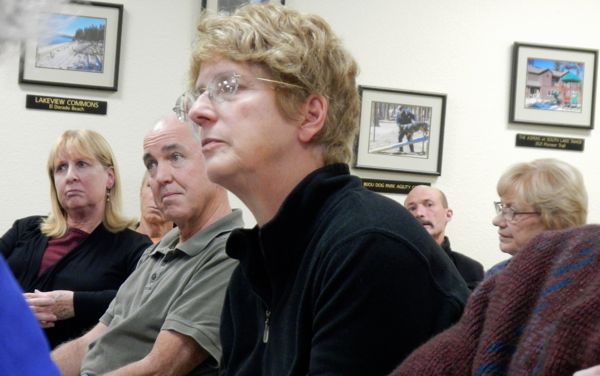
Theresa Brown voices frustration with Lukins water service on Oct. 28 as others listen. Photo/Kathryn Reed

Theresa Brown voices frustration with Lukins water service on Oct. 27 as others listen. Photo/Kathryn Reed

“I feel robbed. I can’t afford it,” Theresa Brown said. She said for 50 years there has been sand in the water. She doesn’t want to pay more for this service.

Thaler said service is one of the criteria the CPUC looks at when it investigates whether a rate increase should be granted.

Jen Lukins, who runs the company, admitted this was the worst summer for sand coming out of spigots. She attributed it to the drought.

“We are now doing monthly flushings,” she said.

Ratepayer Carolyn Meiers said things are “deplorable” – and questioned why there is so much deferred maintenance.

Gary Norton said, “It should have been cleaned up a long time ago when things were cheaper.”

While the South Lake Tahoe water company is privately owned, it is regulated by the state. Nearly everything it does is controlled by the state. It was explained that the state prevents a district of this size from offering low-income discounts because then a disproportionate number of the 963 ratepayers would be subsidizing the others.

Lukins said she would prefer timelier rate increases, but the process for applying for them makes it too cumbersome to do so.


Quality of U.S. Hospices varies, patients left in dark

By Peter Whoriskey and Dan Keating, Washington Post

More than a million times a year, a terminally ill patient in the United States is enrolled in hospice care. Each time, the family confronts a decision that, while critical, often must be made almost blindly: Which hospice to hire?

A boom in the industry allows patients to choose from an array of hospice outfits, some of them excellent. More than a thousand new hospices have opened in the United States in the past decade. But the absence of public information about their quality, a void that is unusual even within the health-care industry, leaves consumers at a loss to distinguish the good from the bad.

Though the federal government publishes consumer data about the quality of other health-care companies, including hospitals, nursing homes and home health agencies, it provides no such information about hospices.

After years of public pressure, Congress in 2010 required that the government publish information about hospice quality, but the Medicare agency said in May that such consumer information would not be forthcoming until 2017 — at the earliest.

Similarly, state records of hospice inspections are often unpublished, sparse, and, when they are available, difficult to find and understand. Government inspections of hospices have typically been scheduled about every six years, though Congress in September called for more frequent checks.

Read the whole story


Mining tax before Nevada voters

By Sandra Chereb, Las Vegas Review-Journal

CARSON CITY — Nevada voters will decide next month whether to give lawmakers the power to raise mining taxes — a revenue source long decried by critics as an under-tapped funding spigot shielded by the state Constitution.

Whether or not passage of Question 2 will lead to more taxes on gold, silver and other minerals remains to be seen. But if history is any indication, lawmakers will seek to capitalize on the new tool in the budget box, should the measure pass, and again turn their eye toward all that glitters to boost state coffers.

State Sen. Tick Segerblom concedes that raising mining levies is the ultimate goal.

“It’s the first time in 150 years that the Legislature will actually have a chance to raise taxes on mining,” said the Las Vegas Democrat. “That is, in my perspective, incredibly significant.

“We’ve finally gotten rid of that stone around our neck.”

Question 2 is the last step in a process that began three years ago to purge a cap on net mining proceeds from the constitution.

Read the whole story


Van Arnum calling it quits after 40 years

By Kathryn Reed

Name any of the significant criminal cases to have occurred on the South Shore in the last four decades and Pete Van Arnum was likely involved.

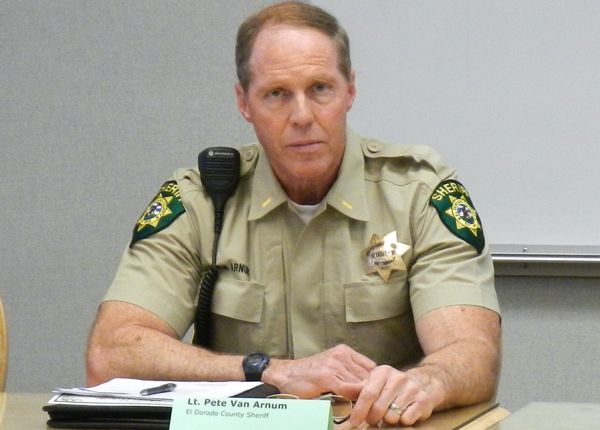
Van Arnum is turning in his badge Dec. 26, three days after he turns 61. He is retiring from the El Dorado County Sheriff’s Department, where he has been lieutenant of the Tahoe substation since March 2012.

His start in the field was a bit ominous. While he was at the Nevada Highway Patrol Academy he was assigned to Incline Village where Gary Gifford was going to be his trainer. They never met. A man who had robbed a bank in Round Hill killed Gifford near Cave Rock.

“That was a wake-up call for me … that this is serious stuff,” Van Arnum told Lake Tahoe News.

It was the beginning of a lot of seriousness.

One thing he won’t miss is the work of coroner. That is the job of the sheriff’s department. And for five years he was the coroner. In an area as small as the South Shore invariably he had to make death notifications to friends and acquaintances.

A harrowing case Van Arnum remembers is when three convicts escaped from state prison in Nevada and they came to Tahoe in a stolen vehicle. They broke into a home of the Edgewood Tahoe golf pro in Round Hill and took his wife hostage and stole her car.

“They came to a roadblock and opened fire on us and pushed through the roadblock,” Van Arnum recalled. “She was in the car. We didn’t know it at the time. She was tied up on the floor.”

Five Douglas County sheriff’s vehicles chased the bad guys east toward Spooner Summit.

“They were firing guns at us the whole time. We were returning fire. We shot out all of the tires. We ordered them out of car at gunpoint. They were wounded. The wife came rolling out. Luckily she was not injured,” Van Arnum said.

Pete Van Arnum will retire Dec. 26 after 40 years of being in law enforcement. Photo/LTN

Pete Van Arnum will retire Dec. 26 after 40 years of being in law enforcement. Photo/LTN

Before Douglas County built the current facility for DCSO in Stateline there was a substation in Zephyr Cove that could house about a dozen inmates.

They were all in one room that was overseen by a dispatcher. If there were a hanging or fight, it could take a while for a deputy to come to the station to deal with it. Van Arnum said it was so unpleasant that it acted as a deterrent for repeat offenders.

Van Arnum worked the Harveys bombing in the 1980s. In the late 1980s he went undercover for a year with the FBI and DEA for Operation Deep Snow that netted Mayor Terry Trupp and about 20 others in a drug trafficking and money laundering case.

“I remember sitting in on a wire tap and the mayor said the local cops are too stupid to catch him,” Van Arnum said. “That is what got the FBI office up here. They realized the need to have federal agencies up here because of all the drug trafficking.”

The most rewarding part of the job was when he worked at South Tahoe Middle School as the gang prevention officer. A wilderness program was created as well as a boxing program. Van Arnum still sees some of those kids – now with their own children.

Obviously he has seen a lot of changes in his 40 years.

“It’s definitely a lot more technical. I consider myself old school. We flew by the seat of our pants then,” Van Arnum said. “All reports were hand written. We didn’t have computers. The threats now are from active shooters. We never even thought about that when I started. Now I’m the SWAT team commander. You have to train and practice for a crazy person going into a school and shooting kids. It scares me to have to think about that for my grandkids.”

What he’ll miss when he leaves in two months is the people he works with.

“I think it’s going to be a loss because of his history. He knows the history of 40 years of working in Tahoe,” Douglas County Sheriff Ron Pierini told Lake Tahoe News. “One thing in law enforcement is gaining relationships. We know Pete, we can call him, we trust him and we know he will follow through.”

Van Arnum credits Pierini for keeping him in law enforcement. After graduating from CSU Sacramento, Van Arnum got a job with the Nevada Highway Patrol.

“I worked for NHP for three years and decided the work was not what I was interested in. I basically got a little irritated with NHP and just went down and quit and came home and told my wife I had quit,” Van Arnum said. “I was going to go into construction. Pierini called me up; he was captain at the time. He said come to work for him. He talked me into taking a job with him. It was probably a good move in the long run.”

He was with DCSO until 1984, and then went to South Lake Tahoe Police Department for 15 years before joining EDSO as a deputy.

“I want to personally thank him for his dedication and assistance in perseverance of the vision of the El Dorado County Sheriff’s Office and in my administration,” Sheriff John D’Agostini told Lake Tahoe News.

A replacement for Van Arnum has not been named.

Van Arnum will soon be busy hunting and fishing. Next summer he may put the uniform back on, though, but only to work the boat patrol.


Olympics delays crack down on human rights abuses

By Katie Rose Quandt, Mother Jones

Following widespread allegations of wrongdoing in both the Beijing and Sochi Olympics, human rights protections will be added to the contracts signed by future Olympic host cities. The International Olympic Committee’s president presented this change to Human Rights Watch at an October 21 meeting.

The new language will contractually require host countries to “take all necessary measures to ensure that development projects necessary for the organization of the Games comply with local, regional, and national legislation, and international agreements and protocols, applicable in the host country with regard to planning, construction, protection of the environment, health, safety, and labour laws.”

These changes make the human rights requirements for Olympic host cities more explicit than ever before, particularly with the mentions of health, environmental, and labor concerns. The new “international agreements and protocols” rule makes it clear that hosts will be required to abide by laws like the International Covenant on Civil and Political Rights, which prohibits forced labor, arbitrary arrest or detention, sentence without trial, and protects freedoms of assembly, religion, and opinion.

Read the whole story


Survey: Harassment a common part of online life

By Barbara Ortutay, AP

NEW YORK — A study confirms what many Internet users know all too well: Harassment is a common part of online life.

The first-of-its-kind report by the Pew Research Center found that nearly three-quarters of American adults who use the Internet have witnessed online harassment. Forty percent have experienced it themselves.

The types of harassment Pew asked about range from name-calling to physical threats, sexual harassment and stalking. Half of those who were harassed said they didn’t know the person who had most recently attacked them.

Young adults — people 18 to 29 — were the most likely age group to see and undergo online harassment. Women ages 18 to 24 were disproportionately the victims of stalking and sexual harassment, according to the survey. And people who have more information available about themselves online, work in the tech industry or promote themselves on the Internet, were also more likely to be harassed.

Case in point: Celebrities. Stars such as the actress Jennifer Lawrence had nude photos stolen and posted online recently in a widespread hacking scandal in late August. Lawrence, 24, later told Vanity Fair that she considered looking at the pictures a sex crime.

It can be difficult for police to go after online bullies in part because “our legal system hasn’t quite caught up with technology,” said Elizabeth Dowdell, a nursing professor at Villanova University who studies online aggression. On top of that, adults are generally hesitant to report harassment because they might view it as a “child or teenage problem.”

“But the Internet has no age limits,” Dowdell said. “People look for outlets for aggression and the Internet is a wonderful place because it’s anonymous and you don’t have to be truthful.”

Social networking companies have sometimes been criticized for not doing enough to stop online harassment, even though it’s standard policy to ban threats, bullying and harassment. But they have at least tried to respond to complaints.

Twitter, for example, changed its policy recently after some users sent crude, altered images of Robin Williams to his daughter Zelda following the actor’s suicide in August. The company now says it can remove images of deceased individuals that circulate on its site.

Trendy new social networking site Ello, meanwhile, recently added tools people can use to block or mute users who are bothering them. The ad-free, decidedly anti-Facebook website was criticized early on for not providing blocking features that are standard practice for social networks.

Though online harassment is as old as the Internet itself, the Pew survey is particularly timely as conversations around it have grown louder in recent months — and not just because of the celebrity hacking scandal. Beginning this summer, people involved in an online campaign dubbed “Gamergate” have been harassing several prominent women in the video game industry and their supporters for criticizing the lack of diversity and how women are portrayed in games. One of the targets is Brianna Wu, a software engineer and founder of game developer Giant Spacekat. Wu, who is in her mid-30s, said she has frequently been harassed online, but it’s gotten worse this year.

Earlier this month, people threatened her and her husband with rape, death and castration on Twitter and posted her address online, she said, and they have been trying to impersonate her on the Internet to smear her reputation. She got so frightened that she left her home in Boston.

Wu went to the police, but most people harassed online don’t. According to Pew, just 5 percent of those who were harassed reported the incident to law enforcement, while nearly half confronted the person online. Forty-four percent said they unfriended or blocked the person.

But victims of harassment often don’t know where it’s coming from. Thirty-eight percent of people who were harassed online said a stranger was behind the threats, and another 26 percent didn’t know who the person was.

“You can have many different (personas) online,” Dowdell said. “So you might think ‘I’m going to block Scaryfriend123’ and Scaryfriend says ‘Fine, I’m going to use my other name Superniceguy’ and you just don’t know.”

Among other key findings from Pew:

  • Two-thirds of those who were harassed said the most recent incident took place on a social networking site or app, while 22 percent saw it happen in the comments section of a website. Sixteen percent, meanwhile, said it happened in online gaming.
  • Men were more likely to be called offensive names than women. Of all Internet users (89 percent of the U.S. population), 32 percent of men and 22 percent of women were called names. Men were also more likely to be physically threatened.
  • Not everyone said they were hurt by online harassment. While 14 percent of people found their most recent incident “extremely upsetting,” 22 percent said it was “not at all upsetting.” The rest of the people surveyed had reactions in between.

The telephone and online survey was conducted between May 30 and June 30 among 3,217 respondents. It has a margin of error of plus or minus 2.2 percentage points.

AP business writer Tali Arbel contributed to this report.


West Shore hike captures Tahoe’s raw beauty

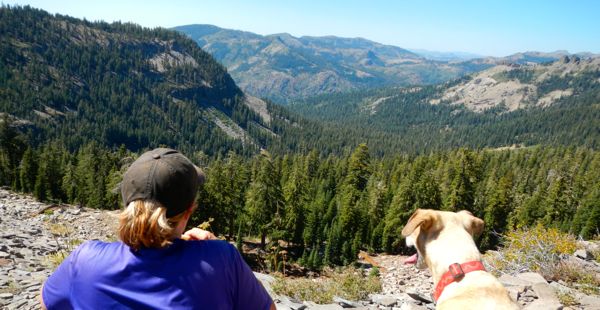
Sue and AJ enjoy lunch with a view of Granite Chief Wilderness Area. Photos/Kathryn Reed

Sue and AJ enjoy lunch with a view of Granite Chief Wilderness Area. Photos/Kathryn Reed

By Kathryn Reed

HOMEWOOD – Variety is what the trail to Twin Peaks is all about. The terrain and views seem to change around each bend.

Rugged at times, lush at others. Granite and volcanic rock. A few remaining wildflowers and a field of brittle dry mule’s ear. Wide-open expanses, closed-in by towering pines. Lake Tahoe in the distance.

This West Shore hike in the Desolation and Granite Chief wilderness areas also at times follows the Tahoe Rim Trail and Pacific Crest Trail.

The Barker Pass trailhead is at 7,500 feet. The end point is at 8,878 feet. But most of the climb is gradual, so the elevation gain is not a deterrent. There is a small stretch that requires going down a bit after climbing. This is never ideal because it means on the return there will be an uphill segment.

Not far in there is a side trail to the right. This provides the first view of Lake Tahoe. While it would have been easy to stop there and call it a day, we were glad we didn’t.

Not too much farther we come across a rock outcropping. The narrow trail with a significant vertical drop makes it not the best place to be for someone with a fear of heights. A little handholding and I get through it. More spectacular views of Lake Tahoe are the reward.

It would have been possible to climb the rocks, but we didn’t want to take the time and we had a dog with us. The mostly single-track trail is well maintained. At times it is soft dirt, other times it’s rocky. We are surprised to find water in a couple sections. This delighted AJ so she could stay hydrated without her people’s assistance.

The water provides for lush vegetation like ferns.

It’s a Saturday in early September and we see few people. One guy is on the PCT headed south. We are happy to just be doing what we estimated was a 6-mile round-trip.

No bikes or motorized vehicles are allowed, though we could hear dirt bikes at the start of the trip on the road we came in on.

We get to the peaks and stop for lunch on the saddle. The vastness of Granite Chief Wilderness Area is mesmerizing. It looks like the forest goes on forever. It’s easy to feel very small and insignificant, but also very appreciative to be able to embrace Mother Nature’s raw beauty.

—–

Getting there:

From South Lake Tahoe take Highway 89 north. Beyond Homewood and before Sunnyside in Tahoe City will be a sign for Kaspian Campground. Turn left there. The road goes for about 7 miles. Veer to the left and don’t go straight on the dirt road. At the end of the hill the pavement turns to dirt. Go beyond the start for the trek to Ellis Peak. Parking for the trailhead will be on the right.

ngg_shortcode_0_placeholder (Click on photos to enlarge.)


Weather takes toll on Calif. olive oil

By Tim Hearden, Capital Press

DAIRYVILLE — Despite some weather issues, olive oil producers in California hope to at least match last year’s mark of 3.5 million gallons, an industry expert says.

As the harvest of oil olives started about two weeks earlier than normal, growers anticipate “excellent” quality, said Patty Darragh, executive director of the California Olive Oil Council.

Last year’s production was a big jump from the roughly 2.5 million gallons turned out in 2012. But olives are an alternate-bearing fruit, and freezes, a wet spring and wind pressure may have hampered growth, Darragh said.

However, the drought that’s stymied production of many crops in California hasn’t affected oil olives as much, she said.

The Gerber-based Pacific Farms and Orchards, which produces Pacific Sun Olive Oil, anticipates a fairly light crop on the oil varieties because of poor chilling hours in the winter and warm weather during the bloom, general manager Brendon Flynn said.

Grower Larry Maben, who sells to the California Olive Ranch, said yield was down from his trees near Orland.

Read the whole story