FBI agent part of Lake Tahoe’s fabric

By Kathryn Reed

“When victims and families have a really bad day, that is when our good work starts. That is one of the things that is odd about our career – some of the most challenging and interesting cases are some of the most horrific.”

Chris Campion, retired FBI agent
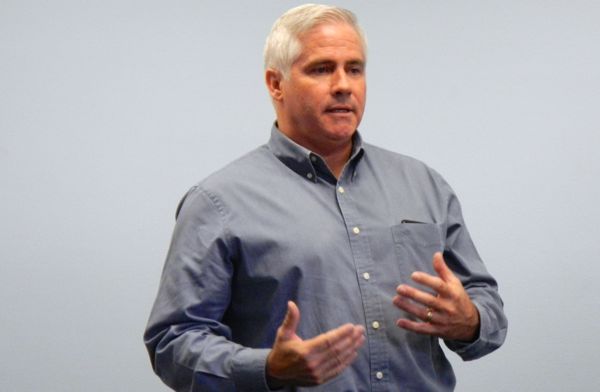
 

Chris Campion spent 25 years with the FBI stationed in South Lake Tahoe. Photo/Kathryn reed

Chris Campion spent 25 years with the FBI stationed in South Lake Tahoe. Photo/Kathryn Reed

Jaycee Lee Dugard is the one case in Chris Campion’s 25-year career that stands out above all the rest. The day she was kidnapped from a Meyers bus stop and 18 years later when she was freed from captivity.

“A lot of people don’t realize all the leads that went on in between … at times we thought we had something,” Campion told Lake Tahoe News. “Right up to the day she came back I was working a lead of a guy in New York who kidnapped five women, some as young as 14, and kept them in an underground bunker. He had ties to Lake Tahoe and Reno.”

Last spring he spoke at a conference for the National Center of Missing and Exploited Children. Terry Probyn, Dugard’s mom, was a speaker, too.

Campion has kept in touch with Dugard during the past five years.

“She is doing amazingly well. You stop and think about it … her spirit and ability to adapt. She is an amazing person and constantly astounds me,” Campion said.

Campion is a walking encyclopedia of crime on the South Shore for the last quarter century. But he is no longer going after the bad guys for the FBI. He retired from the agency – he was close the mandatory retirement age – two months ago.

He isn’t done working, though. He has been hired by a firm to do corporate investigations. It allows him to keep living in South Lake Tahoe, while also getting his passport stamped plenty of times.

And when Campion is in Tahoe he plans to do more of the outdoor activities he never had time for when he wore a badge.

Plenty to do

He attributes the crime rate on the South Shore to the casinos, the nightlife – that they are a draw for criminals, just like they are for the average person.

“People come here to get away from things all the time. They think maybe there is not as much law enforcement and more anonymity,” Campion said.

The office handled cases in five counties from Truckee to Mammoth.

South Lake Tahoe had an FBI office in the 1970s that closed in 1979. Then there was the Harveys’ bombing, and the Coddington and Operation Deep Snow cases.

(Herbert James Coddington, who was in his 20s at the time, murdered two women at his residence in the Tahoe Verde Mobile Home Park on May 16, 1987, and kidnapped and sexually assaulted a 14-year-old and 12-year-old girl. He is sitting on death row. Deep Snow involved the mayor of South Lake Tahoe and about 20 others on drug and money laundering charges.)

Those cases led to the FBI reopening the office in 1989. Chick McDevitt was the sole agent until Campion joined him.

This was Campion’s first assignment after graduating from the academy. While California was on his list of choices, originally he was headed for Fresno. He didn’t regret his destination changed before he ever went to the Central Valley.

Campion’s intention after graduating law school was to join the FBI, but the agency was in a hiring freeze. This led him to work in a large law firm doing civil work. In that time he wrote a brief for the Minnesota Supreme Court.

When the FBI called, though, he was still interested.

“I took a pay cut and never looked back,” Campion said.

FBI policy used to be that agents moved every few years. That changed and allowed Campion to stay in Tahoe. While thoughts of working in a bigger office filled his head in the early days, he realized he got to do more in a smaller office.

“When the phone rings, it is for you,” Campion said. “All the cases we get and worked have a big impact on the community.”

At times he was the only agent, other times there were three in the office; two from the Sacramento division, one from Las Vegas.

Memorable cases

Two cases he is glad to have gotten convictions in are Joseph Nissensohn and Richard Swanson.

The Platz case also sticks out for Campion. He was one of the hostage negotiators. What they didn’t know at the time is the little girl was already dead.

(In 2003, Lisa Platz was found guilty of the 2001 murder of her 9-year-old daughter, Rebbeca Aramburo. The child was found with her throat slashed inside a tent at Campground by the Lake. Platz was sentenced to life in prison. Her boyfriend James Csucsai hanged himself in jail.)

He was able to retire with all the child abduction cases in the area being closed.

But there are three missing person cases he hopes one day will be resolved even though the women involved are presumed dead. They are Donna Lass from the early 1970s who may be linked to the Zodiac killer; Bobette Ulrich who was in her 40s and went missing from South Lake Tahoe in the early 2000s; and Catherine Hatadis, a retired Stateline woman, who disappeared.

The three public corruption cases that stand out for him are Operation Clean Sheets that involved fraud with hotels in the redevelopment area; the arrest of Mary Kay McLanahan, South Lake Tahoe associate city planner, on embezzlement and grand theft charges; and the conviction of Johnny Poland, who was a South Lake Tahoe police officer.

Campion received the Shield of Bravery from the FBI after he was shot at in front of the Safeway in South Lake Tahoe.

Brian Williams, now a lieutenant with the South Lake Tahoe Police Department, was with Campion as they went after the fugitive robber.

“There was a big bullet hole in my brand new car where I would have been sitting if I were still in the car,” Campion said.

And, still, he would not have wanted another career.

“There was never a time I wanted out. It’s a tremendous privilege to be in those situations where you are needed, where you are bringing some harmony back to the community,” Campion said. “I look at it as law enforcement people are healers in a way. They are taking the ripped fabric of society and trying to mend it.”


Winter to bring no promise of rainfall, snow

By Eyragon Eidam, Auburn Journal

Weather experts have little confidence the winter months will bring the rain and snow needed to improve drought conditions in California.

According to a National Weather Service Seasonal Drought Outlook report, the “forecast confidence for California is low,” despite the potential of an El Nino winter.

Typically, California receives approximately 50 percent of its annual precipitation between November and January, but forecasters are not banking on a drought-ending winter.

Doug Parker, director of the UC Institute for Water Resources, said the state would need approximately 150 percent of normal rainfall to pull out of the state’s current drought conditions.

Read the whole story


LTCC names library after founder, trustee

By Diane Lewis

It took the considerable effort of a number of community members, educators and parents to bring Lake Tahoe Community College to life back in 1974. But from the college’s very beginnings to its present-day campus on Al Tahoe, no single person has contributed more to the creation, success and growth of LTCC as longtime board of trustee member Roberta Mason.

To honor her five decades of hard work on behalf of the college and its students, the board of trustees voted in favor of renaming the LTCC library in her honor. It will now be called the Roberta L. Mason Library.

“There is no one single individual that deserves more recognition for the formation of Lake Tahoe Community College,” LTCC President Kindred Murillo said. “Roberta is truly the mother of LTCC, and naming the library for her is just a small token of the deep appreciation the faculty, staff, students, and community have for her for her years of dedication. Roberta is the most amazing woman I have ever had the honor of working with.”

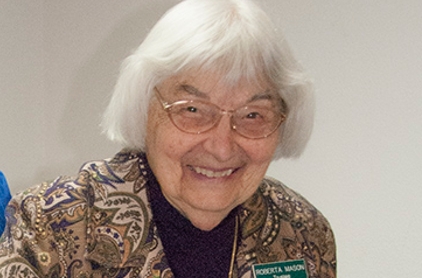
Lake Tahoe Community College's library is being named after Roberta Mason. Photo/Provided

Lake Tahoe Community College’s library is being named after Roberta Mason. Photo/Provided

Mason was one of a small group of citizens who began laying the groundwork for a college in South Lake Tahoe back in 1964. That’s when the Lake Tahoe Unified School District board first appointed a citizens study committee to explore the feasibility of operating a junior college. Friends with an interest in having a college in town reached out to the levelheaded and hard working Mason, who became the committee’s chairwoman.

She and El Dorado County Assistant Superintendent of Schools Hazel Hoak were primarily responsible for getting a community college off the ground – a feat that was finally accomplished on March 5, 1974, when voters approved the formation of the Lake Tahoe Community College District by a 66 percent vote.

“You could rename the college Roberta Mason University, and that would be perfectly appropriate,” Hoak says. “She absolutely deserves all the recognition and praise in the world for making Lake Tahoe Community College happen.”

On the same day the new college district was born, voters also selected a four-member board of trustees to supervise the new college district: Mason, Will Cluff, Donald Swanson, and Fritz Wenck. Mason has served as a trustee ever since, right alongside Wenck.

Staff and faculty at LTCC are quick to point out just how involved and supportive Mason has been over the years. If there is a lecture or concert or art exhibit opening or a theatrical presentation happening on LTCC’s campus, then Mason is pretty much guaranteed to be in attendance.

Library Director Lisa Foley says, “Roberta has honored this library with her presence quite frequently for years, to sit by the fireplace and catch up on news in the Sacramento Bee, or to attend our local author and writers’ series events. You’ve got to admit, the Roberta Mason Library has a catchy ring to it.”

Mason was born and raised in Sacramento. She earned an associate of arts degree from Sacramento Junior College, and a bachelor’s in science in chemistry from UC Berkeley. She worked for Dow Chemical in Pittsburg for about five years after graduating, then met her husband, married, and started a family.

They moved to South Lake Tahoe in 1957 when her husband’s architectural work brought him to the area to prepare for the upcoming Squaw Olympics in 1960.

She has served on a multitude of education-related committees and councils, worked at the El Dorado County Library for a few years, and is also a member of Soroptimist International of South Lake Tahoe and the American Association of University Women.

Mason has two sons who live in town, one teaches at South Tahoe High School. One of Mason’s granddaughters just started teaching kindergarten at Bijou Community School.

“I am deeply honored to have the college’s library named after me,” Mason said. “It means a great deal to me, especially because the library is not just for our students, but for our entire community. Anyone can come in and get a library card and enjoy what the library has to offer. It’s really gratifying to be associated with that.”

After 40 years of service as a board of trustee member, Mason will officially retire at the board’s last meeting of the year on Dec. 9.

Diane Lewis is LTCC’s marketing and communications officer.


Edgewood works to keep sediment from Tahoe

Edgewood Creek is getting an overhaul to improve water quality. Photos/Kathryn Reed

Edgewood Creek is getting an overhaul to improve water quality. Photos/Kathryn Reed

By Kathryn Reed

Playing in the rough has taken on a whole new meaning at Edgewood Tahoe.

The Stateline golf course looks like a construction zone these days. And that’s because it is one.

By December 2016 the 154-room Edgewood Lodge should be open. There will also be 40 cabin units along the eighth and ninth fairways that will be fractional ownership. The lodge will include a 120-seat restaurant, adventure center, spa, fitness center and lakefront pool.

Right now much of the golf course appears to be more dirt than grass. Work on the lodge will resume in the spring. Work on water quality projects will continue through the winter.

“The best time to perform creek enhancements is during periods of low flow,” Lew Feldman, attorney representing Edgewood Tahoe, told Lake Tahoe News. “It includes increased storage capacity of ponds that act as a catchment basin and expansion of wetlands. It will occur over this winter period, which from an environmental perspective is the safest time to undertake these enhancements.”

That is the work that can be seen from Highway 50. Mounds of dirt have been piling up.

It is Edgewood Creek that is getting so much attention. It is at the bottom of the 4,000-acre Kingsbury Watershed.

Holes 7, 8, and 9 will be tweaked to accommodate Edgewood Lodge.

Holes 7, 8, and 9 will be tweaked to accommodate Edgewood Lodge. The clubhouse is in the background.

That dirt being taken out of the ponds is called “dredge spoils”. The plan is to keep as much of it as possible on the property to be used for the hotel and golf course hole realignments.

When the project is done it’s estimated that more than 400,000 pounds of sediment will be captured each year, with another 50,000 pounds of fine sediment. This means all those particles will not be reaching Lake Tahoe.

Future dredging will be necessary because sediment will always flow downhill to Edgewood.

Feldman called this the largest private water quality improvement project in the basin’s history.

While he wouldn’t give the exact dollar amount, he said it is costing several million dollars. The project is expected to be finished by spring before the runoff starts.

On the other side of the golf course holes 7, 8 and 9 are being worked on. Nine should be done next year. It will have a lakefront finish. Seven and eight will be finished the following year.


’14 Calif. wine harvest 3rd largest

By Western Farm Press

California vintners and growers across the state are grateful for another excellent vintage, despite an ongoing drought and earthquake that rocked south Napa in late August as crush was getting underway.

A mild winter and spring caused early bud break, although the overall length of the growing season was similar to past years.

A compacted harvest began in July for sparkling wines and started winding down by mid-October for later ripening varieties. Moderate temperatures, with only minimal rain in September, allowed for even ripening.

According to the USDA Pacific Regional Crop Production Report from August 2014, California’s wine grape production this year is forecast at 3.9 million tons, down 8 percent from 2013’s record high crop. The 2014 harvest is the third largest on record.

Read the whole story


Big bucks spent on EDC growth initiatives

By Peter Hecht, Sacramento Bee

Building and real estate interests, led by the developer of the Serrano El Dorado Hills community, have dumped more than $1million into the campaign to defeat growth control ballot measures in El Dorado County.

Parker Development Co., builder of the 4,700-home Serrano community, has donated $866,750 through its affiliates, Serrano Associates and Marble Valley Co., to campaign committees opposing local November ballot initiatives M, N and O. The money has helped bankroll a blitz of mailers as well as anti-initiative television commercials during the World Series.

Parker Development is seeking county zoning changes to build 3,236 homes and townhouses and retail and event centers in a development called the Village of Marble Valley, planned for oak-studded hills south of Highway 50 in El Dorado Hills. In addition, the company is hoping to win approval to build 1,028 homes and townhouses on the site of the former El Dorado Hills golf course and a second location in the community.

A ballot measure backed by growth control advocates – Measure M – could challenge Parker Development’s plans. Measure M would ban any new residential subdivisions in the county if the California Department of Transportation determines that any stretch of Highway 50 west of Placerville is at or is forecast to reach gridlock traffic levels. The measure also would prevent the county from rezoning rural residential properties for higher-density housing construction.

Another growth restricting initiative, Measure O, qualified for the ballot thanks to a grass-roots movement of residents fighting a proposed 1,045-home subdivision, San Stino, near Shingle Springs communities of mostly 5-acre parcels. Measure O seeks to amend the general plan to effectively stop San Stino and similar building plans by restricting higher-density residential construction in Shingle Springs, Camino, Pollock Pines and parts of El Dorado Hills and Cameron Park.

A third initiative, Measure N, was put on the ballot by a Sacramento commercial builders alliance, Region Builders. Measure N would extend for 25 years the provisions of a 1998 voter-approved measure that imposed steep traffic impact fees on subdivision developers. But Measure N also proposes allowing local county road funds to be used for improvements to Highway 50, a move seen by opponents as a potential boon for commercial building in the freeway corridor.

Read the whole story


Land dispute part of Nev.’s storied past

By Anne Knowles

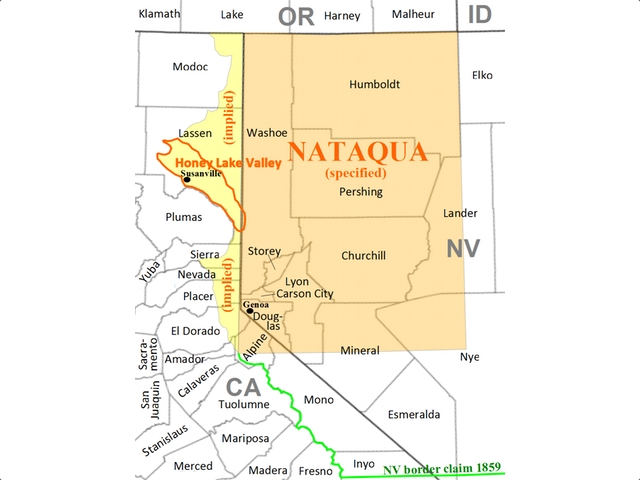
CARSON CITY – Nevada’s statehood, celebrated this sesquicentennial year, came on the heels of a boundary dispute with California that left one person dead and the border that split Lake Tahoe still undefined.

“The battle took place in February 1863 and lasted just four hours,” Jeff Kintop, Nevada state archivist in Carson City, told Lake Tahoe News. “As soon as somebody was hurt, they decided to try something else.”

The Roop County War, fought over Susanville and Honey Lake, ended in an agreement to jointly survey the land, but it was more than 100 years before the line between the two states would be definitively settled.

The problem started on the eve of California statehood in 1849. A convention was convened to write a constitution for land known as Upper California that was acquired during the Mexican-American War. The land stretched as far east as Utah and included the Great Basin, but for various reasons the convention delegates decided to cut California off at the Sierra Nevada mountain range.

The clause inserted into the state Constitution defined the border by latitude and longitude without surveying it. With the Gold Rush on, California, ill defined as it was, became a state in 1850.

Then a few years later California’s ambiguous border came into play around another body of water.

“Susanville up around Honey Lake was first settled in 1854 and the people there basically refused to pay California taxes,” Kintop said. “They tried to create their own territory called Nataqua. There weren’t that many people there and it wasn’t recognized, but they didn’t want to pay taxes to Utah either.”

Nevada and California land disputes continued until 1980.

Nevada and California land disputes continued until 1980.

Nevada became a territory in 1861 and the area known as Nataqua became Roop County, named after Isaac Roop, the founder of Susanville, named after his daughter, and a member of Nevada Territory’s Senate.

“He was serving in the Legislature and didn’t try to organize the county until 1863,” Kintop said. “California said ‘No, we won’t rescind from this boundary.’ But no one knew where the boundary was. They hadn’t surveyed it yet and they thought Susanville was in Nevada and Aurora was in California.”

In 1863, the Roop County justice of the peace, John Ward, issued an injunction against the Plumas County, Calif., justice of the peace. In retaliation, the Plumas County sheriff arrested Roop County’s sheriff and justice of the peace. He was stopped by an armed group of men, according to Kintop, and then organized a posse of about 70 men and headed for Susanville.

“They were met with resistance by Isaac Roop and his men held up in Roop’s cabin, which they named Fort Defiant,” Kintop said. “They started shooting at each other. As soon as one person was killed and two people were wounded, they mutually called a truce.”

To resolve it, they agreed to appoint a surveying team — Surveyor-General J.F. Houghton acting for the state of California and Butler Ives, for the territory of Nevada.

The final report placed Susanville and Honey Lake in California and was accepted by California in April 1864 and Nevada in February 1865, five months after it became a state.

But that didn’t put an end to the bigger border dispute. Surveys continued, including one approved by the U.S. Congress in 1872 and another conducted from 1893-99.

Then in 1977, California sued Nevada. “California was trying to collect taxes on Nevada property holders whose property crossed state lines,” said Kintop.

The U.S. Supreme Court settled the case in 1980, using the 1872 survey done by Alexey Von Schmidt for the boundary from North Lake Tahoe to Oregon and the U.S. Coast and Geodetic Survey started in 1893 for the border from South Lake Tahoe to the Colorado River, leaving Lake Tahoe, as always, split between the two states.

—-

Notes:

Nevada turns 150 on Oct. 31. The state has been having celebrations all year. It culminates Saturday with a parade in Carson City. For more info, go online.


Beavers may be good where drought looms

By Jim Robbins, New York Times

BUTTE, Mont. — Once routinely trapped and shot as varmints, their dams obliterated by dynamite and bulldozers, beavers are getting new respect these days. Across the West, they are being welcomed into the landscape as a defense against the withering effects of a warmer and drier climate.

Beaver dams, it turns out, have beneficial effects that can’t easily be replicated in other ways. They raise the water table alongside a stream, aiding the growth of trees and plants that stabilize the banks and prevent erosion. They improve fish and wildlife habitat and promote new, rich soil.

And perhaps most important in the West, beaver dams do what all dams do: hold back water that would otherwise drain away.

“People realize that if we don’t have a way to store water that’s not so expensive, we’re going to be up a creek, a dry creek,” said Jeff Burrell, a scientist with the Wildlife Conservation Society in Bozeman, Mont. “We’ve lost a lot with beavers not on the landscape.”

For thousands of years, beavers, which numbered in the tens of millions in North America, were an integral part of the hydrological system. “The valleys were filled with dams, as many as one every hundred yards,” Mr. Burrell said. “They were pretty much continuous wetlands.”

Read the whole story


Calif. AG: 18.5 mil. residents’ info exposed

By Associated Press

LAGUNA BEACH — Personal information about more than 18.5 million Californians was hacked, stolen or otherwise exposed last year and as many as one-third of those people will become victims of fraud, California Attorney General Kamala Harris said Tuesday in a report on data breaches in the nation’s biggest state.

Retailers, banks, health care providers and other organizations reported 167 different breaches in the state during 2013. That’s six times more than the 2.5 million accounts hacked in 131 breaches in 2012, and represents nearly half of the state’s 38 million residents. The alarming increase in malicious hacking and accidental leaks due to poor information security was mainly due to breaches at Target stores and Living Social, an online marketplace. Even without those two incidents, the number of customer accounts exposed by hacking, lost and stolen hard drives and accidental data leaks, jumped 35 percent last year.

Kamala Harris

Kamala Harris

As many as one-third of people whose information is exposed in a data breach will subsequently suffer some kind of fraud, Harris adds in the report, citing estimates by Javelin Strategy and Research, a California firm that tracks financial industry trends.

More than half of the breaches reported in California involved malicious attempts by hackers or cyber-criminals who were determined to steal customer data, according to the report, which said “trans-national criminal organizations” appear to be responsible in many cases.

“Increasingly, highly sophisticated criminal organizations and state-sponsored entities — located as far away as Russia, China and Eastern Europe — are responsible for breaches,” Harris said. The report cites one federal prosecution of an overseas hacker group. It doesn’t provide any new details on a multi-state investigation, announced earlier this year, in which officials from California and elsewhere said they were looking into Target Corp.’s response to its breach.

State law requires businesses to notify consumers when their data is exposed in a breach affecting more than 500 accounts. They also must file a report with Harris’s office. While there is no similar requirement at the federal level, the figures from California may provide insight into broader trends nationwide.

Retailers were the largest category of businesses that were hacked, followed by financial institutions and then health care providers. Health care organizations were more likely to report the loss or theft of laptop computers or other electronic storage devices containing patient files. What was taken? Social Security numbers were exposed in nearly half of the breaches; 38 percent of breaches involved account information for credit or debit cards.

Criminals can use both to commit financial fraud: The average amount of fraud linked to a stolen social security number is $2,330 and the average for a credit card is $1,251, according to estimates that the attorney general attributes to Javelin.

A new state law that goes into effect next year will require companies to offer at least one year of free theft-prevention assistance, such as credit monitoring, to consumers affected by data breaches. While many companies already do this, the report says that kind of help was only offered in half of the breaches reported over the last two years.

Harris is recommending additional changes, including legislation that sets stricter notification requirements and provides financial aid to help small businesses adopt data safeguards. She also urges companies to use stronger encryption and other protective methods, although she noted that a recent legislative effort to require encryption was unsuccessful.

Harris also is urging companies to notify consumers about data breaches more promptly and to make their notices easier to understand, with less legal jargon. She notes that the purpose of such notices “is undercut if the recipients cannot understand them.”


Supes delay decision on Meyers plan

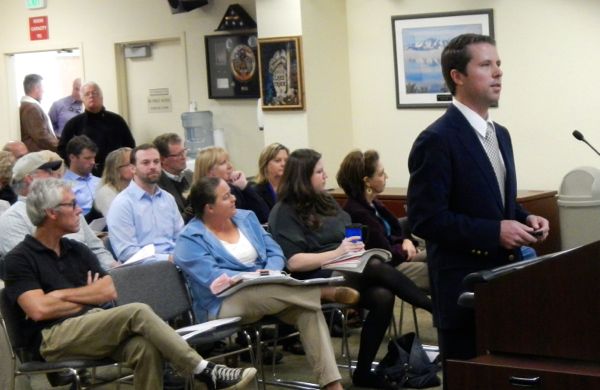
Brendan Ferry with the El Dorado County Planning Department briefs the Board of Supervisors about the Meyers Area Plan on Oct. 28. Photo/Kathryn Reed

Brendan Ferry with the El Dorado County Planning Department briefs supervisors about the Meyers Area Plan on Oct. 28. Photo/Kathryn Reed

By Kathryn Reed

El Dorado County supervisors are not ready to sign-off on the Meyers Area Plan. Instead, they want the community to weigh in at one more public meeting.

The Meyers issue was the main item on board’s agenda during their annual meeting in Lake Tahoe on Oct. 28. It was clear the supervisors, except for Norma Santiago, were unfamiliar with this unincorporated area to the west of South Lake Tahoe. They asked about demographics, boundaries of the area, didn’t understand what a TAU (tourist accommodation unit), or CFA (commercial floor area) were.

Supervisor Brian Veerkamp asked more substantive questions pertaining to how things are working with Caltrans and water concerns. In response to one of the 18 people who spoke, Veerkamp cautioned people about wanting a traffic light on Highway 50. He said all they do in Placerville is create a greater backup, and that once they are in it’s near impossible to get one removed.

The four (Supervisor Ron Briggs was absent) agreed to have a board workshop in December in the basin to hash out the remaining issues concerning the area plan. Those include height limitations for new construction, how much can be built per acre (density), the ability to transfer commercial floor area square footage (looking at economic and environmental concerns), and the creation of an advisory council that would report to the supervisors and have to follow open meeting laws.

The county Planning Commission when it met last week went against staff’s recommendation and said the local working group should be more casual and not have to adhere to the Brown Act.

However, everyone who spoke to this concern on Tuesday said they wanted the group to have transparency. After all, some of the reason for Meyers’ becoming splintered of late is because of the perceived backroom deals made at meetings that were not publicized. Going forward all sides want the ability to hear what is being discussed before it seems to be a done deal.

The supervisors agreed.

Most of the public comments centered on the process for the past 32 months.

Brendan Ferry, planner with the county, gave a brief history to the board about the process that started in February 2012.

He had hoped to have a final draft of the area plan done in November. That won’t happen now that there will be a workshop. Also delayed is the start of the CEQA environmental review process.