Controversy surrounds future EDC courthouse

By Joann Eisenbrandt

PLACERVILLE – Plans to build a spacious new El Dorado County courthouse in Placerville by fall 2020 are moving forward, but not without allegations of backdoor politics, favoritism and manipulation of the system for personal financial gain.

On Nov. 6, the Judicial Council had a public meeting in Placerville to explain the draft environmental impact report.

Laura Sainz with Environmental Compliance and Sustainability, Office of Real Estate and Facilities Management explained the areas in which significant environmental issues were found, including aesthetics, noise, biological and cultural resources and transportation and circulation, and how these would be mitigated to “less than significant.”

The sparsely attended meeting was composed mainly of government agency representatives, but local resident Lisa Johnson expressed the sentiments of some residents living nearby the project.

“I just recently purchased my home here because of the rural quality of life. Why was this project not disclosed to me at that time? There is only one road in and out of where I live onto Forni (Road),” she said.

She was also concerned about years of potential construction noise.

“I hear the (El Dorado County) fairgrounds like they’re in my backyard. And this will be on my side (of Highway 50),” Johnson said.

Sainz responded that no project has formally been approved yet, so notification was not possible.

John Koster, project manager with the Office of Court Construction and Management, noted that the quietest construction techniques would be used; hopefully without any blasting or pile driving, and that the first six months of construction will be the noisiest.

An additional concern is the fate of the historic Main Street courthouse once operations cease there. In a 2012 letter, Placerville resident Kathleen Newell noted the “adverse economic effects on Historic Downtown Placerville after the courthouse is moved to another location. Specifically with the issue of creating a blighted Main Street due to businesses vacating downtown and relocating closer to the new site.”

The courthouse is more than 100 years old and appears eligible for listing in the California Register, making it an “historical resource.” In September, the city and county agreed to the formation of a Blue Ribbon committee of city and county stakeholders to explore potential reuses of the Main Street courthouse.

“It’s the heart and soul of downtown,” Placerville City Councilmember Wendy Thomas said at the Thursday public meeting. “It’s a huge issue.”

The old courthouse in Placerville needs replacing. Photo/LTN

The old courthouse in Placerville needs replacing. Photo/LTN

Slow process

The Placerville courthouse project has been in the planning stages since 2008. It will be funded and managed by the state, not the county, as the courts are a separate branch of government, independent of the county’ administrative structure. This funding is not from the state’s General Fund, but from statewide increases in court user fees authorized in 2008 by Senate Bill 1407. The Administrative Office of the Courts (AOC), the staff agency of the Judicial Council of California, is responsible for site acquisition, design and construction of this and other critical-need courthouse projects throughout California.

Severe cuts to the judicial branch’s budget in 2011-12 delayed funding for the project, but in February 2013 the Court Facilities Working Group recommended the Judicial Council proceed with funding this and other high priority courthouse projects. The 88,000-square-foot facility would be located on property owned by El Dorado County adjacent to the existing county jail just off Forni Road in Placerville. It would also require purchase by the county of 5.2 acres from an adjoining parcel owned by John Briggs, father of El Dorado County Supervisor Ron Briggs, grandfather of Placerville Planning Commissioner Brian Briggs and father-in-law of Superior Court Judge Steve Bailey. The county entered into an Option Agreement with the Briggs Family Trust for this purchase in 2012. It was extended once and now expires on Dec. 18.

Some claim this is more than a happy coincidence for the Briggs family.

Currently, Superior Court services are divided between two locations — the historic Placerville Courthouse on Main Street that was built in 1913, and a portion of Building C in the county Government Center. Both buildings fail to meet current standards for security and other services. The project would consolidate operations in one secure facility capable of handling all case types, providing secure parking for judges as well as 240 on-site parking spaces for staff, visitors and jurors.

The technical part of this process is straightforward. In March 2011, the state Public Works board approved the selection of a potential courthouse site. The Judicial Council, the policymaking body of the California courts and the lead agency for the project, circulated a notice of preparation of a draft environmental impact report in April 2012. The California Environmental Quality Act (CEQA) requires lead agencies for projects to consider potential environmental impacts, determine if any are significant, and propose mitigation measures for those impacts.

The DEIR was prepared, and a 45-day circulation period, during which agencies and individuals can comment on the report ends Dec. 1.

Controversy lingers

The issues not addressed at last week’s meeting are the allegations that this was not necessarily the best or only site and its selection is tinged with political cronyism. El Dorado County Taypayers Group sent a letter to the Judicial Council in July 2013, pointing to, “the local corruption going on regarding the proposed new court house project in Placerville,” and asking that the state not fund the site. The letter alleges Supervisor Briggs had been pushing this site selection behind the scenes for his family’s gain.

The letter says, “The remaining six project parcels and other nearby abutting parcels are held in Ron Briggs and his son’s name will not be required to pay for their normal proportional and equitable share of reimbursement of the heavy master infrastructure improvement costs and off-site improvements ….”

The letter also notes the group asked the El Dorado County Grand Jury to investigate the issue twice but, “The grand jury was abruptly disbanded in February 2013 ” by El Dorado County Superior Court Judge Steve Bailey, Ron Briggs’ brother-in-law.

In September 2013, Curt Child, chief operating officer of the Judicial Council, sent a letter to the El Dorado County Board of Supervisors and then El Dorado County Counsel Ed Knapp stating the Taxpayer’s Group’s concerns warranted treatment of the site as “controversial,” and requested a response from the county explaining “what action the Board will take to address these concerns.”

In a January letter to Presiding Superior Court Judge Suzanne Kingsbury, Steven Jahr, administrative director of the courts, indicated that El Dorado County counsel had “provided written documentation to address the concerns raised by the Taxpayers Group,” concluding that the site was no longer considered controversial and the project would continue. Lake Tahoe News was unable to obtain a copy of that documentation.

After the DEIR comment period ends Dec. 1, the Judicial Council will prepare written responses to all comments received, circulate the report for 10 days and then decide whether to certify it. Once it’s certified, El Dorado County would likely purchase the private parcel from the Briggs Family Trust, and the Judicial Council would then purchase the entire project site from the county. Bids for construction and other project services would then begin, with estimated completion now set for fall 2020.



Showdown looms as Calif. eyes pesticides

By Elle Knickmeyer, AP

SAN FRANCISCO — With organic food growers reporting double-digit growth in U.S. sales each year, producers are challenging a proposed California pest-management program they say enshrines a pesticide-heavy approach for decades to come, including compulsory spraying of organic crops at the state’s discretion.

Chief among the complaints of organic growers: The California Department of Food and Agriculture’s pest-management plan says compulsory state pesticide spraying of organic crops would do no economic harm to organic producers, on the grounds that the growers could sell sprayed crops as non-organic instead.

“I would rather stop farming than have to be a conventional farmer. I think I am not alone in that,” said Zea Sonnabend, a Watsonville organic apple-grower with California Certified Organic Farmers, one of more than 30 agriculture groups, environmental organizations and regional water agencies to file concerns about the agriculture department’s pesticide provisions by an Oct. 31 state deadline.

At issue is a California organic agriculture industry that grew by 54 percent between 2009 and 2012. California leads the nation in organic sales, according to statistics tracked by University of California-Davis agriculture economist Karen Klonsky, who says the state is responsible for roughly one-third of a national organic industry. The U.S. Department of Agriculture puts the overall value of the U.S. organic sector at $35 billion.

The U.S. organic industry has seen a similar growth spurt nationally in the same time frame, and three out of four grocery stores in the country now carry at least some organic goods, according to the USDA. California’s $43 billion agriculture industry is the largest in the country by revenue, so what happens here matters to consumers and to the agriculture industry nationwide.

The state’s more than 500-page document lays out its planned responses to the next wave of fruit flies, weevils, beetles, fungus or blight that threatens crops. Many groups challenging the plan complained that it seems to authorize state agriculture officials to launch pesticide treatments without first carrying out the currently standard separate environmental-impact review.

But Steve Lyle, a spokesman for the agriculture department, said the outline doesn’t give state crop-pest programs any power they don’t already have by law.

The state’s program is designed “to protect California’s food system through the principles of integrated pest management, while also protecting public health and the environment,” Lyle said in an email.

For some conventional growers as well as some organic ones, the fate of the pest-management plan outlined by the state isn’t a theoretical concern.

It’s an immediate issue of their economic survival due, in part, to a disease-carrying pest that’s a little bigger than a pencil point.

The disease spread by the Asian citrus psyllid kills citrus trees outright and has caused billions of dollars in damage to crops in Florida and Texas. California’s $2.4 billion citrus industry has found incursions by the bug, but not yet significant outbreaks of the disease it carries.

The standard treatment for the citrus pest is conventional pesticides, including neocotinoids linked to the decline of crop-pollinating bees. The citrus industry and federal government also have spent $25 million to try to find, without major breakthroughs so far, less toxic controls for the citrus pest, said Joel Nelsen, head of the California Citrus Mutual industry trade-group.

Organic farmers complain about the state’s frequent reliance on pesticides, but “if we don’t eradicate the pest, their organic production is non-existent,” Nelsen said. “A pest or a disease doesn’t know if it’s eating an organic or a non-organic orange.”

Organic farmers are asking the state to give more consideration to non-toxic controls, including long-term methods to strengthen crops and habitats in advance against marauding tropical species, said Kelly Damewood, policy director for California Certified Organic Farmers.

The growing alarm over the citrus bug is part of the problem — California agriculture reels from pest emergency to pest emergency, treating most with the same pesticide programs and crop quarantines, argued James R. Carey, an entomologist at the University of California-Davis. He’s been watching California respond to invading tropical pests since at least the 1980s’ Mediterranean fruit-fly spray program. Some programs were successful; others struck even many conventional growers as unnecessary.

“They treat this in a crisis mode in the same way they would an earthquake or a fire,” Carey said. “Most times there’s not that kind of urgency at all.

“Every pest that comes in they request federal money for, run out of money for, and it just kinds of fades away.”


U.S. casino revenue up as economy strengthens

By Stephen Singer, AP

HARTFORD, Conn. — Revenue at U.S. casinos jumped more than 6 percent in 2012, the first significant increase in three years as economic growth picked up speed and more casinos opened in several markets.

But revenue generated by Indian casinos rose less than 2 percent the same year, Casino City’s North American Gaming Almanac found. Growth is limited due to regulations restricting tribal casino expansion beyond reservations and differences between tribes over how best to expand, said Vin Narayanan, editor in-chief of Casino City.

“There’s a giant political question about that,” he said.

Total gambling revenue in 2012 was $94.47 billion, with the largest share, $40.38 billion, from casinos and card rooms. Tribal casinos generated $28.14 billion followed by lotteries ($23.41 billion) and racing and sports gambling ($2.55 billion) in 2012.

Casino revenue grew by a fraction of 1 percent in 2011 and 2010 and fell nearly 6 percent in 2009 as the steepest economic downturn since the Depression took hold.

Year-to-year revenue changes are vastly different from one state to another. In Ohio, for example, total gambling revenue jumped by one-third from 2011 to 2012 as casino gambling ramped up.

But in New Jersey, seventh largest among the states in overall gambling revenue in 2012, casino revenue fell from $3.69 billion in 2009 to $2.71 billion in 2012 as three Atlantic City casinos shut. Nevada, California and New York are the top three states in casino revenue.

Narayanan said saturation is the culprit for the decline of Atlantic City’s casinos, but it’s not an issue elsewhere.

“Are there too many casinos in the market? As far as Atlantic City is concerned, there are too many casinos on the market,” he said.

But casinos opening in Ohio are satisfying “pent-up demand,” he said.

Similarly, the legalization of casino gambling in Maryland in 2008 and the opening of the state’s first casino in 2010 generated tremendous revenue. Casino and card room revenue increased from $27.6 million in 2010 to $377.8 million in 2012. Total gambling revenue jumped to $1.15 billion in 2012 from $760.6 million in the same period.

“Maryland is a place that’s just taking off,” Narayanan said.

The opening of casinos in Massachusetts in the next few years is expected to lead to a significant new source of revenue, possibly at the expense of neighboring Connecticut’s Mohegan Sun and Foxwoods Resort casinos.

Narayanan questioned if gamblers who check out a Massachusetts casino will still be comfortable traveling to Connecticut’s tribal casinos.

“That’s a real good question,” he said.


Fort Ross embraces Russian history on U.S. soil

Firing of the cannons is a tradition at Fort Ross. Photos/Kathryn Reed

Firing of the cannons is a tradition at Fort Ross. Photos/Kathryn Reed

By Susan Wood

JENNER – More than two centuries later, one can still hear the Russian influence in the voices amid the grounds of Fort Ross State Historic Park.

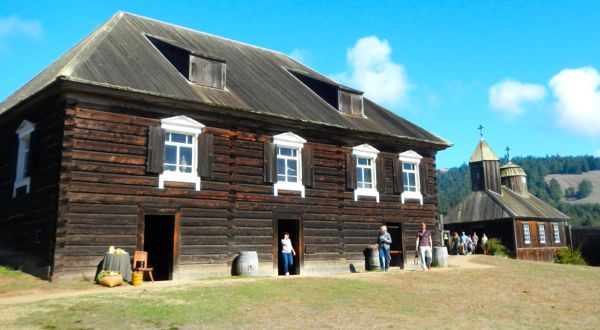
Although lesser known in contrast to other California parks, this 3,386-acre park represents one of the oldest in the system. The Fort Ross Colony established it in 1812 through a cooperative company of U.S. and Russian settlers. With help from the Alaskan Alutiiq native Americans, the establishment 11 miles northwest of Jenner on Highway 1 became a large trading base for Russians seeking other venues to hunt fur-bearing marine mammals. They found them here on the wild Sonoma Coast.

The Russians and Americans worked together in building a colony with a stockade and homes for the settlers who tended a wheat farm and other crops. The cooperation lasted through the Gold Rush days until John Sutter bought the holdings in 1841. From there, Sutter sold to rancher George Call who exported apples, dairy products and wood supplies such as railroad ties. He, in turn, sold the property to the California Historical Landmarks Committee in 1903.

Coming out of the California State Park’s 100-year anniversary, one can still experience the spirit of that engrained cooperation today.

The original buildings still dot the landscape.

The original buildings still dot the landscape.

The park recently celebrated with its second Harvest Festival featuring a grand tasting of 11 local winemakers including the area’s own Fort Ross Vineyard and Tasting Room perched high up from the Sonoma Coast bluffs and featuring the oh-so temperamental Pinot Noir. There was also an artisan cheese maker from Freestone, along with tours and activities commemorating the park’s bountiful tradition.

The event can be a blast, literally.

“Fire in the hole,” many of the hundreds in attendance yelled, as park employees stuffed and lighted the cannon on the grounds of the stockade. The process appeared to take so long, one could almost imagine the enemy would have already climbed the stockade wall and attacked long before the cannon went off.

But today’s contemporary cannon blast is all in good fun. Attendees were instructed to cover their ears, along with dignitaries in attendance. Among them was Sergey Ivanovich Kislyak, who has served as Russia’s ambassador to the United States since 2008.

The acreage of the state park extends to the Pacific Ocean.

The acreage of the state park extends to the Pacific Ocean.

“It’s wonderful that a lot of Americans devote time to preserving Russian heritage and to try to pass that on from one generation to another,” Kislyak told Lake Tahoe News.

He then darted off to tour the grounds, complete with a general store, grain windmill and a residence built in 1836.

The ambassador was in Sonoma County for a conference on U.S.-Russia relations – diplomatic efforts intended to curb recent strained interactions around the world.

But Fort Ross represents a microcosm in relations of what could be in say a perfect world. At the festival, many Russian accents could be heard from visitors. This included one San Francisco couple who toured the site for the first time and declared their allegiance and support of preserving this heritage.

—

Notes:

• 19005 Highway 1, between Jenner and Timber Cove

• 707.847.3286.


Staying alive in avalanche terrain

By Outside

Over the past few years, we’ve seen a sea change in terms of people’s attitudes, perception, and behavior about recreating in avalanche-prone terrain, especially skiing in the backcountry.

There are more of us out there than ever before, using increasingly fancy and sophisticated gear. But despite these advances, and a shift in how and what avalanche safety professionals teach, we’re not collectively making better decisions out there. Backcountry ski gear manufacturers, ski resorts, and avalanche forecasters and educators are acutely aware of the issue — and have just recently started taking industry-wide initiatives to help people make smarter choices in avalanche-prone terrain.

Here, we take a look at how the surge in popularity of backcountry users has altered the landscape, how to safely navigate slide-prone mountains, the tools and skills required to dig out someone buried by an avalanche, the advent of avalanche airbags, the human factors that can affect people’s judgement in the field, whether or not you should be concerned about inbounds avalanches at ski resorts, the tools professionals use to manage the snowpack, and a potentially game-changing new piece of avalanche safety gear.

The information we’ve gathered here is by no means everything you need to know to be an educated, safety-minded, and well-equipped backcountry user, but it’s a good place to start.

Read the whole story


Lawsuit calls for quicker executions in Calif.

By Don Thompson, AP

SACRAMENTO — A victims’ rights organization sued California state officials on Thursday as it seeks to speed up executions that have been on hold since 2006.

Sacramento-based Criminal Justice Legal Foundation filed a petition in Sacramento County Superior Court asking a judge to order state corrections officials to adopt procedures for a single-drug, barbiturate-only method of execution.

State policy calls for using a series of three drugs to put condemned inmates to death. The Department of Corrections and Rehabilitation is drafting new lethal injection regulations after Gov. Jerry Brown said in April 2012 the state would switch to a single-drug injection.

However, department spokeswoman Deborah Hoffman said a nationwide shortage of execution drugs is slowing progress. She declined to comment on the lawsuit.

The foundation says the department is taking too long to adopt the new regulations. No executions can occur until the new rules are adopted.

It is asking the judge to order the state to adopt temporary regulations within 30 days and take immediate steps to adopt permanent regulations.

The foundation sought the court order on behalf of Kermit Alexander, whose mother, sister and two nephews were murdered in 1984, and Bradley Winchell, whose sister was raped and murdered in 1983, contending that as relatives of the victims they are affected by the continued delays.

Alexander and Winchell said in nearly identical letters to Corrections Secretary Jeffrey Beard in September that the murders of their relatives took place 30 years ago, yet there is “no end in sight” for the convicted killers solely because of the department’s failure to adopt the new regulations.

Executions in California have also been halted by a series of legal challenges over the last eight years, most recently when a federal judge in Los Angeles ruled in July that carrying out the death penalty takes so long that it amounts to unconstitutional cruel and unusual punishment. Attorney General Kamala Harris is appealing that ruling.

The judge noted that more than 900 people have been sentenced to death in California since the current death penalty system was adopted 35 years ago. But only 13 have been executed, leaving most condemned inmates to die of natural causes before their executions are carried out.


Gaines not fazed by insurance commissioner loss; plenty to do as Tahoe’s state senator

By Kathryn Reed

Even though Ted Gaines will not be California’s next insurance commissioner, he is happy with many of the outcomes from the Nov. 4 election – namely propositions 45 and 1.

Gaines’ loss in the statewide race means he continues on as Lake Tahoe’s state senator. District 1 encompasses a large swath of the northeast part of the state. His term is up in two years. He’s not sure if he will run for another four-year stint in the Senate or go for a statewide office in 2018. He also knows his wife, Beth, who is in the Assembly, would one day like his Senate seat.

Running for insurance commissioner made sense because that is the business he came from before getting elected to the Assembly in 2006. His daughter and son-in-law now run the day-to-day operations of the business. But Gaines was running against the incumbent – Dave Jones. Jones won with 56.4 percent of the vote compared to Gaines’ 43.6 percent.

Controller or treasurer are also on Gaines’ radar because he has always been interested in financial issues.

Sen. Ted Gaines, R-Rocklin, is contemplating his options. Photo/LTN file

State Sen. Ted Gaines, R-Rocklin, is contemplating his options. Photo/LTN file

For now, though, he will be focusing on issues relevant to his district and the state as a whole.

He brought Senate President Pro Tem Kevin de León, D-Los Angeles, to Tahoe about a month ago to explain the environmental and economic issues affecting the basin.

“We went out on the lake and looked at milfoil, found out what is happening with Asian clams and talked about how those issues need to be addressed,” Gaines told Lake Tahoe News.

While he doesn’t have any specific pieces of legislation he plans to introduce, he is looking at how to create more jobs in the state that pay a decent wage.

“I would like to see us provide some relief of burden for small business owners so they can hire people,” Gaines said. “Studies show 80 percent of job creation comes from small businesses. We need to look at regulatory reforms; specifically how they impact business.”

He is concerned with county jails being overcrowded and inmates being released prematurely. Redding, which is in his district, is encountering what Gaines calls a “dramatic” increase in crime committed from criminals who are getting an early release. Gaines would like to create a revenue stream so sheriffs have the option to transfer people to facilities in or out of state that have room for the inmates.

Proposition 45 would have given the state insurance commissioner veto power when it came to rate increases for individual and small-business health insurance policies. Gaines was against this measure, with much of his campaign wrapped around it.

The $7.5 billion water bond was another issue Gaines supported.

“It will take a lot of time to get water storage built, but at least we have the means of funding it. It will help us in the long run,” Gaines said.

As a skier who has a second home in Truckee, Gaines has seen what the natural snowpack has been like the last three winters.

“I’m hoping for an awesome season that dumps lots of fresh powder,” Gaines said. “Looking at the ‘Farmers Almanac’ it says normal precipitation for the Pacific. I hope that is in the form of snow in the Sierra Nevada.

“So much of the economy is driven by that. I pray the snow falls at the right time and we can break through the drought.”


Study: Retreating snow line will worsen droughts

By Andy Coghlan, New Scientist

The Golden State is baking. After months of drought in California the long-term forecast is … more drought.

Rising global temperatures will turn much of the snow that currently replenishes the state’s reservoirs to rain, according to modelling studies by Dan Cayan at the Scripps Institution of Oceanography in San Diego. Unlike snow, which melts each spring and recharges California’s reservoirs, rain evaporates and soaks into the ground — it dwindles away, he says.

Cayan says the Sierra Nevada snowpack could be a third smaller in 2050 than it has been in recent years, and two-thirds smaller by 2100. The snowpack isn’t the only source of fresh water in California, but Cayan says it would be “more of a challenge” to manage water as rainfall rather than snow. He presented his findings at the Bay-Delta Science Conference in Sacramento last week.

Cayan’s findings emerged as California’s Department of Water Resources  launched its latest strategic plan to manage the state’s water. The future is one of never-ending restraint in water use. “The goals of the plan are to make conservation a way of life,” says a department statement.

Read the whole story


How to spend water bond could be contentious

By Scott Smith, AP

LOS ANGELES — Passing a $7.5 billion water bond may turn out to be the easy part. Agreeing on how to spend all the money could be much harder.

California voters overwhelmingly approved Proposition 1, which aims to expand the state’s water storage capacity to better weather droughts like the one that has gripped the state for three years. Much of the money already is earmarked for specific uses.

But $2.7 billion is not and so the debate to decide what to do with it now starts in earnest. One option is to spend it all on two new reservoirs. Other possibilities include desalination plants and underground storage facilities.

“Now that we have the money, the challenge begins of expeditious and effective implementation of the bond,” said Lester Snow, executive director of the California Water Foundation, an advocacy group that pushes for sustainability for communities, farms and the environment.

Jay Ziegler, the Nature Conservancy’s director of external affairs, said he expects a variety of new ideas to emerge during discussions among state officials and a variety of special interests, including environmentalists and farmers.

“We’re hoping to have a genuine dialogue,” he said. “We don’t really know today what the right project mix is and how to optimize the system.”

The spending plan is intended to make more water available and to stabilize California’s water supply, even during drought periods Gov. Jerry Brown, who campaigned hard for the ballot initiative, said the margin of passage underscores that Californians want something done.

“Water is fundamental to life itself, to our economy, to our wellbeing,” he said Wednesday. “Proposition 1 is about investing in vital resources that make California the state it is.”

Some $725 million of Proposition 1 will be spent on water recycling and treatment projects, and $900 million will go toward cleaning up contaminated groundwater. Residents in poor California communities where wells have gone dry may be among the first to see some relief. Communities would have to apply for grants and be responsible for paying for a portion of the projects.

Central Valley farmers favor building the Sites Reservoir in Colusa County north of Sacramento and the Temperance Flat reservoir northeast of Fresno.

Mark Borba, 64, who tends 9,000 acres of almonds, tomatoes, melons and cotton in the Fresno County community of Huron, said he doesn’t expect to see any benefits of the ballot measure in his lifetime but nonetheless was glad it passed. Farmers like him rely on water pumped south from the Sacramento-San Joaquin Delta.

Borba said he is confident that contentious issues such as levee repairs and salmon restoration in the delta can be addressed with the bond money, enabling farmers to get the water they need for crops.

“Unless we can pump water, we’re dry,” Borba said. “All of those issues internal to the delta have to be addressed. There’s lots of money in that bond to help do that.”

The California Water Commission, a nine-member board appointed by Brown, ultimately will decide how the money is spent. It plans to take comments from the public as it weighs options.

Richard Stapler, a spokesman for the California Natural Resources Agency, said it could take 18 months to two years to determine which water storage projects will be funded.


Scientists studying life below Tahoe’s surface

Geoff Schladow talks Nov. 6 about what is happening below the surface of Lake Tahoe. Photo/Kathryn Reed

Geoff Schladow talks Nov. 6 about what is happening below the surface of Lake Tahoe. Photo/Kathryn Reed

By Kathryn Reed

ROUND HILL – What is going on beneath the surface of Lake Tahoe?

Scientists don’t really know. Geoff Schladow, director of the Tahoe Environmental Research Center, said everything that is known could be told in a 45-minute presentation.

He gave two talks this week – one in Kings Beach, the other Round Hill – about what affects the water actions of Lake Tahoe. Tahoe’s circulation patterns are detailed in the NDEP-Tahoe Water Suppliers Association 2014 Risk Assessment Report.

Wind is the No. 1 driver.

“We all think wind is from the southwest,” Schladow told the packed room at the Tahoe Douglas fire station in Round Hill on Nov. 6. “And it is when it is measured at the airport.”

He showed a model depicting the wind movement on the lake and it is anything but the same across the whole water body. Farther north it swirls counterclockwise, while near the south it moves clockwise. And sometimes it is blowing straight across the water.

Thermal stratification and velocity are other factors.

“You may look at the lake and it is calm and placid, but it is always moving,” Schladow said.

Researchers are using a variety of tools to calculate that movement. Drogues are instruments that act like a big sail with a GPS device that measure where the wind current is carrying it.

Scientists did studies involving the intakes for Kingsbury General Improvement District and Edgewood Water Company. Part of this was to analyze how pathogens move from beaches on the Nevada side to the pipes taking water out for consumption by the South Shore districts.

While Schladow’s research showed the contaminants were well below the federal levels for concern, he said if the intakes were deeper, the threat of pathogens would be reduced.

One of the tests scientists did was to release particles at the Tahoe Keys to see where they would move. This was done over a 10-day period.

Some went west, others traveled deeper into the lake, and others hugged the shoreline going north.

The purpose of this study was to get a glimpse of where an herbicide might spread if it were to be used to rid the Keys of milfoil.

But Schladow stressed this experiment did not take into account several factors such as dilution of the chemical.

The least amount of knowledge is known about the near shore movement. This in large part has to do with the middle of the lake getting most of the attention in regards to any studies, but especially with water clarity.

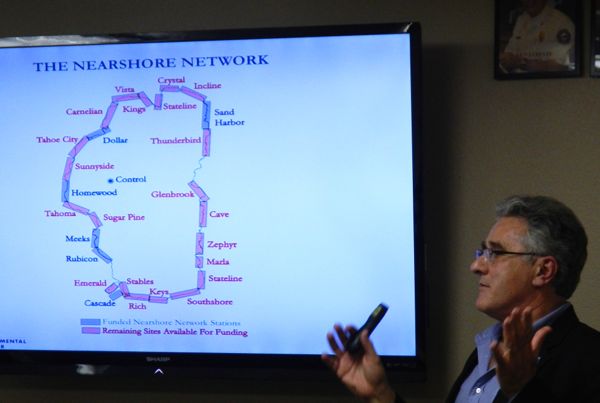
A near shore network has been created to gather data. However, only five locations are in the study area, with a sixth expected to come on board in the next couple weeks.

An instrument about 3-feet-long is placed in the water. Every 30 seconds data such as temperature, turbidity and dissolved organic material are being sent back to TERC.

Turbidity, or the cloudiness of the lake, is not always associated with storms. Schladow said that is something that needs to be investigated more.

With little data available regarding what is going on beneath the surface of Lake Tahoe, the whys of those occurrences are even more elusive. But more research is in the works.