Study: Regular pot smokers have shrunken brains

By Melissa Healy, Los Angeles Times

Experimental mice have been telling us this for years, but pot-smoking humans didn’t want to believe it could happen to them: Compared with a person who never smoked marijuana, someone who uses marijuana regularly has, on average, less gray matter in his orbital frontal cortex, a region that is a key node in the brain’s reward, motivation, decision-making and addictive behaviors network.

More ambiguously, in regular pot smokers, that region is better connected than it is in non-users: the flow of signal traffic is speedier to other parts of that motivation and decision-making network, including across the superhighway of “white matter” that connects the brain’s hemispheres.

The researchers who conducted the study speculate that the orbital frontal cortex’s greater level of “connectedness” — which is especially pronounced in people who started smoking pot early in life — may be the brain’s way of compensating for the region’s under-performing gray matter.

Read the whole story


Desire to eat ‘clean’ food can become an obsession

By Sumathi Reddy, Wall Street Journal

The growing interest in eating healthy can at times have unhealthy consequences.

Some doctors and registered dietitians say they are increasingly seeing people whose desire to eat pure or “clean” food—from raw vegans to those who cut out multiple major food sources such as gluten, dairy and sugar—becomes an all-consuming obsession and leads to ill health. In extreme cases, people will end up becoming malnourished.

Some experts refer to the condition as orthorexia nervosa, a little-researched disorder that doesn’t have an official diagnosis in the Diagnostic and Statistical Manual of Mental Disorders, or DSM, considered the bible of psychiatric illnesses. Often, individuals with orthorexia will exhibit symptoms of recognized conditions such as obsessive-compulsive disorder or end up losing unhealthy amounts of weight, similar to someone with anorexia.

Read the whole story


Experiments test budding scientists’ theories

Marcus Haven explains which elements rust first in water. Photos/Kathryn Reed

Marcus Haven explains which elements rust first in water. Photos/Kathryn Reed

By Kathryn Reed

It’s possible many of the adults in the room were not smarter than a first-grader – at least on Friday.

Pink volcanoes, bottles of unknown substances, melting candy and crayons. Rows of tables with trifold cardboard displays explain what all of this is about.

“We wanted them to do science,” Shaina Lucas told Lake Tahoe News. “Why shouldn’t first-graders be able to do projects?”

Lucas is the first-grade teacher at Bijou Community School who last year started what is now an annual science fair.

Students worked on their projects for five weeks, focusing on a question and hypothesis. All last week they presented their experiments to their classmates, explaining the question they were asking, and then conducted the experiment or showed the finished product.

The culmination was Nov. 14 when they all had to answer questions for parents, staff and other adults.

Bijou first-graders show off their science experiments Nov. 14.

Bijou first-graders show off their science experiments Nov. 14.

“I thought the steel and aluminum would rust first,” Marcus Haven told Lake Tahoe News. His reasoning was “those were two metals.”

The steel was rusting after having been in water four days.

Marcus put glass, galvanized steel, aluminum, copper, wood, steel and plastic in water to see which would rust first.

Others asked questions about oil and water, and what happens when distilled water is mixed with baking soda.

Kayden Morales tests how fast crayon colors melt.

Kayden Morales tests the speed at which crayon colors melt.

Kayden Morales wanted to find out if different color crayons melt at the same rate. They don’t. Lighter colors melt faster.

He used a blow dryer to test his theory.

He and his mom correctly predicted the outcome, while his dad and sister thought the darker colors would melt faster.

For Krystal Octavo it was all about finding the M&M that melts the fastest. The first test was to put six colors on her palm, the second to hold them while making a fist. Both times the brown one melted first.

For students who are in the two-way immersion program they had to present their experiments in Spanish.


Incorporate Olympic Valley faces uphill battle

By Melissa Siig, Moonshine Ink

The struggle between Squaw Valley Ski Holdings and Incorporate Olympic Valley over the future of the valley may be playing out publicly in newspaper ads and editorial pages, but behind the scenes another battle is brewing — one that involves hundreds of thousands of dollars, multiple attorneys and consultants, and a complex political process that pits a grassroots effort against a million dollar corporation.

In the latest chapter of this saga, the ski resort and the anti-incorporation group it funds, Save Olympic Valley, won out in their request that an environmental impact report (EIR) be conducted for the proposed town. Incorporate Olympic Valley, which will have to pay for the study, claims this is part of an ongoing strategy by SVSH to draw out the incorporation process and force it to exhaust its financial resources. The ski area, however, states that it is merely exercising its legal rights and abiding by state laws, unlike IOV. Whether you see this story as a modern day David versus Goliath or the majority protecting itself from minority interests, Squaw Valley Ski Holdings is making incorporation supporters work hard to achieve their goals.

“We are moving forward but against strong headwinds,” Fred Ilfeld, chairman of the IOV Foundation, told Moonshine Ink.

Squaw Valley Ski Holdings has been pushing since April for the Placer County Local Agency Formation Commission to require an EIR as part of the incorporation process. An EIR, as required by the California Environmental Quality Act (CEQA), identifies a project’s significant environmental impacts and ways to avoid or mitigate those impacts. The ski area believes that an EIR is necessary because the proposed town would result in a change of wildfire fighting responsibility from the state to the new town, as well as shift transit occupancy tax (TOT) dollars away from public transportation.

“The IOV incorporation may result in a potentially significant adverse impact by reducing wildland fire response times and thereby exposing people and structures to a significant risk of loss, injury, or death,” wrote law firm Remy Moose Manley, on behalf of SVSH, in an April 4 letter to LAFCO.

“Incorporation could also result in a reduction in TOT revenue needed to ensure continuation of basic TART [Tahoe Area Regional Transit] levels of service.”

Additionally, SVSH hired Environmental Science Associates, which stated in an Aug. 11 letter to LAFCO that an EIR is needed because of the vagaries of climate change. The environmental science and planning firm claims that because the town’s income would be dependent on the ski industry, the town will have to diversity its economy, which would result in ”additional development and land use changes.”

IOV, on the other hand, argues that an EIR is not necessary because no land is being disturbed in the decision to form the town of Olympic Valley.

“We are not turning a spade of dirt,” Ilfeld told Moonshine Ink. “It has no effect on the environment.”

IOV points to a 2008 article written by lawyer Julie Biggs, who has represented numerous California community incorporation attempts — some successful, some not — such as Goleta, Caramel Valley, Wildomar, and East Los Angeles. Biggs argued that, as decided by the Monterey County Superior Court in 2008, an EIR is not required when forming a city because incorporation of a new city alone does not constitute a project under CEQA. In other words, the decision is who should govern, not what will be constructed.

Read the whole story


California pension funds running dry

By Marc Lifsher, Los Angeles Times

A decade ago, many of California’s public pension plans had plenty of money to pay for workers’ retirements.

All that has changed, according to a far-reaching package of data from the state controller. Taxpayers are now on the hook for billions of dollars more to cover the future retirements of public workers, with the bill widely varying depending on where they live.

The state’s pension goliath, the California Public Employees’ Retirement System, had $281 billion to cover the benefits promised to 1.3 million workers and retirees in 2013. Yet it needed an additional $57 billion to meet future obligations.

The bill at the state teachers’ pension fund is even higher: It has an estimated shortfall of $70 billion.

The new data from a website created by state Controller John Chiang come at a time of growing anger from taxpayers over the skyrocketing cost of public workers’ retirements.

Until now, the bill for those government pensions was buried deep in the funds’ financial reports. By making this data available, Chiang is bound to stir debate about how taxpayers can afford to make retirement more comfortable for public workers when private-sector employees’ own financial futures have become less secure. For most non-government workers, fixed monthly pensions are increasingly rare.

Read the whole story


SLT council to tackle public beach access

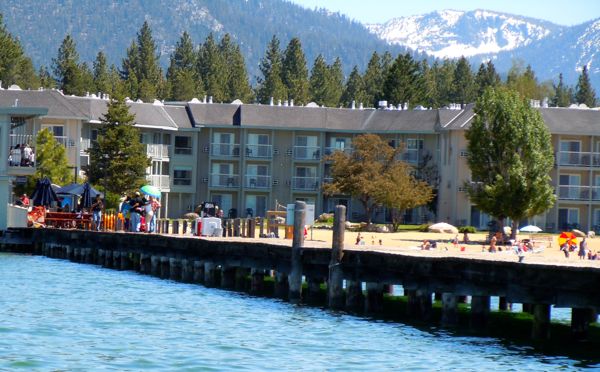
Timber Cove Pier is private, but the beach is public and private. Photo/LTN file

Timber Cove Pier is private, but the beach is public and private. Photo/LTN file

By Kathryn Reed

The beach by Timber Cove Marina is not as public as some would like it to be and is too public for the hotel-pier owners.

This stretch of sand in South Lake Tahoe is going to be the subject of discussion by the City Council when it meets Nov. 18 at 9am at Lake Tahoe Airport. City Attorney Tom Watson, who will be making the presentation Tuesday, was not available for comment.

Public access has been a battle for decades. And the state Supreme Court has been involved.

Problems arose again this summer and continued into the fall as the Beach Retreat & Lodge cut off access to parking at the marina and therefore the beach while some construction was taking place on the property.

Owners believe the beach is for their guests. And the public parking spaces they believe can be used by their employees.

City staff has done extensive research to sift through the legalities, to know who owns what, and when the public gets to play there without being a guest of the lakefront hotel.

Connolly Beach, which is the official name, was open to the public – including the pier – before South Lake Tahoe incorporated in 1965. It was in 1972 that a 261-room hotel was proposed.

“Initially the city’s Architectural Review Committee approved the project, requiring only a 15-foot wide pedestrian easement along the beach, measured from the high water mark,” the staff report says. “This decision was approved on a 2-1 vote. John Cefalu and Larry Muston in favor, Patricia Lowe against.”

The council at the time changed things a bit to accommodate concerns of local residents. Added were 18 public parking spaces and free use of the beach by the public. HKM, the owners of the property, sued the city in 1974 because of the public access.

The case languished in the court system for 11 years. South Lake Tahoe and the Tahoe Regional Planning Agency were the defendants.

In April 1975, the state Lands Commission decided it had a vested interest in the shoreline of Lake Tahoe. Then the state Attorney Generals Office took over as well. The case was now about public access to the beach and the state’s interest in the shoreline.

Eventually the state Supreme Court got involved. The justices ruled in August 1985.

The final outcome:

• The state of California owns the land below the historic low water mark. The public has the right to be on that section at any time.

• Property owners may use the beach for commercial purposes by temporarily sectioning off part of the beach in the 100-foot mark from high water, but cannot exclude the public from the entire beach. The state is the only entity that can enforce this provision.

• The public can use 100 feet of beach during daylight hours from June through September.

• The state owns a public trust easement that allows access for the public year-round between the high water mark (6,229 feet) to low water mark and below.

• There must be 18 parking spaces for the public.


Calif. leads by example on climate change

By Associated Press 

SACRAMENTO — As the U.S. and China — the world’s top two polluting nations — turn to implementing new rules aimed at curbing climate change, the countries can look to the most populous U.S. state as an example of the costs and challenges of fighting global warming.

California already has imposed some of the world’s toughest air quality standards as it moves aggressively to lower emissions.

The state’s cap-and-trade program, launched nearly three years ago, offers one of the few real-world laboratories on how to reduce carbon emissions. The state has opted to impose extra costs on businesses that emit pollutants.

Next year, the program will be expanded to include companies that produce gasoline and other fuels, prompting predictions that consumers will see a spike in prices to cover the costs.

Gov. Jerry Brown, a Democrat, has been unapologetic about the program, saying there needs to be a completely new way of thinking if the world is going to curb carbon emissions.

“California has the most integrated response and strategy to deal with climate change of any political jurisdiction in the world,” Brown said in an interview with the Associated Press before he was re-elected this month. “What happens here doesn’t stay here, it goes all around the globe.”

Brown also said he intends to push for even tougher greenhouse gas emission reduction goals that will be far more difficult to meet by 2030. The current goal is to reduce emissions of heat-trapping gases to 1990 levels by 2020.

California’s carbon emissions law already has cost industrial polluters nearly $2.3 billion in permit fees. Starting next year, the law will include fuel distributors in the same cap-and-trade marketplace as utilities and major manufacturers.

“California is the living experiment right now,” said Jay McKeeman, a California Independent Oil Marketers Association vice president. “They are, as far as I know, the only government entity that’s fully engaging on a variety of fronts regarding greenhouse gas reductions.”

The state is also a leader in setting building and appliance energy efficiency standards, requiring the use of renewable energy and setting low carbon fuel standards.

The state’s cap-and-trade program has grabbed the most recent attention. It limits, or caps, the amount of heat-trapping gases companies can emit by requiring companies to pay for each ton of pollution emitted. The price is set at an auction. Polluters that cut emissions below the cap can sell their leftover pollution permits to companies that produce more pollution.

Including fuels such as gasoline, natural gas, propane and heating oil under the program has McKeeman and others predicting it will bump prices at the pump next year, though estimates vary widely and gasoline prices otherwise have been on a steep decline.

Mary Nichols, chairwoman of the California Air Resources Board, which regulates the cap-and-trade law, has said oil companies are not required to pass on the costs to consumers and should absorb the cost of the allowances.

Cap-and-trade is a key component of AB32, the landmark law signed by former Gov. Arnold Schwarzenegger, a Republican, in 2006. But other provisions, such as requiring energy efficiency, renewable energy and lower-carbon fuels, also are intended to promote changes in Californians’ transportation and energy consumption habits.

Adrienne Alvord, California and western states director of the Union of Concerned Scientists, said California’s success has happened at the same time the economy is growing.

“There was a prediction that our energy costs would be prohibitive and industries would be leaving the state,” she said. “We just haven’t seen that.”

Brown has tried to be a leader in promoting the state’s climate change programs internationally, signing agreements with China and officials in other nations.

China this week set a target for its emissions to peak by about 2030, while President Obama set a goal to cut U.S. emissions.

Catherine Reheis-Boyd, president of the Western States Petroleum Association, was pleased with the international agreement in part because she is concerned that California’s go-it-alone policies will harm consumers and businesses while having little practical impact.

She noted the state produces less than 1 percent of the world’s greenhouse gas emissions. But she warned that widespread adoption of some California requirements, like low-carbon fuels, could lead to shortages of products that meet those standards.



Governors working on coping with drought

Govs. Jerry Brown, left, and Brian Sandoval at the Aug. 19 Lake Tahoe Environmental Summit. Photo/Kathryn Reed

Govs. Jerry Brown, left, and Brian Sandoval are dealing with drought in their respective states. Photo/LTN file

By Associated Press

The governors of California and Nevada met Thursday at a forum aimed at coming up with the best ways to cope with the unprecedented drought affecting the Western U.S., now in its third year.

“I think the drought will test our imagination and our science, our technology and our political capacity to collaborate,” California Gov. Jerry Brown, a Democrat, said in opening remarks.

Nevada Gov. Brian Sandoval, chairman of the Western Governors’ Association, initiated the yearlong series of meetings that include senior water, energy and agriculture policy leaders from government and the private sector. The meetings will lead to a report of best practices to be released next June.

This week’s meeting in Sacramento is focused on how to manage the drought’s effect on agriculture.

“These farmers … they come to me and they feel really helpless. They don’t know what to do. And their livelihood is at stake,” said Sandoval, a Republican.

California voters last week approved a $7.5 billion water bond measure that will allow the state to expand storage and develop water management plans.

Brown noted that the proposals for addressing California’s water problems will be controversial, including his contested $25 billion plan to build twin tunnels underneath the Delta that would make it easier to pump water from the Sacramento River to Central Valley farms and Southern California cities.

In another contentious move, Brown recently signed into law the first regulations governing the use of California’s groundwater, bringing it in line with other states.

Brown said a recent flight over Northern California gave him a view of the hundreds of canals and tunnels that help the state move water. Brown’s father, former Gov. Pat Brown, built the State Water Project, an extensive system of reservoirs and canals that was considered an engineering marvel in its day but was built for a population of half the current 38 million.

“There are a lot of people who think somehow engineering water from point A to point B is somehow unnatural,” he said. “Well we long ago passed the unnatural in California.”


Million dollar fire truck back in the shop

By Kathryn Reed

The last time anyone saw the South Lake Tahoe Fire Department’s ladder truck it was on a flatbed headed east on Highway 50.

This specialized piece of equipment that cost the city more than $1 million has never seen one day of service since it arrived in town at the beginning of this year.

It is in Reno having the power take off assembly repaired. This connects the engine to the ladder. It disintegrated while an outside trainer was in town to show the troops how to use the rig.

This is the second time since the city took possession of the nearly 48-foot truck that something serious has gone wrong. The first was when a driver for the manufacturer drove it from Louisiana to Tahoe in six-wheel drive for part of the trip.

That took a while to fix because the part had to be manufactured outside the United States. The differential had to be rebuilt.

South Lake Tahoe's ladder truck has not been operational since arriving in February. Photo/Provided

South Lake Tahoe’s ladder truck has not been operational since arriving in February. Photo/Provided

It will be a few more weeks before the ladder truck returns from Reno. When does it will be tested to make sure everything is working, and then training will resume.

While the parts that are failing are under warranty and new warranties are issued when they are fixed, the city is not satisfied with this being enough.

“We as a city have gone after the manufacturer trying to get some money back,” Fire Chief Jeff Meston told Lake Tahoe News. The City Attorneys Office is handling that aspect of the matter.

Meston said the state Lemon Law does is not a factor because it is not the same part that keeps failing.

The need for the ladder truck comes into play for tall buildings and those that are set back a ways.

“You don’t want a fire truck right on top of a building in case it would collapse,” Meston said.

To get the original Chateau project approved the city needed a working ladder truck.

The old ladder truck was so decrepit it was taken out of service in 2012.

The city has been relying on Tahoe Douglas for its ladder truck.

South Lake Tahoe’s truck does not have a tank, pump or hose bed. Adding them would have made the apparatus too heavy to be driven on California roads. Meston said it is common at larger fire departments for there to be separate engine and truck companies.

Besides the cost of the truck, the city also remodeled Station 2 across from South Tahoe Middle School so the truck will fit there. In the winter it will most likely be stored at Lake Tahoe Airport. The goal is to not have equipment sitting outside during the winter.


Women recount life in the military

Staff Sgt. Bethany Brown is administered the Army oath Nov. 13 by Capt. David Robinson. Photo/LTN

Staff Sgt. Bethany Brown is administered the Army oath Nov. 13 by Capt. David Robinson. Photo/LTN

By Kathryn Reed

For those who say the military is no place for a woman, they have not met Bethany Brown, Poli Policarpio, Sheryll Valencia or Christina Frolich.

These women on Nov. 13 shared with Soroptimist International of Tahoe Sierra some of their experiences.

Brown is so dedicated that on Thursday she retook the Army oath, which is done each time a soldier signs up for another stint. Right now she is stationed in Carson City.

“She is the best non-commissioned officer I have in my company,” Capt. David Robinson said.

Brown, who like the other women honored on this Veterans Day week, has been deployed multiple times. This time around she will be a recruiter for the Army.

She spoke about how when she was in Afghanistan a bomb went off about 10 feet from her. Most of the impact was to her midsection and hips.

“We walked away. That was huge because a lot didn’t walk away,” Brown said.

But the impact of war is often brought home.

“Twenty-two veterans commit suicide every day,” Brown said. “No veteran should take their life because they have already given so much.”

She spoke of a young woman at Fort Bragg who last weekend took her life. She was one of the best soldiers and no one saw it coming.

For Valencia, she got choked up when she spoke of the reasons to serve – of how it meant she was ultimately helping to protect her family and friends, as well as everyone else in the United States. In Iraq she worked 16 to 20 hour days. On occasion there would be a half or full day off.

Frolich joined when she was 20. Via a computer she was piloting unmanned aerial vehicles that were the size of a car. In Afghanistan they didn’t work well because of the mountains. Several of the half million dollar UAVs crashed.

Then they were used in Iraq. They were flying so slow they were shot out of the air, she said.

On her third deployment to South Korea she was injured while jumping out of a C130 with the Airborne. They were 800 feet above ground – which is low – and she ran into someone in the air.

“A female officer found me. I didn’t know where I was,” Frolich said. It’s rare for officers to have anything to do with enlistees. “There’s a lot of amazing women in the military. We take care of each other.”